|
|
April 1-15, 2014
Volume 22 – Number 6 $1
Prolétaires de tous les pays, unissez-vous!
Otatoskewak ota kitaskinahk mamawestotan!
Workers of all lands, unite
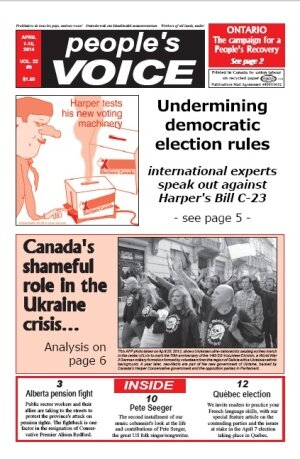
1) ONTARIO COMMUNISTS PREPARE FOR SPRING ELECTION
2) REDFORD RESIGNS, BUT BUSINESS AS USUAL
3) RALLIES PROTEST CUTS TO ALBERTA PUBLIC SECTOR PENSIONS
4) CHALLENGER EMERGES FOR CLC PRESIDENT RACE
5) ON THE DANGEROUS DEVELOPMENTS IN UKRAINE
6) SOLIDARITY WITH VANCOUVER TRUCKERS - Editorial
7) WE ARE STILL LOSING THE WAR - Editorial
8) MYTHS AND FACTS ABOUT CANADA POST
9) FROM CIVIL WAR TO PEACE ACCORDS IN EL SALVADOR
10) SOLIDARITY WITH SOUTH KOREAN'S POLITICAL PRISONERS
11) EXCITING PROGRAM FOR 2014 CHE BRIGADE
12) REMEMBERING PETE SEEGER ‑ Part 2
PEOPLE'S VOICE APRIL 1-15, 2014 (pdf)
People’s Voice 2014 Calendar
”The Truth About the Great War”
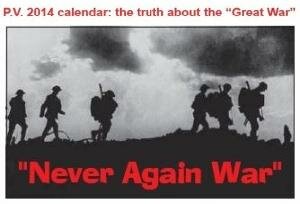
To order a copy of the People’s Voice 2014 Anti-First World War
Calendar, send $15 (includes postage and handling) to
People’s Voice, 706 Clark Drive, Vancouver, BC, V5L 3J1. Contact us at
604-255-2041 or pvoice@telus.net for bulk order prices.
|
People's Voice deadlines: April 16-30 May 1-15 Send submissions to PV Editorial Office,
|
REDS ON THE WEB
http://www.parti-communiste.ca/
peoplesvoice.ca
www.ycl-ljc.ca
www.solidnet.org
|
People's Voice finds many "Global Class Struggle" reports at the "Labour Start" website, http://www.labourstart.org/. We urge our readers to check it out! |
* * * * *
People's Voice
Canadian Publications Mail Sales Product Agreement #205214
ISSN number 1198-8657
People's Voice is published by
New Labour Press Ltd
PV Editorial Office
706 Clark Drive,
VANCOUVER, B.C. V5L 3J1
Phone:604-255-2041
Fax:604-254-9803
email: pvoice@telus.net
Editor: Kimball Cariou : Business Manager: David Au
Editorial Board: Kimball Cariou, Miguel Figueroa,
Doug Meggison, Naomi Rankin, Liz Rowley, Jim Sacouman
* * * * * *
Letters
People's Voice welcomes your letters
on any subject covered in our pages.
We reserve the right to edit for length and clarity,
and to refuse to print letters which may be libellous
or which contain unnecessary personal attacks.
Send your views to:
"Letters to the Editor",
706 Clark Dr., Vancouver, BC V5L 3J1,
or pvoice@telus.net
People's Voice articles may be reprinted without permission,
provided the source is credited.
* * * * * *
The Communist Party of Canada, formed in 1921,
has a proud history of fighting for jobs, equality, peace,
Canadian independence, and socialism.
The CPC does much more than run candidates in elections.
We think the fight against big business and its parties
is a year-round job,
so our members are active across the country,
to build our party and to help strengthen people's movements
on a wide range of issues.
All our policies and leadership
are set democratically by our members.
To find out more about Canada's party of Socialism,
give us a call at the nearest CPC office.
* * * * * *
Central Committee CPC
290A Danforth Ave Toronto, Ont. M4K 1N6
Ph: (416) 469-2446
fax: (416) 469-4063 E-mailmailto:info@cpc-pcp.ca
Parti Communiste du Quebec (section du
Parti communiste du Canada)
5359 Ave du Parc, Montréal, Québec,
H2V 4G9
B.C.Committee CPC
706 Clark Drive, Vancouver, V5L 3J1
Tel: (604) 254-9836
Fax: (604) 254-9803
Edmonton CPC
Box 68112, 70 Bonnie Doon P.O.
Edmonton, AB, T6C 4N6
Tel: (780) 465-7893
Fax: (780)463-0209
Calgary CPC
Unit #1 - 19 Radcliffe Close SE
Calgary AB, T2A 6B2
Tel: (403) 248-6489
Ottawa CPC
Tel: (613) 232-7108
Manitoba Committee
387 Selkirk Ave., Winnipeg, R2W 2M3
Tel/fax: (204) 586-7824
Ontario Ctee. CPC
290A Danforth Ave., Toronto, M4K 1N6
Tel: (416) 469-2446
Hamilton Ctee. CPC
265 Melvin Ave., Apt. 815
Hamilton, ON.
Tel: (905) 548-9586
Atlantic Region CPC
Box 70 Grand Pré, NS, B0P 1M0
Tel/fax: (902) 542-7981
http://www.parti-communiste.ca/
* * * * * *
News for People, Not for Profits!
Every issue of People's Voice
gives you the latest
on the fightback from coast to coast.
Whether it's the struggle for jobs or peace, resistance to social cuts,
solidarity with Cuba, or workers' struggles around the world,
we've got the news the corporate media won't print.
And we do more than that
- we report and analyze events
from a revolutionary perspective,
helping to build the movements for justice and equality,
and eventually for a socialist Canada.
Read the paper that fights for working people
- on every page, in every issue!
People's Voice
$30 for 1 year
$50 for 2 years
Low-income special rate: $15 for 1-year
Outside Canada $50 for 1 year
Send to: People's Voice, 706 Clark Drive, Vancouver, BC, V5L 3J1
You can call the editorial office at 604-255-2041
REDS ON THE WEB
http://www.parti-communiste.ca/
http://www.ycl-ljc.ca/
http://www.solidnet.org/
(The following articles are from the April 1-15, 2014, issue of People's Voice, Canada's leading socialist newspaper. Articles can be reprinted free if the source is credited. Subscription rates in Canada: $30/year, or $15 low income rate; for U.S. readers - $45 US per year; other overseas readers - $45 US or $50 CDN per year. Send to People's Voice, c/o PV Business Manager, 706 Clark Drive, Vancouver, BC, V5L 3J1.)
1) ONTARIO COMMUNISTS PREPARE FOR SPRING ELECTION
PV Ontario Bureau
The Provincial Committee of the Communist Party of Canada (Ontario) met on March 15‑16, to discuss the situation in the province and prepare for a widely anticipated spring election. The minority Liberal government of premier Kathleen Wynne is expected to table a budget in April, and most indications are that the opposition parties will vote it down.
The CPC(O) meeting was held against a backdrop of the highest provincial unemployment rate in Canada outside the Atlantic region, and youth unemployment as the highest in the country. The deepening jobs crisis has been exacerbated by several recent announcements of plant closures. Among the high profile closures are Heinz (740 jobs), Kellogg's (500 jobs), automotive supplier Faurecia SA (650 jobs), and US Steel.
As CPC (Ontario) leader, Liz Rowley noted, "All of these jobs have been lost, all of these operations closed, because Canadian plants are being moved outside of the country, or because the parent companies are consolidating their enormous wealth and capital. Faurecia, for example, is the world's sixth largest automotive supplier, employing 94,000 people in 34 countries. Its sales in 2012 were $22.5 billion, with $6 billion in North America. There is no reason, apart from unbridled corporate greed, that this company and others have closed their Ontario plants and ruined hundreds of working people's lives and communities. It's shameful that the Ontario government has sat on its hands and watched this happen, time and time again."
As in other parts of Canada, and throughout the capitalist world, the provincial government has continued to inflict drastic austerity measures on the working class, while ensuring that corporations have all the assistance needed to enjoy a "jobless recovery." Alongside attacks on wages, pensions and benefits, the working class in Ontario faces huge increases in household debt, costs of utilities and services, tuition fees, and housing costs.
Right in step with the profit interests of their corporate masters, the provincial government is driving to privatize healthcare, sell off public assets such as public school lands and buildings, and contract out public services and social programs.
The CPC(O) noted that the working class currently has no champion in the Ontario legislature. The Liberals are proving that they can deliver the "create a crisis" strategy, initially proposed by the Mike Harris Conservatives, for privatization of everything from health care to government services to public education. The NDP, once regarded as the conscience of the legislature, is now widely seen as unwilling to strike hard as it continues to shed its ties to labour and adopt a pro‑austerity, pro‑business government‑in‑waiting stance. It speaks volumes that NDP leader Andrea Horwath was not only unwilling to support the $14 minimum wage campaign, but actually linked her pathetic $11.50 minimum wage proposal to a 30% cut in business taxes.
The Tim Hudak Conservatives continue to be the main danger to the working class in Ontario, with an aggressive platform based on massive privatization, deep tax cuts, and drastic attacks on wages, pensions, labour and democratic rights. The Tories are framing their reactionary, "right‑to‑work" policies in the language of right‑wing populism, in an effort to appeal to severely marginalized and alienated sectors of the population; this coagulation of discontent on the right has all the makings of something much more sinister.
The absence of a strong progressive block, including Communists, in the legislature means the absence of voices who will challenge corruption and the attacks on the working class. It means the absence of voices who will advance policies to address people's needs and curb corporate power. It means the absence of voices that can expose the systemic nature of the economic crisis, and project a socialist alternative.
Ontario Communists are preparing to confront this problem directly, by looking to run more candidates, in more areas of the province, than in the previous election.
The platform will be based on the party's "10‑Point Prescription for a People's Recovery", a program of concrete, progressive reforms to confront corporate power, reverse the austerity attacks, and open the door to further progressive reforms in Ontario. Campaign demands will include a full‑employment plan, massive housing and infrastructure construction, and progressive tax reform that puts the burden on corporations and the very rich. Communists will also campaign for increased public transportation, public auto insurance legislation, free post‑secondary education, and expansions to public healthcare, education and childcare programs.
"We are heading into a campaign," said Rowley, "where widespread insecurity and deep anger exist right across the province. Working people have seen their lives destroyed so easily, and so quickly, by the privileged and powerful. These are some of the people we've been talking to, along with all those who are fighting back against austerity. Our message of real and progressive change, as an urgent priority, has to ring out in this election campaign!"
2) REDFORD RESIGNS, BUT BUSINESS AS USUAL
By Naomi Rankin
Alberta premiers come and go as the reigning Progressive Conservatives require more and more spin to maintain credibility with the voters. But the only question that matters - whether the public or the multinationals own and control the oil and gas sector of the Alberta economy - will not be up for debate as the Tories choose their next "leader".
The previous premier, Ed Stelmach, never the choice of the Calgary/oil sector of the party, was forced out after five years when Tory support dipped along with an economic downturn. The mutiny breathed life into the even more reactionary Wildrose Party.
Now a relatively brisk internal power struggle, including the defection of two MLAs and the rumoured meeting of ten to sixteen others to debate following suit, plus the truly comical spectacle of the party leadership putting the premier on a "work plan", has forced Alison Redford to resign with only four days notice after less than three years.
Tories complained of Redford's high‑handedness, and public criticism focussed on her lavish travel expenses. In fact, a coup in a capitalist party is always about the expected unelectability of the current leader in the next provincial election. In Redford's case it arises from her harsh treatment of public employees, and cuts to social spending ‑ not because the Conservatives don't agree with these policies, but because such extreme right‑wing measures reduced the possibility of once again spooking the majority of urban voters into voting Conservative to avoid the more terrifying possibility of a Wildrose government.
Through the period of the Tory dynasty in Alberta the two major cities, Edmonton and Calgary, have not only increased in population, but have become more cosmopolitan through immigration and through the weakening of social and ideological ties to Alberta's agricultural roots. This is reflected in the relative strength of Liberal support in corporate headquarter Calgary, and NDP support in the somewhat more industrial Edmonton.
The Tories have been able to command large majorities for decades from a combination of the social conservatism of rural Alberta and the lop‑sided economic development arising from the energy sector. Alberta is essentially a one‑industry province controlled by large multi‑nationals, with very little local industrial base to generate either competing capitalist interests or any offsetting strength in the union movement.
But the source of their majorities could also become the source of their decline, as the Wildrose Party challenges for dominance in the rural areas and their capacity to seduce working class voters is limited by their corporate allegiances.
"I will never apologize for selling Alberta to the world, going where we needed to to find new customers and get fairer prices for our products," were Redford's almost final words as premier of Alberta.
After all, it's really hard to get anybody to buy oil and gas. And the price varies so much with nuances of styling.
3) RALLIES PROTEST CUTS TO ALBERTA PUBLIC SECTOR PENSIONS
By Doug Meggison with files from Naomi Rankin and Corinne Benson
The first day of spring roared in like a lion all over Alberta, but frontline public employees braved the cold to protest cuts to provincial public pension plans.
The abrupt resignation of the Progressive Conservative premier, Alison Redford, will likely not affect the basic outline of the austerity agenda the neoliberal government is trying to implement.
Hundreds of workers gathered with union flags outside workplaces like the University of Alberta Hospital, Edmonton City Hall and Alberta Children's Hospital in Calgary. Demonstrations took place in about 30 locations.
The Alberta Federation of Labour has brought together a dozen unions under the Alberta Labour Coalition on Pensions, and has produced dynamic campaign materials including a website, FaceBook page and their own actuarial study to counter the unsupported pronouncements coming from the provincial government.
Three main changes are in store for the public pension plans. Government is moving to increase the "85 factor" to 90 years of service plus age for unreduced pension. The penalty for earlier retirement than age 65 or reaching the 90 factor will be increased from about 3% a year to 5% a year of early retirement. Indexing to inflation will remain at 60% but keeping up at this rate will not be guaranteed.
The Coalition on Pensions has had electronic town hall meetings and a 2,000 attendance outdoor demonstration on a frigid March 2.
"Nobody voted on these cuts," Alberta Federation of Labour President Gil McGowan said on behalf of the Coalition. "By breaking the promise it made to frontline public employees, the Redford Government is sending the message that no one can trust the agreements it makes."
4) CHALLENGER EMERGES FOR CLC PRESIDENT RACE
PV Vancouver Bureau
For the first time since 2005, there will be a contest for the presidency when the Canadian Labour Congress meets May 5-9 in Montreal. Ken Georgetti, who has led the 3 million member federation for 15 years, will be challenged by Hassan Husseini, a negotiator for the Public Service Alliance of Canada and a member of Unifor local 2025.
A long‑time labour activist, Husseini has launched a campaign to "Take Back the CLC." A statement on his campaign website says, "As workers and unions, we are facing a massive and unprecedented right wing attack. Labour and employment standards, collective bargaining rights, and the right of workers to organize and be politically active, are all targets of right wing governments at the federal and provincial levels. The labour movement is in a fight for survival as a force for progressive social change in Canadian society.
"In recent years, grassroots activism has won real gains. There is much we can learn from these successful struggles such as that of the Quebec students, Idle No More, the Toronto Library workers, the Chicago teachers and others. As CLC President I will empower and support that kind of local activism. I will help build the local leadership it takes to challenge someone like Stephen Harper, and his corporate backers....
"I will give the CLC back to the workers, because there is nothing that bosses and this federal government fear more than an organized, united and worker‑driven labour movement. We need, quite simply, a bottom‑up, grassroots movement."
Expanding on this theme, Husseini says, "Our fight isn't simply a battle for `fairness' that can be solved through clever appeals to politicians or a glitzy branding exercise. We must be willing to listen to our own members - and place their experiences at the heart of our campaigns. We must empower our members to fight the battles that lie ahead.
"We must also be honest about what we're up against. We are facing an aggressive form of capitalism that has put a target on the back of every unionized and non‑unionized worker, and anyone else standing in the way of corporate profits. Nothing is sacred, and no one's job is safe. Our opponents will stop at nothing to strip away hard‑won gains, and sacrifice them at the altar of corporate greed."
His platform includes the following points:
- Support provincial federations and labour councils and enable them to regain their role as centres of political action and mobilization at the provincial and local levels.
- Build solidarity and not walls between our affiliates and bring us all back to the table. Work with affiliate unions to organize meaningful strike support for unions on strike.
- Bring affiliates together to coordinate our organizing strategies.
- Work with affiliates to ensure all locals are affiliated and active in their labour councils.
- Engage the membership at the grassroots level in identifying and articulating an independent political vision, one premised on the potential and ability of workers to make social change at all levels of our society.
- Transform the public debate on the basis of a new vision and a progressive alternative. We need to shift from continuously fighting defensive battles and be prepared to fight to win new victories that our children and future generations deserve.
- Build worker‑to‑worker solidarity across borders. Encourage a new era of concrete solidarity with fellow workers around the world. Global solidarity would not be restricted to resolutions and infrequent conferences.
- Engage in the electoral process on the basis of a clear labour agenda. We can best support our allies in Parliament, by mobilizing our members to defend our rights every day of the year.
- Develop an organizing strategy that engages the members, activists and the community.
- Build a broad‑based movement that can effectively challenge the austerity agenda. Launch a pan‑Canadian campaign to improve public services including healthcare, education, public transit, Canada Post and others.
- Empower the rank and file of our movement and give real voice to young workers, marginalized workers, activists and workers from equity seeking groups.
Husseini has more than two decades of activism in the student, labour, social justice, community and international solidarity movements. He has served as a union local president, human rights vice‑president, health and safety representative, negotiating team member, and labour council delegate.
In the mid 1990s, he was an organizer for the Ottawa‑Carleton CUPE District Council, playing a lead role in mobilizing for the Ontario Days of Action. He also coordinated Ottawa's walk for peace, the environment and social justice.
Born in Beirut, Lebanon to a large working class family of ten siblings, Hassan Husseini immigrated to Canada in the mid‑1980s. He holds a Masters degree in legal studies from Carleton University.
5) ON THE DANGEROUS DEVELOPMENTS IN UKRAINE
Statement by the Central Executive, Communist Party of Canada, March 13, 2014
The deepening political crisis in Ukraine and the threat of regional conflict, possibly an even wider war erupting over the fate of Crimea, is extremely alarming. The "war of words" emanating from Washington and Brussels is inflaming international tensions and could in turn provoke a global catastrophe. This crisis has been stoked by the ongoing imperialist strategy of the U.S. and NATO to encircle Russia, as seen in the installation of anti‑missile systems in Poland, and the integration of Georgia into the NATO alliance. Their goal is to isolate Russia and China, neutralizing potential obstacles to the drive by transnational capital based in the NATO countries to exploit the resources and labour power of the entire planet.
It is appalling that the Harper Conservative government has been playing an active role in this dangerous escalation, and that the mainstream media continue to whip up lies and distortions around recent developments in Ukraine. The claim by right‑wing forces that the March 16 referendum on the status of the Crimean Autonomous Republic is equivalent to the 1936 Nazi occupation of Sudetenland is particularly odious. The unchecked expansion of Hitler fascism led to World War Two, which killed some 60 million people, including over 27 million citizens of the USSR. As an autonomous republic, Crimea has the legal right to determine its status, free from all foreign interference.
The current impasse in the region was precipitated by an orchestrated campaign of right‑wing opposition and neo‑fascist forces inside Ukraine - with the financial backing and strategic guidance of the U.S. and other Western imperialist powers - to overthrow the elected government of President Yanukovich, and replace it with the current illegitimate "coalition government" in Kiev. Far from being a popular, pro‑democracy "people's uprising" in Maidan Square, it is now clear that this coup d'Θtat was a highly organized operation, carried out with military precision, and masterminded by the U.S. and EU powers. The intention was to complete the unfinished business after the break‑up of the former Soviet Union, and later the so‑called "Orange Revolution" of 2004, and bring Ukraine entirely under the influence and domination of the Western imperialist powers. This longstanding imperialist objective would not only bring Ukraine's natural and labour resources under its control, but would also further weaken the Russian Federation economically and politically, and give US/NATO another firm foothold along Russia's sensitive Southern flank, strengthening the military/strategic encirclement of this rival power.
The now‑infamous leaked telephone conversation in early February between US Assistant Secretary of State Victoria Nuland and US Ambassador to Ukraine Geoffrey Pyatt, makes it abundantly clear that Washington - both directly and through its shady network of NGOs and the National Endowment for Democracy - was pulling all the strings and considered itself arrogantly in charge of the future government to be installed after the coup in Kiev. That U.S. and other Western governments can now denounce the "foreign interference" of Russia in Ukraine's internal affairs, and demand respect for Ukraine's independence, reeks of hypocrisy of the highest order.
Western corporate press - lapdog of imperialism
Despite growing evidence to the contrary, the mainstream corporate press in Canada and internationally continues to portray the orchestrated regime change in Kiev as a "grassroots", popular uprising of the majority of the Ukrainian people, striving for "freedom" and "justice". Any revelation which contradicts this script is conveniently downplayed or blacked out entirely.
Well‑known neo‑Nazi and fascist groups had a major presence among the street fighters in Maidan Square. Of these, the largest include the Svoboda ("Freedom") Party, Pravi Sector (Right Sector), and the UNA‑UNSO (Ukrainian National Army - Ukrainian National Self Defense). All of these organizations are documented as having pro‑fascist, racist and anti‑Semitic policies and ideologies. When they seized and occupied the Ukrainian Parliament building, they adorned it with fascist and Nazi symbols and banners. Even the Huffington Post was forced to concede: "Groups such as the ultra‑nationalist Svoboda party, with its ominous talk of a "Muscovite‑Jewish mafia", are now playing a key role in the new interim government - Svoboda controls three government ministries and the prosecutor‑general's office." Several government positions are occupied by Svoboda leaders, including Ihor Tenyukh, Defense Minister; Andriy Parubiy, National Security Council chief; and Serhiy Kvit, Education Minister. Dmytro Yarosh, the co‑founder of the Pravi Sector, has been named deputy head of the National Security Council, responsible for Intelligence.
The U.S., Canadian and other NATO governments are whitewashing these disturbing facts, and the mainstream press are largely failing to report this "news" to the international community, because such exposure would undercut the credibility and legitimacy of this motley group of conspirators and reactionaries.
An even more damning revelation has now surfaced concerning the events which took place on the critical night of February 20 in Maidan Square, when some 80‑plus street fighters and police were killed by sniper fire. That tragedy was predictably blamed on Yanukovich and his security forces, and helped to sweep him from power. But a private telephone conversation between Estonian Foreign Minister Urmas Paet and EU Foreign Affairs Chief Catherine Ashton tells a very different story. In the conversation (since authenticated by the Estonian government), Paet states: "All evidence shows that the people who were killed by snipers - both policemen and people in the streets - that it was the same snipers killing people from both sides. Same handwriting, same type of bullets, and it's really disturbing that now the new coalition doesn't want to investigate what actually happened. So there is now a stronger and stronger understanding that behind the snipers but was not Yanukovich, but it was somebody from the new coalition."
Canada’s deplorable role in the current crisis
Recent statements by PM Stephen Harper and foreign Minister John Baird uphold the (il)legitimacy of the newly installed government in Kiev, offering it economic, technical and political support. By attacking the Russian Federation for "interference" and attempting to violate the "territorial integrity" of Ukraine - even going so far as to threaten Russia's expulsion from the G‑8 - they are piling more kindling on a spreading fire. For Canada and other Western imperialist government to criticize Russia for foreign interference and violations of territorial integrity displays an incredible amount of hubris, given the repeated instances of imperialist interference and outright aggression - often in violation of the UN Charter - in Iraq, Yugoslavia, Afghanistan, Haiti, Venezuela, Libya, Pakistan, and many other countries.
Equally deplorable has been the opportunistic posturing of the other "opposition" parties in Parliament around this issue. Both the Liberals and New Democrats have congratulated the coup leaders in Kiev, waxing rhetorical in their condemnation of "Russian aggression". On this, as on other critical questions, they all seem to essentially "sing from the same songbook", notwithstanding any nuanced differences between them.
The Communist Party of Canada, on the other hand, denounces the criminal imperialist conspiracy to impose "regime change" on Ukraine and its people. As the Joint Declaration which our Party and some 40 other communist and workers' parties signed recently states: "We denounce the USA and the EU regarding their blatant involvement in the internal affairs of Ukraine, regarding the direct support they provided and are providing to the armed fascist groups, supporting historical revanchism against the outcome of the 2nd World War, transforming anti‑communism into their official policy, as well as beautifying the fascist groups, their criminal ideology and activity, promoting the division of the people of Ukraine with planned persecutions at the expense of the Russian‑speakers of Ukraine."
We urge all peace‑loving Canadians to reject the barrage of imperialist propaganda justifying this orchestrated coup and the NATO drive to impose sanctions against Russia. Urgent peace actions by the labour and democratic movements are needed to help block the growing threat of military confrontations and war. The Harper government should be told immediately to end its support for the far‑right forces which seized power in Ukraine, to restore full diplomatic relations with Russia, and to oppose the calls for sanctions and other threats and brinkmanship targeted against Russia.
6) SOLIDARITY WITH VANCOUVER TRUCKERS
People's Voice Editorial
The corporate sector and the BC Liberal government have some big ideas. Their economic strategy is based on investing billions of dollars into massive expansion of highways, bridges, pipelines, and tankers. Of course, none of this is to create value‑added economic growth within Canada. The aim is constant acceleration of raw materials extraction and exports, part of the decades‑long transformation of Canada into a supplier of resources for other imperialist powers, at the expense of secondary industry and jobs for Canadian workers.
But the big dreams of the BC ruling class do not extend to a living wage for the workers who are critical to this expansion agenda. As we go to press, the Liberals are forcing unionized truckers back to work, and encouraging the employers to fire non-union members of the United Truckers Association who started job action in late February. This is the third major struggle by these drivers over the past decade and a half, seeking compensation for long unpaid hours while they wait to deliver goods. This time, the Liberals blatantly sabotaged negotiations by encouraging the employers to simply wait for back to work legislation.
The message is clear. BC's so‑called world class economy will continue to be built on poverty‑line wages for workers who generate huge profits for the employers. If this strike is costing the economy $125 million every day, as the provincial and federal governments say, the employers can afford to pay truckers for their waiting time, and to implement standardized rates for this crucial section of the workforce.
This struggle could become a turning point for the working class in British Columbia. If the truckers refuse to surrender, all‑out solidarity by the labour movement and community allies will be needed to help them beat back the government/employer attack.
7) WE ARE STILL LOSING THE WAR
People's Voice Editorial
Amidst smug back-patting by pro-war politicians and pundits, the flag has been lowered on Canada's direct military involvement in the US-led occupation of Afghanistan.
An estimated 50,000 people have died as a direct result of the war, most of them Afghan civilians or insurgents, and about 3,400 occupation soldiers, including 158 Canadians.
The cost of this tragedy has been about $22 billion for Canadian taxpayers, and still rising. More veterans have committed suicide in recent weeks, victims of post-traumatic stress disorder related to their experiences in uniform. Yet these casualties are not counted among the "official" Canadian deaths.
Violence in Afghanistan is growing. On average, over 100 Afghan troops and police are killed every week, and another 300 wounded. Two Canadian aid workers were killed in a March 27 attack against foreigners at a luxury hotel, one of the "safest" places in Kabul. This attack came just hours after a Taliban assault killed eleven police officers in Jalalabad.
Western leaders claim that life expectancy for Afghans has improved over the past decade, but the CIA's own figures appear to contradict those proclamations. Recent polls indicate that Afghans favour the Taliban over NATO forces and their own "elected" government. In his recent book about the Afghan war, former Globe and Mail correspondent Graeme Smith writes, "We lost the war in southern Afghanistan and it broke my heart... We're leaving behind a great big mess."
Mr. Harper, put a lid on your shameful "patriotic" nonsense. Simply put, Canada and our NATO allies lost this war by any measure that really counts. The time has come to end Canada's role as a "partner" of the Pentagon, and to adopt an independent Canadian foreign policy based on peace and disarmament.
8) MYTHS AND FACTS ABOUT CANADA POST
By and Doug Nesbitt, for the Support Postal Workers website, http://supportpostalworkers.wordpress.com/
Myth #1: Canada Post service cuts and cost increases are necessary.
Fact: On Dec. 11, 2013 Canada Post's management announced, without warning either the public or the Canadian Union of Postal Workers, that home delivery for five million Canadians would be cut, there would be at least 8,000 layoffs, and letter costs would increase from 63 cents to a dollar. As many have pointed out, Canada Post's reasons for worse service at a higher cost are bogus, based around half‑truths and flat out fabrications.
Myth #2: Canada Post says it is no longer profitable.
Fact: Since the mid‑1990s Canada Post has been profitable every single year ‑ except in 2011 when the company locked out 50,000 of its workers in an effort to weaken the union and its contract. In that time, Canada Post has fed over a billion dollars into the public purse.
Myth #3: Letter traffic is decreasing so much that a profitability crisis is inevitable; according to Canada Post the Internet is to blame.
Fact: Since 1989, before the advent of the Internet, the volume of mail has actually increased. Parcel delivery has increased as letter volume has decreased. Private for‑profit couriers make money delivering parcels, not letters.
Myth #4: The $6.5 billion shortfall in the Canada Post pension plan is a time bomb that can destroy the company.
Fact: The Canada Post pension plan is in decent shape. Unlike private‑sector pensions, the Canadian government requires Canada Post to fund the pension plan at a higher level than the private sector. The current underfunding only means that if all Canada Post employees retired at once, they wouldn't get the entire pension they're due. Under Harper, the Canadian government gave Canada Post a four‑year reprieve from paying into the pension plan. With the money they saved, they invested $2 billion into new letter‑sorting machines, even though letter volume is declining ‑ and is now being cited as a reason to cut Canada Post services! If money has been wasted, it was management's fault. There is no pension crisis.
Myth #5: Canada Post has to end home delivery ‑ there are no other options.
Fact: If Canada Post introduced postal banking it could become even more financially sound and offer even better services to the public, especially in rural areas where home delivery often doesn't exist. Many national postal services around the world offer postal banking which helps them stay afloat and even profitable. In fact, postal banking is exactly what the Canadian Union of Postal Workers is proposing for Canada Post.
Myth #6: Service cuts and increased costs are about saving Canada Post.
Fact: The service cuts and increased costs are about making the public upset with lack of services. The layoffs are about weakening the union. Cuts and layoffs are about preparing Canada Post's retail network of post offices and outlets ‑ the largest and most extensive retail network in the country ‑ and its unparalleled delivery services for privatization. Canada Post is being prepared for privatization precisely because it is highly profitable.
Myth #7: Community super‑boxes, which are to replace door‑to‑door delivery in urban areas, are safe and accessible.
Fact: Community super‑boxes are not safe and accessible. A CBC report has revealed that there were 4,880 incidents of vandalism, arson and theft from these super‑boxes between 2008 and 2013. There is also no guarantee that these super‑boxes will be accessible for thousands who have mobility issues, seniors or the disabled. And Canada Post has no plans to consult us on where the community boxes are placed.
Myth #8: Canada Post must have done consultations before deciding to cut services and raise postage rates.
Fact: Canada Post management kept both its workers and the public in the dark. They announced the cuts and service cost increases the day after Parliament retired for the holidays. They have provided no evidence that any real consultations with Canadians was ever attempted.
Myth #9: Seniors are telling Deepak Chopra that they want more exercise and being forced to pick up mail at community super‑boxes in all seasons is good for their health.
Fact: Seniors have not expressed that they think being forced to walk to community mailboxes will be good for their health. This is an outrageous lie that Deepak Chopra told to members of Parliament when he was being questioned about the proposed changes at an emergency parliamentary committee meeting. He provided no evidence for his claim. This shameful response highlights just how heartless these service cuts are.
Myth #10: There is no privatization agenda at Canada Post.
Fact: Canada Post management has a privatization agenda. CEO Deepak Chopra sits on the board of the Conference Board of Canada, a policy think‑tank that writes papers proposing policies for the federal and provincial governments to turn into legislation. The Conference Board of Canada wrote a paper that favoured wholesale privatization of Canada Post. The paper even used faulty arguments and figures to justify privatization. In other words, sound and careful gathering of facts was dispensed in favour of ideologically‑driven ideas.
(Sources for this piece include: Canadian Union of Postal Workers; Canadian Centre for Policy Alternatives, Canada Post reports, news stories, interviews and independent research.)
9) FROM CIVIL WAR TO PEACE ACCORDS IN EL SALVADOR
By Larry Wasslen, Ottawa
Throughout the 1960s and '70s the working class, peasantry, and students continued to organize in El Salvador. Much of the work on the left was done within broadly based coalitions in attempts to create some democratic space. This was complemented by work in trade unions, and within peasant and student movements.
Electoral fraud accompanied military governments as Generals and Colonels replaced each other in the presidential office. Repression was a constant theme of everyday life.
It was at precisely this time that the left became fractured. Some members of the Communist Party of El Salvador left to develop the Fuerzas Populares de Liberacion‑Farabundo Marti (FPL‑1970) and carried out their first battle in 1972.
The left wing of the Partido Democrata Christiano followed a similar course and founded the Ejercito Revolucionario del Pueblo (ERP‑1972), which in turn split to form the Fuerzas Armadas de Resistencia Nacional (FARN‑1975).
In the same year the Partido Revolucionario de Trabajadores Centroamericanos formed its guerrilla organization: Ejercito Revolucionario de Trabajadores Centroamericanos.
The Communist Party of El Salvador, after several attempts to work with other parties to find a path to democracy, created the Fuerzas Armadas de Liberacion (FAL) on 24 March 1980, the same day that Archbishop Oscar Romero was murdered.
Mass demonstrations, strikes, land and embassy occupations and kidnappings of prominent members of the ruling class or foreign business leaders continued. Military and police actions against the working class were proving less effective in stemming the mobilization of the masses, so certain sections of the oligarchy decided to re‑invigorate death squads, a more direct form of repression.
This was not a completely novel development for the oligarchy, which had organized vigilante groups as far back as the 1930s. In the 1960s the ruling class responded to an upsurge in trade union and peasant organization by establishing the Organizacion Democratico Nacionalista, infamously known by its acronym ORDEN. The founder of this organization was General Jose Alberto Medrano.
In exchange for petty favours, jobs, and immunity from repression, 50,000 to 100,000 joined this organization and became the eyes and ears of the military regimes in the villages, towns, universities and cities. In addition, they made up vigilante groups and acted as paid assassins. Roque Dalton, the famous Salvadorian poet, identified this group as "a key element in the rise of a fascist tendency within certain military and oligarchic circles".
The business group Associacion Nacional de Empresas Privadas (ANEP), and landowners from the eastern part of the country (the Frente de Agricultores de la Region Oriental, FARO), organized the first paramilitary death squad, known as Fuerzas Armadas de Liberacion Nacional‑Guerra de Exterminacion (FALANGE) in 1975. Their objective was to exterminate all known communists and their collaborators. A collaborator could be any union member, any student or peasant who spoke out in favour of even the mildest of reforms. In one week in October 1975 thirty‑eight people were executed. In 1976 FALANGE changed its name to Union Guerrera Blanca (UGB) but its function remained unchanged.
Within the left there were significant differences in terms of strategy and tactics. Some organizations sought to develop a prolonged people's war combined with the construction of support within the working class, peasantry, and students. Others wanted to rely more on a general uprising and paid little attention to mass organizations. By the late 1970s it was apparent that a divided left would not be able to win this undeclared civil war.
Examples from Cuba and Nicaragua were important. In Nicaragua, the Frente Sandinista de Liberacion Nacional united three factions into one command in March 1979, prior to its final offensive against the hated Somoza regime in the same year. Fidel Castro strongly encouraged unification, which had been achieved in Cuba in the late 1950s.
The Salvadorian left began to work towards unification. To optimize military action the FPL, PCS, and RN formed the Coordinadora Politico Militar in December 1979. In January‑February of 1980 the Coordinadora Revolucionaria de Masses (CRM) was created to unite the many mass organizations of the popular movements. By May 1980, the various guerrilla forces united, and the Frente Farabundo Marti para la Liberacion Nacional (FMLN) was established. Coordinated guerrilla action resulted in 41 ambushes of army convoys and 122 army casualties.
The forces of repression responded by a joint action of regular army, National Guard and ORDEN units in a "mopping up" operation against the villages of San Jacinto and Las Aradas near the Sumpul River on the border with Honduras. The villagers fled across the river, which was in full flow, only to be met by Honduran troops who forced everyone back into the river. Hundreds drowned, and those who managed to get back to El Salvador were machined‑gunned. Over 600 people were massacred.
The FMLN launched its first coordinated military action on January 10, 1981; this is considered the official start of the civil war. The first offensive of the revolutionaries secured control over the departments of Morazan and Chalatenango. Over a period of several years, the FMLN used basic guerrilla tactics to ambush military convoys and attack outposts around the country. Interspersed with this approach were major offensives such as the attack on the ILopango Air Base, destroying fourteen Bell UH1 Iroquois helicopters, five Dassault Ouragan planes, and three C47s.
Early in the conflict the USA began to give material and financial support to the regime. When military advisers proved insufficient to hold back the revolution, some 1,500 soldiers were sent for direct training in the infamous School of the Americas. Among those were the brutal Atlacatl Battalion, which was responsible for the El Mozote and Cabanas massacres, in which hundreds of innocent civilians were raped and murdered.
Initial attempts by the FMLN to achieve a negotiated end to the war began as early as 1984. But it was not until the major FMLN offensive in 1989 that the USA finally realized they could not defeat the rebel army and agreed to support the peace process.
By the time the Acuerdos de Paz de Chapultepec (Mexico) was signed in January 1992, the 11 year conflict had cost 70,000 lives. Another 8,000 were "disappeared," mostly civilians killed by military or police units, or by the death squads. In addition US imperialism had "invested" $4.2 billion in the savage war.
The final agreement brought important changes to the constitution of El Salvador. The armed forces came under civilian control. Several organs used to attack the people were disbanded, including the National Guard, National Police, Hacienda Police, military intelligence (a civilian intelligence service was established), some military battalions, and paramilitary death squads. More than 10,000 members of these organs were demobilized, reducing the military from 130,000 to 16,000 today. Judicial and electoral reforms made it harder for the right wing to commit fraud during elections. Significant land and labour reforms were also won. The FMLN became an official political party and began to compete in elections.
Since the peace accords, the FMLN has participated in nine elections. From 1994 through 2014, the percentage of the popular vote won by the Frente increased from approximately 30% to greater than 50% in 2009, when, for the first time, a party from the left won the presidential election. In 2014 the FMLN won re‑election in the second round with 50.11% of the popular vote.
10) SOLIDARITY WITH SOUTH KOREA'S POLITICAL PRISONERS
By Sean Burton
The term political prisoner or prisoner of conscience as applied to the Korean peninsula is often depicted in the mainstream media as a phenomenon that only occurs in the north, in the Democratic People's Republic of Korea (DPRK). We are often told that a miserable fate awaits any who defy the northern government or who face trumped up accusations.
Few people stop to think about the other side of the fence. South Korea is rarely criticized in any fashion. If anything, it is praised as one of the "Asian Tigers" for its global economic success. But since North and South are still technically at war, there are bound to be distortions on both sides. In South Korea's case, despite a period of democratization after the fall of the military regime, the political/economic boundaries are still largely being set by the same people and defended by the same law, the National Security Law.
The National Security Law basically prohibits contact with and travel to the DPRK, or promoting the DPRK's system. This predictably narrows the range of politically accepted dialogue in the South. There are people charged with small things, like a recent case where a man shared a DPRK twitter statement. Other times, there are people who want to travel north to see for themselves or who meet north Koreans abroad. Ridiculous though it may be, these actions have led to charges of spying on the North's behalf.
According to my human rights activist contacts, there are currently about 45 such cases, and most of these have sentences of several years. I have recently become involved with one of those cases, which I will share here.
Lee Byeong‑jin was a professor of political science at Osan University and Kyunghee University. In the early 1990s, Prof. Lee was studying in India's capital, New Delhi. During that time he made friends with North Koreans studying there and made a number of trips to the DPRK. Lee was arrested in 2009, charged with espionage, and given a 10‑year prison sentence, since reduced to eight years.
Such a charge carries with it a heavy blow to one's reputation in any country, let alone one where the realities of conflict are still close to home. For Lee's wife, it was too much to bear. She abandoned him, along with their children.
Those of us in activist circles who had heard of his situation formed a support group and journeyed to the prison in Jeonju city to speak to Lee directly. We were given 30 minutes. On entering the small room, Lee instantly brightened up and expressed his tremendous gratitude that anyone still cared for his well‑being. Prof. Lee stated that for a man of his background, it was only natural that he should desire political openness. He emphasized that he was not a communist or socialist, or for that matter a spy. He simply desires that one should be able to discuss any and all political and social issues in Korea as a whole without fear of harm to life or liberty. His personal life and career have been destroyed over nothing.
Lee made a special request: that people all over the world open their eyes to cases like his in South Korea. He is trying to make his case clear in a new trial, and is awaiting another hearing in April. Committees in support of his release have already been established in Korea, but the information must be more widely publicized. I encourage all readers to lend their support and spread this news as much as they can.
11) EXCITING PROGRAM FOR 2014 CHE BRIGADE
The Canadian Network on Cuba (CNC) will have the 22nd annual Che Guevara Volunteer Work Brigade to Cuba at the end of April. The 2014 program offers a very exciting trip, with a great mix of activities for all who attend. From April 28 to May 18, the Brigade will travel through the cities of Havana, Trinidad, Santa Clara, and Sacti Spiritus, as well as the rural areas around the Escambray mountains. There are three parts to the trip: volunteer work, educationals, and free time!
Through a partnership with the Canadian Friendship Institute (ICAP in Spanish), the Che Brigade provides Canadians with a unique perspective on Cuban society through a well‑planned itinerary involving many organizations covering all aspects of Cuban life, including health and education, housing, womens' and workers' rights, community organizations, LGBTQ rights, lessons on the economy, cultural activities, and more. There will also be opportunities to meet family members of the Cuban 5.
Our volunteer work will be on a co‑operative farm, where we will help tend the crops and learn about the Cuban agricultural system.
Brigadistas will enjoy May Day celebrations in Revolution Square, and a visit to the Che Monument in the lovely city of Santa Clara. The small town of Trinidad, with its photogenic, pastel-coloured Spanish colonial architecture and nearby beach, will be a well enjoyed part of the trip.
Accommodation for the first week is at the Camp International Julio Antonio Mella (CIJAM) near Havana. Named after the founder of the Cuban Communist Party, the camp is in a rural setting with many murals, a soccer field, a bar, cafeteria, and educational rooms. Following the camp, we will stay at hotels in the cities we visit.
Two main themes of the Brigade are volunteer work and internationalism. Che sought to build a new attitude towards work, from a compulsory obligation to a social duty. It is also educating, as Che stated that volunteer work is a "school that creates socialist consciousness". This work builds solidarity between Canadians and Cubans and allows one to learn from another through the struggle to build a better society. At the end of the trip, Canadians will leave with a much stronger understanding of Cuba, along with memories for a lifetime!
If you are interested in more information or want to sign up for the 2014 trip, please email me at chevolbrigade@gmail.com. The cost is about $1150 plus flight. Flights from Toronto vary from $600‑$800. Registrations are still being accepted!
The Brigade website is a great resource, at www.canadiannetworkoncuba.com/chebrigade and includes the 2014 Brigade program as well as other promotional material.
In Solidarity, Alvand Mohtashami, Che Brigade Coordinator
12) REMEMBERING PETE SEEGER ‑ Part 2
\Music Notes, by Wally Brooker
In 1955, when Pete Seeger took his stand against McCarthyism, refusing to "name names", and pleading the First Amendment at congressional hearings, he was blacklisted from concert halls and broadcast media. Ironically, his very persecutors were the ones who set him on the path to becoming the torchbearer of the popular front legacy to a younger generation seeking to move beyond Cold War repression and cultural conformism.
Pete had always been dedicated to a grassroots concept of culture. To the grassroots he returned, performing at summer camps, union halls (that were still open to him) and college campuses, where he found students and younger faculty receptive to his message. Backing him was a small but stalwart network of progressive folk music institutions, like Sing Out! magazine (which he had co‑founded in 1950), and Folkways Records, founded in 1948 by friend and supporter Moses Asch.
During these years Seeger recorded many albums of American folk music and songs of struggle ‑ sometimes as many as five per year. The heavy vinyl records in thick cardboard sleeves were produced in small quantities, becoming treasured items as interest in folk music picked up in the late fifties. Pete added teaching to his repertoire, and soon his instruction book "How to Play the 5‑String Banjo" could be found wherever young folk musicians and aficionados gathered.
The blacklisting of progressive entertainers by the House Committee on Un‑American Activities began in 1947, lasting well into the sixties. It was still going strong when Pete was subpoenaed, but in retrospect, the beginning of the turnaround might have been in December 1955, when The Weavers came out of their enforced retirement for a triumphal sold‑out concert at Carnegie Hall. Their album "The Weavers at Carnegie Hall", and subsequent recordings, exerted a powerful influence on the folk music explosion of the sixties. While the band carried on until 1964, Pete left the group in 1958 because of a disagreement ‑ the others had decided to record a cigarette commercial!
As a solo artist, Seeger recorded frequently, toured, wrote a regular column for Sing Out!, helped out a new folk magazine called Broadside (which featured young songwriters like Bob Dylan and Phil Ochs), and composed memorable songs including "Where Have All the Flowers Gone?" and "Turn, Turn, Turn". He played a key role in adapting and popularizing "We Shall Overcome", the African‑American spiritual that was embraced as the anthem of the civil rights movement. He also adapted a Cuban song called "Guantanamera", based on a poem by José Marti, and sang it in solidarity with the Cuban revolution during the missile crisis of October 1962. Pete's version was adapted by The Sandpipers and became a hit.
In 1959 Pete and Toshi helped to found the Newport Folk Festival, which became a national showcase for roots‑oriented music, featuring young artists like Bob Dylan and Joan Baez, African‑American artists like Odetta, Muddy Waters, and Mississippi John Hurt, and activist musicians like the Student Nonviolent Coordinating Committee's Freedom Singers. While Pete may be remembered by some veterans of the sixties as the older guy who pulled the plug on Bob Dylan when the singer went electric at Newport in 1965, in the end most of this cohort came to respect and even love him. It is testimony to his ultimate openness to musical styles and forms, that Seeger would later attract the company of progressive (and loud) rock stars like Bruce Springsteen and Tom Morello.
As the political climate evolved, more opportunities to challenge the blacklist presented themselves. In 1965‑66 Seeger hosted "Rainbow Quest", a local New York City TV show that featured him talking and jamming with guests like Buffy Sainte‑Marie, Johnny Cash, June Carter, Bernice Johnson Reagon, and Malvina Reynolds. In 1968 he made a national TV breakthrough when he appeared on the popular CBS show, The Smothers Brothers Comedy Hour, and sang his powerful anti‑war song "Waist Deep in the Big Muddy".
After the sixties, the main cause in Pete Seeger's life undoubtedly became the environment. Influenced by Rachel Carson's important 1962 book Silent Spring, he and Toshi decided to undertake a daunting task: cleaning up the PCB‑polluted Hudson River, which ran by their home in upstate New York. In 1966 the two co‑founded the Hudson River Sloop Clearwater and its related musical offshoot The Great Hudson River Revival (a.k.a. The Clearwater Festival).
In 1969 the foundation's dream, The Clearwater, a replica of a 19th century sloop, began to sail the river. Pete, Toshi, and other activists combined popular education with music, and invited community participation. Their cleanup campaigns played a key role in the passage of the Clean Water Act (1972) and the eventual clampdown by the EPA on Hudson River polluters.
Despite his turn to the environment, Pete never strayed far from working class struggles, the women's movement, the rights of migrant workers, and the fight against racism. He also continued to speak out against war and imperialism. Pete braved public condemnation by travelling to North Vietnam in 1972, while the American war on that country still raged. Shortly after the 1973 U.S.‑backed coup that overthrew the Popular Unity government in Chile, he joined Bob Dylan and Phil Ochs at a New York benefit concert for Chilean refugees. In 1983 he attended the Nueva Cancion song festival in Nicaragua, while the Reagan Administration was fomenting terrorist attacks against the country's Sandinista revolution. The list could go on and on.
In his last years, as tributes poured in, Pete Seeger was recognized by sectors of the establishment. In January 2009 he was invited to sing with Bruce Springsteen at President Obama's inauguration. At Pete's suggestion, they sang Woody Guthrie's anthem "This Land is Your Land". They made sure to sing the two verses that are usually left out ‑ the ones that take a dig at private property and speak of lines of hard‑hit people standing outside relief offices.
In October 2011 Pete could be seen, hands gripping his walker, at the head of a procession from his just‑completed Symphony Hall concert, down thirty Manhattan blocks to Occupy New York's Columbus Circle encampment. There, accompanied by grandson Tao, and Arlo Guthrie, he led a new generation in a singalong of "We Shall Overcome".
After his death on January 27th, much of the mainstream media was lavish in its praise. President Obama called him "America's tuning fork" and hailed him for defending worker's rights, civil rights, world peace and the environment. Although the obituaries often mentioned his early membership in the CPUSA, what was missing was any examination of the underlying philosophy that formed the basis of his remarkably consistent world‑view.
However, a few left‑wing publications suggested that it might have something to do with his essential communism. Seeger himself, in several interviews declared that he was still a communist (as in "small‑c"). A tribute on the CPUSA's website declared that Pete Seeger "never wavered from his communist beliefs even after leaving the Communist Party, and in fact remained a friend of the party and reader and supporter of People's World until his death". ("Pete Seeger and American Communism", People's World, Feb. 13, 2014).
Similarly, in a January 29th tribute, Jacobin editor Bhaskar Sunkara wrote: "It's not that Pete Seeger did a lot of good despite his longtime ties to the Communist Party; he did a lot of good because he was a communist." Now that's something to talk about.
For a good documentary on Seeger's life, check out Pete Seeger: The Power of Song (PBS, 2007).