|
|
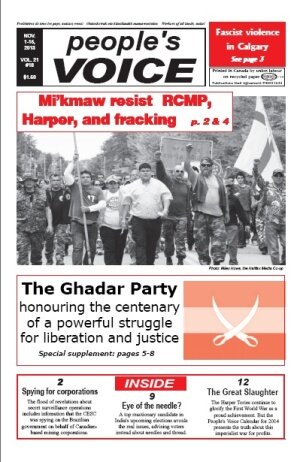
November 1-15, 2013
Volume 21 – Number 18
$1
Prolétaires de tous les pays, unissez-vous!
Otatoskewak ota kitaskinahk mamawestotan!
Workers of all lands, unite
1) SOLIDARITY WITH ELSIPOGTOG FIRST NATION!
2) NEW CYCLE OF FASCIST VIOLENCE IN CALGARY
3) YOUTH OF CANADA AND THE WORLD HEADING TO ECUADOR
4) WISE WORDS FROM UN RAPPORTEUR - Editorial
5) VICTIMS OF THE PROFIT SYSTEM - Editorial
6) SHUT DOWN CANADA'S SPY AGENCIES!
7) THE CENTENNIAL OF A REVOLUTIONARY NEWSPAPER
8) A BRIEF HISTORY OF THE GHADAR MOVEMENT
9) GHADAR CENTENARY RESOLUTIONS
11) SYRIA: THE ONGOING IMPERIALIST DRIVE TO WAR AND THE NEED FOR ANTI-WAR MOBILIZING
12) CODIR WARNS AGAINST "LEGAL PAEDOPHILIA" IN IRAN
13) MUSIC NOTES, by Wally Brooker
14) PEOPLE'S VOICE 2014 ANTI-WAR CALENDAR
PEOPLE'S VOICE NOVEMBER 1-15, 2013 (pdf)
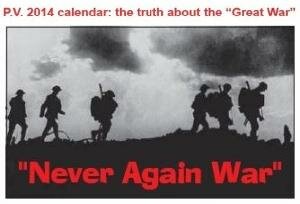
People’s Voice 2014 Calendar
”The Truth About the Great War”
|
People's Voice deadlines: November 16-30 December 1-31 Send submissions to PV Editorial Office,
|
REDS ON THE WEB
http://www.parti-communiste.ca/
peoplesvoice.ca
www.ycl-ljc.ca
www.solidnet.org
|
People's Voice finds many "Global Class Struggle" reports at the "Labour Start" website, http://www.labourstart.org/. We urge our readers to check it out! |
* * * * *
People's Voice
Canadian Publications Mail Sales Product Agreement #205214
ISSN number 1198-8657
People's Voice is published by
New Labour Press Ltd
PV Editorial Office
706 Clark Drive,
VANCOUVER, B.C. V5L 3J1
Phone:604-255-2041
Fax:604-254-9803
email: pvoice@telus.net
Editor: Kimball Cariou : Business Manager: David Au
Editorial Board: Kimball Cariou, Miguel Figueroa,
Doug Meggison, Naomi Rankin, Liz Rowley, Jim Sacouman
* * * * * *
Letters
People's Voice welcomes your letters
on any subject covered in our pages.
We reserve the right to edit for length and clarity,
and to refuse to print letters which may be libellous
or which contain unnecessary personal attacks.
Send your views to:
"Letters to the Editor",
706 Clark Dr., Vancouver, BC V5L 3J1,
or pvoice@telus.net
People's Voice articles may be reprinted without permission,
provided the source is credited.
* * * * * *
The Communist Party of Canada, formed in 1921,
has a proud history of fighting for jobs, equality, peace,
Canadian independence, and socialism.
The CPC does much more than run candidates in elections.
We think the fight against big business and its parties
is a year-round job,
so our members are active across the country,
to build our party and to help strengthen people's movements
on a wide range of issues.
All our policies and leadership
are set democratically by our members.
To find out more about Canada's party of Socialism,
give us a call at the nearest CPC office.
* * * * * *
Central Committee CPC
290A Danforth Ave Toronto, Ont. M4K 1N6
Ph: (416) 469-2446
fax: (416) 469-4063 E-mailmailto:info@cpc-pcp.ca
Parti Communiste du Quebec (section du
Parti communiste du Canada)
5359 Ave du Parc, Montréal, Québec,
H2V 4G9
B.C.Committee CPC
706 Clark Drive, Vancouver, V5L 3J1
Tel: (604) 254-9836
Fax: (604) 254-9803
Edmonton CPC
Box 68112, 70 Bonnie Doon P.O.
Edmonton, AB, T6C 4N6
Tel: (780) 465-7893
Fax: (780)463-0209
Calgary CPC
Unit #1 - 19 Radcliffe Close SE
Calgary AB, T2A 6B2
Tel: (403) 248-6489
Ottawa CPC
Tel: (613) 232-7108
Manitoba Committee
387 Selkirk Ave., Winnipeg, R2W 2M3
Tel/fax: (204) 586-7824
Ontario Ctee. CPC
290A Danforth Ave., Toronto, M4K 1N6
Tel: (416) 469-2446
Hamilton Ctee. CPC
265 Melvin Ave., Apt. 815
Hamilton, ON.
Tel: (905) 548-9586
Atlantic Region CPC
Box 70 Grand Pré, NS, B0P 1M0
Tel/fax: (902) 542-7981
http://www.parti-communiste.ca/
* * * * * *
News for People, Not for Profits!
Every issue of People's Voice
gives you the latest
on the fightback from coast to coast.
Whether it's the struggle for jobs or peace, resistance to social cuts,
solidarity with Cuba, or workers' struggles around the world,
we've got the news the corporate media won't print.
And we do more than that
- we report and analyze events
from a revolutionary perspective,
helping to build the movements for justice and equality,
and eventually for a socialist Canada.
Read the paper that fights for working people
- on every page, in every issue!
People's Voice
$30 for 1 year
$50 for 2 years
Low-income special rate: $15 for 1-year
Outside Canada $50 for 1 year
Send to: People's Voice, 706 Clark Drive, Vancouver, BC, V5L 3J1
You can call the editorial office at 604-255-2041
REDS ON THE WEB
http://www.parti-communiste.ca/
http://www.ycl-ljc.ca/
http://www.solidnet.org/
(The following articles are from the November 1-15, 2013, issue of People's Voice, Canada's leading communist newspaper. Articles can be reprinted free if the source is credited. Subscription rates in Canada: $30/year, or $15 low income rate; for U.S. readers - $45 US per year; other overseas readers - $45 US or $50 CDN per year. Send to People's Voice, c/o PV Business Manager, 706 Clark Drive, Vancouver, BC, V5L 3J1.)
1) SOLIDARITY WITH ELSIPOGTOG FIRST NATION!
People's Voice Commentary, Oct. 22, 2013
The shocking attack on Oct. 17 by RCMP officers against anti-fracking protesters in New Brunswick sends a clear signal that the Canadian state and the Harper Conservative government want to smash the growing resistance by Aboriginal peoples, environmentalists and other forces which oppose the destructive profiteering of transnational energy monopolies, such as the Houston-based Southwest Energy company (SWN).
People's Voice and the Communist Party of Canada join with all democratic and progressive people in condemning this brutal police violence. The Oct. 21 decision by the Court of Queen's Bench to lift SWN's injunction, which had been filed to end the blockade protecting Mi'kmaq traditional territory from fracking, is a major victory, and makes clear that the RCMP attack was completely unjustified.
We urge full solidarity with the Elsipogtog First Nation in the struggle against fracking on their traditional territories. The wave of solidarity demonstrations across Canada and around the world was a powerful statement that the Harper government must be compelled to abandon its repressive tactics, and to engage in meaningful and constructive dialogue with Aboriginal peoples.
But the RCMP attack in New Brunswick, coming just two days after the departure from Canada of James Anaya, the UN Special Rapporteur on indigenous peoples, proves that much stronger public opposition will be needed to block the Conservative agenda.
Fracking exploration and development of shale gas are proceeding at a frantic pace across much of Canada, despite mounting evidence that injecting a mix of sand, chemicals and water into the ground contaminates drinking water sources.
In western Canada, the Conservatives continue to give one hundred percent support to the drive by the big energy monopolies to export diluted bitumen from the tar sands, heedless of the massive environmental dangers involved in using pipelines, tankers and rail transport. The Line 9 proposal in central Canada, again backed by the federal Conservatives, is yet another energy export plan which has generated serious concerns among Aboriginal peoples and other residents.
In every case, the inherent rights of Aboriginal peoples are trampled in the race to expand energy exports. The rights of all Canadians are also under attack, as the Harper government removes or even simply ignores legislative and legal impediments to its reactionary agenda.
We extend our full support to all struggles by Aboriginal peoples and their allies against the expansion of energy exports, which threatens to further poison the natural environment, and which contributes to the serious crisis of climate change fuelled by carbon emissions. This is a struggle for the future of Canada, and for the entire planet.
We further demand that the Conservative federal government and provincial governments immediately cease their campaign of injunctions, harassment, violence against critics of their environmental destruction.
|
|
2) NEW CYCLE OF FASCIST VIOLENCE IN CALGARY
By Jason Devine, Calgary
Editor's note - Over the past several years, Calgary, Alberta has been the scene of so-called "white pride" demonstrations, vicious attacks against people of colour and anti-racists, and other actions by local neo-nazi groups. There has been a strong public response against these activities, led by Anti-Racist Action and other concerned groups and individuals. For some time until quite recently, the fascist "white pride" groups in Calgary had been less visible, while one of their key leaders served time in jail for his illegal actions.
Among the prominent anti-racist campaigners in Calgary are Jason and Bonnie Devine, who have been the target of frequent threats and physical attacks. The latest violence against their home, reported here by Jason Devine, indicates that neo-nazi hatred is growing again. Readers are encouraged to contact the Calgary Police Service to demand swift action against the persons responsible for these crimes.
In the early morning of 29 September 2013, between 5:10‑5:15 am, I was awoken by a loud noise, one which sounded like a metal pipe striking another metal pipe. Since we live in a busy working‑class street I assumed it was merely someone getting ready for work outside. Then I heard another, even louder noise. This time a crash and then glass breaking. Automatically I knew we were under or had just been attacked.
I jumped out of bed and rushed to living room where Bonnie had been sleeping on the couch. She was coming out of her sleep, having heard the noise, and told me it sounded like an explosion of some type. I then ran downstairs to check on the boys. Seeing them safely asleep I then inspected each room and the windows to look for any structural damage. While I was doing this Bonnie checked the rooms upstairs and got dressed.
I returned upstairs and got dressed. We both had found nothing until I pull the blinds up on the front window in our living room. There we saw that the first pane had been shattered, though thankfully the second pane was intact.
Bonnie then phoned the police to get this attack on record and I started taking pictures in order to be able to post them online. Clearly it was not as Bonnie first thought a pipe bomb, but some projectile had been thrown at the window.
After getting off the phone Bonnie ventured outside to inspect the damage; she took the camera and also crowbar in case those who did the attack were outside waiting.
No one was there thankfully, but Bonnie found two broken pieces of a brick and took pictures of them and the glass outside. Clearly someone had thrown the brick and it broke on the first throw; this being the first sound I heard. Then they must have thrown it again, this time shattering the window.
I then uploaded the pictures to Facebook with a small note on what had happened and what we felt it meant; I also alerted as many comrades, friends, and allies to the attack.
In our mind it is quite clear who was behind this most recent attack: Blood & Honour‑Combat 18 (B&H‑C18). More specifically, we are certain it was the work of the local group led by Kyle McKee.
In the context of the history of attacks we have faced, almost six years now, and in light of the fact that Kyle has been out of jail for the last 4‑5 months and has been actively organising in Calgary, who else would do such a thing?
When the police officer arrived a couple of hours he asked who I suspected was behind the attack and I told him. He said it could be a possibility, but that I should put not too much stock in such a supposition.
Well, later in the day Bonnie went to go out and pick up some food with our children when she discovered that three of our van's tires had been slashed. She phoned the officer back and reported this new fact. He came back to our house and inspected the tires. He then informed us both the he now believed that we were right in suspecting B&H, that he now suspected them as well, that he was considering this a hate crime, and was now sending this to the Calgary Police Services Hate Crimes Unit.
The next day while Bonnie and the boys were on route to picking me up from work, one of the tires blew out; it turned out that they had actually slashed four tires, but did not fully succeed on the fourth tire. They were stranded far from home, but thankfully my Mother was able to pick them up, and thanks to friends and comrades we were able to change and replace the tires and get back up and running.
Of course we do not know who exactly did this crime. Bonnie has conjectured that it was likely not Kyle McKee himself: after the firebombing and home invasion/murder attempt, throwing a brick is kids' stuff to him. Possibly it was a new B&H recruit being initiated. Who can say? But it really does not matter: what matters is the violence that has again occurred.
It is, to some extent, wearying to talk about this, but it is even more wearying to go through it yet again. At times I lose count of all the attacks, threats, and slanders. All this violence has become normal to us, but something like this should never be normal for anyone.
One thing that has been continual and keeps us going in the struggle is the love and solidarity from our comrades, friends, and family. From words of support like a recent letter of solidarity we received from the CUPW‑STTP, to helping pick up the damage, to monetary help, and to publicising the struggle as our comrades in the CPC have never failed to do, these past years have been an object lesson on the importance of unity and solidarity in any struggle.
This recent attack is likely only the beginning of a new cycle of fascist violence here in Calgary. While Kyle McKee was incarcerated, B&H locally dissolved and fell apart. It was a nice, if short, peace. That is now over. New and worse forms of violence are now an eventuality for us and others. We must be on our guard. We must call for solidarity and we must organise. The struggle continues.
|
|
3) YOUTH OF CANADA AND THE WORLD HEADING TO ECUADOR
PV Youth Bureau
Mobilizing continues to forge ahead for the 18th World Festival of Youth and Students. The largest gathering of anti‑imperialist youth in the world will assemble in Quito, Ecuador this December 7‑14. Youth from across Canada are now busy fundraising and making the necessary plans to attend. Developments on the international arena point to the event being a site of real friendship and solidarity among the peoples.
Ecuadorian‑Colombian youth talk peace
In early October organizers held an Ecuador‑Colombia Bi‑National Meeting in Pasto, a city near the border between the two countries and in the shadow of the giant Galeras volcano. Despite the difficult conditions for progressive forces in Colombia, where upwards of 200 trade unionists are killed in a year, a large delegation is expected at the festival from that country.
The Pasto meeting, which filled a university auditorium, discussed common concerns of the youth in the two countries and building for the festival. Workshops and other events were also held over the course of a weekend addressing themes of democracy, land and territory, and the concerns of high school and university students.
At the 2005 16th WFYS in Caracas, Venezuela, Colombia sent a delegation of over 500 youth. On return, most of the delegation was detained and arrested at the border. Then‑President Uribe of Colombia reportedly accused of the youth on national television of plotting insurrection.
Clearly setting a different tone from that of the Festival's ultra‑right detractors, the Colombian‑Ecuadorian meeting in Pasto concluded a symbolic march "for unity of the youth involved to peace and a better world."
IOC now in Ecuador
Also reflecting the internationalist spirit of solidarity was the installation of the WFYS International Organizing Committee, elected at the third world‑wide organizing meeting held in India. The IOC arrived in Ecuador in late October to begin its work of political and logistical coordination before the event.
The IOC includes representatives of Preparatory Committees from over 20 countries, including Nepal, Korea, Vietnam, Namibia, South Africa, Western Sahara, Palestine, Syria, Lebanon, Cyprus, Greece, Portugal, Cuba, Venezuela, Brazil and the OCLEA (Organization of Caribbean and Latin America Students). The composition gives a truly international character to the festival.
One of the IOC's biggest jobs will be coordinating the political programme of the festival. Already announced topics for the major conferences include a wide‑range of topics reflecting the main slogan of the festival, "for peace, solidarity and social transformation."
The initial schedule will feature major opening and closing ceremonies, show‑casing Ecuador. Other days will be themed around each of five global regions: Asia and the Pacific, Africa, the Middle East, Europe, and the Americas.
Sports and cultural events include a photo exhibit, an anti-imperialist film festival, a marathon, and a soccer match.
Conference, seminar and workshop titles include subjects like Foreign Military Bases, Military alliances and Demilitarization and Peace agreements; Youth unemployment in Europe; Palestine: the Zionist occupation, Apartheid wall, danger of settlements, and the detainees in the Israeli jails.
Other topics touch on issues like Patents and concentration of knowledge, science and technology; Sexual and reproductive rights, Gender Equality; the Peace Process in Colombia; and Natural resources: in the hands of monopolies or in the hands of the peoples?
Ecuadorian organizing
The local Ecuadorian Committee has sent out three promotion teams doing an effective marathon of publicity across the country. The teams are named after Venezuelan President Hugo Chavez, the historic liberator of Ecuador Eloy Alfaro, and Transito Amaguana, a female indigenous rights activist and socialist. They will bring the banner of the festival to all cities and most large towns in the coastal, Andean and Amazonian regions of the bio-diverse country.
The local host Ecuadorian Committee is using creative ideas like holding a song contest by young progressive musicians. The winners will perform their music at the festival.
The Ecuadorian Committee has also released a flashy new website, with lots of information although exclusively in Spanish. The site is linked from the Pan‑Canadian website, www.18wfys.tumblr.com
Canadian organizing grows
The Pan‑Canadian Festival Committee is busy purchasing airline tickets. At the time of press, the Festival Committee was scrambling to finalize the details of bulk‑buy ticket rate with significant discounts through a Latin American Airline, Drew Garvie told People's Voice.
"We are seeing growing interest, and emails coming in almost every other day," Garvie said. "While we have a core delegation for whom we are fundraising, the Canadian delegation can still include many more people if they are interested."
There are at least 30 confirmed delegates, and anywhere between 50 and 100 people expected. Garvie, who represents the Young Communist League on the Festival Committee, is co‑chair with Raphaella Weissgerber, a Vancouver-based youth and community activist.
Local committees are also moving into fundraising mode. Montreal held a fundraiser garage sale earlier in October, while Vancouver is holding a Scary‑oke Karaoke night for Halloween. Similar events like raffles, bottle‑drives, and fundraising appeal letters are happening in places like Winnipeg, Guelph, Ottawa and Halifax.
Supporters in the trade union movement are urging other labour and progressive groups to help. "We've made a donation to the Kamloops delegation, but more importantly, we wish to encourage more young people to consider making the trip to this great event," the Kamloops District Labour Council President Peter Kerek said in an open letter from the KDLC endorsing the festival.
In Toronto, festival delegates are planning a special night of entertainment and dinner on Oct. 26 at the Greek‑Canadian Democratic Organization Hall, 290 Danforth Ave.
And in Vancouver, the annual Revolution Dinner on Nov. 16 sponsored by the Centre for Socialist Education will be a fundraiser for Festival delegates. (See the ad on page 3 for details, or call 604-254-9836.)
To make a donation, send cheques to the Marty Skup Memorial Fund c/o S. Skup, Treasurer, 56 Riverwood Terrace, Bolton, ON, L7E 1S4. For more information, visit www.18wfys.tumblr.com or write 18wfys.canada@gmail.com.
|
|
4) WISE WORDS FROM UN RAPPORTEUR
People's Voice Editorial
On Oct. 15, James Anaya, the UN Special Rapporteur on the rights of Indigenous peoples, called on the Harper government to avoid a "rocky road" in its relations with Aboriginal peoples. After visiting communities in six provinces, and meeting with federal officials and the RCMP, Anaya warned that Indigenous peoples still suffer from "multiple legacies of the history of colonization, treaty infringements, assault on their cultures and land dispossession."
Anaya's full report will be released next year. For now, he said, the government needs to reverse its "hardened positions" on three key issues: by extending the mandate and time-line for the Truth and Reconciliation Commission (TRC) into residential schools; by heeding the calls for a national inquiry into the high number of murdered and missing Indigenous women; and by reconsidering its proposed legislation governing on‑reserve education.
PM Harper (who rules his Cabinet with an iron fist) has repeatedly signalled that there will be no meaningful moves to address Aboriginal demands around such issues. That's not surprising, since Harper denies any element of colonialism or racism in Canada's historic relations with First Nations.
But the most immediate answer to Anaya's proposals came 48 hours after his news conference, when RCMP violence was used against anti-fracking protesters from the Elsipogtog First Nation in New Brunswick. While the mainstream media showed burning police cars, the real story here is the centuries-long record of land theft and poverty imposed by Canada on Aboriginal peoples.
Despite the stubborn positions of Harper and his government, the movement to reverse the genocidal policies of the Canadian state continues to gain momentum. The wise words of the UN Rapporteur should be heeded, not met with more RCMP batons, rubber bullets, and pepper spray.
|
|
5) VICTIMS OF THE PROFIT SYSTEM
People's Voice Editorial
We don't always agree with Green MP Elizabeth May, but her dust‑up with ultra‑right cabinet minister Jason Kenney was certainly welcome. Slamming the Harper government's donation of $1.5 million for a "monument to victims of communism," May tweeted: "No mention of monument to victims of capitalism."
The volatile Kenney tweeted back that "no one was shot in the back while risking their lives to flee eastward over the Iron Curtain" and much similar nonsense. We recall that one of Mr. Kenney's "heroes" is the late Aloysius Stepinac, the fascist Catholic Cardinal convicted in post‑war Yugoslavia for collaboration with Hitler's Nazis.
More to the point, a list of the deaths caused by capitalism would fill this entire newspaper, but here are some examples. The trans‑Atlantic slave trade by emerging capitalist powers caused the deaths of ten million Africans. Another ten million people in the Congo were the victims of capitalist Belgium's expansion of the rubber industry. The indigenous population of the Americas fell by 40 million following the colonial capitalist occupation kicked off by Columbus.
What about the wars of the 20th century? Over ten million dies in the First World War, a brutal inter‑imperialist bloodbath over lands and resources, i.e. capitalist profits, plus a staggering 57 million in the Second World War, instigated by capitalist Nazi Germany.
More? In Indonesia, half a million were massacred to preserve capitalism in Suharto's 1965 coup; 200,000 were killed in Guatemala to protect the capitalist landlord system; thousands were executed after the 1973 capitalist coup against Chile's socialist Popular Unity government. And what about the capitalist workplace? The International Labour Organization reports that some 2 million workers die every year from occupational accidents and work‑related diseases.
So, Mr. Kenney, you want to build a monument? Look no further than the victims of the murderous private profit system.
|
|
6) SHUT DOWN CANADA'S SPY AGENCIES!
Statement by the Central Executive Committee, Communist Party of Canada, Oct. 11, 2013
The revelation that the Communications Security Establishment Canada (CSEC) has been conducting surveillance of Brazil's Mines and Energy Ministry gives new importance to demands to shut down Canada's spy agencies.
Documents leaked by former U.S. National Security Agency (NSA) contractor Edward Snowden, and reported by Brazil's Globo TV, show that Latin America's biggest country has been subject to intensive snooping by U.S., British and Canadian spy agencies, which cooperate closely in the interests of this clique of imperialist powers.
The metadata of phone calls and emails from and to the Brazilian ministry have been targeted by the CSEC, using a software program called Olympia to map the ministry's communications. While Stephen Harper's PMO has evaded direct comment on the news reports, there seems little doubt that the CSEC is being used to support the private interests of Canadian‑based mining transnationals.
Working from his base in Rio de Janeiro, U.S. journalist Glenn Greenwald broke this story, as well as earlier reports about the NSA's global spy program. The NSA has been gathering metadata on billions of emails, phone calls, and other internet data flowing through Brazil, which is an important transit point for international communications. Brazilian President Dilma Rousseff and state‑run oil company Petrobras are among the key targets of NSA spying. The revelations led Rousseff to cancel a planned visit to the U.S., where she was to be the guest of honour for a state dinner, and Brazil is stepping up efforts to protect its state and economic interests from U.S. espionage. Speaking at the United Nations General Assembly last month, Rousseff called for international regulations on data privacy and limiting espionage programs targeting the Internet.
From the Canadian perspective, there are several ominous aspects to the CESC revelations. One is that this arm of the Canadian state appears to be acting directly at the service of private investors, with the active collusion of the Harper Conservative government. In effect, Canadian taxpayers, without any prior knowledge or consent, are subsidizing the financial interests of Canadian mining capital.
Just as significant, the growing role of the CESC indicates that under the Tories, the repressive apparatus of the Canadian state continues to expand relentlessly, with the aim of criminalizing more Canadians and engaging in ever‑wider surveillance and espionage activities. While the governments of the major imperialist powers cling to the fiction that they do not spy on their own citizens, it is crystal clear that their mutual cooperation includes mutual swapping of surveillance information from country to country. This raises the stakes much higher, as these governments devote enormous resources on gathering information about individuals and movements which raise criticisms against the drive towards new imperialist wars, neoliberal economic policies, theft of indigenous lands, environmental destruction, relentless expansion of fossil fuel consumption, and wider attacks on democratic rights and civil liberties.
Third, the CESC spying on Brazil indicates that much, or perhaps even most of this espionage activity is not directed at alleged "terrorist threats," but rather at supporting the interests of big capital, which sees Brazil and the other BRICS countries as serious potential rivals to the global hegemony of US imperialism and its closest allies. This points to a dangerous sharpening of international tensions, at a time when global cooperation is desperately needed to tackle climate change, hunger, economic disparities, and militarism.
The Communist Party of Canada demands that the repressive spying agencies of the Canadian state, including the CESC, CSIS, etc., must be fully dismantled, and the data gathered by these anti‑democratic forces be destroyed. The people of Canada seek cooperation and friendship with peoples of all countries, including Brazil, which (unlike the Harper Tories) is attempting to provide genuine leadership in the search for solutions to the serious problems facing our planet. We call for a swift and unconditional apology by the Harper government for the CESC spying activities, and for an immediate end to all such efforts to undermine the legitimate economic interests of other nations. Finally, we demand that the Canadian government and military end all cooperation with U.S. security agencies, and begin to work with Brazil and the other BRICS countries to find ways to protect the privacy and security of global communications networks.
|
|
7) THE CENTENNIAL OF A REVOLUTIONARY NEWSPAPER
By Kimball Cariou, Editor of People's Voice
The middle four pages of this issue of People's Voice pay tribute to the 100th anniversary of a remarkable political movement, and to the newspaper at the heart of its activities.
During the early decades of the 20th century, the west coast of North America was fertile ground for radical political movements. This was a period of mass union organizing campaigns, general strikes, utopian communes, widespread anti-war sentiments, and frequent clashes between the authorities and labour activists.
It was also an era when the ruling class used every possible weapon to divide working people. Employers sought to undermine working class efforts to raise wages and improve conditions, by expanding the pool of surplus labour in both the U.S. and Canada. At the same time, the bosses and their political parties carefully fanned the flames of racism, chauvinism and religious sectarianism, pitting workers of European origin against their sisters and brothers from Asia, and those from the "British Isles" against newer sections of the working class arriving from eastern Europe.
On the west coast, this led to violent attacks and riots by misguided whites against the Chinese, Japanese and South Asian communities. More far-sighted socialists and communists called for working class unity against the bosses, and unions like the IWA pioneered the struggle for unity by recruiting thousands of non-European immigrant workers into their ranks.
But racist sentiments remained widespread for many years, creating the basis for policies such as the Chinese Head Tax and the denial of voting and political rights for Asian migrants.
In this context, the publication of revolutionary newspapers in languagues other than English was a powerful contribution to the emergence of a truly united working class movement.
One of the first such publications was Ghadar, the organ of the "Hindi Association of the Pacific Coast of America" formed in April 1913. Known by the name of the newspaper, this organization signalled the emergence of a revolutionary struggle to liberate India, the "crown jewel" of British imperialism.
As detailed elsewhere in these pages, the Ghadar party and its newspaper worked fearlessly and relentlessly for the goal of national liberation. Their strategy was based on unity against British imperialism in India and against racist oppression in North America. Rather than succumbing to divisions along the lines of language, religion or caste, the Ghadars "kept their eyes on the prize," placing the goals of their movement in the forefront.
The Ghadar newspaper, like other such publications of the time, depended entirely on the solidarity and discipline of its readers to stay in print. Despite the threat of state attacks, the newspaper appeared weekly, starting on November 1, 1913, until the Ghadar leaders and members returned to India to spark an uprising against the British.
The Ghadar movement remains a powerful inspiration to revolutionaries in Canada and the U.S. today. A century later, we carry on our struggles in a society where the mass media - TV, radio, movies, print - are overwhelmingly dominated by huge capitalist monopolies. But the message of working class media such as People's Voice remains as relevant as ever. By paying tribute to the Ghadar newspaper on this important anniversary, we recognize its outstanding role in the struggle against ruling class ideologies - and for the liberation of all humanity from the evils of exploitation, oppression, war, hunger, and disease.
|
|
8) A BRIEF HISTORY OF THE GHADAR MOVEMENT
By Gurpreet Singh
The Ghadar movement was launched by a group of radical South Asian immigrants on the Pacific coast of North America in 1913 to mainly overthrow the colonial rule of the British government in India and challenge racism abroad.
The origin of the Ghadar movement can be traced to the first rebellion of 1857 against the British occupation of India. This uprising brought the people of different faith groups, like Hinduism and Islam and caste backgrounds, together against the British Empire. Marx described it as the first war of independence. The British government termed it as "Ghadar", an Urdu expression which means an act of treason, but was later appropriated by the Ghadar Party members.
This rebellion was a result of anxiety among the Indian soldiers working for the British armies. They were unhappy with their pay. But what triggered the crisis were rumours that the grease inside the cartridges used by the soldiers was mixed with animal fat taken from cows and pigs. The soldiers had to tear off these cartridges with their teeth before loading them in the rifles. Since Hindus did not eat beef and Muslims were forbidden from eating pork, they felt deceived and revolted.
However, the Sikh Chiefs who were largely pro-British back then helped in suppressing the rebellion. Ironically, the Ghadar Party had a big following among the Sikhs, who constituted the majority of South Asian immigrants in North America. The party was originally formed as Hindi Association of the Pacific Coast of America, but came to be known as Ghadar Party after the launching of the newspaper named "Ghadar" on November 1, 1913. The title was taken from the rebellion of 1857.
Punjab was a garrison state for the British rulers and provided recruits for the armies. As part of some calculation or perhaps their notorious "divide and rule" policy, the British treated Sikhs as a martial race and preferred recruits from this community. The Sikh clergy was also hand‑in‑glove with the rulers and often prayed for the success of the Empire.
Though the rumours of animal fat inside the cartridges sparked the rebellion of 1857 for religious reasons, underneath this revolt was the discontent of the Indian people with the economic policies of the British rulers. These policies marginalized Indian industry and agriculture at the cost of the prosperity of England.
The British government was not paying attention to the needs of the people of India. As a result many died due to starvation and plague. Local industry was discouraged and the cheaper raw material produced in India was being sent to England.
Land revenue collection also wreaked havoc on the small and middle peasantry. Rigorous methods were used for collection of taxes and no respite was given in an event of crop failure. All this led to a rise in land mortgages and borrowings that further increased rural indebtedness.
The Ghadar newspaper published a regular column exposing this pillage. It gave startling figures to illustrate the loot. It accused the British rulers of spending more on the military budget instead of providing basic services to the Indian population.
The migration of East Indians to US and Canada was an outcome of the economic hardships suffered under the British rulers. These conditions compelled many Sikh farmers from Punjab to migrate to other countries for better living by the end of the 19th century.
Most of the middle level peasants had mortgaged their lands to the money lenders. The irrigation water rates had tripled and land holdings were reduced to small plots. As a result the farmers were compelled to move abroad for better livelihood.
The first immigrants reached Malaya and China and were willing to take any task including lending services to the outposts of British imperialism. They later learnt from the travellers to Canada and US that in those countries, a worker could earn more. Eventually, these immigrants took off to North America.
But the migration was not confined to economic hardships alone; many political refugees lived in exile. The political atmosphere of India had charged up on the occasion of the 50th anniversary of the first mutiny. The Punjab in particular witnessed an uprising in the form of a farmers' agitation in 1907. Some of its prominent leaders were forced to leave India.
Others like Vinayak Damodar Savarkar lived in England, where he organized an event to commemorate the 50th anniversary of the first Ghadar. He also wrote an important book on the history of the mutiny of 1857 in response to British propaganda against the participants of the first uprising. The book that gave an insight on the upheaval was banned by the British authorities.
In a way these exiled leaders had already laid the ground for the Ghadar movement within the South Asian Diaspora.
Most of these men came to this part of the world as British subjects. Many had previously served in the British armies and trusted the fairness of the British Empire. They were soon disillusioned when they were exposed to racial hatred. The British diplomats did not come to their rescue in an event of hate crimes. The government of Canada, a former British colony, adopted racist immigration policies to "keep Canada white". These immigrants were neither allowed to bring in their families, nor to vote. The Indians were disfranchised in 1907.
Across the border in the US, the social environment was very hostile towards South Asians. The white labour groups felt threatened because East Indian immigrants were willing to work for lower wages. This reduced their bargaining power and as a result they started intimidating the Asian immigrants.
The Canadian government, buckling under pressure of white supremacy, adopted discriminatory policies, while the US authorities looked the other way during racial violence.
The Indian immigrants soon realized that the root cause of their sufferings was foreign occupation back home. Racial taunts and violence hardened their feelings against the British establishment and they gradually turned their back towards an empire whose interests many of them had served before. Many moderate Sikhs had tried to draw the attention of the authorities to their loyalty towards the Empire during those times.
Enough was enough for these men. Rampant racism taught them to fight back. They started getting organized and decided to buy weapons and resist. A strong urge emerged to form a group that brought all Indian migrants together irrespective of their religious beliefs and castes.
Under these circumstances Hindi Association of the Pacific Coast of America was established on April 21, 1913 in Astoria, with Sohan Singh Bhakna, a Sikh as its President and Har Dayal, a Hindu as a Secretary of the group. The association resolved to launch an armed rebellion against the British Empire. The term "Hindi" represented Hindustanis, a reference to all East Indians.
On November 1, the Association launched its newspaper titled Ghadar. Hay Dayal, the editor of the paper, believed that it would revive the memories of the first uprising. The Ghadar newspaper was initially published in Urdu language. Shortly, the Punjabi edition of Ghadar was also launched. Kartar Singh Sarabha translated the Urdu edition in Punjabi.
The Ghadar newspaper with its radical content soon became popular among the Indian community abroad. It gave an open call for armed resistance. As a result the Association came to be known as Ghadar Party.
The Ghadar Party established its headquarters in San Francisco, considered a hotbed of revolutionaries from different countries, such as China, Ireland and Russia.
The Ghadar leaders anxiously waited for an opportunity to strike. As a crisis between Britain and Germany was brewing, they eyed an opportunity to start an armed revolt in case there was a full scale war between the two countries. Their calculations were that the two nations would take several years to go to war. With such possibilities in mind, many revolutionaries abroad started collaborating with Germany for political and military support. Har Dayal looked upon such a war as a golden opportunity. However, he was served with an arrest warrant for spreading anarchy in US in March, 1914, allegedly under pressure from the British authorities. The party decided to send him to Switzerland. Har Dayal's departure was a big jolt to the party, but it continued to grow even after he was forced to leave America.
The party had a big following in Canada. Ghadar activities in Vancouver also came to the notice of Canadian officials. A groundwork for the Ghadar party was laid in Vancouver much earlier. The Khalsa Diwan Society was established there in 1906. The body not only governed the Sikh temple, but also encouraged its congregation to indulge in political activism, and provided space to all the communities, including non-Sikhs, to hold political meetings.
In a major development of its time, the former Sikh soldiers, who had served in the British armies, burnt their medals, uniforms and certificates as a mark of protest against the systemic racism and discrimination at the Vancouver Sikh temple on October 3, 1909.
The Ghadar activists condemned all peaceful means of struggle, such as boycotts and petitioning. They planned to go back to India and encourage Indian soldiers to quit the British armies and turn their guns against the authorities and toadies.
Although the majority of the members and supporters of the Ghadar Party were Sikhs, the party was secular in composition and character. The party resolved to form an egalitarian and democratic society in independent India and believed in economic and social equality.
Har Dayal was not the only non-Sikh face of the Ghadar Party. The central committee of the party had Kanshi Ram, another Hindu as treasurer and Karim Baksh, a Muslim, as Organizing Secretary.
The Ghadar activists had learnt to work together to resist racism and oppression despite differences of opinion. A case in point is the close friendship between Jawala Singh and Wasakha Singh. The two men had leased a farm land near Stockton, California, that supplied free of cost rations for volunteers working at the Ghadar Party Headquarters in San Francisco.
Jawala Singh was not a religious person, but Wasakha Singh was a devout Sikh saint. Jawala Singh was opposed to teaching divinity to the Indian students sponsored by them. He believed that such teaching was a waste of time for students who should be spending more hours on studying their curriculum books.
In spite of Jawala Singh's unconventional ideas, Wasakha Singh was very close to him and the two men respected each other. During their detention in the Andaman Jail, when Wasakha Singh had become frail and weak due to poor conditions, a doctor recommended him to eat fish curry. Because of religious reasons he refused to do so, but Jawala Singh convinced him to have it once for the sake of the larger interest of the freedom struggle.
Wasakha Singh also wrote poetry that became a part of the Ghadar narrative. He had passionately written a poem dedicated to Paramanand Jhansi, a Hindu member of the Ghadar Party who suffered physical torture in the Andaman Jail. In his poem he described Jhansi as a brave man, who did not show any sign of weakness despite repression by the authorities.
Jhansi had participated in a hunger strike launched by the Sikh prisoners, against the jail rule that forced the Sikhs to remove their turbans and wear caps during detention.
Casteism had no place in the party, and everyone was treated equally. The Ghadar party explicitly denounced caste-based discrimination. This policy inspired Manguram Muggowal, a Dalit or so-called "untouchable" to join the Ghadar movement. Muggowal later rose to become a towering leader of the Dalit emancipation movement in Punjab.
People were encouraged to leave aside their spiritual beliefs and work in harmony as Indians. Vegetarians or non-vegetarians, beef eaters of pork eaters, were treated alike in the party. The taboos that triggered the Ghadar of 1857 were broken by the Ghadar Party.
Though the party sometimes invoked religion where it was necessary to attract public support, it was never biased towards any particular religious group and denounced all kinds of prejudices. For instance the Ghadar activists instigated the Sikhs to react when an outer wall of a historical Sikh temple in Delhi was demolished during the extension of the Viceroy's palace in 1913. Similarly, the Ghadar party also condemned the demolitions of Hindu temples and mosques under British rule. It also recognized heroes of Sikh history and Hindu mythology to ensure mass appeal and encourage people to follow the ideals of these figures and fight against oppression.
The Ghadar party heavily emphasized people's unity and cautioned against the divide and rule policies of the British rulers.
Against all calculations of the Ghadar Party, war broke out between Britain and Germany in August 1914. Seeing this as an opportunity to strike, the Ghadar newspaper gave a call for war against occupation.
Around this time another episode occurred in Vancouver that galvanized the Ghadar movement. On May 23, 1914 a Japanese vessel named Komagata Maru reached Vancouver with 376 Indian passengers aboard. The passengers were not allowed to disembark under the discriminatory "continuous journey" law which aimed at preventing permanent settlement of Indians in Canada. The ship remained stranded for two months and was forced to return.
When the ship reached India, a shootout occurred near Calcutta that left 22 people dead on September 29, 1914. The violence ensued when the police tried to forcibly send the passengers to Punjab by a special train, fearing them to be subversives.
The Ghadar Party was in touch with the South Asian community activists who were providing support to the passengers during the Komagata Maru standoff. The Ghadar newspaper brought out a special issue in solidarity with the passengers.
Both the war and the Komagata Maru incident encouraged Ghadar activists to return to their home country to seek revenge for all their sufferings from the British Empire.
On way to India the Ghadar activists recruited supporters from among the police and army officials working for the Empire. The Ghadar propaganda in Singapore culminated in a revolt by Indian soldiers, mainly Muslims, who turned their guns against the British authorities on February 15, 1915. But after much bloodshed the authorities were able to suppress the rebellion.
Scores of Ghadar activists returned to India to face the gallows or long imprisonments. Those who escaped arrest continued their activities secretly. While men like Bhakna and Wasakha Singh were arrested upon reaching India, others like Sarabha gave slip to the police and continued to reorganize the Ghadar activists. He approached the Indian soldiers directly with intent to incite them for a coup.
The party had made plans to engineer a coup in the armies in different parts of India on February 21, 1915. But the plot was foiled by the government with the help of their moles in the Ghadar Party. A number of Ghadar activists were arrested and the army cantonments were alerted. Sarabha was held in March 1915. He and six others were hanged in Lahore Jail on November 16, 1915. Among those executed alongside Sarabha was Vishnu Ganesh Pingle, a Hindu from Maharashtra.
Many of those who were awarded long sentences were sent to Andaman jail, situated on a faraway island. The political prisoners detained there were subjected to inhuman treatment. Bhakna and Wasakha Singh were sent to the Andaman Jail.
The British government was able to crush the second Ghadar with an iron fist, but the spark of activism lit by the movement refused to subside. The Party activists who escaped the police dragnet continued their work. Some joined other nationalist movements and carried on the struggle until India gained its independence in 1947.
Karam Singh Daulatpur was one of them. He had spent years in Canada. He gradually joined another militant movement that was aimed at liberating the historical Sikh temples from the clutches of corrupt priests who were patronized by the British government. Known as Babbar Akali movement, it inspired many former supporters of the Ghadar Party. The Babbar Akali movement also believed in an armed struggle. Daulatpur died in a police shootout in September, 1923.
Bhagat Singh, a towering revolutionary who was hanged by the British in 1931 for killing a police officer, was influenced by the Ghadar Party. Bhagat Singh considered Sarabha as his role model.
The Ghadar activists continued their struggle for social justice even in post-independent India. People like Bhakna were thrown into jail for challenging the policies of the government. Likewise, Boojha Singh, a former Ghadar party activist was killed by the police in a staged shootout in 1970 for being a member of the ultra-leftist Naxalite movement that sought equality for the oppressed classes.
The Ghadar ideology remained popular among the radical youth seeking complete freedom through an armed rebellion. The moderate leadership that sought nothing more than a dominion status for India was ultimately forced to seek complete independence from foreign occupation because of the continued efforts of the militants.
The moderate Congress party that dominated the political landscape of India for years claimed to have a monopoly over the history of freedom struggle. Its propaganda of having achieved freedom without spilling blood was recognized internationally, while the Ghadar history remained obscured. But the legacy of the Ghadar movement remains alive and never gave up its rightful claim over the history of resistance.
|
|
9) GHADAR CENTENARY RESOLUTIONS
The year 2013 has seen the Ghadar Party centenary being celebrated across the world at grand scale. While it is appreciated that the radical Ghadar history which remained hidden for years is getting due recognition at every level, we wish to express our strong disagreement with symbolic and tokenistic gestures of the establishments both in India and elsewhere and attempts to distort the Ghadar history and its appropriation by some vested interests. Through People's Voice we undersigned urge everyone, particularly the progressive groups to ensure the Ghadar centenary celebrations in a more meaningful and fitting manner:
1. Be it resolved that since the Ghadar Party was mainly established to end foreign occupation of India and denounced all forms of oppressions and colonialism, we strongly urge all progressive forces to challenge occupation and imperialism in the contemporary world. All the imperialist wars and attempts to topple legitimate regimes must be confronted. It has been seen that the issue of Palestine that continues to be under Israeli occupation is being ignored conveniently even by the social democratic forces in Canada and elsewhere. It's a shame that the social democrats in Canada have participated in Ghadar centenary celebrations, but they are courting big powers such as Israel instead of standing up for the rights of the Palestinians. It is the responsibility of the progressive forces to keep the struggle against this aggression alive. Likewise, the inhuman blockade on Cuba and occupation of Afghanistan must be opposed forcefully.
2. Be it resolved that since the Ghadar Party was opposed to pillage of the resources and wealth under occupied India, all the progressive forces should unite against the neo liberal economic policies being implemented under international trade agreements causing massive damage to environment and small economies resulting into poverty and misery.
3. Be it resolved that since the Ghadar Party was formed against the backdrop of racism in US and Canada, we urge all progressive forces to break silence against the ongoing racial violence and hate crimes. Let this be known that we stand in solidarity with all the visible minorities and people of colour, who have been under constant attack in these countries. We must recognize that the US and Canada are nations built on the stolen land of the indigenous peoples. We must also acknowledge that the language and the culture of the First Nations have been under assault ever since the colonists started coming to this part of the world. We must therefore reject the doctrine of discovery and other racist notions and join the ongoing grassroots level indigenous movements, such as Idle No More. A hate crime targeting any one particular group on the basis of colour, religion, language, ethnicity, gender or sexual orientation should be seen as an attack on everyone. That's how the Ghadar activists fought back together and that's the way we need to stand up in unity against such challenges in the contemporary world.
4. Be it resolved that since the Ghadar activists fought for equal rights in US and Canada, such as right to vote, all the discriminatory immigration policies must be opposed. The current policies unfairly hurting refugees coming from war torn regions like Sri Lanka or discouraging family reunions need to be opposed.
5. Be it resolved that since the Ghadar Party believed in secularism and democracy, we must stand up against all undemocratic and sectarian forces anywhere in the world. It is rather surprising that many autocratic and communal political groups, particularly those in India are trying to appropriate the Ghadar movement to their advantage. Among them are the parties that promote religious hatred, such as the Hindu nationalist Bhartiya Janata Party and its allies like Shiv Sena and Akali Dal, whereas the Ghadar activists denounced all forms of prejudices. Even the so called secular Congress party which has dominated the political landscape of India for years has also played religious card to whip emotions to remain in power. Although the majority of the Ghadar activists were Punjabi Sikhs, the Ghadar Party was secular in character and had members and leaders from among the Hindu and Muslim communities. The Ghadar activists also opposed the religious division of India in 1947 that resulted into creation of Muslim Pakistan and tried to save innocent Muslims from the Hindu and Sikh fundamentalists on the Indian side of the border. Yet the sectarian forces such as those seeking a theocratic Sikh homeland are trying to distort the image of the Ghadar movement by trying to portray it as "a Sikh movement". All such attempts must be questioned. Besides, all these groups including those holding power in India have time and again implied censorships and brutality to muzzle independent voices. What's the point celebrating the Ghadar history if they cannot guarantee religious freedom or right to free expression?
6. Be it resolved that since the Ghadar activists believed in social equality and stood for women and so called untouchables we must oppose all kinds of gendered violence both in India and Canada. The progressive forces must stand up in solidarity with the families of the missing and murdered Aboriginal women in Canada and the victims of the recent and past cases of sexual violence in India. Similarly, the ongoing caste based oppression and untouchability in India and within the South Asian Diaspora must also be denounced strongly by the progressive groups.
7. Be it resolved that since the Ghadar activists promoted pro-people literature and art through their powerful poetry and free publications, all the progressive forces should strongly denounce the trend of promoting commercial art and raunchy music to celebrate the Ghadar centenary. Rather, the idea of pro-people theatre should be encouraged by the groups that claim to be leftists and progressive.
8. Lastly, the Ghadar activists continued their struggle for social justice even in post independent India. Their fight was not confined to the struggle for freedom from foreign occupation alone. Some of them were thrown into jails or endured police repression even in independent India for questioning the establishment. Be it resolved that the struggle for social justice for women, "untouchables", poor and marginalized and religious minorities in India must continue.
Long live struggle of the Ghadar movement!
Sadhu Binning, Kimball Cariou, Varinder Dabri, Purshotam Dosanjh, Sukhwant Hundal, Saif Khalid, Makhan Tut, Harsha Walia, Gurpreet Singh
|
|
By B. Prasant
With elections to the lower house or Lok Sabha of the Indian Parliament creeping nearer than a year away, the reactionary, bourgeois outfits have started to posture at their slagging worst.
In the age‑old, hoary tradition of Indian politics, two leading outfits are in the fray. The Congress is shaking like a leaf in the seat of power, bedraggled with mammoth financial scams and a failed foreign policy, fearing the worst cometh the elections, versus the aspirant proto‑fascist Bharatiya Janata Party (BJP), backed to the hilt by the Hindu communal Rashtriya Swayam Sevak Sangh (RSS). Fearfully referred to in India as Bharat, the BJP has to cope with internecine feuds along lines of caste, region, and ‑ oh, horror! ‑ gerontocratic supremacy.
Congress has realised that making a subservient former IMF official a prime minister has been a complete mistake. Loyalty can be a political burden, starting from poor performance administration-wise, to being accused of scams and scandals of an interesting variety. The accusations, now enquiries, encompass a diverse spectrum, from cell phone MNCs and allotment of coalfields to the favoured few of the Indian bourgeoisie. Sadly, amongst the accused in the latter category is the house of the Birla family, which played a stalwart role in supporting Gandhi in his form of independence struggle.
The media has just started to warm up to the game of forecasts, and they chose the BJP. This is apparently an easy exercise, since the Congress is so much burdened with corruption and malgovernance. Inflation runs riot, land reforms have come to a grinding halt, rights and privileges of the common people are cut down, the rich become richer, foreign investment is basically confined to the money market, making the whole cycle more vicious all the time, all the way.
The BJP yet awaits a test in the seat of power in the present turbulent times. It is a scenario where the economy sinks deeper into the morass of multi‑dimensional crises, social tensions increase, the country is confronted with wider and deeper fault lines of religion, sects, region, and language. Riots of fearsome proportions are kept from the public eye by a docile media kow-towing to the bourgeois diktat, while the political leaders make oblique, crude references to such horrific armed conflicts as the Muzaffarnagar riots between two communities.
What does the BJP's PM‑in‑waiting Narendra Modi, he of the Gujarat riot infamy, have to say? Well he speaks of the glorious past and of the heinous present. He speaks of moonlight, power outages and eyes of needles.
He also attacks the Congress family rule. On the last point he is on more stable ground in the hearts and minds of the Indian. But moonlight and needles?
On seeking to clarify from our BJP source, we learn what Modi said, and we would not blame anybody who either gets confused on reading this, or ends up laughing hysterically. Addressing a rally in the Hindi heartland, a traditional Congress bastion, Modi said that on every night of the full moon, people should switch off power, and come out in the streets or semblance thereof, we presume he implied, with a short length of thread and a needle in hand. And why? Because that would: a) save electricity; b) improve the eyesight (try passing a thread into the eye of the needle in the dark and you would realise the iron‑clad illogic of the RSS supremo); and c) enhance the sale of said needles and threads.
"After all I am a businessman at heart," Modi is said to have chortled during his speech, which met with an awkward silence borne no doubt of awe and fear.
Is this the leader that India deserves?
|
|
11) SYRIA: THE ONGOING IMPERIALIST DRIVE TO WAR AND THE NEED FOR ANTI-WAR MOBILIZING
Central Executive Committee, Communist Party of Canada
October 8, 2013
The imperialist drive to launch a military attack on Syria, which was rapidly accelerating only weeks ago, has been temporarily forced back. This is a victory for the forces of peace and solidarity, but the danger of escalation and direct intervention remain very high. The Communist Party of Canada calls on all peace and anti‑war organizations to continue organizing and mobilizing to prevent aggression against Syria.
The US‑led effort to blame the Al‑Assad government for chemical attacks against civilians, and to use the incident as a pretext for launching direct military action, could not gain traction in the UN Security Council. These efforts failed, in part, through a combination of global public opposition, the commitments of Russia and China to block any approval for military strikes, and the rapid international isolation of the United States and the small handful of its allies, including Canada, which favoured a military strike.
In particular, the drive to direct war was forestalled by the timely proposal advanced by Russia for Syria, and approved by the Syrian government, to turn over its chemical weapons to the Organisation for the Prohibition of Chemical Weapons (OPCW) for destruction and for Syria to sign the Convention on Chemical Weapons. This development is a positive contribution towards reduction of militarism in the region, and removes a key US/NATO pretext to justify a direct military attack on Syria.
However, this respite also allows imperialism an opportunity to find and promote new justifications for war and the overthrow of the Syrian government. Already, the US has indicated that it is prepared to launch aggression if the Syrian government doesn't fully comply with American interpretations of the chemical weapons turnover. The main issue is not chemical weapons, but the ongoing imperialist drive for war and regime change in Syria.
There is a real danger that the current cooling off period may have a negative effect on the peace and anti‑war forces. Organization, coordination and mobilization were beginning to grow during the recent period of aggressive war‑mongering. It would be a serious mistake to allow this work to be placed on hold, or even rolled back, under the illusion that the danger of war has passed. While Syria is participating in the destruction of its chemical weapons, imperialist countries and their allies ‑ including Israel ‑ maintain massive stockpiles of chemical, nuclear and "conventional" weapons of mass destruction, as well as land mines and cluster bombs. All of these armaments, and others, continue to be deployed in the effort to intimidate and provoke Syria and overthrow its legitimate government.
The danger of an imperialist attack on Syria continues at a very high level and it is critical that peace and anti‑war activists continue to engage, organize and mobilize the public to oppose any imperialist intervention under any pretext. The United States and its allies, including Canada, advance the argument of "Responsibility to Protect" (R2P), which cynically seeks to provide moral and humanitarian cover for imperialist aggression. In response to this, progressives need to expose imperialism's historical role as a purveyor of war and aggression in the quest for control of territory, wealth and resources.
All over the world, people are struggling to resist and to liberate themselves from imperialist domination, exploitation and oppression ‑ these are heroic, courageous and just struggles that demand our active solidarity. The struggle of the Syrian people against imperialist intervention and war is one of these.
The Communist Party calls on all progressives in Canada to expand their active solidarity with the Syrian people. We demand that the US and other imperialist powers, as well Turkey, Saudi Arabia and other reactionary Gulf states, cease their covert military aid and support to the Free Syrian Army and other "rebel" forces which have fomented a `civil war' in Syria.
We call for an international treaty, monitored and enforced by the UN, to eliminate nuclear, chemical, biological and other weapons of mass destruction in all areas of the Middle East, including Israel. We call for the resumption of the stalled "Geneva 2" talks to bring about a negotiated political solution to the conflict in Syria, and for an end to imperialist sabre‑rattling.
Hands off Syria!
|
|
12) CODIR WARNS AGAINST "LEGAL PAEDOPHILIA" IN IRAN
By Jane Green
On October 11th, the United Nations celebrated the Day of the Girl in an attempt to highlight the position of girls across the world and to improve their rights.
In the Islamic Republic of Iran, however, the day was marked by the Guardian Council of the regime approving a bill passed by Iran's Majlis or parliament for the "protection" of children and young people. The bill controversially contains a clause which allows men to marry their adopted daughters with the permission of a court. While the law applies to both male and female adoptive parents or children, given the patriarchal nature of the Islamic Republic, it is most likely that it will be used in the case of girls rather than boys.
Ironically, the bill had previously been denied and sent back for review because it had originally banned the marriage of step-fathers and their adopted daughters. The Guardian Council found this to be in contradiction with Islamic Sharia law. Opposition groups have condemned the bill as legalised paedophilia, calling for the law to be revoked and for international pressure to be brought to bear upon the government of Iran.
The abuse of the rights of women and girls is a constant concern under the regime of the Islamic Republic. The catalogue of discriminatory laws and practices against women and girls is a long one. The age of marriage for girls is 13 years old, although it is possible before that age, provided the court and the father decide so. The age of criminal responsibility for girls is only nine years old. Girls have to wear the hejab at an ever‑earlier age, supposedly to protect them from lustful eyes.
A statement by Salaar Moradi, an MP who sits on the Social Committee of the parliament, betrays the sentiments behind the bill. Moradi stated that, "An adopted child is not the same as [one's own] child. The religious teaching allows a guardian to marry his adopted daughter". Further, said Moradi, "When a girl enters a family, she becomes Na Mahram (non‑familial) when she reaches puberty, unless the oath of making Mahram, or marriage is taken".
Inside Iran, Shiva Dolatabadi, head of Iran's society for protecting children's rights, has warned that the bill implies that the parliament is legalising incest. "You cannot open a way in which the role of a father or a mother can be mixed with that of a spouse," she said. "Children can't be safe in such a family."
In the UK the Committee for the Defence of the Iranian People's Rights (CODIR) have spoken out against the new law. Assistant Secretary, Jamshid Ahmadi, made clear the need for action, stating: "This outrageous bill must be condemned as vociferously as possible. Girls must be protected from potentially being exposed to such damaging abuse. The Iranian government's efforts to portray a moderate image, internationally, should not divert attention from the severe violation of human and democratic rights of the most vulnerable individuals, in domestic policy. Such measures demand an outcry to stop the introduction of new laws that may lead to the destruction of young lives."
At a time when the president of the Islamic Republic is trying to promote himself as a symbol of moderation and decency, the new law exposes the reality of life in Iran for a huge section of the population.
If Rouhani is willing to be accepted as a moderate and a different type of leader in the "reformed" Islamic Republic then legislation of this character must be reversed. Iran cannot operate an internal policy so incompatible with the norms of behaviour at the beginning of the 21st Century.
Jane Green is Campaigns Officer of CODIR (UK Committee for Defence of Iranian People's Rights), www.codir.net.
|
|
13) MUSIC NOTES, by Wally Brooker
Harmer & Downie rock against Line 9
More than a thousand people turned out Oct. 6 on a foggy afternoon in Toronto to hear activist singer‑songwriter Sarah Harmer, the Tragically Hip's Gord Downie, and the Sadies give a concert at Mel Lastman Square. "Rock the Line" was initiated by Environmental Defence Canada and Harmer, who chose the north Toronto venue because of its proximity to the path of Line 9. The Enbridge corporation seeks to reverse the existing flow of oil along Line 9 between Sarnia and Montreal, so it can pump tar sands oil through southern Ontario to world markets. The risk of toxic spills to humans and the environment is well‑documented. Within 50 km of the pipeline there are 9.1 million people, including 99 towns and cities and 18 First Nations. The concert was part of what will be an epic struggle to Stop Line 9. To get involved visit http://environmentaldefence.ca.
Springsteen's homage to Latin America
Bruce Springsteen paid tribute to several revered Latin American musicians on his recent tour of the continent. On Sept. 12 in Santiago he delivered a eulogy in Spanish for Victor Jara and performed a haunting rendition of the Chilean singer's Manifesto. It was a fitting contribution to the observances of the 40th anniversary of the notorious military coup that overthrew the government of Salvador Allende. Later in Buenos Aires, at the end of a marathon concert, Springsteen spoke of a 1978 protest song by Argentinean composer Leon Gieco. He'd learned Solo le pido a Dios/I Only Ask of God from the late singer Mercedes Sosa, and had intended to perform the anthem as an encore, but he was too tired to do it justice. Next day Springsteen delivered on a promise and posted an acoustic bilingual performance of the song on his website. Check it out at http://brucespringsteen.net/. For his Chilean performance visit http://peoplesworld.org/.
GSY!BE wins 2013 Polaris Prize
Montreal rock band God Speed You! Black Emperor (widely known as GSY!BE) was awarded the prestigious Polaris Prize at a gala in Toronto on Sept. 24. The prize was established in 2006 to honour the "best" Canadian album based on artistic merit, regardless of genre, sales or record label. Sponsors include Toyota, Sirius XM Radio, the Government of Canada and several Canadian musical organizations. GSY!BE was not present at the gala but in a statement they questioned the inclusion of Toyota as a sponsor at a time when environmental catastrophe is fast approaching. They promised to spend the $30,000 prize money on musical instruments for inmates in Quebec prisons. GSY!BE is noted for its progressive stance on social and political issues. They've played a nurturing role in the Montreal indie music scene. In 2000 they founded the Casa del Popolo club, where many local bands, including Arcade Fire, got their start. For more info visit www.brainwashed.com/godspeed
Emma's Revolution: working for peace
Emma's Revolution is respected in the folk music world for its close harmonies and commitment to social justice. In the aftermath of 9/11 the duo (Pat Humphries and Sandy Opatow) composed "Peace, Salaam, Shalom," a song that invokes the longing for peace between all peoples and nations. The chant has since become a staple in the repertoire of progressive community choirs. Of late Emma's Revolution has been reaching beyond its base in the left‑leaning folk world to work with faith‑based groups committed to working for peace and justice. Notably, they've collaborated with the Missouri‑based Community of Christ. The church (which claims 250,000 members) is including "Peace, Salaam, Shalom" in its hymnal and has just released "Peace Through All People," a video of the song performed by Emma's Revolution with church members and musicians from around the world. On Oct. 19 the duo performed in Independence, Missouri at a "Peace Colloquy" where the new hymnal was launched. For more info: www.emmasrevolution.com/.
Scottish "girl band" protests tar sands
A timely reminder that the whole world is watching the tar sands was broadcast during a September episode of the U.S. news show "Democracy Now!" Between news segments a video was shown of a youthful "girl band" dressed as "oily" bankers performing some brilliant street theatre in Edinburgh outside the Royal Bank of Scotland's greenwashing (and taxpayer‑sponsored) "Low Carbon Conference." The five young women, all activists with Friends of the Earth Scotland, altered the lyrics of UK singer Jesse J's 2011 hit single "Price Tag" to tell the story of RBS's destructive oil and gas investments ‑ including mining tar sands in Canada. The street theatre took place in 2011, but "Wanna Pump the Tar Sands" by the Girl Band of Environmental Activists remains relevant and uplifting.
14) PEOPLE'S VOICE 2014 ANTI-WAR CALENDAR
With the centenary of the First World War (1914-1918) approaching, a propaganda bombardment of epic proportions will be launched by the Harper government. Claiming that "Canada was born at Vimy Ridge," the Tories and the pro-war media will spend millions to whip up support for expanding the Canadian military forces and backing the U.S. in new imperialist interventions across the planet.
In reality, this brutal conflict slaughtered an estimated six million soldiers and four million civilians, as part of an imperialist struggle over resources and territories. Another six million people died prematurely as a result of hunger and disease. The so-called "war to end all wars" set the stage for an even deadlier global war just two decades later.
Now on sale, the People's Voice 2014 Calendar is dedicated to the opponents of the "Great War", and to all struggles of the international working class for peace, equality and socialism. The calendar presents the voices of those on both sides of the front lines, who often risked jail or death for speaking against the war.
One of the sharpest critics was revolutionary U.S. journalist John Reed, who wrote the following in April 1917, just as his country was entering the war:
"Whose war is this? Not mine. I know that hundreds of thousands of American workingmen employed by our great financial `patriots' are not paid a living wage. I have seen poor men sent to jail for long terms without trial, and even without any charge. Peaceful strikers, and their wives and children, have been shot to death, burned to death, by private detectives and militiamen. The rich have steadily become richer, and the cost of living higher, and the workers proportionally poorer. These toilers don't want war ‑ not even civil war. But the speculators, the employers, the plutocracy ‑ they want it, just as they did in Germany and in England; and with lies and sophistries they will whip up our blood until we are savage ‑ and then we'll fight and die for them."
A quarter-century before hostilities began, Frederick Engels accurately predicted: "The only war left for Prussia‑Germany to wage will be a world war, a world war, moreover of an extent the violence hitherto unimagined. Eight to ten million soldiers will be at each other's throats and in the process they will strip Europe barer than a swarm of locusts. The depredations of the Thirty Years' War compressed into three to four years and extended over the entire continent; famine, disease, the universal lapse into barbarism."
One of the few politicians to act on the anti-war resolutions of the Socialist International was Karl Liebknecht, the only Reichstag member to vote against Germany's entry into the war: "This war was not started for the benefit of the German or of any other people. It is an Imperialist war, a war for capitalist domination of the world markets and for the political domination of the important countries in the interest of industrial and financial capitalism. Arising out of the armament race, it is a preventative war provoked by the German and Austrian war parties in the obscurity of semi‑absolutism and of secret diplomacy."
Liebknecht was supported by his colleague Rosa Luxemburg: "This world war is a regression into barbarism.... The world war today is demonstrably not only murder on a grand scale; it is also suicide of the working classes of Europe. The soldiers of socialism, the proletarians of England, France, Germany, Russia, and Belgium have for months been killing one another at the behest of capital. They are driving the cold steel of murder into each other's hearts. Locked in the embrace of death, they tumble into a common grave."
British philosopher Bertrand Russell wrote these words after the outbreak of hostilities: "Against the vast majority of my countrymen... in the name of humanity and civilisation, I protest against our share in the destruction of Germany. A month ago Europe was a peaceful comity of nations: if an Englishman killed a German, he was hanged. Now, if an Englishman kills a German, or if a German kills an Englishman, he is a patriot who has deserved well of his country."
The troops on both sides found nothing heroic about battle. Canadian Private R.A. Coldwell wrote this about the battle of Passchendaele: "There was not a sign of life of any sort. Not a tree, save for a few dead stumps which looked strange in the moonlight. Not a bird, not even a rat or a blade of grass. Nature was as dead as those Canadians whose bodies remained where they had fallen the previous autumn. Death was written large everywhere."
German soldier Hans Otto Schetter gave a similar picture: "The whole earth is ploughed by the exploding shells and the holes are filled with water, and if you do not get killed by the shells you may drown in the craters. Broken wagons and dead horses are moved to the sides of the road, also many dead soldiers lie here. Wounded soldiers who died in the ambulance have been unloaded and their eyes stare at you. Sometimes an arm or leg is missing. Everybody is rushing, running, trying to escape almost certain death in this hail of enemy shells. Today I have seen the real face of war."
Behind the propaganda about "the Kaiser's soldiers bayonetting Belgian babies" (a forerunner of the lies to justify the wars against Iraq), the truth is that the war was about profits. During the 1920s and '30s, retired U.S. Marine Corps Major General Smedley Butler toured the continent, presenting his famous speech, "War is a racket." As Butler said, "It is possibly the oldest, easily the most profitable, surely the most vicious.... It is the only one in which the profits are reckoned in dollars and the losses in lives. A racket is best described, I believe, as something that is not what it seems to the majority of the people. Only a small inside group knows what it is about. It is conducted for the benefit of the very few, at the expense of the very many. Out of war a few people make huge fortunes."
Clara Zetkin, who helped organize the 1915 International Women's Peace Conference, wrote: "Who profits from this war? Only a tiny minority in each nation: The manufacturers of rifles and cannons, of armor‑plate and torpedo boats, the shipyard owners and the suppliers of the armed forces' needs. In the interests of their profits, they have fanned the hatred among the people, this contributing to the outbreak of the war. The workers have nothing to gain from this war, but they stand to lose everything that is dear to them."
The most penetrating analysis of the war was written by Russian Bolshevik leader V.I. Lenin: "This is a war firstly, to fortify the enslavement of the colonies by means of a `fairer' distribution and subsequent more concerted exploitation of them; secondly, to fortify the oppression of other nations within the `great' powers; and thirdly, to fortify and prolong wage slavery, for the proletariat is split up and suppressed, while the capitalists gain, making fortunes out of the war, aggravating national prejudices and intensifying reaction, which has raised its head in all countries. even in the freest and most republican."
The war did spur revolutionary sentiments in many countries. Canadian Communist leader Tim Buck later wrote: "The world imperialist war of 1914‑1918 signalized the beginning of the breakdown of capitalism and the transition to socialist society. The epoch of the transition to socialism was ushered in with a crash by the great Russian Revolution. The cheers of the workers storming the Winter Palace in far‑away Petrograd were echoed in the hearts of hundreds of thousands of Canadian workers."
U.S. socialist leader Eugene V. Debs was jailed for his anti-war organizing. As he said, "They have always taught and trained you to believe it to be your patriotic duty to go to war and to have yourselves slaughtered at their command. But in all the history of the world you, the people, have never had a voice in declaring war, and strange as it certainly appears, no war by any nation in any age has ever been declared by the people."
Helen Keller, the famous blind socialist activist, urged Americans to "Strike against all ordinances and laws and institutions that continue the slaughter of peace and the butcheries of war. Strike against war, for without you no battles can be fought. Strike against manufacturing shrapnel and gas bombs and all other tools of murder. Strike against preparedness that means death and misery. Be not dumb, obedient slaves in an army of destruction. Be heroes in an army of construction."
Over the decades, even some capitalist politicians have understood the cost of militarism. In a 1953 speech, U.S. President Dwight Eisenhower said, "Every gun that is made, every warship launched, every rocket fired signifies in the final sense, a theft from those who hunger and are not fed, those who are cold and are not clothed. This world in arms is not spending money alone. It is spending the sweat of its labourers, the genius of its scientists, the hopes of its children. This is not a way of life at all in any true sense. Under the clouds of war, it is humanity hanging on a cross of iron."
To order a copy of the People's Voice 2014 Anti-First World War Calendar, send $15 (includes postage and handling) to People's Voice, 706 Clark Drive, Vancouver, BC, V5L 3J1. Contact us at 604-255-2041 or pvoice@telus.net for information on lower-cost bulk orders. The Calendar is also on sale at PV Bureaus in Toronto, Montreal, and Winnipeg.