|
|
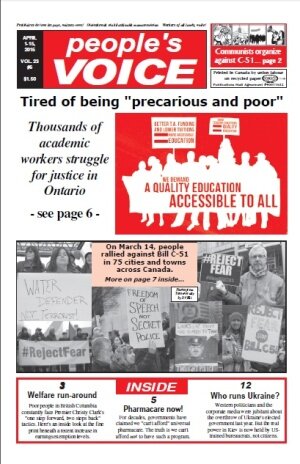
April 1-15, 2015
Volume 23 – Number 6 $1
Prolétaires de tous les pays, unissez-vous!
Otatoskewak ota kitaskinahk mamawestotan!
Workers of all lands, unite
Kimball Cariou on Bill C-51:
collective punishment
People’s Voice April 1-15, 2015
Concise Version
1) COMMUNISTS STEP UP CAMPAIGN AGAINST C-51
2) “PRECARIOUS AND POOR” ON STRIKE AT U OF T AND YORK U
3) QUEBEC JOINT DECLARATION AGAINST C-51
4) NO TO EXPANDED IRAQ WAR - Editorial
5) CSN DEFENDS CIVIL LIBERTIES - Editorial
6) UNIVERSAL PHARMACARE COULD SAVE BILLIONS
7) THE TIME TO BUILD A UNITED AND MILITANT STUDENT MOVEMENT IS NOW!
8) QUEBEC STUDENTS STRIKE AGAIN
9) ST. CATHARINES "JE SUIS MOI" PANEL ON ISLAMOPHOBIA
10) “VENEZUELA IS NOT A THREAT”
11) CLIMATE CHANGE DISASTER NEEDS SOCIALIST RESPONSE
12) BC’S INCOME REPORT HAMSTER WHEEL
13) IMPERIALISM’S TRUSTED GOVERNESS
14) MUSIC NOTES, by Wally Brooker
PEOPLE'S VOICE APRIL 1-15, 2015 (pdf)
|
To order a copy send $15 (includes package and handling) to People’s Voice, 706 Clark Drive, Vancouver, BC, V5L 3J1. Contact us at 604-255-2041 or pvoice@telus.net for bulk order prices. |

|
People's Voice deadlines: April 16-30 May 1-15 Send submissions to PV Editorial Office,
|
REDS ON THE WEB
http://www.parti-communiste.ca/
peoplesvoice.ca
www.ycl-ljc.ca
www.solidnet.org
|
People's Voice finds many "Global Class Struggle" reports at the "Labour Start" website, http://www.labourstart.org/. We urge our readers to check it out! |
* * * * *
People's Voice
Canadian Publications Mail Sales Product Agreement #205214
ISSN number 1198-8657
People's Voice is published by
New Labour Press Ltd
PV Editorial Office
706 Clark Drive,
VANCOUVER, B.C. V5L 3J1
Phone:604-255-2041
Fax:604-254-9803
email: pvoice@telus.net
Editor: Kimball Cariou : Business Manager: David Au
Editorial Board: Kimball Cariou, Miguel Figueroa,
Doug Meggison, Naomi Rankin, Liz Rowley, Jim Sacouman
* * * * * *
Letters
People's Voice welcomes your letters
on any subject covered in our pages.
We reserve the right to edit for length and clarity,
and to refuse to print letters which may be libellous
or which contain unnecessary personal attacks.
Send your views to:
"Letters to the Editor",
706 Clark Dr., Vancouver, BC V5L 3J1,
or pvoice@telus.net
People's Voice articles may be reprinted without permission,
provided the source is credited.
* * * * * *
The Communist Party of Canada, formed in 1921,
has a proud history of fighting for jobs, equality, peace,
Canadian independence, and socialism.
The CPC does much more than run candidates in elections.
We think the fight against big business and its parties
is a year-round job,
so our members are active across the country,
to build our party and to help strengthen people's movements
on a wide range of issues.
All our policies and leadership
are set democratically by our members.
To find out more about Canada's party of Socialism,
give us a call at the nearest CPC office.
* * * * * *
Central Committee CPC
290A Danforth Ave Toronto, Ont. M4K 1N6
Ph: (416) 469-2446
fax: (416) 469-4063 E-mailmailto:info@cpc-pcp.ca
Parti Communiste du Quebec (section du
Parti communiste du Canada)
5359 Ave du Parc, Montréal, Québec,
H2V 4G9
B.C.Committee CPC
706 Clark Drive, Vancouver, V5L 3J1
Tel: (604) 254-9836
Fax: (604) 254-9803
Edmonton CPC
Box 68112, 70 Bonnie Doon P.O.
Edmonton, AB, T6C 4N6
Tel: (780) 465-7893
Fax: (780)463-0209
Calgary CPC
Unit #1 - 19 Radcliffe Close SE
Calgary AB, T2A 6B2
Tel: (403) 248-6489
Ottawa CPC
Tel: (613) 232-7108
Manitoba Committee
387 Selkirk Ave., Winnipeg, R2W 2M3
Tel/fax: (204) 586-7824
Ontario Ctee. CPC
290A Danforth Ave., Toronto, M4K 1N6
Tel: (416) 469-2446
Hamilton Ctee. CPC
265 Melvin Ave., Apt. 815
Hamilton, ON.
Tel: (905) 548-9586
Atlantic Region CPC
Box 70 Grand Pré, NS, B0P 1M0
Tel/fax: (902) 542-7981
* * * * * *
News for People, Not for Profits!
Every issue of People's Voice
gives you the latest
on the fightback from coast to coast.
Whether it's the struggle for jobs or peace, resistance to social cuts,
solidarity with Cuba, or workers' struggles around the world,
we've got the news the corporate media won't print.
And we do more than that
- we report and analyze events
from a revolutionary perspective,
helping to build the movements for justice and equality,
and eventually for a socialist Canada.
Read the paper that fights for working people
- on every page, in every issue!
People's Voice
$30 for 1 year
$50 for 2 years
Low-income special rate: $15 for 1-year
Outside Canada $50 for 1 year
Send to: People's Voice, 706 Clark Drive, Vancouver, BC, V5L 3J1
You can call the editorial office at 604-255-2041
<pvoice@telus.net>
REDS ON THE WEB
www.communist-party.ca
peoplesvoice.ca
www.ycl-ljc.ca/
http://solidnet.org/
http://www,rebelyouth-magazine.blogspot.com
(The following articles are from the April 1-15, 2015 issue of People's Voice, Canada's leading socialist newspaper. Articles can be reprinted free if the source is credited. Subscription rates in Canada: $30/year, or $15 low income rate; for U.S. readers - $45 US per year; other overseas readers - $45 US or $50 CDN per year. Send to People's Voice, c/o PV Business Manager, 706 Clark Drive, Vancouver, BC, V5L 3J1.)
1) COMMUNISTS STEP UP CAMPAIGN AGAINST C-51
PV Ontario Bureau
The Communist Party of Canada’s campaign against Bill C-51 is stepping up across the country. “During the day of action against this police-state style legislation, our party mobilized in almost thirty cities and towns,” Johan Boyden CPC Central Organizer told People’s Voice. The CPC is distributing thousands of leaflets against the Bill in these communities and organizing a series of actions and events, he said. In Nova Scotia, public meetings took place in Halifax and in rural Pictou county. A major storm prevented speaker Drew Garvie from making the Halifax event, but Jim Sacouman spoke about his experience with no fly lists because of solidarity work with Columbia. Sacouman, a retired professor at Acadia University, also spoke the week before at the Halifax anti-C 51 rally.
The next day Garvie’s plane got through, and he spoke at a meeting in Westville, joined by a local representative from Amnesty International. Many in the audience were learning about both the Bill and the CPC for the first time. The meeting, organized by postal worker and activist Mark Hamilton, resolved to hold a picket outside Conservative Justice Minister Peter MacKay's office.
“Because of the overly broad definition of terrorism, which might even include a strike, the legislation could target environmentalists, aboriginal protesters, the Muslim community – even the labour movement,” Garvie was quoted as saying in the New Glasgow News.
In Quebec, where the Parti communiste du Quebec was one of the first national organizations to oppose the Bill, the PCQ has organized a special movie and discussion about C-51, featuring retired immigration lawyer and long-time CPC candidate Bill Sloan. The PCQ has also made over $250 in “stop C-51” button sales at rallies, and published a new issue of its newspaper Clarté that exposes the anti-people content of the legislation.
PCQ leader Pierre Fontaine spoke at the March 14 anti-C-51 rally after NDP leader Thomas Mulcair, who had compared Harper’s bill to the Padlock law. Fontaine noted the actual name of the legislation, "La Loi protégeant la province contre la propagande communiste," or the law to protect the Province of Quebec from Communist Propaganda. He described how the PCQ and CPC had long fought to overcome political repression including successfully defeating this legislation.
The infamous law took its nickname from the ability it granted police to padlock the offices of the party, its press, and another other group accused of advocating vaguely-defined leftist and pro-labour ideals. Brought in during the 1930s, it took until the 1950s for the CPC to finally overturn the legislation at the Supreme Court.
In Ontario, party leader Elizabeth Rowley spoke at a rally in Brampton, which the local CPC club helped organize. “The attack on Parliament Hill and on soldiers in Montreal were not terrorist acts, but isolated incidents being called terrorist acts,” Rowley the local Brampton Guardian newspaper.
“Most Canadians aren’t even aware of what is in the bill,” Rowley said. “The Conservatives really want to declare war on civil liberties in this country. They want to declare war on you.”
Rowley has also appeared on panel discussions in Ottawa and at the University of Guelph. In Ottawa she was joined by a representative of the Canadian Peace Alliance.
The connection between the attack on democratic rights and the struggle for peace will be highlighted as part of a mid-April speaking tour organized by the British Columbia Provincial Committee of the CPC. The tour will visit Nanaimo, Victoria, Vancouver, Surrey, Kelowna, and Kamloops, featuring Johan Boyden as well as, in several locations, BC organizer Hassan Azimikor. By this time, the Bill may be under discussion in the Senate.
Miguel Figueroa, the CPC leader, has already been to Winnipeg, where he spoke at a large rally, and then Edmonton. “Capitalism is in a deepening crisis,” Figueroa told the Winnipeg rally, noting both the systemic crisis of capitalism and the most recent downturn starting in 2007-2008.
“What happened when austerity was imposed, in a very sharp way?” Figueroa asked. “People started to fight back, and that’s why they are bringing in this agenda, to repress the right of descent, to intimidate the working people, and make us cower and retreat. The struggle against C-51 and the struggle to defend and extend social rights, individual rights and liberties is in a very fundamental way connected to the struggle to move our country in a fundamentally different direction, to put people before profits, and to build the kind of Canada the people need, deserve and in fact have every right to win,” he said to loud cheers from the crowd.
2) “PRECARIOUS AND POOR” ON STRIKE AT U OF T AND YORK U
By Sam Hammond
At the end of February and beginning the first week of March, approximately 10,000 academic workers went on strike at two of Canada’s largest universities. They are represented by two CUPE Locals, 3902 and 3903, who represent Units of Teaching Assistants, Graduate Assistants and Contract Faculty at the University of Toronto and York University respectively. Nine thousand are still on strike. The issues and responses at both universities, York with about 4000 strikers and U of T with about 6000, are so close that they can be detailed in the same general overview. A good place to start is with the words of Erin Black, Union Chair at U of T, “We are poor and precarious and need improvement in our standard of living”. This is by no means an overstatement but what analyses will show is probably an understatement of the precarious existence of Teaching Assistants (TAs), Graduate Assistants (GAs) and Contract Faculty (CFs) at most universities.
The population that stretches from Oshawa to St. Catharines and includes the Greater Toronto Area and Hamilton contains the heaviest concentration of precarious workers in Canada. 40% of these, including immigrant workers, have some kind of university or college degree. Educated, precarious and poor. When we think of precarious workers, we might think of fast food or service jobs, but that is incorrect. They are post-graduate TAs, contract white collar workers, self-employed tradespeople, and the highest percentage are in private sector manufacturing. They are 40% of the work force.
Under the general stress of underfunding, universities have moved to a narrow customer-service business model that has transformed academia into a corporate mentality of more user fees for less service, many-tiered remuneration categories, contract work, competition for your own job renewal and an ever increasing work load.
Ontario has the lowest per student funding in Canada, now at 2001 levels. Inflation adjustment means that it has actually declined after rising slightly in 2006. The Ontario government's own studies have advised universities that the only way to deal with the increased enrollment/declining funding crisis is to cut labour costs in collective bargaining. This is a strike of desperation staged by the victims of declining corporate taxes and the offloading of the burden onto the working people.
In an open letter to his colleagues in the English Department at U of T, Prof. Paul Downs states, “This strike is a symptom of all the things many of us are most concerned about: the shrinking public investment in education; the corporatization of the university; the marginalization of the humanities; the rise of one or another form of precarious employment; the widespread hostility towards organized labour; and the ongoing disaster of our inability to promise PhD students in the humanities a decent chance of securing a tenure-track job after they have helped us to teach our undergraduate classes, fill our graduate classes, enhance our reputation and professional status as research professors and sustain a vibrant departmental culture. This strike may not be the strike we wanted, it may be something of a blunt instrument, but it is the strike we have helped to produce and we have offered our students no alternative….”.
The Contract Faculty at both York and U of T have settled at this writing, with some gains in the amount of tenured positions available and in the benefit package. They remain steadfast in their statements of solidarity with the TAs who, in both universities, have turned down the latest offers and continue their strikes. The students at York have circulated and signed a solidarity petition with over 5000 names, and 300 Faculty members have signed a letter to the University Senate demanding a just settlement and criticizing attempts to resume classes. There are parallel solidarity actions at U of T where over 1000 students staged a solidarity walkout, and the Students Union, representing 50,000 students, is solid in its support. The support grows daily with over 70 Faculty Groups, Gender Studies, Academic Departments and labour unions publishing open letters of solidarity.
The Universities are 60% publicly funded, and the largest criteria for these shrinking funds is enrolment. The TA’s, because they are graduate students as well as academic workers, swell the ranks of enrolment and thus become money-makers for the Universities. They generate income not only as enrolled post-graduates, but because they provide the cheap labour for the university to provide expanded curricula and programs. The fact that 9000 are still on strike after the CF settlement shows the scope of this phenomenon. Both York and U of T have made public statements that TAs are treated generously. This is similar to all the teacher-bashing that has become so popular. TAs in some faculties might receive $17,000 plus a tuition waver (total package $25,000), while in other faculties they might receive $15,000 with no tuition waver (total wage $7000). When tuitions rise their disposable income drops.
“Precarious and poor”.
The TA and CF negotiated hours of work are fiction, as is the administration propaganda about generous hourly rates. What is the sense of claiming TAs earn $35 an hour when there is a cap of $15,000 and an open-ended workload? Like most teaching professionals, they do what is necessary to maintain and service the needs of their students. To maintain passing levels in their own post-graduate courses and perform required research requires a full time presence at the campus that usually stretches into the evenings.
“Precarious and poor” living in the Toronto area requires family assistance and large debt accumulation. Years ago, although false even at that time, society and academia claimed this was an entrance ritual that led to tenure and job security. That myth has evaporated. Tenure is shrinking to a handful of positions every year, and regular work has been eroded into contract precarity. The carrot is gone and only the stick remains. These strikes are the tip of the iceberg and probably will be repeated elsewhere. The TAs and GAs at York and U of T may be deciding the direction of negotiations for the whole of CUPE on campuses across Ontario.
A tentative offer on March 18 from the University of Toronto was recommended by the CUPE 3902 negotiating committee. Over the March 21-22 weekend, 1101 union members voted to reject the tentative agreement, and 992 voted to ratify. "Our members have clearly indicated that continued strike action is necessary to achieve the gains that are necessary for long-term financial security as student workers," CUPE 3902 spokesman Craig Smith said in a statement.
At PV deadline, there was no breaking news from the York University strike. Our next issue will include further information and analyses of both strikes.
3) QUEBEC JOINT DECLARATION AGAINST C-51
A coalition of over 100 Quebec organizations has voiced strong opposition to the Harper government’s “anti-terrorist” legislation. At a March 19 press conference, representatives of nearly every major labour, environmental and civil rights group in Quebec condemned Bill C-51, and urged members of the Quebec National Assembly to oppose the legislation. They also presented the following “Joint Declaration on anti-terrorism Bill C-51”.
We will not surrender to the fear campaign of the Canadian Govern-ment. We will not give up civil liberties in favour of strengthening security measures. We refuse to be manipulated in the name of security. We reject the project of the “anti-terrorist Bill C-51.”
The Government is not able to explain why these new measures are necessary to ensure our safety, considering the legal arsenal currently available. Already in 2001, Bill C-36 undermined our judicial and legal system by removing, in certain circum-stances, the guarantees recog-nized by the Canadian Charter of Rights and Freedoms. C-51 goes much further.
The Arab and Muslim commun-ities have been particularly targeted in recent years, as evidenced by the cases of Maher Arar, Abdullah Almalki, Muayyed Nureddin and Ahmad Abou-Elmaati. C-51 also proposes to include protest move-ments, environmental groups, Indigenous peoples, anti-capit-alists, citizens fighting against climate change, etc. Moreover, some groups have already been identified in the federal government’s policy to combat terrorism. Several articles of the draft law will define activities which affect the functioning of critical infrastructure (such as pipeline projects) or which interfere with the ability of the Government to maintain economic stability, as affecting the security of Canada, paving the way for implementation of repressive measures.
Also, since C-51 provides that only lawful protests will be not judged to contravene certain of its provisions, activities such as a demonstration prohibited under a municipal bylaw such as P-6, a simple “sit-in”, peaceful citizens actions, or a strike that is not within the parameters of the Labour Code, would contravene these pro-visions.
The Bill proposes the establishment of a comprehensive system of collection and exchange of information within the Government. These proposed measures are contrary to the current rules on protection of personal information. And all this, without adequate monitoring mechanisms of intelligence activities, or for appeal by people who are the object.
C-51 proposes the creation of a new offence, “advocating or promoting the commission of terrorism offences in general”, and allows for the seizure and destruction of terrorist propaganda material whose definitions are also very broad and ambiguous. The vague nature of the provisions may well undermine the freedom of expression by the effect of self-censorship.
Bill C-51 disproportionately expands the circumstances to allow preventive detention, weakens the degree of evidence necessary, lengthens the possible duration of this detention from 72 hours to 7 days, and hardens the conditions for release, all without a criminal charge. To justify such detention, it will suffice that a peace officer has reasonable grounds to believe the possibility that an activity regarded as ‘terrorist’ may be undertaken.
Bill C-51 brings major changes to the mandate of CSIS, which had been limited to information gathering. It may now take steps to “reduce” a threat to the security of Canada, a definition so broad that it may include activities carried out by various social protest movements. CSIS may, subject to obtain a judicial warrant, act unlawfully and even take measures that will undermine the rights protected by the Charter of Rights and Freedoms. This power is totally unacceptable. The nature of the proposed in-camera judicial review procedure has nothing to do with allowing the courts to determine if there is any infringement of a right protected by the Charter.
C-51 in fact proposes the implementation of a vast integrated system of information gathering, investigation, preventive arrests, and interventions that may be contrary to the Charter, without any control and monitoring mechanism or means to exercise real surveillance on all these activities. In this context, we fear the creation of a political police and an increase in political profiling practices.
To combat and prevent terrorism, rather than adopting draconian measures, Governments must tackle the injustices built into system, be they political, economic, social or cultural, here and elsewhere in the world. Instead, this Bill risks labelling as terrorist individuals and organizations working to defend the common good.
While the federal Government must remove C-51, Quebec cannot remain silent about this Bill which could deprive individuals of the protection of the Canadian Charter of Rights and Freedoms. We therefore ask members of the House of Commons to defeat C-51, and those of the National Assembly to oppose this Bill.
(To read the huge list of endorsing groups, search online for “Déclaration commune contre C-51”.) n
People’s Voice Editorial
Just as anti-war activists and progressive media like People’s Voice predicted last fall, Canada’s participation in the latest imperialist war in Iraq quickly went from a bombing and training role to direct combat operations. Now, the PM is poised to extend the “six month” mission, and expand into neighbouring Syria. Only the most naïve observer could doubt that Canada is on the way to another disastrous Afghanistan-style war of occupation, costing billions of dollars and thousands of Iraqi and Syrian lives.
Predictably, the Tories claim that this war is necessary to “protect the women and children”. Sadly, this feeble lie may prevent the NDP and Liberals from putting up more than token opposition, despite overwhelming evidence that the “responsibility to Protect” doctrine has been a disaster. The long list of R2P victims include the thousands killed in NATO’s bombing of Yugoslavia in 1999, countless Afghan civilians, the million or more Iraqis dead in the wake of the 2003 US-UK invasion, the people of Libya which has been torn to pieces with the eager help of Western imperialism, and many others.
Plunging Canada into these modern day crusades only creates a more dangerous world. The biggest terrorists are not the reactionary movements which wrap themselves in fundamentalist dogmas, but the U.S., British, Canadian and other governments which brazenly encourage and finance the Taliban, Al Qaeda, ISIS and other such groups when it suits the geo-political interests of western imperialism, only to whip up fear and hatred against the same forces when this becomes politically advantageous. This cynical game brings enormous profits to the military-industrial corporations, but only death and destruction to working people. It’s time to discard the R2P scam, and demand Canada’s immediate and complete withdrawal from NATO and US-led military interventions, starting with the expanded war in Iraq and Syria.
5) CSN DEFENDS CIVIL LIBERTIES
People’s Voice Editorial
The labour movement is speaking out against Bill C-51, and with good reason. Opposition ranges from the Canadian Labour Congress to national union bodies such as CUPE, to local labour councils. One of the most powerful statements came from Quebec’s Confédération des syndicats nationaux (CSN, or Confederation of National Trade Unions), which has a proud history of resistance against right-wing governments and bosses.
“The labour movement is fully opposed to this legislation,” Jean Lortie, Secretary General of the CSN, recently told People’s Voice. Lortie said the CSN was immediately troubled by Bill and its apparent targeting of the Muslim community, and “then we realized how the context and language of the bill” could impact labour.
Citing examples of workers in the railways, ports, and airlines, or construction workers on a pipeline project, Lortie said it was entirely conceivable that a workplace action or strike might be classified as disrupting national infrastructure and therefore terrorism. He pointed to injunctions reducing the days of strikes, legislating labour back to work, and restoring “constitutional order”, and referenced the historic experience of the Common Front in Quebec where, during major strike actions and social turmoil in the 1970s, three major labour leaders were jailed to “stabilize society.”
“This is not about domestic issues and anti-terrorism, it is about pleasing [the Conservatives] electoral base and shutting up critical voices – starting with the First Nations and pipeline protestors,” Lortie said. “We’re going into the ditch with this law which violates human rights including free speech, association and the right to strike – and the Supreme Court just reminded us that striking is a fundamental right.”
This crucial fight will not end with Bill C-51. The labour movement has the numbers and organization to help build a powerful coalition which can take this struggle into the next federal election and beyond.
6) UNIVERSAL PHARMACARE COULD SAVE BILLIONS
By Kimball Cariou
Even before the time of Karl Marx and Friedrich Engels, labour radicals, Communists and other social activists have always been accused of proposing completely impractical, utopian schemes.
In Britain, the “Factory Act of 1847" to shorten the working day in textile mills to 10 hours for women and youth was furiously denounced by employers and right-wing economists. One absurd argument was that since the entire profit “earned” by capitalists was produced during the final hour of the day, this reform would bring down the whole economic system. Since that era, the working class struggle to shorten the working day and reduce the intensity of exploitation has often made gains, without destroying capitalism. More recently, the historic progress towards a shorter work day (and week) has been pushed back by the neoliberal economic offensive.
The point is that “wild-eyed” social reforms often turn out to be far more practical than the ruling class would have us believe. A partial list in Canada would include old age pensions, unemployment insurance, universal medicare, the right to organize trade unions, etc. Most such ideas were branded as dangerous threats, or at the very least, completely unaffordable. The fact that these reforms were initially raised by Communists made them even more unacceptable. Yet all of these reforms were eventually adopted in response to massive working class struggles. It’s also true that the ruling class grudgingly accepted such measures in part to “prove” that revolution was unnecessary in Canada, where many working people were favourably impressed by the gains of their sisters and brothers in the USSR and other socialist countries.
For decades, the Communist Party of Canada has advocated another such reform: the expansion of Medicare to include universal pharmacare, and dental and optical care. Predictably, right-wing economists and politicians have always called this demand a pipe dream.
But now, a study in the prestigious Canadian Medical Association Journal says that a universal prescription drug plan could reduce total spending on medications by billions, providing full coverage at an affordable price for taxpayers.
Few Canadians realize that ours is the only developed country with universal health insurance coverage which does not also offer some form of universal pharmacare. That particularly hurts the ten percent of Canadians who cannot afford to take their medications as prescribed.
The study in the March 16 CMA Journal says the extra total cost to government of providing universal pharmacare could range from about $1 billion, to as high as $5.4 billion a year, depending on how much was saved through bulk purchases of medications and other measures. Such a program would save the private sector the $8.2 billion annually it spends on prescription drugs, mainly through employee health plans.
"When we did the analysis, we were, at first, a little bit surprised," said study author Steven Morgan, a professor of health policy at the University of British Columbia. "Wow. Canada can really save billions of dollars by covering everybody for virtually every drug? And then we started to look deeper at the math, and it made perfect sense. You save about 10 per cent by getting better generic prices, you save about 10 per cent [on] brand name prices and you save an additional 10 per cent by encouraging more cost-effective prescribing. Mine those three things together, you save 30 per cent of a very large budget. Therefore you're saving billions of dollars."
Morgan’s numbers are based on conservative estimates. He and the other authors say that if Canada adopted policies comparable to countries like Switzerland, Italy and Spain, and achieved the rates of generic drug use seen in some provincial drug plans, a universal public drug plan would reduce total spending on prescription drugs in Canada by $7.3 billion per year.
They point out that U.S. studies suggest that providing free prescription increases the chance that patients will take the medicines they need. In the long run, this improves their health and reduces demands on the health-care system.
Morgan’s conclusion: "Pharmacare is not unaffordable for taxpayers. Quite the opposite. It is unsustainable for taxpayers not to have a universal pharmacare system."
That’s not something the Harper Conservatives, or event the federal opposition parties, really want to hear. For all the government’s talk about defending taxpayers, they are far more committed to protecting the big pharmaceutical companies, which have a monopoly on one of the most profitable sectors of the entire capitalist system.
Interviewed by the CBC, Health Minister Rona Ambrose refused to say whether she would favour a pharmacare program. Instead, Ambrose wanted to talk about a bulk purchasing system for provinces to cut costs.
That sounds like a very tiny reform, mainly aimed to allow the Tories to take credit for spending cuts, while they keep slashing Medicare and the rest of Canada’s social safety net. But as the population ages, the need for universal pharmacare will become more acute. In the federal election later this year, the Communist Party will put this demand high on its list of platform points. Expanded public health care is not a utopian dream - it’s an urgent priority for working people, and a demand which also makes complete economic sense.
7) THE TIME TO BUILD A UNITED AND MILITANT STUDENT MOVEMENT IS NOW!
Even before the time of Karl Marx and Friedrich Engels, labour radicals, Communists and other social activists have always been accused of proposing completely impractical, utopian schemes.
In Britain, the “Factory Act of 1847" to shorten the working day in textile mills to 10 hours for women and youth was furiously denounced by employers and right-wing economists. One absurd argument was that since the entire profit “earned” by capitalists was produced during the final hour of the day, this reform would bring down the whole economic system. Since that era, the working class struggle to shorten the working day and reduce the intensity of exploitation has often made gains, without destroying capitalism. More recently, the historic progress towards a shorter work day (and week) has been pushed back by the neoliberal economic offensive.
The point is that “wild-eyed” social reforms often turn out to be far more practical than the ruling class would have us believe. A partial list in Canada would include old age pensions, unemployment insurance, universal medicare, the right to organize trade unions, etc. Most such ideas were branded as dangerous threats, or at the very least, completely unaffordable. The fact that these reforms were initially raised by Communists made them even more unacceptable. Yet all of these reforms were eventually adopted in response to massive working class struggles. It’s also true that the ruling class grudgingly accepted such measures in part to “prove” that revolution was unnecessary in Canada, where many working people were favourably impressed by the gains of their sisters and brothers in the USSR and other socialist countries.
For decades, the Communist Party of Canada has advocated another such reform: the expansion of Medicare to include universal pharmacare, and dental and optical care. Predictably, right-wing economists and politicians have always called this demand a pipe dream.
But now, a study in the prestigious Canadian Medical Association Journal says that a universal prescription drug plan could reduce total spending on medications by billions, providing full coverage at an affordable price for taxpayers.
Few Canadians realize that ours is the only developed country with universal health insurance coverage which does not also offer some form of universal pharmacare. That particularly hurts the ten percent of Canadians who cannot afford to take their medications as prescribed.
The study in the March 16 CMA Journal says the extra total cost to government of providing universal pharmacare could range from about $1 billion, to as high as $5.4 billion a year, depending on how much was saved through bulk purchases of medications and other measures. Such a program would save the private sector the $8.2 billion annually it spends on prescription drugs, mainly through employee health plans.
"When we did the analysis, we were, at first, a little bit surprised," said study author Steven Morgan, a professor of health policy at the University of British Columbia. "Wow. Canada can really save billions of dollars by covering everybody for virtually every drug? And then we started to look deeper at the math, and it made perfect sense. You save about 10 per cent by getting better generic prices, you save about 10 per cent [on] brand name prices and you save an additional 10 per cent by encouraging more cost-effective prescribing. Mine those three things together, you save 30 per cent of a very large budget. Therefore you're saving billions of dollars."
Morgan’s numbers are based on conservative estimates. He and the other authors say that if Canada adopted policies comparable to countries like Switzerland, Italy and Spain, and achieved the rates of generic drug use seen in some provincial drug plans, a universal public drug plan would reduce total spending on prescription drugs in Canada by $7.3 billion per year.
They point out that U.S. studies suggest that providing free prescription increases the chance that patients will take the medicines they need. In the long run, this improves their health and reduces demands on the health-care system.
Morgan’s conclusion: "Pharmacare is not unaffordable for taxpayers. Quite the opposite. It is unsustainable for taxpayers not to have a universal pharmacare system."
That’s not something the Harper Conservatives, or event the federal opposition parties, really want to hear. For all the government’s talk about defending taxpayers, they are far more committed to protecting the big pharmaceutical companies, which have a monopoly on one of the most profitable sectors of the entire capitalist system.
Interviewed by the CBC, Health Minister Rona Ambrose refused to say whether she would favour a pharmacare program. Instead, Ambrose wanted to talk about a bulk purchasing system for provinces to cut costs.
That sounds like a very tiny reform, mainly aimed to allow the Tories to take credit for spending cuts, while they keep slashing Medicare and the rest of Canada’s social safety net. But as the population ages, the need for universal pharmacare will become more acute. In the federal election later this year, the Communist Party will put this demand high on its list of platform points. Expanded public health care is not a utopian dream - it’s an urgent priority for working people, and a demand which also makes complete economic sense.
8) QUEBEC STUDENTS STRIKE AGAIN
Quebec students are in action again. In late March, 30,000 students voted to go on strike for access to education, as well as against anti-austerity measures, climate change and gender inequality. The strike will last for one or two weeks, but may be extended. It is spread across 25 student associations on six CEGEP and University campuses.
Despite freezing rain and snow, a rally of several thousand was held on March 21 in Montreal. In violation of bylaw P6, organizers refused to release their route. Continuous actions are taking place across the province during the strike week. The students have the support of the Quebec labour movement through the Front Commun and other anti-austerity coalitions. They are building mass protests for April 2 and May 1.
“The mobilization of students in Quebec serves as an inspiration for students across Canada to fight back against austerity,” says Mohamed, an organizer with the Young Communist League from Toronto who attended the rally. He told People’s Voice, “the students have a common agenda and common struggle.”
Quebec solidaire MNA Françoise David, whose party is also supporting the broad movement, said that "More measures will affect large segments of the population, they will rebel. At some point, people will say ‘no it's not possible, we want a state that takes care of the people.
9) ST. CATHARINES "JE SUIS MOI" PANEL ON ISLAMOPHOBIA
By Asad Ali
After several Muslim university and high school students experienced Islamophobia in the classroom and in public places, including a teacher instructing that terrorism is based on Islam, they organized a public forum titled "Je Suis Moi". The forum was through the auspices of the Islamic Society of St. Catharines as well as the Qamar Foundation, a youth-oriented charity.
In addition to youth panellists detailing their local experiences, the event included spoken word performances. A "community leaders" panel included a historian, a social scientist studying media monopolization, a speaker from the Canadian Peace Congress, as well as the imam (prayer leader) of the local mosque and a specialist in inter-faith dialogue.
Historian Dr. Samah Marie gave examples from Islamic history of co-existence and religious diversity which contradict Islamophobic myths being inflamed by media coverage of the "Islamic State". Communications specialist Dr. Scott Henderson talked about the danger of monopolistic concentration of media in Canada which makes it difficult to challenge racism. Saleh Waziruddin of the Niagara Coalition for Peace and an executive member of the Canadian Peace Congress explained that the biggest misconception was that radicalization comes from religion, as those who have been arrested said they were radicalized by the wars. FBI and European data shows Muslims are responsible for only 6% of terrorist attacks in the US and 2% in Europe over the last 10 years. In response to an audience question he explained that "Jihadist" is an Islamophobic term because it uses a pillar of the faith, Jihad which means struggle, as a derogatory term.
Audience members asked about how to stop people from going to Canada to the "Islamic State", and answers ranged from pointing out the greater number of Canadian troops being sent by the government, as well as the need to address racism and the wars as causes of radicalization. The context of the impending danger from Bill C-51, driven by Islamophobia and racist coverage in the mainstream media, was spelled out at the forum, as well as the need to counter it through panel discussions such as "Je Suis Moi" as well as demonstrations and letters to the editor.
10) “VENEZUELA IS NOT A THREAT”
Letter to the people of the United States, by Nicolas Maduro and the Government of the Bolivarian Republic of Venezuela, March 17, 2015
We are the people of Simon Bolívar, our people believe in peace and respect for all nations.
More than two centuries ago, our fathers founded a Republic on the basis that all persons are free and equal under the law. Our nation made the greatest sacrifices to guarantee South American people their right to choose their rulers and to enforce their own laws today. The historical legacy of our father, Simón Bolívar, is always remembered. Bolívar was a man who gave his life so we would inherit a nation of justice and equality.
We believe in peace, national sovereignty and international law.
We are a peaceful people. In two centuries of independence, we have never attacked another nation. Our people live in a region of peace, free of weapons of mass destruction, and in freedom to practice all religions. We uphold respect for international law and the sovereignty of all people of the world.
We are an open society. We are a working people, we care for our families, and we have freedom of religion. Immigrants from around the world live among us, whose diversity is respected. We have freedom of press and we are enthusiastic users of social media.
We are friends of the American people: the histories of our people have been connected since the beginning of our struggles for freedom. Francisco de Miranda, a Venezuelan hero, fought with the American people during their independence fight. We share the idea that freedom and independence are fundamental elements for the development of our nations.
The relations between our peoples have always been peaceful and respectful. Historically, we have shared business relations in strategic areas. Venezuela has always been a responsible and trustful energy provider for the American people. Since 2005, Venezuela has provided “heating oil” through subsidies for low-income communities in the United States, thanks to our company CITGO. This contribution has helped tens of thousands of American citizens survive in harsh conditions, giving them relief, and necessary support in times of need, evidencing how solidarity can create powerful alliances across borders.
Incredibly, the U.S. government has declared our country a threat to its national security and foreign policy.
In a disproportionate action, the government of Obama has issued a “National Emergency” declaring Venezuela as a threat to its national security (Executive Order, 03-09-2015). This unilateral and aggressive measure taken by the United States Government against our country is not only unfounded and in violation of basic principles of sovereignty and self-determination under international law, but also has been unanimously rejected by all 33 nations of the Community of Latin American and Caribbean States (CELAC) and the twelve member states of the Union of South American Nations (UNASUR). In a statement made on March 14, 2015, UNASUR reiterated its firm rejection of these coercive measures that do not contribute to the peace, stability and democracy in our region and called on President Obama to revoke his Executive Order against Venezuela.
We reject unilateralism and interventionism.
President Obama, without any authority to interfere in our internal affairs, unilaterally issued a set of sanctions against Venezuelan officials with potentially far-reaching implications, interfering in our constitutional order and our justice system.
We advocate for a multipolar world. We believe that our world must be based on the rules of international law, without interference in the internal affairs of other countries. We are convinced that the relationship of respect between all the nations is the only path for strengthening peace and coexistence, as well as for ensuring a more just world.
We honour our freedoms and uphold our rights.
Never before in the history of our nations has a president of the United States attempted to govern Venezuelans by decree. It is a tyrannical and imperial order and it pushes us back into the darkest days of the relationship between the United States and Latin America and the Caribbean.
In the name of our long-term friendship we alert our American brothers and sisters, lovers of justice and freedom, of the illegal aggression committed by your government on your behalf. We will not allow our friendship with the people of the United States to be affected by this senseless and groundless decision by President Obama.
We demand:
1) The U.S. Government immediately cease hostile actions against Venezuelan people and democracy.
2) President Obama abolish the Executive Order that declares Venezuela a threat to U.S. national security, as has been requested by the Union of South American Nations (UNASUR).
3) The U.S. Government retract its libellous and defamatory statements and actions against the honourable Venezuelan officials who have just obeyed our laws and our constitution.
Our sovereignty is sacred. The principles of the founding fathers of the United States of America are followed today with the same dignity by the people of Simón Bolívar. In the name of our mutual love for national independence we want the government of President Obama to think about and rectify this dangerous precedent.
We are convinced that the defense of our freedom is a right we shall never give up because the future of the humanity lies also in our country. As Simón Bolívar said: “The freedom of the New World is the hope of the universe”. “Venezuela is not a threat, but a hope.” “Independence or nothing.”
http://venezuelanalysis.com/analysis/11277
11) CLIMATE CHANGE DISASTER NEEDS SOCIALIST RESPONSE
By Rob Gowland, from The Guardian, weekly newspaper of the Communist Party of Australia
The respected British newspaper The Guardian has come out fighting on the subject of climate change. The paper’s editor-in-chief Alan Rusbridger in a statement says that “climate change stands out as perhaps the single most important issue now facing humanity” and notes that “climate change will probably, within the lifetime of our children, cause untold havoc and stress to our species.”
The paper has launched a series of major articles that it says will cover “what governments can do to attempt to regulate, or otherwise stave off, the now predictably terrifying consequences of global warming beyond 2C by the end of the century.” The paper comes down firmly on the side of the view that the majority of the planet’s unexploited fossil fuels – our remaining reserves of coal, gas and oil – must stay in the ground.
The Guardian also published an extended excerpt from Naomi Klein’s award-winning and best-selling work, This Changes Everything: “We know that if we continue on our current path of allowing emissions to rise year after year, climate change will change everything about our world. Major cities will very likely drown, ancient cultures will be swallowed by the seas, and there is a very high chance that our children will spend a great deal of their lives fleeing and recovering from vicious storms and extreme droughts. … There are ways of preventing this grim future, or at least making it a lot less dire. But the catch is that these also involve changing everything. For us high consumers, it involves changing how we live, how our economies function, even the stories we tell about our place on earth.
“What if,” she asks, “we realised that real disaster response means fighting inequality and building a just economy – that everyone working for a healthy food system is already a climate warrior? So too, are people fighting for public transit in Brazil; housing and immigrant rights in the United States; battling austerity in Europe; extraction in Australia; pollution in China and India; environmental crime in Africa; and the bad trade deals that lock in all these ills everywhere.”
As readers of our Guardian know, “fighting inequality and building a just economy” means doing away with capitalism and replacing it with Socialism, for there is no other way to achieve that aim. People who want to build a just economy while retaining capitalism (which is predicated on inequality and exploitation of the many by the few) are doomed to disappointment.
Klein also dismisses “the assertion that we have been held back [in combatting climate change] by a lack of technological solutions.” She points out that “Power from renewable sources like wind and water predates the use of fossil fuels and is becoming cheaper, more efficient, and easier to store every year. The past two decades have seen an explosion of ingenious zero-waste design, as well as green urban planning. Not only do we have the technical tools to get off fossil fuels, we also have no end of small pockets where these low carbon lifestyles have been tested with tremendous success.”
She wants to see the same kind of approach used to achieve “the kind of large-scale transition that would give us a collective chance of averting catastrophe” and is puzzled by the fact that apparently it continues “to elude us”.
She rejects the idea that it might be “human nature” holding us back. “In fact,” she says, “we humans have shown ourselves willing to collectively sacrifice in the face of threats many times”. We could point to the extraordinary sacrifices of the Soviet people in defeating fascism, but Klein uses examples drawn instead from the Anglo-US experience in the same conflict. “To support fuel conservation during World War 2, pleasure driving was virtually eliminated in the UK, and between 1938 and 1944, use of public transit went up by 87% in the US and by 95% in Canada. Twenty million US households – representing three-fifths of the population – were growing victory gardens in 1943, and their yields accounted for 42% of the fresh vegetables consumed that year.”
What is holding us back, of course, is the fact that capitalism makes its top priority not the well-being of humanity or even the planet, but the pursuit of profit.
12) BC’S INCOME REPORT HAMSTER WHEEL
People’s Voice recently received the following submission from a correspondent who wishes to remain anonymous. Anti-poverty advocates assure us that this article reflects the difficulties faced by thousands of social assistance and disability recipients across British Columbia.
Several times in recent months, the government of BC Premier Christy Clark has come out with “good news” about provincial social assistance policies. But there is always “bad news” buried in the fine print, which I try to follow since my own son is among those who depend on the system for survival.
One example was the welcome end to the province’s clawback of child support payments owed to parents (mainly women) who receive social assistance. After a long and well-publicized campaign by anti-poverty groups, this discriminatory clawback was finally removed in the 2015 BC Budget, allowing these families to finally receive their child support payments, totalling about $13 million per year. But the kicker was that the government decided to “pay” for this “generosity” by laying off the employees who administered the clawback. Their union and anti-poverty groups objected that the policy change was not really “costing” the province any revenue; this money rightfully belonged to the recipients in the first place. The laid-off workers could easily have helped to improve services for social assistance and disability recipients, but that would go against the government’s strategy of making it more difficult to access benefits.
That brings me to my son, a young man with life-long intellectual disabilities. After finishing high school (without a Dogwood certificate), he took college courses designed to help such students find employment. Then he was channelled into one of the myriad of non-profits linked to the Ministry responsible for social assistance (the name of the Ministry changes every time a new Minister is appointed). Two years later, this organization was able to help my son land a part-time job, working two or three hours a week at minimum wage for a major corporation in the movie industry.
Fortunately, by that time he was receiving monthly disability assistance of $906 per month. Unlike many in far more difficult circumstances, he lives at home with his parents, using his income to cover his share of the rent and groceries, buy his own clothes, etc. Like others in his PWD category, there was no strict requirement for income reporting, since he earned about $100 a month from his part-time job, far below the $400 level which would require submitting regular income reports.
Then came the “good news”. Late in 2014, the province announced that it was raising the PWD earned income exemption level to $9600 per year. This positive change allows those who can find a job to keep up to $800 of their extra earnings every month. This leaves most far below the poverty line, but any increase is a good thing.
However, with this change also came more stringent reporting requirements. Like the employable category of social assistance recipients, my son would have to report by the 5th of each month his previous month’s earnings. But this would be easy, since the province was implementing an online reporting system. A couple of clicks of the mouse and voila, report submitted and the next cheque automatically deposited, no longer delivered by Canada Post.
OK, off to the credit union to set up the automatic deposit. Check! Online to set up his BCeID account. Check! Well, not quite. There were a few glitches, and we were instructed to finish the procedure at a particular Ministry office downtown. A few days later we went to this office. Oops, wrong address. Go to a different office over on Robson Street, they say. After lining up for half an hour at the Robson Street office (cleverly hidden above De Dutch Pancake House), we were told to try at his original Ministry office, back near where we live.
There, they let us turn in one of the old-fashioned paper reports for the previous month. But the BCeID problem could only be handled at my son’s new Ministry office (the old office was being closed in the interests of “efficiency”). So, on a drizzly, cold “welfare Wednesday” morning, we lined up for 90 minutes in the heart of the downtown eastside, the lowest-income urban postal code in Canada, getting the inside scoop from some new friends about welfare bureaucracy problems.
At last we get in, and helpful Ministry workers turn over his cheque and complete the BCeID registration process. They tell us to submit future income reports online, quite simple really, just an electronic version of the old paper report.
Mission accomplished! Well, not really.
On February 4, we duly submit the electronic report for January, including income based on his credit union statement. Two weeks later, an ominous email arrives from the Ministry: the report is incomplete! Finish the report or the cheque will be delayed! Or cancelled!!!!
What the heck? Back at the Ministry office, they accept a physical copy of his January bank statement, and tell us in future to send an electronic version of this document or his pay stubs online. Great, we know the procedure! The cheque is deposited on time. Huge sigh of relief.
On March 4, we submit an electronic monthly report. But puzzlingly, there seems to be no place to attach his February bank statement. Sure enough, on March 16 we receive an ominous warning from the Ministry (see above, yada yada). Online again, there is now a procedure to attach a document proving monthly income, such as bank statement or pay stubs. One quick scan later, we click the button to send the bank statement (a 46 KB size PDF) to the Ministry. Seconds drag by, and then an error message: Cannot send! Too many documents! File size too large - cannot exceed 1 MB!
Back at the new Ministry office, they grudgingly admit that the new electronic reporting system does not yet accept attachments. OK, here’s his bank statement. “Oh, that. We don’t accept those. It has to be pay stubs.”
I point out that this is the first time anyone has told us we must provide the physical pay stubs. Nothing we can do, they say, it’s policy. But you could appeal it - here’s the number.
Here’s the thing: my son’s employer does not give him physical pay stubs. This giant transnational corporation has a highly sophisticated online personnel system where wage slaves can try to access such information, but mere mortals can rarely penetrate the secrets of this website. Luckily, his workplace is just a few blocks away. Even better, a very sympathetic manager spends half-an-hour patiently walking us through the system and printing out the necessary pay stubs.
Back to the Ministry with the pay stubs. Here I point out the next problem. The province wants a monthly report submitted by the 5th of the next month. But this employer uses a two-week pay system, not monthly. The pay stub covering the two-week period starting March 26 will not be available until April 8, three days after the next cut-off for reporting.
This information is met with silence and an uncomfortable stare at the ceiling. Clearly, many recipients have already pointed out this incongruence between the province’s rules and the reality of the corporate world. Finally, the Ministry worker confers with a superior. They explain that the dates on the pay stubs don’t matter, just the dates of the automatic bank deposit, etc. etc. All clear? Hmm, not really, but this has already taken three hours. We’ll leave the next round for another day.
Talking later to anti-poverty advocates, we hear that many people trapped on this hamster simply submit whatever documents they have available on the 5th, and hope the Ministry accepts their report. If not, they appeal, and repeat next month. Who knows how many millions of dollars are wasted in this bureaucratic tail-chasing? All I know is that it’s taking a lot of Ministry worker time to check up on my son. His earned income for February? $85.27.
But hey, they did raise his earnings exemption limit. Hooray for progress!
13) IMPERIALISM’S TRUSTED GOVERNESS
By Zoltan Zigedy, http://zzs-blg.blogspot.com/
Her face is on the cover of Bloomberg Businessweek (3/9-3/15/2015) next to a dramatic headline: Putin vs. the Accountant. Her name is Natalie Jaresko. And, if Bloomberg's Brett Forrest is to be believed, she and some of her colleagues may hold the fate of Western Ukraine in their hands. As the Minister of Finance, she must find a way to salvage an economy that is in free fall.
Forrest paints a flattering, sympathetic picture of a feisty expatriate determined to rescue Ukraine economically and from the clutches of the evil Putin. Jaresko is encountered visiting hospitalized Ukrainian troops wounded while attacking the resistance fighters in Eastern Ukraine or, as Forrest prefers: consoling “convalescing veterans of recent battles against Russian forces and their proxies in the Ukrainian East. 'When did you serve?' she asks, moving slowly from room to room.'How were you wounded?'”
Apart from recounting Jaresko's mimicking of the obsequious and opportunistic condescension of veterans displayed universally by Western politicians, Forrest offers a calculated adulation of the Minister that conjures many less laudatory questions and suspicions.
For someone who holds the fate of Ukraine in her hands, Jaresko appears to be somewhat of a carpetbagger. Her appointment to lead the Finance Ministry came before she was granted Ukrainian citizenship, a fact that would only be curious outside of a government where two other cabinet members were also not citizens when appointed: her counterpart in the Ministry of Economy and Trade, Lithuanian Aivaras Abromavicius, and Minister of Health, Georgian Alexander Kvitashvili. Jaresko, a US citizen, has two years to renounce her US citizenship. She and her other imported colleagues were appointed by Prime Minister Arseniy Yatsunyuk, the infamous “Yats” vetted by foul-mouthed US Assistant Secretary of State for European and Eurasian Affairs, Victoria Nuland.
Obviously the US and the EU had to scramble after they encouraged and supported the coup deposing the elected President in February of 2014. They had to reach outside Ukraine to find reliable clients to support the hastily elected candy baron, Petro Poroshenko. The story of the clumsy construction of the post-coup government from non-nationals, careerists, and unstable rightists would make for an entertaining episode of House of Cards if Western journalists had the spine to tell it.
So what has Jaresko done to deserve a phone call from Nuland? Er, Poroshenko?
Her credentials begin with a master's degree from the Kennedy School at Harvard, a training ground for those tasked with delivering the US ruling class message to friends and foes alike. Doors opened immediately at the State Department's Soviet Affairs division. She coordinated her work at the State Department with all of the big national and international trade and economic organizations. When Ukraine left the Soviet Union, Jaresko was perfectly suited to operate on the US State Department's behalf at the newly installed US Embassy. Her position - Chief of the Economic Section - was a trusted position of a type often calling for close collaboration with covert agencies.
She parlayed that experience into the creation of an “investment“ vehicle for Ukrainian businesses funded by USAID, again a position of great trust and associated in many countries with US influence peddling. Documentation of the modest seed capital from USAID - $150 million - can be found at http://johnhelmer.net/?p=12317. One would expect that a 30-year-old entrusted with this task surely had the confidence of highly placed officials in the US government.
Her 1995 venture was absorbed by a new investment management firm, Horizon Capital, which she founded in 2006. Journalist John Helmer documents the consistent losses of Horizon Capital in his detailed report on Dances with Bears (12-03-2014). Despite his discovering only two years of modest gains in a decade, both Bloomberg and Forbes laud the success of Horizon Capital.
Helmer also discovers the fallout from Jaresko's divorce from her spouse and business partner. Her former husband, Ihor Figlus, has accused her of saddling him with debt from “improper” loans. Their contentious relationship continues. Helmer comments: “It hasn’t been rare for American spouses to go into the asset management business in the former Soviet Union, and make profits underwritten by the US Government with information supplied from their US Government positions or contacts. It is exceptional for them to fall out over the loot.”
Jaresko's own account of her recruitment bears telling: “...representatives from a headhunting firm hired by the new government, WE partners, visited Jaresko at the Horizon Capital offices. They discussed candidates for various government posts before asking her if she would be willing to serve...” (Bloomberg Businessweek)
While some may find it odd that an independent, sovereign state would engage a US-based (parent company: Korn Ferry) headhunting firm to fill top political posts, Jaresko explains: “I think the president and prime minister wanted me to bring [my] experience.”
Within a week, she was vetted and appointed.
Anticipating skepticism, Bloomberg's reporter, Brett Forrest, notes that “Jaresko's appointment... provides fuel to conspiracy theorists...”
Indeed.
His apologetics continue: “No matter their origin, these ministers - and the numerous Poles, Germans, Canadians, and other foreigners who've joined the government in senior and mid-level positions - are pulling the same oar.” Forrest joins a host of Western journalists and commentators who find no contradiction in a rabidly nationalistic government staffed with foreigners.
Despite generous aid from the US, the EU, and the IMF, Ukraine has experienced a 21% loss of industrial production, a 69% drop in the value of the currency against the dollar and a 6.9% decline in GDP in the last year.
Estimates of Ukraine’s debt go as high as $40 billion. Recently, Jaresko announced that investors should expect a “haircut” which “...will probably involve a combination of maturity extensions, coupon reductions and principal reductions.”
Compare the matter-of-fact reporting of this announcement in papers like The Financial Times or The Wall Street Journal to the hysterical media response to the faintest hint of a possible reduction in Greek sovereign debt. Clearly assuming client status, selling your sovereignty to imperialism, earns generous debt forgiveness.
Despite the media-spun fairy tales about Ukraine's struggle for democracy and independence, the facts challenge that narrative. Behind the curtain of deceit and fabrication is a motley crew of foreign agents, corrupted officials, oligarchs, and neo-Nazis. But one would never know it from the Western media.
14) MUSIC NOTES, by Wally Brooker
Legend & Common speak out at Oscars
The Oscar acceptance speech for Best Original Song by R&B singer, John Legend, and hip-hop artist/actor, Common, was one of those moments when the reality of the crisis of American democracy breaks through the fog of the mainstream media. After having just performed 'Glory', their theme song for director Ava DuVernay's acclaimed film, Selma, the Oscar recipients drew the parallel between the courageous civil rights campaign led by Martin Luther King Jr. fifty years ago and the contemporary struggle for racial justice in America. Referring to the Edmund Pettus Bridge, site of the Bloody Sunday incident dramatized in the film, Common said, “This bridge was once a landmark of a divided nation, but it is now a symbol of change". He left it to Legend to drive the point home. "We wrote this song for a film about events that took place fifty years ago”, the singer said, “but Selma is now, because the struggle for justice is right now. We know the Voting Rights Act that they fought for 50 years ago is being compromised today. We live in the most incarcerated country in the world. There are more black men under correctional control today than were under slavery in 1850.” Look online for the official video, with lyrics, of 'Glory”.
SXSW: No to 'Hipster Apartheid'
The U.S. Campaign to End the Israeli Occupation has blasted SXSW, the annual Austin-based festival of film, music, and interactive media, for its participation in the Israel government's “Brand Israel” propaganda campaign. Local groups, including, Austin Artists Against Apartheid, Jewish Voices for Peace-Austin, and Code Pink-Austin, have joined in the protest, launching a “No Hipster Apartheid” petition campaign against the festival, which blithely ignores the Palestinian call for boycott, divestment, and sanctions. SXSW, held annually in March, attracts more than 130,000 visitors to Austin and they spend a lot of money. In recent years SXSW has been criticized for abandoning its original grassroots focus and becoming increasingly commercial. Its board of directors has no qualms about helping to put a pretty face on Israel, scheduling events with slogans like “Israel: Land of Creation” and “Israel: Small Country, Big Ideas”. The “Brand Israel” marketing campaign was launched in 2006 to combat growing global solidarity with Palestinians. Its founders have specifically targeted liberal communities with a strong “creative class” for their message. For more info visit www.electronicintifada.net.
Celebrating Ewan MacColl
The centenary of Ewan MacColl is being observed in the U.K. with a host of tribute concerts, radio broadcasts, and feature articles. MacColl was a folk singer, songwriter, poet, actor, playwright, record producer and cultural organizer, as well as a labour activist and militant communist. He was born James Henry Miller on January 25, 1915 in Manchester, the son of a socialist iron worker and Gaelic-speaking charwoman. As an unemployed teenager Miller educated himself at the public library, joined the Young Communist League, and immersed himself in writing songs and scripts for agitprop theatre. His partner for many years was actress and director Joan Littlewood. The two became influential figures in England's alternate theatre world, establishing what eventually became the world-famous Theatre Workshop. While Littlewood went on to become the doyenne of radical theatre in the U.K., MacColl (who changed his name in 1945) branched out into folk music. In 1953 he founded the Ballads and Blues Club in London's Soho district, and exerted a powerful influence on the 60's folk revival. In 1961 he married the young American folksinger Peggy Seeger (Pete's half-sister). Their partnership, musical and personal, flourished until MacColl's death in 1989. Besides their recordings together, they founded and hosted the Critics Group, an innovative collective of folk music and theatre artists who met regularly in the sixties and early seventies. Ewan MacColl's most famous compositions are 'The First Time Ever I Saw Your Face' and 'Dirty Old Town', but all of his recordings are worth exploring, both for his consistently fine singing and for his passionate commitment to the working class. For more info: www.ewanmaccoll.co.uk.
Todd Serious 1974-2015
Western Canada's rock music community lost a bright light when Todd Jenkins (aka Todd Serious), lead singer for the punk band The Rebel Spell, was killed in a March 7th rock-climbing accident in Nevada. He was 41. Jenkins was described in a Georgia Straight tribute as “one of the most articulate and passionate members of the Vancouver punk scene”. His lyrics covered a wide-range of social and ecological justice issues, including police brutality, prisons, colonialism, native rights, and animal rights. Since the band's inception in 2002, The Rebel Spell has produced four albums: Expression in Layman's Terms (2003), Days of Rage (2005), It's a Beautiful Future (2011), and Last Run (2014). They've also released an EP: “Four Songs About Freedom” (2007). For info: www.therebelspell.com.