|
|
December 1-31, 2013
Volume 21 – Number 20 $1
Prolétaires de tous les pays, unissez-vous!
Otatoskewak ota kitaskinahk mamawestotan!
Workers of all lands, unite
3) RYAN ACCLAIMED AS OFL SUPPORTS AUSTERITY FIGHT
4) ACTIONS ACROSS ONTARIO DEMAND $14 MINIMUM WAGE
5) COMPROMISES WEAKEN WARSAW CLIMATE CHANGE TALKS
6) A POSITIVE STEP, BUT DANGERS REMAIN – Editorial
7) HOW AUSTERITY WORKS FOR SOME – Editorial
8) B.C. AGAIN HAS HIGHEST CHILD POVERTY
9) SFL CALLS FOR BAN ON CORPORATE POLITICAL DONATIONS
10) COMMUNIST PARTIES PLAN COMMON ACTIONS FOR 2014
11) "THE CENTRAL QUESTION IS THE TRANSITION TO SOCIALISM"
12) US IMPERIALISM CONCENTRATING IN THE ASIA-PACIFIC REGION
13) LEFT COALITION TAKES BIG LEAD IN CHILE ELECTION
14) ACTIVIST FROM VENEZUELA REPORTS ON SOCIALIST COMMUNES
15) MUSIC NOTES, by Wally Brooker
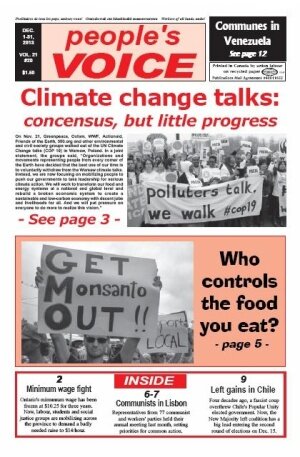
PEOPLE'S VOICE DECEMBER 1-31, 2013 (pdf)
People’s Voice 2014 Calendar
”The Truth About the Great War”
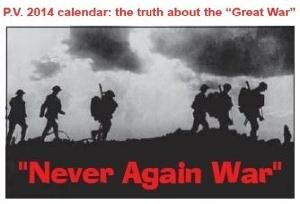
To order a copy of the People’s Voice 2014 Anti-First World War
Calendar, send $15 (includes postage and handling) to
People’s Voice, 706 Clark Drive, Vancouver, BC, V5L 3J1. Contact us at
604-255-2041 or pvoice@telus.net for bulk order prices.
|
People's Voice deadlines: January 16-31 February 1-14 Send submissions to PV Editorial Office,
|
REDS ON THE WEB
http://www.parti-communiste.ca/
peoplesvoice.ca
www.ycl-ljc.ca
www.solidnet.org
|
People's Voice finds many "Global Class Struggle" reports at the "Labour Start" website, http://www.labourstart.org/. We urge our readers to check it out! |
* * * * *
People's Voice
Canadian Publications Mail Sales Product Agreement #205214
ISSN number 1198-8657
People's Voice is published by
New Labour Press Ltd
PV Editorial Office
706 Clark Drive,
VANCOUVER, B.C. V5L 3J1
Phone:604-255-2041
Fax:604-254-9803
email: pvoice@telus.net
Editor: Kimball Cariou : Business Manager: David Au
Editorial Board: Kimball Cariou, Miguel Figueroa,
Doug Meggison, Naomi Rankin, Liz Rowley, Jim Sacouman
* * * * * *
Letters
People's Voice welcomes your letters
on any subject covered in our pages.
We reserve the right to edit for length and clarity,
and to refuse to print letters which may be libellous
or which contain unnecessary personal attacks.
Send your views to:
"Letters to the Editor",
706 Clark Dr., Vancouver, BC V5L 3J1,
or pvoice@telus.net
People's Voice articles may be reprinted without permission,
provided the source is credited.
* * * * * *
The Communist Party of Canada, formed in 1921,
has a proud history of fighting for jobs, equality, peace,
Canadian independence, and socialism.
The CPC does much more than run candidates in elections.
We think the fight against big business and its parties
is a year-round job,
so our members are active across the country,
to build our party and to help strengthen people's movements
on a wide range of issues.
All our policies and leadership
are set democratically by our members.
To find out more about Canada's party of Socialism,
give us a call at the nearest CPC office.
* * * * * *
Central Committee CPC
290A Danforth Ave Toronto, Ont. M4K 1N6
Ph: (416) 469-2446
fax: (416) 469-4063 E-mailmailto:info@cpc-pcp.ca
Parti Communiste du Quebec (section du
Parti communiste du Canada)
5359 Ave du Parc, Montréal, Québec,
H2V 4G9
B.C.Committee CPC
706 Clark Drive, Vancouver, V5L 3J1
Tel: (604) 254-9836
Fax: (604) 254-9803
Edmonton CPC
Box 68112, 70 Bonnie Doon P.O.
Edmonton, AB, T6C 4N6
Tel: (780) 465-7893
Fax: (780)463-0209
Calgary CPC
Unit #1 - 19 Radcliffe Close SE
Calgary AB, T2A 6B2
Tel: (403) 248-6489
Ottawa CPC
Tel: (613) 232-7108
Manitoba Committee
387 Selkirk Ave., Winnipeg, R2W 2M3
Tel/fax: (204) 586-7824
Ontario Ctee. CPC
290A Danforth Ave., Toronto, M4K 1N6
Tel: (416) 469-2446
Hamilton Ctee. CPC
265 Melvin Ave., Apt. 815
Hamilton, ON.
Tel: (905) 548-9586
Atlantic Region CPC
Box 70 Grand Pré, NS, B0P 1M0
Tel/fax: (902) 542-7981
http://www.parti-communiste.ca/
* * * * * *
News for People, Not for Profits!
Every issue of People's Voice
gives you the latest
on the fightback from coast to coast.
Whether it's the struggle for jobs or peace, resistance to social cuts,
solidarity with Cuba, or workers' struggles around the world,
we've got the news the corporate media won't print.
And we do more than that
- we report and analyze events
from a revolutionary perspective,
helping to build the movements for justice and equality,
and eventually for a socialist Canada.
Read the paper that fights for working people
- on every page, in every issue!
People's Voice
$30 for 1 year
$50 for 2 years
Low-income special rate: $15 for 1-year
Outside Canada $50 for 1 year
Send to: People's Voice, 706 Clark Drive, Vancouver, BC, V5L 3J1
You can call the editorial office at 604-255-2041
REDS ON THE WEB
http://www.parti-communiste.ca/
http://www.ycl-ljc.ca/
http://www.solidnet.org/
(The following articles are from the December 1-31, 2013, issue of People's Voice, Canada's leading socialist newspaper. Articles can be reprinted free if the source is credited. Subscription rates in Canada: $30/year, or $15 low income rate; for U.S. readers - $45 US per year; other overseas readers - $45 US or $50 CDN per year. Send to People's Voice, c/o PV Business Manager, 706 Clark Drive, Vancouver, BC, V5L 3J1.)
By Liz Rowley
Around the world Toronto's Mayor Rob Ford and his brother Doug have been objects of media derision since the Mayor's crack habit and alcoholism were confirmed by a police report.
A lengthy police investigation exposed the video where Ford is smoking a crack pipe, making racist and homophobic attacks. Two of the men in the video have been shot, and one was killed. Ford's driver has been arrested for drug trafficking and other offenses.
With everything the Mayor does, the intent is build up a heroic persona as a defender of the underdog, a red‑tape cutter, a man unafraid to "say it like it is."
But the police report exposed the Mayor as a racist with criminal connections, and a list of domestic assault complaints from his wife. Ford also faces sexual assault complaints, and reports of drunken and belligerent behaviour at official events. He was removed from coaching and financing a high school football team after racially stereotyping players and their families.
In November, City Council passed a series of motions to transfer most of the Mayor's powers to Deputy Mayor Norm Gardner, a member of Ford's hand‑picked Executive Committee. As the Fords blustered retribution, hundred of protestors demanded the Mayor's ouster as the key to "Save Our Toronto".
Premier Kathleen Wynne, who had offered to provide City Council with "new tools" to strip the Mayor of his powers, was relieved. Wynne has never been elected, having inherited the top job when Dalton McGuinty resigned after stripping collective bargaining rights from School Boards, teachers and educational workers.
With such a reprehensible public record, why has Ford not faced charges for any of the offenses he has committed?
Toronto lawyer Clayton Ruby has asked exactly this question. At the very least, Ruby says, police have had grounds to search the Mayor's car and home, as they do in thousands of similar cases every year. Why is Ford exempt?
The fact is Ford has been protected by police, by the corporate moneybags in the city, and by the Tory machine in Ontario and federally.
These powerful forces moved mountains to elect Ford and the right‑wing majority on Council in 2010. They wanted to slash city budgets, privatize public services and assets, attack municipal unions, tear up collective agreements, destroy public housing and eliminate public boards and input wherever possible.
For the last three years, budget deliberations have consisted of threats to the public and retribution to councillors who opposed the Ford cuts. This Mayor and his right‑wing majority have done the job they were contracted to do by those who bought and paid for their election.
Not surprisingly, these are the same forces the police "serve and protect."
But now it seems the Big Money is shifting to support John Tory for Mayor in 2014, if the Mayor is unable to resurrect himself. Yet Ford is already campaigning against the proposed 2014 budget which includes a 2.5% tax hike. Ford calls the increase the same "gravy train" he "derailed" in 2010. Will this stick? Some of it will, but how much depends on the progressive forces and the alternative they project ‑ or don't ‑ in the 2014 campaign.
Ford's base, while shrinking, is still significant, shifting between 20% and 40% in the polls. Where does this support come from?
According to figures published by the Toronto Star, the poor white working class, poorly educated and increasingly marginalized, are the core support for Ford Nation. But it also includes the bankrupted and ruined small business class who have no solidarity with anyone, and who often blame low‑waged workers and unions for their situation, not big business. And this group is growing.
Ford Nation also includes the déclassé elements whose loyalty is bought and sold as strike‑breakers and union‑busters. Add in the racists, homophobes and bigots, and it's a potent mix of blind anger and resentment, skilfully turned against organized labour, youth, women, Aboriginal Peoples, migrants, and the LGBTQ community. It also has a very sharp anti‑communist edge.
In the US, this same grouping make up the base of the Tea Party, while in parts of Europe this is the base of far right movements, such as Golden Dawn in Greece.
Without a decisive political challenge, this grouping will sink deeper roots as the capitalist crisis deepens, and the threat to working people will grow.
In the 2014 elections, the target for labour and its allies must be to replace the Mayor and the right with a progressive majority in Toronto, and across the province.
To do that we need a coalition of forces able to unite around progressive municipal policies, and candidates who will work with these coalitions and be accountable to them between elections.
This is urgent in Toronto, where the right-wing affliction is easily transmittable, and could appear in any number of cities if action isn't taken soon.
By T.J. Petrowksi
The capitalist system is based on the exploitation of workers and the environment in an effort to maximize profit, and therefore privatization and the corporate control of essential services is a recipe for disaster. Corporate control of food and agriculture is a particularly serious threat to both working people and the environment. Democratic rights, despite their limitations, are increasingly being eroded to make way for unlimited corporate control of our food system.
In 2012 we witnessed the largest tainted meat recall in Canadian history from an outbreak of E. coli at an XL Foods Lakeside meat processing plant in Alberta. Almost 2,000 items were removed from store shelves in Canada and the United States, and over 600 tons of meat were dumped at a landfill in Alberta. The scandal rocked the Harper Government, but Federal Agriculture Minister Gerry Ritz, who presided over the 2008 listeriosis outbreak at a Toronto Maple Leaf Foods packing plant that killed 23 people, refused to acknowledge any responsibility.
The 2012 outbreak raised questions about food safety regulations in Canada, which have been being systematically dismantled for decades under both Liberal and Conservative governments. The Harper Government drastically cut back food safety regulations and muzzled critics, but the outbreak is only the latest expression of problems when corporations control our food system.
From genetically modified organisms (GMO), unsanitary and unregulated food production, terminator seeds, slave labour, to toxic chemicals in our food, working people and the environment are under attack by major agricultural corporations that have no interest other than to make a profit. Agribusiness does everything it can to lobby governments and to keep its farming practices secret from consumers.
Eric Schlosser, co‑producer of the documentary Food Inc., has said, "The way we eat has changed more in the last 50 years than in the previous 10,000... Now our food is coming from enormous assembly lines where the animals and the workers are being abused, and the food has become much more dangerous in ways that are deliberately hidden from us. This isn't just about what we're eating. It's about what we're allowed to say. What we're allowed to know."
According to the American Academy of Environmental Medicine, the consumption of GMOs is linked to adverse health issues, and a test done on rats shows severe organ damage from the consumption of GMOs.
Of course none of this matters to major corporations. A Monsanto official told the New York Times that it's not the responsibility of the company to ensure the food is safe, their only interest is selling as much of it as possible. But how do consumers know if their food contains GMOs?
An attempt in California to require retailers and food companies to label products that contain genetically modified ingredients was defeated, thanks to the tens of millions of dollars that major corporations like Monsanto and Hershey contributed to the campaign against the legislation.
Studies have also shown that the use of GMOs has a number of serious environmental consequences, from soil fertility to the decrease in the number of certain plants and animals.
The majority of GMOs are designed to be able to tolerate an excessive use of toxic chemicals, such as pesticides and herbicides. Some scientists predict that the use of herbicides will triple as a result of GM agricultural products, leading to an increase in soil toxicity. Do we want more chemicals on our food?
GMOs have been linked with the decrease in some beneficial insects that are critical to the environment, especially important pollinators like Monarch butterflies and honeybees. During Monsanto's trial of GM cotton, 40% of the bees died, and GM canola flowers are known to be harmful to important pollinators. Technology companies are now building robotic honeybees as a possible future replacement for real ones. Lacewings, springtails, and ladybird beetles are among other insects that GMOs are known to harm.
Although corporations want us to believe their claims about GMOs, David Ehrenfield, Professor of Biology at Rutgers University, is not convinced: "Genetic Engineering is often justified as a human technology, one that feeds more people with better food. Nothing could be further from the truth. With very few exceptions, the whole point of genetic engineering is to increase sales of chemicals and bio‑engineered products to dependent farmers."
As more crimes committed by these corporations come to the public's attention, they are lobbying right‑wing governments to enact legislation to make it illegal to expose or film corporate agricultural practices.
In several U.S. states, this aggressive legislation, supported by anti‑worker and anti‑democratic companies like Koch Industries and ExxonMobil in addition to agricultural corporations, will prohibit anyone from filming or exposing illegal farming practices, other than law enforcement and food and safety regulators. No doubt the push to criminalize exposure of brutal and inhumane corporate farming practices is a result of the high costs associated with massive food recalls, and the unwillingness of corporations to follow current food and safety regulations.
Earlier exposés by animal rights and environmental activists have shown sick animals being shocked or beaten before being shot, farm animals with infected wounds, and animals living in their own waste.
The American Legislative Exchange Council, an ultra‑right‑wing organization, called these activists "terrorists". A Republican Senator claimed that because law enforcement agencies exist, this legislation is necessary to maintain corporate privacy. However, the senator didn't say that as regulations are dismantled and austerity forces cutbacks in safety regulators, official agencies are less able to deal with illegal corporate practices.
The real terrorists are companies such as Monsanto, which recently purchased Blackwater (Xe Services), the infamous mercenary army that committed extensive human rights abuses in Iraq and Afghanistan, to target anti‑GMO activists.
Corporations should never be trusted with any vital service, whether healthcare, water, or food. Working people and farmers need to fight the corporate takeover of our food system, and create our own reliable, healthy, and safe food for consumption.
3) RYAN ACCLAIMED AS OFL SUPPORTS AUSTERITY FIGHT
PV Ontario Bureau
President Sid Ryan, Secretary Treasurer Nancy Hutchison and Executive Member Irwin Nanda were all acclaimed on Nov. 25 as officers of the Ontario Federation of Labour.
In a barn-burner of a convention opening speech, Ryan told delegates that the OFL had to move its members and community allies in the Common Front into mass action to fight austerity and defend labour's hard-won gains. Promising more of the militant struggles the OFL has been engaged in since his election in 2009, Ryan had the support of the largest section of delegates in the hall.
Two contenders for President dropped out after a struggle that took place in the OFL leading up to the convention.
Fed up with demonstrations and under pressure from the NDP caucus to settle it down, the right wing in the OFL leadership was out to dump Ryan with a surprise challenge, expecting a low turnout from cash‑strapped affiliates.
A staffer from UFCW, Bob Lynton, was set to go when the coalition backing him realized they didn't have the votes to defeat Ryan. A visit from Hutchison the night before the convention began was said to be the reason why a USW candidate from Sault Ste. Marie stepped down, though he was running only to prevent Ryan's acclamation.
It was clear from the get‑go that delegates support Ryan, and the militant direction he is leading the OFL. The challenges would have been a defeat for the right if they had played out as initially planned.
As PV went to press on Nov. 26, the Convention was preparing to deal with the Action Plan. Also on the agenda are constitutional amendments which aim to curb the power of the President and the elected leadership, with the creation of an unelected executive body comprised of three public sector unions, three private sector unions, two equity vice presidents and the table officers. Being sold as a body with an advisory function only, which could act to smooth out sharp differences in the leadership, the amendment is a dangerous step away from membership control of the OFL.
The Canadian Labour Congress was restructured in this way at its last convention, and is being touted as a model for the constitutional change. The CLC is also virtually invisible in the struggle against austerity in Canada today.
People's Voice will report on the convention decisions on this and other resolutions in our January issue.
4) ACTIONS ACROSS ONTARIO DEMAND $14 MINIMUM WAGE
From the Campaign to Raise the Minimum Wage, http://raisetheminimumwage.ca
Ontario workers are struggling to get by. More and more decent jobs are being replaced by low‑wage work.
The minimum wage has been frozen at $10.25 for three years. In that time, food and transit costs have soared while inflation has driven down minimum wage earnings 19% below the poverty line.
It's time for an increase! We need a minimum wage of $14 to bring workers and their families above the poverty line (by 10%) and a commitment to annual cost‑of living adjustments.
The three year freeze on minimum wage drags down workers wages, increases inequality and hurts our economy.
The Campaign to Raise the Minimum Wage was launched in March 2013, with communities across Ontario demanding the government break the freeze. Creative actions and rallies took place in 14 cities with local community groups and activists delivering our message to local MPPs and Ministry of Labour offices.
The Ontario government has said that it will have a panel study minimum wages. But Ontarians can't wait for another commission. We need a raise now.
On November 14, the Campaign spearheaded a province‑wide day of action where students, labour activists and community members visited Members of Provincial Parliament (MPPs) urging them to support a $14 minimum wage for all workers.
Across Ontario, community members organized visits with well over half of all sitting MPPs in Ontario and presented cheques for $5 billion - the amount a $14 minimum wage would put back into workers' pockets.
On dozens of campuses, students organized outreach blitzes and joined MPP delegation visits, supported by the Canadian Federation of Students‑Ontario.
Community, student and labour activists in BARRIE organized a minimum wage rally that made front page news. The group marched from Georgian College to Conservative MPP Rod Jackson's office.
In THUNDER BAY, a rally was organized by Poverty Free Thunder Bay and the Thunder Bay and District Labour Council outside the office of Liberal MPP Michael Gravelle.
Hope Hamilton members met with NDP MPP Monique Taylor, while the Hamilton Labour Council met with NDP MPP Paul Miller. Meanwhile, McMaster students delivered petitions to NDP Opposition Leader Andrea Horwath's office.
In BRAMPTON, the Mississauga and District Labour Council met with Liberal MPP Harinder Takhar, and presented a cheque for $5 billion to Liberal MPP Linda Jeffrey.
In the TORONTO GTA, about 50 people joined a delegation at Premier Kathleen Wynne's constituency office, delivering a large cheque in the amount of $5 billion. Following the action at Wynne's office, labour, community and student groups split up visits to MPPs from Rexdale to Scarborough.
Together Access Alliance Community Health Centre, ACORN, Bread and Bricks, CASSA, PCLS, Respect Scarborough, SAWRO, Scarborough Anti‑Poverty Coalition, South Riverdale Community Health Centre, Toronto & York Region Labour Council, University of Toronto Scarborough Campus Students' Union, UNIFOR members and Workers' Action Centre visited 17 different MPP offices in the GTA!
Other community members carried out outreach drives to gather support for the campaign.
Other actions took place in Brantford, London, Kitchener-Waterloo, St. Thomas, Woodstock, Ottawa, Oshawa, Peterborough, Sudbury, Niagara, Kenora, Chatham, Sault Ste. Marie, Burlington, Oakville, Guelph, Kingston, Timmins, Windsor, and in York Region.
In total, campaign supporters visited more than 50 MPPs across Ontario, and close to 1,000 people sent a message to their MPP asking them to support a $14 minimum wage!
5) COMPROMISES WEAKEN WARSAW CLIMATE CHANGE TALKS
By Kimball Cariou
The United Nations Framework Convention on Climate Change (COP 19) wrapped up on Nov. 23, after heated late‑night debates and a walkout by environmental groups. Most of the "civil society" observers at the conference shared a consensus that the compromise deal struck in Warsaw will do little to help cut down carbon emissions which are driving climate change.
Much of the conference was deadlocked in disputes between negotiators from the major capitalist countries and the developing world over the division of responsibility for cutting down emissions, and over financing to countries suffering from the impacts of climate change.
A deal was finally reached through terminology that asks countries for "nationally determined contributions", instead of "commitments" to reduce greenhouse gas emissions, during talks for a new global climate agreement to be finalized at a 2015 summit in Paris.
The wealthiest capitalist countries have made pledges to help developing countries cope with the impacts of extreme weather events, rising sea levels, desertification, and others. But the United States blocked substantive progress in climate financing, particularly on how these countries will scale up their yearly contributions to $100 billion by 2020. The U.S. even succeeded in having private finance counted in as climate finance commitments.
Speaking on behalf of the G77+China group of developing countries, Fiji said "there is absolutely nothing to write home about at the moment."
The Warsaw outcomes were met with negative reactions from the civil society groups which staged a mass walkout on Nov. 21. The walkout highlighted what they called the "serious lack of ambition in the talks", where developed countries backtracked on earlier commitments, while "dirty energy corporations" flaunted their overweening influence.
Around 800 representatives from 13 non‑governmental organisations joined the walkout, when it became clear that the conference would not produce a timetable to ensure that targets for emissions cuts and climate finance pledges will be set in time for Paris.
The rich capitalist countries continue to demand uniform national emission targets, while developing nations say the major industrialised nations must lead in setting targets and foot most of the bill because they have accounted for most emissions.
The talks were also sharply divided over aid. Developed nations agreed in 2009 to raise climate aid to $100 billion a year from 2020 from an annual $10 billion for 2010‑12. But the major imperialist countries, focused on their own embattled economies, are now resisting calls to raise aid levels over the rest of this decade.
The Warsaw conference started in early November, in the shadow of Typhoon Haiyan which devastated the Philippines. Speaking at the time, the lead delegate from the Philippines, Yeb Sano, drew tears in the auditorium with a heartfelt plea to "stop this climate madness".
But serious progress was foiled by the complexity of finding consensus among the participating countries. Things began going badly when the Japanese government announced that it would not meet its 2020 emissions cuts target. Instead of cutting emissions by 25% below 1990 levels as previously agreed, Japan now says emissions will actually rise by 3%. Meanwhile, the Polish government, tasked with chairing the talks, came under sharp criticism for being closely tied to the coal industry. The head of the meeting was then sacked as environment minister in a Polish government reshuffle.
Agreement on the outline framework for a "pathway" towards the 2015 Paris summit proved the most difficult aspect of the negotiations during the tense final thirty hours. This battle eventually centred on a single word in the pathway document. The text originally spoke of "commitments" by all parties. But in a plenary session, delegates from China and India said they could not accept the language.
"Only developed countries should have commitments," said China's lead negotiator Su Wei. Emerging economies could merely be expected to "enhance action", he said.
With time running out, ministers and advisers huddled in a corner of the hall for an hour, before agreeing to change "commitments" to "contributions". The more flexible word allows the US and EU to insist that everyone is on the same page, while also allowing China and India to insist that they are doing something different from the richer countries.
Another key battle was over the issue of loss and damage. This was crucial for developing countries which say that money to help them adapt to climate change is insufficient to cope with extreme events such as Typhoon Haiyan. They argued for a new institution called a loss‑and‑damage mechanism that would have the financial clout to deal with the impacts of such events clearly affected by climate change.
But in the text the new mechanism would have to sit "under" an existing part of the UN body that deals with adaptation.
This word angered delegates from developing countries. In another moving intervention, Yeb Sano of the Philippines said, "It has boiled down to one word and I would say this is a defining moment for this process. Let us take that bold step and get that word out of the way."
After another huddle the word was changed and the text accepted.
But many civil society groups like Oxfam, World Wildlife Federation, and Greenpeace concluded that Sano's appeals largely fell on deaf ears.
"Governments are not doing enough," said Oxfam's Celine Charveriat, speaking to BBC News. "We need to tell them you are not allowed to make a mockery of this process. We can't continue to watch in silence. Enough is enough."
Executive director of Greenpeace International, Kumi Naidoo, was sharply critical of the overall handling of the talks. "The Polish government has done its best to turn these talks into a showcase for the coal industry," he said.
6) A POSITIVE STEP, BUT DANGERS REMAIN
People's Voice Editorial
The initial agreement on Iran's nuclear programme is a welcome step away from many years of U.S. threats to launch a devastating war against that country. But the region remains volatile and dangerous. The "new Middle East" strategy of U.S. imperialist domination remains in place, and the Israeli Zionists have not abandoned the goal of occupying the entire territory of Palestine and beyond.
While the western corporate media demonizes Iran, the Rouhani government in Tehran has shown a far stronger grasp of political responsibilities than its counterparts in Washington and Tel Aviv. Unlike both the U.S. and Israel, Iran has no historic record of initiating wars. Nor is Iran guilty of using nuclear bombs, white phosphorus, agent orange, or depleted uranium. It is true that the Iranian fundamentalist regime has committed serious human rights abuses for many years. But both the U.S. and Israel are guilty of a wide range of human rights violations, and war crimes against other countries.
Any success in blocking the spread of nuclear weapons is welcome. But the Middle East remains awash with the estimated 200 nuclear warheads possessed by Israel, and many more on U.S. warships in the Mediterranean and the Gulf. Easing the threat of war in the Middle East requires comprehensive progress towards disarming the entire region, including the huge arsenals held by the U.S. and Israel.
Unfortunately, the government of Canada has criticized the Iranian nuclear agreement, apparently because the deal reduces the likelihood of a bloody imperialist war to destroy Iran. Removing the pro‑war Harper government from office as soon as possible would mark a significant victory in the struggle for international relations based on mutual dialogue and cooperation, international law, and reduction of tensions, not threats and violence.
7) HOW AUSTERITY WORKS FOR SOME
People's Voice Editorial
How does our society measure what "works" and what doesn't? The economic crisis which broke out in 2008 provides a classic lens to examine this question.
On a global scale, the major shareholders of the most powerful corporations and banks have recovered, and much more. Huge bailouts squeezed from the working class covered any short-term losses suffered by the rich, and then profits and stock prices rebounded past pre-crisis levels.
Here in Canada, studies on the "Rich 100" bear out this analysis. As one media commentary said in November, "because these people have been at it for decades, they keep getting fabulously, obscenely, gloriously richer."
Collectively, the individuals on Canada's Rich 100 are worth $230 billion, more than the total gross domestic product of many countries. This year alone, their combined net worth surged by more than 15%, the biggest increase since 2000. The cutoff for making Canada's Rich 100 list is now $728 million, compared to $309 million in 1999.
Here's one example. While the retail and grocery sectors in Canada have been challenged by Target and Walmart, profits in these sectors have seen big profit increases. Companies controlled by two Rich 100 families, the Westons and the Sobeys, have bought up Shoppers Drug Mart and Safeway Canada. The net worth of these families shot up by $2.1 billion and $598 million, respectively, for gains of about 25%.
So, does capitalist austerity work? The bottom line is that it serves the "one percent" quite well, while working people, the so-called "ninety-nine percent," keep getting shafted. It's time for a system that works for the vast majority, not the ultra-rich.
8) B.C. AGAIN HAS HIGHEST CHILD POVERTY
How many years will BC continue to have the highest child poverty rate in the country? That is the question raised by the "2013 Child Poverty Report Card" released by the First Call: BC Child and Youth Advocacy Coalition.
According to the latest Statistics Canada figures, 18.6% of BC children were poor in 2011, up from 14.3% in 2010. This is more than 5 percent higher than the Canadian average.
The number of poor children in BC was 153,000 (up from 119,000 in 2010) - enough children to fill Rogers Arena eight times. This represents about one of every five BC children.
Children living in single mother families had a shocking 50 per cent poverty rate in 2011, a dramatic increase from 21.5 per cent in 2010.
"BC stands out as having done the least among all provinces to bring down child and family poverty through government supports and programs," said Adrienne Montani, First Call's Provincial Coordinator. "Concerted government action in the form of a comprehensive poverty reduction plan for the province is long overdue."
Other key findings in the report include:
* BC also had the worst poverty rate of any province for children living in two‑parent families: 14%.
* BC's poverty rate for young children (under 6) was 21%, eight percent higher than the Canadian average.
* Nearly one third of BC's poor children lived in families with at least one parent working full time all year.
* British Columbia has the most unequal distribution of income among rich and poor families with children, primarily due to the very low incomes for the poorest families.
"Seeing the children's poverty rate climb higher than the overall poverty rate again is particularly worrisome," said Lorraine Copas, Executive Director of SPARC BC. "We know the experience of poverty and social exclusion undermines children's physical and emotional well‑being, and this is a breach of their right to optimal care and protection. BC is not a poor province and we can do better."
The Report Card makes 16 policy recommendations to help reduce the child poverty rate to seven percent or less by 2020. These include adopting the $10 a Day Child Care Plan; increasing and indexing the minimum wage, welfare rates and federal child tax benefits; paying living wages; enhancing Employment Insurance benefits and eligibility; increasing affordable housing options for families; and improving the affordability of post‑secondary education.
9) SFL CALLS FOR BAN ON CORPORATE POLITICAL DONATIONS
By Darrell Rankin
The Saskatchewan Federation of Labour is urging Premier Brad Wall to ban corporate political donations.
"The people of Saskatchewan should have faith that their government is not beholden to corporate donors, and that decisions are made in the interests of the province," said SFL president Larry Hubich.
The SFL made the call "In light of revelations about how a handful of Saskatchewan construction companies donated more than $64,000 to the current government in 2011 alone... (This is) the same government that passed Bill 80 at the industry's request in 2008."
Bill 80 did away with the basic rights of building trades workers to choose their own union. Contractors can now choose which union will represent workers on job sites, effectively banning craft unions from the industry and ripping up province‑wide collective agreements.
"The news about how significantly some construction companies are involved in Saskatchewan politics is extremely troubling," said Hubich.
The SFL is probably the first labour fed to make such a demand. Most federal and provincial election laws ban both corporate and trade union political donations.
The Communist Party has also called for a ban on corporate donations since corporations should not have the same rights as people; they are purely legal entities.
The current ban on union donations was put in place in the last 20 years as a way to "guarantee" governments are "neutral" and distant from the class struggle. In fact, there is no such thing as a neutral government in class‑divided societies. All governments in a capitalist society defend the interests of the ruling capitalist class, a class which always has pools of money to donate to their political parties. The Communist Party has always opposed the ban on union donations.
10) COMMUNIST PARTIES PLAN COMMON ACTIONS FOR 2014
The 77 parties which took part in the 15th international Meeting of Communist and Workers' Parties (IMCWP), held Nov. 8-10 in Lisbon, adopted a set of guidelines for "common or convergent action." The meeting mandated the Working Group of the IMCWP to implement these guidelines in coordination with other parties of the Solidnet List (http://solidnet.org).
Activities will be held to commemorate 2014 as the 100th anniversary of the beginning of World War I, and the 75th anniversary of the beginning of World War II, "through a joint campaign alerting to the dangers of new international military clashes, the need to enhance the struggle for peace and against imperialist aggressiveness and wars, and highlighting that the struggle for peace is intimately linked with the struggle for socialism."
Next year is also the 15th anniversary of the criminal NATO aggression against the Federal Republic of Yugoslavia, which marked a new phase in the development of imperialist military strategy.
The Working Group, in coordination with parties from Asia, Africa, Latin America and the Caribe, will hold an international seminar on the impact of the capitalist crisis in the developing countries. The seminar will focus on issues such as the right to economic and social development, protection of natural resources, agriculture, land tenure, and food security.
International campaigns will build solidarity with socialist Cuba against the US blockade, with Bolivarian Venezuela, and with the Colombian people's struggle for peace with social justice.
Taking advantage of international events where a large number of Parties are present, efforts will be made to organize a working meeting to debate the ideological offensive and the mass media's role, and to exchange experiences on mass communication work.
Parties will mark International Women's Day (March 8), by highlighting the effect of the crisis and the imperialist offensive on working women and national oppressed women, expressing solidarity with their struggles.
May Day 2014 will be honoured with participation in struggles in each country to defend workers' economic and social rights, highlighting the importance of the class struggle for the abolition of exploitation. Particular attention will be given to actions against youth unemployment and to defend the rights of trade unions.
Convergent actions will be considered to combat racism, xenophobia, and fascism, stressing the importance of the ideological struggle against anti‑communism, and denouncing the European Union's campaign to equate communism with fascism. A day of action will be announced against the persecution of communist parties and the ban against communist symbols in several countries. The 95th anniversary of the creation of the Communist International (March 3, 1919) will be commemorated, emphasizing the central contributions of V.I. Lenin to the international communist movement.
Parties from the Arab countries and Middle East will organize an international seminar on the social and national emancipation struggles of that region, expressing solidarity with the victims of imperialist and Zionist crimes and aggressions, including the Palestinian and Syrian peoples.
The Communist parties will continue to denounce imperialist intervention against Syria and Iran, and to struggle for the recognition of an independent Palestinian state.
Finally, to promote the international front against imperialism, the parties will continue to support the activities of the World Federation of Trade Unions (WFTU), the World Peace Council (WPC), the World Federation of Democratic Youth (WFDY), and the Women's International Democratic Federation (WIDF), in the specific framework of every country.
11) "THE CENTRAL QUESTION IS THE TRANSITION TO SOCIALISM"
From the intervention of the Communist Party of Canada to the 15th International Meeting of Communist and Workers' Parties, held Nov. 8‑10 in Lisbon, Portugal, presented by Elizabeth Rowley, member of the CPC Central Executive and Ontario Provincial Leader
Last spring, our 37th Convention determined that our Party Program, which outlines our strategy for socialism in Canada, should be reviewed and updated prior to the 38th Convention in 2016. The central question is the transition to socialism, the phases of transition and the objectives of each phase, and the alliances necessary to achieve those objectives.
In addition, the national question in Canada and the national rights of the Québecois(es) and of Aboriginal peoples across the country, is a central factor that affects all aspects of the struggle for socialism, and for a united mass resistance to imperialism and war abroad, and austerity and reaction at home.
As we prepare for this discussion, which is about the role and objectives of our small revolutionary party in non‑revolutionary conditions, we reiterate our conviction that we are in the epoch of the transition from capitalism to socialism and that there is no other rung on the ladder of social and human history but socialism.
We also reiterate that the transition to socialism occurs in each country according to a timetable determined by the objective and subjective conditions obtaining in each country, including the strength and unity of the working class and its allies, the strength and influence of the Communist Party, the development of class and political consciousness among the people, and the development of a revolutionary situation.
More than twenty years after the fall of the USSR and the socialist bloc, we can say that the greatest damage to our revolutionary cause, in Canada, was the widespread conclusion that socialism doesn't work and is therefore not the alternative to capitalism that working people are searching for in increasing numbers today. This is the consequence of the "end of the history" proclamations, which while they are quite wrong, have had widespread effect in the advanced capitalist countries, including Canada. We have an enormous job to do politically and ideologically to counter the state sponsored anti‑communist campaigns, and to recreate the magnetism of socialism - working class power - that galvanized workers for socialism in the past.
Developments in Cuba and Latin America have sparked the hopes of millions of people that imperialism can be defeated and that a new world order, based on democracy, sovereignty, peace, environmental security, and socialism, can be achieved through the people's struggle.
We are confronted with new problems, including the environmental catastrophe that is engulfing the whole world; the result of unbridled capitalist greed and development. We must become the champions of peace and the environment, linking these issues to the need for profound and fundamental change, to the Communist agenda, and to socialism.
In this same time, we have seen the crisis of social democracy play out internationally and in Canada, where the New Democratic Party has abandoned all responsibility and accountability to the working class and the organized labour movement, and has jettisoned its progressive policies in favour of neoliberal dogma - all in pursuit of government power and corporate approval.
The CPC has long since abandoned its 1971 policy of seeking cooperation with the NDP, when the NDP leadership abandoned socialism as its stated goal; all references to socialism have been finally purged from that party's program and constitution earlier this year.
Yet there are many socialist‑minded members of the NDP with whom we work closely in the labour and people's movements, who are horrified by the NDP's positions in support of war and against the best interests of the working class and working people. The NDP's electoral gains in the last election could easily melt away in the 2015 election, as those votes were mainly against the Conservative austerity policies; not in support of social democratic policies of austerity.
As austerity bites deeper into wages and living standards, as unemployment and social conditions worsen, and as the attack on labour and democratic rights sharpens, there is also a growing demand for an organized economic, social and political resistance lead by labour and its social and community allies.
A sharp struggle has opened up in the labour movement between left and right social democrats over the direction of the trade union movement, their view of mass independent labour political action, and their relations with the NDP. The central issue is class struggle or class collaboration.
Communists in the trade unions and people's movements are fighting for escalating mass independent political action that will put tens of thousands of people in the streets against austerity and anti‑labour, anti‑democratic attacks, including Conservative efforts to break the trade union movement and eliminate the right to strike with US styled, right‑to‑work laws. We fight for a people's agenda of jobs, rising wages, incomes and living standards, for strong public services, affordable housing, quality public and post‑secondary education, universal public healthcare, expanded labour, social, civil and democratic rights, for peace and environmental security, for sovereignty, and for the right of nations to self‑determination up to and including the right to secession.
While we do not advocate secession, and in fact warn against secession in the current political context, we defend and uphold the right to nations in Canada to choose secession, in the same way we defend and uphold the rights of men and women to divorce if that is their choice.
In upholding these rights, we create the essential conditions for unity on an equal, voluntary basis in a socialist Canada. We also create the conditions for unity of the working class in English‑speaking Canada, in Québec, and among Aboriginal Peoples, in the struggle to resist capitalist globalization, austerity, war, and reaction today, and for socialism tomorrow.
Our objective is to build a broad‑based People's Coalition which, with labour at its core, is an alliance that can launch an extra‑parliamentary counter‑offensive against the corporations and their right‑wing governments. We anticipate that this will lead to new forms of cooperation and alliances that will have a political parliamentary expression, able to curb corporate power, and introduce far‑reaching and fundamental social and economic reforms. This will not unfold without the strong, revolutionary leadership of the Communist Party.
Canadian Communists recognize that the specific conditions in Canada, as an advanced capitalist country deeply integrated into the US economy and being rapidly integrated into the US war machine, will not be the same as in other countries where objective and subjective conditions are different. Lenin looked for the weak link in imperialism's chain, reflecting the dialectics of the class struggle nationally and internationally.
What is universal is the transition to socialism as a historical necessity, based on the specific conditions and alignment of forces in each country. We recognize and respect those specificities, while also expressing our strong support for more coordination and unity of the World Communist Movement and of the international working class movement.
12) US IMPERIALISM CONCENTRATING IN THE ASIA-PACIFIC REGION
From the contribution to the International Meeting of Communist and Workers' Parties, by Sitaram Yechury, member of the Polit Bureau, Communist Party of India (Marxist)
The global capitalist crisis that is plaguing the world has not abated. The recently published IMF, World Economic Outlook Report, October 2013, states: "Global growth is still weak, its underlying dynamics are changing, and the risks to the forecast remain to the downside... old problems - a fragmented financial system in the euro area and worrisomely high public debt in all major advanced economies - remain unresolved and could trigger new crises... the global economy could grow by only slightly more than 3 percent a year over the medium term, instead of reaccelerating to over 4 percent..."
It further states: "Industrial production recovered modestly in the advanced economies but is still slowing in the emerging market and developing economies. Together with the MENA region, the euro area is seeing another increase in an already high unemployment rate".
The crisis has once again resoundingly demonstrated capitalism's inherent oppressive and exploitative character. It is imposing greater miseries on the vast majority of the world's population. This crisis is also increasingly demonstrating that imperialism, notwithstanding all ideological efforts to obfuscate its existence and role, is leading global capitalism in this offensive against humanity...
Following the shift in favour of imperialism in the international correlation of class forces, USA has embarked to consolidate its global hegemony. This new world order is designed to operate in all spheres. This, on the one hand, led to unleashing unilateral wars and on the other, it led to the strengthening of the US military machine. At the same time, NATO, whose need for existence should have simply disappeared with the end of the Cold War, was further strengthened as imperialism's global war machine.
In pursuit of its hegemonic designs, US imperialism is now concentrating on Asian continent because it is host to two of the largest populated countries in the world - China and India - which means they constitute the largest market. The imperialist powers need this region more than anything else today to come out of the deep economic crisis they find themselves in. And to their strategic concentration in this region is another vital class reason: socialist China, which imperialism considers is developing into a formidable foe and a threat to its hegemony.
All these reasons translated into prioritising Asia‑Pacific as a region that deserves the attention of the US, both economically and militarily. The US, over the years had been developing its strategic plans to increase its presence and ensure its hegemony over the entire Asia‑Pacific region. Outlining these priorities, US President Barack Obama during his visit to Australia, stated "After a decade in which we fought two wars that cost us dearly, in blood and treasure, the United States is turning our attention to the vast potential of the Asia Pacific region... As we plan and budget for the future, we will allocate the resources necessary to maintain our strong military presence in this region..."
Accordingly, the US decided to reposition its Navy so that 60 per cent of its warships would be assigned to the Asia‑Pacific region by 2020.
The increasing economic integration of South and East Asia has strengthened the strategic significance of the Indian and Pacific Oceans as a continuous throughway for global commerce and energy. The US intends to develop its strategic ties with India in this background. This explains some of the vital reasons for the Indo‑US nuclear deal, several defence tie‑ups and other accords on various other sectors like agriculture, education, etc. Moreover, to establish its global hegemony, the USA needs the containment of China and for this it sees India as a potential ally.
The Asia‑Pacific region has also become strategically important because approximately 90 percent of globally traded merchandise travels by these seas. As much as 50 percent of the world's container traffic and 70 percent of global energy trade now transits the Indian Ocean.
In order to improve its economic hold the US now intends to create the world's biggest free trade zone in this region.
Considering itself as a leader of all the countries surrounding the Pacific rim and Indian ocean it wants to seal a strategic partnership with most of them. This is needed to break the economic relations of China with these countries and prise open the markets of these countries for US goods and services.
Accordingly the US is moving towards the goal of the Trans‑ Pacific Partnership (TPP) to create the world's largest and most demanding free‑trade area in ways that deepen the economic integration of the US and its Asia‑Pacific allies. This TPP zone, if created, will include countries from Chile in Latin America to Australia, Japan and all other countries in the Pacific Ocean. The US wants India too to be part of the TPP.
As a group, the TPP countries are the largest goods and services export market of the United States. US goods exports to the broader Asia‑Pacific totalled $942 billion in 2012, representing 61 percent of total U.S. goods exports. US exports of agricultural products to the region totalled $106 billion in 2012, 75 percent of total US agricultural exports. US private services exports totalled $226 billion in 2011, 38 percent of total US private services exports to the world. The US is also promoting the re‑militarisation of Japan in the region as a counterweight to China. To achieve its strategic opportunities, it is pulling India into its vortex and scheme of things as can be discerned through the joint naval exercises conducted in the Bay of Bengal by both the countries along with Australia, Japan, Philippines.
The rising bourgeoisie of the advanced capitalist countries, in order to consolidate their class rule, had earlier championed national sovereignty as being sacrosanct.
Today, imperialism is using FTAs and also its military might to subvert and negate national sovereignty of independent countries.
The "Global War Against Terror" launched under the leadership of US imperialism is being used as the justification for brazen military intervention, and for trampling national sovereignty to impose "regime change" to suit its interests. Like the "war against Communism" the pretext during the Cold War to justify imperialist military intervention, the "war against terror" is being used today to violate the national sovereignty of independent countries and the basic human rights of its people.
State terrorism practised by imperialism and individual terrorism unleashed by fundamentalist outfits feed on each other. The fight against both these dangers, is necessary to build the unity of the working class and other toiling sections of the society and also to counter the growing threat of right‑wing fundamentalist forces.
We should remember that the devastation caused by the great depression of the 1930s was met in different ways by different capitalist countries. One of these ways laid the basis for the rise of fascism. Georgi Dimitrov, in his speech at the Communist International in 1935, underlined, "Fascism adapts its demagogy to the peculiarities of each country. And the mass of petty bourgeois and even a section of the workers, reduced to despair by want, unemployment and insecurity of their existence fall victim to the social and chauvinist demagogy of fascism."
Further, he explained how "it is in the interests of the most reactionary circles of the bourgeoisie that fascism intercepts the disappointed masses who desert the old bourgeois parties. But it impresses these masses by the vehemence of its attacks on the bourgeois governments and its irreconcilable attitude to the old bourgeois parties".
Hence, how this economic crisis will be tackled and how the world comes out of it will determine the nature of social conflicts that arise as various sections of the people scramble for their share of the shrinking cake. The absence of a powerful communist-led counter attack, engenders the danger of the rise of reactionary forces.
It is hence the responsibility of the Communists and the progressive sections of the society not only to fight back the tendencies that lead to the growth of right‑wing politics and neo‑fascist forces, but also properly channelise the popular discontent.
This is one of the important steps that needs to be undertaken in the present juncture to strengthen the "subjective factor" that Lenin had talked about and utilise the developing objective conditions to usher in a social transformation - a political alternative to capitalism - socialism.
13) LEFT COALITION TAKES BIG LEAD IN CHILE ELECTION
PV Vancouver Bureau, with files from the Morning Star
The second round of Chile's general election will take place on December 15, with the New Majority coalition of left parties looking to win both the presidency and control of the Senate and Chamber of Deputies.
In the first round on Nov. 17, New Majority presidential candidate Michelle Bachelet fell short of the necessary 50% for victory, receiving 46% of the 6.6 million votes cast. She is far ahead of the top right-wing candidate, Evelyn Matthei, who received just 25%. Candidates for several other left and centre parties picked up about 16% of the total votes. The right-wing parties around outgoing President Sebastian Pinera suffered a crushing defeat, backed by only about one-third of the electorate.
The elections followed massive social mobilisations since 2011, and growing calls for sweeping changes to the political system left by the Pinochet dictatorship. Issues of inequality and social injustice were prominent in the campaign.
While the New Majority coalition did not achieve the number of seats necessary to push through constitutional changes alone, they did win a majority in both houses of parliament. In the Senate races, the New Majority won 50.5% of the votes, while the Right got 38%. If the second round vote goes as projected, the New Majority will have 58% of Congress members.
With this majority, Bachelet ‑ a socialist, paediatrician and former political prisoner ‑ will have the power to implement key elements of her platform: a more progressive tax system, genuine educational reform, and reduction of Chile's huge income inequalities. But to legislate constitutional changes, the New Majority will have to negotiate with other parties.
Chile's political left has been significantly strengthened within the New Majority. The Socialists won six extra seats in Congress, and the Communists doubled their representation to six seats, with most of their candidates winning high majorities.
While Bachelet did not run on a platform for revolutionary social change, the left parties see the New Majority as a parliamentary force with institutional power to complement the huge mobilisations by workers, students, indigenous peoples, and other progressive movements. From their perspective, the Bachelet government can lay the basis for more democratic and socialist-leaning reforms in the future.
Chilean student leader and Communist Party member Camila Vallejo backed Michelle Bachelet for president, and eagerly awaits education reforms. She has led millions into the streets since 2011, demanding the right to free education. Three other student leaders were also elected.
Chile's educational system still fails families with poor quality state schools, expensive private universities, unprepared teachers and banks that make big profits on costly loans.
But Vallejo is confident Bachelet's coalition will have enough seats in congress to effect change.
"Given the result of the elections, we have a majority that allows us to make structural changes," Vallejo told a Nov. 21 news conference, together with Karol Carolia, another Young Communist student elected to Congress.
"Social movements are pressuring many sectors that were not in favour of change before and that have now changed their mind," she said.
Vallejo said the Dec. 15 run-off vote will be a major challenge to convince others to support the education reform that she fought for in the streets. But she predicts that Bachelet and her coalition will score a "huge victory."
Responding to the argument that the New Majority coalition lacks the "super‑majorities" to change the dictatorship‑era electoral system and constitution, Vallejo replied, "Many sectors say we won't be able to makes these changes because we don't have the votes in congress, but we've learned that there's no limit to what the social movement can achieve."
14) ACTIVIST FROM VENEZUELA REPORTS ON SOCIALIST COMMUNES
By Peter Miller, Rebel Youth Magazine
Venezuela is a country that represents a different vision for our future. Its Bolivarian revolutionary process is the opposite of capitalist austerity and neoliberalism that many working class people around the world are facing today.
In November, Katrina Kozarek came to Ontario and Quebec for a speaking tour about Venezuela today.
Kozarek is active in the Ataroa Socialist Commune and a long-term activist in the Nacional Association of Community, Free and Alternative Media (ANMCLA). She grew up in Apollo, Pennsylvania, but moved to Venezuela in 2003.
Kozarek gave a background into the situation in Venezuela before launching into discussion about the pro‑socialist communes. Venezuela faced neoliberal policies in the 1980s and 1990s. In 1989 uprisings occurred across the country against neoliberal politics.
Hugo Chavez was elected to be president in 1998, backed by a people's movement and progressive forces. Right away he initiated policies that helped the poor, including a land law that redistributed unoccupied land to peasants or the state.
Chavez's reforms went too far for rich corporations, and the right wing organized a CIA‑backed coup in 2002. The coup was to no avail though, mainly because the people in Venezuela showed their strength on the streets and pressured the democratic‑minded forces in the military to quickly free Chavez.
The main part of Kozarek's presentation focused on her experiences living and working in "Ataroa Socialist Commune" which has a population of around 30,000 people in Lara province. The people of Venezuela have been setting up communes even before the government implemented the Ministry of Communes in 2009. The communes are real living examples of democracy and the seeds for socialism.
Communal councils are made in areas of around 250 families. These families get together frequently in what are called citizens assemblies to take control over their lives, and democratically organize their communities.
Spokespeople are elected from the councils, and these spokespeople represent the communal council in larger communes, and in some cases, even communal cities. Decisions made in higher bodies, like communal parliaments, are to be brought back to smaller communal councils for approval, allowing everyone to have the opportunity to have a say in decision making.
The people decide the geographical boundaries of communes in Venezuela.
"In our commune, we have a territorial ties because we fought together against the privatization of health in our community," Kozarek explained. The history of organizing in the Ataroa community, and other factors, were what influenced the community's decisions about the boundary of the Ataroa commune.
Now, thanks to their struggle for public health care, a health clinic that faced threats of privatization is now a hospital that is socially run by the commune.
The communal city Kozarek is from, like all communes in Venezuela, organizes to control communal enterprises in common. The idea is that these enterprises will benefit the community. For instance, Ataroa Socialist Commune runs its own block making enterprise under communal control. Therefore, as well as getting some funding from the government, people in communes look to create funding from these socialist enterprises.
The Ataroa commune also democratically controls a school that teaches people construction skills, and another separate agricultural school. Along with schools, enterprises, and a hospital, the commune runs cultural events, and allows people in the commune to be empowered by collectively operating different grass roots media outlets that Kozarek is very involved in.
The Ataroa Socialist Commune sometimes has conflicts with big business. The owners of big business do not want production to be organized and controlled by workers and communities in communes.
For instance a company that extracts sand from a river in the area of the commune causes environmental damage.
"That company causes problems for the commune, because it's under private control and it has no interest in the community whatsoever," Kozarek explained.
The commune has a plan however.
"The idea is to somehow to do a take over of that company and get permission from the Ministry of Environment to take over the extraction," she added. By extracting sand in their territory in an environmentally friendly way, the community can benefit from collectively taking over extraction.
The Ataroa Socialist Commune is also located in the state of Lara, an area of Venezuela that has elected an opposition governor, making it impressive that the people have been able to set up a people's commune. Unsurprisingly, the commune has faced opposition from the governor of the state, Henry Falcon, a neoliberal politician in support of big business.
For instance, the sewer system in Ataroa is about to collapse; yet the people are receiving no support from the Falcon to fix the problem. Falcon has been in office for four straight years without tackling the issue despite growing demands. The reason behind his inaction is his dislike of socialist communes that threaten the material interests of his main supporters, big business. The communal city also has goals of connecting with other communal cities to create a communal state, something that would make his position obsolete.
Kozarek emphasized the importance of organizing in solidarity with the Venezuelan people in their process of the Bolivarian Revolution. Wealthy corporations, and rich people with particular interests, have been trying to cause economic chaos in Venezuela. Speculating on the dollar value has caused Bolivars to be worth little compared to the dollar. At the same time, companies are hoarding food and other resources to create psychological and economic panic. People often have to wait in long lines for food when companies and supermarkets behind closed doors store large amounts of food. The result is a type of psychological warfare.
Wealthy elites in Venezuela and imperialists from Canada have interests in sabotaging the Bolivarian revolution because they want to overthrow a government that takes into account the interests and demands of working people.
"Venezuela is preparing itself for some sort of military intervention in the next months," Kozarek warned.
Kozarek emphasized that there will be municipal elections on December 8, and the right wing opposition is already threatening to create havoc during the elections to make the Bolivarian Revolution look bad. It is important for supporters of the revolution in Canada to hear true stories during any upheavals that will happen during the municipal elections by connecting to people on the ground in Venezuela. By connecting to people in Venezuela activists can spread the true story of the Bolivarian Revolution to fellow citizens.
Peter Miller is a student activist and member of the Young Communist League in Guelph. He will travel to Ecuador this month as part of the Pan‑Canadian delegation to the 18th World Festival of Youth and Students. The delegates' stories will be reported here at http://www.rebelyouth.blogspot.com.
15) MUSIC NOTES, by Wally Brooker
UFCW releases "100 Years of Solidarity"
A new generation of labour activist musicians can be heard in a free download album from UFCW Canada. The United Food and Commercial Workers is Canada's largest private sector union, with more than 250,000 members, 40% under the age of 30. This generation is reflected in the union's new compilation album "100 Years of Solidarity". It features progressive young hip‑hop artists from a diversity of backgrounds, with an emphasis on rappers of Latin‑American descent. Most of the tracks clearly reflect the social justice policies of the UFCW, including its policy of including temporary foreign workers as full members. A case in point is the brilliant "I'm Working on a Farm" by Spin El Poeta, an emcee who helped organize the 2005 World Festival of Youth and Students in Venezuela. Other stand‑out performers for this listener are Ruben "Beny" Esguerra and Manuela Astudillo. Esguerra ("Solidarity Forever Remix") is a poet, band leader and arts educator of Colombian descent. Astudillo ("My Accent") is a broadcaster with "Voces Latinas" on Toronto's unique community radio station AM 1610. Download this essential (and free) album at www.ufcw.ca.
"No Woman, No Drive"
On October 26 Saudi women activists attracted the attention of the world's media as they defied their country's ban against females driving and posted videos of themselves online behind the wheel. On the same day, in a well‑timed act of culture jamming, comedian Hisham Fageeh released "No Woman, No Drive", a video parody of reggae legend Bob Marley's classic song "No Woman, No Cry". By mid‑November Fageeh's video had gone viral with more than ten million YouTube hits. The Saudi‑born actor, stand‑up comedian and human rights activist attended Columbia University and is now based in New York City. Fageeh achieved a breakthrough of his own in becoming the first Saudi to headline an Arabic stand‑up comedy tour in the U.S. and England. Saudi Arabia remains the only country to prohibit women from driving, but the campaign to change the law is picking up steam.
Tunisian rappers unionize
Rappers and DJs are among the most outspoken social critics in contemporary Tunisia, and, as Islamist influence grows in that country, they're coming under increasing attack. In response they've founded the National Rap Union and affiliated with the General Confederation of Tunisian Workers, the country's trade union central. According to Italian news agency Ansa, the National Rap Union will focus on defending its members' right to criticise the authorities. In September rapper Klay BBJ was jailed for "insulting the police" at a concert (his co‑performer that night is still in hiding). Klay BBJ had earlier been imprisoned for performing his song "The Police are Dogs". Rappers Mustapha Fakhfakh and Ayem El‑Fikih have been charged respectively with "affronting morals" and "insulting public officials". For a look at the struggle of artists in today's Tunisia visit journalist Monica Mark's column at www.theguardian.com.
Symphony musicians protest austerity
European symphony orchestra musicians are mobilizing against austerity policies that threaten their livelihood and lay waste to the continent's musical heritage. In Spain on September 23, more than 1000 musicians in 23 orchestras united to protest against arts budget cuts and a sharp rise in sales tax on concert tickets. A nation‑wide concert was staged with musicians simultaneously playing the same program. A week later in Germany musicians from 100 symphony orchestras took to the streets to protest a sustained drop in public funding that has led to the closing of 37 symphony orchestras over the past 20 years. The German event began with an open‑air concert by the world‑renowned Berlin Philharmonic, followed by dozens of concerts throughout the country. Attacks against symphony orchestras and their unions are escalating throughout Europe and North America. The International Federation of Musicians (FIM) will meet in Oslo in February to map out the next stage of its fightback strategy. For more info visit http://www.fim‑musicians.org/.
Los Van Van honoured at WOMEX Awards
One of the most influential post‑revolutionary Cuban bands was honoured at the International World Music Expo (WOMEX), held in Cardiff, Wales in October. Perennially popular dance band Los Van Van is the recipient of the 2013 WOMEX Artist Award. The prize was founded in 1999 to honour "musical excellence, social importance, commercial success, political impact and lifetime achievement." Previous winners include South African vocal group The Mahotella Queens and the late Pakistani singer Nusrat Fateh Ali Khan. Los Van Van was founded in 1969 by bassist‑composer Juan Formell. Together with timbales player Changuito he created a new rhythm called "songo" which gave birth to a new genre of dance music. Los Van Van updated Afro‑Cuban popular music by fusing it with contemporary rock and jazz. After more than 40 years Los Van Van is arguably still the most popular band in Cuba. Catch their WOMEX performance at www.womex.com/.