|
|
December 1-31, 2014
Volume 22 – Number 20 $1
Prolétaires de tous les pays, unissez-vous!
Otatoskewak ota kitaskinahk mamawestotan!
Workers of all lands, unite
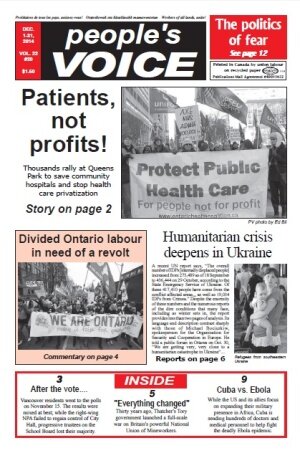
1) 3,000 PROTEST PRIVATIZATION, EXTRA-BILLING, HOSPITAL CLOSURES
2) LEFT FACES NEW CHALLENGES AFTER VANCOUVER ELECTION
3) HISTORIC VOTE FOR PUBLIC EDUCATION CANDIDATES
4) DIVIDED ONTARIO LABOUR IN NEED OF A REVOLT
5) UNITE AGAINST HARPER'S POLITICS OF FEAR
6) SUPREME COURT TO HEAR APPEAL IN DANIELS CASE
7) SLAPPING DOWN PROTESTS - Editorial
8) REMEMBER AND RESIST - Editorial
9) TRANSFORMING CANADA THROUGH "HARPERISM"
10) CANADA VOTES AGAINST COMBATTING GLORIFICATION OF NAZISM
11) MORE OBFUSCATION IN LATEST U.N. REPORT ON UKRAINE
12) AFRICA CALLED, CUBA ANSWERED: CNC CAMPAIGN
13) WHERE THE MONEY LEADS IN U.S. POLITICS
PEOPLE'S VOICE DECEMBER 1-31, 2014 (pdf)
|
To order a copy send $15 (includes package and handling) to People’s Voice, 706 Clark Drive, Vancouver, BC, V5L 3J1. Contact us at 604-255-2041 or pvoice@telus.net for bulk order prices. |

|
People's Voice deadlines: January 1-31 February 1-15 Send submissions to PV Editorial Office,
|
REDS ON THE WEB
http://www.parti-communiste.ca/
peoplesvoice.ca
www.ycl-ljc.ca
www.solidnet.org
|
People's Voice finds many "Global Class Struggle" reports at the "Labour Start" website, http://www.labourstart.org/. We urge our readers to check it out! |
* * * * *
People's Voice
Canadian Publications Mail Sales Product Agreement #205214
ISSN number 1198-8657
People's Voice is published by
New Labour Press Ltd
PV Editorial Office
706 Clark Drive,
VANCOUVER, B.C. V5L 3J1
Phone:604-255-2041
Fax:604-254-9803
email: pvoice@telus.net
Editor: Kimball Cariou : Business Manager: David Au
Editorial Board: Kimball Cariou, Miguel Figueroa,
Doug Meggison, Naomi Rankin, Liz Rowley, Jim Sacouman
* * * * * *
Letters
People's Voice welcomes your letters
on any subject covered in our pages.
We reserve the right to edit for length and clarity,
and to refuse to print letters which may be libellous
or which contain unnecessary personal attacks.
Send your views to:
"Letters to the Editor",
706 Clark Dr., Vancouver, BC V5L 3J1,
or pvoice@telus.net
People's Voice articles may be reprinted without permission,
provided the source is credited.
* * * * * *
The Communist Party of Canada, formed in 1921,
has a proud history of fighting for jobs, equality, peace,
Canadian independence, and socialism.
The CPC does much more than run candidates in elections.
We think the fight against big business and its parties
is a year-round job,
so our members are active across the country,
to build our party and to help strengthen people's movements
on a wide range of issues.
All our policies and leadership
are set democratically by our members.
To find out more about Canada's party of Socialism,
give us a call at the nearest CPC office.
* * * * * *
Central Committee CPC
290A Danforth Ave Toronto, Ont. M4K 1N6
Ph: (416) 469-2446
fax: (416) 469-4063 E-mailmailto:info@cpc-pcp.ca
Parti Communiste du Quebec (section du
Parti communiste du Canada)
5359 Ave du Parc, Montréal, Québec,
H2V 4G9
B.C.Committee CPC
706 Clark Drive, Vancouver, V5L 3J1
Tel: (604) 254-9836
Fax: (604) 254-9803
Edmonton CPC
Box 68112, 70 Bonnie Doon P.O.
Edmonton, AB, T6C 4N6
Tel: (780) 465-7893
Fax: (780)463-0209
Calgary CPC
Unit #1 - 19 Radcliffe Close SE
Calgary AB, T2A 6B2
Tel: (403) 248-6489
Ottawa CPC
Tel: (613) 232-7108
Manitoba Committee
387 Selkirk Ave., Winnipeg, R2W 2M3
Tel/fax: (204) 586-7824
Ontario Ctee. CPC
290A Danforth Ave., Toronto, M4K 1N6
Tel: (416) 469-2446
Hamilton Ctee. CPC
265 Melvin Ave., Apt. 815
Hamilton, ON.
Tel: (905) 548-9586
Atlantic Region CPC
Box 70 Grand Pré, NS, B0P 1M0
Tel/fax: (902) 542-7981
http://www.parti-communiste.ca/
* * * * * *
News for People, Not for Profits!
Every issue of People's Voice
gives you the latest
on the fightback from coast to coast.
Whether it's the struggle for jobs or peace, resistance to social cuts,
solidarity with Cuba, or workers' struggles around the world,
we've got the news the corporate media won't print.
And we do more than that
- we report and analyze events
from a revolutionary perspective,
helping to build the movements for justice and equality,
and eventually for a socialist Canada.
Read the paper that fights for working people
- on every page, in every issue!
People's Voice
$30 for 1 year
$50 for 2 years
Low-income special rate: $15 for 1-year
Outside Canada $50 for 1 year
Send to: People's Voice, 706 Clark Drive, Vancouver, BC, V5L 3J1
You can call the editorial office at 604-255-2041
REDS ON THE WEB
http://www.parti-communiste.ca/
http://www.ycl-ljc.ca/
http://www.solidnet.org/
(The following articles are from the December 1-31, 2014, issue of People's Voice, Canada's leading socialist newspaper. Articles can be reprinted free if the source is credited. Subscription rates in Canada: $30/year, or $15 low income rate; for U.S. readers - $45 US per year; other overseas readers - $45 US or $50 CDN per year. Send to People's Voice, c/o PV Business Manager, 706 Clark Drive, Vancouver, BC, V5L 3J1.)
1) 3,000 PROTEST PRIVATIZATION, EXTRA-BILLING, HOSPITAL CLOSURES
By Liz Rowley
Toronto ‑ More than 3,000 people turned out Oct. 21 for a Queen's Park rally and march past some of the biggest hospitals in Toronto, to protest the Wynne government's drive to close hospitals across the province, privatize the clinics that operate inside them, and allow widespread and illegal extra‑billing for services covered by OHIP.
About 20 buses brought protestors from Windsor, Sudbury, Ottawa, Niagara Falls, and other communities in the middle of a cold work day, to express their anger at the Legislature. Torontonians also came to make their views known, loud and clear.
"This is not hospital cuts as usual," stated Natalie Mehra, Executive Director of the Ontario Health Coalition. "It is the systematic dismantling of public community hospitals all across this province. We are seeing the death of community hospitals and we must take a stand to stop these cuts and privatization now if we are to save our local public hospitals and preserve care in our home towns."
"We are experiencing the most aggressive moves to dismantle local community hospital services in decades," said Ross Sutherland, R.N., Chairperson of the Coalition. "As care is moved out of our hospitals it is being privatized and patients face higher costs, user fees and worse access to care."
Unsafe conditions in the private clinics springing up across the province have recently been exposed. Thirteen percent (one in seven) of private clinics failed mandatory inspections and did not meet minimum healthcare standards. Another 22 clinics (not part of the 13%) received "conditional passes".
The clinics offer cosmetic surgery, colonoscopies, and pain injections, among other procedures.
"The percentage of clinics that did not pass inspection without conditions should be setting off alarm bells," said medical negligence lawyer Paul Harte, in a Toronto Star interview.
One pain clinic infected three women with hepatitis C, leaving one permanently crippled and the others with long‑term consequences after spinal cord injections gone wrong. Dirty needles and an anesthetist with undetected colonies of disease on his skin were responsible.
Private clinics have been booming since the province began closing public hospitals where many public health clinics for out-patients were traditionally housed. Closing public hospitals and re‑building some as P3s, minus the clinics, has opened the floodgates for the new private clinics. This was clearly intentional by a Liberal government working hard to privatize public assets and services.
Liberals have been in government in Ontario since 2003, continuing to carry out the Harris Tories' plans for P3 hospitals and private clinics, though they were elected to reverse the health privatization plans which were just taking hold 11 years ago.
Now, Ontario's hospitals are funded at the lowest rate of any province. Ontario has the fewest hospital beds per person in the country, and provides the least amount of hospital nursing care. The average patient (average weighted case) in Ontario receives six hours less nursing care than the Canadian average, according to the most recent figures available from CIHI.
The government plans to close outpatient clinics, cut chronic care beds by as much as 50% in regions of the province, and cut public hospital surgeries and diagnostics to contract them out to private clinics. Already outpatient physiotherapy and labs have been systematically closed and privatized, and more outpatient services are closing every day. Patients face new user fees for privatized care, amounting to hundreds or even thousands of dollars. Community hospitals will be devastated, after already suffering more than 20 years of almost non‑stop service cuts.
The Communist Party, in a flyer handed out at Queen's Park, called for a halt to the closure of public hospitals, restoration of P3s into fully public hospitals, and replacement of private clinics with public clinics, located in hospitals and communities, and operated at the highest standards.
Hospitals and healthcare must be adequately funded in Ontario, so that beds and staffing are adequate to meet the needs of urban and rural areas. Further, the wages of healthcare workers must not pay for rising costs of healthcare, as suggested by the government's budget which will freeze public sector wages across the board.
The CPC (Ontario) says the Liberals are colluding with Ottawa to roll back Medicare and open the doors to US big box healthcare providers and insurers. "But the Communist Party and the public demand an end to healthcare privatization and the expansion of Medicare to include pharmacare, dental care, vision care, long‑term care, and mental health care now."
The Ontario Health Coalition has more than 400 member organizations, including the CPC (Ontario), and 70 local chapters. Representing more than half a million people, it is one of the most active and effective coalitions in the province, with a mandate to uphold single‑tier public Medicare under the principles of the Canada Health Act. Visit the OHC website at www.ontariohealthcoalition.ca or call 416‑441‑2502.
2) LEFT FACES NEW CHALLENGES AFTER VANCOUVER ELECTION
By Kimball Cariou, Vancouver
Municipal elections in Vancouver resemble a three ring circus, with simultaneous city‑wide campaigns for Council, School Board and Park Board. This year was no exception, as a close race drew 180,000 voters to the polls on November 15, a 44% turnout compared to 35% in 2011. With no campaign finance limits, the major parties spent an estimated $5 million, the most expensive civic elections in the country. Contribution and spending limits have been promised by provincial governments for nearly 20 years, but this change seems no closer today.
The election saw a range of political winners, losers and survivors. In the critical race for Council, Vision Vancouver beat back a challenge from the right‑wing NPA, the city's long‑time "natural" ruling party. Mayor Gregor Robertson was re‑elected to a third term, defeating NPA candidate Kirk Lapointe by 83,529 to 73,443. Vision won six out of ten council positions, a loss of one from 2011, and below the two‑thirds majority they used to limit budget discussions in previous terms. The NPA gained one council seat, up to three, and the Greens' Adriane Carr topped the polls, winning re‑election with 74,077 votes.
Many observers thought the outcome might be closer, perhaps costing Vision its majority. Since sweeping into office on a wave of anger against the NPA in 2008, Vision has often minimised public consultation over hot button issues, making crucial decisions behind closed doors. The result has been dismay over top‑down plans for massive redevelopment, even in areas which remain Vision electoral strongholds.
This phenomenon reflects public distress over the impact of development on the quality of urban life, unaffordable housing and childcare costs, homelessness, inadequate public transit, and other issues. Despite its lofty promises, Vision has been unable to resolve such problems, which are rooted in the inequities of the capitalist system. Serious progress on housing, social programs and mass transit requires a full commitment from provincial and federal governments, which instead continue to download responsibilities to municipalities and school boards, while imposing neoliberal cutbacks and massive tax breaks for the wealthy and the corporations. This contradiction has left Vision ‑ a centrist coalition of NDP and Liberal supporters ‑ in a difficult position, but one partly of their own making.
What saved Vision was justified fear of the alternative. Once again, the NPA was strongly backed by the most reactionary forces in Vancouver, including the far‑right Fraser Institute, the big resource monopolies, a large part of the developer industry, and local allies of the Harper Tory machine. The NPA accused Vision of corruption for receiving donations from public sector unions, a bizarre claim which was played up heavily by the corporate media.
However, this did give Robertson an opening to appeal for broad support against the NPA's drive to give full support to tar sands extraction and exports, to attack municipal workers, and to reverse environmental initiatives such as expanded bike lanes. Vision kept its Council majority with the backing of relatively lower‑income neighbourhoods, women, trade unionists, and other sections of the population which reject the NPA's far‑right policies. But Vision was nearly wiped out at the Park Board, winning just one seat to the NPA's four and two for the Greens. At school board, the defeat of two Vision incumbents leaves the party with 4 trustees, along with four NPA and one Green who now holds the balance of power. (See sidebar article).
For left‑minded readers, the results for the Coalition of Progressive Electors (COPE) and the new OneCity left party are of interest. OneCity candidate R.J. Aquino, who ran for COPE last time, pulled in 30,050 votes, a high number for a new party. OneCity won wide respect for its thoughtful platform based on the needs of working people, and the party is clearly here to stay.
In light of their frequent anti‑labour comments, COPE's current leaders appeared oddly shocked when the Vancouver & District Labour Council backed the Vision slate, giving support to just two of COPE's 18 candidates. Civic and teachers unions donated only a small fraction of their former contributions, leaving COPE to run a shoestring campaign. Mayoralty candidate Meena Wong used right‑wing rhetoric to lash out at "labour bosses" for not backing COPE, further alienating union members from the electoral organization they had worked to build for over 40 years.
A telling response to Wong's statement came from Leanne Toderian of CUPE Local 15, who wrote "That is not building bridges. As president (not labour boss) of approximately 5,700 members who work for Vancouver School Board, City of Vancouver and Parks, she never reached out to me? All I got were some inflammatory tweets that I have turned my back on my members... As a former member of COPE, I cannot support the `new' COPE. Many decades-long members of COPE have left the party for various reasons. This is not the COPE I worked and supported for many years... As president I owe it to the members to encourage members to vote for candidates who we can work with."
Even so, COPE appeared to gain traction early in the campaign, with some innovative policy planks and a diverse group of candidates. But that momentum faltered after COPE jumped on the right‑wing "anyone but Vision" bandwagon. By completely ignoring the dangers of an NPA victory, the COPE leadership lost further ground among union supporters and other traditional progressive groups.
In the end, Wong won just 9% of the votes, far below the results of past COPE mayoralty candidates, such as Harry Rankin (1986, 43%), Jean Swanson (1988, 37%), Jim Green (1990, 45%) or Carmela Allevato (1996, 29%). Even in the 1996 NPA sweep, COPE's Tim Louis received 28,480 votes, less than 8,000 from being elected to Council. This year, he took only 31,650 votes, even though the total number of ballots nearly doubled, and was over 25,000 short of victory. COPE's Lisa Barrett came closest to a council seat, with 35,240, just over 19% of the total.
COPE calls these results a huge victory, arguing that it raised crucial issues and alternatives, and that it has built a new, energetic membership base. There is an element of truth to this argument, and the numbers point to a certain level of support for radical civic reform policies in Vancouver. On the other hand, right up to election day, COPE supporters were being invited to join the "victory celebration". The yawning gap between these predictions and the final result may be difficult to bridge.
The outcome also shows that merely nominating a large, diverse slate of progressive candidates, as COPE did, does not guarantee any positive result. The ballot included a huge range of centre to left candidates, running against a smaller number of right‑wing candidates.
In Vancouver electoral math, the result is often gains by the political right, and less diversity among the winners. Those elected this year are overwhelmingly white, straight, upper‑income west side residents with Anglo‑Saxon names ‑ even more so than usual in Vancouver. Among the defeated Vision incumbents were Tony Tang, a Chinese‑Canadian city council member, school trustees Ken Clement (the city's only Aboriginal elected official) and Cherie Payne (a Black woman), and Parks Commissioner Trevor Loke, a prominent figure in the gay community.
The next question for the political left in Vancouver is where to go from here. There are urgent calls to discuss ways to build stronger left‑centre unity leading towards 2018, and some preliminary talks are expected early next year. But at this point, the COPE leadership appears determined to avoid discussions with other forces, including the labour movement.
3) HISTORIC VOTE FOR PUBLIC EDUCATION CANDIDATES
PV Vancouver Bureau
The Vancouver-based Public Education Project became the first civic party to run candidates only at the school board level in the Nov. 15 election. The aim of the group was to raise awareness of the need to defend public education, which is often ignored in municipal campaigns.
By that measure, education issues received more attention than in the past. That was partly due to the high level of interest generated by the BC teachers' strike earlier this year, and the resulting focus on provincial underfunding of schools. Another issue factored into the campaign, however: a public relations effort by a major oil corporation to advertise in schools.
Disguised as a "donation", Chevron's marketing gimmick was a promise to donate cash tied to sales of fuel at its gas stations. This commercial angle led Vancouver School Board staff to reject the offer, but the corporate media completely distorted reality, howling that "ideologically blinkered" Vision trustees were turning away free money for needy children.
The right-wing NPA candidates picked up this lie, hammering away at Vision, a propaganda tactic which brought gains at the polls. Several days after the vote, the Vancouver Sun finally printed a factual account of the Chevron "offer". By then, Vision had lost its majority on the VSB, electing four trustees along with four for the NPA, and one Green who now holds the balance of power. Premier Christy Clark must be delighted that strong critics of her education policies no longer have a majority on the VSB.
For the Public Education Project, the result was gratifying but also frustrating. Candidates Bouey and Gwen Giesbrecht were not elected, but did win the highest vote totals (41,757 and 35,064 respectively) in the history of Vancouver for Trustee candidates not running for an established party. This result, achieved by a party launched less than two months before voting day, underlined their view that voters are eager to support candidates who focus on the needs and interests of students, parents, teachers, and education staff. Bouey and Giesbrecht were endorsed by the labour movement and a wide range of progressive activists.
In a post-election statement, the group said, "We welcome the outpouring of support we received during this campaign. This has encouraged us to carry forward our project between elections, with the participation of all those who agree that public education is a cornerstone of our democratic society.
"The provincial government must be compelled to provide the full funding necessary to help meet the unique learning needs of all students in our schools.... Vancouver cannot accept more cuts which reach into every classroom in our system, particularly impacting students who face challenges such as learning disabilities, English as an additional language, poverty, racism, homophobia and transphobia.
"Two outgoing Trustees who campaigned on the negative politics of fear and division were decisively defeated. This result, despite their huge advantage of being incumbents, sends a strong message that Vancouver voters want a school system which is fully diverse and welcoming for all students, and public schools where bullying, harassment, and bigotry are completely unacceptable.
"This election has also highlighted the attempt by private corporations seeking to take advantage of provincial under‑funding by directly providing classroom teaching materials. The Public Education Project strongly opposes any such effort to inject corporate values into Vancouver classrooms, a strategy will would quickly undermine the entire concept of public education.
"Over the next four years, we will continue to raise these issues within the school system, and in the community at large. We pledge to work, in Vancouver and across the province, with those who share these ideals. We are working on concrete plans to reach out to all supporters of public education. For more information, contact us at votepubliced@gmail.com."
4) DIVIDED ONTARIO LABOUR IN NEED OF A REVOLT
By Hassan Husseini, reprinted from RankandFile.ca
At a time when the right is escalating its attacks on workers' rights across the country, labour leaders seem to be a lot more interested in parochial turf wars than the deteriorating conditions of the working class.
There is no place where this turf war is more pronounced than at the Ontario Federation of Labour (OFL), Canada's largest labour federation. Let's be clear, this war is not over financial misconduct or bad management at the OFL but about politicking and the drive to protect the status quo within our movement.
The latest conflict emerged a few weeks back when on October 7 the United Steelworkers (USW) announced that it was withholding membership dues from the OFL, and the United Food and Commercial Workers (UFCW) and the Machinists (IAM) revealed their plans to do the same. These plans were promptly leaked to the Toronto Sun newspaper, which, as per their mandate, used the story to advance its explicitly anti‑union agenda.
Such drastic measures by the USW and the threats to do the same by IAM and UFCW were allegedly made because they are worried about the state of the OFL's finances under the leadership of Sid Ryan. So, the leaders of these unions are starving the OFL of much needed resources in order to make it financially accountable?
At a time when workers in Ontario need a united, courageous labour movement, it is unfortunate that conflict has re‑emerged.
These tactics are part of a long standing campaign by a small group of labour leaders who opposed the activist left‑leaning leadership of Sid Ryan from the beginning, and who were quite content with an invisible, inactive and marginal OFL for years. I can acknowledge that no leader is perfect and there may certainly be legitimate criticisms of Sid Ryan's leadership. I would wager, however, that the actions of this group of leaders has more to do with maintaining the status quo and their power than it does the state of finances of the OFL.
The campaign to undermine and attack the OFL began as soon as Sid Ryan was elected in the fall of 2009. OPSEU, SEIU and Ontario Nurses were the first to withdraw from the OFL long before they could claim that finances were an issue. The situation stabilized and the OFL actually expanded with more affiliations during Sid's term. The OFL has been more visible than ever before and has engaged in successful political actions including the #stophudak campaign of last year.
At a time when workers in Ontario need a united, courageous labour movement, it is unfortunate that conflict has re‑emerged. So, why withdraw now?
There are 3 main reasons:
Structural: the OFL, as with all labour federations and the CLC for that matter, rely on affiliates who carry the ôfreightö so to speak: those who pay for these organizations to be able to operate. As no affiliate wants to see central labour bodies become more prominent or powerful than their own, the preference for many labour leaders is for non‑active federations.
Political: The OFL leadership correctly identified defeating Tim Hudak and his Conservative Party as the main task during the 2014 Ontario elections. In the lead up to the Ontario elections, the OFL successfully organized a campaign that engaged members across the province and mobilized them with this goal in mind. The fact that Sid Ryan and the OFL did not blindly endorse Andrea Horwath and the Ontario NDP was taken as a slight to those affiliates who unquestioningly follow the ONDP. This despite the fact that the ONDP's election campaign platform was shifting to the right. While the OFL did not provide a blanket support for the ONDP, it is a fact that no OFL resources where given to the Liberal election machine, and rightly so!
Personal: The defeat of Ken Georgetti as President of the CLC has created a rift amongst affiliates, and the OFL leadership is being penalized for their support of Hassan Yussuff who won the presidency of the CLC. Yussuff's move toward a progressive program and a promise of building a militant, active labour movement is a threat to many labour leaders whose interests are self‑serving.
It is abundantly clear that certain labour leaders in Ontario are incapable of defeating Sid Ryan democratically on the Convention Floor. They have shamefully opted to employ the same strategy that the right wing would like to impose on trade unions in Canada and are trying to force him out by starving the OFL of its much needed resources.
If anything, such actions speak volumes about the democratic deficit we have in our movement. It also exposes the deep seated political, ideological and structural challenges we face: challenges that I am becoming more convinced can only be resolved through a bottom up, rank and file revolt to turn our house of labour into a labour movement, something we urgently need to do if we ever hope to present an alternative to the neoliberal agenda of Harper and company.
(Hassan Husseini is a negotiator with the Public Service Alliance of Canada and a member of Unifor. He recently ran for president of the Canadian Labour Congress.)
5) UNITE AGAINST HARPER'S POLITICS OF FEAR
Statement of the Central Executive Committee, Communist Party of Canada, against Bills C‑44 and C‑13, Nov. 18, 2014
In the wake of the violent events in Ottawa and Quebec last month, the Communist Party of Canada warned against attempts to use such incidents to impose new restriction on civil liberties and democratic freedoms. The Harper government is clearly adopting such a strategy, in an effort to intimidate Canadians against expressing criticism of Conservative policies, by expanding the frightening scale of mass surveillance of the activities and communications of the people of this country. We join with many others to warn that this trend towards police state tactics will have dangerous consequences for democracy and freedom.
Instead of adopting an "evidence‑based approach" to dealing with violent crime, the Harper government is engaged in a blatant attempt to frighten Canadians into silence. The Conservatives strategy is to use various hot‑button issues to head off serious debates, such as their claim that terrorist threats pose a mortal danger to the entire country, or that "cyber‑bullying" can only be stopped by giving police sweeping new powers to monitor virtually all online communications.
As civil rights groups point out, the drive to reach "perfect" security and safety by giving governments and police the unchecked ability to spy upon and even incarcerate people for their thoughts and beliefs is the real danger to a democratic society.
The latest threat is the recently tabled Bill C‑44, "The Protection of Canada from Terrorists Act", which gives CSIS new powers to expand its international espionage activities beyond the borders of Canada. Even before this legislation, the CSEC (Communications Security Establishment Canada) was monitoring Canadians' telecommunications data, despite express legal prohibitions against such conduct. Both CSIS and the RCMP have a long record of espionage against trade unions, Aboriginal movements, environmentalists, Communists and other radical forces, and many others who express criticisms of government policies. Given the near complete absence of genuine oversight or accountability, Canadians have little idea of the extent or reasons for this espionage. Now, among other features, Bill C‑44 would cut judicial oversight out of the admission of information from confidential informants at trial, automatically preserving the anonymity of those informants. In other words, Canadians are losing the right to confront their accusers in court.
As if Bill C‑44 was not frightening enough, Bill C‑13 (the "Cyberbullying Bill") gives law enforcement agencies even wider surveillance powers, and allows Internet Service Providers to voluntarily turn over huge volumes of information about individuals to the government.
This legislation is not based on any serious threat. Only a handful of Canadians have ever been the victims of terrorist actions or so‑called "lone wolf" attacks. A far larger problem is the breakdown of social programs and services, caused by neoliberal austerity cutbacks imposed by federal and provincial governments. Instead of turning Canada into a police state, governments should be funding community‑based prevention programs, better mental health support, and anti‑racism and pro‑diversity campaigns to protect disadvantaged groups and racialised communities. As the recent attacks showed, monitoring text messages and Facebook postings did not prevent violent actions; but unlimited surveillance of communications will fundamentally weaken civil rights and democracy.
Bills C‑13 and C‑44 must be viewed within the larger context of the drive by corporations and right‑wing governments to impose austerity policies on Canada. These policies are being met with increasing public awareness and opposition, and governments are responding with even more draconian tactics.
Look at some examples of this anti‑democratic trend: the government's voter suppression tactics in federal elections; the massive police operation to monitor every protest demonstration across Canada; sweeping efforts to ban street protests by youth in Quebec; the prohibition against media interviews by federal scientists; the Revenue Canada campaign to prevent non‑profits from addressing any issues of public concern; the use of injunctions and "SLAPP" lawsuits by corporations to prevent citizens from challenging their actions; escalating measures to limit the ability of trade unions to campaign around issues on behalf of their members; legislation to allow federal bureaucrats and politicians to arbitrarily remove Canadian citizenship rights.
This list could be expanded with dozens of similar examples of sharpening attacks on our labour and democratic rights. The real aim of the Harper Conservatives is not to protect Canadians from terrorist attacks or cyber‑bullying; their strategy is to spread paralyzing fear, leaving governments and security forces free to block the emergence of broad popular movements and coalitions to demand pro‑people policies. In other words, the best way to impose neoliberalism is to intimidate Canadians from even discussing how to build a powerful resistance struggle for real change.
The struggle to defend democratic freedoms and civil rights, including the rights to free speech and assembly, to communications privacy, to organize and bargain collectively, and to cast a ballot in elections, is not an abstract question. To block the neoliberal agenda and to unite for real progressive change, working people must be able to act collectively, without fear of constant surveillance and harassment. The fight for democracy is a fight for the right to put the needs of working people ahead of corporate greed.
The Communist Party of Canada once again calls on the labour movement and all its allies ‑ Aboriginal peoples, women, students, seniors, environmentalists, racialized communities, LGBTQ movements, critics of CETA and other "free trade" deals ‑ to unite in resistance against the Harper government's agenda. Scrap Bills C‑13 and C‑44! Yes to democracy and human rights, and no to corporate dictatorship and police state tactics! Defeat the Harper Tories, and fight to build a People's Coalition!
6) SUPREME COURT TO HEAR APPEAL IN DANIELS CASE
The Métis National Council has welcomed the Supreme Court of Canada's decision to hear the legal case as to whether the Métis fall within the Constitution Act 1867 section defining "Indians and the lands reserved for the Indians". At issue is which level of government has the constitutional jurisdiction to engage in a government-to-government relationship with the Métis Nation.
The MNC says, "As it did in 1939 for the Inuit, it is our firm belief that the Supreme Court of Canada will agree that the Métis, as one of the three Aboriginal peoples in Canada, recognized as such in s.35 of the Constitution Act 1982, are likewise included in the term `Indians' in s.91(24), confirming that it is Parliament and the federal government which has jurisdiction and responsibility vis‑a‑vis the Métis.
"We look forward to intervening in the appeal and cross‑appeal to ensure that the interests of the Métis Nation are properly before the Supreme Court of Canada which in previous cases has shown a deep understanding of the distinctive characteristics and rights of the Métis. We are hopeful and confident that this longstanding issue that has relegated the Métis Nation to a state of jurisdictional limbo will finally be laid to rest and that Ottawa and the Métis Nation can move ahead toward building a stronger Canadian federation."
The Harper government has resisted accepting constitutional responsibilities for hundreds of thousands of off‑reserve Aboriginal Peoples, including the Métis.
In the case named for the late Métis leader Harry Daniels, the Métis are essentially seeking a level playing field with Canada's two other legally recognized Aboriginal peoples, the First Nations and the Inuit.
Earlier this year, the Federal Court of Appeal ruled that non-status Indians weren't considered "Indians" under the Constitution, so they also have a big stake in the Supreme Court hearing.
The Congress of Aboriginal Peoples, along with several Métis and non‑status Indians, took the federal government to court in 1999, alleging discrimination because they were not considered "Indians" under the Constitution Act. Both the Métis and non‑status Indians scored a victory last year when the Federal Court recognized them as "Indians" under the Constitution. But the federal government appealed that ruling. Earlier this year, the appeals court ruled that while Métis should remain Indians under the Constitution, extending that recognition to non‑status Indians should be done on a case‑by‑case basis since it is a separate issue.
The Congress of Aboriginal Peoples - which represents both non‑status Indians and Métis - in turn appealed that ruling.
"The decision of the Court of Appeal was flawed in our view, as it drew an unhelpful distinction between the federal government's responsibility for non‑status Indians and its responsibilities toward Métis peoples and status Indians," CAP National Chief Betty Ann Lavallee said in a statement.
People's Voice Editorial
Every day, the RCMP arrests more protesters for supposedly "trespassing" in the Burnaby Mountain Conservation Area which is protected by municipal bylaws. Defying the police and courts, and threats by the Texas-based Kinder Morgan energy transnational, hundreds of courageous citizens keep resisting the push for a massive increase in tar sands exports by "twinning" the existing pipeline which runs across British Columbia and through Burnaby Mountain.
This case is a classic example of raw corporate power flexing its muscles, with the eager compliance of pro-business politicians. Despite objections from First Nations who reject tar sands exports across their unceded traditional territories, and from a majority of the British Columbia public (including Burnaby City Council) the BC and federal governments side with Big Oil.
Kinder Morgan is even suing BROKE, the citizen group which initiated the protests, for a whopping $5.4 million in B.C.'s latest SLAPP suit (strategic lawsuit against public participation). Meanwhile, Kinder Morgan subsidiary Trans Mountain Pipeline defies the legal process by conducting geotechnical survey work on Burnaby Mountain while the issue is before the B.C. Court of Appeal.
All this goes on while scientists warn that unchecked greenhouse gas emissions pose a grave threat to billions of people, not in some distant future, but within our own lifetimes. Someday our children and grandchildren will ask: why were the protectors of life hauled off to jail while our elected "leaders" backed a U.S. corporation busy destroying the planet? The only answer will be that in the dismal years of the early 21st century, private profit was the only measure of value, while human beings and the natural environment were trashed by global capitalism. Fortunately, the Burnaby Mountain protesters speak for the future, and they deserve our thanks and solidarity.
People's Voice Editorial
On the 25th anniversary of the massacre of fourteen female engineering students at Montreal's Ecole Polytechnique, violence against women remains an appalling reality. As we remember the victims of December 6, 1989, we also note some sober statistics gathered by the Canadian Women's Foundation.
Half of all women in Canada have experienced at least one incident of physical or sexual violence since the age of 16. Two‑thirds (67%) of all Canadians know at least one woman who has been sexually or physically assaulted. On average, every six days a woman in Canada is killed by her intimate partner; about 85% of spousal homicide victims are women. On any given day, more than 3,300 women (and their children) sleep in emergency shelters to escape domestic violence. Each year, over 40,000 arrests result from domestic violence. Since only 22% of all such incidents are reported to the police, the real number is much higher. There are still hundreds of unsolved cases of missing or murdered Aboriginal women.
Canada today suffers under a misogynistic government, which callously claims to support women facing violence at home and abroad, while cynically doing the opposite. The Conservative record includes attacking pay equity, rejecting an inquiry into the murdered and missing Aboriginal women, ignoring the crisis of unaffordable child care, making conditions even more dangerous for street sex workers, and much more. The Tory caucus includes MPs who think that the most important role of women is to remain at home and perform domestic labour.
If the Harper Conservatives are re‑elected in 2015, the progress towards economic and social equality gained by struggles over the past century is at risk. The best way to pay tribute to all victims of violence is to step up the fight for women's rights and equity, and to defeat the viciously anti‑equality Tories.
9) TRANSFORMING CANADA THROUGH "HARPERISM"
Harperism: How Stephen Harper and his think tank colleagues have transformed Canada, by Donald Gutstein, $22.95 pb; James Lorimer & Co., Publishers, September 2014, 288 pages. Book Review by Doug Meggison
Donald Gutstein argues persuasively that the reign of Stephen Harper is accomplishing, by steady increments, profound and possibly permanent changes in Canadian political economy and the way we perceive and do things.
The relentless neoliberal advance of Harper is treated by Gutstein as significant enough to be titled as a full‑blown ideology.
"Harperism" is not as crass as Thatcherism, illustrated by Margaret Thatcher's provocative remark that there is no such thing as society‑only individuals in the market place. Harper, in subdued creepy contrast, says there is no such thing as sociology, when talking about Canada's shameful response to murdered and missing aboriginal women. There are only criminals to be severely punished. But, his sentiments are essentially grounded in the same market fundamentalism shared by the zealots from the various right wing think tanks Donald Gutstein surveys.
Similarly, rather than dramatic confrontation with unions (Thatcher vs. the miners), Harper has been engineering incremental suffocation. Donald Gutstein devotes most of chapter 3, "Reject Unions and Prosper" to charting the origins and players lurking behind the supposedly private members bill C‑377 which seeks to impose onerous reporting requirements on unions.
Donald Gutstein makes the case that a handful of crusty neoliberal ideologists like Friedrich Hayek have, through their published ideas, profoundly influenced their students, broadly understood. Starting after WW II, the original neoliberal think tanks have proliferated under corporate and multi‑millionaire munificence, plus skewed charitable contribution regulations.
The neoliberal think tanks (e.g. Fraser Institute) have developed communication strategies to influence second hand dealers in ideas like newspaper columnists and gradually cover us with a blanket where no other way of viewing the world seems "reasonable."
Gutstein writes (p 73) "... a tightly knit, smoothly operating neo‑liberal propaganda system has been installed in Canada. The foundations of wealthy businessmen, corporations, and individuals are investing more than $26 million a year in neo‑liberal think tanks and single issue advocacy organizations. ... The long‑term goal is to discredit government as a vital institution and to champion market alternatives. ... The repetition of these ideas... has been effective in incorporating them into the common‑sense understanding of the world held by Canadians of all political stripes."
The famous Communist leader, Antonio Gramsci, is not referenced in Gutstein's book, but Gramsci's intricate writings on "hegemony" provide a theoretical framework to evaluate Harperism. Gramsci wrote about struggle from above, and struggle from below, where the terrain of class struggle includes cultural expressions as well as downing tools in a strike.
Harperism is, in my opinion, a popularized Gramscian analysis. Donald Gutstein does a real service by clearly identifying where various products from the right‑wing blast furnace originate. For instance, Harper and his Ministers often make the hypocritical claim that their policies on environment, fisheries, and so on will be based on "sound science." From where did this non sequitur arise? Gutstein traces it back to a neocon strategist from the US who came up with the wording in 2002. You can just hear any of Harper's Ministers of Environment bleating from the playbook that sound science must back up any policy dealing with climate change, which after all, is only 99% certain.
Harperism is a complete and radical program hidden by incremental ratcheting up of market fundamentalist forms. Donald Gutstein's chapters on "free market environmentalism" and "a new land ownership regime for the First Nations" and "fashioning Canada as a great nation" through permanent war are only part of this book. Get it for yourself, and work with others to develop counter‑hegemonic strategies to rid us of Stephen Harper and his ilk.
10) CANADA VOTES AGAINST COMBATTING GLORIFICATION OF NAZISM
By Darrell Rankin, Leader, Communist Party of Canada ‑ Manitoba
On November 21, the Harper government displayed undying love for Hitler fascism in the United Nations, in full collaboration with Ukraine and international imperialism's bulwark of reaction, the United States.
According to a UN news release (Nov. 21/14), "A draft text on combating glorification of Nazism, neo‑Nazism and other practices was... approved by a record vote of 115 in favour, 3 against (Canada, Ukraine, United States), with 55 abstentions."
The vote continues international imperialism's policy of appeasing fascism in Ukraine, which bans holidays celebrating the defeat of fascism, allows the lawless destruction of memorials to Soviet soldiers who died fighting the Nazis, and celebrates the founding of Ukrainian fascist groups who murdered Jews, communists and anti‑fascists.
European countries comprised 41 of the 55 abstaining countries. Lithuania explained the EU's decision to abstain, saying fascism has nothing to do with racism, an outright deception. In fact, Lithuania has an active neo‑Nazi movement, much like Ukraine. Too afraid of pubic opinion to show their fascist stripes, these countries are allied with the U.S. and Canada in their ideological support for fascism.
The vote is a major step of North American imperialism publicly to embrace fascism as an acceptable ideology in its foreign policy ambitions. The vote tramples on the very reason for drafting the UN Charter itself, the defeat of fascism.
It continues the policy of propping‑up of Ukraine as an Eastern outpost of NATO imperialism, for use as a springboard of aggression against Russia and China. War would be the natural continuation of this policy by violent means.
Russia is imperialism's new target and perhaps the most dangerous front of aggression, motivated by rivalries among capitalist countries. Imperialism's most reactionary circles also view war as tool of class struggle against resistance to global capitalism.
Such a war against Russia would be the final argument of a capitalist system lurching into deeper crisis. Fascism and imperialism's policy of appeasement, which caused the last world war, must not be allowed to take root again.
Such a war today would have a profoundly harmful impact on democratic rights and the conditions of the class struggle in Canada, similar to the other inter‑imperialist wars of the last century. For example, the First World War ended in the banning of democratic, progressive and socialist groups and parties, all of whom were opposed to Canada's participation.
Democratic and progressive groups in Manitoba who oppose a new war against Russia need to raise the demand for the return of Canada's warplanes, soldiers and ships from Eastern Europe and the Black Sea, and for Canada's departure from the NATO military alliance.
11) MORE OBFUSCATION IN LATEST U.N. REPORT ON UKRAINE
By Roger Annis, Nov. 24, 2014
The latest monthly report on Ukraine by the United Nations Human Rights Office (OHCHR) has earned some headlines because it reports that significant numbers of people are still being killed by the war in the east of the country, notwithstanding a ceasefire agreement on September 5 to which the Ukrainian government committed itself.
The 49‑page UN report covers the period Sept. 17 to October 31 and is based on the work of the United Nations Human Rights Monitoring Mission in Ukraine (HRMMU). The report says nearly 1,000 people were killed between Sept. 6 and Oct. 31. "Since the beginning of the hostilities in mid‑April until 31 October, at least 4,042 people were killed and 9,350 were wounded in the conflict affected area of eastern Ukraine".
The report also says that the HRMMU and World Health Organisation consider these numbers to be conservative estimates. "Both believe that the casualties have been under reported, and that their actual numbers are considerably higher."
Because of the UN authorship of these monthly reports (this latest report is the seventh), readers will assume they are getting a balanced and unbiased view of the situation in Ukraine. But this is far from the case. A careful reader can quickly discern the very deep bias contained within.
The OHCHR does not formally recognize the governing authorities in the peoples republics of Donetsk and Luhansk. It considers the two territories to be under the control of lawless "armed groups". There is not a word of explanation as to why such "armed groups" arose in the first place. Indeed, the agency considers the war by the governing regime in Kyiv that began in April as the legitimate act of a government under attack. In a clever but evil public relations ploy, Kyiv calls its war launched last April an "Anti‑Terrorist Operation".
The latest report touches ever so briefly on the reported use of cluster munitions by the Kyiv government. This war crime was reported on Oct. 20 by The New York Times and Human Rights Watch. As with other reported war crimes (shellings of towns and cities, discoveries of mass graves in the territories occupied by Kyiv), the OHCHR dances delicately around the issue, avoiding ascribing responsibility. Thus, the report says:
Due to their wide radius and indiscriminate impact, their use [cluster weapons] in areas with a civilian presence would constitute a violation of international humanitarian law and may amount to a war crime. The Government has denied the use of cluster munitions. Reports on the use of cluster munitions, as well as those of indiscriminate shelling, need to be investigated promptly and thoroughly.
Speaking of "prompt investigations", the UN report makes no direct reference and provides no information on the investigation of the crash of Malaysia Airlines Flight 17 last July 17 that killed 298 passengers and crew. Only recently have a few (only very few) mainstream media outlets reported that the four countries that make up the "international investigation team" - Holland, Australia, Belgium and Ukraine (not Malaysia!) - signed an agreement last August 8 whereby any of them can veto the release of any information gathered. Meanwhile, much of the debris from the crash is still scattered on the fields of eastern Ukraine because the Kyiv government has never agreed to cease its military operations long enough to allow investigators to conduct their work thoroughly. The stalling and the rigged nature of the investigation are prompting rising concern and criticism in Malaysia.
The UN report says, "The overall number of IDPs [internally displaced people] increased from 275,489 as of 18 September to 436,444 on 29 October, according to the State Emergency Service of Ukraine. Of these 417,410 people have come from the conflict affected areas,,, as well as 19,034 IDPs from Crimea." Despite the enormity of these numbers and the numerous reports of the dire conditions that many face, including as winter sets in, the report provides less than two pages of analysis. Its language and description contrast sharply with those of Michael Bociurkiw, spokesperson for the Organisation for Security and Cooperation in Europe. He told a public forum in Ottawa on Oct. 30, "We are getting very, very close to a humanitarian catastrophe in Ukraine".
Rather tellingly, the report devotes one sentence to the externally displaced persons affected by Kyiv's war, that is, the massive number of people who have been forced to seek refuge in Russia. The report cites the UN High Commissioner for Refugees in listing 454,339 people who have taken refuge there. The numbers reported by Russian government agencies is more than twice that. The report says there are an estimated 3.1 million people living in the territories of the peoples republics of Donetsk and Luhansk.
Additionally in the report, we read:
There have also been allegations by victims and their relatives, as well as civil society representatives of secret and illegal places of detention being operated by the armed groups, as well as some being maintained by some volunteer battalions outside of judicial oversight. The HRMMU continued to receive credible reports of persons deprived of their liberty being subjected to torture and ill‑treatment while being illegally held or detained by either the armed groups or by Ukrainian law enforcement agencies and some volunteer battalions.
And,
There has been no significant progress in the investigations of crimes committed during the Maidan protests, except for limited progress in the investigation into mass killing of protesters by officers of the former Berkut police unit, with three former officers having been accused of killing 39 protesters on 20 February 2014.
The report also says that an investigation is ongoing into the mass murders committed in Odessa on May 2 when right‑wing mobs attacked opponents of the pro‑European Union government that came into power in Kyiv in February.
Other examples of the UN's obfuscation are contained in the UN News Center report announcing the OHCHR report. It reads:
According to the report, violations of international human rights and humanitarian law "persist" as the situation in the conflict‑affected area in Ukraine's eastern regions of Donetsk and Luhansk becomes "increasingly entrenched, with the total breakdown of law and order and the emergence of parallel governance systems." The result, continued the report, has been a simmering conflict which has left 957 people dead in defiance of a 5 September ceasefire.
The report summarizes the origin of the conflict in the following words:
In late February 2014, the situation in Ukraine transcended what was initially seen as an internal Ukrainian political crisis into violent clashes in parts of the country, later reaching full‑scale conflict in the east. The situation has since continuously deteriorated, with serious consequences for the country's unity, territorial integrity and stability, culminating in the recent 2 November separatist vote described by Secretary‑General Ban Ki‑moon as a "breach of the constitution and national law."
Thus does a war by a government against a portion of its national territory become transformed into a "conflict" between "armed groups". We read further:
The OHCHR document - the seventh produced by the UN Human Rights Monitoring Mission in Ukraine - covers the period between 17 September and 21 October 2014 during which serious human rights abuses by the armed groups were reported, including torture, arbitrary and incommunicado detention, summary executions, forced labour and sexual violence as well as the destruction and illegal seizure of property.
Which "armed groups", and where? The heavy inference throughout the report is that the "armed groups" of the pro‑autonomy forces of eastern Ukraine are the primary culprits. Indeed, the report happily explains, that, "a number of positive measures have been adopted by the Government in Kiev amid the pressures of the crisis. Laws on IDPs, on corruption, and on reform of the Office of the Prosecutor have all passed the country's legislature while Ukrainian President Petro Poroshenko recently signed a decree tasking the Government to develop a national human rights strategy for Ukraine by 1 January 2015."
Earlier this month, in the wake of Nov. 2 elections in the peoples republics of Donetsk and Luhansk, Poroshenko announced he would present to the new parliament a law to cancel the promise he made at the time of the signing of the Sept. 5 ceasefire to grant a vacuous status of "autonomy" to the two rebellious regions. Voter turnout on Nov. 2 was reported to be very high, in contrast to the very low turnout for the national election on Oct. 26 in the areas of the two regions under the control of Kyiv.
Throughout the course of the war, the Poroshenko government and its police and judicial forces have enacted one draconian measure after another against civil and political freedoms, including authorizing police to shoot on sight anyone advocating "separatism" for eastern Ukraine. These receive scant mention in the Un report. The recognition and the recommended remedies of those rights abuses that are listed in the report amount to a slap on the wrist.
The report is published in the context of a mainstream media frenzy emanating from the corridors of power of the NATO countries in which Russia is blamed for all the ills in Ukraine. The liberal Observer (Guardian on Sunday) in the UK summed up the increasingly warlike and hawkish tone towards Russia in a Nov 16 editorial sub‑titled, "World leaders must stand up to Putin to bring him to heel". The newspaper proposes to bar Russia from international institutions, increase economic sanctions and step up military pressure and threats. "Increased financial pressure coupled with intensified diplomatic action and bolstered NATO support for European countries bordering Russia could convince Moscow that the costs of its antisocial behaviour are too high to bear."
The "anti‑social behaviour" that so annoys the Observer/Guardian editors and the leaders of NATO is Russia's refusal to police the pro‑autonomy movement in eastern Ukraine to their liking. This is all the more hypocritical on their part considering that, as a recent article by Russian writer Boris Kagarlitsky makes clear, the Russian government can scarcely be accused of fomenting anti‑austerity or socially progressive struggle in Ukraine.
Roger Annis is an editor of the new website The New Cold War: Ukraine and beyond where this article first appeareared.
12) AFRICA CALLED, CUBA ANSWERED: CNC CAMPAIGN
By Isaac Saney, Co‑Chair & Spokesperson, Canadian Network on Cuba, November 14, 2014
The Canadian Network On Cuba (CNC) is launching the Cuba For West Africa Campaign to raise funds to assist the ongoing Cuban medical missions in the West African nations of Guinea-Conakry, Liberia and Sierra Leone that are engaged in fighting the Ebola epidemic.
The Cuban medical mission is by far the largest sent by any country. Standing side‑by‑side with the peoples of West Africa, 461 Cuban doctors and nurses, chosen from more than 15,000 volunteers, have gone to West Africa and joined the struggle against Ebola.
Jose Luis Di Fabio, a representative of the World Health Organization, underscored that "there are more human resources from Cuba than from many, many NGOs put together."
Such is the magnitude of Cuba's solidarity with Africa that even the corporate media, usually unduly harsh in their views concerning Cuba, had to give the Caribbean nation plaudits for its actions. For example, the New York Times, recognizing at last Cuba's virtue, has been moved to editorialize its position that the U.S. economic embargo against the island should end and the three Cubans still imprisoned in the U.S. as fighters against terrorism should be freed. Also, on October 9th, the Wall Street Journal stated: "Few have heeded the call, but one country has responded in strength: Cuba." As Jorge Lefebre Nicolas, Cuba's ambassador to Liberia, declared: "We cannot see our brothers from Africa in difficult times and remain there with our arms folded." Havana's contribution is to be contrasted with that of Washington, which dispatched thousands of soldiers, instead of more desperately needed healthcare personnel and resources.
The Cuban doctors serving in West Africa are motivated not by financial gain but by the profound internationalist values of solidarity inculcated since the triumph of the Cuban Revolution. Since 1959, more than 300,000 Cuban medical workers have served in 158 countries. Currently, 50,000 Cuban doctors and nurses are serving in 66 countries across Latin America, Africa and Asia. Indeed, before the Ebola epidemic there were more than 4,000 Cuban healthcare personnel treating people in 32 African countries. As Dr. Jorge Perez Avila, the director of the Pedro Kouri Institute for Tropical Medicine in Havana ‑ where those going to fight ebola get three weeks of intensive specialized training before going overseas ‑ noted: "Our principle has been to share what we have."
In 2010 Cuba rose to the immense challenge of helping the heroic people of Haiti after the earthquake that inflicted such horrendous suffering. In response, the CNC launched the Cuba For Haiti Campaign as the best way by which Canadians could help Haiti. The success of the Cuba For Haiti Campaign demonstrates the confidence and respect that Canadians have for the people for Cuba. The respect and confidence increase the better we know Cuba.
In 2014, as it has always done, Cuba is taking up the cause of humanity in Guinea‑Conakry, Liberia & Sierra Leone. Africa has called and Cuba has answered.
At the September 16, 2014 meeting of the United Nations Security Council, Cuban representative Abelardo Moreno declared: "Humanity has a debt to African people. We cannot let them down."
The CNC is asking Canadians to support the invaluable work of the Cuban medical mission by donating to the Cuba For West Africa Campaign. You can support the Cuba For West Africa Campaign by sending a cheque to the Canadian Network On Cuba.
The cheques should be made out to the Canadian Network On Cuba, writing "Cuba for West Africa Campaign" on the memo line. Your donation should be mailed to: THE CNC, Attn: S. Skup, 56 Riverwood Terrace, Bolton, ON L7E 1S4.
13) WHERE THE MONEY LEADS IN U.S. POLITICS
By Zoltan Zigedy, http://mltoday.com/where‑the‑money‑leads?utm, November 7, 2014
"Traditionally in American history, politics is like a seesaw: When one side is up the other side is down," said Peter Wehner, a former aide to President George W. Bush. "Now it's as if the seesaw is broken; the public is distrustful of both parties." Wall Street Journal (11‑04‑14)
"Follow the money" is a seemingly simple, but telling popular prescription for discerning people's motives, a slogan made popular by literature and movies.
But it is more than that. It is also a useful key to unlocking the mysteries of social processes and institutions. In a society that affixes a monetary worth on everything, including opinions, ideas, and personal values, tracking dollars and cents becomes one of the best guides to our understanding of events unfolding around us.
Take elections, for example.
Every high school Civics class teaches that elections are the highest expression of democratic practices. Apart from the direct democracy of legend ‑ the New England town meeting or the Swiss canton assemblies ‑ organized secret‑ballot‑style elections count as the democratic ideal deeply embedded in every US school‑age child's mind.
Let's put aside the arrogant high hypocrisy of US and European politicians and pundits who deride secret ballots when they result in the election of a Chavez, Morales, Maduro, or Correa. That will make for a juicy topic on another occasion. Instead, let's examine what the flow of money tells us about the gold standard of democracy as celebrated in Europe and the US.
Surely, no one would deny that money has a profound effect upon election outcomes. That comes as old news. Even before the dominance of party politics, even before the evolution of party politics into two‑party politics, money played a critical factor in advantaging issues, campaigns, and candidates.
To the extent that mass engagement ‑ rallies, outreach, canvassing, etc. ‑ could match or even trump both the corrupting and opinion‑changing power of money, electoral democracy maintained an aura of legitimacy. To be sure, buying elections seems a nasty business, but as long as elections remained highly contested extravaganzas drawing interest and engagement, credibility remains intact.
New and changing technologies cast a lengthening shadow over the electoral process. News and entertainment media, like radio, were only too happy to take advertising dollars to promote electoral campaigns. At the same time, these technologies eroded the efficacy of traditional campaigns reliant upon campaign workers' sweat and shoe leather.
With television and now the Internet, the power of media and media dollars has grown exponentially. It has hardly gone unnoticed that these shifts have amplified the power of money and diminished the traditional get‑out‑the‑vote efforts of unions, civil rights, and other people's organizations.
Most recently, the Supreme Court's Citizens United decision has opened the spigot of unregulated cash into elections, further overwhelming any counter forces to the outright purchase of candidates and election results.
Readers may find nothing new here. The sordid story of money's corrupting and deflecting influence has certainly been told before, as has the pat remedy offered by reformers. To return to the halcyon days of US electoral democracy is simply a matter of establishing financial limits on campaigns and campaign contributions. By leveling and limiting the electoral playing field, we can restore the legitimacy tainted by money.
Unfortunately, this idealistic solution will itself be overpowered by the power of money. The traditional forces in US politics are not unhappy with buying and selling political power, except insofar as their own money is not put at a disadvantage.
But the reformist panacea would not work even if it were implemented. Advocates of campaign financial reform fail to see that capitalism and informed, independent, and authentically democratic electoral processes are incompatible. Capitalism, unerringly and universally, erodes and smothers democracy. Eliminating, even significantly, reducing the power of money in politics under a capitalist system is an impossibility. The historical trajectory goes the other way.
A Broken System
Since the New Deal era, political partisanship and the accompanying flow of money was linked to Party politics. Corporations and the wealthy gave generously to opponents of the New Deal, the Republican Party. To a great extent, the people power (and significant independent money) of unions and other progressive organizations served as an adequate counterweight to the resources of the rich and powerful. The Democratic Party enjoyed the benefits of this practice.
The television and money‑driven election of J.F. Kennedy in 1960 marked a watershed in both the diminution of issue relevancy and the maturation of political marketing. Money and the advertising and marketing attention that money bought moved to center stage. Key chains, buttons and inscribed pens were replaced by multimillion dollar television advertisements in the buying of election outcomes.
In 1964, the organic link between the money of wealth and power and the Republican Party began to stretch with the campaign of Barry Goldwater. So called "liberal Republicans" of the East Coast establishment recoiled from what they perceived as extremism, leaving Goldwater's campaign treasuries to be filled by the extreme right's wealthy godfathers in the Southwestern and Western US (The looney right rebounded to Goldwater's loss by investing heavily in rallying and expanding the 26 million Goldwater voter base and by buying a broader, louder, but less shrill voice in the media; that project paid off handsomely by 1980).
While it is understandable that donors would spend to their interests ‑ support candidates of shared ideology ‑ things began to change with the Democratic Party's retreat from New Deal economic thinking, the general decline of traditional Party politics, and the rise of the politics of celebrity and personality. With advertising and marketing domination of electoral campaigns, constructing an attractive personal narrative replaced issues and accomplishments ‑ contrived image replaced content.
Today, the two‑party system holds electoral politics in its tight grip. And issue‑driven politics has been replaced by the politics of flag pins, winning smiles and a "wholesome" family.
Undoubtedly, the decline of substance in politics further encouraged the activity of sleazy lobbyists and influence peddling. Politicians are not faced with the conflict of principles against powerful interests because electoral politics have turned away from principles.
We see the cynicism of principle in the Republican Party's rejection of its ideological zealots. So called "Tea Party" radicals sat well with the Republican corporate leaders when they were energizing electoral campaigns, but the zealots were challenged after setbacks in 2012. Today, the Republican corporate god fathers are making every effort to temper party radicalism in order to insure the only important principle: electability.
The Democratic Party, on the other hand, simply ignores its left wing, treating it alternately as an embarrassment or a stepchild. It is this trivialization of principle and ideology that channels the flow of money today.
Barren Politics
I wrote in 2008: "This election cycle has revealed something new: Democrats are raising more money from corporate interests for their campaigns than the traditionally dominant Republicans. This process began before the 2006 elections, accelerated sharply in the Presidential elections, strengthened in the early primaries and continued into 2008. In March, 2008, McCain gained somewhat on his Democratic rivals, but still fell well below the total raised by the two Democrats.
"Within the Democratic camp, Clinton dominated most corporate contributions until 2008, when Obama enjoyed big gains, pushing ahead through March especially in the key industries of finance, lawyers/lobbyists, communications and health.
"Wall Street has strongly supported the Democratic candidates over the Republicans. Through the end of 2007, seven of the big 8 financial firms (Goldman Sachs, Citigroup, Morgan Stanley, Lehman Brothers, JP Morgan Chase, UBS, and Credit Suisse) showed a decided preference towards the Democrats. Only Merrill Lynch gave more to Republicans, though they gave the single most to Clinton. The Wall Street Journal (2‑3/4‑08), while noting that Obama receives a notable number of contributions from small donors, pointed out that `even for Sen. Obama, the finance industry was still the richest source of cash overall.'
"Through February, Obama led the other candidates in contributions from the pharmaceutical industry and was in a virtual dead heat with Clinton with respect to the energy sector.
"These numbers strongly suggest that candidates, especially Democratic Party candidates, are unlikely to challenge their corporate sponsors in any meaningful way."
Clearly, Corporate America was not afraid that Obama or Clinton would step on their toes or even stand in their way. While the Republican message and program were more overtly and adamantly pro‑business, big business was not trying to swing the election their way. While they may have differed on social and even foreign policy questions, wealth and power understood that the Democrats would not challenge them on any matters relevant to their business agenda. Six years after, they appear to have been right.
Another way to illustrate the uncoupling of corporate money from party ideology is through the trend in corporate PACs to shovel money to incumbents of either party: In 1978 corporate PACs gave 40% of their contributions to House incumbents; in 2014, that number had leaped to 74%.
Corporations are not trying to deliver a message; they are outright buying all of the candidates.
With respect to this year's November 4 interim election, corporate PACs have shifted their support ‑ sometimes dramatically ‑ from Democrats in key races to Republicans over the last 18 months (WSJ, 10‑29‑14). Obviously, neither the corporations nor the candidates have changed their agendas greatly. So it's not about issues, but electability.
It should be transparent that two‑party politics in the age of extreme concentrations of wealth and media influence is far from a rousing example of democratic process. Consequently, we should surely not expect the results of the tainted process to be democratic. Like the commercialization of commodities, the commercialization of politics results eventually in the domination of the market by a few products (parties, candidates) and the minimizing of their differences. We no more pick our leaders than we pick the products offered in the showroom.
Corporate America picks them both.
14) MUSIC NOTES, by Wally Brooker
Musicians rally for clean air in N.S.
A host of prominent Maritime musicians donated their time to a free "Clear the Air" concert on the waterfront of Pictou, Nova Scotia on Sept. 9. 2,000 people gathered to listen, and to protest corporate and government indifference to the effects of air pollution on the local population. The Northern Pulp Company's kraft paper mill provides 200 jobs in this town of 3500, but its smokestack spews out a toxic cloud of sodium sulphate over the community that irritates the eyes and throat. Musicians at last summer's Lobster Festival actually stopped playing because of the chemicals in the air. The local residents' group, Clean Pictou Air, is demanding that the mill be closed until the problem is fixed. Concert organizers Dave Gunning, an acclaimed singer‑songwriter and local resident, and Troy Greencord, artistic director of the Stan Rogers Folk Festival in nearby Canso, recruited 17 performers, including East Coast luminaries Joel Plaskett, Catherine MacLellan, Matt Anderson, and J.P. Cormier. Dr. Dan Reid, former chief of staff at the Pictou hospital, blasted both the current Liberal Government of Stephen McNeil and the former NDP Government of Darrell Dexter for dithering on the issue.
International Orchestra Week
The Paris‑based International Federation of Musicians (FIM), an umbrella organization that represents musicians' unions in more than 60 countries, designated November 17‑23 International Orchestra Week, calling for actions to resist austerity policies that are decimating orchestras, choirs, and opera theatres. This fall, in the country where opera began four centuries ago, management of the Teatro dell'Opera di Roma (Rome Opera) sacked 200 orchestra musicians and chorus members. The FIM called it "a scandalous act of cultural vandalism". Throughout Europe and North America artists and workers employed by venerable cultural institutions have been under management attack because of declining operating grants and subsidies. In some countries, entire orchestras have been shut down. The campaign calls for local affiliates and their members to distribute the FIM leaflet at concerts, to address audiences from the stage, to dedicate works in their program to orchestras that are under attack, to build alliances with other sectors of the population, and to deploy the FIM's web banners, widgets, and electronic signatures in their social media campaigns. Read the statement and sign the petition at: http://www.stop-cultural-vandalism.org/.
Belafonte's stirring Hollywood speech
Harry Belafonte delivered an inspiring speech at the annual Governors Awards in Hollywood on Nov. 8. The singer, actor, and social justice activist, now 87, was the recipient of the Jean Hersholt Humanitarian Award, one of three given prior to the Oscars by the Academy of Motion Picture Arts and Sciences. Belafonte cited the pioneering, but deeply racist, 1915 D.W. Griffith film "Birth of a Nation" as an example of the powerful role of cinema in shaping social attitudes. Despite its apologetic depiction of American slavery, the film was legitimized by a White House screening, with subsequent praise by then President Woodrow Wilson. Next, Belafonte recalled watching Tarzan movies in Harlem as a child, when a generation of black youth learned to cheer the white man and boo Africans. Lastly, he reminded his audience that Native Americans and Arabs have fared no better. Belafonte paid tribute to his mentors, including W.E.B. DuBois, Langston Hughes, and Paul Robeson. A singer, actor, and activist like Belafonte, Robeson encouraged him at the beginning of his career with a vision of the artist as "civilization's radical voice." Before inviting his friend, African‑American actor Sidney Poitier, to the stage, Belafonte called upon his peers to create films that challenge those who seek to "punish truthseekers". View Belafonte's acceptance speech at www.variety.com.
I Thought I Heard Sweet Victor
Paul Baker Hernandez is a Scottish activist and musician who has worked in solidarity with Latin American struggles since 1980. As a resident of Nicaragua since 1994, he's worked with the Sandinista government's Zero Hunger Project, as well as various international solidarity campaigns, while cultivating his musical vocation. In 2013, on the 40th anniversary of the coup that overthrew the Popular Unity government of Salvador Allende, Baker Hernandez was in Chile, helping in the search for justice for victims of the coup. He visited the Victor Jara Foundation, established in 1994 to honour the great singer‑songwriter and theatre director, who was tortured and murdered by the Pinochet regime days after the coup. Coaxed to pick up Victor's guitar at the insistence of Jara's widow, Joan, he was inspired to write "I Thought I Heard Sweet Victor". The song has since become part of the campaign for justice for (in his words) "all those whose names are known only to their beloveds." Key in "Bringing Victor Home" at YouTube to view Paul and friends performing the song around the kitchen table at the Victor Jara Foundation. It has English subtitles.