|
|
February 1-14, 2014
Volume 22 – Number 2 $1
Prolétaires de tous les pays, unissez-vous!
Otatoskewak ota kitaskinahk mamawestotan!
Workers of all lands, unite
1) EU POSTAL PRIVATIZATION: THE FUTURE FOR CANADA?
2) CHARGES DEMANDED IN BURNS LAKE EXPLOSION
3) MAKE CORPORATE CRIMINALS PAY FOR SAWMILL DEATHS
4) MINIMUM WAGE CAMPAIGN PRESSURES ONTARIO LIBERALS
5) THE CANADA POST FIGHTBACK – Editorial
6) B.C. TEACHERS WIN BIG – Editorial
7) B.C. COMMUNISTS SLAM FERRY SERVICE CUTS
8) "FIRE O'LEARY" CAMPAIGN CONTINUES
9) NEW REPORT DISMANTLES U.S. ACCUSATION AGAINST SYRIA
10) "KHALISTAN MOVEMENT" - THE BRITISH HAND
11) WHAT'S REALLY GOING ON IN UKRAINE?
13) HUNDREDS OF MIGRANT WORKERS DIE IN QATAR
14) WHAT WILL THE "BILLIE JEAN DELEGATION" MEAN FOR LGBT RIGHTS IN SOCHI?
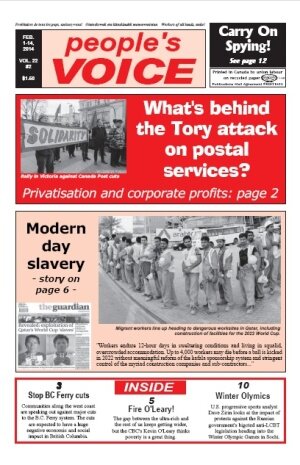
PEOPLE'S VOICE FEBRUARY 1-14, 2014 (pdf)
People’s Voice 2014 Calendar
”The Truth About the Great War”
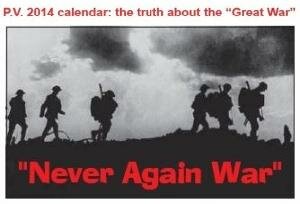
To order a copy of the People’s Voice 2014 Anti-First World War
Calendar, send $15 (includes postage and handling) to
People’s Voice, 706 Clark Drive, Vancouver, BC, V5L 3J1. Contact us at
604-255-2041 or pvoice@telus.net for bulk order prices.
|
People's Voice deadlines: February 15-28 March 1-15 Send submissions to PV Editorial Office,
|
REDS ON THE WEB
http://www.parti-communiste.ca/
peoplesvoice.ca
www.ycl-ljc.ca
www.solidnet.org
|
People's Voice finds many "Global Class Struggle" reports at the "Labour Start" website, http://www.labourstart.org/. We urge our readers to check it out! |
* * * * *
People's Voice
Canadian Publications Mail Sales Product Agreement #205214
ISSN number 1198-8657
People's Voice is published by
New Labour Press Ltd
PV Editorial Office
706 Clark Drive,
VANCOUVER, B.C. V5L 3J1
Phone:604-255-2041
Fax:604-254-9803
email: pvoice@telus.net
Editor: Kimball Cariou : Business Manager: David Au
Editorial Board: Kimball Cariou, Miguel Figueroa,
Doug Meggison, Naomi Rankin, Liz Rowley, Jim Sacouman
* * * * * *
Letters
People's Voice welcomes your letters
on any subject covered in our pages.
We reserve the right to edit for length and clarity,
and to refuse to print letters which may be libellous
or which contain unnecessary personal attacks.
Send your views to:
"Letters to the Editor",
706 Clark Dr., Vancouver, BC V5L 3J1,
or pvoice@telus.net
People's Voice articles may be reprinted without permission,
provided the source is credited.
* * * * * *
The Communist Party of Canada, formed in 1921,
has a proud history of fighting for jobs, equality, peace,
Canadian independence, and socialism.
The CPC does much more than run candidates in elections.
We think the fight against big business and its parties
is a year-round job,
so our members are active across the country,
to build our party and to help strengthen people's movements
on a wide range of issues.
All our policies and leadership
are set democratically by our members.
To find out more about Canada's party of Socialism,
give us a call at the nearest CPC office.
* * * * * *
Central Committee CPC
290A Danforth Ave Toronto, Ont. M4K 1N6
Ph: (416) 469-2446
fax: (416) 469-4063 E-mailmailto:info@cpc-pcp.ca
Parti Communiste du Quebec (section du
Parti communiste du Canada)
5359 Ave du Parc, Montréal, Québec,
H2V 4G9
B.C.Committee CPC
706 Clark Drive, Vancouver, V5L 3J1
Tel: (604) 254-9836
Fax: (604) 254-9803
Edmonton CPC
Box 68112, 70 Bonnie Doon P.O.
Edmonton, AB, T6C 4N6
Tel: (780) 465-7893
Fax: (780)463-0209
Calgary CPC
Unit #1 - 19 Radcliffe Close SE
Calgary AB, T2A 6B2
Tel: (403) 248-6489
Ottawa CPC
Tel: (613) 232-7108
Manitoba Committee
387 Selkirk Ave., Winnipeg, R2W 2M3
Tel/fax: (204) 586-7824
Ontario Ctee. CPC
290A Danforth Ave., Toronto, M4K 1N6
Tel: (416) 469-2446
Hamilton Ctee. CPC
265 Melvin Ave., Apt. 815
Hamilton, ON.
Tel: (905) 548-9586
Atlantic Region CPC
Box 70 Grand Pré, NS, B0P 1M0
Tel/fax: (902) 542-7981
http://www.parti-communiste.ca/
* * * * * *
News for People, Not for Profits!
Every issue of People's Voice
gives you the latest
on the fightback from coast to coast.
Whether it's the struggle for jobs or peace, resistance to social cuts,
solidarity with Cuba, or workers' struggles around the world,
we've got the news the corporate media won't print.
And we do more than that
- we report and analyze events
from a revolutionary perspective,
helping to build the movements for justice and equality,
and eventually for a socialist Canada.
Read the paper that fights for working people
- on every page, in every issue!
People's Voice
$30 for 1 year
$50 for 2 years
Low-income special rate: $15 for 1-year
Outside Canada $50 for 1 year
Send to: People's Voice, 706 Clark Drive, Vancouver, BC, V5L 3J1
You can call the editorial office at 604-255-2041
REDS ON THE WEB
http://www.parti-communiste.ca/
http://www.ycl-ljc.ca/
http://www.solidnet.org/
(The following articles are from the February 1-14, 2014, issue of People's Voice, Canada's leading socialist newspaper. Articles can be reprinted free if the source is credited. Subscription rates in Canada: $30/year, or $15 low income rate; for U.S. readers - $45 US per year; other overseas readers - $45 US or $50 CDN per year. Send to People's Voice, c/o PV Business Manager, 706 Clark Drive, Vancouver, BC, V5L 3J1.)
1) EU POSTAL PRIVATIZATION: THE FUTURE FOR CANADA?
Special to PV, based on a report by Christoph Hermann, in http://www.globalresearch.ca
Virtually everywhere in the major capitalist countries, the drive towards privatization of formerly public assets continues to wipe out jobs, services, and government revenues. The "restructuring" of Canada Post announced in December follows a similar pattern, leaving the door wide open for private delivery companies to expand even further into this sector of the economy.
A look at the European Union helps to understand where this trend is leading.
The final elements of the old national postal delivery monopolies are being eliminated across the EU, concluding a lengthy process of the "liberalization" of postal services. While the "letter markets" are still dominated by the former national post companies (some of which have been privatized), new competitors are gaining ten per cent of the market share or more, with negative results for the public, small business, and postal workers.
The traditional post office network has been largely replaced with private partners such as grocery stores or gas stations, offering a reduced range of services. In Germany and the Netherlands, the former national companies have given up their own postal outlets.
With few exceptions, the new competitors emerging from the liberalized market never opened post offices or installed letter boxes. Instead they pick up mail directly from their large corporate customers, and typically deliver only two or three days a week in highly populated areas.
Prices for large customers such as banks, telephone companies and online retailers have decreased, since they can negotiate individual rebates. But standard mail costs have increased in a number of countries. Even so, in spite of automation and drastic cuts in labour costs, several former national companies are struggling to break even, because of decreasing letter volumes and market losses to new competitors.
The only delivery businesses doing well have a major stake in the booming parcel and express services market, such as Deutsche Post with its subsidiary DHL Express.
Postal liberalization has not improved services and reduced prices. Instead, liberalization has produced a few winners - private shareholders of former public monopolies, managers and large customers - and many losers, including private households (especially in rural areas), and postal workers.
Liberalization has reduced employment dramatically since the late 1990s. In some cases, the job cuts amount to as much as 40-50 per cent, and typically for 20 to 30 per cent. Contrary to the European Commission's prediction, these job cuts were not offset by job growth among new market entrants.
In the Netherlands, 34,000 near‑full‑time jobs were lost at Dutch Post compared to 22,000 part‑time jobs created by the new competitors. In Germany, 38,000 mostly full‑time jobs have been wiped out in the letter market since 1999, while the new market entrants have created 16,308 full‑time equivalent jobs. In Sweden, 1,740 full‑time equivalent jobs were created by the new competitors, but 12,000 jobs were lost at Swedish Post between 1998 and 2008. In Spain, 4,000 full-time job losses are "balanced" by an equal number of mostly part-time jobs created by the new competitors.
The former national post companies have increased the proportion of part‑time workers. Dutch Post has shifted to a mail delivery model based on 85 per cent of the workforce employed on part‑time contracts. In Cyprus and Lithuania, nearly 60 per cent of workers employed at the former national post companies work part‑time, and in Latvia and Luxembourg about 40 per cent.
Part‑time work is even more widespread among the new competitors. In Germany and Spain, the new market entrants mainly operate with staff who often work less than half‑time jobs. In the Netherlands, the new market entrants hire mainly "self-employed" workers for just a few hours per week.
In Austria, new market entrants almost exclusively operate with "self‑employed" mail deliverers. Workers in this category account for slightly more than 50 per cent of the new competitors' workforce in Poland. "Self‑employed deliverers" suffer from a lack of employment protection and social security, and are also paid extremely low, piece‑rate‑based wages.
In the parcel and express service industry, much of the workforce are self‑employed drivers paid at piece rates. Both the new companies and the former national post companies contract "service partners" who, in turn, hire self‑employed drivers to carry out the delivery tasks. In 2010, 85 per cent of the parcels sent through Dutch Post were delivered by subcontractors.
Some former national companies also use temporary employment, including Malta (where 32 per cent of the workforce of the former public postal company are employed on a temporary basis), Estonia (21 per cent), Greece (18 per cent), Poland and Ireland (14 per cent), the Czech Republic (13 per cent), Finland (12 per cent), and Portugal (9 per cent).
Some former national companies cut wages for workers hired after a certain date in the liberalization process (in Germany minus 30 per cent after 2001, in Austria minus 25 per cent after 2008). In others, wage cuts were decreed for new job categories, such as assistant or auxiliary mail deliverers, who earn 40 percent less in the Netherlands.
The wages paid by the new competitors are usually still lower than the reduced wages of the former national companies. In Germany and Austria, the difference is about 30 per cent, while in Spain it may have risen to 50 per cent since the economic crisis.
Liberalization and new surveillance technology have led to a far‑reaching deterioration of working conditions. This includes the extension of delivery routes, and under‑staffing in post offices and sorting centres.
In the parcel and express service industry, self-employed deliverers need to cope with unforeseen difficulties, and also from working hours of up to 15 hours per day.
2) CHARGES DEMANDED IN BURNS LAKE EXPLOSION
By Kimball Cariou
The decision against laying charges in the Jan. 2012 explosion which killed two workers and severely injured 20 others at Babine Forest Products in Burns Lake has sent shockwaves across British Columbia.
A ten-month investigation by WorkSafe BC ultimately led to a report to Crown counsel, "for consideration of charges under the Workers' Compensation Act." The findings of the investigation made it clear that the explosion was preventable, and that the owners of the sawmill had failed to take the necessary steps to prevent the deaths of Robert Luggi and Carl Charlie.
But B.C.'s Criminal Justice Branch declined to charge the principal owner, Hampton Affiliates of Portland, Oregon, claiming that the supposed "inadmissibility" of some evidence gathered by investigators made a conviction less than certain.
In response, B.C. Federation of Labour President Jim Sinclair urged significant steps to restore confidence in worker protection in British Columbia.
The investigation report clearly shows the incident was preventable, that risks were known and that necessary measures were not taken, said Sinclair, yet the crown rejected the recommendation to lay charges.
Sinclair called on Premier Christy Clark to ensure a full public review of the matter. He also demanded the imposition of maximum penalties under the Workers' Compensation Act, and that the Criminal Justice Branch, the WCB and the BC Safety Authority should report within six months on a new process to ensure investigations into workplace incidents are conducted in a thorough, timely and effective manner, resulting in charges where warranted.
"Unless these steps are taken, and effective cooperation between agencies results, worker safety will remain compromised in our province," said Sinclair.
WorkSafe BC, assigned to prevent and investigate injuries, illness and disease at 500,000 workplaces across the province, describes itself as an independent body governed by a board appointed by the province.
As a recent Vancouver Sun editorial says, "At the Burns Lake sawmill, a team of 30 investigators found a horror story of unsafe conditions."
Problems included an ineffective dust collection system at the sawmill, inadequate inspection and maintenance, and poorly trained supervisors.
And yet the Crown counsel was more concerned about whether the investigation complied with the Charter of Rights and Freedoms, and other statutory and legal requirements. This despite the fact that WorkSafe BC staff have used the same investigative methods for at least the last decade.
The Sun editorial continues, "B.C. workers, and families of those who died or were injured, must now wonder why the rules regarding evidence gathering suddenly changed in the case of the Burns Lake accident. And were the investigators given notification of such a change beforehand? In other words, who is responsible for the current situation in which a mill was found to be operating in an unlawful and reckless manner, resulting in death and/or injury to 22 B.C. workers and where no charges can be laid? Are the rules regarding the gathering of evidence in WorkSafe BC investigations clear even today? And what remedy can now be sought against the mill owners who clearly bear responsibility for the January 2012 disaster?"
Premier Clark quickly appointed her deputy, John Dyble, to carry out an investigation, but this will not bring justice to the families and co-workers of those killed and injured in Burns Lake.
In fact, the roots of this tragedy go much deeper than the crimes of individual sawmill owners, reflecting the patterns of capitalist extraction of resources in North America over the past two centuries.
As revealed in the ground-breaking "Empire of the Beetle" by environmental journalist Andrew Nikiforuk, the over-harvesting of old growth forests along the west coast brought unexpected consequences, including the unchecked pine beetle infestations which have killed billions of trees.
The B.C. government has encouraged companies to harvest beetle‑infected trees before they crumble into stumps. But as experts now agree, processing such trees creates a finer form of sawdust, with far more potential for the 2012 explosions which destroyed mills in Burns Lake and Prince George.
In other words, the scramble for forestry profits which began over a century ago leads directly to the deaths of Robert Luggi and Carl Charlie. But no corporate executive will face jail time for these crimes against workers and the environment.
3) MAKE CORPORATE CRIMINALS PAY FOR SAWMILL DEATHS
BC Committee, Communist Party of Canada, Jan. 25, 2014
It is shocking and unacceptable that criminal charges will not be laid in the 2012 explosion at Babine Forest Products in Burns Lake. The BC Committee of the Communist Party of Canada demands immediate action against those who bear responsibility for the deaths of two workers and the injuries of 20 others.
The claims by Crown counsel that charges should not be laid because of perceived shortcomings in the investigation certainly point to a resistance against holding corporate interests accountable for their actions. This is unfortunately not surprising in British Columbia, where employers rarely face serious consequences for workplace deaths, injuries and diseases.
The thorough investigation into the Burns Lake catastrophe by WorkSafe BC made it clear that the owners of Babine FP failed to take steps to avoid a preventable explosion. Their failure to install and maintain an efficient dust collection system led directly to the deaths of Robert Luggi and Carl Charlie. There is no other possible conclusion - given the strong evidence that the owners are guilty of homicides, they should face appropriate legal charges, and the maximum penalties available under the Workers' Compensation Act.
The BC Committee CPC agrees with the BC Federation of Labour, which has called for swift action to reassure the public that investigations into workplace deaths will be carried out swiftly and competently, with charges whenever warranted. The health and safety of the workers of British Columbia must have a higher priority than protection of corporate profits, not the other way around.
Fearful of the political blowback from this situation, Premier Clark has appointed her deputy, John Dyble, to conduct another investigation, but this will not lead to criminal charges. This process is therefore simply a face-saving exercise for Christy Clark, who is in truth the "Corporate Premier" of B.C., not the "family premier" as she claims. We call upon Clark to use her powers to bring the Babine Forest Products owners to justice.
4) MINIMUM WAGE CAMPAIGN PRESSURES ONTARIO LIBERALS
With files from RY Ontario
In Ontario over the last several months, the "Campaign to Raise the Minimum Wage" has built considerable pressure on the Wynne Liberals to raise the minimum wage to $14/hr from their current poverty rate of $10.25.
On the Jan. 24‑25 weekend, activists, local campaigns and supporting organizations convened in Toronto to discuss the way forward and hear from successful campaigns in the United States.
Under the slogan, "Fair Wages Now", and "You deserve a raise", the campaign has been successful in organizing days of actions around different themes on the 14th of every month, in dozens of communities, for the past several months.
Recently the Toronto Star has come out in favour of the raising the minimum wage, and the "Minimum Wage Advisory Panel" which was created by the Wynne Liberals almost a year ago, is expected to report their findings. The campaign has been focusing much of its message on the panel, and it hopes that their recommendations will be adopted.
While the public has rallied around the demands of the campaign, and it has unified grassroots poverty and labour activists across the country with a success that is rare in Ontario, there is still a battle to make sure that Wynne and her government can't shelve the report and shut out the campaign with the buzz of an election, where it looks like none of the major parties are supporting the demands of the campaign.
How can we take it to the next level and build a very successful campaign into a movement that can't be ignored by the parties in Queen's Park - the very parties who are supported by large employers who benefit from poverty wages. It's possible, but requires even greater militancy and unity from the campaign, anti‑poverty groups and the labour movement as a whole across Ontario. It is also important that if an election is called, that the campaign step up its work, and resist the tendency to give up its independent voice to a lesser‑evil political party, that ultimately won't deliver on the demands of the campaign.
The guests from south of the border attending the meetings included representatives from the historic "Fight for 15" fast‑food worker strikes, and from "Working Washington" which recently won a $15/hr wage at the Seattle‑Tacoma airport.
Join the fight for a $14 minimum wage! Get in touch with the campaign through the website www.raisetheminimumwage.ca or find your local chapter.
People's Voice Editorial
In Conservative cowardly fashion, the news of huge service cuts and layoffs at Canada Post was revealed just before Christmas, the most difficult time of the year to mobilize public anger. Now, resistance is building against the federal government's attack, including rallies, town hall meetings, petition campaigns, letters to the editor and to MPs. But much more is needed, because time is short, and because the stakes are so high.
The Harper government is trying to frame their vicious decision as something "forced" by factors beyond anyone's control. The losses would be staggering, they claim, and "nobody sends mail anymore." And anyway, seniors and people with disabilities have been begging the Prime Minister for a reason to get out and exercise on icy sidewalks in the middle of winter.
This is just noise and lies. The truth is that right-wing governments in most capitalist countries have been deliberately attacking public mail delivery for over a decade, with predictable results: declining service, higher costs, massive layoffs, lower living standards... and higher corporate profits. The real agenda is to eliminate every aspect of public ownership, except of course for the repressive arms of the state (prisons, courts, the armed forces, surveillance agencies) - and even these may end up being sold to private interests.
The assault on the public sector is well underway in Canada. We have to draw a line in the snow, before we lose universal medicare, public pensions, and much, much more. The fight to save Canada Post should become that line. We call on every People's Voice reader to get union locals and community groups to pass resolutions, to circulate CUPW's petitions in neighbourhoods, workplaces and classrooms, to flood MP's offices with calls and letters, all raising the demand: Save Canada Post!
People's Voice Editorial
British Columbia teachers have won a major court victory, with implications across Canada. In a Jan. 27 ruling, the BC Supreme Court restored collective agreement provisions stripped in 2002 under then‑premier Gordon Campbell, whose Education Minister was Christy Clark, the current premier. The province was also ordered to pay the BC Teachers Federation $2 million in damages plus court costs.
This has been a marathon battle for the teachers, targetted by the Liberals since Campbell was elected in 2001. The 2002 legislation was already declared unconstitutional in 2011, when a judge found that by removing class‑size limits and class‑composition guarantees, the government had damaged learning conditions in schools across British Columbia. The Liberals were given one year to restore the bargaining rights illegally removed nine years previously. Instead, they arrogantly reintroduced the same unconstitutional provisions.
As the BCTF points out, children who were in kindergarten when the bills were passed are now in Grade 12, having spent their entire school careers in larger classes with fewer resources. The legislation removed provisions that guaranteed smaller classes, support for students with special needs, and services from teacher‑librarians, counsellors, and other specialists. The contract‑stripping allowed the government to slash hundreds of millions of dollars from education budgets, forcing school boards to cut programs, close more than 200 schools, and eliminate 3,500 teaching positions.
Whenever pro‑corporate governments engage in similar illegal union‑bashing, this ruling provides a useful weapon to fight back, and to help build mass resistance. But it also appears likely that Premier Christy "Cutback" Clark, still a bitter enemy of public education, will appeal the ruling. In the meantime, provincial spending annually per student in British Columbia remains a shocking ninth out of ten provinces, and a shameful $1000 below the Canadian average. This fight is a long way from finished.
7) B.C. COMMUNISTS SLAM FERRY SERVICE CUTS
Starting in April, British Columbia residents face yet another increase in costs to take the ferry system, plus a wide range of service cuts on many routes. The announcement has sparked wide public opposition, especially since it comes in the wake of major fare increases and steep decline in ridership in recent years. Protest rallies have been held in a number of coastal communities, especially in areas which rely largely on the ferry system for personal travel and delivery of goods.
The BC Committee of the Communist Party has released the following statement, condemning the attack on the ferry system.
"The decision by the British Columbia Liberal government and the BC Ferry Corp. to slash services on many so‑called `minor routes', and to eliminate free sailings during Monday to Thursday each week for seniors, will cause enormous hardships to the people of this province, while bringing paltry benefits to taxpayers. In fact, these cutbacks will likely create economic losses far outweighing the supposed savings which are the justification for this announcement.
"We join with groups and individuals across British Columbia demanding the cancellation of these changes. In our view, the coastal and inland ferry system of BC must be treated as an extension of the highway system, i.e. as an essential public service for the people of this province, not as a `for sale' operation geared to squeeze a profit out of each route.
As with the highway system, residents of British Columbia have historically made important life decisions about where to seek employment and to live, based largely on access to regular, reliable, affordable transportation routes. For decades, working people in this province have contributed to the economy through their employment in a wide range of industries along the coast, depending on the ferries to get to work, school, and community facilities.
"This remains true today, even when some industries have shrunk, especially as the importance of tourism becomes more significant. It is particularly unfair and unjust to treat coastal residents in this way, by imposing cuts which will have huge consequences on their communities, all for the sake of arbitrary budget decisions.
"These cuts will severely impact the ability of residents of many communities to get to crucial medical appointments within one day, or to send sports teams or cultural groups to other communities. The cuts will further devastate the tourism sector on Vancouver Island and other coastal regions, which already suffer from reduced numbers of visitors due to skyrocketing ferry rates. And to add insult to injury, the cuts are being imposed by a top‑heavy BC Ferries bureaucracy, loaded with high‑paid managers.
"The latest announcements are an ominous signal to the workforce at BC Ferries, who can expect layoffs and a determined corporate/government attack on their wages and working conditions in the next round of collective bargaining. The Liberal government is gearing up for a push to convince the public that the hard‑working, skilled workforce of BC Ferries, those with serious responsibilities to transport passengers, vehicles and goods safely under all types of conditions, are somehow the cause of the system's financial problems. The real truth is that the economic losses of BC Ferries are mainly caused by the decline in passenger numbers following years of sharp rate increases.
"We demand that all the current ferry sailings be protected, that the plan to impose charges for seniors during Monday to Thursday be cancelled, and that the government take urgent steps to increase ridership, including by a moratorium on any rate increases as a first step towards reductions. We also extend solidarity to our sisters and brothers who work at BC Ferries, as they prepare to defend their jobs, incomes and working conditions in the next round of collective bargaining."
8) "FIRE O'LEARY" CAMPAIGN CONTINUES
Rebel Youth magazine is renewing its call to fire CBC economic commentator Kevin O'Leary after comments made on Jan. 21 about growing global social inequality.
Responding to co‑host Amanda Lang's summary of an new report by Oxfam which notes that the 85 richest people on the planet have as much wealth as the poorest 3.5 billion people, O'Leary said: "It's fantastic. And this is a great thing because it inspires everybody, gets them motivation to look up to the one per cent and say, `I want to become one of those people, I want to fight to the get up to the top.' This is fantastic news and of course I applaud it. What could be wrong with this?"
Oxfam is an international anti‑poverty NGO. Its report "Working for the few," confirmed that almost half of the world's wealth is now owned by just one percent of the population.
Ishmael Daro of the news site The Albatross broke the story and recorded a Youtube video below which received close to 10,000 views in less than 24 hours.
On the clip O'Leary calls the report "a celebratory stat, I'm excited about it, wonderful to see it happen" and says "I love capitalism!" adding: "Don't tell me that you're going to redistribute wealth again, that's never going to happen."
"What value [O'Leary] possibly provides to the CBC is entirely unclear. Either nobody watches the Lang & O'Leary Exchange to catch this routine stupidity or management is purposely destroying the CBC," Daro wrote on The Albatross.
Oxfam documents how seven out of ten people live in countries where economic inequality has increased in the last 30 years, a "massive concentration of economic resources in the hands of fewer people" which means "governments overwhelmingly serve the interests
of economic elites to the detriment of ordinary people."
"That monopoly capitalism undermines democracy and social well‑being is, of course, a suggestion which fits with the long‑standing analysis of our magazine," says Rebel Youth. "The reality that working people socially produce all the wealth in society but do not control the results of their labour which is privately accumulated has been consistently exposed by Marxists who describe this relationship of `we make it, they take it' as exploitation and the main contradiction of capitalism."
Perhaps ironically the Oxfam report still sets out to defend capitalism, quoting Adam Smith and claiming that "Some economic inequality is essential to drive growth and progress, rewarding those with talent, hard earned skills, and the ambition to innovate and take entrepreneurial risks."
But Oxfam's picture in its new report can't hide the reality today ‑ an emergency situation with the global capitalist economic crisis which is very difficult to hide, despite continued claims of "economic recovery" just around the corner ‑ capitalism is crisis.
Rebel Youth says that "O'Leary's role as a commentator on CBC is to peddle cheap lines defending the boss class and their capitalist system, presented as news from a expert TV personality ‑ and for that reason we urge all our readers to sign the petition to get him off the air."
Check out the petition at www.change.org/en-CA/petitions/cbc-fire-kevin-o-leary.
The Rebel Youth website is www.rebelyouth-magazine.blogspot.com.
9) NEW REPORT DISMANTLES U.S. ACCUSATION AGAINST SYRIA
By Kimball Cariou
The corporate media in Canada has ignored revelations exposing the U.S. claim that the Syrian military fired rockets carrying poison sarin gas into a Damascus suburb last August 21.
From the moment the accusations were made, many observers were extremely dubious. The gas attack killed hundreds of people, at a time when the Syrian government and armed forces were winning important successes against mercenaries backed by the NATO alliance and reactionary Gulf Arab regimes. Why would Syria pick such a moment to risk provoking a U.S. attack?
The incident invited comparison with the lies spread by the Bush regime about non-existent "weapons of mass destruction" to justify the 2003 destruction of Iraq. The extent of foreign involvement in the war against Syria pointed to a strong possibility that the gas attack may have been an attempt by the "rebels" to lure the U.S. into launching missiles. That strategy failed, in the wake of massive public skepticism in Britain and the United States.
Now, the McClatchy news service reports that "a team of security and arms experts, meeting ... in Washington to discuss the matter, has concluded that the range of the rocket that delivered sarin in the largest attack that night was too short for the device to have been fired from the Syrian government positions where the Obama administration insists they originated."
Apparently, the rocket in question, said to be an improvised 330mm to 350mm rocket equipped with a large receptacle on its nose to hold chemicals, did not appear in the Syrian government’s declaration of its arsenal to the Organization for the Prohibition of Chemical Weapons.
Washington continues to claim that Syrian government forces could have used such a rocket.
But the authors of a report released on Jan. 15 said that it would have been impossible for the rocket to have been fired from inside areas controlled by the government of Syrian President Bashar Assad.
Titled "Possible Implications of Faulty U.S. Technical Intelligence," the report fingers a major weakness in the Obama administration's call for military action.
President Obama later withdrew his request for congressional authorization for a military strike, after Syria agreed to submit to the Chemical Weapons Convention.
The report focuses on one key target of the attacks, the suburb of Zamalka, where the largest quantity of sarin was released. Relying on mathematical projections about the likely force of the rocket, and noting its awkward design, the authors conclude that the rocket likely had a maximum range of two kilometers, far short of the necessary range of at least six kilometers.
The authors used a map produced by the White House, showing which areas were under government and rebel control on Aug. 21 and where the chemical weapons attack occurred. Drawing circles around Zamalka to show the range from which the rocket could have come, the authors conclude that the likely launching points were inside rebel‑held or disputed areas.
Theodore Postol, a professor of science, technology and national security policy at the Massachusetts Institute of Technolog, explained, "My view when I started this process was that it couldn't be anything but the Syrian government behind the attack. But now I'm not sure of anything. The administration narrative was not even close to reality. Our intelligence cannot possibly be correct."
The second author, former UN weapons inspector Richard Lloyd, disputed assumptions that the rebels are incapable of making rockets. "The Syrian rebels most definitely have the ability to make these weapons," he said. "I think they might have more ability than the Syrian government."
Both rejected U.S. Secretary of State John Kerry's insistence that satellite images had shown the impact points of the chemical weapons. The charges that detonate chemical weapons are too small, they said, to be visible in a satellite image.
"What, exactly, are we spending all this money on intelligence for?" Postol asked.
www.mcclatchydc.com/2014/01/15/214656/new-analysis-of-rocket-used-in.html#storylink=cpy
10) "KHALISTAN MOVEMENT" - THE BRITISH HAND
By B. Prasant, PV correspondent in India
The lanes and by‑lanes of the town of Amritsar in the Punjab were not quite deserted that fateful evening in 1981. I crept along hugging the dilapidated brick‑made boundary wall of a large single‑storey house, my trusty Minolta 101 at the end of my upthrust left arm, clicking away blindly.
I was shooting at a large column of oddly jungle‑camouflaged Indian army troops who crept along the far side path of the curving street, nervous fingers shivering along the trigger‑guards of the British‑made sten guns crooked in their arms. There was a sudden burst of gun fire from some roof top. The army column halted and the officers went into a huddle.
The smell of gunpowder hung acrid in the summer evening air. The Khalistan movement was raging across north India, with hundreds killed almost every week. What could have enraged the very stable and courageous community of the Sikhs, dubbed as one of the martial races over the centuries?
My mind went back to my childhood days when I lived in a large middle bourgeois household in north‑central Calcutta. Our large and strapping chauffeur, the young Gurudev Singh, was the only man other than my father and uncles who was allowed into the andar-mahal (inner sanctorum) of the household, talking to the women and asking for the inevitable shopping lists of daily necessities.
I recalled the brave role of kirpan‑brandishing groups of Sikhs on powerful motorbikes, saving men and women of both the majoritarian communities in Calcutta during the successive riots we had in the sixties, seventies, and eighties.
What had made the Sikhs go violent? The answer lies with the negotiated settlement called independence, which was handed over to India on a platter of platitudes by the Sandhurst man, Lord Mountbatten, to the Oxford‑educated Nehru.
Linguistic states were set up across India. Only the Sikhs were asked to be satisfied with what at least one right‑wing Congress party leader called the truncated and moth‑eaten remnants of Sikhdom. The Sikhs began by politely petitioning the Nehru government to expand into the Punjab, where Punjabi was spoken and where the Punjabis had migrated after being driven out in a bloodbath from Pakistan.
When this was not properly done, the Sikhs started to agitate under the Akali Dal, which however had its allied loyalties to Congress and the centre‑right groups in Delhi. The failure of the Akali Dal led other frustrated Sikh groups to the point of demanding semi‑autonomy for the expanded Punjab.
This was the start of the movement for a separate, semi-independent state called Khalistan, by the Sikhs in particular and Punjabis in general. Khalistan means "land of the chaste." In an unfortunate turn, extremists among the Sikh leadership wanted Khalistan to be a theocratic entity, clashing with the existing religious groups as well as the state.
Terrorist elements soon took over. The killings of non‑Sikhs started, as did those of Sikhs by "low‑caste" communities of the majoritarian groups. There was indescribable violence on every side. The federal government, now under Indira Gandhi, deployed the Army and gave it a free hand. A hellish "Lebanese" situation developed in the entire sweep of north and central India.
Then an unfortunate event occurred in 1984. Under circumstances yet to unravel fully, Indira Gandhi was found dead, ridden with bullets inside her residential complex. One of her two bodyguards killed the other. The Indo‑Tibetan border police officer guarding the complex killed the first bodyguard. All three were Sikhs with a high sense of loyalty to the prime minister, to the extent they were distrusted by the Sikhdom in general.
A fourth Sikh Army man was found on the spot, quickly brought to justice, and later hanged. Waves of killers spread out, under the overt and covert encouragement of the then majority political party, and in the space of two weeks 84,000 Sikhs were dead.
These events came just months after the Army, determined to deal a final blow to the theocratic centre of the Sikhs, attacked the Golden Temple of Amritsar and destroyed the Akal Takht, one of the seats of temporal‑physical authority of the Sikhs. Close to four thousand Sikhs and a few Armymen died in this "Operation Blue Star".
There was a sharp repercussion in the Hindi heartland. Burst after burst of killings on all sides took place ‑ women and children as soft targets suffered most. The riots continued well into the 1990s. The Sikhs then gradually withdrew from all parts of India and considered it safe only in the Punjab, a sad story.
Recently, documents have been leaked that Margaret Thatcher's government facilitated and aided the Congress government to plan and execute Blue Star. The documents show that India sought the help of British intelligence, especially the SAS, to chalk out a plan to "oust the Sikhs" from the Golden Temple.
Accordingly, an SAS operative, maybe a team of officers, visited India and drew up a plan that the Indian Army subsequently put into operation. There is a possibility that a team of SAS officers took part in the op itself. According to Army veterans we spoke to, the SAS in camouflage and visors carried dozens of RPGs and gas explosives which they used with deadly effect. Two letters that have appeared have put paid to all chances of the Congress getting into a denial mode about the role of the SAS.
The first letter from Thatcher's P.A. to the Indian Prime Minister talks about sending advisers to aid the government in occupying the Golden Temple. The second letter talks glibly about the possible role of the SAS in the op that was to be unleashed 'shortly' on the unsuspecting Sikh religious men and women and on others who reside in the Golden Temple. The officer then requests the Indian PM that the role of the SAS, if known to the public, would enrage the Indian community in the UK and elsewhere with "possible domestic implications."
Sikh communities in the sub‑continent and those forming the diaspora in Great Britain, Canada, Australia, New Zealand, South Africa, and the US have registered their strong protest over the dastardly events that have now come to light. Prime Minister Cameron's "inquiry" will do little assuage the hurt feelings of the Sikh community, and of all the right‑thinking people of the sub‑continent and beyond.
11) WHAT'S REALLY GOING ON IN UKRAINE?
This excerpt from a commentary by Andy Dilks on the Global Research website www.globalresearch.ca gives a perspective on events in Ukraine which is very different from that found in the Canadian corporate media.
... The problem with the "popular protests against the government and for integration into the EU" narrative is that it omits crucial information regarding the role of the West is fomenting and orchestrating demonstrations such as these; a role which illuminates broader geopolitical objectives in the region and the extent to which intelligence agencies and their offshoot organizations meddle in the affairs of sovereign nations...
The seemingly spontaneous 2004 Ukrainian "Orange Revolution", sparked by alleged electoral fraud and allegations of voter intimidation, was led largely by a number of grassroots movements tied to political activists and student groups. Many of the groups involved, however, were funded and trained by organizations intimately linked to the US government. The foreign donors of these groups included the US State Department, USAID, the National Democratic Institute for International Affairs, the Open Society Institute and the National Endowment for Democracy.
The candidate who emerged victorious in the wake of these widespread orchestrated protests, Viktor Yushchenko, was not only endorsed by the same institutions which wielded their influence over the protest movements themselves, he was also supported by the International Monetary Fund...
It is tempting to automatically assume that the same process is taking place in Ukraine at the moment.... The widespread political support for the protesters in Ukraine and the lack of condemnation for their use of violence would certainly add to the view that these protests are at least tacitly backed by the West, if not outright orchestrated. While none of this constitutes "proof" of outside interference, at the very least it is enough to raise suspicions. On the other hand, without firm evidence it is perhaps equally plausible that the support for the protesters is simply a case of making political capital out of the situation, stoking the flames of an already lit fire.
As the violence on the streets of Kiev continues, already spreading away from the capital, the Russian State Duma recently passed a resolution slamming foreign politicians and other players for interfering in Ukrainian internal affairs in an attempt to escalate the conflict. It's a marked contrast to the rhetoric emerging from Washington and the EU, both of whom have expressed the possibility of intervening, with the US adopting a stance which hints at another planned "regime change" on Russia's doorstep.
Perhaps the most damning indictment of the West's stance over Ukraine and their support for what they refer to as a "pro‑democracy protest movement" is the profoundly anti‑democratic leanings of the violent protestors at the vanguard of the assault on the Ukrainian authorities. Anyone familiar with the crisis in Syria and the attempts to topple President Assad will be all too familiar with the US's willingness to get into bed with extremists of the worst possible nature in order to achieve their objectives.
In Ukraine today it appears that very little has changed. Just as the Western‑backed Syrian rebels with intimate ties to al‑Qaeda were presented in our media as "pro‑democracy" organizations, so too are many of those protesting in Ukraine drawn from far‑right and fascistic groups such as the opposition Svoboda party, whom John McCain was more than happy to appear on stage with in December 2013 and offer his - and by extension America's - support.
Yet it would also be wrong‑headed to characterize the protests in Ukraine as being led by far‑right extremists - many protesters are taking to the streets through genuine and legitimate grievances with the current government. The danger lies in these moderate protesters allying themselves with those on the far‑right - combined with tacit support from the US for the likes of the Svoboda party, it could be a concoction which would set the stage for a dictatorship far more corrupt and repressive than those currently clinging onto power.
With the geopolitical stakes as high as they are, not least with the potential for a broader NATO influence in the region, it would be wise to view the situation in Ukraine through the wider prism of the global balance of power and all that this entails. Equally, we should be wary of simplistic media narratives which seek to paint any conflict in black and white/good vs. evil terms, particularly when the "good guys" are being backed by the US government and her allies. All too often this amounts to little more than propaganda designed to rouse support for opposition movements favourable to "regime change", and by now it should be very clear how little this has to do with vague, idealistic notions of "democracy", and how much it has to do with regional - and ultimately global - hegemony.
By Judy Haiven and Sid Shniad
Headlines in the news trumpet the fact that the Prime Minister has taken a group of 208 (!) supporters to Israel, many at Canadian taxpayers' expense.
Reading through the list is an eye‑opener. It includes 21 Jewish rabbis and more than 56 representatives from various Zionist lobbying groups and private Jewish schools. In addition, there are 10 representatives from evangelical Christian groups which unconditionally support the most extreme Israeli positions. The delegation includes members of these groups: the Christian Missionary Alliance of Canada, the Evangelical Fellowship of Canada, Trinity Bible Church, Crossroads Christian Communications, and the Pentecostal Assemblies of Canada.
The Prime Minister is also taking more than 27 chief executives of Canadian corporations, lawyers and two Canadian university presidents.
From his own government, the Prime Minister brings six cabinet ministers and eight Tory MPs. In addition, he gave free seats to former Tory cabinet minister Stockwell Day and his wife Valorie. Stockwell Day sits on the board of the Centre for Israel and Jewish Affairs (CIJA), the most prominent pro‑Israel lobbying group in Canada.
The rear of the plane was reserved for members of the media. The cost - $8,000 for the flight, hotel and ground transportation for each reporter or photographer covering Harper's trip - gives some indication just how much Canadian taxpayers will be on the hook for this political undertaking.
What will the Prime Minister's huge delegation do? There will be little of substance. But clearly that's not the real purpose of the trip, in any event. Harper's junket is designed to mark the beginning of an unsurpassed effort to align the Canadian government with one of the most aggressive, intransigent, hardline, expansionist governments in the history of Israel.
Why is Harper doing this? The PM is doubling down on his already unprecedented alliance with Benjamin Netanyahu in order to woo Jewish and Christian evangelist voters' support in Canada's 2015 federal election.
It's a pity that, having spent all of this taxpayer money on getting so many of his supporters on this junket, the PM doesn't do something really useful. What the PM should do is get the Israelis to stop expanding their settlements on the West Bank and remove them altogether because they are illegal under international law. The Jewish settlements are a major obstacle to a just and lasting peace. They are what is generating a rising tide of international opposition to Israel.
By ignoring Israel's transgressions and giving unconditional support to the government of Israel, the PM shames us all.
(Judy Haiven teaches at Saint Mary's University. Sid Shniad is retired research director of the Telecommunications Workers Union.
This commentary is from the website of Independent Jewish Voices-Canada, http://www.ijvcanada.org/2014/harpers-planeload.)
13) HUNDREDS OF MIGRANT WORKERS DIE IN QATAR
From the UK Guardian
The extent of risks faced by migrant construction workers building the infrastructure for the 2022 World Cup in Qatar has been laid bare by official documents revealing that 185 Nepalese men died last year alone.
The 2013 death toll, which is expected to rise as new cases come to light, is likely to spark fresh concern over the treatment of migrant workers in Qatar and increase the pressure on FIFA to force meaningful change. According to the documents the total number of verified deaths among workers from Nepal ‑ just one of several countries that supply hundreds of thousands of migrant workers to the gas‑rich state ‑ is now at least 382 in two years alone.
At least 36 of those deaths were registered in the weeks following the global outcry after the Guardian's original revelations in September.
The revelations forced FIFA president Sepp Blatter to promise that football would not turn a blind eye to the issue following a stormy executive committee meeting. Qatar's ministry of labour hired law firm DLA Piper to conduct an urgent review and Hassan al‑Thawadi, chief executive of the World Cup organising committee, said the findings would be treated with the utmost seriousness, vowing that the tournament would not be built "on the blood of innocents". The DLA Piper report is expected to be published in the coming weeks.
The Nepalese make up about a sixth of Qatar's two million‑strong population of migrant workers. Verified figures for the 2013 death rates among those from India, Pakistan, Sri Lanka and elsewhere have yet to emerge.
The Nepalese organisation working with the families of dead workers to repatriate their bodies and campaign for adequate compensation from the companies that employed them under the kafala sponsorship system said on Jan. 24 that FIFA should do more.
The Pravasi Nepali Co‑ordination Committee (PNCC), which has cross‑checked the figures from official sources in Doha against death certificates and passports, is still receiving new cases on a regular basis. There is evidence of at least a further eight cases, which would take the 2013 total to 193.
The PNCC called on FIFA's sponsors to reconsider their relationship with world football's governing body, which awarded the World Cup to Qatar in December 2010.
"FIFA and the government of Qatar promised the world that they would take action to ensure the safety of workers building the stadiums and infrastructure for the 2022 World Cup. This horrendous roll call of the dead gives the lie to those reassurances," said the PNCC. "These were young or otherwise able‑bodied men, with their futures in front of them, families at home and everything to live for. Many have been literally worked to death. Some have met with even more sinister ends. All have been betrayed by FIFA."
Last year 44 Nepalese workers died in Qatar between June 4th and August 8th, more than half of them of heart attacks, heart failure or workplace accidents. But the full list of deaths recorded during the year, collated by the Nepalese NGO from official sources and documents in Doha and seen by the Guardian, shows that the actual figure is much higher.
In June, July and August alone 65 deaths were recorded by the PNCC during summer months when temperatures can regularly top 40C. The causes included traffic accidents, blunt injuries and fractures ascribed to falls and suicide. But more than 65 of the deaths in 2013 are ascribed to "sudden cardiac arrests" and more than half to some kind of heart failure. Campaigners believe the cause of death is often officially listed as a cardiac arrest because it covers a "multitude of sins".
Asked last year by the Guardian why so many young Nepalese men died of heart attacks, the Qatari labour ministry said: "This question would be better suited for the relevant health authorities or the government of Nepal."
As long ago as 2011, FIFA said it would work with the International Trade Union Confederation to address labour issues with the Qatari authorities. "We have a responsibility that goes beyond the development of football and the organisation of our competition," FIFA secretary general Jerome Valcke said in November 2011.
But the ITUC has remained a strident critic of the lack of progress made by Qatari authorities on the issue, while groups including Human Rights Watch and Amnesty International have continued to highlight the appalling conditions suffered by some of the workers in a 165 billion Euro construction boom.
In November, Amnesty warned in a damning report that workers were enduring 12‑hour days in sweltering conditions and living in squalid, overcrowded accommodation. The ITUC has warned that up to 4,000 workers may die before a ball is kicked in 2022 without meaningful reform of the kafala system and stringent control of the myriad construction companies and sub‑contractors involved.
After last summer's report, Blatter travelled to meet the Emir of Qatar and declared it was "on the right track" in dealing with the issue. But following a meeting with the ITUC in Zurich a month later, FIFA said that "fair working conditions with a lasting effect must be introduced quickly".
The PNCC, which has painstakingly cross‑checked death certificates and other documentation with official records in Doha, said FIFA and the Qatari government needed to move faster: "FIFA president Sepp Blatter said in October there was 'plenty of time' to address this issue. For the labourers dying every week in Qatar to build the infrastructure to host Mr. Blatter's World Cup, there is no time left."
Attention is also turning to the role of FIFA's sponsors, with the PNCC joining calls for them to review their relationship with it. Visa and Adidas recently signed new deals until 2022. "Qatar's failure to disclose or explain these deaths, and FIFA's failure to monitor them, are alarming in the extreme. We call upon the World Cup's corporate sponsors ‑ Coca‑Cola, Adidas, Visa, Hyundai and Budweiser ‑ urgently to review their arrangements with FIFA," a spokesman said.
Last month the London mayor, Boris Johnson, travelled to Doha to drum up trade for British business. Foreign Office minister Hugh Robertson held talks with the Qataris aimed at boosting trade and said the UK would "offer support" in delivering the 2022 World Cup.
A spokesman for the Foreign Office insisted the issue of migrant workers was also raised. "Mr Robertson discussed the issue of migrant workers with the Qatari authorities during his recent visit," he said."
But the PNCC said that the flow of coffins returning to Kathmandu airport, which continued throughout December, even on Christmas Day, told its own story. "Thanks to the work of the Guardian and other media, this abuse is finally being exposed," said the PNCC spokesman.
"We call upon civilised governments as a matter of the greatest urgency to demand that Qatar takes meaningful action to protect foreign workers on its soil ‑ including reform of the kafala system of labour, which encourages employers to treat their workers as property rather than human beings."
The full list of deaths recorded between January and September 2012, also seen by the Guardian, shows that at least 127 Nepalese nationals died during that period and there are believed to have been at least another 70 fatalities during the final three months of that year.
Qatar is spending huge sums at home and abroad in an attempt to position itself as the diplomatic and business hub of the Middle East and secure its position politically and financially for the years ahead.
Qatari officials insist moves are being made to hold construction companies, and their myriad sub‑contractors, to existing labour laws, which they argue are among the strongest in the region.
Qatar's under‑secretary to the ministry of labour, Hussain al‑Mulla, has said that at least 99% of businesses are complying with the law. The ministry of labour says it is "committed to ensuring that all workers are treated in a fair and just manner".
The Qatar 2022 supreme committee, which is responsible for staging the World Cup and recently began work on its first stadium, pointed to its own workers' charter and said it was "committed to the wellbeing, health, safety, security and dignity of every worker".
"We anticipate 2014 being a big year for the supreme committee in terms of delivery, with up to five stadiums in various stages of construction. With this in mind, and as an evolution of the charter, we have worked hard to develop detailed workers' standards which will be enforced across all Qatar 2022 projects," a Qatar 2022 statement said.
"It has been our commitment and our belief from the first day of our bid to host the FIFA World Cup that we can utilise the power of football to accelerate positive social and human development across our country and our region."
14) WHAT WILL THE "BILLIE JEAN DELEGATION" MEAN FOR LGBT RIGHTS IN SOCHI?
The Winter Olympic Games opens Feb. 6 in Sochi, Russia. As always, the Olympics is more than a sporting competition, raising a wide range of social and economic issues. In the case of Sochi, these include the staggering expense ($50 billion to host the event in a sub-tropical region), allegations of immense corruption, displacement of much of the local population, the potential for terrorist attacks, and a frightening level of military security. The Sochi Olympics also take place in the context of Russia's recent anti-gay laws. This column by progressive U.S. sports analyst Dave Zirin examines this topic.
Anyone who opposes the draconian anti‑Gay laws in Russia, and supports the emerging movement of LGBT athletes in the sports world, should take serious note of the latest news out of Washington DC. President Barack Obama's White House has chosen their official delegation for the opening and closing ceremonies of the 2014 Winter Games in Sochi. For the first time since 2000, this group will not include a current or former President or Vice President. Instead, the faces representing of the United States will include out‑and‑proud tennis legend Billie Jean King and out‑and‑proud two‑time Olympic hockey player Caitlin Cahow. [NOTE - plus figure skater Brian Boitano, who came out after Zirin's column was published.]
Both King and Cahow are far more than just people who happen to be "part of the LGBT community." King has been a fearless activist over the course of decades on a host of issues from labor rights to women's reproductive freedom. On the issue of making sure Sochi is a platform of LGBT resistance she is as unafraid as one would expect, saying that she is not only "deeply honoured" to be part of the delegation but is also "equally proud to stand with the members of the LGBT community in support of all athletes who will be competing in Sochi... I hope these Olympic games will indeed be a watershed moment for the universal acceptance of all people."
King was chosen even though she made an explicit plea for athletes to defy the International Olympic Committee's decree against political statements in Sochi, saying in September, "Sometimes I think we need a John Carlos moment." This was a reference to the great 1968 Olympian who along with Tommie Smith raised his fist for civil rights on the 200 meter medal stand.
Caitlin Cahow's story is far less known than "the legend of Billie Jean" but she is also more than an athlete. Cahow is an activist who is part of what is known as the Principle 6 Campaign. This is a movement that aims to pressure the craven International Olympic Committee to actually enforce Principle 6 of its own charter which states, "Sports does not discriminate on grounds of race, religion, gender, politics or otherwise." Their work has already pushed the IOC to state that "otherwise" includes sexual orientation.
As Cahow has said, "The Olympics is a global celebration that belongs to all of us. Principle 6 is a way for everyone everywhere to celebrate the values that inspire the Olympic Games while showing their support for Russians suffering under Putin's human rights crackdown."
The appointing of King and Cahow is in so many respects a tribute to the movement over the past year of LGBT athletes to make sure the locker room no longer continues to be the last closet. It is also, let's be clear, a diplomatic power play by the Obama administration. The White House just delivered a thumb to the eye of a country that has challenged US hegemony in Syria and East Asia, and provided safe haven to NSA whistleblower Edward Snowden. There is a strong element here of the administration using LGBT rights like a pawn on a chessboard against a country that is more adversary than ally. It is hard to see it as anything else considering the lack of commentary from the Obama administration on ally India's recent anti‑LGBT legislation. In addition, this White House's own piss‑poor record in pushing The Employment Non‑Discrimination Act (ENDA) and the attendant fact that it is still legal in 29 US states to fire people on the basis of their sexuality, should be mentioned every time this administration speaks out for LGBT rights internationally.
The most important question however is whether this move by the Obama administration to send the "Billie Jean Delegation" will serve to make the situation on the ground better for LGBT people in Russia or will it just serve to open the door for more repression? Will this provide a pretext for Putin to maliciously say that LGBT activists inside Russia are just tools of the United States? Does the intervention in a grass roots movement by the world's number one super power create more or less oxygen for the brave people fighting for their freedom inside Russia? After the smoke has cleared and all the delegations have gone home from Sochi it is the only question that really matters.
15) MUSIC NOTES, by Wally Brooker
Saxophonist enters T.O. mayoralty race
Jazz musician Richard Underhill has entered Toronto's mayoralty race, stepping out with the emphatic issues‑oriented
slogan "may the best PLAN win." He's rightly sidestepped the divisive and misleading personality politics surrounding controversial neo‑con Mayor (and candidate) Rob Ford. Underhill is a Juno Award‑winning saxophonist and co‑founder of the Shuffle Demons, a popular jazz combo that combines funk, rap and avant-garde jazz with extravagant costumes. His platform contains a host of thoughtful and innovative proposals including: "Yes" to the Scarborough LRT; "No" to island airport expansion; more affordable housing, expanded TTC service, increased arts funding, more nutritional and recreational programs for kids and seniors, solar farms above TTC parking lots, and proportional representation. While he has little chance of winning, Underhill's campaign could have a positive effect on the outcome of the Oct. 27 vote. At the very least he'll help mobilize the arts community. He's promised to withdraw at some stage to support a "more viable progressive candidate." For more info visit: http://www.underhillformayor.com.
Where is Pussy Riot going?
In February 2012, five members of feminist punk rock collective Pussy Riot staged their anti‑Putin "Punk Prayer" in Moscow's Cathedral of Christ the Saviour, and became instant global celebrities. The subsequent "hooliganism" trial of members of the group exposed deep cultural fault lines in Russian society. The defendants attracted international support from prominent musicians, politicians, and human rights groups. The Pussy Riot story resumed in December, when band members Maria Alyekhina and Nadezhda Tolokonnikova were released as part of a general amnesty. The two announced that they would abandon performances to concentrate instead on founding "Rights Zone," a human rights organization. It's hard not to sympathize with these young women. They've exposed the cozy relationship between the governing United Russia Party and the Orthodox Church. Their "Punk Prayer", if nothing else, dramatized the reactionary nature of this alliance. But another statement gives cause for concern. The two also declared their "close ideological and conceptual cooperation" with the recently‑released oligarch Mikhail Khodorkovsky. The tycoon (and reputed future presidential candidate) is the most prominent representative of a generation of corrupt Soviet‑era bureaucrats who made vast fortunes, thanks to the wholesale privatization policies of the Yeltsin era. Are Alyekhina and Tolokonnikova naive or what?
Inaugural "Woody Guthrie Prize"
Legendary folksinger Woody Guthrie (1912‑1967) has proven a hard act for American elites to co‑opt. Despite the mainstream acclaim on the centenary of Guthrie's birth, his progressive legacy endures. Pete Seeger, who passed away on Jan. 27, was to have received the inaugural Woody Guthrie Prize at a Feb. 22 ceremony in New York. The annual award will honour an artist who "best exemplifies the spirit and life work of Woody Guthrie." In the announcement, Woody's daughter Nora Guthrie said, "We hope that the Woody Guthrie Prize will shed an inspirational light on those who have decided to use their talents for the common good rather than for personal gain," adding, tongue‑in‑cheek, that her father loved to refer to himself and a "common‑ist." That Pete Seeger should be the first recipient is a no‑brainer. Woody's old sidekick and friend inspired millions of people around the world, both with his music, and with his activism on behalf of world peace and countless social and environmental causes. An obituary of Pete Seeger will appear in our next issue. For more info visit: http://www.woodyguthriecenter.org.
Amiri Baraka 1934‑2014
Poet, playwright, cultural critic and political activist Amiri Baraka died in Newark, NJ on Jan. 8. Typically, the New York Times headline announcing his death referred to him as a "polarizing" figure. Even before he founded the influential Black Arts Movement in 1965, Amiri Baraka (then known as LeRoi Jones) exerted a powerful influence on American culture. He played a leading role in the beat poetry movement in the 1950s. In the 1960s, he received acclaim for his play The Dutchman, and for his book Blues People, a groundbreaking study of African‑American music. By the mid‑seventies, influenced by his wife Amina, Baraka moved from cultural nationalism towards Marxism. He called himself a scientific socialist for the rest of his life. His influence on the younger generation can be heard on "Something of the Way Things Are (In Town)", his 2002 collaboration with hip‑hop band The Roots. The Jan. 10 episode of Democracy Now (www.democracynow.org) was dedicated to Amiri Baraka, It features archival film clips (including one of the poet performing with jazz saxophonist David Murray), and insightful interviews with Puerto Rican and African-American activists he'd mentored, as well as with his Black Arts Movement collaborator, poet Sonia Sanchez. For more info visit: http://peoplesworld.org.