|
|
February 1-14, 2015
Volume 23 – Number 2 $1
Prolétaires de tous les pays, unissez-vous!
Otatoskewak ota kitaskinahk mamawestotan!
Workers of all lands, unite
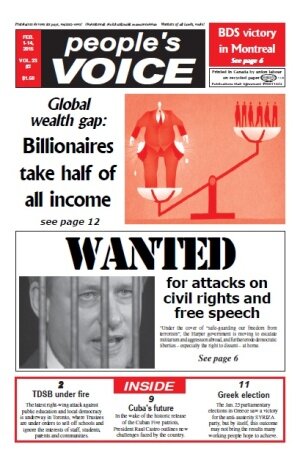
1) ON THE EXPANDING “WAR ON TERROR”
2) LIBERAL GOVERNMENT ATTACKS TDSB, ORDERS SCHOOL CLOSURES
3) POLITICAL FOCUS OF B.C. LABOUR - THE MAIN ISSUE
4) END THE RACIST EXCLUSION: ABORIGINAL PEOPLE ARE WORKERS
5) BDS VICTORY STORY: NAOT CLOSES SHOE STORE ON ST. DENIS STREET
6) FEBRUARY 14: REMEMBER AND MOBILIZE - Editorial
7) ECONOMIC CRISIS AND GRAND LARCENY - Editorial
8) COLLECTIVE PUNISHMENT - AS CANADIAN AS MAPLE SYRUP?
9) GREEK COMMUNISTS RESPOND TO ELECTION RESULTS
10) RAUL CASTRO SPEAKS TO CUBA’S NATIONAL ASSEMBLY
11) OXFAM WARNS OF “EXPLOSION IN GLOBAL INEQUALITY”
12) TUDEH PARTY CONDEMNS IMPERIALISM AND :”CHARLIE HEBDO” TERROR
13) MUSIC NOTES, by Wally Brooker
PEOPLE'S VOICE FEBRUARY 1-14, 2015 (pdf)
|
To order a copy send $15 (includes package and handling) to People’s Voice, 706 Clark Drive, Vancouver, BC, V5L 3J1. Contact us at 604-255-2041 or pvoice@telus.net for bulk order prices. |

|
People's Voice deadlines: February 15-28 March 1-15 Send submissions to PV Editorial Office,
|
REDS ON THE WEB
http://www.parti-communiste.ca/
peoplesvoice.ca
www.ycl-ljc.ca
www.solidnet.org
|
People's Voice finds many "Global Class Struggle" reports at the "Labour Start" website, http://www.labourstart.org/. We urge our readers to check it out! |
* * * * *
People's Voice
Canadian Publications Mail Sales Product Agreement #205214
ISSN number 1198-8657
People's Voice is published by
New Labour Press Ltd
PV Editorial Office
706 Clark Drive,
VANCOUVER, B.C. V5L 3J1
Phone:604-255-2041
Fax:604-254-9803
email: pvoice@telus.net
Editor: Kimball Cariou : Business Manager: David Au
Editorial Board: Kimball Cariou, Miguel Figueroa,
Doug Meggison, Naomi Rankin, Liz Rowley, Jim Sacouman
* * * * * *
Letters
People's Voice welcomes your letters
on any subject covered in our pages.
We reserve the right to edit for length and clarity,
and to refuse to print letters which may be libellous
or which contain unnecessary personal attacks.
Send your views to:
"Letters to the Editor",
706 Clark Dr., Vancouver, BC V5L 3J1,
or pvoice@telus.net
People's Voice articles may be reprinted without permission,
provided the source is credited.
* * * * * *
The Communist Party of Canada, formed in 1921,
has a proud history of fighting for jobs, equality, peace,
Canadian independence, and socialism.
The CPC does much more than run candidates in elections.
We think the fight against big business and its parties
is a year-round job,
so our members are active across the country,
to build our party and to help strengthen people's movements
on a wide range of issues.
All our policies and leadership
are set democratically by our members.
To find out more about Canada's party of Socialism,
give us a call at the nearest CPC office.
* * * * * *
Central Committee CPC
290A Danforth Ave Toronto, Ont. M4K 1N6
Ph: (416) 469-2446
fax: (416) 469-4063 E-mailmailto:info@cpc-pcp.ca
Parti Communiste du Quebec (section du
Parti communiste du Canada)
5359 Ave du Parc, Montréal, Québec,
H2V 4G9
B.C.Committee CPC
706 Clark Drive, Vancouver, V5L 3J1
Tel: (604) 254-9836
Fax: (604) 254-9803
Edmonton CPC
Box 68112, 70 Bonnie Doon P.O.
Edmonton, AB, T6C 4N6
Tel: (780) 465-7893
Fax: (780)463-0209
Calgary CPC
Unit #1 - 19 Radcliffe Close SE
Calgary AB, T2A 6B2
Tel: (403) 248-6489
Ottawa CPC
Tel: (613) 232-7108
Manitoba Committee
387 Selkirk Ave., Winnipeg, R2W 2M3
Tel/fax: (204) 586-7824
Ontario Ctee. CPC
290A Danforth Ave., Toronto, M4K 1N6
Tel: (416) 469-2446
Hamilton Ctee. CPC
265 Melvin Ave., Apt. 815
Hamilton, ON.
Tel: (905) 548-9586
Atlantic Region CPC
Box 70 Grand Pré, NS, B0P 1M0
Tel/fax: (902) 542-7981
* * * * * *
News for People, Not for Profits!
Every issue of People's Voice
gives you the latest
on the fightback from coast to coast.
Whether it's the struggle for jobs or peace, resistance to social cuts,
solidarity with Cuba, or workers' struggles around the world,
we've got the news the corporate media won't print.
And we do more than that
- we report and analyze events
from a revolutionary perspective,
helping to build the movements for justice and equality,
and eventually for a socialist Canada.
Read the paper that fights for working people
- on every page, in every issue!
People's Voice
$30 for 1 year
$50 for 2 years
Low-income special rate: $15 for 1-year
Outside Canada $50 for 1 year
Send to: People's Voice, 706 Clark Drive, Vancouver, BC, V5L 3J1
You can call the editorial office at 604-255-2041
<pvoice@telus.net>
REDS ON THE WEB
www.communist-party.ca
peoplesvoice.ca
www.ycl-ljc.ca/
http://solidnet.org/
http://www,rebelyouth-magazine.blogspot.com
(The following articles are from the February 1-14, 2015 issue of People's Voice, Canada's leading socialist newspaper. Articles can be reprinted free if the source is credited. Subscription rates in Canada: $30/year, or $15 low income rate; for U.S. readers - $45 US per year; other overseas readers - $45 US or $50 CDN per year. Send to People's Voice, c/o PV Business Manager, 706 Clark Drive, Vancouver, BC, V5L 3J1.)
1) ON THE EXPANDING WAR ON TERROR
Unite to defend democracy, peace and equality
Central Executive, Communist Party of Canada, January 21, 2015
Since the terrible events of January 7 and beyond in Paris, politicians and the corporate media in the NATO countries, including Canada, are thundering that “we must all unite” in response to a so‑called “declaration of war” by religious extremist groups. But under the cover of “safeguarding our freedom from terrorism”, the Harper and other Western governments are moving to escalate militarism and aggression abroad, and further erode democratic liberties - especially the right to dissent - at home.
To be clear, the Communist Party of Canada categorically condemns all terrorist acts, whether committed by individuals, movements or imperialist states. As we stated immediately after the 9/11 events, “acts of terrorism undermine the struggle for progressive change; they sideline and neutralize the mass movement, create fear and disorientation in the broad people’s fightback, and provide imperialism and reaction with a powerful pretext to intensify repression.”
That said, the most serious threats to peace and security, and to democratic rights and freedoms, are posed by the policies and actions of Western governments themselves, not by a small number of violent criminals who seek to provoke repression in hopes of winning support for their own narrow fundamentalist agenda.
Working people today are being told to “pick sides” in the confrontation between the major imperialist powers and reactionary religious movements. This false choice ignores the reality that the NATO powers, including Canada, bear the responsibility for creating conditions which encouraged the emergence of fundamentalist groups. In many cases, Western intelligence agencies had a direct hand in their formation. During the 1980s, for example, the United States armed the opponents of Afghanistan’s progressive government, with the geopolitical aim of destabilizing the USSR. The US and other imperialist powers have intervened in Iraq, Iran, Libya, Syria, Yugoslavia and many other countries, always seeking to undermine progressive forces and to seize control of oil and other natural resources. Israel, the closest ally of US and Canadian imperialism, has likewise continued to occupy Palestinian lands during this period.
Millions of people have died as a result of these imperialist wars and occupations, and the imposition of western‑backed neoliberal economic and social policies. This has generated enormous resentment among the peoples of these affected countries, with predictable results. It has also fed the growth of dangerous fascist and anti‑immigrant forces across Europe and North America.
We defend the right to free speech, including the right to criticize religious beliefs, but we also note that the contents of Charlie Hebdo often contributed to the deadly growth of bigotry and xenophobia across Europe. The only way out of this downward spiral of hatred and violence is to promote the common action of working people of all national origins and religious beliefs, against the domination and exploitation of the transnational corporations, and to defend national sovereignty.
The fact is that both the imperialist powers and reactionary extremist groups stand for narrow interests which are utterly hostile to working people. The false “clash of civilizations” theory divides and weakens working people, by turning us against each other on the basis of religious outlook or national origin. Instead, the real alternative is to build unity around a genuine people’s agenda and a strategy to roll back austerity, end imperialist wars of occupation, and defend the environment. Rather than killing each other, the working class of all countries needs to join together for full employment, access to health care, education and social programs, a healthy environment, and peaceful economic development.
The Communist Party of Canada urges the labour and people’s movements to defend civil rights and liberties, and to resist the escalating attacks which target Muslims, Arabs, religious minorities, and racialized communities. In particular, we condemn PM Stephen Harper’s plan to introduce new legislation which would allow “pre-emptive arrests” of anyone considered a potential “threat”. This legislation is reminiscent of the War Measures Act, adopted during the First World War to criminalize sections of Canada’s immigrant population as “enemy aliens” and to ban left‑wing and anti-war literature.
The true intention of this and other ’national security’ laws is to stifle free speech and to silence critics of right‑wing policies and governments. Harper’s real strategy is to turn back the clock, to allow governments the authority to crack down on trade unions, indigenous resistance movements, immigrants, environmentalists, defenders of civil rights, political radicals and others who oppose the corporate agenda of “free trade”, neoliberal austerity and militarism.
The Communist Party demands an end to Canada’s participation in the wars of aggression, including in Iraq and Syria, which can only lead to further violence. We urge the labour and democratic movements to condemn the drive by the Harper government (with the support of the other parliamentary parties) to scrap civil liberties, labour rights and other democratic freedoms in the name of waging war against Islam and even against citizens of our own country.
Instead, we demand: Canada out of NATO, and out of Syria and Iraq! Elect a government which will adopt an independent foreign policy of peace and disarmament. Don’t send young Canadians to war - fund job creation and social programs, not militarism. Protect minorities and expand social, civil and labour and democratic rights, at home and abroad. Curb the power of the Canadian and international corporations. Scrap the “free trade deals”, and protect and restore the sovereignty of Canada and all other countries.
In today’s volatile situation, Canadians need to reject attempts to manipulate public opinion through fear, police state surveillance, racism and intimidation. The Communist Party urges all who support peace, civil rights and democratic freedoms to speak out - in the streets, in the social media, and at the ballot box - against the escalating state repression which is trying to stifle our collective resistance. It is not too late, but the time to defend democracy is today!
2) LIBERAL GOVERNMENT ATTACKS TDSB, ORDERS SCHOOL CLOSURES
PV Ontario Bureau
Forty-two deputants and many more parents, students, teachers and supporters of public education gave the Toronto and District School Board a strong message on Jan. 26 not to comply with 13 directives that would see up to 25% of the city's public schools close, and profoundly alter the role of locally elected Trustees. Minister of Education Liz Sandals issued her directives on Jan. 15, with an implementation deadline of Feb. 13, leaving the newly elected Board reeling and the public still largely in the dark.
Sandals commanded the TDSB to close 133 schools which the Ministry claims are under-utilized and must be sold off, to cover $3 billion in capital costs to repair hundreds of schools in various states of disrepair after 25 years of provincial under-funding. The closures add up to almost a quarter of the 588 schools in the system.
The Directives also command the Board to immediately close Trustee offices, lay-off part-time Trustee assistants, and ban Trustees from all involvement in the selection of principals and superintendents, as well as any involvement in the schools they are responsible for, or in the administration of schools system-wide. Sandals states that the Ministry is proposing to dismantle the Board, but has not yet decided how or what to replace it with.
The Board's initial January 19 meeting voted to comply with the Directives after the TDSB's lawyer advised that the government had amended a Regulation to give themselves the power to override the Education Act. The message was that the Board had no legal choice, but to comply.
With 11 of the 22 Trustees newly elected and in office only 46 days, the politics of fear and intimidation took hold. Almost the entire Jan. 19 meeting was spent trying to figure out how to accomplish compliance by the deadline, just 25 days away. Only one Trustee, Howard Kaplan, voted against compliance, urging the Board to consult with parents and educators and to test public opinion before making any decisions.
Kaplan was successful in getting the Board to hold the Jan. 26 public meeting, at which 41 of the 42 deputations came armed with facts and figures that exposed the folly of the Directives. The sale of TDSB properties to date showed an average of $6 million generated on each sale, while the cost of building a new school is $15 million. According to TDSB’s own figures, it would never be able to buy back these properties, many of which are prime downtown real estate.
The calculations of under-utilization used by the province also exclude space used by childcare centres, as well as space used for services to youth and new Canadians, such as English as a Second Language, and other vital programs that the community has fought for decades to hold in Toronto schools. Schools declared "under-utilized" are actually being fully utilized, serving as desirable community hubs that are lauded in the media and promised by politicians running for office.
Several referred to the Mike Harris Tories, who in 1995 declared war on public education. Their aim was to “create a crisis” that would open the door to a wholesale change in education funding, governance, labour relations, and curriculum. The results included increasing the drop out rate with racist "zero tolerance" policies, an attack on liberal arts education, and elimination of grade 13.
Several spoke about boondoggles over the gas plants, ehealth, ORNGE, Bill 115, and other scandals, pointing out the Liberals have no moral authority to attack the TDSB. Toronto Trustees represent constituencies that are twice as big as provincial ridings - which have six times the staff and budgets, and full-time elected representatives.
Toronto District Labour Council President John Cartwright called on the Board to reject the Directives, as did representatives of OSSTF, CUPE and the ETT, the main unions at the TDSB. Teachers spoke about the losses their students would suffer, and parents from across the City expressed their distress at the consequences for their schools and neighbourhoods. Domenic Bellissimo told Trustees they were the voice of parents and communities who were counting on them.
Former Trustees Elizabeth Hill and Liz Rowley pointed out that when previous provincial governments tried similar things, the Board and Trustees had refused to comply, showing courage and integrity, with the support of their communities. Hill thanked Howard Kaplan for voting against compliance, and urged the Board to do likewise.
Liz Rowley spoke about the provincial budget and the Liberal plan to cut $500 million from education this year and to freeze public sector wages. This will create turmoil in the schools, and the public will blame you, she told the trustees, saying “Don=t do it!”
With the public still discovering what the Directives will mean for their children and grand-children, the Board has agreed to organize meetings in Scarborough and at the old York Board of Education building in the west end. This is the opportunity for the public to give a clear direction to the Board, not to comply with the latest attack on public education.
3) POLITICAL FOCUS OF B.C. LABOUR - THE MAIN ISSUE
BC Labour Committee CPC
In his farewell speech last November to delegates at the BC Federation of Labour, which he led for 15 years, retiring President Jim Sinclair highlighted the many positive actions of the Federation under his leadership: defending health care, education and social services in the face of massive government cuts; criticizing the outrageous tax cuts for big business and the wealthiest in the province; working with community allies in campaigns on these issues.
Although not directly stated as such, the main theme of his speech reflected the differing approaches to the question of the political role of the BC Fed. Should the main organization of labour activism in the province have an independent political voice for the working class, or simply concern itself with trade union issues and leave political affairs to the New Democratic Party? This was the opening shot in the leadership debate that dominated the five‑day convention.
The only contentious resolution of note was one submitted by CUPE‑BC calling on the BC Fed to reject strategic voting, and to re‑affirm its total support for the NDP. Not surprisingly, because of the political undercurrents in play due to the leadership contest, this resolution drew a considerable amount of attention and debate. Despite strong opposition from many delegates, the resolution narrowly passed.
The two sides of this issue were clearly evident in the leadership contest. Irene Lanzinger from the BC Teachers Federation, and the federation’s outgoing Secretary Treasurer, represented a continuation of the activist policies established under Sinclair. She had the support of some of the largest affiliates widely considered to be more militant or left‑leaning, such as Unifor, Hospital Employees Union, CUPW, the BC Teachers Federation and local labour councils.
Amber Hockin from CUPE, currently the CLC’s Pacific Regional Director, was the other candidate. Her approach advocated a return to the political policies in effect under the previous leadership of Ken Georgetti, who was defeated last May as CLC president after a contest reflecting similar debates. Hockin’s campaign was endorsed by the BCGEU, COPE 378, CUPE BC, the IBEW Provincial Council, and IAMAW 250.
Both campaigns spared no effort to bus in as many supporters as possible, inflating the number of credentialed delegates to a whopping 2227 on voting day, the largest convention ever. In a close vote, illustrating the political divisions in the BC labour movement, Lanzinger won by just 57 votes when the counting was done.
Lanzinger deliberately chose to not campaign together with a candidate for Secretary Treasurer, rejecting the concept of “slates” as undemocratic and not needed in the labour movement. The Hockin campaign partnered with Aaron Ekman, Northern Regional Coordinator with the BC Government and Service Employees’ Union, as her running mate for Secretary Treasurer. This set up a clear contest for President, but until just before the close of nominations for Secretary Treasurer, it appeared that Ekman would be un‑opposed.
Many believed that based on Ekman’s history in the Vancouver area as the chair of the VDLC Youth Committee, he would be an acceptable choice for Lanzinger’s supporters. There were even some buttons circulating that said, “Lanzinger and Ekman - The Dream Team”. However, Ekman distanced himself from this supposition, with critical comments directed towards Sinclair and his record, suggesting that the outgoing president’s policies were partly responsible for the decline in labour density in the province. Both campaigns expressed their concern around this issue, identifying it as a major problem, but only Lanzinger clearly linked the decline to mass layoffs, plant closures, and the attack on unions by big business, and also to government cuts, contracting out and legislative changes which have made it harder for unions to organize.
A lot of the goodwill towards Ekman was diminished during the campaign when he identified himself with traditional economist, right social‑democratic attitudes to working class politics. Many of his key interventions reinforced the political positions of the affiliates who supported the Hockin‑Ekman team, surprising some observers.
The response was the last minute nomination of Howard Huntley from the Grain Workers Union for the position of Secretary Treasurer. He received an impressive 722 votes to Ekman’s 1027. Clearly this was a tactical move intended to send a message that many delegates were wary of the attempt to shift away from the strategies advanced by Sinclair and Lanzinger.
The working class of British Columbia will be best served by the continuation and expansion of the political direction established under Sinclair. This provides a jumping off point for real and productive resistance to the attack on the working class and its most organized section, the trade unions. It remains to be seen if Lanzinger and Ekman will develop the close partnership necessary to carry this work forward.
The debate over which political trend will become dominant in the labour movement is clearly not settled. This is and has been for some time the debate amongst labour activists across Canada, a debate which actually screens the much deeper and more important divide between collaboration/tri‑partism versus class struggle strategies to defend working class interests. Unqualified support for the NDP, or independent labour political action, can be two sides of a coin only if the latter means mobilization and extra‑parliamentary struggle in the here and now. If the departure from exclusive support for the NDP is only a shift towards strategic voting collaboration with the Liberals B one section of big business ‑ the class struggle is weakened, not strengthened.
Within this context, the BC Fed convention delegates gave a clear mandate that the majority approve of class‑based, independent labour activism. The job of the new leadership is to act on this mandate immediately, not simply prepare for the 2017 provincial election.
4) END THE RACIST EXCLUSION: ABORIGINAL PEOPLE ARE WORKERS
Statement from the Communist Party-Manitoba, Jan. 23, 2015
The overwhelming majority of Aboriginal people are workers and they among the most oppressed and exploited part of the working class in Manitoba. Excluding Treaty First Nations workers living on reserves from the Labour Force Survey is an official reinforcement of the racist view that Aboriginal people do not value work or contribute to the economy.
Manitoba and other prairie provinces should stop bragging about their low jobless rate and end the long, agonizing jobs crisis. The racist exclusion of Aboriginal people from the labour force survey is a big reason why Manitoba, of all the prairie provinces, is a low‑wage province.
The Communist Party of Canada‑Manitoba demands that the Conservative government end the racist exclusion by immediately including all workers in the Labour Force Survey.
The truth is that for centuries Aboriginal people have been the backbone not just of the fur trade but of Manitoba's industrial, mining, farm labour and manufacturing industries. And today their racist‑inspired joblessness is a weapon for big business to depress wages for all workers.
Refusing to consider Aboriginal people as part of the working class, the Conservative government is whitewashing the real rate of unemployment for all workers.
This is a much more significant problem in provinces with high numbers of Treaty Aboriginal people, such the Prairie provinces. In Manitoba, the official rate is 5.2% (35,000 jobless).
Counting the labour force on reserves (at an estimated 70% jobless rate and 68.5 participation rate), Manitoba's real unemployment rate is actually closer to 8.6 per cent, or more than 65% higher (about 64,000 jobless actively looking for work).
[Using similar calculations, Saskatchewan's unemployment rate grows from 3.6% (21,000 jobless) to 7.6% (48,000 jobless looking for work); about 110% higher. Alberta's jobless rate grows from 4.7% (114,000 jobless) to 5.6% (137,000 jobless), about 20% higher.]
Aboriginal leaders report that unemployment rates reach 90 per cent on many reserves.
One of the biggest anchors dragging down wages in Manitoba is the high rate of unemployment. The real rate of unemployment should include discouraged workers, people who simply have given up actively looking for work. The real rate of unemployment is higher than the official rate. Adding the officially excluded working class in Manitoba means that the real rate is higher still.
The real challenge for working people is to mount a strong campaign for genuine job‑creation policies, such as a shorter work week with no loss in pay or a plan to build 1,000 child care centres and 10,000 homes. All job creation initiatives and hiring must have affirmative action for Aboriginal nations which have higher rates of unemployment, which in all likelihood means all of them.
Unemployment is not only a reckless waste of labour power, it is “a constant dead weight upon the limbs of the working class in its struggle for existence with capital, a regulator for the keeping of wages down to the low level that suits the interests of capital.” (Engels, Socialism: Utopian and Scientific).
5) BDS VICTORY STORY: NAOT CLOSES SHOE STORE ON ST. DENIS STREET
In 2010, PAJU (Palestinian and Jewish Unity) announced its campaign to make Montreal's St. Denis Street an apartheid‑free zone. The campaign began by targeting Beautyfeel shoes (made in Israel) at Le Marcheur shoe store.
The ultimate target of the campaign was the Naot store, a transnational corporation (Disney is the major share‑holder by way of Shamrock investments) with a manufacturing centre in the illegal Gush Etzion settlement block near Hebron. But the choice to begin our picket in front of Le Marcheur made it clear that PAJU was picketing an Israeli product and that there was nothing “anti‑Semitic” about the campaign, despite comments to the contrary by the usual circles of support for the illegal Israeli occupation of Palestinian territories.
Thanks to the latter ‑ and their supportive media contacts ‑ the PAJU campaign became front‑and‑centre in the media, not only in Montreal but across Canada. We had thereby pierced the curtain of silence concerning the Boycott, Divestment and Sanctions campaign against the illegal Israeli occupation and its institutionalized system of apartheid.
At that point, PAJU moved its Saturday picket across the street in front of the Naot shoe store. Soon after, a group of counter‑demonstrators began showing up on Saturdays to harass the PAJU picket and to lend their support to the principle of Israeli apartheid. They had the support of both the Journal de Montréal and The Suburban. Despite this pro‑apartheid opposition (the latter stopped showing up around two years ago), the members of PAJU distributed on average around 300 leaflets (French and English) every Saturday to passersby for the two‑hour period that the picket lasted.
This continued for four years until the Naot store closed its doors several weeks ago. From 2010 to 2014, PAJU's members distributed more than 35, 000 leaflets explaining the nature of the illegal Israeli occupation, the purpose of the BDS campaign and the nature of Naot's manufacturing centres in the illegally occupied Palestinian territories.
PAJU used its campaign to inform and educate the public on what is happening on the ground in occupied Palestine, and what role the public can play in forcing Israel to respect the rule of international law and the principle of human rights by way of support for the BDS campaign.
PAJU continues its boycott campaign against the Indigo‑Chapters bookstore chain whose CEO, Heather Reisman, promotes the HESEG Lone Soldier program, which incites young people to enroll in the Israeli occupation army in exchange for educational and social benefits in Israel.
PAJU invites all members of the public to buy their books elsewhere than at Indigo-Chapters. The PAJU Indigo‑Chapters boycott takes place every Friday from noon to 1 pm in front of the Indigo bookstore, Ste. Catherine Street corner, McGill College Avenue in Montreal. Come join us.
When hundreds of popular groups and social activists around the world work together in support of the Palestinian people, things change on the ground as they did in South Africa consequent to the BDS campaign against apartheid. The tide is turning against Israeli apartheid. PAJU is proud to be part of that process.
From www.pajumontreal.org (abridged)
6) FEBRUARY 14: REMEMBER AND MOBILIZE
People’s Voice Editorial
For most Canadians, February 14 is simply Valentine’s Day, one of the biggest dates on the retail sector calendar. But in many cities, this is now a day to remember over a thousand murdered and missing Aboriginal women and girls. On this date in 1991, the first Women’s Memorial March was held in response to the murder of a Coast Salish woman on Vancouver=s Powell Street (her name is not spoken in respect of her family’s wishes). The March brings thousands through the Downtown Eastside neighbourhood which was “ground zero” for over fifty murders, committed while city police and RCMP shrugged off pleas to track down a serial killer.
Today, the racist attitude behind that official indifference to human lives remains embedded at the heart of our federal government. Despite growing international calls for a fully independent public inquiry into the murdered and missing indigenous women, Prime Minister Harper and other cabinet ministers mouth platitudes about the need for “action, not studies.” Their smug arrogance reflects the “we know best” mentality which imposed the reservation system, the potlach ban, residential schools, shocking incarceration rates, and other forms of genocide.
Let’s be quite clear. Nobody has ever said that action to address systemic racism should be put on hold during such an inquiry. The people and organizations raising this demand desperately want swift and radical action, including real government support for grassroots initiatives to tackle the consequences of centuries of high unemployment, deplorable housing, inadequate health care and schools, and even the lack of clean drinking water. But this is not in contradiction to the demand that Canada must protect the human rights of indigenous peoples, including a fundamental and serious examination of the reasons behind the violence against Aboriginal women and girls.
7) ECONOMIC CRISIS AND GRAND LARCENY
People’s Voice Editorial
During January, Canada was hit by a series of retail closures and mass layoffs in the energy industry. Even before the so‑called "recovery" from the crisis of 2008 brings any genuine relief to working people, it's already over.
This won't stop neoliberal think tanks from repeating discredited theories about the '"trickle down effect", or the lie that the super‑rich are the drivers of the economy. This nonsense has been shot down by Target, which stomped into the Canadian retail market by replacing the Zellers chain, laying off thousands of unionized employees, and re-opening without establishing adequate supply chains. The predictable result of this genius corporate strategy: an estimated $2 billion in losses over two years, and then an epic shutdown of 133 stores.
Naturally, heads rolled as a result of this debacle, right? Well, not exactly. Target CEO Gregg Steinhafel was dunped last May over his role in the Canadian expansion mess, and for the massive data breach during the 2013 holiday season that affected 70 million U.S. customers. But for his efforts while the retail giant lost billions, Steinhafel received a total compensation package of about $61 million, which included severance of $15.9 million.
In mind‑boggling contrast, Target's 17,600 Canadian wage slaves will share an Aemployee trust package" worth some $70 million, which is supposed to cover 16 weeks of pay ‑ apparently about $3181 each on average. If there was any justice, Steinhafel would be headed for a long stretch in prison, with his ill‑gotten millions going to workers. But capitalism is a system based on very different principles, including frequent economic crises, and a form of exploitation which some might consider grand larceny. Target's venture into the Canadian market was certainly a "teachable moment," but that's small consolation for employees now paying the price.
8) COLLECTIVE PUNISHMENT - AS CANADIAN AS MAPLE SYRUP?
By Kimball Cariou
As the global debate over the Charlie Hebdo killings descends into chest‑thumping and finger‑pointing, Canadians are being treated to the latest round of arguments over how to "defend our values." For me personally, the term "Canadian values" brings to mind maple syrup, three‑down football, Hockey Night in Punjabi, the lyrics to "I'se the b'y that builds the boat", sugar‑dipped fried bannock, and similar cultural constructs found only within the borders of Canada. But perhaps this simply reflects my own family and geographic background.
On the political level, the debate revolves around "protecting our cherished freedoms," and other noble‑sounding phrases. Some argue that in these perilous times, we must keep a close eye on potential suicide bombers of a certain... well, let's be polite and not mention the characteristics shared by these wannabe terrorists, but we all know what we're talking about, nudge nudge, wink wink. Other more liberal‑minded folks are shocked by such talk. After all, Canada is the great land of multiculturalism, the destiny all people facing persecution; surely to engage in racial or religious profiling is to violate this sacred tradition. Well, they admit, perhaps its OK a little bit, if we establish proper "safeguards" and "sunset clauses" to avoid "going overboard".
And so, the stage is set for political drama as Parliament reconvenes. Mr. Harper's Conservatives have pledged to expand police and spy agency powers, wth explicit legislation to permit so‑called "preventive arrests". They will speak as though this is a sad necessity in the face of the "war against western values" waged by the so‑called jihadists. The opposition parties will generally agree about the threat, while warning about the need to be "careful". Perhaps Justin Trudeau and Thomas Mulcair will even speak in vague terms about the tense international climate of wars and inequality, while carefully avoiding any reference to "root causes" of violence, since of course this phrase is deliberately misinterpreted by the Conservatives and the mass media to mean knee‑jerk wooly‑minded approval of any horrific massacre committed by the "enemies of liberty."
Unfortunately, the underlying assumptions which frame such debates are badly flawed. Most notably, the idea that Canada has always been a country based on protection of civil rights and democratic freedoms is quite contrary to historical reality. From this false starting point, the entire discussion is warped into fantasy land.
In fact, the "preventive arrest" concept echoes doctrines used to criminalize entire sections of the population during previous periods of colonization, war and turmoil. Each time, the underlying strategy has been to justify suspending civil liberties and democracy to allow collective punishment of groups said to 'threaten our Canadian values."
Early in Canada's colonial history and again after 1867, the targets were Aboriginal peoples who inconveniently insisted that they were the true owners of their historic landbase. Treaties, reservations and residential schools were imposed to put an end to such "barbaric" notions by means of genocide. A similar fate befell the Métis people, twice driven off their lands after confronting the expansionist Canadian state in 1871 and 1885.
But other groups were also targetted at times, especially immigrants like Irish Catholics who were considered insufficiently loyal to the British Crown (imagine that!). Then other immigrants failed to pass the "keep Canada white" skin colour test ‑ notably the Chinese, Japanese and south Asian migrant workers who began arriving on the west coast in large numbers in the late 19th century. Racist "collective punishment " was quickly meted out to these groups, in the form of Vancouver's anti‑Asian riots of 1907, the discriminatory "continuous voyage" law which effectively limited the arrivals of south Asians, bans on family reunification, removal of voting rights, etc.
Other European immigrants also faced collective punishment. By the late 1800s, having exhausted the supply of farmers from the British Isles to populate the prairies stolen from the indigenous peoples and Métis, the Canadian state enticed hundreds of thousands from central and eastern Europe with promises of free land. Imagine the horror of the Anglophile Canadian ruling class when war broke out in 1914, pitting the mother country against "the Hun" ‑ Germany and its allies. The colonial mentality assumed that recent immigrants from countries now at war with England would be loyal to their homelands rather than to Canada. Another "problem" was the lack of enthusiasm among Francophones for the prospect of dying on the battlefields of Europe for the interests of the British Crown, which had after all conquered Quebec. As the slaughter decimated warring armies, one solution was to impose forced conscription on the white working class of Canada.
But another strategy was the War Measures Act, a federal statute adopted by Parliament in 1914, to maintain "security and order". The War Measures Act gave sweeping emergency powers to the federal Cabinet, allowing it to govern by decree when it perceived the existence of "war, invasion or insurrection, real or apprehended." During the First World War, the Act was used to imprison Canadians of German, Ukrainian and Slavic descent, i.e. perceived traitor populations. It was next in force from 1939 to 1942, to imprison Japanese Canadians and confiscate their properties, outlaw the Communist Party and 15 other organizations, and to jail over 250 communist and trade union leaders. The Act was dusted off again during the "October Crisis" of 1970, when a state of "apprehended insurrection" was declared to exist in Quebec, in response to two kidnappings by the Front de Liberation du Québec. More than 450 people were arrested, including hundreds of left‑wing and labour activists with no connections to the FLQ; most were later released without any charges. But it took until 1988 to repeal the War Measures Act, which was replaced by the Emergencies Act, giving more limited and specific security powers to the federal government.
There isn't enough space here to go into the resurgence of racism and Islamophobia which followed the 9‑11 attacks in the USA, except to note that from that time, Muslims and Arabs in Canada have been treated with grave suspicion, i.e. as "potential terrorists" subject to police monitoring of their organizations, much closer inspection at airports, etc.
In the wake of the Charlie Hebdo killings, the threat to allow "preventive arrests" escalates the very real tradition of racist scapegoating to a new and dangerous level. And it revives a very old, well‑established "Canadian value" ‑ the belief that certain arbitrarily chosen sections of the population are by definition not truly Canadian. That was the accusation levelled under the War Measures Act against people of German, Austrian, Ukrainian, Japanese and other national origins, as well as against many who were openly critical of corporations and governments. In none of these cases was there ever any proven attempt to attack the Canadian state. Similarly today, random violent acts by a tiny handful of individuals do not translate into any threat requiring governments to scrap democratic rights and civil liberties.
In fact, it could well be argued that one genuine Canadian value is the tradition of resisting arbitrary state attacks on the right to express dissent. That's a tradition which is well worth keeping alive in these dangerous and confusing times.
(This article first appeared in the February 2015 issue of Radical Desi magazine.)
9) GREEK COMMUNISTS RESPOND TO ELECTION RESULTS
In the Jan. 25 parliamentary elections in Greece, the social democratic SYRIZA party won 36.3% of the votes, taking 149 out of 300 seats, two short of an absolute majority. The incumbent conservative New Democracy (ND) fell to 27.8% and 76 seats (a loss of 53), its worst result ever . The right social‑democratic PASOK, ND's coalition partner, was reduced to just 13 seats (from 33 in 2012) and just 4.7% of the total vote, also a historic low.
The fascist Golden Dawn lost votes, but placed third with 6.3% and 17 MPs, many of whom are in jail for various crimes. The newly‑created To Potami (The River) centrist party entered parliament with 17 seats and 6.1%. The Communist Party of Greece (KKE) improved on its 2012 results, gaining one percent to 5.5%, and 15 seats, a gain of three.
SYRIZA leader Alexis Tsipras was sworn in as Prime Minister on January 26, after reaching a coalition agreement with ANEL, the “Independent Greeks” who elected 13 MPs with 4.7% of the vote, a decline from 7.5% in 2012. This right wing party, formed largely by former ND supporters, opposes the “Memorandum” deal between Greece, the EU and the International Monetary Fund, but it takes racist anti-immigrant positions and wants to develop a Christian Orthodox education system.
The KKE achieved a net increase of 60,000 votes, and placed third in eleven electoral regions: 2nd region of Piraeus, Samos, Lesvos, Lefkada, Zakynthos, Kephalonia, Kerkyra, Larisa, Trikala, Prebeza, Boiotia.
In its post-election statement, the KKE leadership said, “”First of all, we would like to salute the thousands of working people in our country, the young people that responded to the appeal of the KKE and contributed to its strengthening today, confirming the positive tendency of forces to rally again around the KKE, the tendency to regain votes. This tendency appeared last year, in the EU parliamentary elections, the regional and municipal elections and continued in all the various struggles of the people, in the labour, trade union and wider people=s movement.
“In particular we would like to salute the people who voted for the KKE for the first time, because they appreciated its firmness, consistency and selflessness.
“As a whole, the election results reflect the great discontent and anger of the people against ND and PASOK, the parties that plunged the people into poverty and unemployment during the economic crisis.
“Of course they express to a great extent the false hope that the new government of SYRIZA might follow a political line in favour of the people.
“Based on the official statements and positions of SYRIZA before and during the election campaign, the KKE has assessed that the new composition of the Parliament and the formation of a government of SYRIZA - either on its own or in a coalition government ‑ will follow the beaten track: the EU one way street, the commitments to big capital, monopolies, the EU and NATO with the negative implications for our people and the country. Once again the people will pay the price for these choices.
“We consider particular negative the fact that a Nazi party, a party with specific criminal murderous activity, a party that was formed by the mechanisms of the system, a party that is clearly against the interests of the people, has received again a significant percentage of the electorate’s votes.
“As whole, we assess that the line of counterattack and rupture with the capitalist path of development, the EU and against the policies that support this path through assimilation and passivity must be strengthened among the people and the movement.
“The KKE will increase its efforts and initiatives regarding the acute problems of the workers and the people, with our proposals for the relief of the unemployed, the families from the popular strata, the self‑employed, the farmers and the students.
“It will increase its efforts for the regroupment of the labour and people’s movement, the construction of the people’s alliance in order for the people to realize their hopes and expectations and free themselves for the yoke of the monopolies.
“We will fight both inside and outside the parliament, with the strength that the people gave to our party so as to reveal the plans that are being concocted against the people.
“We will fight dynamically as the militant workers=‑people’s opposition, as the organizer and the driving force of the workers= struggle and the people’s alliance for the survival of the people and also for the prospect of a radical overthrow.
“We wish strength to all of you. We continue our struggle! Thank you.”
10) RAUL CASTRO SPEAKS TO CUBA’S NATIONAL ASSEMBLY
Four days after the mutual announcement of a new understanding between the governments of the United States and Cuba, President Raul Castro addressed the Cuban parliament on the changing relationship between the two countries, and on the situation and prospects of the Cuban economy. The following excerpts are from the official translation of Raul Castro’s speech.
Comrades All:
We have all lived through intense and exciting moments in the last few days.
In this very month of December we successfully held the Fifth CARICOM‑Cuba Summit. Last Sunday we held the Thirteenth Summit of the Bolivarian Alliance for the Peoples of Our America and, on that occasion, we paid a well‑deserved tribute to their founders: our close friend and Bolivarian President, Hugo Chávez Frías, and the Commander of the Cuban Revolution, Comrade Fidel Castro Ruz (APPLAUSE).
Present in this session are Gerardo, Ramón and Antonio, a source of genuine rejoicing and happiness for all of our people BI will elaborate on this important even towards the final part of my statement. Also present here are comrades Fernando and René and the relatives of the Five Heroes, as well as the young Elián González, his father Juan Miguel and Colonel Orlando Cardoso Villavicencio, Hero of the Republic of Cuba, who endured a harsh incarceration for more than ten years in Somalia.
As has been the usual practice in the sessions of our Parliament, it is now my turn to make a review of the country’s economic performance throughout the year that is about to conclude, as well as of the economic plan and budget for the year 2015, which have been thoroughly discussed by deputies in all the 10 commissions of the Assembly and also in yesterday’s plenary session.
The Ninth Plenum of the Central Committee of the Party that was held on Thursday last was also devoted to the discussion of these issues. That is why I will just refer to them very briefly.
As has been already explained, the Gross Domestic Product, known as GDP, increased by 1.3 per cent, a figure below the originally planned rate, as a result of the insufficient economic performance during the first semester of the year, when we were faced with significant financial constraints deriving from the failure to meet the expected level of revenues from abroad, the adverse weather conditions and the internal insufficiencies in economic management.
Although, in fact, during the second semester of the year, we managed to modestly reverse that trend and achieve better results.
Next year’s economic plan will consolidate and reinforce the trend towards a more solid growth of the Cuban economy, based on the optimal use of our reserves in terms of efficiency; the restoration of productive sectors, particularly the manufacturing industry; a more efficient use of energy sources and a higher number of investments in infrastructure and material production, while preserving social services, such as public health and education, for our population.
A GDP growth of a little more than 4 per cent has been projected for the year 2015. This is an attainable goal, considering that, as different from the situation faced in the early months of 2014, a better funding has been guaranteed with sufficient time in advance, which in no way means that it will be an easy task. We will have to continue coping with the effects of the global economic crisis and the US blockade that still remains in force and creates undeniable obstacles to the development of our economy.
At the same time, we will continue to strictly honor the commitments entered into when we rescheduled our debts with our main creditors, thus contributing to the gradual recovery of the international credibility of the Cuban economy.
Yesterday afternoon, the National Assembly approved the Law on the State Budget for the year 2015, which envisages a 6.2 per cent deficit in the GDP, considered to be an acceptable rate under the present circumstances. New taxes will be implemented and the tax burden on the business system shall be reduced in accordance with the gradual implementation of the Tax Law.
Likewise, a series of steps have been taken to improve tax control against indiscipline and tax evasion by both juridical and natural persons.
In this regard, we should not only penalize those who fail to comply with their duties, since impunity would be an encouragement to the infringement of the legal norms in force. We have also considered it to be necessary to promote among all institutions, enterprises, cooperatives and self‑employed workers a culture of civic behavior towards taxation as well as the view that taxes are the main formula to re‑distribute national income in the interest of all citizens.
Furthermore, the process of implementation of the Guidelines of the Economic, Political and Social Policy of the Party and the Revolution, approved by the sixth Congress has continued. As has already been announced, we are now on a qualitatively higher stage of this process in which we are addressing extremely complex tasks, the solution of which will affect all the aspects of national affairs.
I am referring, first and foremost, to the process aimed at unifying both currencies, an area in which a very sound progress has been achieved during the second half of this year from the conceptual point of view. We have managed to streamline a comprehensive program of measures in order to avoid damages to the economy and the population.
The decision to generalize sales in CUP at the hard‑currency stores has been positively welcomed by citizens, and this process will continue to expand in a gradual way.
This is an auspicious occasion to ratify two concepts that we should not ignore.
The first is that the Unification of Currencies is not the universal or immediate solution to all the problems our economy faces.
This important decision should be complemented by a series of macro‑economic measures that would favor the ordering of the monetary regime of the country through a series of instruments that would guarantee a proper national financial balance, which will decisively contribute to improve economic performance and the construction of a prosperous and sustainable socialism in Cuba.
The second, and no less important concept, is that all bank accounts in foreign currency, Cuban convertible pesos (CUC) and Cuban pesos (CUP), as well as the cash in the hands of the population and the national and foreign juridical persons shall be protected.
We have known about the well‑intended and not very‑well intended opinions that are being expressed both inside and outside the country about the rhythm of the process to update our economic model.
There has also been an open encouragement from abroad to speed up privatization, even of the main production and service sectors, which will b equal to laying down the flags of socialism in Cuba.
It seems as if the latter have not bothered to read the Guidelines which clearly states as follows, and I quote: “The economic system that shall prevail in our country will continue to be based on the people’s socialist ownership over the fundamental means of production, governed by the socialist principle of distribution: “from each according to his/her capacity to each according to his/her contribution”, end of quote.
We will continue to implement the agreements adopted by the Sixth Congress of the Communist Party of Cuba in a responsible and firm way, at the speed that we may sovereignly determine here, without jeopardizing the unity of Cubans, without living anyone to his or her own fate, without resorting to shock therapies and without ever renouncing the ideals of social justice of this Revolution of the humble, by the humble and for the humble.
Next year we will initiate the preparations for the celebration of the Seventh Congress of the Party in April of 2016. Prior to that there will be a broad and democratic debate among all Communist Party members and the entire people about the process of implementation of the Guidelines.
Closely associated to the updating of the economic model is the process for the gradual, I repeat, gradual decentralization of faculties from the ministries down to the business sector.
This is not something that can be done overnight, if we want to succeed. We will require a reasonable time to prepare and train, as we have been doing, our cadres at every level; modify the old‑fashioned mentality and get rid of old habits; and work out and implement the legal framework and specific procedures that would enable all of us to see to it that the decisions are adequately implemented and mistakes are timely corrected, thus avoiding unnecessary setbacks.
Among other steps, a decision was made to expand and make more flexible the social object of the Socialist state‑owned enterprises in order to increase their autonomy. The mission assigned to them by the State was redefined and they were entrusted with the faculties required for the marketing of their production surplus. Likewise, the removal of administrative limitations, which will allow for the payment of salaries based on results, was also established.
These transformations shall be gradually implemented, without haste, in an orderly, disciplined and rigorous manner.
The just aspiration of earning higher salaries is a very sensitive question. We can not allow ourselves to make any mistakes, nor letting ourselves be drawn by desire or improvisation.
We would be happy to see that the salaries earned by those workers who work in those sectors recording the most efficient results and reporting benefits of particular economic and social impact are gradually increased.
However, I should state very clearly that we can not distribute a wealth that we have not been capable of creating. Doing so would have serious consequences for the national economy as well as for the personal finances of each and every citizen. Pouring out money into the streets without an equivalent increase in the offer of goods and services will generate inflation, a phenomenon that, among other harmful effects, would reduce the purchasing power of salaries and pensions, which will particularly affect the most humble. And we can not allow that to happen.
The first year of implementation of the new salary policy in quite a few enterprises has revealed that there has been a violation of the salary cost index per every gross value‑added Peso. In other words, higher salaries have been paid without the corresponding backing in production. On several occasions I have warned that this should be considered as a serious, very serious indiscipline that should be resolutely confronted by the administrative cadres and trade union organizations.
The fact that in our social system, trade unions defend workers’ rights is secret to no one. To effectively do so, trade unions should be the first to look after the interests of any given workers group, but also the interests of the entire working class, which are essentially the same interests defended by the entire nation.
We can not leave any room for selfishness and greed to thrive and consolidate among our workers. We all want and need better salaries, but first we have to create wealth and then distribute it according to the contribution each one can make.
Obviously, there are many other issues related to the updating of the economic model which I have not mentioned. In several of them there have been deviations that we are called to correct in due time, in the spirit of never having to back. But for that we have to work in a very serious and responsible way.
No one in the world could ignore Cuba’s outstanding international record in the course of the year that is about to conclude. Cubans are faced with a huge challenge: We must put the economy on a par with the political prestige that this small Caribbean Island has earned thanks to the Revolution, the heroism and the resilience of our people. Economy remains the most important unresolved matter and it is our duty to place it, once and for all, down the right path towards the sustainable and irreversible development of socialism in Cuba.
As I said at the beginning, the deputies and the entire people feel deeply moved and excited about the possibility of sharing the presence in Cuba of Gerardo, Ramón, Antonio, Fernando and René, which makes true the promise made by Comrade Fidel thirteen years ago. The extraordinary example of firmness, sacrifice and dignity of the Cuban Five has filled with pride an entire nation that struggled tirelessly for their liberation and now welcomes them as true heroes (APPLAUSE).
I should reiterate the profound and sincere gratitude to all solidarity movements and committees that struggled for their release and to innumerable governments, parliaments, organizations, institutions and personalities for their valuable contribution.
The Cuban people are grateful for this just decision made by the US President, Barack Obama. Such decision has removed one obstacle that hindered the relations between our two countries.
The entire world has had a positive reaction to the announcements made last Wednesday; it has assessed their importance for international relations, particularly for the US links with the region. They have led to favorable statements being made by governments, presidents and well‑known personalities, which we sincerely appreciate.
This has been the result of talks held at the highest level and under absolute secrecy, thanks to the contribution made by Pope Francis and the facilities offered by the government of Canada.
Besides, this result has been possible thanks to the profound changes occurred in Latin America and the Caribbean, a region where governments and peoples call for a new US Cuba policy.
We welcome the decision announced by President Obama to begin a new chapter in the relations between both countries and introduce the most significant changes in the US Cuba policy in more than 50 years.
We likewise recognize his willingness to hold discussions with the US Congress about the lifting of the blockade and his desire to achieve a better future for both nations, our hemisphere and the world.
We share the idea that a new stage could open up between the United States and Cuba that will begin with the resumption of diplomatic relations, which should be based on the Conventions governing Diplomatic and Consular Relations and regulating the conduct of Diplomatic and Consular Missions and their officials.
We will engage in the high level contacts between both governments with a constructive, respectful and reciprocity spirit and with the purpose of moving towards the normalization of relations.
As I expressed last December 17, a very important step has been taken, but the essential problem still remains unresolved, which is the lifting of the economic, commercial and financial blockade against Cuba, that has been further tightened during the last few years, particularly in the area of financial transactions, through the application of skyrocketing and illegitimate fines on banks from several countries.
Our people should understand that, under the circumstances that have already been announced, this will be a long and hard struggle which will require the international opinion and the US society to mobilize in order to continue calling for the lifting of the blockade.
Every data indicate that the majority of US citizens and an even broader majority within Cuban émigrés favor the normalization of bilateral relations. Within the US Congress, which codified the blockade provisions into law, there is also an increasing opposition to that policy.
We hope the US President would resolutely use his executive prerogatives to substantially modify the implementation of the blockade in those aspects in which Congress approval is not required.
At the same time, we will analyze the scope and the form of implementation of the positive executive measures announced by President Obama.
The instructions he has given to review Cuba’s unjustifiable inclusion in the List of States that Sponsor International Terrorism is encouraging. Facts have shown that Cuba has been a victim of multiple terrorist attacks, many of whose perpetrators have so far enjoyed impunity. As we all know these attacks have taken a toll on thousands of human lives and maimed persons.
The pretexts used to launch those attacks are absolutely groundless, as is known by the entire planet. They only serve political interests under the false pretense of justifying the tightening of the blockade, particularly in the financial sector.
Never has any terrorist action against any US citizen, interest or territory been organized, financed or perpetrated from Cuba; nor will that ever be permitted. Every time we have received any information about terrorist plans against the United States we have relayed that information to the US Government to which for several years now we have been suggesting the establishment of a cooperation agreement in that area.
We have always been ready to establish a dialogue, on an equal footing, to discuss a wide range of issues on the basis of reciprocity and without casting a shadow on our national independence and self‑determination and, as Fidel has pointed out, without renouncing any of our principles.
I reiterate that it will only be possible to move forward based on mutual respect, which involves the observance of the principles of International Law and the UN Charter, among them, the sovereign equality of States, peoples’ equal rights and self determination, the peaceful settlement of international controversies, the principle of refraining from the threat or use of force against the territorial integrity or independence of any State and the obligation not to intervene in matters which are within the domestic jurisdiction of States, which means that any form of interference or threat to the political, economic and cultural elements of any given State is considered a violation of International Law.
In accordance with the proclamation of the Latin American and Caribbean region as a Zone of Peace, which was signed by the Heads of State and Government on January 29 this year in Havana in the context of the CELAC Summit, all States have the inalienable right to choose their own political, economic, social and cultural system, without any interference whatsoever from another State, which is a principle of International Law. That document was signed here in Havana by all Heads of State and Government of this continent, with the exception of the United States and Canada, which were not invited to attend.
Between the governments of the United States and Cuba there are profound differences which include, among others, different views about the exercise of national sovereignty, democracy, political models and international relations.
We reiterate our willingness to establish a respectful dialogue on our differences based on reciprocity. We have firm convictions and many concerns about what is happening in the United States in terms of democracy and human rights, and we would agree to talk on the basis of the principles referred to previously, about any issue, and about all what the US might be willing to discuss, about the situation here Cuba but also about the situation in the United States.
No one should expect Cuba to renounce the ideas for which it has struggled for more than a century, and for which its people have shed lots of blood and run the biggest risks in order to improve its relations with the United States.
It is necessary to understand that Cuba is a sovereign State whose people, through a free referendum held to approve the Constitution, chose a socialist path as well as its political, economic and social system (APPLAUSE).
We will demand respect for our system in the same way that we have never intended the United States to change its political system (APPLAUSE).
Both governments should take mutual steps to prevent and avoid any action that might affect the progress achieved in bilateral relations, based on the observance of the law and the constitutional order of both Parties.
We do not ignore the vicious criticisms that President Obama has had to put up with as a result of the already mentioned announcements by some forces that are opposed to the normalization of relations with Cuba, including some lawmakers of Cuban descent and ringleaders of counterrevolutionary groups who refuse to lose the means of support granted to them by the several decades of conflicts between our two countries. They will do whatever it takes to sabotage this process. We should not rule out the perpetration of provocations of every sort. On our part, a prudent, moderate and reflexive - though firm - behavior shall prevail. (APPLAUSE).
In Cuba there are numerous and different mass, trade union, farmers, women, students, writers and artists and social organizations, which have even a representation at the Council of State, as well as non‑governmental organizations, many of them represented by several deputies in this Assembly, which will feel offended if they are mistaken for a few hundreds of individuals who receive money, instructions and a breath of air from abroad.
At the multilateral organizations, such as the United Nations, we will continue to advocate for peace, International Law and all other just causes, and we will continue to denounce the threats to the survival of the human species posed by climate change and the existence of nuclear arsenals.
We will continue to promote the exercise of human rights, including the economic, social and cultural rights, by all persons, as well as the right of all peoples to peace and development.
The Cuban Revolution is deeply grateful to the peoples, parties and governments from which it has received an unwavering and permanent solidarity, and shall continue to orient its foreign policy based on our unshakable allegiance to principles (APPLAUSE).
A symbol of the above are the special relations that we maintain with the Bolivarian Republic of Venezuela, to which we will continue to offer our support, in the face of the attempts to destabilize the legitimate government that is headed by Comrade President Nicolas Maduro Moros. We reject every attempt to impose sanctions against that sister nation (APPLAUSE).
As I said a few days ago, we are willing to cooperate with the United States at the multilateral and bilateral levels, as well as in the event of any dangerous situation that may require collective and effective humanitarian responses that should never be politicized.
Such is the case of the combat against the Ebola virus in West Africa and its prevention in the Americas, as was proclaimed by the ALBA Special Summit that was held in Havana on this issue on October last.
Just as I have stated in the recently held CARICOM and ALBA Summits, I appreciate the invitation conveyed to me by the President of Panama, Juan Carlos Valera, to attend the Seventh Summit of the Americas and I confirm I will attend in order to explain our positions, in an honest and respectful way, to all Heads of State and Government without any exception.
Cuba’s attendance to that Summit has been the result of the solid and unanimous consensus achieved within Latin America and the Caribbean, a region that is living through a new era and has united, amidst its diversity, under the Community of Latin America and Caribbean States (CELAC) which Cuba was honored to preside last year.
We do not forget that ALBA, with its continued appeal and the support of all countries of the region, managed to remove the old and opprobrious sanctions imposed against Cuba back in 1962 by the Organization of American States, at a meeting held in the Republic of Honduras, where hardly one month later a coup d=état was perpetrated that ousted Comrade Zelaya, the president of that country.
Comrades all:
Within just a few days we will be celebrating the upcoming New Year and the fifty sixth anniversary of the Triumph of the Revolution. Only two days ago, on December 18, we marked the fifty eighth anniversary of the occasion when we reunited with Fidel at a place called Palmas de Vicana, in the Sierra Maestra mountains (APPLAUSE), in the heart of the Sierra Maestra, and Fidel’s historical exclamation when he knew that, in total, we had seven rifles to resume the struggle: Now we will for sure win the war! (APPLAUSE).
The unshakable faith in victory that Fidel instilled in all of us shall continue to lead our people in the defense and further improvement of the work of its Revolution.
Happy New Year! We salute the new fifty seventh year of the Cuban Revolution! Thank you, very much (OVATION).
11) OXFAM WARNS OF “EXPLOSION IN GLOBAL INEQUALITY”
PV Vancouver Bureau
The combined wealth of the world’s richest 1 percent will overtake that of the other 99 percent next year unless the trend of rising inequality is checked. That was the message delivered by the Oxfam International agency to the World Economic Forum held Jan. 21-24 in Davos, Switzerland.
This annual meeting attracts the global economic elite, costing $20,000 to register, and $600-700 per night for a hotel room. Ironically, Davos 2015's co-chair was Oxfam executive director Winnie Byanyima, who warned that the “explosion in inequality is holding back the fight against global poverty” at a time when 1 in 9 people do not have enough to eat and more than a billion people still live on less than $1.25‑a‑day.
Wealth: Having It All and Wanting More, a research paper published by Oxfam, shows that the richest 1 percent have seen their share of global wealth increase from 44 percent in 2009 to 48 percent in 2014. Members of this global elite had an average wealth of $2.7 million per adult in 2014.
Of the remaining 52 percent of global wealth, almost all (46 percent) is owned by the rest of the richest fifth of the world’s population.
The other 80 percent share just 5.5 percent and had an average wealth of $3,851 per adult B that’s 1/700th of the average wealth of the 1 percent.
Byanyima asked: “Do we really want to live in a world where the one percent own more than the rest of us combined? The scale of global inequality is quite simply staggering and despite the issues shooting up the global agenda, the gap between the richest and the rest is widening fast...It is time our leaders took on the powerful vested interests that stand in the way of a fairer and more prosperous world.
“Business as usual for the elite isn’t a cost free option - failure to tackle inequality will set the fight against poverty back decades. The poor are hurt twice by rising inequality - they get a smaller share of the economic pie and because extreme inequality hurts growth, there is less pie to be shared around.”
It appears that major corporate interests are deeply worried that the “income gap” could spark unrest on a bigger scale than the “Occupy” movement. While most capitalist governments are increasing spending on the repressive elements of the state apparatus - police, security and surveillance, prisons, the military - there are also calls to mitigate the impact of neoliberal policies in hopes of averting political turmoil.
Lady Lynn Forester de Rothschild, Chief Executive Officer of E.L. Rothschild and chair of the “Coalition for Inclusive Capitalism”, called on business leaders to play their part in tackling extreme inequality.
She said: “Oxfam’s report is just the latest evidence that inequality has reached shocking extremes, and continues to grow. It is time for the global leaders of modern capitalism, in addition to our politicians, to work to change the system to make it more inclusive, more equitable and more sustainable. Extreme inequality isn't just a moral wrong. It undermines economic growth and it threatens the private sector's bottom line. All those gathering at Davos who want a stable and prosperous world should make tackling inequality a top priority."
Oxfam International is calling on governments to adopt a seven point plan to tackle inequality:
- Clamp down on tax dodging by corporations and rich individuals.
- Invest in universal, free public services such as health and education.
- Share the tax burden fairly, shifting taxation from labour and consumption towards capital and wealth.
- Introduce minimum wages and move towards a living wage for all workers.
- Introduce equal pay legislation and promote economic policies to give women a fair deal.
- Ensure adequate safety‑nets for the poorest, including a minimum income guarantee.
- Agree a global goal to tackle inequality.
Here are some statistical highlights from the Oxfam report, which follows the organization=s recent global Even It Up campaign. The numbers are derived largely from data published by Credit Suisse, and from Forbes magazine’s annual rankings of global billionaires.
* In 2014, the richest 1% of people in the world owned 48% of global wealth, leaving just 52% to be shared between the other 99% of adults on the planet.
* Almost all of that 52% is owned by those included in the richest 20%, leaving just 5.5% for the remaining 80% of people in the world.
* If this trend continues, the top 1% will have more wealth than the remaining 99% of people in just two years,, with the wealth share of the top 1% exceeding 50% by 2016.
* The billionaires on the Forbes list have seen their wealth accumulate even faster over this period. In 2010, the richest 80 people in the world had a net wealth of $1.3 trillion. By 2014, the top 80 had a collective wealth of $1.9 trillion; an increase of $600 billion in just 4 years, or 50% in nominal terms.
* Between 2002 and 2010 the total wealth of the poorest half of the world in current US$ had been increasing more or less at the same rate as that of billionaires; however since 2010, it has been decreasing.
* The wealth of the richest 80 individuals matches the total owned by the bottom 50% (3.5 billion people) of the global population.
* In 2010, it took 388 billionaires to equal the wealth of the bottom half of the world?s population; by 2014, the figure had fallen to just 80 billionaires.
* In 2014, 1,645 people were listed by Forbes as billionaires. Almost 30% of them (492 people) are citizens of the USA.
* Over one‑third of billionaires started from a position of wealth, with 34% of them having inherited some or all of their riches.
* Among this group, 85% are aged over 50 years and 90% are male.
* A few important economic sectors have contributed to the accumulation of wealth of these billionaires. In March 2014, 20% of them (321) were listed as having interests in the financial and insurance sectors.
* Since March 2013, there have been 37 new billionaires from these sectors, and six have dropped off the list. The accumulated wealth of billionaires from these sectors has increased from $1.01 trillion to $1.16 trillion in a single year; a growth of 15%.
* Between 2013 and 2014 billionaires listed as having interests and activities in the pharmaceutical and healthcare sectors saw the biggest increase in their collective wealth. Twenty‑nine individuals joined the ranks of the billionaires in this sector between March 2013 and March 2014 (five dropped off the list), increasing the total number from 66 to 90, or over 5% of the total billionaires on the Forbes list. The collective wealth of billionaires with interests in this sector rose from $170 billion to $250 billion, a 47% increase.
* The biggest companies from the finance, insurance, pharmaceutical and healthcare sectors achieve extremely high profits to compensate their owners and investors. These resources can also be used for economic and political influence, through the direct lobbying of governments.
* During 2013, the finance sector spent more than $400 million on lobbying in the USA alone, or 12% of the total amount spent by all sectors on lobbying in the US in that year. During the election cycle of 2012, $571 million was spent by companies from this sector on campaign contributions.
* The financial sector is found by the Centre for Responsive Politics to be the largest source of campaign contributions to federal candidates and parties.
* Billionaires from the US make up approximately half of the total billionaires on the Forbes list with interests in the financial sector.
* The number of US finance billionaires increased from 141 to 150, and their collective wealth from $535 billion to $629 billion, an increase of $94 billion, or 17% in a single year.
* In the EU, an estimated $150 million is spent by financial sector lobbyists towards EU institutions every year. Between March 2013 and March 2014, the number of billionaires in the EU with interests in the financial sector rose from 31 to 39, increasing their collective wealth by $34 billion, to $128 billion.
* During 2013, the pharmaceutical and healthcare sectors spent more than $487 million on lobbying in the USA alone. This represented 15% of $3.2 billion total lobbying expenditures in 2013. During the election cycle of 2012, $260 million was spent by this sector on campaign contributions.
* At least $50 million is spent by the pharmaceutical and healthcare industry on lobbying each year in the EU, where 20 of the 90 billionaires who made their money from pharmaceuticals and healthcare reside, and who together increased their wealth in the last year by $28 billion.
* Meanwhile, a health crisis has erupted in West Africa. The Ebola virus has been threatening the lives and livelihoods of millions of people in Guinea, Sierra Leone and Liberia in 2014.
* Three major pharmaceutical companies have collectively donated more than $3 million in cash and medical products for the Ebola relief effort. But these three companies together spent more than $18 million on lobbying in the US during 2013.
* The World Bank estimates that the economic cost of the Ebola crisis to Guinea, Liberia and Sierra Leone was $356 million in output forgone in 2014, and a further $815 million in 2015 if the epidemic is slow to be contained.
* A single pharma‑related billionaire could pay this $1.17 billion cost three times over from his new wealth. Stefano Pessina increased his net worth from $6.4 billion in 2013 to $10.4 billion in 2014, the largest single increase among the billionaires listed with pharmaceutical and healthcare interests.
12) TUDEH PARTY CONDEMNS IMPERIALISM AND “CHARLIE HEBDO” TERROR
Statement from the Tudeh Party of Iran, published on SolidNet
A few days ago the world witnessed the horrendous crime of murdering writers, cartoonists and staff of the French magazine “Charlie Hebdo” in Paris. The attack of extremist Muslims on the office of “Charlie Hebdo” and the massacre of editorial personnel and staff members of this magazine only because of their views and opinions is an indication of the growth of a very dangerous and destructive phenomenon that the progressive people cannot remain silent about. As a result of the terrorist attacks in recent days in Paris, 14 innocent people, from the staff of the “Charlie Hebdo” magazine to the customers of a Jewish kosher shop and 3 police officers‑ one of whom was a Muslim of Algerian descent‑ were killed. Tudeh Party of Iran strongly condemns this dreadful crime whose objective is to exterminate dissidents and to spread fear and intimidation.
Attempts to physically exterminate and massacre dissidents is nothing new and surprising for us, Iranians, who have been living for years under the chains of a medieval theocratic regime. From Khomeini’s fatwa (religious decree) to murder Salman Rushdie, to massacre of thousands of political prisoners for their progressive and freedom‑seeking beliefs in the summer of 1988; from serial killings in which prominent figures like Foroohars [Dariush and Parvaneh] and Mokhtari and Pouyandeh and other political activists and dissidents were slaughtered by the security forces of the regime, to arresting and jailing and persecution of dissidents and screams of Asuppress them, crush them@ by the Supreme Leader to silence any dissenting voice; all are similar ways to deal with opposition views, which has caused our nation to suffer for three decades. Thousands of freedom‑loving and progressive people, scientists, writers, translators, artists, and social and union activists have lost their lives because of that.
It is interesting that under the pressure arising from strong repugnance in world public opinion, some of the regime leaders and figures had no choice but to condemn terrorist actions and the attack on the “Charlie Hebdo” magazine. For instance, Ahmad Khatami, the Friday prayer Imam of Tehran and one of the most dark‑minded advocates of the theocratic regime, said in his sermon on January 9th: “We strongly condemn the terrorist attack in France and believe that Islam does not permit the killing of innocent people. It does not make any difference if these innocent people are in Paris, Syria, Iraq, Yemen, Pakistan or Afghanistan.”
These words come out of the mouth of someone like him when he and his like‑minded allies, such as Jannati and Larijani (Speaker of the Parliament) and others, in recent weeks have reconfirmed their support for the bloody suppression of the people protesting against the 2009 election coup, and have asked for execution of the leaders of the Green Movement, Mousavi and Karrubi, who are still under house arrest, for their opposition to that coup. Jannati, the spokesperson of the Guardian Council, said in an interview with an Islamic Republic TV station: “These perpetrators have been treated with favour. If they are tried, any educated and fair judge would sentence them to death. No country treats such people who oppose the system ‑ not the President or a Minister or a judge, but the system ‑ like we did. Therefore we have done them a favour. For whatever reason, such as Islamic kindness, their punishment was reduced. Otherwise, if this was anywhere else in the world, they would have been executed.”
The Paris terrorists claimed that the reason for killing the writers and cartoonists and staff of the magazine was their “publication of offensive material against Islam.” While we believe that all religions and schools of thought have to be respected and the faith symbols of people must dealt with diligently, we also believe that the idea of exterminating dissidents stems in medieval thinking, when individuals were killed because of casting doubt on and questioning religion (then the Rome Catholic Church), or were forced to confess against their own beliefs and burned, as in the case of Galileo. Emergence of such ways of thinking and behaviour in the 21st century and in the present stage of the development of the human society is a horrific and destructive phenomenon which has to be opposed and confronted by any progressive person and advocated of human rights.
Following the emergence of the “political Islam” and its view points about the role of Islam in today=s world and the aspiration to establish an “Islamic Empire”, such conducts gradually transformed from political protests into state policies and took the shape of a global order for Jihad against the opponents of “political Islam”. One of the most notorious and controversial examples of such conduct was Khomeini’s fatwa against Salman Rushdie in 1989.
A point to reflect upon is that a few months before this fatwa, Khomeini had issued another fatwa for mass killing of thousands of political prisoners in Iran, which at the time was mainly ignored by the European leaders, who practically turned a blind eye on it. The double standard [of the West] in reacting to these two fatwa was noteworthy. In his 14 February 1989 fatwa Khomeini said: “I am informing all brave Muslims of the world that the author of The Satanic Verses, a text written, edited, and published against Islam, the Prophet of Islam, and the Qur'an, along with all the editors and publishers aware of its contents, are condemned to death. I call on all valiant Muslims wherever they may find them in the world to kill them without delay, so that no one will dare insult the sacred beliefs of Muslims henceforth. And whoever is killed for this cause will be a martyr, Allah Willing. Meanwhile if someone has access to the author of the book but is incapable of carrying out the execution, he should inform the people so that [Rushdie] is punished for his actions.”
At the time, Nameh Mardom, the central publication of the Tudeh Party of Iran wrote in an article titled “Khomeini and Rushdie”: “... during the recent massacre of political prisoners, religious judges were calling on the prisoners and asking them whether they believe in god or not; whether they were still insisting on their views and beliefs or not. If they were not getting their desired response, they would immediately issue the death sentence. [The news published in Nameh Mardom] might have created this doubt for those who are unfamiliar with the “culture” and “logic” of the theocratic regime of Supreme Leader that we had exaggerated in circulating these news… The order to kill Salam Rushdie, the author of The Satanic Verses proved that when these guys don’t like an opinion or belief (rightly or wrongly) and consider it “offensive”, they cannot like any other civilized person deal with it in a logical and scientific manner, so they decide to kill the person.”
The context of growth of terrorism and extremism in the region and the world
While unconditionally condemning such medieval and destructive beliefs (mentioned above) in dealing with the dissidents, we cannot ignore the objective context of the growth of this phenomenon which is directly related to the destructive and adventurist policies of the global imperialism in the Middle East in the recent decades. The founding of the terrorist group “Al Qaeda” in Afghanistan during the “cold war”‑ with the aim of toppling the democratic government of that country at the time ‑ with the financial and moral support of the US and Britain imperialism and under the direct supervision of the intelligence service in Pakistan, and with the cooperation and financial aid from the local reactionary forces, such as the Saudi Arabian regime, created and mobilized a horrible beast in the world which revealed itself in the bloodiest way in the West in the terrorist attacks of September 11 of 2011, and its continuation could be seen today in bloody civil wars in Syria and Iraq.
The military attack of the US and its allies on Afghanistan and then Iraq, and the continuing bloody suppression and violent violation of the rights of the Palestinians by the state of Israel, have in general laid the ground for the growth of religious extremism and intensification of tensions and bloodshed not only in the Middle East region, but also all around the world.
A careful and critical review of the news in the recent months about the raids of ISIS in Iraq and Syria, and then the recent terrorist attacks, indicate this undeniable fact that imperialists and their allies have supported these same criminals as “freedom fighters” in Syria in the past two years, and have provided all kinds of financial and military assistance to them. The revelation that the French terrorists have been training and transferring “jihadists” to Syria and Iraq under the guidance of the France security forces in the past few years, and the European states turning a blind eye on the fact that terrorist organizations have been recruiting warriors in the European capitals in order to organize “jihad” in the Middle East countries, backed by the billion‑dollars financial support of the Saudi Arabia and Qatar regimes, are indications of the destructive consequences of a policy that strives to impose its hegemony, in this very sensitive and high‑tension region at any cost, and without any consideration for the will and interests of the people of the region and the world.
Another important point to note is the growth of fascist and racist views in European countries, including France, which provides grounds for the growth of extremism in various forms and shapes. The results of the recent EU parliamentary elections and the unprecedented and dangerous growth of racist forces, from Germany to France and England and Greece and Holland and East European countries, is a serious indication of a social crisis which is spreading widely every day on the ground of the capitalism economic crisis and its efforts to impose neoliberal policies on the world. The demonstrations of racist groups in Dresden and other German cities in recent days, which were opposed by the progressive forces and ordinary citizens, and also the events in Ukraine and the support of the imperialists of fascist forces in that country proves that contrary to what the Western leaders say, it is not the governing capitalist system that defends the human rights, equality and fraternity and “liberté” in France or anywhere else in the world.
While categorically condemning the horrendous crime of terrorists affiliated with the Islamic extremists in killing writers, cartoonists and staff of the “Charlie Hebdo” magazine, our party does not believe that the way to save the world from the scourge of terrorism is a religious crusade and transforming the cities in Europe and North America to military bases; the answer is in the fair and just solution of the crisis in the Middle East, implementing people‑orientated socio‑economic policies, and in putting an immediate stop on the adventurist and destructive policies of imperialism to impose its hegemony over the Middle East region. The presence of millions of French people in the streets of various cities of France and the solidarity of the progressive and humanitarian people around the world in memory of the victims of this horrific crime and in defence of freedom of thought and expression does not mean that they defend the devastating policies of the imperialist states in the Middle East and Africa.
From Nameh Mardom, Central Organ of TPI, No. 964, January 12th 2015
13) MUSIC NOTES, by Wally Brooker
Sid Dolgay 1923‑2014
Sid Dolgay, a founding member of the Canadian folk group The Travellers, died in Toronto on December 25th. He was born in Winnipeg, the son of Jewish immigrants from Czarist Russia. He later moved to Toronto, where he joined the United Jewish People's Order (UJPO). It was in the left‑wing UJPO, with its nearby summer retreat, Camp Naivelt, that Dolgay, and the other musicians who formed The Travellers, came under the spell of visiting American folk musicians like Pete Seeger and Paul Robeson. Like them, The Travellers celebrated progressive politics and community singing. In an era when the Canadian music industry was in its infancy, The Travellers sang Canadian folksongs and original works by Canadian folk‑oriented songwriters like Wade Hemsworth ("The Black Fly Song"). They also sang people's music from around the world, with a repertoire that was uniquely "multicultural" long before the term was coined. Their biggest hit was their Canadianized version of Woody Guthrie's "This Land Is Your Land". It made them unofficial ambassadors. They even toured the USSR in a 1962 cultural exchange. Dolgay, who sang bass and played the eight‑stringed mandocello, left the group in the mid‑sixties because the others wanted to make a beer commercial. Check out The Travellers on YouTube ‑ including said beer commercial!
Protest Tweets sink Strange Fruit PR
Billie Holiday's 1939 version of the anti‑lynching song "Strange Fruit" remains one of the most influential protest recordings ever made. That's why it was particularly insensitive when, in 2012, Mary Mickel and Ali Slutsky of Austin, Texas named their fledgling public relations firm "Strange Fruit PR". The two knew about the song, but assumed that enough time had passed that people would not associate the civil rights classic with their company. On December 9, after a barrage of critical Tweets, the two changed their company's name to Perennial Public Relations. "We sincerely apologize to those offended by the former name of our firm," they wrote in a publlic statement. "In no way did we ever intend for the name of our firm to offend or infer any implication of racism." "Strange Fruit" was written by Abel Meeropol, a member of the CPUSA. It was first published as a poem in New Masses magazine. Later Meeropol wrote a melody and offered it to Holiday. The song has been recorded countless times. In 1999 Time Magazine named it the "song of the century". Incidentally, Meeropol and his partner Anne later adopted Robert and Michael, the sons of Julius and Ethel Rosenberg, executed by the U.S. in 1953 in one of the most notorious episodes of the Cold War.
U.S.‑Cuba thaw good for music lovers
If the Obama Administration eases the embargo against Cuba and drops the preposterous claim that the country sponsors terrorism, visa application procedures for visiting Cuban musicians should become much easier. Today, security clearance for Cuban visa applications can take up to four months. Visiting musicians like jazz pianists Gonzalo Rubalcaba and Chucho Valdes have faced a Catch‑22 situation: U.S. venues are reluctant to offer a contract to artists lacking a visa, while the U.S. government requires a signed contract before granting a visa. Furthermore, the embargo on currency exchange stipulates that visiting Cuban artists cannot be paid by the contracting party. Instead, they're paid a per‑diem of $50‑$100 by the State Department. This for musicians who fill concert halls througout the world. The futile U.S. attempt to blockade Cuban music was dramatized in 2004, when The Buena Vista Social Club was not allowed to attend the Grammy Awards ceremony after they had been nominated for Best Traditional Latin Album. (They won). While the complete dismantling of the embargo will require congressional approval, musicians and music lovers in both countries stand to benefit from the expected increase in cultural exchanges. For more info visit http://en.granma.cu/
Monthly Review remembers Pete Seeger
The American socialist journal, Monthly Review, has devoted its January issue to long time reader and supporter Pete Seeger (1919 2014). Contributors include Brooklyn based cultural activist Daniel Rosza Lang/Levitsky ("Don't Waste Any Time In Mourning"), veteran singer activist Holly Near ("Who Was This Pete Fellow?"), Latin American solidarity worker and scholar Emily Paradise Achtenberg ("Friends and Neighbors: Remembering Pete Seeger and Camp Woodland"), sociologist Brett Clark and journalist Scott Borchert ("Pete Seeger, Musical Revolutionary"), Amy Schrager Lang and John J. Simon,("Pete Seeger, Socialist Songster"), plus a reprinted 2006 interview with Seeger by Linda C. Forbes ("Possibility and Hope: Getting From Here to There"). I highly recommend it. The tributes are affectionate and comradely. They explore Seeger's life and work and argue for his enduring relevance. The New York based socialist journal (which also operates Monthly Review Press) was founded in 1949 and continues to make significant contributions to contemporary socialist debates. To purchase the Seeger issue visit www.monthlyreview.org.