
|
|
People’s Voice July 1-31, 2015
Volume 23 – Number 12 $1
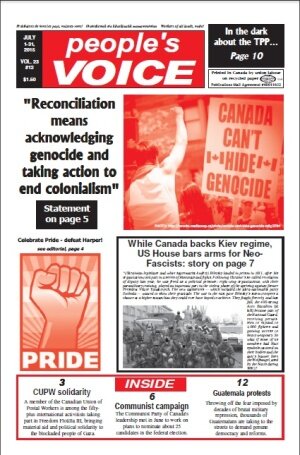
1) MEDICARE SUPPORTERS BREATHE SIGH OF RELIEF
2) QUEBEC POSTAL WORKER JOINS FREEDOM FLOTILLA III
3) COMMUNIST PARTY LEADERSHIP GEARS UP FOR FEDERAL CAMPAIGN
4) CANADIAN NETWORK ON CUBA CONVENTION SETS PRIORITIES
5) CELEBRATE PRIDE AND DEFEAT HARPER! - Editorial
6) CONFRONTING RACISM AND FASCISM - Editorial
7) MASS STRUGGLE IS STILL THE KEY TO VICTORY
8) “RECONCILIATION MEANS ACKNOWLEDGING GENOCIDE AND TAKING ACTION TO END COLONIALISM”
9) ECUADORIANS MOBILIZE AGAINST LATEST COUP ATTEMPT
10) US HOUSE BARS ARMS FOR KIEV NEO-FASCISTS
11) DISMANTLE GUATEMALA’S CRIMINAL POLITICAL STRUCTURE
12) MUSIC NOTES, by Wally Brooker
PEOPLE'S VOICE JULY 1-31, 2015 (pdf)
|
To order a copy send $15 (includes package and handling) to People’s Voice, 706 Clark Drive, Vancouver, BC, V5L 3J1. Contact us at 604-255-2041 or pvoice@telus.net for bulk order prices. |

|
People's Voice deadlines: August 1-31 September 1-15 Send submissions to PV Editorial Office,
|
REDS ON THE WEB
http://www.communist-party.ca
peoplesvoice.ca
www.ycl-ljc.ca
www.solidnet.org
|
People's Voice finds many "Global Class Struggle" reports at the "Labour Start" website, http://www.labourstart.org/. We urge our readers to check it out! |
* * * * * *
Central Committee CPC
290A Danforth Ave Toronto, Ont. M4K 1N6
Ph: (416) 469-2446
fax: (416) 469-4063 E-mailmailto:info@cpc-pcp.ca
Parti Communiste du Quebec (section du
Parti communiste du Canada)
5359 Ave du Parc, Montréal, Québec,
H2V 4G9
B.C.Committee CPC
706 Clark Drive, Vancouver, V5L 3J1
Tel: (604) 254-9836
Fax: (604) 254-9803
Edmonton CPC
Box 68112, 70 Bonnie Doon P.O.
Edmonton, AB, T6C 4N6
Tel: (780) 465-7893
Fax: (780)463-0209
Calgary CPC
Unit #1 - 19 Radcliffe Close SE
Calgary AB, T2A 6B2
Tel: (403) 248-6489
Ottawa CPC
Tel: (613) 232-7108
Manitoba Committee
387 Selkirk Ave., Winnipeg, R2W 2M3
Tel/fax: (204) 586-7824
Ontario Ctee. CPC
290A Danforth Ave., Toronto, M4K 1N6
Tel: (416) 469-2446
Hamilton Ctee. CPC
265 Melvin Ave., Apt. 815
Hamilton, ON.
Tel: (905) 548-9586
Atlantic Region CPC
Box 70 Grand Pré, NS, B0P 1M0
Tel/fax: (902) 542-7981
* * * * * *
News for People, Not for Profits!
Every issue of People's Voice
gives you the latest
on the fightback from coast to coast.
Whether it's the struggle for jobs or peace, resistance to social cuts,
solidarity with Cuba, or workers' struggles around the world,
we've got the news the corporate media won't print.
And we do more than that
- we report and analyze events
from a revolutionary perspective,
helping to build the movements for justice and equality,
and eventually for a socialist Canada.
Read the paper that fights for working people
- on every page, in every issue!
People's Voice
$30 for 1 year
$50 for 2 years
Low-income special rate: $15 for 1-year
Outside Canada $50 for 1 year
Send to: People's Voice, 706 Clark Drive, Vancouver, BC, V5L 3J1
You can call the editorial office at 604-255-2041
<pvoice@telus.net>
REDS ON THE WEB
www.communist-party.ca
peoplesvoice.ca
www.ycl-ljc.ca/
http://solidnet.org/
http://www,rebelyouth-magazine.blogspot.com
(The following articles are from the July 1-31, 2015, issue of People's Voice, Canada's leading socialist newspaper. Articles can be reprinted free if the source is credited. Subscription rates in Canada: $30/year, or $15 low income rate; for U.S. readers - $45 US per year; other overseas readers - $45 US or $50 CDN per year. Send to People's Voice, c/o PV Business Manager, 706 Clark Drive, Vancouver, BC, V5L 3J1.)
1) MEDICARE SUPPORTERS BREATHE SIGH OF RELIEF
PV Vancouver Bureau
Supporters of Canada’s universal Medicare system were relieved in mid-June when Dr. Alan Ruddiman was elected as the new president of Doctors of B.C. (formerly the BC Medical Association). Ruddiman won a run-off election against Dr. Brian Day, who supports expanding privately funded healthcare, by a 3,065 to 2462 vote margin, or 55.5% to 44.5%.
Day, an orthopedic surgeon and founder of the for-profit Cambie Surgery Centre, was originally elected president by a one-vote margin, until a recount determined that one ballot had not been counted, making the result a tie.
The initial count had sent shock waves, seeming to indicate that BC doctors backed Day’s longstanding campaign to replace the single-payer system for compensating doctors, by adding a second “two-tier” parallel private system.
On his campaign website, Day boasted that he has campaigned for over 20 years to “liberate both patients and doctors from policies and laws that ration access and funding.”
Day's clinic has launched a constitutional challenge against the B.C. government over its attempt to stop his company from billing patients directly. The court case was filed after the B.C. Medical Services Commission determined in 2012 that the clinic and its related Specialist Referral Clinic were repeatedly extra billing in violation of the Medicare Protection Act. A partial audit at the time found that Day’s clinics had unlawfully billed patients $491,654 over a single month period. The clinics were ordered to stop breaking the law, but refused. The court case has been delayed at least twice while Day attempts to negotiate some kind of settlement with the province, possibly indicating that his chances of success in the courts are doubtful.
Day claims that for-profit health care will make hospital wait-lists shorter, but international evidence shows that increasing for-profit care has no impact on public wait times.
Pro-Medicare groups point out that while wait times for some elective surgeries do need to be addressed, there is considerable evidence showing that, in some cities and provinces, innovations in the public system are shortening wait times in ways that benefit everyone. Adding a second private tier would not solve these challenges, they argue; in fact, this would mean longer wait times, poorer health, and runaway health care costs for Canadians. The fundamental flaw in Day’s argument is the invalid assumption that Canada has an over-supply of trained medical personnel; in fact, establishing a full parallel private system would tend to attract large numbers of doctors, leaving most of the population facing longer wait times for access to a smaller pool of specialist physicians and other health professionals.
Medicare supporters also point out that for-profit care is no guarantee of a better health outcome. Research has shown that the total time spent recovering from an injury is often shorter in the public system.
The BC Health Coalition warns that adopted a US-style health system would put enormous new cost burdens onto most Canadians. In the United States, the cost of insurance for an average family of four is $16,000 per year, and most bankruptcies are caused by high medical bills.
2) QUEBEC POSTAL WORKER JOINS FREEDOM FLOTILLA III
Christian Martel, a recently retired letter-carrier from the Quebec City area, left on June 17 to join the Freedom Flotilla III that is headed to Gaza. He is one of over fifty citizens from different countries, and he is joined by three other Canadians: Robert Lovelace, member of the Ardoch Algonquin First Nation, Kevin Neish, an activist from Victoria, BC, who is already on board the Marianne, which left Sweden several weeks ago, and Ehab Lotayef, an engineer and poet from Montreal, member of the steering committee for the Canadian Boat to Gaza and the Freedom Flotilla Coalition.
Martel, an retired member of the Canadian Union of Postal Workers (CUPW) and for many years head of the Quebec section and international solidarity issues, as well as being a member of the Quebec Federation of Labour (FTQ) executive, is engaging in an act of courage and solidarity toward the Palestinian people.
The population of Gaza lives in an open-air prison, or, as Lovelace puts it, “in the world’s largest Indian reservation”. The blockade of Gaza, imposed by Israel since 2007, is illegal and immoral. It violates international law, specifically the fourth Geneva Convention, the International Covenant on Civil and Political Rights and the International Covenant on Economic, Social and Cultural Rights (Article 1), the Universal Declaration of Human Rights (Article 13), and the International Convention on the Suppression and Punishment of the Crime of Apartheid. This blockade is killing the population little by little.
All of this is happening in front of our eyes, with the complicity of the international community and in particular that of the Canada’s Harper government, whose unconditional and obsessive support for Israel essentially constitutes a “declaration of war” on the Palestinian people. As Martel says: “when we witness this kind of situation, we need to assume our responsibilities.”
The gathering of supporters that saw Christian Martel off at the airport included a Québec Solidaire representative, who delivered a statement of support from his party. A number of Québec organizations support Martel and what he is doing, including the Ligue des droits et libertés, the Québec Federation of Labour, the Confédération des syndicats nationaux, the Centrale des syndicats du Québec, the Greater Montréal Central Council of the CSN, the Centre Internationale de Solidarité Ouvrière, the Association québécoise des organismes de coopération internationale, Fédération des femmes du Québec, Palestinians and Jews United, Independent Jewish Voices, the Justice and Faith Centre, BDS-Québec Coalition, and the Trois-Rivières Solidarity Committee.
The Freedom Flotilla III sets its course on Gaza to call for an immediate end to this inhumane blockade This peaceful international initiative bears witness to the fact that Israel’s treatment of Gaza Palestinians is not done “in our name”, that to the contrary, Israel’s position is increasingly rejected across the globe. “It’s time for the criminal blockade of Gaza to end. Until human rights are respected and Palestinians are given control of their own destiny, peace in the region will remain a distant dream,” commented Mike Palecek, CUPW National President.
Canadian Boat to Gaza, http://www.tahrir.ca/content/donate, https://www.facebook.com/CanadaBoatGaza, and Twitter: @CanadaBoatGaza
3) COMMUNIST PARTY LEADERSHIP GEARS UP FOR FEDERAL CAMPAIGN
Special to PV
Meeting over the June 13-14 weekend in Toronto, the Central Committee of the Communist Party of Canada reviewed a recent upsurge of membership recruiting, and stepped up plans for the federal election expected on October 19. The CC meeting also set the ball rolling for the party’s 38th Central Convention, planned for May 2016.
CPC leader Miguel Figueroa opened the gathering with a wide-ranging report on the international situation, and on political developments in Canada.
Figueroa warned that "the main feature today is the dramatic escalation in militarism and the drive to war by U.S. imperialism and its allies... by growing interference in the domestic affairs of other countries, and by outright intervention to overturn states and governments perceived to be hostile to its regional or global interests.... (and by) an all-sided offensive to roll back the social and economic gains of the working class and working people generally, and sharpened attacks on labour, democratic and civil rights."
The report slammed the Harper government's support for the US intervention in Iraq and Syria, its backing for the pro-fascist regime in Ukraine and for Israeli expansionism, and for its belligerent attitude to the Bolivarian government in Venezuela.
Imperialist interventions and "regime change" tactics, says the report, are pushing the world in a dangerous direction. As the World Peace Council recently noted, overall military expenditures last year reached almost $1.5 trillion (2.4 % of global GDP), 37% of which was spent by the USA.
The global web of U.S. military bases and installations is now estimated at roughly 1,000. The "new cold war" campaign against the Russian Federation over the issue of Ukraine, together with NATO’s push to tighten the encirclement of Russia, raise the potential of nuclear war.
U.S. imperialism has also begun a dangerous expansion in the Pacific. The “Pivot to Asia” plan to encircle the People’s Republic of China calls for deployment of 60% of the U.S. naval fleet in the area, with grave consequences to peace and stability. This strategy also has a South Asian component, based on closer U.S. relations with India's reactionary BJP government under PM Narendra Modi.
Meanwhile, the U.S. and NATO imperialist powers are conducting new wars in the Middle East, under the cover of the ‘war on terror’. In reality, as the report says, this is part of a strategy to impose a ‘New Middle East’: a patchwork of weak, fractured Arab states divided among sectarian lines, in order to undermine pan-Arab unity and facilitate Israeli expansionism.
Imperialist intervention is also growing in Africa, where the first major operation after the formation of the U.S. Africa Command (AFRICOM) in 2008 was the US/NATO operation to smash the Gaddafi government in Libya in 2011. One recent study found US military involvement in no fewer than 49 African nations.
As the report notes, one continent where imperialist interests continue to suffer setbacks is South America. At the Summit of the Americas in April, delegation after delegation rose to condemn U.S. economic and political interference in their affairs, and to demand that Washington rescind its executive decree calling Venezuela a ‘national security threat’. It was also a significant moment for socialist Cuba, invited to participate for the first time, represented by President Raul Castro.
CC members discussed these developments at length, along with the ominous growth of extreme right parties in several countries across Europe. While ultra-right and neo-fascist groups are less visible in Canada, some are emerging, adding heightened importance to the struggle to combat right-wing populism, anti-immigrant attacks, racism and fascism in this country.
Turning to the domestic situation, Figueroa referred to growing job insecurity, increased household debt, deteriorating social services due to government ‘restraint’ measures, and a tightening squeeze on real incomes and living standards of working people, in contrast to rapidly accumulating wealth in the coffers of the banks, corporations and the super-rich. Widening disparities in Canada are “the net result of the anti-working class offensive of monopoly interests at the workplace, around the bargaining table, and through the austerity policies of governments, especially the Harper Conservatives.” The true face of Harper’s “economic action plan,” he stressed, is to “enhance corporate profitability and the concentration of capital through a wholesale transfer of wealth from the working class, small farmers and primary producers, Aboriginal peoples, women, new immigrant communities and migrant workers, youth and the elderly.”
This is the context of the Conservative government’s Bill C-51, which aims to blunt the growing trend of resistance and fightback by a wide range of labour and democratic movements. It is apparent, Figueroa said, that the main weapon in Harper’s re-election bid will be to play on people’s fear and insecurities, by hyping up the danger from the “Russian menace”, ISIS and Islamic extremism, praising the military, and attacking the opposition parties for their “weakness” in the face of the “terrorist threat”. A hawkish, cold war-style campaign theme will be drummed out at every opportunity, he predicted.
CPC Central Organizer Johan Boyden reported to the meeting on Communist Party activity in recent months. The Party’s visibility reached its highest levels in years during the recent cross-Canada struggle to defeat Bill C-51, and communists played a major role in building demonstrations and other forms of opposition in a number of areas.
Overall, the Communist Party and the Young Communist League have both registered significant growth since the CPC’s party-building campaign was launched last fall. Boyden and other party leaders visited many areas of the country, and most local clubs have recruited new members. New clubs have also been established, including a Halifax Club which was chartered by a special vote of the Central Committee.
These developments are a good sign for Communist participation in the federal election. The Party will field about 25 candidates in major cities across the country, including a larger proportion of youth than previously. Some campaign teams have already gathered enough signatures to nominate their candidates, such as in Vancouver East and Esquimalt-Juan de Fuca. The party’s platform was the subject of a special online CC meeting earlier this year, and will be finalized over the summer. The Communists will call for defeat of the Harper Conservatives - the most dangerous party of big business - and urge support for candidates who project a people’s alternative to neoliberal, pro-war austerity policies. Full details of the Communist campaign strategy and platform will be published before the writ is dropped.
4) CANADIAN NETWORK ON CUBA CONVENTION SETS PRIORITIES
The Canadian Network on Cuba (CNC) held a successful 7th Biennial Convention in Toronto from May 30-31, 2015. Delegates from 19 member organizations were joined by observers and invited guests including His Excellency Julio Garmendía Peña, Ambassador of Cuba to Canada, Javier Domokos Ruiz, Toronto Consul General of Cuba and other Cuban diplomats.
The Convention had the honour of hosting Fernando González Llort, one of the Five Cuban Heroes who had been imprisoned unjustly for defending Cuba from terrorist attacks launched from the United States. Fernando Gonzalez participated in his capacity as Vice-President of the Cuban Institute for Friendship with the Peoples (ICAP).
Also present was Dr. José de Jesús Portilla García, who had just completed a nine-city tour to raise awareness about Cuba's contribution to addressing the Ebola crisis in West Africa.
A public meeting on the evening of May 30 was the highlight of the Convention. Fernando González Llort spoke to a standing room-only audience at the United Steelworkers Hall to celebrate the freeing of all the Five Cuban Heroes. Fernando declared his appreciation for the contribution of the Canada-Cuba solidarity movement to the struggle to win their freedom, stating: "On behalf of my four brothers and our families, thank you. This victory belongs to all of you."
Fernando also emphasized that the international solidarity movement still faces the task of ending the U.S. policy of hostility and aggression. He noted that the struggle "hasn't ended. We won a battle but the blockade remains and Guantanamo base is still there [illegally on Cuban territory]. The blockade impacts all aspects of Cuban life." He reiterated that Havana is committed to maintaining its internationalist foreign policy. In Cuba "solidarity is part of our culture," he stated.
Dr. José de Jesús Portilla Garcia explained the human-centred health care system that has emerged in Cuba despite the economic blockade. He emphasized that in Cuba healthcare is a human right enshrined in the Constitution and guaranteed by the Cuban state. Despite being a poor country Cuba has provided medical assistance to other countries in Africa, Asia, Latin America and the Caribbean based on a spirit of internationalism.
At the public meeting, Ambassador Garmendía Peña announced the launch of Cuba Pan Am 2015, a new website http://cubapanam2015.ca designed to provide news and information in English, French and Spanish about Cuba's participation at the 2015 Pan American Games being held July 10-26 in Toronto.
Interesting panel discussions were held during the Convention, within the context of steps toward the establishment of formal diplomatic relations between the U.S. and Cuba, as well as the celebration of 70 years of uninterrupted Canada-Cuba diplomatic relations.
During the panel Canada-Cuba Solidarity & 70 Years of Canada-Cuba Diplomatic Relations, Ambassador Garmendía Peña pointed out that despite the recent victories, the U.S. economic blockade is still in force, and the illegal U.S. occupation of Guantanamo Bay continues. He emphasized the need to continue building and deepening the existing relations of friendship and cooperation that exist between Canada and Cuba.
Jean Augustine, a former Liberal MP and Speaker of the House of Commons, focussed on the role of parliamentarians in fostering Canada-Cuba relations. She regaled the audience with vignettes of her various trips to the island nation, especially her various meetings with the historic leader of the Cuban Revolution, Fidel Castro.
Nino Pagliccia, editor of the recently released book Cuba Solidarity in Canada: Five Decades of People-to-People Foreign Relations, outlined how Cuba's internationalism provides a foreign policy model in which solidarity is the fundamental principle.
The Convention's final panel, Cuba-Today and Tomorrow, featured Professor Emeritus Keith Ellis from the University of Toronto, Javier Domokos Ruiz and CNC Co-Chair Isaac Saney. They presented lively information on the ongoing renovation and updating of the Cuban economy and the significance of U.S. President Obama's new policy. The panel stressed that the economic measures being implemented by Cuba are taking place within the process of the renewal and continuity of the Cuban revolutionary and socialist project, and that while Cubans welcome normalization of relations with the United States, they would never renounce their independence, sovereignty or socialism.
Extensive reports covering the two years since the 6th Convention illustrated the breadth and depth of Canada-Cuba solidarity activities from Vancouver to Halifax. Highlights of the CNC's work included the very successful cross-Canada tours of Geraldo Alphonso and Dr. Portilla Garcia, and the international symposium Africa's Unknown War: Apartheid Terror, Cuba & Southern Africa Liberation.
Recognizing that Cuba has arrived at a new moment which poses specific challenges, CNC delegates resolved to mobilize public and political opinion to end the U.S. economic blockade, return Guantanamo Bay and to challenge the disinformation campaign against Cuba. Resolutions were adopted to strengthen and guide the CNC's work over the next two years and measures were taken to update the CNC's by-laws.
Special attention was paid to the highly successful Ernesto Che Guevara Voluntary Work Brigade and the annual Pastors for Peace Caravan, and the ongoing work with Canadian parliamentarians. The Convention committed to support a symposium in Toronto in 2015 to commemorate the 40th Anniversary of Operación Carlota, the beginning of Cuba's internationalist mission in Angola that was crucial to the success of the southern African national liberation and anti-colonial struggles.
A new CNC executive was elected for 2015-2017, including Michel Dugre, Julio Fonseca, Dave Forman, Elizabeth Hill, Isaac Saney, Aaron Shields and Saleh Waziruddin. The executive subsequently selected Hill and Saney to continue as co-chairs. Isaac Saney was also re-appointed National Spokesperson and Elizabeth Hill as Treasurer, with Saleh Waziruddin assuming the position of Secretary.
5) CELEBRATE PRIDE AND DEFEAT HARPER!
People’s Voice Editorial
As the summer season of LBGTTQ+ Pride events kicks off, People’s Voice sends warm greetings to all those taking part in celebrations, parades, picnics and other activities over the next few months.
Many historic legal, political and cultural victories for equality rights have been gained since the first Pride parades were held. And more progress is being achieved around the world, as seen in the recent Irish referendum on same-sex marriage rights. Another breakthrough over the past year has been the growing movement to end all forms of discrimination based on sexual orientation and gender expression/identity, such as the welcome action by many School Boards to make schools safer and more welcoming for trans* students.
But the struggle for human rights continues to face resistance and even violence from anti-equality forces. Despite the racist stereotype that bigotry is a “third world” problem, the reality is that hatred and gaybashing remain common in Canada. Homophobic and transphobic ideas are being deliberately exported from North America and Europe by fundamentalist groups and far-right ideologues. Here at home, the Senate has stalled Bill C-279, which aims to amend the Canadian Human Rights Code by adding "gender identity" to hate-crime legislation provisions.
These right-wing forces hope to undermine united working class resistance to the corporate austerity agenda, by scapegoating the LGBTTQ+ community along with racialised groups and other minorities. We must stand on the principle that "an injury to one is an injury to all." Full legal and political protections for sexual orientation and gender expression/identity are urgently needed to strengthen working class unity. Such unity will be necessary in October to defeat the Harper Conservatives - the favoured party of big business, and the political home for so-called “family values” bigots who want to roll back LGBTTQ+ equality and women’s access to reproductive rights.
6) CONFRONTING RACISM AND FASCISM
People’s Voice Editorial
Seemingly unconnected events sometimes reveal patterns which are not immediately obvious. One such pattern is the re-emergence of racist and fascist ideas which had been consigned to history.
South of the border, the mass shooting at the Emanuel African Methodist Episcopal Church in Charleston - the historic church of slave revolt hero Denmark Vesey - was not the act of a disturbed individual. The killer openly upheld the centuries-long “tradition” of white supremacy, which includes countless murders, rapes, lynchings and police killings against Black Americans. The Civil War victory over the southern slavocrats was not enough to root out their inhuman ideology, which survives in a modern United States where corporate profits are boosted by the exploitation and oppression of racialized minorities.
Across the ocean, Hitlerism was smashed on the battlefields of World War Two, with the Soviet people led by their Communist Party playing the decisive military role. But US imperialism refused to complete the task of eradicating Nazism, choosing instead to turn the remnants of the fascist machine against the USSR and its socialist allies. Today the followers of these fascists are in power in Kiev, and spreading xenophobic and homophobic terror across the rest of the continent.
Here at home, Stephen Harper stubbornly refuses to utter the “G” word, maintaining the shameful pretence that the genocidal policies imposed on indigenous peoples by colonialism were “mistakes” - not fundamental characteristics of the racist ideology of white European Christian supremacy. And at the “grassroots” level, neo-nazis are seeking to turn legitimate anger over falling living standards into violence against immigrants and refugees.
Such expressions of fascist and racist ideology are encouraged by a ruling class desperate to maintain control at a time of deepening capitalist economic crisis. These ideas must not be trivialized - they must be confronted and beaten back wherever they emerge.
7) MASS STRUGGLE IS STILL THE KEY TO VICTORY
Special Resolution on the 80th anniversary of the On to Ottawa Trek, adopted by the Central Committee of the Communist Party of Canada, June 13-14, 2015
This meeting of the Central Committee CPC salutes the 80th anniversary of the 1935 On to Ottawa Trek - one of the most iconic episodes in the history of the working class struggle in Canada. On this occasion, we pay tribute to the leaders of the Trek - Arthur "Slim" Evans, Robert "Doc" Savage and other working class heroes who fearlessly took on the bosses, the police, the military, and right-wing politicians.
At the same time, we stress the need to understand the lessons of the past in today's context.
The On to Ottawa Trek was initiated by the communist-led Relief Camp Workers Union at the height of the Great Depression, after five years of vicious ruling class attacks on the living standards and rights of the working class across the country. Today we are experiencing another period of economic crisis for the capitalist system, which has seen a rebound of corporate profits since 2008, but no real economic recovery for working people. Once again, the gap between the ultra-wealthy and the mass of the people has increased sharply, reflecting the intensified exploitation of workers as bosses use the "reserve army of labour" to drive down wages and impose austerity cuts.
The Trek was an outstanding example of the capacity of the working class to mobilize militant resistance and win broad support for immediate demands. These included the famous slogan of "work and wages" and closure of the “20 cents a day” slave labour camps, but also the eight-hour day, unemployment insurance, old age pensions, access to health care, the right to organize into trade unions, an end to police state repression, and much more. The generation of radical working class activists who took part in the Trek and other labour battles of that decade were in the forefront of mass labour and democratic movements around these issues from the late 1930s through the post-WW2 era. Their struggles were a decisive rebuff to the earlier domination of narrow craft unionism, and to the class collaborationist strategies of opportunist labour leaders who failed the working class so completely during the early years of the Depression.
We also note another important historical parallel - the role of far-right Conservative federal governments, which act as the political arm of the most reactionary and aggressive sections of the capitalist class. The On to Ottawa Trek was a key event in the mass struggles leading to the defeat of R.B. "Iron Heel" Bennett's Tories, who had ordered the brutal police attack on the Trekkers and supporters on July 1, 1935 in Regina's Market Square. That attack blocked the Trek from advancing eastward, but it did not stop other Workers Unity League members in Ontario from heading to Ottawa to confront the Bennett government. Today, the labour movement and its allies can and must play a leading role in mass mobilizations to drive the Harper Tories out of office, and then to help build a broad, powerful, mass extra-parliamentary movement which could compel a new government to reverse the neoliberal austerity policies imposed over the last three decades.
In all such struggles, both historic and present day, the element of revolutionary working class leadership is a crucial factor. For over 90 years, Communists have led many important battles for labour rights, social justice, democracy, equality, and solidarity. The renewed growth of the Communist Party and the Young Communist League in the recent period is proof that in hard times, a successful fightback requires militant, class struggle strategies.
(To mark this occasion, the Communist Party will hold wreath-laying ceremonies on July 1 at the gravesite of Arthur “Slim” Evans in Burnaby. For information, call the Party’s Vancouver office, at 604-254-9836)
8) “RECONCILIATION MEANS ACKNOWLEDGING GENOCIDE AND TAKING ACTION TO END COLONIALISM”
Resolution adopted by the Central Committee, Communist Party of Canada, June 13-14, 2015, Toronto
The report of the Truth and Reconciliation Commission chaired by Justice Murray Sinclair is an important milestone in the struggle to achieve reconciliation and to overcome the legacy of racist colonial policies imposed upon Aboriginal peoples by the European imperialist powers and later by the Canadian capitalist state. The Communist Party of Canada welcomes the TRC report and pledges our support for its 94 recommendations, which would be a significant step towards full equality, and social justice for Aboriginal peoples. We also express full support for demands to extend the truth and reconciliation process to include the impact of the “day schools” attended by thousands of Metis and First Nations children.
As the summary report of the TRC states:
For over a century, the central goals of Canada’s Aboriginal policy were to eliminate Aboriginal governments; ignore Aboriginal rights; terminate the Treaties; and, through a process of assimilation, cause Aboriginal peoples to cease to exist as distinct legal, social, cultural, religious, and racial entities in Canada. The establishment and operation of residential schools were a central element of this policy, which can best be described as “cultural genocide.”
This conclusion is firmly based on the facts and on international law, which recognizes several categories of genocide, including the mass killing of members of a targeted group (physical genocide); and destruction of structures and practices that allow the group to continue as a group (cultural genocide).
During the TRC’s six year journey across the country, thousands of courageous witnesses came forward, including many Indian residential school survivors, whose legal and political struggles forced the federal government to establish the Commission. Their testimonies and other findings showed that the residential school system, operated by the churches and funded by the government, was a major element of the colonialist strategy to create a “white man’s country” by eliminating and/or forcibly assimilating indigenous peoples. Of the 150,000 students who were forced to attend these schools, an estimated 6,000 (and probably more) died from disease, malnutrition, appalling housing conditions and violence. Thousands of students were the victims of physical and sexual abuse, and they were prevented from speaking indigenous languages or practising their cultural and spiritual traditions..
To be truly meaningful, the reconciliation process must include acknowledgement by the federal government of the core findings of the TRC, and concerted action to implement its recommendations. Instead, the Harper Conservative government has showed its lack of respect for Aboriginal peoples by ignoring the TRC’s conclusions regarding cultural genocide, and by dismissing key recommendations, such as unqualified acceptance of the United Nations Declaration on the Rights of Indigenous Peoples, and a national inquiry into the 1200-plus murdered and missing Aboriginal women and girls. The federal government’s true priorities are shown by its treatment of indigenous land defenders and opponents of corporate energy and resource extraction projects as potential terrorist threats to Canada’s economic security. This is one of the many reasons why the Harper Conservatives – the most viciously anti-working class and racist party of big business – must be defeated in the October 2015 federal election.
The Communist Party of Canada was the first political party in this country to condemn the genocidal racist oppression of Aboriginal peoples, and to fight for their full rights of self-determination, including just and prompt settlement of land claims. We give unconditional support for the TRC’s condemnation of cultural genocide, and for its calls to adopt the UN Declaration on the Rights of Indigenous Peoples and to establish a national inquiry into the tragedy of murdered and missing Aboriginal women and girls. We will continue to advocate for an equal and voluntary partnership of Aboriginal peoples, Quebec and English-speaking Canada, including a new constitutional arrangement which guarantees the full participation of Aboriginal peoples, protecting and extending their inherent national rights. We demand immediate action to close the gap in education, employment, housing, access to clean drinking water, and other indicators of living standards. Not least, we express full solidarity with all Aboriginal peoples engaged in resistance against the expansion of fracking, extraction and export of the tar sands, and other forms of corporate exploitation of natural resources.
Finally, we note that the TRC report is not the first expression of the need for fundament change to overcome the racist legacy of colonialism within Canada. The historic 1996 report of the Royal Commission on Aboriginal Peoples made many significant recommendations, only to be largely ignored by Liberal and Conservative governments over the past two decades. This must not be the fate of the Truth and Reconciliation Commission. We welcome the expressions of support for the TRC report and recommendations coming from many labour and people’s movements, and we will continue to call for a powerful movement to place this issue at the centre of the federal election and beyond.
9) ECUADORIANS MOBILIZE AGAINST LATEST COUP ATTEMPT
By Drew Garvie
On June 15, thousands of supporters of Ecuador’s “Citizens’ Revolution” convened outside the Plaza Grande in Quito to welcome Ecuadorian President Rafael Correa back to the country. The night before right-wing opponents of the Ecuadorian government made some attempts to block traffic from the airport to prevent Correa’s arrival in Quito. The President was returning from CELAC-EU meetings in Belgium.
Last week, a series of demonstrations occurred, spurred on by support from opposition politicians with ties to Ecuador’s old neo-liberal regime friendly to US interests. The initial pretenses for the protests, was a newly tabled “Wealth Redistribution Law”. The corporate media in the country claimed that the new taxes would negatively impact working class families and small businesses, however the new inheritance taxes being introduced will only have an effect on the wealthiest 2 percent of the population. Telesur has reported on the details of the proposed laws:
“The law provides a progressive taxation schedule, meaning those inheriting more will pay more. Only three out of every 100,000 Ecuadoreans will ever receive an inheritance greater than US$50,000…. The highest tax rate of 47.5 percent, charged on inheritances above US$566,400, is in line with those charged throughout the world, and lower than those charged in countries such as Japan. Apart from only affecting two percent of the population, the law provides for important exemptions and deductions. For example, if the inheritance involves the transfer of a home, the non-taxable amount doubles from US$35,400 to US$70,800. The law also allows the inheritance tax to be paid via stock to workers of a company, democratizing the means of production and the state does not receive any money in these cases.”
Ecuador, through the “Citizens’ Revolution”, has managed to lift more than a million people out of poverty. However, inequality still remains very high, with Ecuador in the 132nd spot out of 160 countries. The progressive tax reform is being implemented to realize the new Ecuadorian Constitution which states that: “The primary duties of the state are planning national development and eradicating poverty, promoting sustainable development and equitable distribution of resources and wealth in order to bring about Good Living."
But Correa and many Ecuadorians do not see the protests as really about this law in particular. They are part of a broader reactionary movement against the ongoing processes for sovereignty in Latin America. President Correa is referring to these protests as a destabilization attempt and part of a planned coup. There was already an attempted coup against Correa’s government in 2010. The demonstrators themselves are not limiting their message to opposition to the new tax law. They are calling for the ousting of the PAIS government and President Correa. They have adopted a black flag, to symbolize their mourning over the supposed “death of democracy”. Black also happens to be a favourite colour of fascist movements. The main sectors of society being mobilized in these protests are from wealthy neighbourhoods. There has been violence at these protests, including the injury of a former Minister, who was struck by a glass bottle on the head.
There are many parallels with the coup attempts in Venezuela in 2014, where the right mobilized violent protests that led to the death of 43 people. This violence was in turn used by the United States to justify sanctions against Venezuela for supposed violations of civil rights, and also for the now totally discredited claim that Venezuela was a “threat to the national security” of the US.
South American countries standing up to imperialism have faced growing internal pressure, which is being directly and indirectly supported by the United States and their allies. This includes the belligerent role of Canada’s Harper government which has publicly criticized the Venezuelan government, met with and financed Venezuelan opposition groups, and has been implicated in the latest February 2015 coup attempt in that country. There is an immediate need for progressive and democratic forces in Canada to stand in solidarity with movements and governments in the Americas which are moving away from centuries of colonial and imperialist rule towards self-determination and sovereignty. This includes putting forward the demand that Latin America be considered a “zone of peace”, free from interference by Canada, the US, and other imperialist forces.
In 2013, seventy youth from Canada attended the World Festival of Youth and Students held in Quito, Ecuador. This anti-imperialist meeting of youth was a venue for the exchange of ideas and experiences from around the world. Participants at the Festival met with Ecuadorian youth who described their country’s struggle for a more social and pro-people society with sovereignty over its own affairs. The international solidarity between young people in the Americas at that meeting is needed now to help mobilize against this reactionary coup attempt, and similar efforts to roll-back revolutionary processes on the continent.
10) US HOUSE BARS ARMS FOR KIEV NEO-FASCISTS
By Robert Parry, Consortium News, June 12, 2015
Last February, when ethnic Russian rebels were closing in on the Ukrainian port of Mariupol, the New York Times rhapsodically described the heroes defending the city and indeed Western civilization – the courageous Azov battalion facing down barbarians at the gate. What the Times didn’t tell its readers was that these “heroes” were Nazis, some of them even wearing Swastikas and SS symbols.
The long Times article by Rick Lyman fit with the sorry performance of America’s “paper of record” as it has descended into outright propaganda – hiding the dark side of the post-coup regime in Kiev. But what makes Lyman’s sadly typical story noteworthy today is that the Republican-controlled U.S. House of Representatives has just voted unanimously to bar U.S. assistance going to the Azov battalion because of its Nazi ties.
When even the hawkish House of Representatives can’t stomach these Nazi storm troopers who have served as Kiev’s tip of the spear against the ethnic Russian population of eastern Ukraine, what does that say about the honesty and integrity of the New York Times when it finds these same Nazis so admirable?
And it wasn’t like the Times didn’t have space to mention the Nazi taint. The article provided much colour and detail – quoting an Azov leader prominently – but just couldn’t find room to mention the inconvenient truth about how these Nazis had played a key role in the ongoing civil war on the U.S. side. The Times simply referred to Azov as a “volunteer unit.”
Yet, on June 10, the U.S. House of Representatives approved a bipartisan amendment to the Defense Appropriations Act – from Reps. John Conyers Jr., D-Michigan, and Ted Yoho, R-Florida – that would block U.S. training of the Azov battalion and would prevent transfer of shoulder-fired anti-aircraft missiles to fighters in Iraq and Ukraine.
“I am grateful that the House of Representatives unanimously passed my amendments last night to ensure that our military does not train members of the repulsive neo-Nazi Azov Battalion, along with my measures to keep the dangerous and easily trafficked MANPADs out of these unstable regions,” said Conyers on Thursday.
He described Ukraine’s Azov Battalion as a 1,000-man volunteer militia of the Ukrainian National Guard that Foreign Policy Magazine has characterized as “openly neo-Nazi” and “fascist.” And Azov is not some obscure force. Ukraine’s Interior Minister Arsen Avakov, who oversees Ukraine’s armed militias, announced that Azov troops would be among the first units to be trained by the 300 U.S. military advisers who have been dispatched to Ukraine in a training mission codenamed “Fearless Guardian.”
On Friday, a Bloomberg News article by Leonid Bershidsky noted that “it’s easy to see why” Conyers “would have a problem with the military unit commanded by Ukrainian legislator Andriy Biletsky: Conyers is a founding member of the Congressional Black Caucus, Biletsky is a white supremacist. …
“Biletsky had run Patriot of Ukraine [the precursor of the Azov battalion] since 2005. In a 2010 interview he described the organization as nationalist ‘storm troops’ … The group’s ideology was ‘social nationalism’ — a term Biletsky, a historian, knew would deceive no one. …
“In 2007, Biletsky railed against a government decision to introduce fines for racist remarks: ‘So why the “Negro-love” on a legislative level? They want to break everyone who has risen to defend themselves, their family, their right to be masters of their own land! They want to destroy the Nation’s biological resistance to everything alien and do to us what happened to Old Europe, where the immigrant hordes are a nightmare for the French, Germans and Belgians, where cities are “blackening” fast and crime and the drug trade are invading even the remotest corners.’”
The Bloomberg article continued, “Biletsky landed in prison in 2011, after his organization took part in a series of shootouts and fights. Following Ukraine’s so-called revolution of dignity last year, he was freed as a political prisoner; right-wing organizations, with their paramilitary training, played an important part in the violent phase of the uprising against former President Viktor Yanukovych. The new authorities — which included the ultra-nationalist party Svoboda — wanted to show their gratitude.
“The war in the east gave Biletsky’s storm troopers a chance at a higher status than they could ever have hoped to achieve. They fought fiercely, and last fall, the 400-strong Azov Battalion became part of the National Guard, receiving permission to expand to 2,000 fighters and gaining access to heavy weaponry. So what if some of its members had Nazi symbols tattooed on their bodies and the unit’s banner bore the Wolfsangel, used widely by the Nazis during World War II?
“In an interview with Ukraine’s Focus magazine last September, Avakov, responsible for the National Guard, was protective of his heroes. He said of the Wolfsangel: ‘In many European cities it is part of the city emblem. Yes, most of the guys who assembled in Azov have a particular worldview. But who told you you could judge them? Don’t forget what the Azov Battalion did for the country. Remember the liberation of Mariupol, the fighting at Ilovaysk, the latest attacks near the Sea of Azov. May God allow anyone who criticizes them to do 10 percent of what they’ve done. And anyone who’s going to tell me that these guys preach Nazi views, wear the swastika and so on, are bare-faced liars and fools.’”
Though the House vote on June 10 may have shined a spotlight into this dark corner of the U.S.-embraced Kiev regime, the reality has been well-known for many months – though played down in most of the Western news media, often dismissed as “Russian propaganda.”
Even the Times has included at least one brief reference to this reality, though buried deep inside an article. On Aug. 10, 2014, a Times’ article mentioned the Nazi taint of the Azov battalion in the last three paragraphs of a lengthy story on another topic.
“The fighting for Donetsk has taken on a lethal pattern: The regular army bombards separatist positions from afar, followed by chaotic, violent assaults by some of the half-dozen or so paramilitary groups surrounding Donetsk who are willing to plunge into urban combat,” the Times reported.
“Officials in Kiev say the militias and the army coordinate their actions, but the militias, which count about 7,000 fighters, are angry and, at times, uncontrollable. One known as Azov, which took over the village of Marinka, flies a neo-Nazi symbol resembling a Swastika as its flag.” [See Consortiumnews.com’s “NYT Discovers Ukraine’s Neo-Nazis at War.”]
A Shiver Down the Spine
The conservative London Telegraph offered more details about the Azov battalion in an article by correspondent Tom Parfitt, who wrote: “Kiev’s use of volunteer paramilitaries to stamp out the Russian-backed Donetsk and Luhansk ‘people’s republics’… should send a shiver down Europe’s spine.
“Recently formed battalions such as Donbas, Dnipro and Azov, with several thousand men under their command, are officially under the control of the interior ministry but their financing is murky, their training inadequate and their ideology often alarming. The Azov men use the neo-Nazi Wolfsangel (Wolf’s Hook) symbol on their banner and members of the battalion are openly white supremacists, or anti-Semites.”
Based on interviews with militia members, the Telegraph reported that some of the fighters doubted the reality of the Holocaust, expressed admiration for Adolf Hitler and acknowledged that they are indeed Nazis.
Biletsky, the Azov commander, “is also head of an extremist Ukrainian group called the Social National Assembly,” according to the Telegraph article which quoted a commentary by Biletsky as declaring: “The historic mission of our nation in this critical moment is to lead the White Races of the world in a final crusade for their survival. A crusade against the Semite-led Untermenschen.”
In other words, for the first time since World War II, a government had dispatched Nazi storm troopers to attack a European population – and officials in Kiev knew what they were doing. The Telegraph questioned Ukrainian authorities in Kiev who acknowledged that they were aware of the extremist ideologies of some militias but insisted that the higher priority was having troops who were strongly motivated to fight. [See Consortiumnews.com’s “Ignoring Ukraine’s Neo-Nazi Storm Troopers.”]
But a rebel counteroffensive led by ethnic Russians last August reversed many of Kiev’s gains and drove the Azov and other government forces back to the port city of Mariupol, where Foreign Policy’s reporter Alec Luhn also encountered the Nazis. He wrote:
“Blue and yellow Ukrainian flags fly over Mariupol’s burned-out city administration building and at military checkpoints around the city, but at a sport school near a huge metallurgical plant, another symbol is just as prominent: the wolfsangel (‘wolf trap’) symbol that was widely used in the Third Reich and has been adopted by neo-Nazi groups. …
“Pro-Russian forces have said they are fighting against Ukrainian nationalists and ‘fascists’ in the conflict, and in the case of Azov and other battalions, these claims are essentially true.”
SS Helmets
More evidence continued to emerge about the presence of Nazis in the ranks of Ukrainian government fighters. Germans were shocked to see video of Azov militia soldiers decorating their gear with the Swastika and the “SS rune.” NBC News reported: “Germans were confronted with images of their country’s dark past … when German public broadcaster ZDF showed video of Ukrainian soldiers with Nazi symbols on their helmets in its evening newscast.
“The video was shot … in Ukraine by a camera team from Norwegian broadcaster TV2. ‘We were filming a report about Ukraine’s AZOV battalion in the eastern city of Urzuf, when we came across these soldiers,’ Oysten Bogen, a correspondent for the private television station, told NBC News. “Minutes before the images were taped, Bogen said he had asked a spokesperson whether the battalion had fascist tendencies. ‘The reply was: absolutely not, we are just Ukrainian nationalists,’ Bogen said.”
Despite the newsworthiness of a U.S.-backed government dispatching Nazi storm troopers to attack Ukrainian cities, the major U.S. news outlets have gone to extraordinary lengths to excuse this behaviour, with the Washington Post publishing a rationalization that Azov’s use of the Swastika was merely “romantic.”
This curious description of the symbol most associated with the depravity of the Holocaust and the devastation of World War II can be found in the last three paragraphs of a Post lead story published in September 2014. Post correspondent Anthony Faiola portrayed the Azov fighters as “battle-scarred patriots” nobly resisting “Russian aggression” and willing to resort to “guerrilla war” if necessary.
The article found nothing objectionable about Azov’s plans for “sabotage, targeted assassinations and other insurgent tactics” against Russians, although such actions in other contexts are regarded as terrorism. The extremists even extended their threats to the government of Ukrainian President Petro Poroshenko if he agrees to a peace deal with the ethnic Russian east that is not to the militia’s liking.
“If Kiev reaches a deal with rebels that they don’t support, paramilitary fighters say they could potentially strike pro-Russian targets on their own — or even turn on the government itself,” the article stated.
The Post article – like almost all of its coverage of Ukraine – was laudatory about the Kiev forces fighting ethnic Russians in the east, but the newspaper did have to do some quick thinking to explain a photograph of a Swastika gracing an Azov brigade barracks. So, in the last three paragraphs of the story, Faiola reported: “One platoon leader, who called himself Kirt, conceded that the group’s far right views had attracted about two dozen foreign fighters from around Europe.
“In one room, a recruit had emblazoned a swastika above his bed. But Kirt … dismissed questions of ideology, saying that the volunteers — many of them still teenagers — embrace symbols and espouse extremist notions as part of some kind of ‘romantic’ idea.”
Despite these well-documented facts, the New York Times excised this reality from its article about the Azov battalion’s defense of Mariupol last February. But isn’t the role of Nazis newsworthy? In other contexts, the Times is quick to note and condemn any sign of a Nazi resurgence in Europe. However, in Ukraine, where neo-Nazis, such as Andriy Parubiy served as the coup regime’s first national security chief and Nazi militias are at the center of regime’s military operations, the Times goes silent on the subject.
Rather than fully inform its readers about a crisis that has the potential of becoming a nuclear showdown between the United States and Russia, the Times has chosen to simply be a fount of State Department propaganda, often terming any reference to Kiev’s Nazi storm troopers to be “Russian propaganda.” Now, however, a unanimous U.S. House of Representatives — of all things — has acknowledged the unpleasant truth.
Investigative reporter Robert Parry broke many of the Iran-Contra stories for The Associated Press and Newsweek in the 1980s.
11) DISMANTLE GUATEMALA’S CRIMINAL POLITICAL STRUCTURE
Statement by the Guatemalan Party of Labour (PGT), May 2015
The political crisis arising from the actions of the International Commission Against Impunity in Guatemala (CICIG) and the Public Ministry (MP) to dismantle the criminal structure known as La Linea (The Line) and subsequently the network operating in the Guatemalan Social Security Institute (IGSS) reveals that the state has entered into and been held captive by these kinds of mafia organisations from the highest levels of political power. Both arose about four decades ago, as part of the counterinsurgency alliance of the oligarchy and the military leadership, with the strong support of the United States.
In this context, the military leadership and middle rank army officers created criminal structures of drug, arms and human trafficking, tax fraud and smuggling. The army became, gradually, a real factor of political and economic power through the accumulation of illicit capital. These are the foundations of the bourgeois, militarised counter-insurgency state, controlled by the oligarchy, the military leaders and their gangs of organised crime.
The political transition that began in 1985 reconfigured the state. The counter-insurgency-Mafia state was transformed into a neo-liberal, Mafia and repressive state, whose political control would dispute the oligarchy and the “modernising bourgeoisie” to the leading positions and counterinsurgency military Officer Corp and organised crime. The actions of former President Alvaro Arzu against the “Moreno Network” and Grupo Salvavidas (Lifeguard Group) in 1996 were an expression of that dispute, but were truncated as the main beneficiaries of this network were financiers of the National Advancement Party (PAN), through which Arzú became President of the Republic.
The function of this converted state is to ensure the development of neo-liberal capitalism and the expansion of transnational capital in the country. To do this, counterinsurgency structures (especially intelligence) aim to repress – in partnership with businesses, private security and intelligence apparatus – any manifestations of struggle against neo-liberal capitalism, the plunder and the trans-nationalisation of resources and assets held by the public.
The political crisis arising from the dismantling of some of these criminal networks is an expression of the deep structural crisis to be found within the neo-liberal-Mafia state, controlled by large corporate groups and organised crime. It is a manifestation of the struggle between power groups that control it. The crisis of neo-liberal capitalism in Guatemala is deepening and, as a result of its disastrous effects, popular mobilisation against this predatory model is increasing daily.
The key question is how to solve it. So far, they have clearly revealed two proposals: a “controlled exit” by the ruling class in alliance with the US, and an exit which allows at least the reorganisation and democratisation of the state and its institutions. However, on the horizon one begins to glimpse the demand for a radical refounding of the State, expressed by a cross-class, ethnic and social formation that consolidates its features in the current situation.
With the resignation of vice-president Roxana Baldetti and the subsequent appointment of Alejandro Maldonado Aguirre (a character with a dark past, from the right and the defunct National Liberation Movement (MLN) linked to death squads in the ‘60s -‘70s), the US Embassy and the Guatemalan Business Council sought to impose its “controlled exit”. In this solution to the crisis, CICIG has played a vital role since the revelation of “The Line”. This manoeuvre has the fundamental aim of ensuring the continuity of the neo-liberal project and hegemony and domination of the bourgeoisie, the leadership of the military and the US.
Another proposal suggests the consolidation of institutions, including political parties, in addition to the requirement to prosecute those linked to these criminal structures. It focuses on the need to reform the Electoral Law and Political Parties and the convening of a National Constituent Assembly, within the current parameters. Among these proposals there is a range of approaches to moving towards or away from the demand for radical re-foundation of the State.
From our perspective, neither of the first two ways out of the crisis offer the solution to the great problems of the country. On the one hand, the “controlled exit” only guarantees the continuation of the neo-liberal project of big business, the plunder of public assets and resources and communities; it ensures state control by the traditional economic power, the emerging one and the Mafias. Furthermore, the second proposal reduces the reform of the rules of the political game and the Constitution to institutional reorganisation.
The Guatemalan Party of Labour expresses its full support for the large mobilisations carried out by the urban middle class in the capital city and several departments and the major demonstrations that have also featured support from the peasant, Indigenous and popular movement; demanding clean lawsuits, seeking new institutions, reform of the state and prosecution of all those involved in the criminal structures formed by businessmen, politicians, civil servants, officers and demobilised former military officers, civil institutions throughout the state during the current government, the contemporary expression of the counterinsurgency policy of militarism.
At the same time, the PGT raises the need to deepen these demonstrations; turn them into a broad popular movement, in the city and countryside, of workers, communities and peoples, employees, students of all levels and middle class people. This situation opens up the possibility of promoting a thorough review and parallel elimination of corrupt practices that have contaminated the trade union, peasant and popular movement, and the electoral left itself.
It also proposes to make the crisis a turning point and fight for measures that direct the country towards a deep transformation of the state as well as the promotion of a development model that favours the population, which has hitherto been excluded. In that sense, our demands should be directed to:
1. The demilitarisation of the State, the total dismantling of all criminal structures within it, from national to municipal and local; judicial prosecution of their members (entrepreneurs, politicians, military and former military, civil servants and lawyers) and the dismantling of the structural mechanisms of corruption.
2. The end to the criminalisation of social struggles and repression against the people, social leaders, advocates and human rights defenders, community leaders in the struggle of resistance and defence of the territory.
3. Suspension of the general elections and adoption of a new Electoral Law and Political Parties to ensure: a) participation in conditions of equality of women and of Maya, Xinca and Garifuna peoples with candidacies defined according to their gender and their own norms, independent of political parties’ regulations; b) change of the current electoral districts to others that take into account the territoriality of the Maya, Garifuna and Xinca peoples to ensure their representation; c) the prohibition of private funding to political parties and the establishment of effective supervisory mechanisms; d) strengthening the enforcement capacity of the Electoral Commission, TSE in relation to crimes and offences in electoral matters.
4. Resignation of the Executive in full and the establishment of a transitional government, emanating from the consensus of all social and political forces.
5. The call for a National Constituent Popular Assembly to drive the process of reorganising the state to build one social, plural-national, democratic and participatory, anti-patriarchal one, respectful of nature and ensuring self-determination of the peoples who are integrated.
6. The repeal of all harmful legislation that enables theft of public goods and resources and communities, and that damages the interests of the working class, Indigenous people and mestizos. Also, suspension of the Congress of the Republic.
Finally, the PGT calls on workers in the countryside and in the city, peasants, workers, students, professionals, urban middle class and people in general, to redouble and intensify the struggle for their specific demands, and to join the political struggle against the crisis.
For Guatemala, the Revolution and Socialism!
12) MUSIC NOTES, by Wally Brooker
Neil Young takes on Monsanto
Singer-songwriter Neil Young's 36th studio album, scheduled for release on June 30, takes on yet another corporate villain. The Canadian rocker has collaborated with Willie Nelson's sons, Lucas and Micah, and Lucas' band, Promise of the Real, to produce “The Monsanto Years”, a broadside against the Missouri-based agribusiness and biotechnology giant. Young first hooked up with Lucas and Micah at last year's Farm Aid benefit, and they've subsequently united for concerts in solidarity with the struggle against the Keystone Pipeline. Neil Young, with the Nelson brothers and Promise of the Real, will be touring the USA in July. As for the agribusiness monster, Young says, “I don't really have anything against the human beings working at Monsanto, but Monsanto is the poster child for the problems we're having with the corporate government.” In a related matter, Young is boycotting Starbucks, because the coffee company, along with Monsanto, is a member of the Grocery Manufacturers Alliance, which is suing the tiny state of Vermont (population 600,000) to overturn its GMO labelling law. For more info: www.neilyoung.com.
Valentina Lisitsa's Donetsk concert
As we go to press, preparations are underway for pianist Valentina Lisitsa's historic concert in the besieged city of Donetsk, East Ukraine, capital of the resistance against the far-right Kiev regime of Petro Poroshenko. Lisitsa's June 22 concert will feature the works of a giant of 20th century music. Soviet composer Sergei Prokofiev was born in Donetsk, and the city's international airport, recently devastated by the Kiev regime's bombardment, is named after its most famous citizen. The date is significant: it's the 74th anniversary of the beginning of the Great Patriotic War, the day when the armies of Nazi Germany invaded the USSR. Lisitsa is Ukrainian-born, but she's been an American citizen since emigrating to the USA in 1991. In April, as previously reported here, the Toronto Symphony Orchestra cancelled two of her concerts. Despite a well-orchestrated campaign by pro-Kiev Ukrainian-Canadian nationalist organizations (supported by spiteful articles in the mainstream media), a flurry of letters to the editor and online comments suggest that Canadians are broadly sympathetic to the pianist and support her right to express her opinion on the civil war in Ukraine. Postscript: Lisitsa's June 5-6 concerts with the Calgary Philharmonic were by all accounts a great success.
KKE tribute to Theodorakis
The Communist Party of Greece (KKE) honoured the celebrated composer Mikis Theodorakis with a gala open-air concert in Athens on June 3. Theodorakis is best known in North America as the composer of the soundtracks for the films Zorba the Greek, Z, and Serpico, but in his homeland he's loved as much for his hundreds of popular songs and instrumental pieces. KKE General Secretary Dimitris Koutsoumpas paid tribute to the veteran partisan fighter and anti-fascist activist's “decisive contribution to the cultural renaissance in postwar Greece,” adding that his contribution was “always entwined with the struggles and concerns of our people.” Earlier this year Theodorakis, who turns 90 this month, endorsed a bill introduced in parliament by the KKE for the abolition of the Austerity Memorandum that the previous government had signed with the EU. Like the KKE, the composer is alarmed that the ruling SYRIZA-ANEL coalition is extending the austerity regime. Mikis Theodorakis, a former member of the KKE and MP (1981-85) attended the concert with his great musical interpreter, the singer Maria Farantouri. He addressed the gathering with a personal tribute to the KKE. Read his speech and watch the concert at www.inter.kke.gr.
Ronnie Gilbert: 1926-2015
American folksinger, actress, and activist Ronnie Gilbert died on June 6 in California. She was born in Brooklyn, NY, the daughter of Jewish immigrant garment workers. In 1947 Gilbert and Pete Seeger founded The Weavers, one of the most important vocal groups in American musical history, adding singer Lee Hayes and singer-guitarist Fred Hellerman to complete the original quartet. Although The Weavers were unabashedly left-wing, they achieved mass popularity in the late forties and early fifties with songs like Goodnight Irene, This Land is Your Land, and Kisses Sweeter Than Wine. Gilbert's bold contralto blended perfectly with the others, but it also rose gloriously above them whenever needed. The Weavers were blacklisted in 1953 at a time of anti-communist hysteria, but their defiant and successful Carnegie Hall reunion concert in 1955 paved the way for the folk music boom of the late fifties and sixties. In later years Gilbert worked as an actress, toured and recorded with singer Holly Near, released several solo albums, and wrote and starred in two plays. Ronnie Gilbert was a lifelong global peace activist and feminist. Her memoir “Ronnie Gilbert: A Radical Life in Song” will be published this fall by University of California Press.