|
|
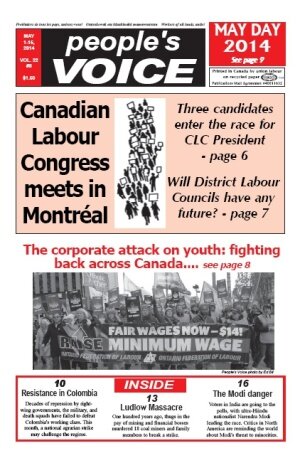
May 1-15, 2014
Volume 22 – Number 8 $1
Prolétaires de tous les pays, unissez-vous!
Otatoskewak ota kitaskinahk mamawestotan!
Workers of all lands, unite
1) BILL C-23 MUST NOT PASS, SAY SMALLER PARTIES
2) THREE CANDIDATES IN CLC PRESIDENT RACE
3) LABOUR COUNCIL CHANGES COULD STIFLE GRASSROOTS ACTIVISM
4) MAY DAY 2014: OUR STRUGGLE FOR THE FUTURE
5) B.C. SCHOOL BOARDS "SHOULD CONSIDER DEFICIT BUDGETS"
7) CRACKS IN THE TORY WALL? – Editorial
8) ALBERTA BITUMEN BOOM ACCOMPANIED BY RISING INJURIES
9) THE CORPORATE ATTACK ON YOUTH IN CANADA
10) WFTU MEETS WITH ARAB TRADE UNIONS
11) THE STRIKING HEROES GUNNED DOWN 100 YEARS AGO
12) NO TO MODI: SOCIAL JUSTICE ACTIVISTS LAUNCH CAMPAIGN AGAINST HINDU RIGHT IN CANADA
13) MUSIC NOTES, by Wally Brooker
PEOPLE'S VOICE MAY 1-15, 2014 (pdf)
People’s Voice 2014 Calendar
”The Truth About the Great War”
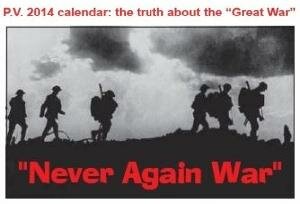
To order a copy of the People’s Voice 2014 Anti-First World War
Calendar, send $15 (includes postage and handling) to
People’s Voice, 706 Clark Drive, Vancouver, BC, V5L 3J1. Contact us at
604-255-2041 or pvoice@telus.net for bulk order prices.
|
People's Voice deadlines: May 16-31 June 1-15 Send submissions to PV Editorial Office,
|
REDS ON THE WEB
http://www.parti-communiste.ca/
peoplesvoice.ca
www.ycl-ljc.ca
www.solidnet.org
|
People's Voice finds many "Global Class Struggle" reports at the "Labour Start" website, http://www.labourstart.org/. We urge our readers to check it out! |
* * * * *
People's Voice
Canadian Publications Mail Sales Product Agreement #205214
ISSN number 1198-8657
People's Voice is published by
New Labour Press Ltd
PV Editorial Office
706 Clark Drive,
VANCOUVER, B.C. V5L 3J1
Phone:604-255-2041
Fax:604-254-9803
email: pvoice@telus.net
Editor: Kimball Cariou : Business Manager: David Au
Editorial Board: Kimball Cariou, Miguel Figueroa,
Doug Meggison, Naomi Rankin, Liz Rowley, Jim Sacouman
* * * * * *
Letters
People's Voice welcomes your letters
on any subject covered in our pages.
We reserve the right to edit for length and clarity,
and to refuse to print letters which may be libellous
or which contain unnecessary personal attacks.
Send your views to:
"Letters to the Editor",
706 Clark Dr., Vancouver, BC V5L 3J1,
or pvoice@telus.net
People's Voice articles may be reprinted without permission,
provided the source is credited.
* * * * * *
The Communist Party of Canada, formed in 1921,
has a proud history of fighting for jobs, equality, peace,
Canadian independence, and socialism.
The CPC does much more than run candidates in elections.
We think the fight against big business and its parties
is a year-round job,
so our members are active across the country,
to build our party and to help strengthen people's movements
on a wide range of issues.
All our policies and leadership
are set democratically by our members.
To find out more about Canada's party of Socialism,
give us a call at the nearest CPC office.
* * * * * *
Central Committee CPC
290A Danforth Ave Toronto, Ont. M4K 1N6
Ph: (416) 469-2446
fax: (416) 469-4063 E-mailmailto:info@cpc-pcp.ca
Parti Communiste du Quebec (section du
Parti communiste du Canada)
5359 Ave du Parc, Montréal, Québec,
H2V 4G9
B.C.Committee CPC
706 Clark Drive, Vancouver, V5L 3J1
Tel: (604) 254-9836
Fax: (604) 254-9803
Edmonton CPC
Box 68112, 70 Bonnie Doon P.O.
Edmonton, AB, T6C 4N6
Tel: (780) 465-7893
Fax: (780)463-0209
Calgary CPC
Unit #1 - 19 Radcliffe Close SE
Calgary AB, T2A 6B2
Tel: (403) 248-6489
Ottawa CPC
Tel: (613) 232-7108
Manitoba Committee
387 Selkirk Ave., Winnipeg, R2W 2M3
Tel/fax: (204) 586-7824
Ontario Ctee. CPC
290A Danforth Ave., Toronto, M4K 1N6
Tel: (416) 469-2446
Hamilton Ctee. CPC
265 Melvin Ave., Apt. 815
Hamilton, ON.
Tel: (905) 548-9586
Atlantic Region CPC
Box 70 Grand Pré, NS, B0P 1M0
Tel/fax: (902) 542-7981
http://www.parti-communiste.ca/
* * * * * *
News for People, Not for Profits!
Every issue of People's Voice
gives you the latest
on the fightback from coast to coast.
Whether it's the struggle for jobs or peace, resistance to social cuts,
solidarity with Cuba, or workers' struggles around the world,
we've got the news the corporate media won't print.
And we do more than that
- we report and analyze events
from a revolutionary perspective,
helping to build the movements for justice and equality,
and eventually for a socialist Canada.
Read the paper that fights for working people
- on every page, in every issue!
People's Voice
$30 for 1 year
$50 for 2 years
Low-income special rate: $15 for 1-year
Outside Canada $50 for 1 year
Send to: People's Voice, 706 Clark Drive, Vancouver, BC, V5L 3J1
You can call the editorial office at 604-255-2041
REDS ON THE WEB
http://www.parti-communiste.ca/
http://www.ycl-ljc.ca/
http://www.solidnet.org/
(The following articles are from the May 1-15, 2014, issue of People's Voice, Canada's leading socialist newspaper. Articles can be reprinted free if the source is credited. Subscription rates in Canada: $30/year, or $15 low income rate; for U.S. readers - $45 US per year; other overseas readers - $45 US or $50 CDN per year. Send to People's Voice, c/o PV Business Manager, 706 Clark Drive, Vancouver, BC, V5L 3J1.)
1) BILL C-23 MUST NOT PASS, SAY SMALLER PARTIES
In our previous issue, we reported that registered political parties currently without representation in the House of Commons met recently in Ottawa to discuss Bill C‑23, "An Act to amend the Canada Elections Act and other Acts and to make consequential amendments to certain Acts". Unfortunately, a news conference planned for April 11 was cancelled due to unforeseen circumstances. But the parties listed below agreed to issue the following statement. These parties are also concerned about many provisions in Bill C‑23 aside from those outlined here. Many of these concerns remain, despite the recommendations for several amendments, issued on April 15 by the Senate committee studying C-23.
The Conservative Party of Canada, overseen by Prime Minister Stephen Harper, is hoping to steal the next federal election. Bill C‑23, the so‑called Fair Elections Act, is their game plan. We are working together to stop the Conservatives, and to protect every Canadian's right to vote in a fair and honest election that is free of voter suppression schemes, of election fraud, of the denial of fundamental rights, and all watched over by an independent and effective Elections Canada.
The Conservatives and Stephen Harper are terrified because they can't win a fair election; they hope they can win a rigged one.
Opposition to Stephen Harper's Bill C‑23 is almost universal, condemned by national and international election officials and experts on democracy and elections. It is supported only by Conservative politicians who hope to benefit from its worst provisions. Bill C‑23 helps people commit election fraud and get away with it; encourages mayhem, confusion, and long delays on election day; and deprives hundreds of thousand of Canadians of their right to vote.
Bill C‑23 goes even further. It prevents Elections Canada from warning Canadians who are targeted by fraud and voter suppression schemes. It even bars Elections Canada from encouraging citizens to vote, especially youth, new Canadians and First Nations people.
From now until the next election and beyond, if necessary, we will be working together to protect Canadians from Stephen Harper's and the Conservatives' cowardly, self‑serving attack on their fundamental right to vote. We will fight for our fellow Canadians and their hard won rights wherever we can ‑ in the courts, in the streets, in elections, on social media, in class rooms ‑ wherever Canadians who believe in democratic rights and honest government gather.
We reach out to all Canadians to help us stop Stephen Harper and the Conservatives stealing their elections and stealing their rights.
- Animal Alliance Environment Voters Party of Canada
- Canadian Action Party
- Christian Heritage Party
- Communist Party of Canada
- Libertarian Party of Canada
- Marijuana Party of Canada
- Marxist‑Leninist Party of Canada
- Party for Accountability, Competency and Transparency
- Pirate Party of Canada
- Progressive Canadian Party
- Rhinoceros Party
2) THREE CANDIDATES IN CLC PRESIDENT RACE
PV Vancouver Bureau
The 27th Canadian Labour Congress convention opens May 5 in Montreal. For the first time in memory, there are now three candidates for president, including the incumbent, Ken Georgetti, who has held the position for fifteen years.
The first to come forward was Hassan Husseini, who has a strong track record as a labour and community organizer in Ontario. Husseini quickly won endorsations from union bodies and activists who see the need for stronger militant strategies. Then, CLC Secretary‑Treasurer Hassan Yussuff entered the race in mid‑April, issuing an open letter titled "Leadership for a Bold Labour Movement."
Yussuff, who has held that position since 2002, was born in Guyana, becoming a trade unionist in Ontario's auto plant sector. He argues that "There is a wind of change blowing in Canada's trade union movement," and he wants to "give voice to that change and work with you to lead our movement."
His statement goes on to say, "There is a desire and a demand to return to the offensive for rights and progress for workers after decades of retreat and decline. There is an eagerness for new leadership that is truly reflective of the diverse reality of today's working class and ready to step forward with new energy and creativity. There is a need for a new labour movement using its power and resources to connect and give leadership to social movements for democracy and sustainability..."
In an implicit critique of the Georgetti leadership, Yussuff continues, "The movement can continue to tell itself that it is doing all it can; that we still hold influence in spite of years of right‑wing economic policy and US‑Republican style politics; that the CLC's ongoing campaign for CPP expansion has kept this social priority on the national agenda; that two‑tier contracts are not as prevalent here as south of the border. But the reality is that the lives of workers and their families are getting tougher; both in their workplaces and their communities."
Yussuff adds, "When labour fails to mobilize its members and to impact employers and governments in the workplace and in the streets, it will have limited effect on decisions."
He calls for "a more inclusive and respectful leadership at the CLC," reflecting a widely held view that the current leadership has not acted in such a manner, either towards labour's community partners or even its own affiliates. The current proposal to gut the authority and powers of local labour councils may be the most visible example.
Speaking to People's Voice, several rank and file or mid‑level trade union activists have asked whether Yussuff is too closely identified with the current leadership to make the changes which are necessary to reinvigorate the CLC.
The first candidate for president, Hassan Husseini, has drawn attention to the serious issues facing working people, while also calling for major changes to the CLC's structure and approach.
In a new document called "My commitment ‑ The first 100 days and beyond," Husseini makes specific proposals, including immediate consultations with Federations of Labour and Labour Councils about their issues and struggles, and enhanced financial and staff resources for the Labour Councils.
He promises to reduce the number of Executive Assistants to the President (from 4 to 1), and allocate those resources to staff support in the field. Pledging to lead by example, Husseini would also reduce his own pay and compensation, helping to "free up resources more usefully put towards grassroots organizing and local leadership development."
He hopes to "work with affiliates on developing cross‑union training sessions for members on organizing drives and effective mobilizations.... Working with affiliates, Federations and Labour Councils, I will develop online resources to help workers in labour disputes and to build labour solidarity with workers on strike. I will modernize the CLC's use of social media to spread the word on workers struggles to union members and social movement allies in an immediate and popular way."
And pledging to go further, he calls for an "open dialogue between the CLC and our allies in the social justice community on ways to support each other and build a broad coalition to challenge the austerity agenda and build an inclusive, democratic country."
This would start with cross‑Canada "Fairness Works" town halls around Labour Day 2014 "to engage the activist base of our movement and to broaden the campaign beyond television ads. Community and social movement allies would be included."
Husseini would also open a discussion on labour's program for the 2015 federal election at the Canadian Council, with Labour Councils and online, so that the CLC can "position itself as an important voice in the organizing that has already begun in the country to get rid of the Harper Conservatives and their anti‑worker, anti‑democratic and big business agenda."
"We need an independent labour vision and platform to mobilize members, present to the political parties who want to form the next federal government, and engage our allies," he argues.
Husseini wants to "place equality issues at the heart of the work of the Canadian Labour Congress. The role of the Women's and Equity Vice‑Presidents and of the committees of equality‑seeking groups will be critical sources of ideas."
He promises to "meet at the first opportunity with these worker representatives to seek advice about the campaigns and issues facing equality‑seeking members, about what role the labour movement should be playing and about how we integrate equality into all of the CLC's campaigns."
He concludes, "My commitment is to find every way possible to listen to and engage our union activists and leaders in developing our vision and in mobilizing our members for positive social change."
3) LABOUR COUNCIL CHANGES COULD STIFLE GRASSROOTS ACTIVISM
By Sam Hammond
Delegates to the 2011 Canadian Labour Congress convention adopted a new structure comprised of the Canadian Council, the Executive Committee and the National Campaign Committee.
Since its 1956 founding from the merger of the Trades and Labour Congress and the Congress of Canadian Labour, the CLC has evolved from a delegate-driven body that elected all its Officers and Executives, to an affiliate governed body. The Canadian Council comprises 75 not elected at Convention, and 10 elected at Convention: the President, the Secretary Treasurer, two executive Vice‑Presidents, five Equity Vice‑Presidents and one Youth Vice‑President.
This last and most drastic structural move completed a fifty-five year metamorphosis, from a leadership elected by a rank and file Convention, to a governing body of professional trade unionists selected outside of Convention and imposed on the delegate body. In this historic flip, the majority had become the instruments of the few.
The major eruption in 2011 Convention came from the Labour Councils and the Labour Council Caucus, which were completely left out of the new model of governance. Despite the knee‑jerk genuflection to the importance of the grassroots Labour Councils, the "boots on the ground" of policy and organization, they were completely shut out of the Canadian Council and even worse, the National Campaign Committee. Nor was their role or connection to the National Campaign Committee defined. Understandingly this created major angst. But the Canadian Council was ready, and proposed and carried a resolution instructing the "Commission on Structural Review" to:
* review the structure, the role, the finances, the capacity and the effectiveness of labour councils and federations of labour;
* examine ways to encourage increased participation and activism by union members at the local and regional level by examining new ways for activists to become engaged and work together;
* explore ways to ensure that the CLC Constitution is enforced so that all affiliated unions shoulder their responsibility in the finance and capacity building of the federations and labour councils; and
* report regularly to the Executive Committee and Canadian Council on this review.
The Canadian Council then established a "Labour Council Task Force" to report back to the Commission on Structural Review, which it did in September 2013. The five member "Task Force" was chaired by Paul Moist from CUPE. It met with local union presidents and Labour Council presidents in twelve communities between October 2012 and May 2013.
The Report contains all the bland requisites to compliment the role and importance of Labour Councils, but ignores completely the financial obligations of the CLC, and stresses involvement in electoral politics. It talks of many things the Labour Councils should deal with, but leaves the onus on the Councils themselves. It defines problems, but tends to leave them hanging. It encourages involvement with labour's allies, and very close co‑operation with social action groups. This is of course positive.
Out of the Report there flows a Resolution to the Canadian Council, which reliable sources say will go unchanged for adoption at the 2014 Convention. The Resolution has 11 recommendations. The first two are as follows:
1. The CLC will develop a set of model by‑laws for labour councils, containing a preamble specifying the focus of labour councils as follows:
- engage in political action by participating in municipal, provincial and federal election campaigns;
- conduct ongoing political activism: addressing local issues, working with community groups, lobbying and advocacy of municipal councils, school boards, members of provincial legislatures and members of Parliament;
- participate in campaigns of the CLC, federations of labour and affiliates by providing support and coordination;
- engage in media relations and public communications campaigns to raise the profile of the labour movement in the community;
- communicate with affiliates and union members to provide information on important issues; and
- promote the identity of the labour movement by organizing events for designated days, such as Labour Day, Day of Mourning, International Women's Day, National Aboriginal Day, December 6.
Any variation of the model by‑laws must be approved by the President of the Congress.
2. The CLC will convene an annual meeting of local union ranking officers and designated affiliate staff in each labour council region to:
- develop a strategic plan with goals and objectives for the community;
- elect a labour council executive from the affiliate representatives; the term of office for the executive will be three years; and
- create working groups and committees which will involve affiliates; these could include strike and bargaining support, community outreach, municipal election campaign, media relations, and union communications and campaigns.
The other nine points cover education and training, secure on‑line sites for local union and Labour Council officers, develop and maintain a data‑base, effective communication strategies, guidelines for retiree and community groups, involvement of CURC and retiree chapters of local unions , young worker involvement and on‑line financial reporting.
What are the big changes? The set of model by‑laws are unknown at this time, but can only be amended with the permission of the CLC President. Veto power over by‑laws which are as yet unknown and will be written without consultation. Governance by decree.
The biggest change is in Section 2. The CLC, Local Union ranking officers and designated affiliate staff (which staff and designated by whom?) will meet in each region to elect an executive for three years, create working groups and committees and develop a strategic plan.
Whatever happened to delegates? If they still exist, they will have an executive, committees and working groups provided for them by Local Union officers and designated staff (janitors? CLC Staff Reps?) who they may never see again for three years. The Labour Councils will no longer be delegate-driven bodies, and we do not even know if they will have elected delegates.
The proposed role of the Labour Councils will be transmission belts for campaigns decided at higher levels of the bureaucratized CLC. The Resolution destroys the last vestiges of ground level creativity and decision making. The result will be a contrived and controlled local bureaucracy, a mirror image of the higher unelected bodies created in 2011, which will stifle the last traces of local autonomy, input and activism by the rank and file.
What is in the minds of the Canadian Council? Is there no moral commitment to democracy? Is it fear of the membership or contempt that devises the stratagem of "we know what's best"? Is it necessary to control everything from the top? Is this the way to build strong community roots? Did anyone consider involving a delegation from every Labour Council to develop proposals for their own governance, and request finances and services from the Canadian Council? That would certainly weld unity and restore confidence. The present Resolution will not.
4) MAY DAY 2014: OUR STRUGGLE FOR THE FUTURE
May Day Greetings from the Central Executive Committee, Communist Party of Canada
This May Day 2014, more than five years have passed since the US housing bubble burst and quickly spread to a global financial crisis, the most acute and dangerous since the 1930s. The neo‑liberal agenda of the main imperialist powers had exported a global movement of unregulated and unrestrained capital, free trade agreements, a gluttony of super exploitation, theft of public property and privatization of public services, provoking a crisis so acute in its scale and breadth that it threatened collapse.
The managers of imperialism could not repair their own damage so they bought themselves a temporary reprieve by plundering public property, expropriating public funds to rebuild bankrupted enterprises, transferring funding for social programs and superstructure from the public purse into their investment houses. They richly rewarded themselves, increasing military budgets, and corrupting markets to the extent that it has created a world unemployment crisis, terrible privation, hunger, disease and war.
Imperialism, the last stage of capitalism, is in an incurable stagnancy marked by declining rates of profit which in turn brought on the crisis, a crisis which is not just cyclical but also structural in nature. If the rate of profit has declined, the absolute volume of profit has not.
Never in the history of humanity has been so much wealth expropriated by so few, from so many. This grisly achievement rests on the shoulders of impoverishment, hunger, disease, environmental degradation and war. Political leaders who refuse, or even hesitate, to deliver their nations into the gristmill of unrestricted capital are targeted.
Yet the people resist and create new leaders because the opposite of exploitation is struggle, resistance, socialism. The flashpoints of resistance in Europe, Latin America, Africa and Asia on the front lines of anti‑imperialism are a living phenomenon that represents the global undercurrent of massive and developing fightback. The imperialist response is destruction of civil liberties, the corruption of democracy and the development of militarism and war as domestic and foreign policy.
In Canada the Harper Tories represent the most rapacious elements of capital, that section of the ruling class that enriches itself at the expense of our social programs, that seeks to fill their bank accounts with the proceeds of privatization, the sell-off of our natural resources, the stolen dreams of our precariously existing youth and the continuing plunder of the indigenous peoples.
According to David Macdonald, Senior Economist at The Canadian Centre for Policy Alternatives, "Canada's wealthiest 86 people represent only 0.002% of the population but they're so flush they could buy absolutely everything owned by every person in New Brunswick, they could buy up all of New Brunswickers' cars, all of their houses, all of their undeveloped land, all of their stocks, bonds, pension funds and RRSPs, all of their jewelry, all of their furniture‑everything‑and still have billions to spare."
Yet they tell us we cannot afford denticare, pharmacare, childcare, universal tuition‑free education, or anything that gives us a modicum of democracy and social security. The truth is that we, the working people of Canada, cannot afford them.
The Harper Tories and the people they represent seek a larger share in the global plunder of imperialism, and a bigger role in the military subjugation of peoples. They seek to shed the cloak of junior partners and dream of full partnership in the imperialist camp. They offer our young people the choice between the military, the food banks, or the part‑time existence of the fast food services. Every month they engineer figures to show unemployment is decreasing and every month there are more unemployed.
They manufacture the lie of labour and skill shortages so they can use the "Temporary Foreign Worker Program" to hold down wages and super‑exploit trafficked "guest‑workers" from other countries, while maintaining high levels of unemployment to keep our young people desperate and vulnerable. The "guest workers" are our brothers and sisters who they seek to use and then discard. But we are not deceived, we will embrace them and fight for them because they are of our class, of our family.
There is a growing ripple of unrest in our country that has not yet found reflection in the trade union leadership, has not found its conscious realization of what precisely is wrong, has not resulted in the articulation of class struggle expressed in program and ideology. It is part of the undercurrent of global unrest, the potential of developing struggle, and it exists in thousands of minor skirmishes every day wherever people labour, in the proud struggle of indigenous nations, in the struggle of students.
It is just as natural for working people to struggle and organize as it is to live and work. The brave people who demonstrated at the G20 in Toronto, the proud Six Nations people who still refuse to give up the Douglas Creek Land, the Idle No More movement, the Occupy movement, the Quebec students and many, many other struggles ‑ all these demonstrate the beginnings of what is coming, demonstrate what consciousness and organization can accomplish.
May Day is a time of reflection of past struggles, a time to remember martyrs and fighters, landmarks of our history, international solidarity and awareness of self, class consciousness. The most important thing that International May Day brings is the realization that all our culture, our martyrs and our struggles are for the future, for a vision of a future free from exploitation, war and greed. A future of peace and prosperity. That is why the concept of May Day must be on the streets, in the workplaces, in internationalist solidarity and in the unbreakable expression of the people's will, unshakeable, anti‑imperialist and visionary.
That vision is socialism, and that is the vision of the Communist Party.
5) B.C. SCHOOL BOARDS "SHOULD CONSIDER DEFICIT BUDGETS"
School boards across British Columbia face huge budget shortfalls this spring, due to the impact of extra costs downloaded by the Liberal provincial government. Compelled by law to bring in "balanced" budgets, many boards are reducing the numbers of teachers and support staff.
The following is from a presentation at the Vancouver School Board's budget consultations, by Jane Bouey and Gwen Giesbrecht, co-chairs of the Vancouver Public Education Project, which is "dedicated to defending, promoting and enhancing public education." Bouey was elected to the VSB in 2002 and 2008, serving the latter term as deputy chair. Giesbrecht is a former president of the city's Parent Advisory Council.
The proposed VSB budget is an effort to mitigate an untenable situation. Over a decade of provincial underfunding continues. The next three years portend more of the same. Is this deliberate? Is the intention to undermine confidence in public education ‑ our society's single most valuable social institution? Your Board is not to blame, but it will bear the burden imposed by a cynical government.
Some recommendations are palatable. Cancelling membership in the BC School Trustees Association and not adding to District Parent Advisory Council's existing funds for the next year are two.
But many recommendations will disproportionately affect vulnerable students. Eliminating an Educational Psychologist will, as stated "... increase the waitlists for psycho‑educational assessments." Cuts such as the Speech and Language pathologist, the Anti‑Racism and Literacy mentors, two SACY positions, the English Language Learner consultant, Britannia Secondary cafeteria worker, the District Athletics Coordinator, Multicultural Liaison worker may be minimal, but the impact will be large.
The arts are vital for a full and rich education. In this proposed budget the entire elementary Band and Strings Program could be axed. The Board could increase the annual fee for the band and strings program to $25 a month. For families able to afford $250 a year per child, access to music could be available. This restriction is contrary to the purposes and spirit of a public system. Such "access" already exists. It's called private music lessons.
This budget proposes more cuts to Maintenance services to save about half a million dollars. Those who spend time in Vancouver schools know that they are shabby and not painted regularly.
How has this happened? It is the consequence of the province downloading expenses onto local school boards. Recently, Victoria put boards on notice that they may need to pay for half the cost of capital projects and seismic upgrades. These abrupt and unilateral directives show contempt for local planning and have a destabilizing impact on all operations.
There is still money in the budget to support the vast array of computer technology that is now a key part of school infrastructures. Both the initial expenses and those in this budget have been downloaded onto local boards by the province. The system absolutely requires the use of computers but refuses to fund it...
Technology expenses eat up a huge amount of capital. The 6,000 computers purchased by the Board in 2009 are now nearing their fifth birthday and need to be replaced by modern tools, says the Board, at a cost of $720,000. Five years young and already obsolete. This infrastructure cost out of operating funds will be needed in perpetuity.
The Vancouver Board of Education has had to put a stark and bleak budget proposal on the table. Its response should be equally stark, but not so bleak.
The single most important part of the board's response should be loud, evidence‑based, hard‑hitting advocacy with a detailed plan that makes good use of all trustees in their role as leaders.
It should ignite public awareness and engagement and media interest about the reality of the provincial government's abrogation of responsibility for public education.
Government has ignored our pleas for 13 years. Now, it is time for more pressure. The Board should consider creating and submitting a deficit budget rather than passing a balanced, inadequate, harmful and irresponsible budget.
Perhaps the Board ought to operate the schools the way they should be run, until the money runs out. And then? Shut it down. Simply refuse to preside over the demise of the Public Education.
Either scenario would leave the Board in very difficult circumstances. You could be fired, it has happened. But consider the opportunity to mobilize for the November municipal election when we could place public education at the center of the civic agenda.
Well‑funded, stable, valued public schools are good for the whole community ‑ not a political add‑on.
But the current reality is a freeze on capital spending; three years of upcoming, compounded cuts until 2017 and ongoing harm to the one system that provides the best opportunities for everyone.
It is time to put the provincial government on the hook. This strategy just might do it.
People's Voice Editorial
Under the guise of addressing shortages of skilled workers in certain regions or industries, the Temporary Foreign Worker Program (TFWP) has been relentlessly expanded under the Harper Tories, as part of their core agenda to weaken the labour movement. New revelations about employer abuses of the TFWP have sparked more calls to change the program, or to shut it down. Unity of all workers is the bedrock of our common struggle for social justice and equality. We must be vigilant against the divisive strategies of the bosses and pro-corporate governments, especially their deliberate attempt to fan hatred against workers from outside Canada. The demand to scrap the TFWP must not become a racist or narrow nationalist campaign. Today, capital flows unrestricted across borders in search of maximum returns, so working people must have the right to improve their own lives by seeking better employment, regardless of their passports, or their lack of formal documentation.
But the TFWP is not a form of solidarity extended by the ruling class to non-Canadian workers. In a recent Vancouver Sun interview, Dan Keely, President of the Canadian Federation of Independent Business, claimed that Canadian youth burdened with student debt refuse to take fast food jobs, while foreign-born workers accept low wages and turn up for every shift. In other words, TFWP employees are considered to be reliable cheap labour.
Today, Macdonald's is being called out for its hiring practices, including reluctance to hire young Canadians. Yet this fast food giant raked in $6 billion (US) profit during 2013. Clearly, such corporations can afford to pay higher wages. The TFWP is a deliberate government tool to help business maximize profits, at the expense of all working people, wherever we are from. The call to scrap the TFWP must be part of a wider struggle to build unity around the fight to put people before profits!
People's Voice Editorial
It appears that Stephen Harper's iron grip over his caucus may be a bit looser these days, at least around Bill C‑23, the "(Un)Fair Elections Act."
A Senate committee report, endorsed by Conservative members, calls for nine changes to the bill. One is to remove the "fundraising" exemption which would allow the Conservatives drive truckloads of cash through election spending limits. While any party could theoretically do the same, the proposal would give the Conservatives an enormous extra advantage, and result in a huge increase in political spending.
Another important amendment would allow Elections Canada to continue funding the Student Vote organization, and other voter education programs in schools. Apparently the senators are feeling the heat for Harper's blatant attempt to steal the next election long before the votes are counted.
Unfortunately, the Senate committee did not recommend the retention of vouching, where one registered voter verifies the identity and address of another voter. This critical change could deprive up to half a million Canadians of their right to vote, according to electoral experts, especially poor people, Aboriginal peoples, the elderly, many immigrants, and those in rural areas who lack the required "street address" ID. The elimination of vouching will almost certainly be challenged in court as a violation of the Charter guarantee of the right to vote.
And that gets to the heart of the matter. Like their ultra‑right US Republican mentors, the Harper Tories pose the democratic right of casting a ballot as a suspicious or even criminal act, to be restricted by making it difficult for sections of the population less likely to vote Conservative.
The Senate amendments are an important reflection of public anger. But this odious legislation must be withdrawn completely, not tinkered with.
8) ALBERTA BITUMEN BOOM ACCOMPANIED BY RISING INJURIES
Alberta's fossil fuel-based economic boom has meant enormous profits for energy corporations, but heavy personal costs for thousands of workers.
Award-winning journalist Andrew Nikiforuk, who writes for The Tyee website and others, has written a scathing article on the shocking extent of deaths and injuries in the Alberta workforce.
Last year, Alberta saw a near‑record high of 173 deaths on the job. As Nikiforuk writes, "excluding occupational disease and vehicle accidents, Alberta, with a population of four million, now reports 5.9 times more fatalities due to workplace injury than the United Kingdom, according to Athabasca University labour expert Bob Barnetson."
Britain also carries out 7.5 times more Occupational Health and Safety prosecutions than Alberta, where prosecutions of employers for unsafe workplaces plummeted from 22 in 2008 to a low of five last year.
The province relies on economic activity which poses many dangers for workers, such as petroleum extraction, mining and construction, but lags behind on occupational health and safety.
According to a 2011 study by the Alberta Federation of Labour, the province has the lowest Workers' Compensation Board premiums in Canada for industries that are "responsible for the most worksite fatalities, occupational diseases, and disabling injuries."
Oil and natural gas exploration companies pay just $0.55/$100 payroll, the study notes, "while companies in the rest of Canada pay four times as much, at $2/$100 payroll."
The Alberta government maintains that only 53,000 workers were injured on the job in 2009. But Prof. Barnetson calculates the number of workplace injuries annually in Alberta may be 500,000, or 10 times the government figure.
That's because the only injuries the government discusses in public are disabling injury claims. Leaving out injuries which do not result in lost or modified work, this under‑represents the true rate of injury by a factor of 10.
9) THE CORPORATE ATTACK ON YOUTH IN CANADA
The Young Communist League will hold its central convention May 24-25 in Toronto. We reprint here some excerpts of the political resolution which is being debated by YCL members across the country, from the section on "The Corporate Attack On Youth In Canada."
Young people searching for a concrete example of the attack by big business in Canada have to look no further than the last three budgets of the Harper Tories: liquidating basic labour and environmental regulations and offering in exchange the promise of further privatization, precarious work, unemployment, inaccessible education, and the shackles of prison or cannon‑fodder in new imperialist wars.
In many ways, our claim as the YCL‑LJC has been confirmed: every problem confronting the youth is connected with the serious political problems in Canada, the Harper government's anti‑people and anti-environment austerity agenda, and the capitalist economic crisis. The way the problem is presented is either/or: it's either accessible education or health, either money for youth or money for seniors. This is a false paradigm.
As the Communist Party wrote in its May Day statement last year, from the perspective of the ruling class, the weakening of the trade union movement is the key to reducing the cost of labour power, and not only among organized workers. They know that such reductions will put tremendous downward pressure on the wages and incomes of all workers, most of whom have no union protection. Finance capital realizes that the labour movement - because of its size, resources, ability to take job action, and organization - is the only social / class force capable of uniting broad sections of the people against its offensive.
The first target of the new Harper majority after the 2011 election was organized labour (CUPW, the Air Canada and CP Rail workers, etc.). The second target in 2012 was Employment insurance. The Harper Conservatives "war on labour" in the federal jurisdiction gave a green light to right wing provincial and municipal governments to demand that workers yield concessions or face the legislative hammer, such as Ontario's attack on the bargaining rights of teachers. Since 1982, federal and provincial governments in Canada have passed 199 pieces of legislation to restrict, suspend or deny collective bargaining rights. What is qualitatively new is the speed, ferocity and punitive nature of these legislative attacks.
At its core, this offensive aims at crippling and ultimately destroying the organized labour movement. The federal passage of C-377, requiring unions to disclose salaries, time spent on political activities and expenses, was only the beginning. There are now ominous signals that the Harper Conservatives are preparing to impose "right to work" legislation on all workers under federal jurisdiction. "Back to work legislation violates the basic rights of working people by subverting the rights of their unions to fair collective bargaining and the use of legal strike action," we said when Harper's first waves of attacks came against CUPW.
The shift to the use of temporary, non-unionized workers, paid minimal wages and benefits, is part of a wider reactionary agenda which the Harper government, and its pro corporate counterparts at the provincial and municipal levels, are carrying through on behalf of finance capital. Their goal is to accelerate the accumulation of capital through every conceivable means (privatization, state-restructuring, corporate tax cuts, etc.), and to weaken and suppress working class and popular resistance. Positively, temporary workers can now unionize - at least in theory. There are three‑times more temporary workers in Canada since 2002, and immigration from temporary workers has outpaced immigration on a route to becoming citizens.
At the same time, right wing forces fan the flames of racism, blaming migrants for high unemployment and declining living standards. The enemy of Canadian workers is not our sisters and brothers from other countries, but rather the anti worker policies of the federal government and the big corporations.
The other attack on workers outside of the organized labour movement is in cuts to Employment Insurance. These are not simply a cut in federal funding to a social program. They are cuts to a system into which all working people must directly pay into, no matter who they are, and which is intended to guarantee employment. The working class majority, whose sweat and toil by "hand and brain" has produced all the wealth in this country, are being robbed.
The federal government has built up a huge surplus of $57 billion since the mid‑1990s, the result of deep cuts in benefits paid to unemployed workers and rules that prevent most unemployed workers from qualifying for benefits at all.
In rural and coastal areas, like the homelands of the Acadian people, the government has never shown any interest in building infrastructure so that there can be work all year long. It is the work which is seasonal, not the workers, who are not to blame for the structure of the economy. Rather, EI is an essential subsidy to big capital in these regions to keep their work force afloat on "the pogey".
The economic system imposed on us has brought with it a reduction in secure employment and a massive increase in precarious work.
Mass unemployment benefits the wealthy by holding down wage rates. Marx called it "the surplus army of labour." This basic truth is behind the Harper government's move to reduce access to Employment Insurance, by forcing jobless workers to apply for any available opening, regardless of qualifications and the conditions of the job.
Attacks on Aboriginal peoples and youth
For years, the ruling class has painted Canada as a happy and unified country where everyone gets a fair deal, including Aboriginal peoples. But a new wave of Aboriginal struggle has made it clear that Canada was built on the theft of Aboriginal people's land and resources, and that only genuine equality of all nations in this country, large and small, can begin to overcome this ongoing genocidal policy...
Recent policies of the Harper Conservatives have made matters worse. Budget bills C‑38 and C‑45 prompted mass united resistance in the form of Idle No More in the Winter of 2012‑2013. Bill C‑45 included changes to the Indian Act that makes it easier to lease out reserve land for economic development without adequate consultation with First Nations. Bill C‑45 also, strips protections from 99 percent of lakes and rivers under the Navigable Waters Protections Act. Many of these bodies of water are on First Nations land, and changes will allow it to be easier for capital to put pipelines across bodies of water. The Omnibus bills also replaced the Canadian Environmental Assessment Act with new laws that will limit First Nations involvement in environmental assessments on their own lands.
The Native Women's Association of Canada has recorded that there have been more than 600 missing and murdered Aboriginal women reported in the last 20 years. The Sisters in Spirit campaign across the country has demanded justice for these missing and murdered women whose cases have been shamefully ignored by the Canadian government. The United Nations has called upon the Canadian government to form an official inquiry, but the Harper government has continued to ignore this crisis...
Aboriginal women and girls remain more frequently subject to gendered violence, human trafficking, and other forms of abuse.
Aboriginal peoples are more likely to be unemployed, paid lower wages, and earn less than the Canadian average. In 2006, the median income for Aboriginal peoples was just below $19,000 ‑ 30 percent below the cross‑Canada median of around $27,000. Aboriginal unemployment is almost double the Canadian average.
Indigenous populations in Canada on reserve are also experiencing a clean water crisis: over 116 First Nations do not have clean water and 75 percent of water systems are at medium to high risk. 40 percent of First Nations homes are in need of major repair with an 85,000 home backlog. Aboriginal peoples off reserve also often live in poor quality housing.
Life expectancy is 8‑20 years less for Indigenous peoples due to extreme poverty. On average, 50 percent of First Nations children live below the poverty line. Teen suicide rates are much higher among Aboriginal youth. In Nunavut, the rate of death by suicide among Inuit is currently 10 times the Canadian suicide rate.
Many young Aboriginal women and men also wind‑up in jail or on the streets. While 4.3 percent of the Canadian population identifies as Aboriginal, 20 percent of the male prison population and 32.6 percent of women prisoners are Aboriginal.
The Harper government has continued to ignore treaties, give mining and oil companies blank cheques, continue unequal funding for education and housing, bury land claims, and in general exacerbate this crisis. In short: a war has and continues to be waged against all Aboriginal peoples. A slow and steady genocide has been committed against First Nations, the Metis and Inuit peoples. We are all on Aboriginal land, and the idea of the treaties was to share and share alike what this land has to offer. Now it is time for the state and corporations to pay the rent! The concept of land ownership was unheard of, until colonial governments forced it upon Aboriginal peoples. Sharing and cooperation were trampled by capitalist values of exploitation of land, profit from misery and feelings of superiority. (Solidarity statement with National Aboriginal Day, 2009).
All these policies amount to genocide and can only be reversed by respect for Aboriginal sovereignty and self‑determination.
The attack on young women
Women account for 50.4% of the Canadian population but they still make just 75% of male salaries in Canada (which is not far from the global average of 70%). Likewise, women make up the vast majority in part time and precarious jobs (80% of part time workers in the world, 67.5% in 2009 across Canada). Since 1980, the number of women having part time jobs around the world has more than doubled, which is also true in Canada. Because of this situation, the 2013 Employment Insurance reforms of the Conservatives will most likely have a greater negative affect on women who in general have less access to programs based on the number of hours. Moreover, the job lost with the economic crisis has especially affected young women through unemployment but also an increase in violence against young women.
As women celebrate the 2014 International Women's Day, many struggles they face are still long‑haul demands. Large sectors of the economy and jobs are still closed to women, while other sectors remain are still "female ghettos" continues. These so‑called job ghettos are generally low paid and linking with "care giving" work, because of the sexist and gendered views. Anyone who looks at the career promotional material given to high school students can see this kind of gendered separation in the photos.
Moreover, the responsibility of children and domestic tasks are still in majority done by women. Marxist feminists call this the "double burden" of women. It is a reality which has become much more difficult as privatization shifts caregiving work more and more back into the home. Single‑parent families are still mainly lead by women, especially young women.
The Conservatives have followed the lead of the federal Liberals (who abolished the Canadian Advisory Council on the Status of Women and cut funding to the National Action Committee on the Status of Women NAC). On coming to power, the Harper Conservative also cut the proposed federal program for child care, at that point had not been only a demand of the women's movement for decades but also a paper demand of most political parties for fifteen years, and replaced it with a system of tax credits. The Tories then closed 12 of 16 offices of the Status of Women Canada, eliminated the funding of any women's organization involved in advocacy , and amended the Act on Equitable Compensation to prevent the use of courts to advance pay equity.
Attack on queer youth
Sexism importantly expresses itself in homophobia, heterosexism and transphobia. Hate crimes motivated by sexual orientation are often violent, confirming news of more gaybashings in recent years. Despite the "It Gets Better" campaign, most LGBTIQ* students still report feeling unsafe at school, and prosecutors are often unwilling to prosecute vicious gay bashings as hate crimes. Transgendered issues are gaining greater social understanding but as we said in our 2013 pride statement: a. The cost of delaying full equality for trans people would be tragic. This is not a "marginal" issue; trans people are 10% of the LGBTIQ* population, and face huge medical costs, higher unemployment, less access to housing, widespread intimidation at work, and lack of legal protections.
Those who spread fear and bigotry are also not giving up. Despite attempts to hide their destructive social agenda, the Harper Tories aim not only to reverse queer rights but also the decades of hard fought gender equality gains by women. Right wing forces continue to scapegoat the LGBTIQ* community and racialized groups.
10) WFTU MEETS WITH ARAB TRADE UNIONS
Interview with George Mavrikos, General Secretary of the World Federation of Trade Unions, about the Arab Trade Union Conference which will take place in Athens on May 10‑12, 2014.
Which is the objective of the meeting held in Athens on 11‑12 May?
An international meeting of Arab trade union organizations will take place with the initiative of the WFTU. The participation will be very large.
Trade union members and friends of the WFTU are invited. It will be an open, democratic, modern trade union Conference, where each trade union will speak freely, will contribute its positions. The developments in the Arab world, Middle East, the Mediterranean, the Gulf are critical, are important and in this Conference we will discuss the tasks, the role of the trade unions and the workers for this period.
The Conference will discuss about the labour issues, the salaries, the social security rights for workers. It is a clear fact that salaries are low, unemployment is terrifying. Trade union rights for the working women concern us, the needs of the youth are high. All these topics will be discussed openly and concrete resolutions will be taken. Resolutions for action. Amongst our objectives, is also the functioning of WFTU offices in more countries in the region so that the presence of the WFTU will strengthen at the regional and sectoral level.
Although you are originally from Greece, you have met many Arab trade unionists. What is your opinion about the Arab trade union movement?
I was born and raised in a small Greek island with 2,000 inhabitants by a family of cattlemen. Our history, our culture, our traditions, our land are similar to the Arabic. We both, Arabs and Greeks have great civilizations. Hence, I feel as a true brother to the Arab workers.
It is true that I have met, I have cooperated, I have worked with great Arab trade union leaders. From all of those that I met in person, I can say that they are militants, honest, proud, people-loving men and women who are stable in their friendships and are in love with their histories and countries. I believe the majority are like that.
I should not mention names, since I am afraid I will leave someone out. But I can say, I have definitely gained many great friends amongst the Arab trade unionists.
It is also true that I have also met, as a General Secretary of the WFTU, many leaders of the Arab World. I will only mention one. I met her together with Yasser Arafat inside his headquarters. The meeting was held in very difficult conditions as we had to break the blockade that the Israeli army had forced against the Palestinian leader. During our meeting the Israeli tanks destroyed half of the building we were in... Yasser Arafat will remain in history as a legendary leader of the Palestinian people and an all-time international militant leader. A great personality, worthy of our admiration and love.
How would you describe the relations between WFTU and ICATU?
The ICATU has a rich and long militant history. From its foundation until today it has defended the rights of the Arab workers and all the workers in the Arab countries. Consistently, ICATU defended the Palestinian struggle, the struggle of the people of Libya, Lebanon, of all the people in the Arab countries.
ICATU teaches pride and decency. The WFTU since its foundation has had honest, fraternal relations with ICATU. In the contrary, the International Trade Union Confederation (ITUC, formerly the ICFTU) has only had a hostile attitude against ICATU. The real reason for this hostility is that the ITUC historically supported the positions and the strategies of Israel. ITUC supports the strategy of imperialism (e.g in Iraq, in Libya, in Syria, in Egypt, in Tunisia, in Algeria etc.) that wants to divide the Arabs, to intervene in the internal affairs of the unions and place trade unionists‑puppets inside the trade unions.
It is the duty of all the militant trade unions in the Arab world to support ICATU, to help it become stronger. This would be for the benefit of the working class in the Arab world, for its great history, great culture and its militant characteristics. The WFTU centrally will continue its course along with ICATU in the Middle East, the Maghreb and everywhere, in all the continents and inside all the international organizations where the role of ICATU may become stronger.
What is the situation today in the International Organizations?
The situation in the international organizations is not good. The correlation of forces is negative. Take into consideration that there are numerous resolutions taken by the United Nations in favour of the Palestinian issue which remain only words, while for the invasions of imperialism against Libya, Iraq, Mali etc. one resolution of the UN was enough to be directly implemented.
Unfortunately, the situation in the ILO, at the central and regional level is not good as well. There is no equality, no democracy, no representativeness. A monopoly continues to exist and operate. A characteristic example is that the ACFTU of China with 290 million members (more than the members of WFTU and ITUC combined) is represented in the Governing Body of the ILO with only one seat of the 31 that exist. So it is clear, that there is no democracy. This heavily reflects in the work and the positions of the ILO.
The last years, the WFTU gained more affiliates and become very strong in the Arab world. What are the reasons for this upward course?
It is true that all the large trade union organizations in the Arab world are either members or they cooperate closely with the WFTU. All the large trade unions are in our family. The trade unions of Sudan, Egypt, Palestine, Lebanon, Syria, Algeria, Mauritania, Djibouti, Somalia, Iraq, Bahrain and other smaller trade unions from Tunisia, Morocco, Libya.
This is mainly because WFTU respects its members and friends. Does not intervene in their internal affairs, respects their religious, linguistic and other differences, respects their history, their culture, their traditions.
Our objective is to strengthen the democracy and the militant characteristics of all the trade unions. To help them obtain democratic constitutions, to hold regular Congresses and elections. To strengthen their anti‑imperialist orientation, their internationalist character and the solidarity expressed between the Arab trade unions with priority to the struggle of the Palestinian people to have their own country with East Jerusalem as its capital.
Your opponents raise the argument that the WFTU supports the governments. Which is your response to that?
The WFTU, the class‑oriented trade union movement is not "governmental trade unionism". We do not support governments; we support the people, the working people, the movements. For example, in Libya, in Iraq our position was not to defend Gaddafi or Saddam Hussein. We were against the imperialists because we believe that the only ones with authority to decide for their present and future are the people themselves. This is our position in Venezuela, in Syria, in Egypt, in Ukraine, in Colombia, everywhere.
The imperialists do not choose to intervene against Syria, against Iraq, against Libya, against Ecuador, against Mali, against the Central African Republic for the purpose of "democracy" and "freedom". The imperialists invade to steal, to plunder, to loot the natural wealth producing resources, for new fields of control, to get the oil, the gas, the waters, the agricultural production. The imperialists invade to gain geostrategic positions, to promote their geostrategic interests.
So those who say that the wars serve peace, democracy and freedom are hypocrites. They lie. It sounds like a joke, the black propaganda of some, that the Kings, the Monarchs of the Gulf, Erdogan and others are interested for the democratic rights and the popular freedoms.
The position of the WFTU is crystal clear. The imperialist aggression to stop. All the Arab territories to be liberated. The relevant prisoners to be released and the refugees to be allowed to return to their homes.
The people are the only ones with power to decide freely and democratically for their present and future. The wealth of the countries belongs to the people and not the monopolies and the multinational trusts.
It is a stable position of the WFTU that all trade unions should demand from the governments the satisfaction of labour rights. Against any government, the trade unions have the duty to struggle for the workers.
What is the message that you want to send to the Arab people?
The World Federation of Trade Unions was, is and will continue to remain their stable ally. We are stable on the side of the working class and the working people of the Arab world. For a fair world, without imperialist interventions and capitalist exploitation. Your countries are all rich. They have gold, oil, silver, sun, sea, gas, fertile land with many natural beauties, unique historic and cultural heritage. You have the Nile. You have worthy working people, scientific personnel, strong unions, militant experience. Thus, if the people take the initiative and the power, the future of the region for the younger generations could certainly be better than it is today.
11) THE STRIKING HEROES GUNNED DOWN 100 YEARS AGO
By Peter Frost, UK Morning Star
The date is April 20, 1914. A few flecks of snow fall on the quiet campsite built by striking miners nestled at the entrance to a canyon in the foothills of the Sangre de Cristo Mountains. The camp, with its many immigrant miners, is celebrating the Orthodox church's Easter.
At around 10 am a strange visitor creeps into the campsite. It is an armoured car and the six barrels of its Gatling machine gun suddenly break the silence as they pump bullets into the tents. Other men empty cans of paraffin on to the flimsy dwellings and set them alight. On this day here in the coalfields of southern Colorado, 18 innocent men, women and children died in what became known as the Ludlow massacre.
Coal miners in Colorado and other western states had been trying to win the right to join the union for many years. By 1913 many had joined the United Mine Workers (UMW) and had started what would be a 14‑month strike to increase their wages and the right to belong to a union.
The employers, led by the Colorado Fuel and Iron Company owned by John D. Rockefeller Jr., fought back violently. His father John D. Rockefeller, founder of Standard Oil, was the richest man in the world.
Capitalists like Rockefeller did all they could to keep wages and conditions for their workers at rock bottom and were perfectly happy to employ and pay local police, the state or National Guard or private armies of thugs and strike‑breakers to achieve their obscene profits. They were happy with a situation that saw their workers not just without a union but also living in company‑owned houses and paid in company scrip that could only be spent at the company store with its high company prices.
Thrown out of those company houses at the beginning of the strike, the Colorado miners and their families had set up a tent colony on public property outside the town.
The massacre was a carefully planned, 14‑hour attack on that tent colony by Colorado militiamen, coal company guards and other thugs hired as private detectives and strike‑breakers.
The Baldwin Felts Detective Agency was a well‑known private army that made its money as violent strike‑breakers all over the US. It had been employed to break the strike. It brought an armoured car mounted with a Gatling machine gun - strikers called it the "Death Special."
This bosses' army shot and burned to death 18 striking miners and their families. Four women, two of them pregnant, and 11 small children died holding each other in the trenches under the burning tents. The miners had dug foxholes in the tents so the women and children could avoid the bullets that were randomly shot through the tent colony by company thugs. Labour historians believe as many as 200 people lost their lives in the terrible strike.
Not one of the bosses or their perpetrators of the slaughter were ever punished, but scores of miners and their leaders were arrested and blacklisted, never able to work in the coal industry again.
The massacre caused protests outside Rockefeller's New York mansion. Public opinion decided that Rockefeller's methods were unacceptable. Rockefeller's spin doctors worked overtime to try to clean up his image, but public outrage led to congressional inquiries and limited new labour legislation.
Woody Guthrie was later inspired to write the song "Ludlow Massacre" about the incident. It is still sung today on picket lines and union events.
A monument erected by the United Mine Workers of America stands today in the ghost town outside Ludlow, Colorado, in remembrance of the brave and innocent souls who died for freedom and human dignity a century ago.
12) NO TO MODI: SOCIAL JUSTICE ACTIVISTS LAUNCH CAMPAIGN AGAINST HINDU RIGHT IN CANADA
From Radical Desi News Bureau (abridged)
As Indian voters are poised to elect a new government, a campaign to stop an arch‑Hindu nationalist leader from becoming the Prime Minister of the world's largest secular democracy has picked up in Canada.
Narendra Modi, the Chief Minister of the Gujarat state of India and the Prime Ministerial candidate of the Hindu nationalist Bhartiya Janata Party (BJP) is contesting two ridings, including Varanasi, one of the centers of Hinduism.
Modi is known as a hardliner within Hindu right‑wing circles. But he is credited for development in his state by his supporters, and some polls indicate that the BJP and its allies are likely to emerge as the single largest political formation, albeit short of a majority.
But a group of social justice activists of Indian origin in this part of the world are not ready to give up. A campaign through social media, such as Facebook, has been launched by radical South Asian activists in Toronto. Support for the "No to Modi" campaign continues to grow.
Ponni Arasu, a vocal critic of Modi and the Hindu right, is in the forefront of the campaign. She is not only challenging the "sectarian politics" of Modi, but also the "myths" of development and progress in Gujarat, which are being positioned to sell his image.
Arasu is associated with the Center for South Asian Studies of the University of Toronto. She is a queer feminist researcher who has been involved in many social movements.
Since the Congress‑led coalition has lost credibility due to a leadership vacuum and allegations of corruption and massive scams, there are high hopes among supporters of the opposition BJP and its allies for Modi, who is seen as an "effective and efficient leader with powerful oratory skills" and a "solid alternative" to the Congress leaders.
Arasu warns that people need to follow what is being said in the mainstream media with skepticism. "Those who make such statements must ask themselves what is he determined to do," she says. "Is he going to turn India into another Gujarat?"
Modi's government is accused of engineering large scale violence against Muslims following an alleged attack on a train carrying Hindu pilgrims in Godhra in February 2002. The train was burned, leaving 59 people dead. The Gujarat government has claimed that it was a terror attack by Muslim extremists, while one commission of enquiry found that it was an accident, perhaps caused by a cooking gas cylinder used by the Hindu pilgrims aboard.
The pilgrims were returning from a disputed site in Ayodhya, the birth place of Lord Ram, who is widely revered by Hindus. The Hindu fanatics had razed an ancient mosque built in Ayodhya in 1992, in the presence of the BJP leaders. The Hindu revivalists claim that the mosque was deliberately built by Babar, an Islamic ruler, after demolishing the Ram temple. The BJP election manifesto released in April has clearly stated its mandate to rebuild the Ram temple at the disputed site. Many top notch BJP leaders were accused of inciting the mobs that razed the mosque.
Eyewitness accounts of the 2002 events suggest that there was a fight between Hindu pilgrims and some local Muslims at the Godhra station before the train was burned. The Hindu fanatics belonging to the Vishwa Hindu Parishad (VHP), an extremist religious group, were given a free hand to murder innocent Muslims following the episode. Modi reportedly told the police to let the Hindu protesters vent their anger, and BJP leaders were seen leading the mobs. According to the statistics of the government, 975 people died, of which 713 were Muslims. Human rights watchers believe this was done to win the next assembly election by whipping up anti‑Muslim emotions. In fact, Modi was re‑elected to power, and never convicted for these crimes. Maya Kodnani, a former minister in his government, was convicted in 2012 for involvement in mass murders. Notably, Modi has been repeatedly denied entry to US and Canada for these incidents.
Much before this violence, the BJP government was also accused of shielding Hindu extremists, who targeted Christian missionaries in tribal areas of Gujarat during late 1990s. The Christian missionaries have been frequently accused of mass religious conversions by the Hindu fundamentalists.
As if these incidents were not enough, recently Sikh migrant farmers from Punjab in Gujarat were physically attacked for not vacating land they were allotted years ago by the state government. This was done to ensure that the barren land close to the Indo‑Pakistan border in Gujarat was transformed into fertile agricultural land. For this the enterprising Sikh farmers from Punjab were invited to settle down there. The government is now forcing the farmers to vacate on the grounds that they are outsiders.
Arasu explains that there is nothing surprising behind the attacks on non‑Hindus in Gujarat, as the BJP subscribes to the philosophy of Hindutva or exclusionist Hindu nationalism. "Do not forget that the BJP cannot be separated from the Rashtriya Swayam Sewak Sangh (RSS), the most influential ultra Hindu nationalist organization which was established with a clear objective to form Hindu nation", she notes. The two still remain inseparable; she believes that even any moderate face within the BJP won't make any difference. "Anyone other than Modi will be equally harmful if the BJP gains a brute majority."
Most BJP leaders were groomed by the RSS in their volunteer camps. Modi himself is an RSS member. He recently acknowledged that he is indebted to the RSS, which makes no bones about its disliking for secularism.
The group was banned following the assassination of Mahatma Gandhi, the passive resistance movement leader against British occupation who believed in a secular India. His opposition to the killings of the Muslims after the partition of India and Pakistan in 1947 on religious lines had irked the Hindu extremists, one of whom, Nathuram Godse, murdered him.
Arasu feels that the Congress party, in spite of its official support to secular and democratic policies, has also failed to protect secularism. It has rather used faith based politics for narrow political ends. "Two examples are good enough to judge the role of the Congress in protecting India; one is the imposition of Emergency and its involvement in the 1984 anti‑Sikh pogrom".
But sectarian politics is not the only cause of worry. "The myth of development in Gujarat is also problematic", according to Arasu. She says the development model of Gujarat has benefitted only a few rich people, while the manual scavenging by the so‑called untouchables and lack of nutrition among the tribal children in Gujarat proves that the development is incomplete.
Nishrin Jafri Husain ‑ who lost her father, Ahsan Jafri, in the Gujarat massacre ‑ agrees with Arasu. Jafri was a former Congress Party MP. He was burned to death by the mob even though he tried to seek help from high officials to protect Muslims who took refuge in his house. His influence did not work; he also became a victim of the bloodshed that resulted in at least 35 deaths in that single locality. Allegations that Modi was directly involved in the incident that led to Jafri's death have not been proved in the courts so far. He was given a clean chit by the Special Investigation Team in 2012.
A resident of Delaware, Husain was in US when the tragedy occurred. "I am pleased that there are some justice loving people in Canada who have taken up this cause. India is going to go through a bad period if Modi becomes the Prime Minister... He has no credentials to prove that he can represent a country like India."
Modi is not off the hook yet, she says, as investigations into the massacre are still pending.
Chinmoy Banerjee of SANSAD, the South Asian Network for Secularism and Democracy, a group which has consistently opposed Modi's policies and also the communal politics of the Congress, says the group supports the initiative launched by Arasu. Describing Modi as a "hate monger", Banerjee says, "he will be terrible for minorities."
He believes that the corporate world and the media in India are creating a false image about Modi, since the growth rate in Gujarat is no better than some other prosperous and developed states of India. "There in an unequal development in Gujarat under him as the poor continue to live in terrible conditions," says Banerjee.
Husain also questions the claims of development in Gujarat: "There is no development in Muslim areas. The localities where the minorities live lack amenities, like gutter system and roads. Aren't they Indians?"
She also expresses her disappointment over the changing attitude of the US government. Nishrin has been closely following the activities of the groups, including Coalition Against Genocide, which have been in the forefront of the campaign to block Modi's entry to US. Former US Ambassador to India Nancy Powell met Modi in February, raising speculations that he may eventually get a chance to visit the US.
"This is a pure mockery," Husain says. "First you raise a hue and cry about religious intolerance and then you change your position for economic and political considerations."
The Indian American Muslim Council, an advocacy group and founder member of Coalition Against Genocide, expressed its outrage in a powerfully worded statement which criticized the US administration's outreach to "infamous Gujarat Chief Minister Narendra Modi, banned from entering the US for his egregious violations of religious freedom".
Sunil Sharma, a volunteer with Sikh Nation, which organizes annual blood donation camps in Canada in memory of the victims of the 1984 anti‑Sikh carnage, also supports the initiative. "This is not a time to shut our eyes," he says. "We must stand up and question people with right wing background and involvement in politics of genocide."
However, Overseas Friends of the BJP recently organized a public event in Vancouver to show its support for Modi's candidacy. Interestingly, a few prominent supporters of the ruling Conservative Party of Canada were in attendance. It is pertinent to mention that the Conservatives represent right‑wing politics in Canada much like the BJP in India. The organizer of the event, Aditya Kumar Tewatia, says that Modi is best suited for India to ensure overall development of the country.
He hopes that Canada, which has also denied entry to Modi in the past, will invite him to visit once he is elected as Prime Minister.
The chorus on both sides of the fence is likely to grow in Canada as the election results come. Whether Modi becomes the Prime Minister or not, the big fight in India has already spilled over and reached North America, creating both anxiety and excitement.
13) MUSIC NOTES, by Wally Brooker
Calls for Neil Young to honour BDS
Petition campaigns have been launched to persuade rock superstar Neil Young to withdraw from a concert scheduled for July in Tel Aviv. Canadians for Peace and Justice in the Middle East and Independent Jewish Voices Canada are asking Young to respect the call from Palestinian civil society for boycott, divestment, and sanctions until Israel ends its illegal occupation of Palestinian territories, recognizes the right of its Arab‑Palestinian citizens for equality, and allows Palestinian refugees to return to their homes. In honouring the boycott, Young would join company with musicians like Roger Waters, Brian Eno, Annie Lennox, Carlos Santana and Elvis Costello. Throughout his long career Neil Young has demonstrated sympathy for native struggles on the North American continent. Earlier this year he gave a series of high‑profile "Honour the Treaties" concerts to raise funds for the Athabasca Chipewyan First Nation in aid of its legal battle to halt tar sands expansion on its territory. One might expect that he'd be able to see the similarities between the oppression of native peoples in North America and that of Palestinians. To sign a petition visit www.cjpme.nationbuilder.com/neil_young or www.ijvcanada.org
Remembering Guthrie's "Deportees"
In 1948 the great American troubadour Woody Guthrie composed Deportee (Plane Wreck at Los Gatos), a protest lyric about the racist mistreatment of migrant workers. After hearing on the radio that 28 migrants who were being deported from California back to Mexico had died in a plane crash at nearby Los Gatos Canyon, Guthrie was struck by the fact that only the names of the flight crew and the security guard were given. The anonymous workers' bodies were buried in a mass grave in Fresno, California. A decade later Guthrie's lyric was set to music by schoolteacher Martin Hoffman. The song soon became an American folk standard, after being popularized by Pete Seeger and recorded by a host of musical luminaries. Flash forward to 2014. Folksinger‑activist John McCutcheon and a group of like‑minded activists had a brainstorm: they guessed that Immigration and Naturalization Service archives in Washington would have a record of the victims' names in the 1948 deportation order. Well, they found the names, and raised the funds to erect a monument at the mass grave site. You can view the moving dedication ceremony and hear the names of the victims read out at a special concert. Visit YouTube and search for "Deportees John McCutcheon".
Breakthrough JUNO for A Tribe Called Red
Mainstream media coverage of the JUNO Awards usually dwells upon best‑selling icons of pop culture like Drake, Arcade Fire, and Teagan and Sara. There's plenty of celebrity gossip too. Will fans boo Justin Beiber? Will Robin Thicke show up? For this writer, however, it's the less hyped recipients who really deserve the attention. These would include 2014 Contemporary Jazz Album winner Christine Jensen (Habitat), World Music Album winner David Buchbinder (Walk to the Sea), and (most notably), Ottawa‑based electronic DJ crew A Tribe Called Red. The latter took home the award for Breakthrough Group of the Year at the gala ceremony, broadcast from Winnipeg on March 30. Although they didn't get to perform, it was gratifying that their win was shown on the national telecast. A Tribe Called Red is a powerful supporter of the Idle No More movement. In 2013 they were voted best group by the Aboriginal Peoples Choice Music Awards, and their second release, Nation II Nation, was voted best album. Their hard‑driving 'pow‑wow step' music and brilliant video productions challenge and subvert the ideology of the Canadian settler state. You can download their eponymous first album (it's free) and view their videos at www.atribecalledred.com.
Funding flap at Beaches Jazz
Toronto's annual free Beaches Jazz Fest attracts an estimated 500,000 visitors a year. It's the biggest festival of its kind in Canada, yet it has to fight for the pittance of funding it receives from Ontario's Ministry of Tourism, Culture and Sport. After a public outcry when the 25‑year‑old festival's funding application was rejected outright, the government announced that $75,000 had been 'found'. What had really happened was that the Wynne government had been embarrassed by the revelation that, while it was depriving a popular free festival of support, it was giving huge grants to superstar rapper Drake ($300,000 for a 2‑day concert that hopes to draw 60,000 people) and Maple Leaf Sports and Entertainment ($500,000 to attract the 2016 NBA all‑star game). According to online ticket agencies, a pass to Drake's upcoming OVA Fest at Toronto's Molson Amphitheatre starts at $291. Of course funding priorities that privilege corporate spectacles over grassroots culture are not unique to the current Ontario government. They are unfortunately typical of most contemporary capitalist regimes. The Beaches Jazz Fest runs from July 18‑23. For more info visit www.beachesjazz.com/.