|
|
People’s Voice May 1-15, 2015
Volume 23 – Number 8 $1
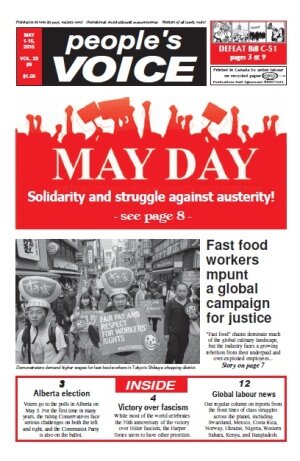
1) MAY DAY 2015: SOLIDARITY AND STRUGGLE AGAINST AUSTERITY
2) DURHAM TEACHERS STRIKE AGAINST WAGE FREEZE AND EDUCATION CUTS
3) VANCOUVER DOCK FIRE AND FUEL SPILL RAISE ENVIRONMENTAL CONCERNS
4) ANTI-POVERTY SUMMIT CONCLUDES WITHOUT CALL TO ACTION
5) 70th ANNIVERSARY OF ANTI-FASCIST VICTORY - Editorial
6) MAY DAY - THEN AND NOW - Editorial
7) NO FOREGONE CONCLUSION IN MAY 5 ALBERTA ELECTION
8) CUPE MOUNTS CAMPAIGN TO BLOCK HYDRO ONE SELLOFF
9) RITZ HANDS WHEAT BOARD TO FOREIGN INVESTORS
10) “DO YOU WANT FRIES WITH THOSE POVERTY WAGES?”
11) AUUC SPEAKS OUT AGAINST TSO CENSORSHIP
12) MUSIC NOTES, By Wally Brooker
PEOPLE'S VOICE MAY 1-15, 2015 (pdf)
|
To order a copy send $15 (includes package and handling) to People’s Voice, 706 Clark Drive, Vancouver, BC, V5L 3J1. Contact us at 604-255-2041 or pvoice@telus.net for bulk order prices. |

|
People's Voice deadlines: May 16-31 June 1-15 Send submissions to PV Editorial Office,
|
REDS ON THE WEB
http://www.parti-communiste.ca/
peoplesvoice.ca
www.ycl-ljc.ca
www.solidnet.org
|
People's Voice finds many "Global Class Struggle" reports at the "Labour Start" website, http://www.labourstart.org/. We urge our readers to check it out! |
* * * * * *
Central Committee CPC
290A Danforth Ave Toronto, Ont. M4K 1N6
Ph: (416) 469-2446
fax: (416) 469-4063 E-mailmailto:info@cpc-pcp.ca
Parti Communiste du Quebec (section du
Parti communiste du Canada)
5359 Ave du Parc, Montréal, Québec,
H2V 4G9
B.C.Committee CPC
706 Clark Drive, Vancouver, V5L 3J1
Tel: (604) 254-9836
Fax: (604) 254-9803
Edmonton CPC
Box 68112, 70 Bonnie Doon P.O.
Edmonton, AB, T6C 4N6
Tel: (780) 465-7893
Fax: (780)463-0209
Calgary CPC
Unit #1 - 19 Radcliffe Close SE
Calgary AB, T2A 6B2
Tel: (403) 248-6489
Ottawa CPC
Tel: (613) 232-7108
Manitoba Committee
387 Selkirk Ave., Winnipeg, R2W 2M3
Tel/fax: (204) 586-7824
Ontario Ctee. CPC
290A Danforth Ave., Toronto, M4K 1N6
Tel: (416) 469-2446
Hamilton Ctee. CPC
265 Melvin Ave., Apt. 815
Hamilton, ON.
Tel: (905) 548-9586
Atlantic Region CPC
Box 70 Grand Pré, NS, B0P 1M0
Tel/fax: (902) 542-7981
* * * * * *
News for People, Not for Profits!
Every issue of People's Voice
gives you the latest
on the fightback from coast to coast.
Whether it's the struggle for jobs or peace, resistance to social cuts,
solidarity with Cuba, or workers' struggles around the world,
we've got the news the corporate media won't print.
And we do more than that
- we report and analyze events
from a revolutionary perspective,
helping to build the movements for justice and equality,
and eventually for a socialist Canada.
Read the paper that fights for working people
- on every page, in every issue!
People's Voice
$30 for 1 year
$50 for 2 years
Low-income special rate: $15 for 1-year
Outside Canada $50 for 1 year
Send to: People's Voice, 706 Clark Drive, Vancouver, BC, V5L 3J1
You can call the editorial office at 604-255-2041
<pvoice@telus.net>
REDS ON THE WEB
www.communist-party.ca
peoplesvoice.ca
www.ycl-ljc.ca/
http://solidnet.org/
http://www,rebelyouth-magazine.blogspot.com
(The following articles are from the May 1-15, 2015, issue of People's Voice, Canada's leading socialist newspaper. Articles can be reprinted free if the source is credited. Subscription rates in Canada: $30/year, or $15 low income rate; for U.S. readers - $45 US per year; other overseas readers - $45 US or $50 CDN per year. Send to People's Voice, c/o PV Business Manager, 706 Clark Drive, Vancouver, BC, V5L 3J1.)
1) MAY DAY 2015: SOLIDARITY AND STRUGGLE AGAINST AUSTERITY
Statement by the Central Executive Committee, Communist Party of Canada
On this May First, the international workers’ day, the Communist Party of Canada sends greetings to all working people in our common struggle for a socialist future and for an end to capitalist exploitation and oppression. May Day is an important occasion to celebrate our historic victories, such as the 80th anniversary of the On to Ottawa Trek, which began in the spring of 1935 in Vancouver; the 70th anniversary of the May 1945 triumph over Hitler fascism; and the 40th anniversary of the liberation of Vietnam from U.S. imperialism on April 30, 1975.
This year, a new solidarity is forming across Canada. It is built on the strong foundation of working class experience, adapted to the present conditions. It showed strongly in the 2012 Quebec student strike, the Occupy movement, Idle No More and environment struggles. Solidarity was the pivot point of victory in the highly visible strikes by post-graduate education workers at the University of Toronto and York University in Ontario. This new solidarity reaches outward to recruit allies beyond the old labour solidarity which created it, making the unity of organized labour, social justice movements and the public a key ingredient in the formula for success. Today’s solidarity reflects changes in the working class itself, which is largely young, educated, street wise and precariously employed, and increasingly female and based in racialized communities. Most importantly, the new solidarity is unity in motion.
This unity is expanding in the fightback movement in Quebec. Tens of thousands of workers and students have been in the streets to defeat the “lightspeed” austerity agenda of the Couillard Liberals, which includes trying to strip municipal workers of pensions, forcing wage freezes, and swinging a wrecking ball into the hard-won principle of universality of Quebec social programs like childcare. These cuts cannot be defeated without winning at the bargaining table, and the collective agreement is a significant weapon of the working class against austerity. The recent Quebec budget has further propelled all public sector unions in the 2015 “Front Commun” towards preparations for strike actions next fall.
Importantly, the leadership of the CSN, FTQ and other Quebec unions have called for solidarity with students as they stand up to police violence and legal repression by the government. The students are fighting not just against austerity in education. Reaching out beyond their campuses, they also oppose the destruction of the environment, and the sharpening attack on women and social equality. Differences over tactics in this struggle will be featured by the right-wing and the corporate media as weaknesses, but in fact these debates are an essential ingredient in the process of maturing resistance. Similarly, the emergence of the Common Front led by the Ontario Federation of Labour and last year’s powerful strike action by British Columbia teachers are welcome signs that the working class is on the move.
The relentless neoliberal attack on workers and trade unions by the Harper Tories and the provincial governments is changing labour and its allies. The “social-partnership” ideology that permeated labour leadership during the years of the “welfare state” is gasping for breath. Canadian capital has gone on the offensive to destroy the public services, social programs, wages and working conditions which gave it a façade of credibility to maintain hegemony. The trade unions so far have been unable to deflect these multiple attacks. Mass unemployment, extensive de-industrialization, privatization, and unprecedented expansion of precarious work have taken a toll at the bargaining table, forcing labour to devise a coordinated response to the new strategy of capital.
As a key part of its new strategy, the ruling class is arming itself with police state weapons. Bill C-51 is the blueprint for tactics to silence labour, First Nations, environmentalists, students, women, and opponents of Quebec’s austerity policies. But even though the labour response to C-51 was delayed by NDP wobbling, it finally joined with the groundswell of resistance which is far from exhausted.
Meanwhile, Stephen Harper’s policy of repression and punishment at home is increasingly combined with war and fascism overseas, including military backing for the far-right government of Ukraine which is attacking its own population, and the expansion of war in Iraq and Syria.
In this situation, the pragmatic opportunism of social democracy is the major stumbling block to unity and solidarity, both within the labour movement and with its allies. A good lessonis Greece, where Syriza, after first adopting a militant position, moved towards tepid acquiescence to capital and managing the economy for the Troika. Changing names and leaders to deliver the “same old” hat-in-hand subservience to capital does nothing to meet the needs of working people.
Here in Canada, the centrist drift of the NDP leadership and its abandonment of support for many of labour’s demands has given rise to growing disenchantment and fueled divisions within labour, making it difficult to attain unity in the face of government and corporate attacks. Although not always clearly expressed, the heart of these divisions revolves around whether we need to mobilize a militant extra-parliamentary struggle, or instead continue to ‘contract out’ labour’s political struggle exclusively to the parliamentary NDP. The necessity for independent militant struggle engages workers and their unions every day in a thousand ground-level skirmishes around the fundamental question of struggle or surrender. The need to respond to the capitalist offensive is here and now, and cannot wait for parliamentary solutions or the arrival of some dreamlike utopian capitalism based on “fairness”.
The mid-level leadership of labour, its heart and soul, is caught in a very large crunch. This helps explain why the candidacy and action program of Hassan Husseini for CLC president was widely welcomed by delegates at the last Congress, and helped set in motion the events which led to the defeat of Ken Georgetti, its former President. Although a very close race, the demand for action and struggle won out, and Hassan Yussuff is now at the helm of the CLC. This marked a significant shift and a victory for labour democracy, though the degree to which it will lead to an actual turn-around in the dynamism and militancy of labour’s largest body is still in question.
With a crucial federal election looming, the working class needs to mobilize to defeat the most aggressive and reactionary section of big capital - the Harper Tories - and to win better political terrain to resist the wider neoliberal agenda. Given the immensity of the attack, it is difficult to criticize strategies designed to prevent a Tory victory. Indeed the ground-
breaking campaign of the Ontario Federation of Labour and its social justice allies, under severe duress from the right wing in the trade unions, contributed significantly to a major defeat of the Hudak Tories. The commendable and productive unity forged by labour and its social justice allies is developing and should continue.
But this unity should not be side-tracked by debates over unqualified NDP support vs. strategic voting, which as it exists today merely extends support from one party to two or more. These two narrow options are merely the extension of a dilemma, wherein support at the ballot box becomes unqualified ideological support. Both options fail to put programmatic demands on any party, and instead assume that labour support will be rewarded by those elected. This debate also identifies parliament - the fortress of capital - as the main area of political struggle for the working class, rather than the crucial extra-parliamentary arena of our workplaces and communities. Even so, elections are a very important part of the class struggle, the opportunity to advance progressive programs, tactics and strategies. The Communist Party and its candidates across the country will campaign hard to defeat the Harper Tories, and to win support for policies to put people’s needs ahead of corporate greed.
Today and beyond the federal election, the working class needs a coordinated ground level strategy and program led by labour. To mobilize and restructure the fightback towards this end will require a resurgence of the left, and a left program. The members of the Communist Party, as we have done historically, will continue to fight for class struggle trade unionism, and for unity in all its expressions, national, class and gender.
On May Day 2015, we call for all-out solidarity to defeat Bill C-51, to block the right wing agenda of austerity, war and fascism, and to drive the Harper Tories out of office!
2) DURHAM TEACHERS STRIKE AGAINST WAGE FREEZE AND EDUCATION CUTS
By Liz Rowley, Toronto
Two thousand secondary school teachers in Durham were out on picket lines April 20, the first of many bargaining units to say NO to austerity in Ontario classrooms. OSSTF members are bargaining for the first time with both the provincial government and the local School Board. In previous negotiations the province was the invisible partner and the banker, after School Boards had been stripped of their taxing powers and then chronically underfunded by the same government.
The province now sits at the bargaining table, but the purse strings are even tighter, with $800 million in education cuts slated over the next four years, and a legislated wage freeze imposed across the public sector.
The province is also trying to force the closure and sale of 600 public schools, most located on prime real estate, as part of its privatization agenda. This is supposed to reduce costs and generate income for School Boards, but will instead result in over-crowding, bussing, reduction in programming, and layoffs.
Negotiations have been crippled by employer demands for concessions and roll-backs, including demands to remove the cap on class size. This would directly affect the quality of education, and is a huge issue for students, parents, teachers and educational workers. Teachers have clearly indicated that they will not bargain concessions on their wages and working conditions, or on the quality of education for students.
Durham secondary teachers are the first to strike among almost 200,000 education sector workers currently in bargaining. Seven Districts will in a position to strike by the end of April, including Thunder Bay, Peel, Rainbow, Ottawa-Carleton, Halton, Waterloo, and Durham.
OSSTF President Paul Elliott told media April 20, “Unless we begin to see school boards take this process seriously, unless we see positive movement at those bargaining tables and the removal of any strips those boards are pursuing, and unless we see some real improvements, our members will make good on their commitment to job action.”
The Wynne government will have to decide quickly whether it wants to conclude agreements in the education sector this spring, or whether it wants a repeat of 2012, which saw the resignation of then Premier Dalton McGuinty after massive province wide struggles protesting Bill 115.
The public is already deeply unhappy with school and hospital closures around the province, both mandated by Queen’s Park. The Premier is taking a big risk assuming the public will support deficit reduction and austerity over schools and hospitals. Does she really want to roll the dice? The next few weeks will tell.
3) VANCOUVER DOCK FIRE AND FUEL SPILL RAISE ENVIRONMENTAL CONCERNS
Statement by the Communist Party of BC, April 19, 2015
Two recent serious environmental incidents in Vancouver, within the unceded traditional territories of the Coast Salish peoples, are a sobering reminder of the potential consequences of transporting huge quantities of volatile raw materials through heavily populated urban areas. On March 4, a fire at the port released clouds of toxic acid into the air over a large part of the city, followed on April 8 by a spill of bunker fuel in English Bay.
In the view of the Communist Party of BC, these cases, and also the massive April 16 fire at the Squamish Terminals deep-water port, are proof that corporate interests and governments at all levels must be held fully accountable when their economic activities (or inaction) endanger people and nature.
There are still many unanswered questions about the March 4 fire at the Vancouver docks. This situation could have been even more dangerous if not for quick action by courageous, well-trained members of the International Longshore Workers Union, who identified the chemical involved in the container fire, and by firefighters who were on scene within 11 minutes. These workers also helped to ensure that the dock area was evacuated and that the health hazard to thousands of people was made known as soon as possible. The city's response in warning residents of the affected neighbourhoods to stay indoors was timely and well justified. However, it appears that little effort has been made to estimate the full extent of the toxic materials emanating from the fire. Residents in the Downtown Eastside, Strathcona and Hastings-Sunrise neighbourhoods reported seeing brownish-yellow clouds of toxic chemicals in streets close to the port, which should warrant a much more in-depth investigation of the possible long-term health impacts in these areas.
Just over a month later, at least 2700 litres of toxic bunker fuel was leaked from the MV Marathassa, a grain carrier in English Bay. Hours elapsed before any cleanup began, and the City was not notified until nearly 12 hours later. Although this size of fuel spill is regarded as relatively minor, it resulted in the temporary closure of recreational fisheries west of the Lion's Gate Bridge, and residents were warned to stay off the beaches for several days during cleanup operations. In the wake of the spill, it was unclear which level of government or which department has authority over monitoring water quality in English Bay and Burrard Inlet, and experts say that federal cuts to science programs have left a major gap in research and preparedness for such events. This incident confirms that the Harper government committed a major blunder by closing down the Kitsilano Coast Guard Station last year. According to retired Canadian Coast Guard Capt. Tony Toxopeus, who spent his 32-year career in the Vancouver harbour, the station could have had a boat with oil-containing booms by the vessel’s side within an hour of the spill. The paltry savings of $700,000 from this closure will lead to a far larger expense in human lives or environmental costs, even sooner than expected.
The Communist Party of BC believes that there are several urgent lessons to be learned from these near-tragedies, which could very easily have become far worse. First, these incidents show the importance of strong public services. The short-sighted austerity agenda of slashing services to allow for bigger tax cuts to the rich and the corporations will have enormous negative long-term costs. Second, these cases emphasize the need for organized workforces in both the private and public sectors. Since they are usually the initial responders in emergencies, workers who have the protection of trade unions and strong collective agreements are in a much better position to act in the wider interests of society, without fear of being fired or disciplined for refusing to put their priority on corporate profits.
These incidents also raise fundamental issues related to jobs, the economy and the environment. As experiences in both capitalist and socialist societies over the past centuries prove, human economic activities inevitably have consequences for the environment, such as the impact of greenhouse gas emissions on global weather patterns. The Communist Party does not advocate ending industrial economic activities, a strategy which would result in the deaths of billions of human beings, especially those who lack the wealth and resources to survive such a change. But we do argue that governments must be compelled to exercise much more stringent controls over the extraction, transport and processing of raw materials, in order to limit the extent of resulting environmental damage. Our collective aim must be to dramatically reduce carbon emissions, and to utilize other strategies to limit the environmental footprint of human economies. Ultimately our goal is to curb the power of transnational capital, and to create economies based on socialized ownership of resources and the means of production, under the genuine democratic control of the working class. In other words, we call to replace the present day capitalist system, which is based on maximising private profit for the tiny handful of rich exploiters, with a socialist society which puts the needs of people and nature first.
Time is running short to block the disastrous environmental crisis looming for our planet, which is overwhelmingly the result of unchecked exploitation of labour and natural resources by transnational corporations and imperialist powers. The Communist Party of BC urges the people of this province to mobilize for immediate measures to preserve the environment, and to fight for a socialist alternative to the dead end of capitalism.
4) ANTI-POVERTY SUMMIT CONCLUDES WITHOUT CALL TO ACTION
PV Ontario Bureau
TORONTO – A much hyped province-wide Anti-Poverty Assembly organized by the Ontario Common Front and the Ontario Federation of Labour started with a bang April 17 and ended with a whimper just a day later..
Themed “Solidarity Against Inequality,” the conference meant more information sharing, not more action, despite the website promoting “the Assembly is designed with one primary purpose: to develop a broad and comprehensive plan for eliminating poverty in Ontario”.
Since the policy pieces required to eliminate poverty are well known (higher minimum wage; higher pensions and social assistance rates; affordable childcare, housing and post-secondary education), most activists assumed this meant “a broad and comprehensive ACTION plan”.
The star-studded list of speakers included Jessica Davis (Fight for $15 Chicago), Rick Ross (Fight for $15 Seattle), Crystal Sinclair (Idle No More), Gabriel Nadeau-Dubois (Quebec student leader), Linda McQuaig (journalist and author), John Clarke (OCAP), Grace-Edward Galabuzi (Ryerson University professor) and Melissa Addison-Webster (disability activist), all of whom spoke eloquently about the depth and urgency of the crisis, and the need for united action.
Many delegates waited patiently to hear the “Call to Action” listed as the last item on the agenda. Instead, they were told they could go home early, while organizers would get back to them after developing a plan from studying workshop notes. Trade union leaders had already left.
With summer and a crucial federal election just weeks away, it seems unlikely that a mass independent political action campaign will be born out of this conference. More likely is a campaign to mobilize support for the NDP in vote-rich Ontario, where the election could be won or lost. But orienting solely on building an electoral machine is the wrong direction to go.
A better strategy would have been to utilize the energy and clarity that this roster of mighty speakers delivered to the three to four hundred committed delegates, to build a mass campaign for a $15 minimum wage, for good jobs and pensions, for social assistance rates above the poverty line, for affordable childcare and housing, for accessible post-secondary education, for peace and an end to austerity and war. Such a campaign would have helped set the stage for labour and its allies to go on the offensive, and to put the Tories and Liberals and their corporate backers on the defensive. Ontario voters would have been much more aware of the real political and economic alternatives to austerity.
Gabriel Nadeau-Dubois, Crystal Sinclair, Jessica Davis, Rick Ross, and John Clarke all talked about building a movement that could achieve profound political and economic change, a movement that also changes the way people think about themselves and their capacity to win.
Sadly, organizers didn’t seem to get that message, and missed an important opportunity to launch a united fight by labour and its allies against poverty and austerity in Ontario.
They also didn’t seem to get the early endorsements of the event by the Communist Party (Ontario) and the Young Communist League, which were never included in the long list of endorsing organizations despite several phone calls and the fact the CPC (Ontario) is a founding member of the Common Front. Is this also about the coming election?
5) 70th ANNIVERSARY OF ANTI-FASCIST VICTORY
People’s Voice Editorial
This month marks the 70th anniversary of the greatest military-political victory of the 20th century: the triumph of the Allied forces over Hitler fascism. Late in the evening of May 8, 1945 (May 9 in Moscow), Germany capitulated to Marshal Georgi Zhukov, commander of the Soviet Red Army which had played the decisive military role in Europe, inflicting over 80% of German military casualties during the course of this terrible conflict. Most of Hitler’s major defeats (especially Stalingrad and Kursk) came at the hands of the Red Army, which also liberated Auschwitz, Maidanek, Ravensbruck, and other concentration camps, and freed most of eastern and central Europe from Nazi occupation. For this, the Soviet people suffered vast economic destruction, an estimated 10 million military deaths, and another 15 million civilians. Despite the Hollywood portrayal of WW2 as a series of triumphs by the capitalist US and Britain, it was the socialist USSR, under the political leadership of the Communist Party of the Soviet Union, which saved the world from fascist domination.
This reality was widely understood in the post-war era, including in Canada. The Soviet victory boosted the popularity of socialist ideas, giving new strength to the labour movement and the political left, which won a series of bitter struggles for the right to organize, the shorter work week, old age pensions, unemployment insurance, universal medical care and much more. It is no exaggeration to say that these gains in working and living conditions achieved by the working class in Canada and elsewhere were largely won thanks to the blood shed by our Soviet brothers and sisters on the battlefields of the Eastern Front.
Given all this, how shameful it is that the Harper government plans to spend millions of dollars to build a huge anti-communist monument. This project is a direct slap in the face to all Canadians, who lost 45,000 soldiers in the fight against Hitler fascism. We urge readers to mark Victory Day by urging members of Parliament to oppose this shocking pro-fascist monstrosity in the heart of Ottawa.
6) MAY DAY - THEN AND NOW
People’s Voice Editorial
May First, the international workers’ day, had its origins in the 19th century struggles by U.S. workers for the 8-hour working day and against the brutal exploitation of that era. On May 1, 1886, about 300,000 workers went on strike across the United States, including 40,000 in Chicago. Two days later, police and thugs attacked strikers at the McCormick Reaper Works, killing two workers. At a protest in Haymarket Square the following day, an unknown person threw a bomb towards the police, who began firing into the crowd. Although the bomb-thrower was never identified, four anarchist leaders were later executed. Despite the “red scare” following Haymarket, the labour movement eventually won the eight-hour day (a victory which has been under attack by the ruling class for many years), and May Day became an international revolutionary tradition.
Over a century and a quarter after these dramatic events, another upsurge by U.S. workers has begun. The struggle by fast food industry workers started in New York on November 29, 2012, when 100 walked out to demand better wages and working conditions, and the right to form trade unions. The struggle spread with days of action across the country, and on April 15 of this year, tens of thousands of fast food workers rallied in 200 cities. Similar actions are now being held in dozens of countries on six continents.
The courageous battle of the U.S. fast food strikers, and the recent successful strike by post-secondary education workers in southern Ontario, are powerful evidence that the bosses can never stamp out the spirit of the working class struggle. On May Day 2015, that spirit should inspire all those who fight for a better world and a socialist future.
7) NO FOREGONE CONCLUSION IN MAY 5 ALBERTA ELECTION
By Naomi Rankin, leader of the Communist Party-Alberta
It's springtime and a whiff of change is in the air. For the first time in 44 years, the outcome of an Alberta provincial election is not a foregone conclusion. The Tory dynasty has survived in part by casting each new leader as a change, asking for and receiving a fresh start from the voters, setting aside the failed promises and accumulating scandals of the previous leader's regime. Jim Prentice, recently elected as Tory leader and therefore premier, to replace the scandal-plagued Alison Redford, seems to have worn out his newness and freshness with remarkable speed. Some polls show the Tories behind the Wildrose and the surging NDP.
Of course, polls of decided voters don't tell us what will be done by undecided voters. Loyal Conservatives who were polled may have claimed to support other parties as their only avenue to express frustration with their own party before finally voting as always. And a province gerrymandered to give disproportionate power to rural ridings, in addition to all the usual problems with the first-past-the-post system, could still give a substantial majority to the Conservatives even with a dwindling minority of the popular vote. An NDP sweep of Edmonton might be thwarted by the far-right Wildrose failing to run candidates in several key ridings, which could presumably give the combined Tory/Wildrose vote the majority.
Beyond the foggy crystal ball of polls, however, more voices across the political spectrum are raising the issue of the free ride the corporations have had in Alberta for many years. The idea of raising royalties and corporate taxes doesn't sound so “Bolshie” anymore. If Conservative voters realize how profoundly weak their politicians are, how utterly they have caved to multinational dictat, they might in fact be in a mood to sweep them from power.
The Communist Party-Alberta has a program that focuses on eliminating poverty, through full employment and higher wages, on improving education and removing financial barriers, and a universally accessible quality child care system. Social services should be well funded, professionally delivered, and should be positive and preventive in nature.
Moreover, services should be provided by professionally trained workers who have job security and benefits and membership in unions. This implies stable, long term funding of services as an integral part of the provincial budget. In health care, education, culture, scientific research, housing, sports and many other sectors that involve provision of necessary services, the government should assume its long neglected role of providing funding from general revenues.
A major job of a government that really serves the interests of ordinary working people is to eliminate economic cycles. There is so much untapped wealth and unused potential in Alberta that a reasonable program of planned development would result in steadily increasing employment and prosperity for many years to come. Anyone can say that things should be better, but we propose to fund social services by increasing royalties and corporate taxes, so that it is not just wishful thinking.
The Communist Party also challenges the conventional frames of reference of the capitalist parties. We want to share part of our vision of socialism - a society where the major productive forces are under democratic public control and used for the benefit of society as a whole.
We imagine a society where those who strive to house the homeless can turn their energies to involvement in their own housing co-ops because there is no more homelessness; where those desperately seeking funding for medical research can instead work on keeping abreast of research and advising on the best use of government funding because there is ample money going to research; where those who combat adult illiteracy can turn their attention to running book reading clubs and drama groups because they will have solved the problem of adult illiteracy; where artists and sports enthusiasts are spending their time not in casinos but teaching kids and adults in publicly funded programs in every community.
All it will take is the political clarity and will to elect governments that are servants of the working people, not the corporations.
(Naomi Rankin is the Communist Party-Alberta candidate in Edmonton Mill Woods, along with Bonnie Devine in Calgary East. For the full Communist Party-Alberta platform and other information, visit www.communistparty-alberta.ca.)
8) CUPE MOUNTS CAMPAIGN TO BLOCK HYDRO ONE SELLOFF
From cupe.on.ca
The Canadian Union of Public Employees (CUPE) is mounting a massive campaign to stop Premier Kathleen Wynne’s plans to privatize Hydro One.
Speaking on April 17, CUPE Ontario President Fred Hahn warned that “The Hydro One selloff is a short-sighted plan by the Liberal government that will mean higher electricity bills and a loss of billions in long-term revenue that could be invested in public infrastructure and services. But Hydro One isn’t sold yet. There’s time to stop this privatization mistake, and we’ll do everything we can - from mobilizing people across the province to legal action, if necessary - to stop the Liberals from selling off what we’ve built together over more than a century.”
Wynne’s announcement to sell 60 percent of a valuable, revenue-generating public asset to the private sector was not part of the Liberal platform during the last provincial election.
“Taking Hydro One out of public hands and selling it to the private sector is a betrayal of Ontarians, who overwhelmingly support keeping Hydro public,” Hahn said. “It will mean losing control of this valuable public asset, which has a long history of providing stable, reliable electricity.”
In every jurisdiction where such a privatization scheme has been carried out, electricity bills have gone up. CUPE points out that while the Liberals claim they will be able to restrict rate increases, with only 40 percent of seats on the privatized Hydro One board, the government will have little influence. The Liberals claim the Ontario Electricity Board will step in and defend the public, but the OEB has never demonstrated any interest in regulating hydro rates.
“Have you ever seen an OEB decision that lowered your hydro bill? I haven’t,” said Hahn. “Ontarians already pay some of the highest hydro rates in Canada, and the government is being less than open about the pressure a private-sector Hydro will face to drive up rates and generate profit for its new owners. Ontarians know the disastrous record of the Liberal government when it comes to privatizing public services. Their record on energy just doesn’t pass muster. We remember the money wasted on Smart Meters, the multibillion-dollar Samsung deal and the gas plant scandal.”
Union members and allies who support public services will mount a campaign to make sure the public knows the full cost of Kathleen Wynne’s privatization plan. CUPE Ontario and lawyer Steven Shrybman have released a legal opinion showing the government’s plans are not only short-sighted, but also will be illegal.
“Let’s be clear, we stopped privatization in 2002, and we’ll stop it again in 2015,” said Hahn. “When the PCs tried it, the Liberals were very vocal in their opposition to selling Hydro One. We truly hope they’ll return to their roots and protect the public good by stopping this sell-off. But if they don’t, we’ll mobilize in every corner of the province and stop it in court if we have to.”
9) RITZ HANDS WHEAT BOARD TO FOREIGN INVESTORS
On April 15, federal Agriculture Minister Gerry Ritz announced that G3, a joint venture owned by two foreign corporations, Bunge and the Saudi investment company SALIC, will be the beneficiary of the privatization of the Canadian Wheat Board (CWB).
“With this, the Conservative government has accomplished the biggest transfer of wealth away from farmers in the history of Canada,” said Jan Slomp, National Farmers Union (NFU) President. “The CWB’s physical assets, its commercial relationships, and its good name have all been given away. The buyers of the CWB actually get to keep the $250 million pittance they are paying for it. Bunge’s 2014 sales totalled $58 billion and multi-billion dollar SALIC is a subsidiary of the Saudi sovereign wealth fund, PIF.”
The federal government has refused to release the CWB’s financial statements after dismantling the Board’s “single desk” authority to conduct prairie wheat sales. After commissioning an audit of CWB assets in the lead-up to privatization, the government refused to release the results. The new G3 entity is private, and thus will not publish financial statements.
“Until August 1, 2012 farmers had full disclosure of the CWB’s financial position,” said Ian Robson, NFU Board member from Manitoba. “The so-called marketing freedom and choice being offered today is a black box.”
Touted as an opportunity for farmers to own equity, a “Farmers Trust” will be set up to own 49.9% of the new company. Individual farmers will be allocated $5 in equity per tonne of grain delivered. After seven years or when the equity reaches $250 million, G3 can buy it out - a sunset clause to terminate the farmers’ equity. The Trust will be managed by three appointed trustees, with one of them getting a Board seat. The farmers’ equity will not be shares in the company, but merely “units” in the trust fund. Farmers who participate will have zero control over this equity stake or over how the company operates. The decision to terminate the Trust is entirely in G3’s hands.
The “Farmer Trust” is an insult, said Doug Scott, NFU Board member from Alberta. “Since they destroyed the single desk, farmers have lost more than $7 billion dollars in less than three years. We had an elected Board of Directors at the CWB that managed the business in our interests and earned premium prices in the world market for all western grain farmers, year after year. Now, the Bunge-Saudi partnership plans to bribe us with our money just to get us to do business with them.”
“At least $170 million of public money was transferred to the CWB to promote its privatization, and Ritz claims - but will not provide evidence - that the total taxpayer investment was around $300 million,” noted Slomp. “The federal government has turned over all of this value, on top of the tangible and intangible assets of the single-desk CWB, to the complete control of Bunge, an American multinational grain dealer and SALIC, a subsidiary of the Saudi Arabian sovereign wealth fund, while farmers and the Canadian public have been locked out of all decision-making... This is not acceptable in a democracy.”
A week earlier, the Supreme Court of Canada refused to hear a farmers’ Class Action lawsuit stemming from the dismantling of the CWB. Had the case proceeded, the Supreme Court would have been able to determine whether common law property rights apply to collective interests in property, namely the assets farmers paid for and added value to as a result of their management and direction of the CWB. The legal action also sought compensation for the losses that resulted from the government’s actions.
Existing CWB legislation had required the government to hold a farmer vote on such a drastic change. During the 2011 election campaign, the Harper Tories promised such a vote, but then refused to do so.
“Minister Ritz claimed the benefits of individual farmers selling wheat and barley to the private grain company of their choice would be felt immediately, yet the first three years have shown massive losses for farmers,” said Doug Scott. “With the CWB we got close to 100% of the full world price of grain, and sometimes more. Today, we are getting 60% if we are lucky, and economists predict that will keep going down as grain companies and railways flex their muscle. There is no more final payment - what you get from the elevator is it. The grain company keeps the rest. If this is Gerry Ritz’s idea of great early results, I shudder to think about how bad it will be in a decade.”
10) “DO YOU WANT FRIES WITH THOSE POVERTY WAGES?”
By Clare Speak, www.equaltimes.org
When Gayhun Lee, a worker at a McDonald’s outlet in Yeokgok, South Korea, joined a rally in support of fast food workers around the world last September, she hoped to draw attention to wage manipulation and unsafe working practices by the company. She didn’t expect to have her own employment contract terminated soon afterwards.
Management at the fast food franchise refused to give an explanation for terminating Gayhun’s contract, instead telling her to reapply for the job. Her application was rejected.
Gayhun had previously been warned about her union activities by the management, citing a call from head office after she’d taken part in a rally in support of fast food workers in May last year.
Now, as part of the latest worldwide action by fast-food workers, the International Union of Food, Agricultural, Hotel, Restaurant, Catering, Tobacco and Allied Workers’ Associations (IUF) are calling on McDonald’s to reinstate Gayhun and to stop union busting in Korea.
Fast-food employees in over 30 countries protested on April 15 against poor working conditions and pay: the use of zero-hour contracts in New Zealand and UK; unfair labour practices in Brazil; unpaid or “charity” work for fast food companies in Indonesia and the Philippines; and in the United States, where it all started, workers will be protesting for an industry minimum wage of US$15.
According to Massimo Frattini, the hotel, restaurant and tourism coordinator at the IUF secretariat in Geneva, “the fast food industry relies on the labour of millions of workers around the world who are largely working under brands operated by few giant corporations. Although many workers are young, often students seeking a part-time job to pay for their studies, an increasing number of workers are older, have dependents and need these jobs to sustain their families. Sadly, poor wages, precarious jobs, absence of benefits, no social security and denial of union rights are the patterns of the global industry.”
This protest is the latest of its kind. Fast-food workers took global action last May, and in December they were joined by minimum wage workers across many sectors.
The protests include Fight For $15, a campaign started by US workers supported by the Service Employees International Union (SEIU) in New York City back in 2012 before spreading to all parts of the country and then gaining momentum worldwide.
Though McDonald’s recently announced a small pay increase for employees, Fight for $15 campaigners were left unimpressed, saying they will not stop fighting until workers earn a living wage.
According to a McDonald’s press release, the company “projects that the average hourly wage rate for McDonald’s employees at company-owned restaurants will be in excess of US$10 by the end of 2016”.
But a Fight for $15 spokesperson states: “The increase applies only to workers at corporate stores, which means only about 10 per cent of the company’s US workers will see a change in their income.”
The problem of low pay isn’t limited to McDonald’s, with employees at many other fast food companies planning to take action.
“Our whole store will strike on April 15 because we work too hard to struggle to pay our bills and put food on the table,” state a group of workers at Little Caesars in New York.
The McDonald’s wage raise followed the decision by US retail giants Walmart and Target to increase their minimum wage to US$9 an hour, which Fight for $15 campaigners say will cover half a million Walmart employees, or “456 percent more employees than are covered by the McDonald’s announcement.”
According to the US Social Security Administration, the average annual wage in the US was about US$44,000 in 2013, or almost three times the yearly income of the average fast-food worker on a wage of between $8-$9 per hour.
Low-wage business models in the US and worldwide are being cited as a root cause of inequality and poverty, leaving many full-time employees struggling to get by. A study conducted by economists at the University of California, Berkeley, found that more than 52 per cent of fast food workers rely on taxpayer-funded public assistance programs, such as food stamp benefits or Medicaid.
This, the researchers argue, means that the government is effectively helping to subsidise corporate profits, as company employees are unable to sustain themselves without state assistance.
“The taxpayer costs we discovered were staggering,” says Ken Jacobs of the Center for Labor Research and Education at the University of California, Berkeley. “People who work in fast food jobs are paid so little that having to rely on public assistance is the rule, rather than the exception, even for those working 40 hours or more a week.”
But it appears that McDonald’s, for one, has begun to pay attention to the protests. In a January SEC filing, risks to shareholders in the upcoming year included protests by low wage workers, as well as increasing public awareness of income inequality.
11) AUUC SPEAKS OUT AGAINST TSO CENSORSHIP
Pianist Valentina Lisitsa was recently barred by the Toronto Symphony Orchestra from performing (for background, see Music Notes, page 14 of this issue). The following letter was sent on April 10 to Toronto Symphony Orchestra President Jeff Melanson, and to the TSO’s Music Director, Board of Directors, and Musician’s Union, by the Toronto Branch of the Association of United Ukrainian Canadians.
Dear Mr. Melanson,
We, the Executive of the Toronto Branch of the Association of United Ukrainian Canadians deplore your decision to bar Miss Valentina Lisitsa from performing with the Toronto Symphony Orchestra. From all media reports, you made this decision without having the slightest indication that Miss Lisitsa intended to carry-out her obligations with anything but the utmost professionalism. Censorship, Mr. Melanson, whether carried out violently (Charlie Hebdo) or heavy-handedly (your way), is still censorship. The fact that Miss Lisitsa is still openly welcomed by many other cities and orchestras is testimony to the ugliness of your decision. We believe an apology from you is in order.
Yours Truly, George Borusiewich, Executive Member, Toronto AUUC Branch
12) MUSIC NOTES, By Wally Brooker
Craven TSO cancels Valentina Lisitsa
Toronto Symphony Orchestra CEO Jeffrey Melanson's decision to cancel April performances by Ukrainian-born concert pianist Valentina Lisitsa, because of her tweets on the civil war in that country, is a dangerous precedent and another sign of the erosion of democratic rights in Canada. While the head of the cash-strapped TSO was apparently responding to the pressure of pro-Kiev Ukrainian-Canadian patrons, he may also have been reflecting the political line of another influential and meddlesome patron, the Harper Government. The affair is an unsettling reminder of the McCarthy era in the ‘50s, when six members of the TSO were blacklisted for their left-wing views. Valentina Lisitsa is a talented and popular performer whose concerts are invariably sold out. Her YouTube videos have been viewed more than 50,000,000 times. Her “deeply offensive” comments are directed against atrocities committed in the Ukrainian civil war, perpetrated mostly by the Kiev regime against the Russian-speaking minority in the eastern regions of Donetsk and Lugansk. Lisitsa's “crime” is to advocate a peaceful solution to the conflict, based on the principles agreed upon at the recent Minsk Summit attended by the presidents of Germany, France, Russia and Ukraine. Fortunately her fundamental decency shines through the calumny. This, combined with her talent and popularity, is what her opponents fear. For more info: http://www.valentinalisitsa.com/.
Wynton Marsalis cancels Venezuela shows
One of the side-effects of the U.S. government's egregious hostility to the government of Venezuela was the recent cancellation of several shows and workshops in that country by jazz musician Wynton Marsalis. The renowned trumpeter and band leader had been scheduled to perform three concerts of his Swing Symphony in Caracas beginning March 13 with the Simon Bolivar Orchestra. Marsalis and his Jazz at Lincoln Centre Orchestra were also scheduled to give a series of workshops with Venezuela's world-famous El Sistema network of youth ensembles. The engagements would have been part of a twelve-city tour of Latin America. A spokesperson for Marsalis blamed “recent political turmoil” and promised to reschedule, adding that neither the U.S. nor Venezuelan government had intervened to influence the decision. Marsalis last visited the Bolivarian republic in 2005. In 2010 he spent a week in Havana jamming with Cuban music students. One can only speculate of course, but it's hard not to think that Obama's absurd declaration that Venezuela represents a “national security threat” to the USA has raised fears of reprisal among artists who depend, as does Marsalis, upon the patronage of the corporate elite.
Buena Vista Social Club says 'Adiós'
It's been said that they're more a brand than a band, but for the surviving members of Buena Vista Social Club, the music they lovingly preserve is a living tradition and they're keepers of the flame. In 1997 Buena Vista Social Club became a worldwide sensation when the mostly elderly and forgotten Cuban musicians recorded their eponymous Grammy-winning album with American musician Ry Cooder. That led to an Oscar-nominated documentary by German director Wim Wenders and a host of solo albums by the band's members. Since then several artists have passed on, including guitarist-vocalist Compay Segundo, pianist Ruben Gonzalez, and vocalist Ibrahim Ferrer. The current band has been on a worldwide “Adiós” tour since mid-2014. This summer and fall they'll be touring North America, before giving a final show in October at Havana's Karl Marx Theatre. With the tour comes a new CD. “Lost and Found” is a compilation of previously unreleased studio recordings and live performances. Is this really the last hurrah for the Buena Vista Social Club? Why not carry on? The Preservation Hall Jazz Band has been keeping New Orleans jazz alive for generations. For more info: www.worldcircuit.co.uk.
Ceilidh Friends: Northern Remembrance
People's Voice readers in western Canada may be better acquainted with folk trio Ceilidh Friends than their counterparts in the east. Among the latter I must include myself - at least until a month ago when a reader sent me the group's 2014 album, Northern Remembrance. Hailing from Yellowknife, Ceilidh Friends performs traditional, modern, and northern music, featuring vocal harmonies and a variety of acoustic instruments, including guitar, dulcimer, recorder, percussion and auto-harp. They've been singing together since they first met at an anti-Gulf War protest in Yellowknife in 1990. Along the way they've released three albums and been profiled in folk music publications such as Sing Out! and Dirty Linen. The album title Northern Remembrance may have a dual meaning. On one hand it's a musical Remembrance Day project, full of songs that express the horrors and illusions of war, some traditional, and some by well-known songwriters. The title might also be seen as the trio's homage to departed band member Steve Goff, who died in 2009. For more info, visit www.celtarctic.ca or write to Moira, Dawn and Steve at ceilidh_friends@hotmail.com.