|
|
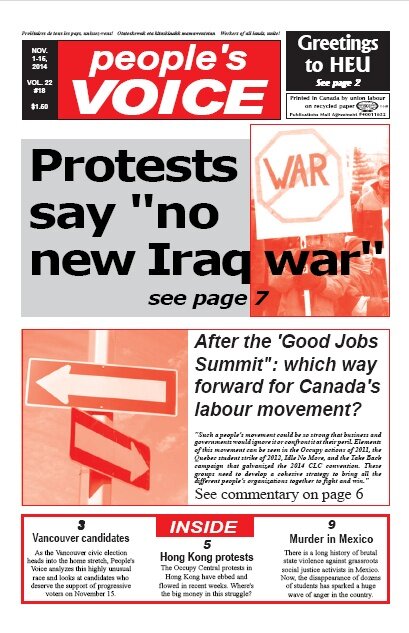
November 1-15, 2014
Volume 22 – Number 18 $1
Prolétaires de tous les pays, unissez-vous!
Otatoskewak ota kitaskinahk mamawestotan!
Workers of all lands, unite
1) UNIFOR GOOD JOBS SUMMIT: TRIPARTISM ON DISPLAY
2) GREETINGS TO HOSPITAL EMPLOYEES UNION
3) WORKERS UNITED STRIKES IN GUELPH AGAINST TWO-TIER SYSTEMS
4) DOWN TO THE WIRE IN VANCOUVER ELECTION
5) THE PLAGUE OF IMPERIALISM – Editorial
6) "NO PASARAN" IN UKRAINE! – Editorial
7) PEACE MOVEMENTS CALL FOR ANTI-WAR PROTESTS
9) BJP GOVERNMENT MISDEEDS SPEAK LOUDER THAN WORDS
10) ANGER IN MEXICO AT ATTACKS ON TEACHER STUDENTS
11) SHADY ACTION BEHIND HONG KONG PROTESTS
12) EBOLA VIRUS DEATHS FACILITATED BY IMPERIALISM
13) A SAVIOUR CALLED JYOTI BASU
14) MUSIC NOTES, by Wally Brooker
PEOPLE'S VOICE NOVEMBER 1-15, 2014 (pdf)
People’s Voice 2014 Calendar
”The Truth About the Great War”
To order a copy of the People’s Voice 2014 Anti-First World War
Calendar, send $15 (includes postage and handling) to
People’s Voice, 706 Clark Drive, Vancouver, BC, V5L 3J1. Contact us at
604-255-2041 or pvoice@telus.net for bulk order prices.
|
People's Voice deadlines: November 16-30 December 1-31 Send submissions to PV Editorial Office,
|
REDS ON THE WEB
http://www.parti-communiste.ca/
peoplesvoice.ca
www.ycl-ljc.ca
www.solidnet.org
|
People's Voice finds many "Global Class Struggle" reports at the "Labour Start" website, http://www.labourstart.org/. We urge our readers to check it out! |
* * * * *
People's Voice
Canadian Publications Mail Sales Product Agreement #205214
ISSN number 1198-8657
People's Voice is published by
New Labour Press Ltd
PV Editorial Office
706 Clark Drive,
VANCOUVER, B.C. V5L 3J1
Phone:604-255-2041
Fax:604-254-9803
email: pvoice@telus.net
Editor: Kimball Cariou : Business Manager: David Au
Editorial Board: Kimball Cariou, Miguel Figueroa,
Doug Meggison, Naomi Rankin, Liz Rowley, Jim Sacouman
* * * * * *
Letters
People's Voice welcomes your letters
on any subject covered in our pages.
We reserve the right to edit for length and clarity,
and to refuse to print letters which may be libellous
or which contain unnecessary personal attacks.
Send your views to:
"Letters to the Editor",
706 Clark Dr., Vancouver, BC V5L 3J1,
or pvoice@telus.net
People's Voice articles may be reprinted without permission,
provided the source is credited.
* * * * * *
The Communist Party of Canada, formed in 1921,
has a proud history of fighting for jobs, equality, peace,
Canadian independence, and socialism.
The CPC does much more than run candidates in elections.
We think the fight against big business and its parties
is a year-round job,
so our members are active across the country,
to build our party and to help strengthen people's movements
on a wide range of issues.
All our policies and leadership
are set democratically by our members.
To find out more about Canada's party of Socialism,
give us a call at the nearest CPC office.
* * * * * *
Central Committee CPC
290A Danforth Ave Toronto, Ont. M4K 1N6
Ph: (416) 469-2446
fax: (416) 469-4063 E-mailmailto:info@cpc-pcp.ca
Parti Communiste du Quebec (section du
Parti communiste du Canada)
5359 Ave du Parc, Montréal, Québec,
H2V 4G9
B.C.Committee CPC
706 Clark Drive, Vancouver, V5L 3J1
Tel: (604) 254-9836
Fax: (604) 254-9803
Edmonton CPC
Box 68112, 70 Bonnie Doon P.O.
Edmonton, AB, T6C 4N6
Tel: (780) 465-7893
Fax: (780)463-0209
Calgary CPC
Unit #1 - 19 Radcliffe Close SE
Calgary AB, T2A 6B2
Tel: (403) 248-6489
Ottawa CPC
Tel: (613) 232-7108
Manitoba Committee
387 Selkirk Ave., Winnipeg, R2W 2M3
Tel/fax: (204) 586-7824
Ontario Ctee. CPC
290A Danforth Ave., Toronto, M4K 1N6
Tel: (416) 469-2446
Hamilton Ctee. CPC
265 Melvin Ave., Apt. 815
Hamilton, ON.
Tel: (905) 548-9586
Atlantic Region CPC
Box 70 Grand Pré, NS, B0P 1M0
Tel/fax: (902) 542-7981
http://www.parti-communiste.ca/
* * * * * *
News for People, Not for Profits!
Every issue of People's Voice
gives you the latest
on the fightback from coast to coast.
Whether it's the struggle for jobs or peace, resistance to social cuts,
solidarity with Cuba, or workers' struggles around the world,
we've got the news the corporate media won't print.
And we do more than that
- we report and analyze events
from a revolutionary perspective,
helping to build the movements for justice and equality,
and eventually for a socialist Canada.
Read the paper that fights for working people
- on every page, in every issue!
People's Voice
$30 for 1 year
$50 for 2 years
Low-income special rate: $15 for 1-year
Outside Canada $50 for 1 year
Send to: People's Voice, 706 Clark Drive, Vancouver, BC, V5L 3J1
You can call the editorial office at 604-255-2041
REDS ON THE WEB
http://www.parti-communiste.ca/
http://www.ycl-ljc.ca/
http://www.solidnet.org/
(The following articles are from the November 1-15, 2014, issue of People's Voice, Canada's leading socialist newspaper. Articles can be reprinted free if the source is credited. Subscription rates in Canada: $30/year, or $15 low income rate; for U.S. readers - $45 US per year; other overseas readers - $45 US or $50 CDN per year. Send to People's Voice, c/o PV Business Manager, 706 Clark Drive, Vancouver, BC, V5L 3J1.)
1) UNIFOR GOOD JOBS SUMMIT: TRIPARTISM ON DISPLAY
By Stuart Ryan, Ottawa
Unifor, formed by the merger of the Canadian Auto Workers and the Communication, Energy and Paperworkers Union, has highlighted three themes since its inception: a) it is time to take the offensive in its labour relations with employers; b) being a union for everyone with its new ways of organizing in non‑traditional sectors, with models like Community Chapters; and c) reaching out to communities to create good, secure and well‑paying unionized jobs.
National President Jerry Dias has highlighted the need to address the crisis of unemployment and the growth of precarious, temporary or contract jobs. Since neither government or business was doing so, the Good Jobs Summit was held October 3‑5 in Toronto. Dias invited several partners to help Unifor organize the event: the Canadian Federation of Students; the Canadian Centre for Policy Alternatives (Ontario); Ryerson University and its Institutes, the Sam Gindin Centre for Social Justice and Democracy, and the Centre for Labour‑Management Relations.
The goal was to bring together representatives of social justice groups (the Metro Vancouver Alliance); students, (Jessica McCormick, National President of CFS); labour leaders (Jerry Dias, PSAC President Robyn Benson, Canadian Labour Congress President Hassan Yussuff); business leaders (GE Canada President Elyse Allan, James Irving of Irving Limited, and Peter Edwards of Canadian Pacific); and politicians (Ontario Premier Kathleen Wynne, federal Liberal Leader Justin Trudeau, NDP MP Peggy Nash, former Toronto Mayor David Miller and Mayoralty candidate Olivia Chow), in order "to start a dialogue about creating good jobs in Canada."
The choice of participants reflected a philosophy of tripartism. Labour and community groups, businesses that "respect the labour movement" and governments willing to engage with labour, would commence a "national roundtable" dialogue on developing a strategy to create good, full‑time and environmentally sustainable jobs.
The featured speakers included Wynne, McCormick, Yussuff, and Allan, as well as Van Jones, a CNN commentator and former "Green Job Strategy" advisor to Barack Obama.
Each spoke about the problems in the North American economy: the elimination of full‑time jobs in the manufacturing sectors, and the replacement since the Great Recession of 2008‑2009 with temporary, contract and part‑time jobs; outsourcing, privatizing social services, etc. The United Way study of precarious employment in Hamilton and the Greater Toronto Area points out the problem of precarious employment and the lack of access to social services for these workers. The CFS outlined the ramifications of graduating with huge student loan debts, which delays full participation in the labour market.
Examples of solutions to the crisis were presented. In Newfoundland, student mobilizations led to the freezing of tuition rates at Memorial University, and the replacement of student loans with education grants. Kathleen Wynne and Olivia Chow promoted Community Engagement Agreements that forced contractors building Light Rail Transit in the GTA or dealing with municipal governments to hire people from marginalized communities. Former Toronto Mayor David Miller highlighted his decision to buy subway cars built in Thunder Bay, rather than take the lowest bidder from China. Peter Edwards claimed that Canadian Pacific had turned itself around by investing $1 billion a year on its own staff and infrastructure, including reopening old facilities in Winnipeg, rather than outsourcing maintenance and other work.
Jerry Dias cried out against the export of raw resources such as timber and oil, while sawmills and refineries close in Canada. Pipelines should be built only if they meet environmental standards and the concerns of Aboriginal nations, and only to supply Canadian refineries.
The 1,000 Summit participants took part in eight workshops. Four outlined the issues: Green Jobs in the new economy; new methods of organizing; Innovative modes for creating good jobs; increasing minimum wages and living wages. Four workshops explored what is to be done for targeted populations: the poor facing unemployment or precarious labour; students entering the labour force; people in rural and regional economies; unemployed youth and those over 40 losing their good jobs.
Several common themes emerged. Governments must establish real employment standards, with real enforcement. Better labour laws are needed to facilitate unionization. Creating jobs must include equity for marginalized groups such as the poor, First Nations people, and those with disabilities, who need access to education, childcare and other social services so that they can maintain their jobs and family lives.
Participants demanded a national employment strategy, and a green and sustainable economy, focused on creating jobs. Unions could play their part by sharing best practices for organizing and bargaining hard for the creation of jobs that provide salaries and benefits, and are also fulfilling for workers.
All saw the need for governments to serve Canadians rather than the needs of business. Saying the weekend could not be the end of the dialogue, Dias called for regional job summits throughout the country to meet the needs of the different economies.
Will it happen?
All this sounds wonderful, but will it work? Not if Stephen Harper and the neo‑liberal capitalist austerity agenda have their say. Not if Kathleen Wynne's declaration at the Summit that "adversarial labour relations are obsolete" is followed.
CLC President Hassan Yussuff warned that the Comprehensive Economic and Trade Agreement with the European Union must be stopped, because CETA is all about preventing government initiative to protect promote local procurement and local production.
Corporations can sue governments if they claim their "rights" to maximize profits are violated. All the proposals of the Good Jobs Summit would be ignored if the Conservatives are re‑elected and CETA is implemented. This leads to the question of what to do in the next election.
Unifor is following the practice of one of its predecessors, the CAW, in promoting strategic voting. The theory is to put resources into supporting NDP incumbents, or candidates who have a chance to win. In ridings where that is not possible, Unifor says to vote for the candidate with the best chance to defeat the Conservative. In English Canada, that means in effect the Liberal Party. Hence the invitations to Trudeau and Wynne.
The Premier outlined her "activist centrism" approach to economic development, declaring that "adversarial labour relations are now obsolete". Her 2014‑15 budget imposed wage freezes in the public sector for the next four years.
Only one participant asked: why not increase corporate taxes (which in Ontario are the lowest in North America), since the strategy of low corporate taxes and cuts to government spending have meant that only 20% of jobs created in the last two years were full‑time. That question was left unanswered, while Justin Trudeau was allowed to state that his priorities were education and infrastructure.
NDP MPs promoted their platform of a $15 minimum wage and a national child‑care strategy, but no one asked why the NDP's sharp turn to the centre led to defeats in the Ontario, BC and Nova Scotia elections.
No one was allowed to ask why Canadian Pacific could benefit from the federal back‑to‑work legislation in the spring of 2012, that imposed a collective agreement on its workers represented by the Teamsters. Only Olivia Chow was allowed to ask a leading question to David Miller.
The threat of a Conservative victory
Some participants believed that the revulsion of voters to the mean‑spirited pro‑business agenda will lead to a minority government in the 2015 election. Don't count on it.
The Harper Conservatives' goal is to permanently shift the economic and political structures of Canadian society, to promote Canada's role as a partner in the capitalist global structure and to support expansionist wars. To date, neither the Liberals nor the NDP have a response, as they compete to capture the "centre" of the political spectrum.
What should be done
The labour movement should adopt a strategy to bring the people together first, to develop and promote an agenda based on the needs of the working class, Aboriginal people, youth, women, and the disabled. Public services such as healthcare, education, and door‑to‑door postal service should be at the forefront of this people's agenda, along with a policy of full employment, and a shorter work week with full benefits and no loss of pay.
Such a people's movement could be so strong that business and governments would ignore it or confront it at their peril. Elements of this movement can be seen in the Occupy actions of 2011, the Quebec student strike of 2012, Idle No More, and the Take Back campaign that galvanized the 2014 CLC convention. These groups need to develop a cohesive strategy to bring all the different people's organizations together to fight and win.
It is time to be bold. Another Canada is possible. There is too much at stake not to take this way forward.
(Stuart Ryan is a member of Unifor 567 and a participant at the Good Jobs Summit.)
2) GREETINGS TO HOSPITAL EMPLOYEES UNION
Greetings to the 29th Biennial Convention of the Hospital Employees Union, from the BC Labour Bureau of the Communist Party of Canada
The Communist Party of Canada extends greetings to the Hospital Employees' Union at its 29th Biennial Convention, and on the occasion of the HEU's 70th anniversary. Your union has a proud historic record of defending the interests of workers in the health care sector, and fighting to achieve equality gains for women and other groups. Our party stands in full solidarity with the HEU in its struggle against endless attacks on public services such as health care, and on health care unions and on their members, by big business and the governments that serve the corporate drive to privatize, contract out, and smash the union movement. We also support the HEU in opposing raids and divisions which only benefit the employers.
Similar anti‑union attacks are taking place across the country and around the world. Just weeks ago, Nova Scotia's Liberal government passed Bill 1, claiming it will cut costs by amalgamating health regions. We know from experience in British Columbia that such amalgamations inevitably lead to privatization, such as public private partnerships (P3s), and fragmenting the unity of the unions and their members. It also means less consultation and involvement of health care workers and the general public, and more attacks on trade union rights. Nova Scotia health sector workers have been legislated into four government‑imposed bargaining units and assigned to unions at the whim of the employer. This goes against the Charter of Rights and Freedoms which includes the freedom of association. This agenda sounds very familiar to HEU members!
The equivalent legislation in B.C., Bill 29, was eventually thrown out in part by the courts, but this unrelenting neoliberal offensive continues. A counteroffensive is needed. Without such a fightback, everything that working people, the union movement and others fought for (such as Doctor Norman Bethune and Tommy Douglas who were in the forefront to establish universal Medicare) will be destroyed. The union movement can't depend on the courts in this struggle, especially given the rightward drift of the NDP, the "party of labour" which fails to resist the corporate agenda. Labour must have an independent political action strategy of its own, to challenge big business and its relentless drive for profits, and to defeat right wing governments propped up by the corporations. Nor can labour win this battle alone. A fighting alliance of all progressive and democratic forces, including the trade union movement, must be built to demand policies that put working people before private profits.
The HEU must be especially congratulated on achieving its last collective agreement in the facilities sector. Your union can truly take pride in preserving its integrity under very difficult circumstances, against a BC Liberal government which relentlessly targets hospital workers. Our Party wishes HEU delegates a successful 29th convention!
3) WORKERS UNITED STRIKES IN GUELPH AGAINST TWO-TIER SYSTEMS
People's Voice Guelph Bureau
Nowadays, the vast majority of workers across Canada are witnessing the erosion of long‑fought human rights, including vacations, pensions and overtime, in addition to decreased health and safety conditions at workplaces. Time after time, workers have been forced to make concessions, in spite of these prosperous times for companies. High profits have not been translated into labour investment and facility improvements; instead, the profits are increasingly transferred to overseas corporations.
This seems to be the case for Tokyo-based Nippon Sheet Glass. For the year ending March 31 2014, the company showed profits of 606 billion yen, or over $6.2 billion (Annual Report 2014, page 3). The Guelph division of NGF Canada makes rubber‑coated glass cords for racing car tires, and was bought by NSG in 1995 from the Owens Corning group. After several years of concessions around wages and benefits, workers at the Guelph factory decided to defend what they had.
The workforce of the Guelph NGF factory is determined to stop the implementation of a two‑tier system on new employees. On Sept. 30, the 26 members of Workers United Local 2641 began strike action, after multiple failed attempts at contract negotiations with NGF Canada.
Over the last year, several attacks have been made on contract language, after a new manager took over the operations in Guelph. These consisted of changes to employee pension plans, reduced vacation time for new employees, changing criteria for overtime pay, and forcing workers to sign a five‑year contract. The workers reject the creation of a two‑tier system, which would negatively affect the salaries and benefits of new employees.
Fortunately, "Workers United is presenting a united opposition to the company's attempts", as Dave Deml, a 33‑year employee said. Susan Taylor, president of WU 2641, Barry Fowley, B.J. Cardy, and other members are engaged in building solidarity across the city and Ontario.
Hassan Yussuff, president of the Canadian Labour Congress, joined the picket line to support the strikers in their just demands. These endorsements constitute a good push for the fight by WU 2641 workers to improve their contract and get a much fairer deal, for them and their families, and the new workers to come.
4) DOWN TO THE WIRE IN VANCOUVER ELECTION
PV Vancouver Bureau
A highly unusual Vancouver civic election is entering the final stretch, with advance polls open from November 4 to 12 and voting day on Saturday, Nov. 15.
Unlike in 2008 and 2011, it appears that the centrist Vision Vancouver party may not be headed for easy majorities at City Hall, School Board and Park Board. On the other hand, none of Vision's challengers on the right and left seem to have seized the public's imagination. The final weeks of the campaign could end in a variety of scenarios, from outright Vision victories over fragmented opponents on the ballot, or a mix of winners from several parties.
As stated before in People's Voice, Vision is backed by an unusual combination. Some of the city's major developers are big financial contributors, but Vision also has the endorsement of the Labour Council and most civic unions, and the support of many environmental activists. The Non‑Partisan Alliance (NPA), which has won most Vancouver elections since being formed in 1938 to keep the left out of City Hall, hopes to take advantage of Vision's perceived arrogance and the unchecked pace of high rise developments. But the NPA is known for its close links to the Harper Tories and big energy and mining corporations, and for its anti‑labour record, including a lengthy lockout of municipal employees during its 2005‑08 term in City Hall.
These circumstances should have been favourable for Vancouver's traditional party of the left. COPE hopes to make a comeback by issuing a series of progressive policy statements, and several of its 19 candidates are well respected community activists.
But the sectarian politics of its core leadership in recent years have alienated some former supporters. Only three COPE candidates were endorsed by the Labour Council, and civic unions are contributing only a fraction of their previous donations to the organization which they helped to found in 1968. In a campaign where many working class voters fear a resurgence by the NPA, COPE needs to reach far beyond a few neighbourhoods where the left remains fairly strong, but lacks the resources for an expensive city-wide campaign.
The arcane mathematics of Vancouver's at-large electoral system could also affect COPE's chances. Vision has strategically nominated fewer than full slates for council, school board and park board races. But in each case COPE is running more than the number of open spaces. Voters who support a mix of Vision and COPE candidates to block the NPA will have to divide their votes, at COPE's expense.
The main beneficiaries of any "anti-slate" trend could be smaller parties backed by voters who want to elect candidates more closely attuned to community voices. In the Council race, R.J. Aquino of the new One City party has strong labour support, backing from the growing Filipino community and other immigrants, and the important organizing skills of many former COPE and Vision supporters.
The Greens may expand on their gains in 2011, when Adriane Carr was elected to Council, just 93 votes ahead of COPE incumbent Ellen Woodsworth. Carr's narrow win was in part due to some COPE supporters declining to vote for that party's entire slate - a classic proof that sometimes nominating more candidates can bring worse results.
While the Greens are riding a wave of popularity, their image took a hit when several candidates disclosed holding shares in mining, fossil fuel and other corporations. On one level, this is not surprising, since the leadership of the Vancouver Greens tend to be from higher income sectors. Nor has Carr been notable as a defender of working class interests during her three years on Council.
In the School Board race, Public Education Project candidates Jane Bouey and Gwen Giesbrecht have the advantages of wide name recognition, strong support from trade unions and education activists, and reputations as determined fighters against the Liberal government's under-funding of schools. During her two previous terms on the Board, Bouey was a powerful voice for Aboriginal education, low-income families, and students with special needs. She drafted the VSB's ground-breaking LGBTQ inclusion policy in 2002, and helped lead the public fight earlier this year to expand that policy.
The "Public Education" theme has struck a chord, especially in the wake of Premier Christy Clark's teacher-bashing. It appears that Bouey and Giesbrecht could move from the "dark horse" category into real contenders, especially if they can pick up the two extra votes from those who back Vision's seven candidates, and from COPE supporters who remember Bouey's two terms as a COPE trustee.
In this complicated situation, People's Voice does not have a full list of recommendations for our Vancouver readers. At City Council, a stronger left presence would help shift debates in a progressive direction. Electing R.J. Aquino from One City would be a big victory. Among the COPE candidates, Sid Chow Tan and Audrey Seigl are proven community activists with broad support, and Gayle Gavin was endorsed by the Labour Council. We'll have more to say about the race for Mayor in our next issue.
At School Board, the Vision majority chaired by Patti Bacchus has been a powerful voice for public education, and they expanded the VSB's inclusion policy over bitter objections from fundamentalist bigots. The entire Vision caucus deserve re-election, but the Board would be greatly strengthened with Public Education Project candidates Jane Bouey and Gwen Giesbrecht at the table. (COPE has paid little attention to school issues since 2011.)
Vision's record at Park Board has been mixed at best. We urge readers to support COPE's Anita Romaniuk, Imtiaz Popat, and Cease Wyss in this vote, along with Green Party gadfly Stuart MacKinnon.
People's Voice Editorial
With each passing day, the death toll from the Ebola virus rises, and the responsibility of the imperialist system becomes more obvious. Over a trillion dollars are wasted each year on militarism and war-making, the bulk of this by the US and its NATO allies. Yet when an epidemic strikes one of the poorest regions of the world, these "great powers" find it nearly impossible to help avert disaster.
Ebola does not have to be a death sentence. As the World Health Organization admits, seven in ten of those affected die because of the lack of proper healthcare facilities. And why are clinics and hospitals woefully lacking in Guinea, Sierra Leone, and Liberia? Because Africa has been plundered by the Western powers, from the days of the hugely profitable slave trade, to the present day when high public debts keep African states and their economies enslaved to the IMF, the World Bank and the big corporations.
As the World Federation of Trade Unions points out, Ebola spreads in conditions of poverty, malnutrition, the lack of basic health care, and limited access to free public education. Courageous medical personnel are risking their own lives without proper safety measures such as gloves and masks, while the pharmaceutical transnationals profit from suffering.
Our world is infected by a virus: the drive by big capital for maximum profits, whether through the sale of weapons or expensive drugs. The cure is the power of the working class, which can overthrow the private profit system and win a future based on peace, equality, democracy, social justice, and an end to all forms of exploitation and oppression. We can see a glimpse of this world in the 50,000 Cuban doctors and medical personnel who work in 66 countries around the world, including 4,000 in 32 African countries. This practical solidarity shows that socialism is the future!
People's Voice Editorial
In a frightening scene that few could have imagined, thousands of fascist thugs rioted outside the Parliament in Kiev recently, demanding full veterans recognition and benefits for the scum who sold out their own people by joining Hitler's armies during the Nazi invasion of the Soviet Union. This nightmare follows the February coup against the democratically elected government of Ukraine, carried out with the eager assistance of the fascist groups and the backing of imperialist powers including Canada. Since then, the right-wing government of Ukraine has sold out the country's sovereignty to the European Union, and its military has conducted a brutal war on the people in the eastern regions, who naturally fear for their future under the thumb of their new invaders.
Every day, fascists in Ukraine, commit atrocities such as defacing monuments to the victims of the Nazi occupation. Meanwhile, the Harper Tories, who howl every time somebody compares Israel's occupation of Palestine to apartheid, refuse to criticize the anti-Jewish thugs rampaging across Ukraine. Think about this for a moment: over 45,000 Canadians gave their lives in the heroic battles to liberate Europe from Hitler fascism, but today, our Prime Minister aligns himself with those who want to reverse the victory of 1945, won through the blood and sacrifice of Canadians, Soviets, and the peoples of all the allied powers and the resistance movements.
Remember the words of Pastor Martin Niemoller: "First the Nazis came for the Communists, but I was not a Communist, so I did not speak out. Then they came for the Social Democrats and the trade unionists, and the Jews, but I did not speak out. Then they came for me, and there was nobody left to speak for me." Today, we must speak out against the fascist atrocities in Ukraine - and against their apologists in Ottawa. No Pasaran! Fascism shall not pass!
7) PEACE MOVEMENTS CALL FOR ANTI-WAR PROTESTS
On the heels of a Parliamentary vote approving Canada's participation in the US-led bombing of Iraq and Syria, anti-war groups are calling for protest actions.
As this issue of PV went to press, affiliates of the Canadian Peace Alliance and the Quebec-based Collectif Echec a la guerre were mobilizing for rallies on the October 25-26 weekend, in Ottawa, Montreal, Toronto, Edmonton, Vancouver and other cities.
These protests coincide with the 12th anniversary of the October 2002 mobilizations in Canada and the US to oppose the preparation of the US invasion and the war of occupation in Iraq that would last from 2003 to 2011. Those early protests drew thousands, building towards much larger demonstrations leading up to the March 2003 invasion of Iraq. Huge protests of over 100,000 in Quebec were credited with forcing the Chretien Liberal government of the day to decline a formal military role in the invasion, although some Canadian Armed Forces personnel were involved as part of U.S. forces in the region.
In early October, the opposition parties in Parliament voted against Canadian participation in the bombing campaign against Islamic State forces. Opinion polling and street actions by anti-war groups give diverging interpretations of public views on the war, but millions of Canadians are deeply ambivalent. Memories are still fresh about the U.S. lies to justify the 2003 war, and the humanitarian disaster which continues in Iraq to this day. Most Canadians are still not convinced that this country's role in the occupation of Afghanistan, which killed many thousands of Afghans and 158 Canadians, was worth the cost in blood and money.
The lack of public enthusiasm for yet another war in the region is clearly a factor in the decision by the NDP and Liberal caucuses to vote against Harper's six-month military action. Anti-war groups hope that this situation may give time to begin building larger protests.
The call-out from the Canadian Peace Alliance and Echec a la guerre states:
"We invite the people of Quebec and Canada to protest:
"Against a new illegal war that contributes to dismantling the existing world order and that threatens world peace and security while pretending to defend them;
"Against the security and humanitarian pretexts invoked by the new coalition: the protection of Iraq's population has nothing to do with the real motives of this war, which will cause them more suffering and further deteriorate their living conditions;
"Against a Canadian foreign policy centred on intensifying conflicts and war;
"Against the hijacking of huge amounts of public resources to make war, promote the military industry, glorify the army and Canada's military past, while for many years austerity measures have cut education, healthcare, public services, the promotion of women's rights, the protection of the environment, international cooperation, etc.
"Together, let's take to the streets to demand:
"The immediate end of Canadian participation in this new aggression coalition which has been set up for the strategic interests of the US empire and its allies;
"A freeze on all major procurement projects of the Canadian military;
"The organization of a broad public debate on Canadian foreign policy, the role of the army, the military industry and the arms trade;
"That the Canadian government immediately cease deportation proceedings against U.S. Iraq war resisters and create, once and for all, a provision that would allow them to remain in Canada."
Information about local anti-war actions can be found at these websites: www.canadianpeace.org, www.echecalaguerre.org.
Statement by the Central Committee, Communist Party of Canada
For all of its 65 years of existence, NATO has been an aggressive, imperialist alliance. It is the largest military organization in the world, committed to the doctrines of first strike and preemptive strike. NATO interventions regularly include the use of toxic weapons containing depleted uranium or white phosphor, and the alliance has repeatedly stated that nuclear weapons are a fundamental part of its military arsenal and strategy.
NATO is also an illegal alliance under international law. Article 52 of the United Nations Charter permits regional military organizations, but only if their activities are "consistent with the Purposes and Principles of the United Nations." The most important principle of the UN is the prohibition of the use of force. Since NATO's membership has always been beyond any commonly identifiable region, and since its primary activity has always involved the use of military force, its foundation contravenes international law.
Firmly dominated by US‑imperialism, NATO is also a pillar of the European Union's military strategy. Since the end of the Cold War, NATO has aggressively expanded both its membership and its theatre of operations. Currently, there are 28 NATO member states across North America and Europe, another 22 countries in the Euro‑Atlantic Partnership Council (EAPC), and a further 19 countries engaged with NATO through programs such as the Mediterranean Dialogue, the Istanbul Cooperation Initiative and the Partners Across the Globe Initiative. This expansion reveals NATO's fundamental character as the key military tool of Western imperialism.
NATO membership carries profound military, political and economic consequences for individual states and their peoples. By compelling its members to adopt, support and enact its mutual clause, NATO draws them into wars of aggression in the pursuit of imperialist expansion. Through the alliance's nuclear weapons sharing policy, NATO countries become de facto nuclear weapons states, active participants in the development, testing, proliferation and use of weapons of mass destruction. Through NATO, officially nuclear‑free countries such as Canada become components in imperialism's multilateral nuclear strike force, usually without the consent or even knowledge of their people.
As the global economic crisis has continued and deepened, Western imperialism has also seen its global might increasingly challenged from emerging economic powers such as the BRICS countries and, more profoundly, from the peoples of the world. Partly in response to these developments imperialism has become increasingly aggressive, using new and old pretexts and instruments for the purposes of intimidation, provocation, aggression and war. As part of this, NATO's eastward expansion has been intensified, with the immediate purpose of encircling and isolating Russia. NATO's aggressive efforts to integrate countries such as Georgia and Romania, as well as its accelerated construction of missile defense installations in Eastern Europe, have poisoned the region with a political backdrop of intimidation and provocation that is aimed at Russia in particular. This drive for the expansion of imperialism's military apparatus has occurred alongside a similar drive to expand its economic institutions, in the form of the EU. This two‑pronged expansion culminated in the criminal interference and intervention in the internal affairs of Ukraine, through the spring and summer of 2014.
Imperialism's aggression against the sovereignty of Ukraine included recruiting, training and arming fascist and neo‑nazi organizations, and using those organizations to terrorize and murder the Ukrainian people. The crisis has now developed into a war that has cost nearly 3000 lives, displaced many thousands more, and destroyed social and economic infrastructure. It has also facilitated Ukraine's economic and political dependence upon Western imperialism, placed openly fascist groups in government, provoked a new Cold War, and sparked a new global arms race.
The recently concluded NATO Summit in Wales confirmed that NATO will develop a multinational rapid response force, that it will construct new bases and deployments in Eastern Europe near the Russian border, and that it will pressure its member states to significantly increase their own military spending. Furthermore, the NATO Summit was the key forum in which the United States pressed its military allies to commit to multinational military operation in Iraq. These initiatives are clearly in the service of imperialism, but they will clearly be paid for by the working classes of those member states.
While Canada has been a member of NATO since its founding, under the Harper Conservative government it has emerged as an aggressor state. Harper both supports NATO aggression globally and facilitates NATO‑friendly policies to guide Canada's economic, social and political development. NATO's priorities have become so deeply entrenched in Canada that there is near unanimity among the political parties in Parliament that Canada's foreign policy should reflect NATO interests. The priorities and needs of the vast majority of the people of Canada are ignored, marginalized and, in some cases, crushed by force.
In this 65th anniversary of NATO's founding, and the 100th anniversary of the beginning of the First World War, the Communist Party of Canada reiterates its longstanding demand for an independent Canadian foreign policy based on peace, international cooperation and solidarity. As a necessary first step in developing such a policy, we call for Canada's immediate and unilateral withdrawal from NATO.
Furthermore, the Communist Party encourages all labour, peace and progressive organizations to work toward Canada's withdrawal from NATO and for the dissolution of that military alliance.
9) BJP GOVERNMENT MISDEEDS SPEAK LOUDER THAN WORDS
By Baldev Padam
The long wait of Hindutva (Hindu Nationalist) elements to assume political power ended last May when BJP leader Narendra Modi won a majority in India's Lower House. With a few smaller parties, the BJP formed the National Democratic Alliance government in Delhi. The NDA is a coalition in name only; the BJP rules the roost. Its electoral tactic to alienate India's minorities from the Hindu majority to pocket the latter's votes succeeded over the ruins of the country's pluralism and communal harmony.
The BJP election manifesto nowhere mentioned the creation of a Hindu Nation. But its promises of a "uniform civil code" and abrogation of Article 370 of India's Constitution pointed in that direction. In order to recognize the diverse practices followed by Hindu and Muslim communities, like marriage, separate laws were enacted long ago. The BJP government now wants a "uniform civil code", which would mean gross interference in their personal laws, complain leaders of the India's Muslim community.
Similarly, Article 370 gave a degree of legislative autonomy to Kashmir, India's only Muslim majority province. Soon after assuming power, some of the BJP's over‑enthused but raw ministers announced plans to remove this Article, inviting much criticism, including from Omar Adullah, the Chief Minister of Jammu & Kashmir. Tampering with such provisions would legitimize the apprehensions of minority communities about the BJP's intentions to turn India into a Hindu‑dominated state. Those anxieties weren't baseless; turning egalitarian India into a Hindu Nation was the goal of the RSS (Rashtriya Swayamsevak Sangh) movement, the BJP's mentor. But this was easier said than done.
Two prong strategy
The country's constitution christened India a secular, socialist and democratic republic. A large section of Indians, Hindus included, always detested the division of communities and neighbourhoods on grounds of religion, particularly after suffering the pangs of partition in 1947. To surmount such hurdles, the BJP has adopted a two point program of action.
First is to try to amend the Constitution by deleting the word "secular". But the BJP lacks a majority in the Rajya Sabha (Upper House), and is unable to muster the requisite number of provinces to change the constitution. So PM Modi has given a clarion call to the people of provinces where assembly elections are going on, to give the BJP a majority to implement its plans. In hot pursuit of one party rule, the BJP has discarded alliances, even with their decades‑old Hindutva ally Shiv Sena in Maharashtra, and in Haryana severed ties with their partner HJC (Haryana Janhit Congress).
The second course is to ignite Hindu religious passions, a strategy that succeeded for BJP President Amit Shah in May. Hundreds of communal riots erupted in Uttar Pradesh state alone after Modi assumed power, and Gujarat again witnessed riots while the PM was in the USA to woo investments. Modi's tweet, "If anyone touches my Muslim brother or sister, I won't be sitting idle," looked hollow. Actions speak louder than words for BJP!
Modi's US Visit
Controversies follow Narendra Modi wherever he goes, and his recent US visit was no different. The media in America and back home interpreted his sojourn differently. Indian media, both print and electronic, said that Modi's charisma drew hundreds of fans to New York's Madison Square to accord him a rock star reception. His first address at the UN and his rendezvous with President Obama were highlighted.
But international newspapers gave lackluster coverage. The New York Times reminded readers that a US court has issued a summons to Modi in connection with the 2002 Gujarat riots. Other US media also reminded about the awkward juxtaposition of Modi's reception and his record of human rights violations at home. The Japanese media just ignored Modi's US stopover.
Amnesty International USA had pressed for raising human rights issues, but U.S. officials made it clear that Modi had immunity as a head of government while on American soil. Such controversies, however, blunted the sheen of his U.S. stopover.
The purpose of Modi's visit was to boost bilateral trade and court investment. However, he returned home empty handed. His tempting talk of a "Red Carpet" reception instead of red‑tape, or simplification of foreign investment regulations or a favourable tax regime, didn't cut much ice with American investors, who offered nothing in return. They are aware that the Indian Parliament always stood in the way of American investments, and their earlier proposals were resisted by opposition parties, the BJP included. US industrialists want a suitable law in line with Modi's assurances to be first passed by Parliament. That means Modi has a six‑month window, which could be stretched to the next budget, to show results. So far it's much ado about nothing.
Sway of RSS over Government
The story of BJP rule until now is only of slogans and more slogans. The PM's promise of Achche Din (Good Times) is fast losing its shine. The nation is worried at what lies in store from this government, which pursues the politics of hatred and hoodwinking more than the economic reforms it promised.
Putting DD (Doordarshan), India's official broadcaster, at the disposal of RSS chief Bhagwat to address the nation on the eve of Dusehra, a Hindu festival which is also RSS Foundation Day, was quite a new phenomenon. In his hour‑long broadcast, Bhagwat talked about his concern that illegal Muslim immigration into Assam, West Bengal and Bihar from Bangladesh had the potential to endanger the "Hindu society". Pleading for Modi, Bhagwat said that people should give more time for efficient execution of BJP policies. He pressed for a complete ban on cow slaughter and meat exports, and urged people to stop buying Chinese goods. The difference, if any, between RSS and Modi's BJP, disappeared. Both look like two sides of same coin.
The Congress, SP and Left parties flayed the national channel for playing into the hands of the government and wasting taxpayers' money by allowing Bhagwat to propagate the RSS agenda of saffronisation, instead of pressing problems like poverty alleviation or fighting joblessness.
In the end
Even so, many surveys show an NDA lead in state elections. Evidently the federal poll outcomes are still fresh in voters' memories, and Modi's tricks also play their part. For example, Modi showered praises on the Khap Panchayats (the most reactionary and backward village organizations, which stand against modernization and gave verdicts against women in Haryana and elsewhere) to get votes. "I bow before these khaps of Haryana," he told an election rally there, inviting loud cheers from party workers.
But that isn't the end of everything. Peoples' struggle for their emancipation from tyrant regimes does ultimately bring positive results. It is hoped that Indians belonging to various regions, races or religions, and speaking different dialects, who together defeated British Imperialism in 1947, won't let the country fall into the hands of dictators and fascists in the 21st century. We are sure that the saffron clouds hovering over India right now can't stop the rainbow of secularism and socialism from appearing over the horizon. Let it be a temporary phenomenon, like a bad dream.
10) ANGER IN MEXICO AT ATTACKS ON TEACHER STUDENTS
By Emile Schepers, People's World
Mexicans reacted with anger and indignation to the disappearance and possible murder of 43 young students of a teachers' college near Iguala, in the Southern State of Guerrero, on September 26. Meanwhile, relatives of the students waited to hear whether 28 dismembered and burned bodies found in a mass grave just outside Iguala are indeed those of their loved ones.
The students, from a teacher training college, the Ayotzinapa Rural Normal School, had gone to nearby Iguala, a city of about 110,000 people, to raise funds for a campaign of resistance to "educational reform" plans of Mexican President Enrique Pena Nieto which they fear will degrade and eventually eliminate teacher training programs like theirs. When they were getting ready to leave, three buses which they had obtained for the ride home were attacked by what appears to have been a coordinated force of hit men from a regional gang and local police from Iguala.
Two of the students, and several bystanders, were killed outright and the remaining 43 disappeared. Two have surfaced alive, but many fear all the rest were murdered. It cannot be assumed that the 28 bodies in the mass grave are theirs, firstly because they were burned beyond recognition, secondly because nobody trusts the local people in charge, and thirdly because since former President Felipe Calderon, at US behest, declared "war" against drug cartels in 2006, up to 100,000 have been kidnapped and/or murdered and there are many, many mass graves.
In Guerrero, there is a long history of protest and revolutionary uprisings in which teachers have often played a part. Since the system of training schools in the countryside was originally set up by President Lazaro Cardenas del Rio in the 1920s (the Rural Normal Schools, Escuelas Normales Rurales), they have been seen as a threat by some, because they have turned out teachers who come from the Indigenous and poor communities and are committed to educating those communities, including using bilingual education methods with non‑Spanish speaking native communities.
Many of these teachers belong to a militant branch of the Mexican teachers union which is not subservient to the "corporate" model of labour unions so rife in Mexico, in which the government and the ruling Revolutionary Institutional Party (PRI) basically appoint and control the union leadership. They have been carrying out protests in Mexico City and elsewhere against government "educational reforms".
The state of Guerrero, with about 3,500,000 inhabitants, is named for Mexico's second president, Vicente Guerrero, who was an African‑Mexican of very advanced views for his day. It contains an ethnic and linguistic mixture including more than 20 Indigenous language communities and also the main concentration of African-Mexican people in the country. It has a violently dramatic history, reaching up to our own times. Much of the conflict has been between poor peasant communities against big landowners and local political bosses backed by national and international power centres. Even today, the Human Development Index in Guerrero is the third lowest of Mexico's 31 states.
In the 1960s, a teacher, Genaro Vazquez Rojas, organised peasants and workers. Police suppressed peaceful dissent, so Vazquez and friends ended up as guerrillas in the mountains. Vazquez was captured and died in 1972. Another teacher trained at one of President Cardenas' Normal Schools, Lucio Cabanas, was involved in unionisation efforts but fled to the mountains to join Genaro Vazquez when a strike he led was violently suppressed. In 1974, Cabanas was killed. Out of these efforts arose the People's Revolutionary Army which has continued in arms in the mountains of Guerrero and neighbouring regions, sporadically clashing with security forces.
Political assassinations carried out at the behest of the powerful still are common, as in the case of several organisers affiliated with the Communist Party of Mexico a little over a year ago.
So the idea that local landowners, businesspeople, and political bosses would find militant, organised students in teacher training schools threatening is not so strange. Nor is it strange that the national government would try to put an end to the normal school institution - it is a significant focus of resistance and struggle against neo‑liberal policies.
But the anger let loose in all of Mexico by the kidnapping and probable murder of the students in Iguala has politicians scrambling. The municipal president of Iguala, Jose Luis Abarca, has fled, and the nominally leftist Revolutionary Democratic Party (PRD) to which he belongs is in the process of kicking him out. The attorney general of Guerrero has denounced the incident and declared that the whole municipal and police structure of Iguala is riddled with criminals. The governor of Guerrero, Angel Aguirre Rivero, is a former member of President Pena Nieto's Revolutionary Institutional Party (PRI) who jumped to the PRD in order to get their support for his election; he has denounced the incident in Iguala but many are calling for his removal.
11) SHADY ACTION BEHIND HONG KONG PROTESTS
By Kenny Coyle, Morning Star
It seems Hong Kong's umbrella revolution has started to fold up.
Protest numbers have dwindled dramatically, rival factions within the eternally fractious anti‑government camp have already started mutual recriminations and public patience with the student and Occupy Central demonstrations has worn thin.
As if on cue, mainstream opposition politicians, who remained strangely silent during the protests' upsurge, have now come forward urging restraint and dialogue at precisely the point at which the movement appears to have exhausted itself.
Likewise the Hong Kong Student Federation leaders, who had earlier demanded what was effectively direct talks with Beijing, now seem open to dialogue with the local government.
Remaining protesters have been berated by irate commuters, traders and workers in the affected areas, especially those directly employed by the government or low‑paid casual subcontractors who cannot afford the luxury of lost work days.
Occasional violent clashes, which the opposition swiftly claimed were orchestrated by triad gangs working for the government, have been used to revive the Western media narrative of brave and peaceful demonstrators standing up to tyranny and intimidation.
Hong Kong chief executive CY Leung appears to have been vindicated in the short term at least that the eroding tolerance for continued disruption by the "silent majority" has tipped the scales in his favour and isolated the radicals.
Despite scaremongering, epitomised by the seemingly obligatory BBC references to the "Tiananmen Square massacre," there was never really any prospect of direct intervention by the central government in Beijing, nor by the People's Liberation Army forces garrisoned in the former British colony.
After an ill‑judged use of pepper spray and tear gas, police enforced a softly‑softly approach toward protesters. This was done to such an extent that protesters later criticised the police for not having enough officers on duty to protect them.
Had it not been for this clumsy defensive use of force when protesters charged police lines and tried to break into government buildings, it's likely the protests would have fizzled out much earlier.
However, key issues have not been resolved. Hong Kong's government and indeed the central government in Beijing will need to reassess a number of their policies within the territory, which reverted to China in 1997.
While the immediate trigger for these protests was a dispute about electoral reform, behind this lurk several other factors - a multilayered crisis of post‑colonial identity, especially among the young, and a yawning gap between rich and poor to name the most obvious. These are the determining internal factors but there are external ones too.
Since the 1997 return to Chinese sovereignty, there has been the hope that Hong Kong's status as a Special Administrative Region could be manipulated by outside powers, principally the US, to complicate the territory's relationship with Beijing and serve the wider purpose of obstructing China's "peaceful rise."
China's concerns that the protests are being manipulated by outside forces have been presented in the Western media as yet another paranoid delusion from an insecure totalitarian state.
Yet as Wikileaks documents have shown, the US consulate in Hong Kong devotes enormous time and energy to monitoring Hong Kong's political life. There's money too, of course.
To take one example, the National Democratic Institute, the US Democratic Party‑controlled wing of the National Endowment for Democracy (NED), allocated $460,000 (US dollars) in 2012 alone to programmes directed at student activism on the contentious issue of the chief executive election.
Since 1997, the NED has funnelled millions of dollars into the territory to support supposedly independent human rights groups and trade unions affiliated with the opposition.
The latter funds are channelled through the Solidarity Center, NED's labour wing run by the AFL‑CIO, and go to "democratic unions" - that is opposition ones. This is in addition to funds earmarked for general China projects that also include the mainland.
Money plays a big part in Hong Kong politics and the local pro‑Beijing forces are no strangers to donations from the city's wealthy elite.
However, it is the internationalisation of the Hong Kong political scene that concerns Beijing. It fears that foreign forces seek to interfere in what it considers China's sovereign affairs to polarise Hong Kong society and become a source of internal instability and international finger wagging.
The regular international tours by Hong Kong Democratic Party founder Martin Lee and former Chris Patten deputy Anson Chan to the United States and Britain have been followed up by pleas from the pair to the US and British governments to intervene - actions the Chinese government sees as at best unpatriotic and at worse verging on treachery.
Just some months ago, startling revelations appeared in the Hong Kong media about the largesse of Hong Kong millionaire Jimmy Lai, owner of Hong Kong's main anti‑Beijing newspaper Apple Daily and who has substantial interests in Taiwan.
Hackers had copied some 900 emails and documents from the computer systems of one of Lai's senior executives.
As the daily Hong Kong Standard reported on July 22: "Leaked documents showed Lai has donated more than $40 million to the pan‑democratic camp and legislators since 2012, of which $9.5 million was made to four political parties in April 2012. Lai also gave the Democratic Party $10 million in two paymentS. The Civic Party also got an additional $6 million during the period.
"Alliance for True Democracy convener Joseph Cheng Yue‑shek and Occupy Central organiser Reverend Chu Yiu‑ming received $300,000 in June 2013 and $400,000 in April 2013 and April 2014, respectively.
"Former chief secretary Anson Chan Fang On‑sang got $3.5 million - more than twice the $1.3 million she received from Lai between 2007 and 2009. Cardinal Joseph Zen Ze‑kiun received $6 million and Democratic Party founder Martin Lee Chu‑ming got $300,000."
Perhaps more surprising were donations to League of Social Democrats lawmaker "Long Hair" Leung Kwok‑hung $1 million and donations to the Hong Kong Labour Party's Lee Cheuk‑yan.
Long Hair is a charismatic semi‑Trotskyist known for sporting a seemingly endless collection of Che Guevara T‑shirts. Lee is the General Secretary of the Hong Kong Confederation of Trade Unions (HKCTU), the major partner of the Solidarity Center in the territory, which issued the rather hollow call for a general strike on October 1, the first day of a two‑day holiday.
Millionaire Lai's dodgy connections don't end there.
The payments were made by Lai's US financial aide Mark Simon, former head of the Hong Kong branch of US Republicans Abroad. Simon is the son of a career CIA agent and is himself a former US naval intelligence officer.
For the sum of $75,000, Lai also hired Paul Wolfowitz as a special adviser in 2013 on his business projects in Burma. Wolfowitz has served on the board of the NED and is the author of the Wolfowitz doctrine, whose core idea was how to prevent the rise of any rival power to the US in a post‑Soviet world. He was also the scandal‑prone head of the World Bank and served in the US Defence Department in the administrations of George H.W. Bush and George W. Bush.
Wolfowitz visited Hong Kong on May 27 this year and held a five‑hour meeting with Lai onboard his yacht.
Not surprisingly, China suspects that these tangled links are far from coincidental. It would be utterly foolish to imagine that the protests are simply manufactured or orchestrated by outside forces - there are too many genuine grievances for that.
However, in the era of Barack Obama's "pivot to Asia," it would be the height of naivete to imagine that Washington does not shape and manipulate these crises as they have in so many other parts of the world.
12) EBOLA VIRUS DEATHS FACILITATED BY IMPERIALISM
"Only free and public healthcare systems with a focus on prevention can provide an adequate response" - Statement by the World Federation of Trade Unions Secretariat
The Ebola epidemic that has struck mainly in Liberia, Sierra Leone and Guinea of West Africa and threatens the entire world has killed thousands of people and caused panic to millions of others.
As high level officials of the World Health Organization confess, the epidemic has severely expanded over the last weeks and 70% of the people affected die because of the lack of proper healthcare facilities.
This epidemic brings in the forefront in the most tragic way the chronic and deep wounds in the African Continent by colonialism, by the continuous plundering of the wealth‑producing resources and by the high public debts that keep African states and their economies enslaved to the IMF, the World Bank and monopolies cartels.
Crucial problems that in extraordinary conditions such as the one today can create an explosive atmosphere are: The poverty, the malnutrition, the lack of basic healthcare infrastructure and social welfare, the limited access to a system of Public and Free Education capable to eradicate illiteracy and the effect of prejudices and superstitions, the slums that continue to exist being a disgrace for humanity and a danger to public health, the militarization and the state violence that are the answer of the panicked state mechanism.
The World Federation of Trade Unions expresses its indignation at the current situation in the existing healthcare facilities in the above-mentioned countries which result in medical personnel offering their services while risking their own lives without any safety measures (gloves, masks). As a result, deaths amongst medical personnel have risen to extreme levels.
The World Federation of Trade Unions and its members worldwide have in the past, with two International Action Days, denounced the role of the Pharmaceutical Multinational Companies which profit from the people's suffering.
State budget cuts in the funding of public institutions in the field of research, pharmaceutical production and healthcare in the USA and the European Union are aggravating the problems while working in favour of the privatization of those fields, the expansion of the control of the monopolies over the industry and against the satisfaction of the people's needs.
It is very clear in the case of Ebola as well that as long as the research, the production and the healthcare are ruled by the laws of the monopoly competition and the profit, the people will be suffering from diseases that should have long been extinct or adequately controlled.
Furthermore, in complete contrast to the imperialist policy of the USA and Britain which in the midst of the crisis have ceased the opportunity to send new troops in Africa, the World Federation of Trade Unions feels the need to congratulate the heroic decision of the Cuban Government and the Cuban people to show in the most humanitarian way their solidarity to the people of Africa by sending in Liberia and Guinea a large group of doctors and medical personnel in order to assist in the efforts for the relief of the Ebola patients. As More than 50,000 Cuban doctors and medical personnel working in 66 countries around the world and specifically 4,000 in 32 African countries, are offering high level Health services as a form of practical solidarity.
We congratulate our affiliate the CTC Cuba and its members in the Health Sector who heroically prove their international solidarity.
The World Federation of Trade Unions representing 90 million workers in 126 countries reaffirms its consistent position that preventive healthcare on a framework of a public, free and adequate healthcare system is the best solution in all Health issues.
The WFTU struggles for:
‑ The creation of contemporary, adequate and fully equipped institutions of healthcare in all countries that will be part of a broad Public, Free and centrally designed healthcare system to offer to all the population proper healthcare services at all stages of their lives. The sufficient number of medical personnel, the satisfaction of the labour rights and the proper conditions of hygiene and safety are important factors.
- The formation of public institutions of research, production and distribution of free or cheap pharmaceutical supplies, medicine and vaccination to all the people.
‑ The eradication of illiteracy by securing the access for all people to a public and free Education.
‑ For state policy that will solve the housing problems in many countries.
‑ The elimination of poverty and hunger. The African Continent is rich in natural resources and agricultural capabilities. If those are put in the control and the service of the people would offer greatly in the rapid improvement of the living standards of the ordinary people and to the drastic elimination of the diseases and poverty.
13) A SAVIOUR CALLED JYOTI BASU
By Gurpreet Singh
It was January 2010. I was on my first visit to Kolkata. Previously known as Calcutta, the city is the capital of West Bengal state of India. The province was under Communist rule when I was travelling in that part of my home country. I went there mainly to visit Budge Budge, the site where the Komagata Maru ship passengers were shot in September, 1914. The Japanese vessel carrying over 300 South Asian passengers was forced to return by the Canadian government under the discriminatory continuous journey law, designed to stop Indian immigrants from permanent settlement in BC. Following a scuffle with the British India police at Budge Budge shore, the deported passengers were shot at, leaving many dead. A Sikh temple in memory of the deceased passengers greets visitors in the town.
My host Sohan Singh, a staunch supporter of the Communist Party of India (Marxist), directed me inside the temple. As a devout Sikh, he stood inside for a moment with eyes closed and hands folded in prayer before the holy‑scriptures. Another man, a baptized Sikh and caretaker of the temple, told us about the history of the place. They said that the town was once populated by many Sikhs when the transport business was flourishing, but they started moving to other parts of West Bengal once the industry went through an economic downturn. The Sikhs are the backbone of the transportation industry in the state, and many I met were the second generation of Sikh migrants from Punjab, who can fluently speak Bengali.
Most intriguing, both these Sikh men supported the communists, who are otherwise infamous for being "anti-religion". Although the current Trinamool Congress government has earned the goodwill of the Bengali Sikh community and has a turbaned Sikh minister in the cabinet, the Sikhs in that region have mainly supported the communists.
The reason is simple. The communists had saved the Sikhs during the 1984 carnage, while the community was targeted by goons led by supporters of the Congress party, seeking revenge for the assassination of Prime Minister Indira Gandhi by her Sikh bodyguards. While Sikhs were being killed with the help of police in Congress-ruled states, the community felt protected in West Bengal. Almost every Sikh I met during my visit felt indebted to the Marxist former Chief Minister, Jyoti Basu, for protecting the lives and properties of the Sikhs.
An ailing Basu was battling for his life in those days. I had a chance to visit the hospital where he was under treatment, but no one could glimpse the veteran communist leader, who was born during the year of Budge Budge shootout. I had interviewed him for radio over the phone a few years earlier. He wanted his body parts to be donated for scientific research after his death. He was against religious rituals. I really wanted to talk about it on my radio program. Since he couldn't hear anything over the phone due to aging, I interviewed him through an intermediary. Because of this, some confusion arose over my line of questioning, and he got agitated and left the conversation.
Basu wrote in his memoirs that he was near Chennai for a national conference of the Water Transport Workers' Federation when Indira Gandhi was murdered. He rushed to New Delhi the next day. Basu's government called out the army in Calcutta, and once he was back to West Bengal, his party supporters worked hard to protect the Sikhs and organized an "Amity Rally". He accused the Congress in his memoirs of using the communal card to win the parliamentary election after the riots. He pointed out that the Rashtriya Swayamsewak Sangh, a Hindu nationalist organization, backed the Congress while targeting the Sikhs.
During my visit to the hospital another important development took place. A prominent film star, Amitabh Bachchan, visited Basu. His fans crowded a street near the hospital entrance to get his picture on their cell phones. That was the first time I saw Bachchan live. As he walked out after seeing Basu, the crowd cheered boisterously. Ironically, Bachchan was elected a Congress MP following 1984 carnage. Born to a Sikh mother, Bachchan never uttered a word to publicly denounce the anti-Sikh violence. Known as angry young men, Bachchan and other Congress MPs got elected with a brute majority, riding on the anti-Sikh wave. I wondered who the real hero was: the one who faked fights on the silver screen, or the one who stood against the current in real life.
Obviously, the real hero was inside the hospital under medical care, whose legacy even affected the critics of the communists. A case in point is a Sikh driver who took me to different places in Calcutta. He had a big sticker of Jarnail Singh Bhindranwale, a fundamentalist Sikh preacher, pasted on the rear window. Bhindranwale had started Sikh militancy in Punjab. His followers killed close to 300 communists. Yet, this Sikh driver acknowledged that Basu will always be remembered as a saviour.
The day I returned to Delhi, Basu passed away at the age of 96. The Punjab government declared a holiday to mourn his death. Basu was also a politician and had his own limitations and contradictions, but he proved himself a real defender of secularism by helping a minority community at the time of crisis.
14) MUSIC NOTES, by Wally Brooker
A Tribe Called Red cancels Rights Fest gig
Acclaimed First Nations electronic band A Tribe Called Red drew attention to the unacknowledged genocide of Aboriginal peoples when it withdrew from a scheduled Sept. 20 performance at Rights Fest, the program of music, dance, and art, accompanying the opening of the Canadian Museum for Human Rights in Winnipeg. In a statement, the Juno Award winning band said that it was cancelling because of "the museum's misrepresentation and downplay of the genocide that was experienced by Indigenous people in Canada by refusing to name it genocide". The museum issued a response that called on the band to tour the museum so that they could see "the full breadth of exhibit content dedicated to Indigenous perspectives and issues". Several other Aboriginal artists performed at Rights Fest, but declared their full support of the band's position. Singer‑songwriter Buffy Sainte‑Marie, in an interview prior to her concert, said the museum's directors still do not understand what the United Nations recognized in 1948: the forcible transfer of native children to residential schools is genocide. For more info: http://atribecalledred.com/.
Halifax baristas sing a union song
An upbeat music video has been released to promote the drive to organize coffeehouse servers in Halifax. "Hey Baristas!" features a catchy doo‑wop tune set in a coffee shop. Although reinforced by a few actor/musicians, the performers are mostly servers. They sing about their precarious and low‑paid working conditions, and call for baristas to unite and join the union. Last year Halifax baristas at the Just Us! Coffeehouse, members of SEIU Local 2, negotiated a first contract. The agreement increased the number of full‑time positions and added benefits, job security, better scheduling, and a cost‑of‑living clause. Now, workers at the Coburg Coffee House have applied for certification, and there have been organizing drives at several Second Cup outlets. Increasingly, baristas see their jobs as more permanent than temporary, and they're seeking the respect and security in the workplace that a only a union can provide. Kudos to all involved in the video, including co‑producer Margaret Anne McHugh, co-producer/composer/musician Mike Chandler, camera operator/photography director/editor Deedee Slye, director/writer Kevin Russell, and a cast of performers too numerous to list. Look for Hey Baristas! on YouTube.
Inuit singer Tanya Tagaq wins Polaris
Inuit throat singer Tanya Tagaq not only won the prestigious 2014 Polaris Prize on Sept. 22 for her album Animism, but she stole the show with a stunning performance. Inuit throat singing is usually performed by two women, but Tagaq, who grew up in Cambridge Bay, Nunavut, has taken it to the world over the past decade, collaborating along the way with artists like the Kronos Quartet and Icelandic singer Bjork. At the Polaris Awards she was joined by a talented group of musicians, including electric violinist Jesse Zubot, drummer Jean Martin, DJ Michael Reed, and the all‑woman 24‑voice Element Choir. The names of the 1200 Aboriginal women, murdered or missing since 1980, scrolled on the screen behind the singer, projecting a powerful political message. Introducing her at the ceremony, Vancouver musician and novelist Geoff Berner declared "there is no artist working today more emphatically herself, more incomparable than Tagaq". View Tagaq's Polaris performance on YouTube and judge for yourself. For more about Tanya Tagaq, and the complete text of Berner's introduction, visit www.tanyatagaq.com.
Emily Yates: Iraq war vet songwriter
Since her return to civilian life, Iraq war veteran Emily Yates, who served a six‑year stint in the U.S. Army as a military journalist, has taken up songwriting. The 32‑year‑old native of Syracuse, New York, is also an activist with Iraq Veterans Against the War (www.ivaw.com). She is emerging as an important voice in the anti‑war movement, as well as a sardonic critic of American life. Her sharp wit and political satire can be experienced on two albums: I've Got Your Folksongs Right Here (2012) and Folk in Your Face (2014). Her songs can also be sampled online at YouTube. Look for such evocative titles as "Try Not to Be a Dick", "I Don't Want to Have a Baby", and "Foreign Policy Folksong". Best of all, check out the brilliant "Yellow Ribbon", with its chorus "take that yellow ribbon off your car". Here, accompanying herself on the banjo, Emily performs in front of a U.S. Armed Forces recruiting station. While her chops on the ukulele and banjo are so far pretty rudimentary, she gamely asserts that she's on a quest for "eventual world domination" (including ukulele "superstardom"). One of her dreams is to form a band of war vet musicians and go back to Iraq to collaborate with local artists on a musical project. Emily Yates is a bold new voice who deserves a wider audience. For more info: http://emilyyatesdoeseverything.com/.