|
|
People’s Voice October 1-15, 2015
Volume 23 – Number 16 $1
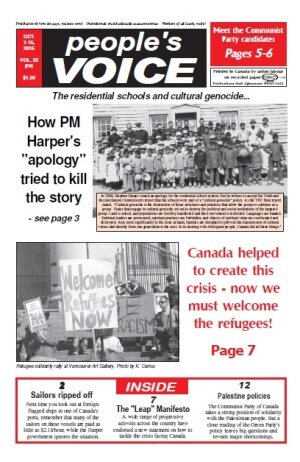
1) CANADA HELPED CREATE THE CRISIS - NOW WE MUST WELCOME REFUGEES
2) GETTING NEWFOUNDLAND AND LABRADOR WORKING
3) THE LEAP MANIFESTO AND THE COMMUNIST PLATFORM - SOME PARALLELS AND DIFFERENCES
4) MR. HARPER’S RACIST SIGNALS - Editorial
5) LABOUR CAN’T AFFORD A NEW TORY MAJORITY - Editorial
6) GROUPS SPEAK OUT AGAINST QUEBEC’S ANTI-MEDICARE BILL 20
7) APOLOGY WAS “STRATEGIC ATTEMPT TO KILL RESIDENTIAL SCHOOL STORY”
8) FOREIGN SAILORS PAID A PITTANCE IN CANADIAN WATERS
9) STOP SILENCING PALESTINE SOLIDARITY!
10) UNPACKING THE GREEN PARTY POLICY ON ISRAEL-PALESTINE
12) PROTESTS SPREAD ACROSS IRAQ
13) KKE ON THE GREEK ELECTION RESULTS
14) 65TH BIRTHDAY OF “INDIAN PABLO NERUDA” CELEBRATED IN BRAMPTON
15) MUSIC NOTES, by Wally Brooker
PEOPLE'S VOICE OCTOBER 1-15, 2015 (pdf)
|
To order a copy send $15 (includes package and handling) to People’s Voice, 706 Clark Drive, Vancouver, BC, V5L 3J1. Contact us at 604-255-2041 or pvoice@telus.net for bulk order prices. |

|
People's Voice deadlines: October 16-31 November 1-15 Send submissions to PV Editorial Office,
|
|
|
REDS ON THE WEB
http://www.communist-party.ca
peoplesvoice.ca
www.ycl-ljc.ca
www.solidnet.org
|
People's Voice finds many "Global Class Struggle" reports at the "Labour Start" website, http://www.labourstart.org/. We urge our readers to check it out! |
* * * * * *
Central Committee CPC
290A Danforth Ave Toronto, Ont. M4K 1N6
Ph: (416) 469-2446
fax: (416) 469-4063 E-mailmailto:info@cpc-pcp.ca
Parti Communiste du Quebec (section du
Parti communiste du Canada)
5359 Ave du Parc, Montréal, Québec,
H2V 4G9
B.C.Committee CPC
706 Clark Drive, Vancouver, V5L 3J1
Tel: (604) 254-9836
Fax: (604) 254-9803
Edmonton CPC
Box 68112, 70 Bonnie Doon P.O.
Edmonton, AB, T6C 4N6
Tel: (780) 465-7893
Fax: (780)463-0209
Calgary CPC
Unit #1 - 19 Radcliffe Close SE
Calgary AB, T2A 6B2
Tel: (403) 248-6489
Ottawa CPC
Tel: (613) 232-7108
Manitoba Committee
387 Selkirk Ave., Winnipeg, R2W 2M3
Tel/fax: (204) 586-7824
Ontario Ctee. CPC
290A Danforth Ave., Toronto, M4K 1N6
Tel: (416) 469-2446
Hamilton Ctee. CPC
265 Melvin Ave., Apt. 815
Hamilton, ON.
Tel: (905) 548-9586
Atlantic Region CPC
Box 70 Grand Pré, NS, B0P 1M0
Tel/fax: (902) 542-7981
* * * * * *
News for People, Not for Profits!
Every issue of People's Voice
gives you the latest
on the fightback from coast to coast.
Whether it's the struggle for jobs or peace, resistance to social cuts,
solidarity with Cuba, or workers' struggles around the world,
we've got the news the corporate media won't print.
And we do more than that
- we report and analyze events
from a revolutionary perspective,
helping to build the movements for justice and equality,
and eventually for a socialist Canada.
Read the paper that fights for working people
- on every page, in every issue!
People's Voice
$30 for 1 year
$50 for 2 years
Low-income special rate: $15 for 1-year
Outside Canada $50 for 1 year
Send to: People's Voice, 706 Clark Drive, Vancouver, BC, V5L 3J1
You can call the editorial office at 604-255-2041
<pvoice@telus.net>
REDS ON THE WEB
www.communist-party.ca
peoplesvoice.ca
www.ycl-ljc.ca/
http://solidnet.org/
http://www,rebelyouth-magazine.blogspot.com
(The following articles are from the October 1-15, 2015, issue of People's Voice, Canada's leading socialist newspaper. Articles can be reprinted free if the source is credited. Subscription rates in Canada: $30/year, or $15 low income rate; for U.S. readers - $45 US per year; other overseas readers - $45 US or $50 CDN per year. Send to People's Voice, c/o PV Business Manager, 706 Clark Drive, Vancouver, BC, V5L 3J1.)
1) CANADA HELPED CREATE THE CRISIS - NOW WE MUST WELCOME REFUGEES
Statement from the Central Executive Committee, Communist Party of Canada
The refugee issue has become a major factor in the federal election, after the tragic deaths of young Alan Kurdi and his brother and mother. But the so-called “refugee crisis” is the predictable result of western imperialist policies of internal intervention and wars in the Middle East, central Asia and North Africa. Millions have died as a result of the military debacles from Iraq to Afghanistan to Libya and now Syria. Homes, cities and economic infrastructure have been demolished across huge areas, and now over 50 million people have been displaced.
Canada has been an important player in most of these US-led military campaigns of the last two decades, and our country therefore bears considerable responsibility for the deaths of Alan Kurdi and many others. Recent reports indicate that Canada has sent over $700 million in arms to anti-government forces in Syria since 2011, which is more than all the EU countries combined in that period.
The Communist Party of Canada has strongly opposed these imperialist policies, and we demand an end to the deadly strategy of militarization and war-making. Canada must withdraw from the NATO alliance, and end all participation in foreign wars and so-called “humanitarian military interventions.” Now that the death and destruction across these regions has left tens of millions of people homeless, unemployed and displaced, Canada must open its doors to accept refugees from Syria, Iraq, Afghanistan, Libya and other countries. To help make this possible, we call for a 75% cut in Canada’s bloated $20 billion-plus annual military budget, and use these funds to support refugees and to provide urgently needed humanitarian aid to the victims of war.
Earlier this week, at a rally in front outside the campaign office of Ontario Conservative MP Rick Dykstra, St. Catharines Communist candidate Saleh Waziruddin said,
“The tragic deaths in the Kurdi family have exposed the Conservative lies about refugees and migrants. The Conservatives are trying to wash their hands of responsibility, saying they only got an application from the uncle, but the aunt wrote a letter to them about the whole family and got no response. The Harper government’s barriers to sponsoring refugees made it impossible for the aunt to bring the whole family. The truth is that the Harper government is hurting migrants and refugees, not helping them.
“Canadians are coming forward to help refugees, but are being blocked by the policies Stephen Harper imposed,” says Waziruddin. “The Conservatives cut refugee healthcare, not because they want to save money, but to appeal to racist sentiments among some voters. Canada has an international treaty obligation to help refugees, and me must make the government accept its responsibility.”
Instead, PM Stephen Harper wants to increase Canada’s military involvement, fuelling the crisis by escalating the bombing and violence in Syria and Iraq, and spreading the lie that refugees pose a terrorist threat to Canada. Mr. Harper must be defeated, and Canada must adopt the only humanitarian option, by opening our doors to the refugees of 21st century wars and environment catastrophes, and stop its involvement in the wars and aggression that has produced this crisis and many others.
In this campaign, the Communist Party of Canada calls for a democratic immigration policy: stop criminalizing refugees; give priority to refugees not to capitalist investors; abolish the racist quota system and two-tier citizenship; create a clear and accessible path to permanent residency and citizenship for all foreign and migrant workers in Canada.
2) GETTING NEWFOUNDLAND AND LABRADOR WORKING
By Sean Burton, Communist Party candidate in St. John’s East
With the Communist Party of Canada running in St. John's East in the current federal election, it is important to discuss just what the Party's platform would mean for the people of Newfoundland and Labrador.
The heart of the platform has been succinctly described as "create jobs and raise wages". Such a statement is highly relevant across the country. Canadian workers have been ravaged by years of layoffs, closures, and cuts to social programs.
Newfoundland and Labrador is no stranger to the boom and bust cycle of capitalism. This province has seen some recent growth as a result of the oil industry, but that growth has only truly benefited the oil corporations and their representatives in St. John’s. Furthermore, as oil prices fluctuate on the market those corporations have no hesitation to eliminate jobs to enhance their profit margins. And though the oil sector employs nearly ten-thousand people, that number pales in comparison to the numbers once employed in our fisheries, an industry ruthlessly exploited by corporations leading to the near total destruction of several Atlantic cod stocks. Miners in Labrador West have the constant worry that iron ore mines will cut production or close altogether. Meanwhile it is still difficult to find good, steady work in the rest of the province and our infrastructure is deplorable or limited in many locations.
The Communist Party proposes an alternative to the austerity that many people are resigned to face. An immediate plan for development has as its core substantial expansion and development of infrastructure, industry, and public services.
Road and rail are critical infrastructure concerns for Newfoundland and Labrador. We propose that the island portion of the Trans Canada Highway be four lanes across its entire length, that significant improvements be made to our province's secondary highways, especially with respect to regular maintenance and higher-quality pavement. We also insist that the Trans Labrador Highway be fully paved and have more frequent service stations along its route.
Newfoundland and Labrador should have a comprehensive, modern railway service, including high speed passenger service. A fixed road and rail link between the island and Labrador should be included. An inter-community bus system should be established to link outlying areas to stations, airports, and with local public transit. Consideration should also be made to building an overland route through the communities of northern Labrador. Existing ferry service in that region should be expanded via larger and faster vessels.
Public transit must be expanded where it exists and established in a few of the other larger communities. Public transit in St. John's should connect directly to the airport as well as to nearby communities. In all cases, wait times between buses should be reduced and service should not end early at any point in the week. Fares should also be eliminated.
The widespread development of alternative, renewable energy sources must also be a priority. The Communist Party would nationalize our natural resources and energy sector to ensure democratic control and environmental sustainability. Corporations that threaten to close plants and mines must face strict legislation that will impose heavy fines upon them or face public seizure of their assets.
Instead of crowding students into "super schools", we should build more neighbourhood schools that would eliminate or greatly reduce the need to bus students; smaller class sizes would greatly reduce stress and workloads on teachers. Access to hospitals and clinics must be expanded, with priority given to rural areas and isolated communities.
We propose a massive emergency housing construction program to provide affordable housing across the entire country, and a ban on evictions, mortgage foreclosures, and utility cut offs due to unemployment.
We propose to rebuild Canada's industrial base. Newfoundland and Labrador could be a leader in the ship-building industry. At the very least, we should be designing and building our own ferries for the coastal service and for the link to Nova Scotia. Our agricultural sector should also be expanded where it is possible.
The construction, maintenance, and operation of the above suggestions would provide thousands of good jobs to people in Newfoundland and Labrador, they would provide tremendous public service, and they will allow for a more diverse economy. It is not impossible to accomplish such a list of demands. Canada is a very wealthy country, and that wealth should be used for the benefit of its people, not for the bank accounts of an elite few. We must cut wasteful military spending, assume control of our resources, and place the burden of taxation squarely on the rich and corporations. On October 19th, put people's needs before corporate greed: Vote Communist!
3) THE LEAP MANIFESTO AND THE COMMUNIST PLATFORM - SOME PARALLELS AND DIFFERENCES
People’s Voice Commentary
Not surprisingly, the “Leap Manifesto” has been arrogantly dismissed by the right-wing talking heads, and ignored by the NDP leadership which avoids any serious critique of neoliberal austerity politics. But the document has stirred wide discussion among left-minded activists involved in struggles around labour, indigenous, environmental and social equality issues. Having little confidence in the NDP (at least under Thomas Mulcair) or the market-oriented Greens, many of these activists are searching for strategies to inject the demands of mass movements into the electoral arena.
The overall merits and shortcomings of the Leap Manifesto will be the subject of further debate, during and after the election. We note, for example, that the manifesto calls for cuts in military spending (unlike any of the Parliamentary parties!), but does not explicitly oppose imperialist wars. The manifesto is powerful in its call for indigenous sovereignty, but not about the national rights of the Quebec and the Acadians. Oddly, it says little about labour rights, or about Bill C-51 and the dangerous growth of the corporate police state apparatus in Canada.
The platform of the Communist Party of Canada does address these issues, and it goes in a more radical direction, projecting the goal of replacing capitalism with a socialist economy. The CPC platform also has many parallels with the policies advocated in “the Leap” document.
For example, the Leap Manifesto calls for “truly just renewable energy, woven together by accessible public transit”, along with opposition to oil and gas pipelines, fracking, and increased tanker traffic.
The CPC calls for closing the tar sands industry within five years (with job guarantees for the current workforce), and rejecting the Northern Gateway, Kinder Morgan, Energy East and Line 9 pipeline projects. The party’s platform advocates high-speed rail, free urban transit, massive investment in renewable energy programs, nationalization of energy resources under democratic control, phasing out coal and nuclear power, banning biofuels , etc.
The manifesto says that “wherever possible communities should collectively control these new energy systems”, and that “as an alternative to the profit-gouging of private companies and the remote bureaucracy of some centralized state ones, we can create innovative ownership structures: democratically run, paying living wages and keeping much-needed revenue in communities.” The Communist Party calls for a People’s Energy Plan, including public ownership and democratic control of energy and natural resources.
The Leap urges higher wage jobs with fewer work hours, very similar to the Communist platform proposals for higher wages, job creation, and a 32-hour work week with no loss in take home pay.
The Leap calls for full implementing the United Nations Declaration on the Rights of Indigenous Peoples, as does the CPC.
The Leap advocates “a universal program to build energy efficient homes, and retrofit existing housing, ensuring that the lowest income communities and neighbourhoods will benefit first and receive job training and opportunities that reduce poverty over the long term.” The Communist platform calls housing “a basic human right,” and demands emergency action to build one million united of affordable social housing.
Unlike the NDP, the Leap Manifesto calls for “an end to all trade deals that interfere with our attempts to rebuild local economies, regulate corporations and stop damaging extractive projects.” The Communist Party demands withdrawal from all current and pending pro-corporate trade pacts.
Both the Leap and the Communist platform call for higher income taxes on corporations and wealthy people, and for cuts to military spending.
We invite readers to check out both documents and draw your own conclusions. The Communist platform is online at www.communist-party.ca. The Leap Manifesto is found at https://leapmanifesto.org.
4) MR. HARPER’S RACIST SIGNALS
People’s Voice Editorial
Occasionally a politician will utter a careless phrase without any deeper intent. But a seemingly unintentional racist or sexist comment often reveals an inherent bias, or it may be crafted to signal a candidate’s real intentions in a “deniable” way.
Stephen Harper’s use of the expression “old-stock Canadians” during the Sept. 17 leaders debate is in the latter category, giving another glimpse into the PM’s racist view of history. Recall Harper’s absurd claim (at a September 2009 G-20 event in Pittsburgh) that “Canada has no history of colonialism” - even though this country was founded on the theft of indigenous territories, through imposed (and usually broken) treaties, or via outright land grabs (almost the entire land mass of British Columbia). His statement sent the clear message that Aboriginal peoples are “second class.”
This message is also behind Harper’s latest comment, in the context of his claims that health care is only denied for “bogus” refugee claimants, and that “new and existing and old-stock Canadians” would agree with him. This is a lie: health care coverage has also been cut off for claimants from so-called “safe” countries. But the truth is that the criteria for refugee status have become sharply politicized, as more people are defined as “bogus” on arbitrary, stereotyped racist grounds, i.e. coming from “bad” countries.
The PM’s statement set off other alarm bells. Does “old stock” hint at plans to deny social programs on the basis on length of residency in Canada, even for citizens? Is this yet another Tory attempt to turn so-called “deserving” recipients (“us”) against others who have not “earned” any rights (“them”)?
Unfortunately, the corporate media gave Harper another free pass for his so-called “gaffe”. On Oct. 19, the real “us vs. them” has to be the working people of Canada against the big corporations and their political parties, especially the Harper Tories.
5) LABOUR CAN’T AFFORD A NEW TORY MAJORITY
People’s Voice Editorial
The attacks against organized workers have been so consistent over the last decade that many Canadians may consider the situation “normal.” But there is nothing ordinary or acceptable about a government which destroys the ability of workers to take collective action to defend their interests.
The Canadian Association of Labour Media has detailed the range of these attacks, which have done much to dismantle rights and protections won through decades of tough labour struggles, advocacy and court victories.
From the moment Stephen Harper became Prime Minister, piece after piece of legislation has taken aim at unions and free bargaining. Here are some examples. Buried within Bill C-60, the omnibus budget bill passed in 2013, was a provision to allow the Treasury Board to direct collective bargaining for 48 Crown corporations, effectively gutting the labour rights of tens of thousands of employees.
Bill C-377, a private member’s bill backed by the Harper Tories, requires unions to report every nickel they spend. This expensive process makes publicly available the financial information of union federations and labour organizations, and even the personal information of individual union members.
Passed last April, the “Act to amend the Canada Labour Code, the Parliamentary Employment and Staff Relations Act and the Public Service Labour Relations Act” fundamentally changes the process of forming unions in the federal sector by eliminating card check certification.
Relying on “back to work” legislation has been a preferred tactic under Harper, whose former Labour Minister Lisa Raitt argued that workers for Canada Post and Air Canada perform “nearly essential” services. Raitt even suggested that the economy itself is an essential service, threatening to put virtually all labour negotiations at risk.
Enough is enough. The most anti-working class government seen in this country since the days of “Iron Heel” Bennett must be defeated on October 19th!
6) GROUPS SPEAK OUT AGAINST QUEBEC’S ANTI-MEDICARE BILL 20
People across the country have expressed their support for Quebec groups opposing Minister Barrette's proposed amendment to Bill 20, which is aimed at legalizing extra billing, according to Canadian Doctors for Medicare.
“The extra billing Minister Barrette's proposes in his amendment to Bill 20 will create a two-tier health-care system that limits care for people who can't afford extra fees. This dangerous precedent would violate the Canada Health Act and jeopardize universal access to health care in every province. Doctors across Canada stand with Quebec organizations in defense of universal health care,” said Ryan Meili, Acting Chair of Canadian Doctors for Medicare.
As amended, the Bill would enable the government to allow currently illegal fees to be added to health care services by simple regulation, with no clearly established limits. These fees can be charged during medical office visits, for facilities, services, supplies, equipment, or tests that are associated with an insured service.
User fees are prohibited under the Canada Health Act. Provinces that allow it are subject to sanction in the form of withholding of federal transfers in the amount equal to the fees. Health Canada confirmed in June that the costs related to the provision of insured medical services are user fees, or extra billing, and that the law prohibits such fees, which effectively create a two-tier health care system.
Research shows that mandatory fees are an impediment to care, especially for low income people who often don’t access care until they are so sick they can’t avoid it, which not only damages their quality of life, but makes them more expensive to treat.
“The Quebec government’s proposed amendment to Bill 20 would erode one of the core principles of medicare, that health care should be based on need and not ability to pay. The extra-billing proposed in Bill 20 is not only unjustifiable, but creates a slippery slope to two-tiered, US style health care where patients suffer. This is not the health that Quebecers expect or deserve,” said Michael Butler, Nation Health Campaigner, Council of Canadians.
"What happens in Quebec has serious implications for the rest of Canada. By compromising access through extra billing practices, the proposed amendment to Bill 20 would be a crushing blow to Canada’s cherished system of universal health care,” said Natalie Mehra, Executive Director, Ontario Health Coalition.
7) APOLOGY WAS “STRATEGIC ATTEMPT TO KILL RESIDENTIAL SCHOOL STORY”
By Jorge Barrera, APTN National News, Sept. 10, 2015, http://aptn.ca/news
Prime Minister Stephen Harper’s 2008 apology to Indian residential school survivors was a “strategic attempt to kill the story,” according to former speechwriter in the Prime Minister’s Office at the time.
Paul Bunner was the head speechwriter in Harper’s PMO between 2006 and 2009. His views on the Indian residential school apology and the possible motivation behind it recently surfaced on a blog by Coast Salish Native American writer Robert Jago who outed a series of Conservative candidates, current and former MP staffers, along with Bunner for their comments and views on First Nation people.
Jago, who currently lives in Montreal, is from the Nooksack Tribe in Washington State. His family is registered with the Kwantlen First Nation, in British Columbia.
Earlier this week, Sue MacDonell was fired from her role as director with the Bay of Quinte Conservative riding association after some of her online, racially-charged comments against First Nation people surfaced.
The blog highlights an article by Bunner written in 2013 titled, The Genocide That Failed, where the former PMO speechwriter discussed the 2008 apology.
“The best that can be said of Harper’s apology is that it was a strategic attempt to kill the story and move on to a better relationship between Native s and Non-Natives,” wrote Bunner, in the C2C Journal. “Unfortunately, it only appears to have deepened the conviction that Church and State conspired not only to ‘kill the Indian in the child,’ but also to physically exterminate the whole race. The Aboriginal grievance and entitlement narrative continues to gather momentum.”
Bunner stood by his writing in an interview with APTN National News. He said they did not reflect the views of the PMO at the time of the apology.
“That was just my opinion long after I left the PMO,” he said. “You know it seemed to me that it in the PM’s mind and presumably in the government’s mind, it was a sincere apology…My concerns about it were strictly my own and they were not obviously shared by the prime minister or other senior people in the PMO.”
Bunner said he told colleagues at the time he was unhappy with the prime minister’s plan to issue an apology for Indian residential schools.
“I was not happy with the apology,” said Bunner, in the interview. “I probably expressed it to some of my colleagues.”
Bunner said he had “very little input” on Harper’s apology speech, but he did read it before it was delivered by the prime minister in the House of Commons to much fanfare.
“I may have seen a draft, I may have commented on it,” said Bunner. “None of my ideas wound up in the final version.”
The Harper government has said it considers the apology to Indian residential school survivors a historic moment. The apology, however, has recently been called hollow.
Truth and Reconciliation Commission Chair Murray Sinclair said during the release of the commission’s residential school report in June that the prime minister had failed to live up to the promise of the apology. Sinclair said at the time he didn’t believe Harper was committed to true reconciliation.
“We believe the current government is not willing to make good on its claim that it wishes to join with Aboriginal people in Canada in a ‘relationship based on the knowledge of our shared history, a respect for each other and a desire to move forward together’ as promised nine years ago,” said Sinclair, at the time. “Words are not enough.”
The Conservative party campaign did not respond to a request for comment.
8) FOREIGN SAILORS PAID A PITTANCE IN CANADIAN WATERS
PV Vancouver Bureau
The Seafarers International Union of Canada is preparing to take the federal government to court over the use of low-paid foreign sailors on internationally-flagged ships in Canadian waters.
The union, which represents unlicensed sailors in coastal waters, has been critical over the growing refusal of shipping agents to hire Canadian crews, while the federal government turns a blind eye. Now the SIU has asked the Federal Court in Vancouver for a judicial review of the practice of issuing the foreign sailors temporary work permits.
The union points to the 60,000 ton, Greek-owned tanker Almathea, which was just in the Port of Montreal and licensed to be transporting crude oil in Canadian waters until Sept. 13.
Fourteen employment contracts, obtained by The Canadian Press, show hourly wages for non-licensed crew members range from $2.13 to $8.80, depending upon the job and before overtime.
SIU Canada president Jim Given said such exploitation is common in international shipping, where companies will hire sailors from the Philippines, Indonesia or other poor countries for a tiny fraction of what Canadians would make.
"The Government of Canada is letting foreign ships replace thousands of qualified Canadian workers at a time when 25 per cent of our workforce is unemployed,'' said Given. "The law is very simple. They're giving work permits to foreign workers on ships in Canadian waters when the law says those jobs should go qualified Canadians first."
Canada Border Services Agency last year issued 142 exemptions to foreign ships so their crews could work legally in Canada, but the union says shipping companies made no attempt to hire Canadian sailors. Another 59 exemptions have been granted so far this year, helping the corporate bottom line of both oil companies and shippers.
More than 800 SIU members are currently looking for work and the temporary foreign worker exemptions are being abused, Given says.
"Those permits are intended for those who are going to open a company and employ people and there is some big economic benefit to Canada,'' said Given. "There is no economic benefit to Canada to this, other than allowing Suncor to put more money into their pocket.''
The Harper government amended the TFWP earlier this year, setting a deadline of April 1st for low-skilled workers to either become permanent residents or leave the country. It also required some employers to provide a labour market impact assessment and demonstrate that no Canadians were available before hiring foreigners. There are loopholes that allow international companies to bypass the assessment, but whether they apply to shipping companies is unclear.
9) STOP SILENCING PALESTINE SOLIDARITY!
Central Executive Committee, Communist Party of Canada, Sept. 17, 2015
So far in the current federal election campaign, there has been a virtual silence from the major political parties about one of the most crucial international issues: Israel’s illegal, apartheid-style occupation of Palestine, and the shift in Canada’s position to unconditional support for Israel’s expansionist policies. Despite the courageous efforts of many grassroots Palestinian solidarity activists, this issue has been almost completely blocked from any meaningful public debate. This is largely due to the consistent attempt by the Harper Conservatives and pro-Israel lobby groups to label any criticism of Israeli policies as “anti-Semitism”, and to vilify all those who support the BDS campaign for “boycott, disinvestment and sanctions” against Israel. One of the key objectives of Harper’s Bill C-51 was its implicit inclusion of BDS campaign activists among the many categories of so-called “terrorists”.
“In our 2015 election platform,” says Communist Party of Canada leader Miguel Figueroa, “we renew our principled call to oppose Israeli apartheid and its continuing siege of Gaza, and to demand a just peace in the Middle East based on total withdrawal of Israel from all occupied territories, the release of Palestinian political prisoners held in Israeli jails, the right of return for Palestinian refugees, and the formation of an independent, viable Palestinian state.”
“Our candidates will make opposition to the illegal Israeli occupation of Palestine a key element of our campaign. We will continue to give full support to the BDS movement, including the ongoing efforts to break the Israeli blockade and bring material solidarity to the people of Gaza.”
Figueroa, who is the CPC candidate in the Toronto riding of Davenport, also noted that “although millions of Canadians are strongly opposed to Israel’s illegal occupation of Palestinian territories and its wars against the people of Gaza, the ‘major’ parties display a shameful consensus that no criticism of such policies can be expressed.”
In this respect, the parliamentary opposition parties refuse to utter a word to challenge the Harper Conservative stance of unquestioning support for Israel. Any candidate of these parties who is discovered to have previously expressed opinions critical of Israeli policies faces possible removal from the race, and in fact a number of NDP candidates or potential candidates have been silenced in this way. By stifling their own candidates and members, these parties all give support to the Israeli regime.
“In some cases, the subservience of the parliamentary opposition parties has gone even further. For example, the Liberals and the NDP joined with the Conservatives in expressing condolences to the family of the late war criminal Ariel Sharon, the butcher of Sabra and Shatilla,” Figueroa added. “We also recall that BC Green MLA Andrew Weaver publicly called for removal of a Vancouver Island billboard calling for support of the BDS campaign, falsely accusing the groups which placed this billboard of being racists and anti-Semitic.”
The Communist Party of Canada is proud of its longstanding policies of solidarity with the Palestinian people, and we will continue to express our views, regardless of the threats of the Conservative government and the complicity of the mainstream media in silencing dissent.
In Montreal, the Communist Party's campaign is aiming to make Palestine an election issue and confront Harper's attempt to criminalize BDS by placing signs throughout the city. The signs are being coordinated by William Sloan, Party candidate in Ville-Marie-Le sud-ouest-Île-des-sœurs.
"For the third straight time our election posters' slogan is END CANADIAN SUPPORT FOR APARTHEID ISRAEL. Two elections ago, the City of Westmount removed these signs illegally, but had their fingers slapped by the Election Commissioner," said Sloan, who is a retired refugee lawyer, and a long time activist with Palestinian and Jewish Unity (PAJU) in Montreal.
"This time we are upping the anti to confront the government's attempt to muzzle freedom of expression," Sloan said. "Our signs have the photo of the little boy who was killed on a Gaza beach last year while playing soccer with his cousins."
10) UNPACKING THE GREEN PARTY POLICY ON ISRAEL-PALESTINE
People’s Voice Commentary
Supporters of the Green Party of Canada sometimes argue that their party has a more nuanced and “even-handed” approach to the Israel-Palestine conflict than the larger parties in Parliament. This applies especially to the most pro-Zionist governing party in the world, the Harper Conservatives, who enthusiastically support every war crime and violation of international law perpetrated by the Netanyahu regime.
It is true that the Greens allow more scope for pro-Palestinian views than the NDP or the Liberals.
Last year, the NDP leadership denied Paul Manly the right to seek a nomination in the Vancouver Island riding of Nanaimo-Ladysmith. Manly says that while nothing was put in writing, he was told verbally that the reason was “what I said and did when my father was in Israel,” and concerns that he would make Israel and Palestine an election issue.
In October 2012, Manly’s father Jim, a retired NDP MP, took part in a humanitarian mission to Gaza aboard the Estelle, along with European members of parliament and Israelis who oppose the blockade of Gaza. The Estelle was illegally seized in international waters by the Israeli military, and Jim Manly was taken to an Israeli prison and held incommunicado.
Not surprisingly, Paul Manly spoke out on behalf of his father, for which he was punished by the NDP. Unhappy with this development, and with the NDP’s support for “free trade” deals and other policies, he moved to the Green Party, winning its nomination in Nanaimo-Ladysmith.
This episode has been interpreted to mean that the Greens have a relatively pro-Palestinian position. But in fact, the party’s policy is based on the view that the “conflict between the Israelis and Palestinians” is the fault of “both sides.” This “balanced” position ignores that historic reality that Israel displaced hundreds of thousands of Palestinians during the 1948 “nakba,” and eventually occupied huge and growing pieces of the remaining Palestinian territories.
The Green policy goes on to state that “military or insurgency strategies” will not bring about an end to the conflict, as though there was any true comparison between the enormous Israeli military machine (including its nuclear arsenal) and the unguided rockets fired by Hamas.
On a more positive note, the policy says that “Canada’s role in the Middle East should be to reduce tensions, find working solutions, and uphold international humanitarian law..” The Greens also support “a two-state solution to the Israel-Palestine conflict”, which is also the historic position of the PLO (and the Communist Party of Canada).
However, the policy statement insists on regarding the occupying Israeli state and the oppressed Palestinians as “equal” partners. For example, the statement says Green MPs will “call on both sides to immediately stop the killing of civilians and adhere to international law,” but nowhere does it recognize the vastly asymmetrical nature of the conflict.
During Israel’s 2014 war against Gaza, an estimated 2200 Gazans were killed (70% of them civilians) and over 10,000 wounded (including 3,374 children). By comparison, 66 Israeli soldiers and five Israeli civilians were killed, and 469 IDF soldiers and 261 Israeli civilians were injured. About 520,000 Palestinians in the Gaza Strip (almost one-third of its population) were displaced, of whom 485,000 needed emergency food assistance and 273,000 took shelter in 90 UN-run schools. The UN calculates that more than 7,000 homes for 10,000 Gaza families were razed, together with an additional 89,000 homes damaged by Israeli bombing. Rebuilding costs are estimated at $4-6 billion over 20 years. In Israel, an estimated 5,000 to 8,000 citizens temporarily fled their homes due to the threat of rocketry from Gaza.
Despite these shocking figures, the Green Party policy is to “protect as inviolable the right of the State of Israel to exist, in the absence of fear and conflict,” remarkably omitting any reference to the rights of Palestinians to exist without fear!
The statement concludes that Green MPs would “call for an end to the collective siege of Gaza so that medical and humanitarian aid can be provided; call on Israel to stop expansion and the building of illegal settlements beyond the 1967 borders; (and) actively support the efforts of civil society groups working for peace, human rights, and justice in the region.”
These are laudable goals. But many questions still need to be asked. For example, would the Greens call for Israeli citizens to be completely withdrawn from the illegal settlements? Do they support the right of return for Palestinians driven out by Israeli ethnic cleansing in 1948 and afterwards? Will the Greens support the call by Palestinians for “boycott, disinvestment and sanctions (BDS)” against Israel? And will they join the growing international recognition that Israel’s anti-Palestinian policies constitute a modern day form of racist apartheid? Or will the Greens remain silent on these crucial questions, allowing the Netanyahu regime a free pass to continue its murderous tactics?
In conclusion, it seems that despite its “balanced” language, “unpacking” the Green Party policy contains an inherent bias in favour of protecting the Israeli occupation state, at the expense of the Palestinian people. Among the registered political parties taking part in this federal election, only one - the Communist Party of Canada - stands in full solidarity with the Palestinian people and in support of the BDS campaign.
We urge People’s Voice readers to use every opportunity in this campaign to pressure the parliamentary parties on this issue, including the right to express solidarity with Palestine without being treated as a terrorist or a “threat to the security of Canada”.
By Michael Parenti, www.michaelparenti.org
Today, across the nation, we witness homicidal violence delivered against unarmed people by law enforcement officers. These beatings and killings are carried out with something close to impunity. The cops almost always get away with murder. Moreover, these crimes are nothing new; they are longstanding in practice.
A study of police brutality in three major cities conducted in 1967 found that all the victims had one thing in common: they were from low-income groups. Other studies however showed that it often was enough just to be Black, even if middle class. Take the case of Carl Newland, an African-American, 48-year-old accountant who happened to be walking by a newsstand that had just been robbed one evening in 1975. He was roughed up by the police, then brought before the newsstand clerk, who emphatically denied that Newland was the stickup man. Nevertheless, because of his "belligerent attitude" he was taken to jail and severely beaten by the police, according to statements by several prisoners. He died in his cell that same night. Consider some other cases.
About a half century ago, a Black man was forced to lie face down in a Detroit motel and a policeman cold-bloodedly pumped a bullet into his head.
At about that same time, a 10-year-old Black boy walking with his foster father in Queens, New York, was killed by a plainclothes policeman who leaped from his unmarked car, firing away without identifying himself, shouting "Hey niggers!"
A White "hippie" (as counterculture people were called in the late 1960s and 1970s), finding his home suddenly surrounded by unidentified, armed men in Humboldt County, California, fled in terror out the back door only to be shot dead by county police and narcotic agents surrounding his house, the wrong house. Raiding the wrong house and shooting its frightened inhabitants became a regular pastime decades ago. "Fighting crime" and "fighting the drug war" were the call of the day.
A 12-year-old Chicano boy in Dallas, arrested as a burglary suspect, was shot through his head by a cop.
A Black shell-shocked Vietnam veteran was killed by two police on a Houston street as he reached into his pocket to take out a Bible.
In Champaign, Illinois, in 1970, a frightened African American bookstore employee attempted flight when police menacingly approached his car. He was shot in the back. The culpable officer was indicted for voluntary manslaughter, released on a $5,000 bond and soon found "not guilty" by an all-White, middle-American jury.
In Cambridge, Massachusetts, an Italian-American, working-class youth was beaten to death by cops in a police van.
A New York policeman shot a 22-year-old Black college student who was standing with his hands in the air. Then the cop planted a toy pistol next to the victim's body.
A Chicano youth in Houston was taken to a secluded spot by cops, beaten until unconscious, then thrown into a bayou to drown.
A Black youth, who was attempting to retrieve a basketball in a schoolyard, was shot through the head by Chicago police. One could go on and on with stories from years past about how the courageous Thin Blue Line repeatedly saved us with their endless killings.
Today, sparked by body-cam videos and social media, people are giving more attention to eye-witness accounts of such frightful events. Our Boys in Blue are being challenged by groups such as Black Lives Matter. But let us not overlook the many who were victimized by police during the late 1960s and 1970s and who are still with us, not merely in memory but in actuality. That is to say, a substantial number of those unjustly convicted long-ago are still in prison today. We all can name some of them: Mumia Abu-Jamal, Leonard Peltier, Herman Bell, Janine Africa, Hugo Pinell, and others. Consider also the lesser known cases. One that I have in mind is Gary Tyler.
In 1974 in Louisiana, a bus carrying Black children was attacked by a mob of whites, some of whom were armed. According to the bus driver, a gun was fired from the attacking crowd. The shot missed the bus but killed a white youth in the surrounding crowd. The police arrived and forced the Black students out of the bus and to their knees. One of them, Gary Tyler (16 at the time) was arrested for "interfering with an officer." What he actually did was voice his objection to the deputy sheriff's putting a gun to the heads of kneeling Black students.
The police claimed they found a gun on the bus but it curiously turned out to be a police revolver with no fingerprints. Nevertheless Gary was charged with being the possessor of the gun and murderer of the white youth. He was convicted by an all-white jury and sentenced to die in the electric chair. The prosecution's case rested entirely on two witnesses, both of whom recanted their testimony. Both charged that police had coerced them into fingering Tyler. The police had threatened to take one witness' child away from her and charge her as an accessory to the killing. In any case, the judge refused to grant a new trial. Gary ended up with a life sentence and no chance of parole.
Gary Tyler had attempted to calm a snarling officer who was uttering threats while pointing his loaded weapon at the heads of Black school children. Gary could sense the rage emitting from the trigger-happy cops. Over the years many of us have confronted police in one or another such situation. Nowadays we get numerous same-day recordings of "cops gone wild" with pile-on beatings and shootings of unarmed civilians. On each occasion the local police department announces, "The incident is under investigation." The killer cop usually is given "administrative leave with pay," or what some of us would call "paid vacation."
The police tell us that the victim was reaching for his waist band or was holding a cellphone in his hand that looked like a gun - certainly enough like a gun to perforate him with a deluge of bullets. The public hears the cop's familiar story. When attorneys and media ask for more information, what we get is what the police department decides they want us to see. Before too long, the accused cop is kindly stroked by a White, suburban Grand Jury and an obligingly soft-handed prosecutor who has his own eye on a more elevated juridical or political office, and who therefore does not want to offend his war-against-crime White constituency.
Gary Tyler is now 57 years old. He has been in prison since he was 16. He will likely remain incarcerated for the rest of his life unless the numerous pleas from around the country and from countries around the world should start having some impact. There are scores of prisoners of political note, and hundreds of others like Gary who were just in the wrong place or just speaking up against the potentially lethal behavior of police. They continue to be victimized by a law enforcement system capable of the most venal acts both within the community and in the courtroom, taking away whole lifetimes of innocent people by use of street executions or judicial killings or perpetual incarcerations---an abuse of justice that is beyond measure.
Michael Parenti is a U.S. political scientist, historian, and cultural critic who writes on scholarly and popular subjects. His most recent books are Waiting for Yesterday: Pages from a Street Kid's Life (an ethnic memoir); and Profit Pathology and Other Indecencies.
12) PROTESTS SPREAD ACROSS IRAQ
By Tim Pelzer, Vancouver
The wave of protests washing across Iraq constitutes a popular revolt against neo-liberal measures being imposed by rightwing religious parties, according to Akram Nadir, a Vancouver-based international representative for the Federation of Workers Councils and Unions in Iraq (FWCUI).
Protests have spread like wildfire. Hundreds of thousands of demonstrators have taken to the streets in Al Basra, Baghdad and other large cities. On August 9th, over a half million workers protested in Baghdad.
The demonstrations were kick-started by electrical workers demanding an end to government efforts to privatize the state electrical company in northern Iraq, Nadir told the PV in a recent interview. From there, people began taking to the streets across Iraq, protesting electrical blackouts in a country where it can get as hot as 60 degrees and air conditioning and fans are essential items of life.
Since then, new demands have emerged among protestors, such as measures to tackle the country’s severe economic crisis as well as an end to privatization.
“Many workers are still not being paid for months on end in many state and private companies,” said Nadir. “The official unemployment rate is 30 percent but is probably more. Many young people, especially those finishing university, are leaving the country because they cannot find a job.”
Life in Iraq today is worse than it was under US sanctions before the US invasion in 2003, he added.
The rightwing Shiite United Iraqi Alliance coalition government of Prime Minister Haider al-Abadi plans to privatize 168 state companies at the urging of the World Bank and US, stated Nadir. State companies still dominate over 60% of the economy, especially strategic industries. The Ba’ath Party during the 1970s and ‘80s created a large state sector to develop the country’s economic base that is largely still intact, despite ongoing privatization.
Nadir called this “organized looting” because managers are deliberately running state companies into the ground to create support for privatization.
“They are sabotaging production to weaken the state sector, hiding or destroying production, creating artificial electricity blackouts and water shortages to undermine the credibility of state companies,” he said. “They don’t want to pay the work force to demoralize workers.”
The al-Abadi government is even underfunding the public healthcare system - once touted as the best in the Middle East- to force people to use private clinics.
Many leaders of the religious and nationalist parties that the US placed in power after the American invasion of Iraq in 2003 are now billionaire business people.
“What they did was steal state assets indirectly by selling state companies to relatives and family members for next to nothing. Privatization is killing the working class”, charged Nadir. “Workers cannot survive and are demanding an end to privatization”.
People are demanding an end to widespread corruption where government officials and military officers, from top to bottom, are primarily interested in filling their bank accounts through bribes and theft, explained Nadir, who keeps his mobile phone open on the table to receive incoming calls from Iraq. “Corruption is worse today than under Saddam Hussein.”
Ahmad al Chalaby Hesya, a member of a parliamentary committee investigating corruption, announced recently that $525 billion (US) in state revenue has disappeared since 2003 and no one knows where it went.
Even the president of Iraq’s Kurdish region was widely condemned for wearing an $80,000 (US) luxury watch while giving a TV speech recently telling people that there is no money to provide basic public services. “People are asking, where did he get $80,000 to buy a luxury watch when people are starving ?” Nadir remarked.
Another demand being made by protestors is for the end of religious sectarianism and the separation of religion and state. The ruling Shiite United Iraqi Alliance coalition - consisting of the Dawa party and the Supreme Islamic Iraqi Council - are closely linked to Iran’s government and want to impose a theocratic state. Iraq has a secular history, and most people do not want conservative Islamic leaders telling them how they should conduct their personal lives or, in the case of women, what clothing they should use.
“While many people go to the Mosques, it is more out of tradition than a strict adherence to Islamic beliefs,” Nadir explained. Large banners with the slogan “No to Sunnis, No to Shiites - For a Secular State” have appeared at many demonstrations, he added.
“What is remarkable is that Iraqis have poured into the streets despite the risk that security forces would step in,” remarked Nadir. During the Arab Spring that washed over the Middle East in 2011, police and military brutally repressed Iraqi street demonstrations.
Nadir stated that no single organization has been responsible for organizing the demonstrations. “Some are spontaneous and others are organized by trade unions (affiliated to both the FWCUI and the Iraqi Federation of Labour, the country’s two labour groupings). In some places, communists - either from the Iraqi Communist Party or Workers Communist Party - have organized demonstrations.”
The demonstrations are not occurring in the ISIS controlled areas of Iraq where the trade union movement has had to go underground.
Nadir called on trade unionists in Canada to support protestors in Iraq. “We cannot be survive without international working class support.”
13) KKE ON THE GREEK ELECTION RESULTS
Statement by Dimitris Koutsoumpas, General Secretary of the Communist Party of Greece (KKE) on the Sept. 20 election results.
The KKE salutes the hundreds of thousands of people who honoured it with their votes. All those men and women who ignored the extortion, the dilemmas, overcame hesitations and various reservations in order to join forces with the KKE.
The KKE will utilize its political, electoral and parliamentary strength to work for the comprehensive regroupment and strengthening of the labour-people’s movement, for the construction of a great social, people’s alliance.
The KKE is the only force whose struggle against the memoranda is at the same time a consistent struggle against the capitalist system itself, the system that also creates the predatory alliances which only bring new torments for the people, the country and the youth.
The KKE, as always, will stand shoulder to shoulder with our people, consistently against any government that is ready to implement the barbaric memorandum.
The correlation of forces in parliament will in any case produce a coalition government. Its programmatic statements are already ready: the implementation of the 3rd memorandum. Capital, its political and governmental personnel, together with the Troika, wants to win the people’s consent in order to implement the barbaric measures without resistance. They want a harmless, fake opposition so that its hands are free to wage the anti-people offensive.
The election results as a whole are negative for the workers, the employees, the urban and rural self-employed, the youth, the pensioners.
The KKE will consistently and continually struggle inside Parliament and inside the people’s movement in order to isolate the Nazi monstrosity, Golden Dawn.
There needs to be a stronger KKE everywhere, in the workplaces, in the places of education, the popular neighbourhoods, in the places where the heart of our struggling and sorely tested people truly beats.
In the final count, the KKE received 5.55% (301,629 votes), retaining its 15 seats in the parliament. The SYRIZA party led by Alex Tsipras finished first with 35.46%, winning 145 seats (including 50 seats for taking the largest vote percentage), and will continue to govern with its right-wing ally, the ANEL (“Independent Greeks”), which won 3.66% and 10 seats. The main big business party, New Democracy, won 28% and 75 seats; the neo-nazi Golden Dawn won 6.99% and 18 seats; the coalition of PASOK-DIMAR right-wing social democratic parties won 6.33% and 17 seats (a gain of four from PASOK’s previous total); “The River” centrist party won 4.06% and 11 seats (a loss of six); and the Union of Centrists won 3.36%, passing the 3% barrier to enter parliament with nine seats. The Popular Unity party (LAE), formed by MPs who left SYRIZA after Tsipras surrendered in July to the most recent EU memorandum, received 2.86% (155,240 votes), not enough to elect any MPs.
14) 65TH BIRTHDAY OF “INDIAN PABLO NERUDA” CELEBRATED IN BRAMPTON
By Shamshad Elahee Shams
On September 12, People’s Voice Forum–Brampton celebrated the 65th birthday of the highly revered poet of Punjab, Avtar Singh Pash, who was gunned down by Khalistani extremists on March 23, 1988.
Pash was only 37 when he took his last breath, but his glory continues to grow each passing year. Most of his poetry has been translated in all major languages of India, including English.
At least three people who addressed the informal memorial meeting had been directly associated with the legendary poet.
Kulwinder Khehra, representing “Kalamo Da Kafila,” shared his memories of Pash, and gave details of his time spent with the poet. He recited the poem which he wrote after hearing the news of the brutal murder of Pash. He connected March 23, 1931, the martyrdom day of Indian independence fighter Bhagat Singh, to the mindless murder of Pash, narrating details that nothing has changed since then. Khehra underlined the relevance of thoughts propagated by Pash, which will continue to gain attraction as long as the economic divide remains in society.
A long associate of Pash, Lal Singh Bains, shared his political experiences with the poet. We hardly see such a level of political commitment as Pash used to have, he said, noting the poet’s deep understanding of Marxism and his tremendous analysis of the local and international political situation. “That was the real key to understand his poetry. He fought fearlessly for the landless peasants and workers and faced indiscriminate torture of the state head on.”
Navkiran Sidhu from North American Rationalist Society also shared his meeting with Pash at a function at Deshbhakt Yadgaar Hal, Jalandhar. He was astonished to see his simplicity and said, “Are you Pash?”
And Pash replied in his own funny way, “Why, Pash would have a tail on his back?”
Navkiran Sidhu said that he considered Pash sitting next to Bhagat Singh when the question arises about study, commitment and dedication for the Indian socialist revolution.
Poet Onkar Singh Preet defined Pash’s poem on dreams, and explained why dreams are important for any living society. A dreamless society or dreamless youths are nothing but dead.
Harparminder Gadri shared his college hostel time memories, when Pash along with his friend would arrive at his room in the middle of the night and start reciting poems, using kitchen utensils as his musical instruments. Pash’s name and his work, he said, will always be a source of inspiration for the working class and their struggle against capitalism and imperialism.
Surprisingly, People’s Voice Forum found out that this was first birthday celebration ever conducted in GTA in the memory of Pash. The Forum later resolved to carry on this event every year on September 12. Shamshad Elahee Shams conducted the event, while CPC Brampton North candidate Harinder Pal Hundal, Prof. Chanan Cheema, Sukhchain Dhillon, Pushpender Singh Mundi, and Sumeet Bains were amongst those present, and famous singer Baljit Bains sang a Pash poem to enlighten the audience.
15) MUSIC NOTES, by Wally Brooker
“Harperman, it's time for you to go”
By now it's safe to say that millions of Canadians have heard of Tony Turner's “Harperman” song. The video of the anti-Harper anthem, composed and sung by the Environment Canada scientist, and accompanied by a community choir, has gone viral. By mid-September, more than 600,000 views had been logged on YouTube. The “Harperman” singalongs, held on September 17 in more than 39 cities have amplified the message. If polls are any indication, the majority of Canadians are in agreement with the song's chorus: “Harperman, it's time for you to go.” The instigator of the uprising is a scientist with one of the public institutions muzzled by the Harperites, so he knows what he's talking about. Turner was set to retire this fall, but instead, he's been put on administrative leave pending an investigation on whether he's contravened the public sector ethics code. His union, the Professional Institute of the Public Service of Canada, is representing him in the investigation. Meanwhile, Tony Turner is encouraging people to get together to sing the song, add verses of their own, make videos and spread the word among their friends. For more info: www.harperman.ca.
“There's Always Money For a War”
It is probably no coincidence that several great anti-Harper songs have sprung from the nation's capital during this election season. Ian Robb and Shelley Posen, two of Ottawa's most distinguished traditional musicians, have entered the political fray with “There's Always Money for a War”, a song that skewers what lyricist Posen calls “Mr. Harper's rending of the Canadian social, scientific, and cultural fabric”, and gleefully parodies the PM's militarism and jingoism. Lead vocalist and music composer is Ian Robb, co-founder of the Canadian folk group Friends of Fiddlers Green. Robb's singing, concertina playing, and brass and drum arrangements evoke old-time U.K. working-class protest music. His musical contribution fits well with Posen's lyrics. Both mock Harper's evident nostalgia for imperialist pomp and circumstance. Clever video and animation work by folklorist Ian Bell and added harmony by vocalist Ann Downey round out a production that is not only topical but built to last. Download the song and lyrics and view the video at www.ianrobb.com.
Steve Earle challenges Mississippi
American roots musician Steve Earle has joined with the Southern Poverty Law Center (SPLC) in a campaign to remove the last Confederate flag from a Southern statehouse. On September 11, Earle released “Mississippi, It's Time” on iTunes. After the killing of nine black church-goers in Charleston, SC in June by a young white man who photographed himself with the Confederate flag, the legislatures of South Carolina and Alabama removed the hateful symbol from their respective statehouses, leaving only Mississippi as the last holdout. The state incorporates the Confederate insignia into its flag. Earle, a native Texan, calls the Confederate flag “a form of terrorism” and completely rejects all sentimentality over the Confederacy. “I lived all my life in the South until I was 50 years old,” he says, “and I don't believe Southern culture is the Civil War. To me Southern culture is Faulkner, Tennessee Williams, the blues, and jazz. The most powerful people have a vested interest in fostering hate because it keeps working people neutralized.” “Mississippi, It's Time” drives the point home in a way that disarms reactionary cultural nostalgia. Proceeds from sales will go to the SPLC. For info: www.steveearle.com.
David Rovics: The Other Side
The release of a new album by David Rovics is always an event, offering an opportunity to reflect upon the tumultuous times in which we live. Rovics is a radical singer-songwriter with a rare ability to respond with eloquence to the daily news cycle of imperialist wars, financial meltdowns, ecological disasters, racist police killings, and sociopathic massacres. His analysis is sharp and critical, but always tempered by compassion for the innocent victims of capitalism and imperialism. The Other Side offers 16 new songs, most of which reflect upon contemporary headlines. 'Angry White American Man' and 'The State House Lawn' remind us of recent racially-inspired killing sprees in North and South Carolina. 'Kobane' tells of the heroic defense of the Kurdish city of Kobane in Northern Syria against ISIS. 'Before the War Came Home' reflects on the Charlie Hebdo shootings in Paris. 'I Can't Breathe' is for Eric Garner, the African-American man who was choked to death by a New York policeman in 2014. The past is present in Rovics as well. The Other Side contains several original songs set in World War II Europe. 'Denmark 1943' tells the story of a successful boat-lift of Danish Jews to Sweden. It couldn't be more timely. There's also a Joe Hill tribute to commemorate the 100th anniversary of the working-class bard's death. Stream it for free or download from http://davidrovics.bandcamp.com/.