|
|
People’s Voice September 1-15, 2015
Volume 23 – Number 14 $1
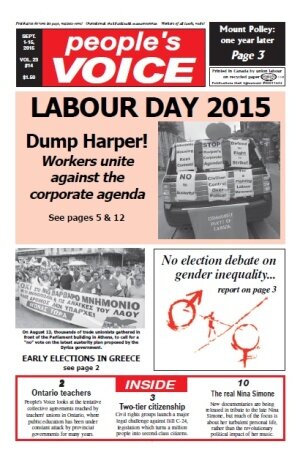
1) WORKERS UNITE AGAINST THE CORPORATE AGENDA!
2) ELECTION MESSAGE FROM THE COMMUNIST PARTY OF CANADA
3) TENTATIVE AGREEMENTS WON BY ONTARIO TEACHER UNIONS
4) MAKE PEACE AN ELECTION ISSUE - Editorial
5) GRAPPLING WITH TOUGH QUESTIONS - Editorial
6) BILL C-24 “TWO-TIER CITIZENSHIP” UNCONSTITUTIONAL, SAYS LAWSUIT
7) ANTI-LABOUR BILL SEEKS TO ELIMINATE UNIONS, NOT ENFORCE TRANSPARENCY
8) STOP HYDRO PRIVATIZATION IN ONTARIO
9) FEDERAL PARTY LEADERS NOT UP FOR DEBATING GENDER EQUALITY
10) MOUNT POLLEY TOXIC SPILL: LOOKING BACK ONE YEAR
11) NDP PURGES CANDIDATES OVER PRO-PALESTINE POSITIONS
12) IN THE FACE OF THE EARLY ELECTIONS IN GREECE
13) AFTER LAND, IT’S LABOUR ON MODI’S CHOPPING BLOCK
14) RALLIES FOR A NEW CANADA ON SEPT. 12
15) MUSIC NOTES, by Wally Brooker
PEOPLE'S VOICE SEPTEMBER 1-15, 2015 (pdf)
|
To order a copy send $15 (includes package and handling) to People’s Voice, 706 Clark Drive, Vancouver, BC, V5L 3J1. Contact us at 604-255-2041 or pvoice@telus.net for bulk order prices. |

|
People's Voice deadlines: September 16-30 October 1-15 Send submissions to PV Editorial Office,
|
REDS ON THE WEB
http://www.communist-party.ca
peoplesvoice.ca
www.ycl-ljc.ca
www.solidnet.org
|
People's Voice finds many "Global Class Struggle" reports at the "Labour Start" website, http://www.labourstart.org/. We urge our readers to check it out! |
* * * * * *
Central Committee CPC
290A Danforth Ave Toronto, Ont. M4K 1N6
Ph: (416) 469-2446
fax: (416) 469-4063 E-mailmailto:info@cpc-pcp.ca
Parti Communiste du Quebec (section du
Parti communiste du Canada)
5359 Ave du Parc, Montréal, Québec,
H2V 4G9
B.C.Committee CPC
706 Clark Drive, Vancouver, V5L 3J1
Tel: (604) 254-9836
Fax: (604) 254-9803
Edmonton CPC
Box 68112, 70 Bonnie Doon P.O.
Edmonton, AB, T6C 4N6
Tel: (780) 465-7893
Fax: (780)463-0209
Calgary CPC
Unit #1 - 19 Radcliffe Close SE
Calgary AB, T2A 6B2
Tel: (403) 248-6489
Ottawa CPC
Tel: (613) 232-7108
Manitoba Committee
387 Selkirk Ave., Winnipeg, R2W 2M3
Tel/fax: (204) 586-7824
Ontario Ctee. CPC
290A Danforth Ave., Toronto, M4K 1N6
Tel: (416) 469-2446
Hamilton Ctee. CPC
265 Melvin Ave., Apt. 815
Hamilton, ON.
Tel: (905) 548-9586
Atlantic Region CPC
Box 70 Grand Pré, NS, B0P 1M0
Tel/fax: (902) 542-7981
* * * * * *
News for People, Not for Profits!
Every issue of People's Voice
gives you the latest
on the fightback from coast to coast.
Whether it's the struggle for jobs or peace, resistance to social cuts,
solidarity with Cuba, or workers' struggles around the world,
we've got the news the corporate media won't print.
And we do more than that
- we report and analyze events
from a revolutionary perspective,
helping to build the movements for justice and equality,
and eventually for a socialist Canada.
Read the paper that fights for working people
- on every page, in every issue!
People's Voice
$30 for 1 year
$50 for 2 years
Low-income special rate: $15 for 1-year
Outside Canada $50 for 1 year
Send to: People's Voice, 706 Clark Drive, Vancouver, BC, V5L 3J1
You can call the editorial office at 604-255-2041
<pvoice@telus.net>
REDS ON THE WEB
www.communist-party.ca
peoplesvoice.ca
www.ycl-ljc.ca/
http://solidnet.org/
http://www,rebelyouth-magazine.blogspot.com
(The following articles are from the September 1-15, 2015, issue of People's Voice, Canada's leading socialist newspaper. Articles can be reprinted free if the source is credited. Subscription rates in Canada: $30/year, or $15 low income rate; for U.S. readers - $45 US per year; other overseas readers - $45 US or $50 CDN per year. Send to People's Voice, c/o PV Business Manager, 706 Clark Drive, Vancouver, BC, V5L 3J1.)
1) WORKERS UNITE AGAINST THE CORPORATE AGENDA!
Labour Day 2015 statement, Central Executive Committee, Communist Party of Canada
On Labour Day 2015, the Communist Party of Canada sends its warmest greetings of solidarity to working people across the country, especially to all those engaged in struggles against attacks by employers and right-wing governments.
This year, Labour Day takes place during a crucial election campaign, in the context of an economic crisis that creates deep hardships for working people in Canada and across the capitalist world. The challenge faced by the organized labour movement is to play a major role in defeating the Harper Conservatives, to reverse the austerity agenda imposed by big business, and to work beyond the election to build a mass movement that can reverse the austerity agenda imposed by big business."
The anti-people impact of neoliberal policies continues to unfold. Even before the 2008 meltdown, the largest corporations and banks were consolidating to downsize production and raise labour productivity, and to attack the wages, benefits and living standards of workers. Real incomes for working people have been declining for decades. While official jobless figures remain at about 6.8%, employment patterns are shifting dramatically. Part-time jobs now account for 80% of net job creation, and nearly 20% of workers hold part-time positions, up from 12.5% in 1976. There are now 1.1 million workers in precarious, temporary contract positions, earning lower pay and few benefits. Mass layoffs have hit tens of thousands of workers this year in the manufacturing, service and retail sectors. Youth unemployment remains two to three times the general rate of unemployment, and even higher among those from racialized and indigenous communities. Housing is increasingly unaffordable for millions of families, and the pay gap between men and women for work of equal value is again widening.
The true aim of PM Harper’s “economic action plan” is to enhance corporate profitability and the concentration of capital through a wholesale transfer of wealth from the working class, small farmers and primary producers, Aboriginal peoples, women, new immigrant communities and migrant workers, youth and the elderly. And it's succeeding: the top 1% of Canadian pre-tax income earners now capture 37% of overall income growth, and swallow up 12.2% of the country's income pie.
The austerity strategy includes undermining the universal public healthcare system, EI, and pensions; cuts to social transfers for education and social welfare; new attacks on labour laws, equity programs, and environmental protections; and more wars, more covert surveillance, and more police and prisons. The rights of labour to organize, to free collective bargaining and to strike are being steadily curtailed through restrictive legislation and back-to-work orders. New pro-corporate trade deals are being finalized, like the Comprehensive Economic and Trade Agreement (CETA) with the EU, and the Trans-Pacific Partnership (TPP) deal, which target sovereignty, democracy, the environment, and working people. Free speech and civil liberties are being restricted by so-called "security" measures, such as Bill C-51, which threatens all those who undermine "the economic or fiscal stability of Canada" - a clear reference to trade unionists, environmentalists, and indigenous land defenders.
There is a growing militant opposition among workers and the broader democratic movements. This is reflected in workplaces, around the negotiating table and on picket lines, and also on the streets – among Aboriginal Peoples struggling for their just national rights; around opposition to tar sands extraction and fracking; among youth and students, especially in Québec, against tuition increases, police violence and austerity; in the opposition to the end of urban home postal deliveries; and the mass mobilizations against C-51. It includes the “Fight for $15” labour/community battle to raise the minimum wage; the battle against Bill 1 in Nova Scotia; the militant struggles by CUPE locals at York and the University of Toronto; job actions by teachers in B.C. and Ontario; and the recent negotiations in Ontario involving UFCW (Loblaw stores) and Unifor (Metro stores), where these unions worked hard to achieve significant improvements for part-time workers, including closing the wage gap.
These examples show that the trade union movement has the numbers, the experience and the organizational strength to play a leading role in building a far broader and more coordinated fightback.
A new mood of resistance has emerged in the Canadian Labour Congress, where President Hassan Yussuff was elected after endorsing the action program of the “Take Back the CLC” movement calling for labour unity and militant action. In Ontario, the OFL under President Sid Ryan has played an important role in building labour coordination and solidarity around major trade union battles, and in forging the Ontario Common Front with social allies in the communities.
In Québec, three main labour centrals (FTQ, CSN and CSQ) have formed a ‘front commun’ to negotiate collective agreements for 450,000 provincial employees. There is wide support in Québec for the concept of a broader coalition of trade unions, feminists, popular and environmental groups and student associations, using escalating tactics such as a political strike against the austerity program of the Couillard government.
But there remains a sharp divide over tactics and strategies. Activist and militant "social union" forces support independent labour political action, while collaborationist, business union leaders favour "contracting out" labour's political role to the NDP, hoping to resurrect the so-called ‘social contract’ between labour, business and government. Underlying these choices is a more fundamental question: “Which way forward for labour – class struggle or class collaboration?”
The answer requires an understanding that as the systemic crisis of capitalism deepens and matures, there is no other way forward except to ‘unite and fight’ against the offensive waged by monopoly capital and its governments, and to advance a real alternative and line of struggle to achieve this goal. The next stage in the fightback begins with defeating the Conservative government, which has been a disaster for workers, Aboriginal peoples, women, youth and students, pensioners, immigrants and racialized communities. But working people don't need a new Liberal version of the Tory pro-war, big business agenda. And unfortunately, despite raising some useful measures such as a $15/hour federal minimum wage and a pan-Canadian child care program, the NDP refuses to reject the capitalist “free trade” deals, or to demand an end to participation in U.S.-led wars.
As shown by the recent example of Greece, where the “radical” Syriza government has imposed the pro-corporate policies demanded by European finance capital, fundamental change requires mass working class action to break with the entire system of neoliberal economics, capitalist trade deals and imperialist military alliances.
In this election, only the Communist Party of Canada has raised a true People's Alternative: jobs and higher wages, defence of labour rights, expanded social programs, one million new housing units, nationalization of resources and the banks, cuts to carbon emissions, scrapping “security state” laws, justice for Aboriginal peoples, full gender equality, military spending cuts, and higher taxes on the corporations and the wealthy. A vote for the Communist candidates is a powerful demand for such fundamental changes. Ultimately, to win a genuine People's Alternative, we need a longer-term fight, and a powerful People’s Coalition of the working class and its allies outside of Parliament. The organized labour movement must become the core of such a coalition, which could break the power of the big corporations and open the path towards a socialist Canada.
On Labour Day 2015, the Communist Party of Canada urges all workers - organized and unorganized, employed and unemployed, of all national origins and genders - to unite against the corporate agenda, and to fight for a world free from exploitation, oppression and war!
2) ELECTION MESSAGE FROM THE COMMUNIST PARTY OF CANADA
On October 19: Dump Harper! Put the needs of working people and the environment first, before corporate profit!
The Communist Party of Canada’s election platform includes: full employment and higher wages; tax the “one percent”, not the needy; expand social programs; a massive housing program; protect labour rights; nationalize energy, natural resources, and the banks; withdraw from NATO; cut carbon emissions; scrap “security state” laws; justice for Aboriginal peoples; full gender equality.
Winning this progressive alternative starts with dumping the Conservatives. Stephen Harper’s pro-war, pro-corporate austerity agenda has been a disaster for Canada’s sovereignty, and especially for workers, Aboriginal peoples, women, youth and students, pensioners, new immigrants and temporary migrant workers, and for racialized communities.
The Tories have chopped and privatized vital social programs and services, slashed real wages, and gutted labour’s right to free collective bargaining. Their drive to export raw materials – while highly profitable for the oil and resource giants – is destroying our environment and trampling on Aboriginal sovereignty. They have attacked civil rights, democracy and equality. And they have driven Canada’s foreign policy to militarism, aggression and war.
At the same time, the annual profits of the big banks and largest corporations have ballooned up to $250 billion. This is a direct result of a vicious corporate offensive, designed to drive down wages and living standards and transfer social and natural wealth to the super-rich.
Working people want real change. The Liberals say they offer ‘change’, but on key issues like economic policy, militarism, health care and social programs, they support the same pro-war, big business agenda. Voting Liberal would be like hopping from the fire back into the frying pan.
Mulcair’s NDP has abandoned many policies supported by the labour and people’s movements. Instead, the NDP presents itself as better administrators of capitalism ‘with a human face’, including continued participation in NATO aggression, support for corporate “free trade” deals like NAFTA and CETA, and acceptance of the primacy of ‘market forces’ – the continued domination of the large national and transnational corporations.
While the Greens have raised some useful ideas around the environment and democracy, they too refuse to discuss any serious alternative to global capitalism. For voters in Quebec, the Bloc Québécois is not a better alternative. Because it can not and does not seek to take power at the federal level, it has been historically an objective ally of the Conservatives. The Bloc’s real program is that of the Parti Québécois and, in reality, it is the PQ’s federal wing. Working people have suffered from PQ policies including strong support of free trade agreements, exploitation of oil and shale gas, as well as neoliberal austerity programmes.
This election takes place in a period of deepening recession, wars, climate change, rising fascist threats, mass unemployment, attacks on civil and democratic rights, and austerity. It’s time for real, fundamental change, time to elect Communists!
We need truly left and progressive voices in Parliament to defend the interests of working people, the cause of peace and social justice, and the protection of our environment.
As a wealthy country, Canada can support such an ambitious alternative, by nationalizing energy, natural resources, and the banks and insurance companies, by cutting military spending, and with progressive taxation to make the corporations and the wealthy pay.
The Communist Party fights for such a genuinely new course, and we invite you to consider our Peoples’ Alternative Platform.
This election alone cannot solve the huge challenges facing our country. A longer-term fight is required, especially mass social mobilizations which can begin to build a powerful and broad People’s Coalition of the working class and its allies outside of Parliament. Such a Coalition could have a huge electoral impact and begin to achieve real gains. This is the way to shift power to working people, and start moving Canada in a new direction!
For Socialism
Everywhere, the income/wealth gap between the vast majority of working people and a handful of the super-rich continues to widen. Today, the top 1% own and control 50% of the entire wealth of our planet, while billions go hungry. Racism and intolerance are spreading, and the threat of fascism is rearing its ugly head.
This global crisis is not only about government policies – it is about capitalism itself. It is time that capitalism and exploitation was replaced with a new system – socialism, a society based on full democracy, human equality, and environmental sustainability, in which the resources and economic wealth are owned and controlled by the working people, not by corporate bosses.
Such a change is possible.
Voting Communist sends a clear message that another Canada – and a better world – is necessary, urgent and worth fighting for. The aim of the Communist Party is a socialist Canada. We welcome everyone who shares our vision. Vote Communist, and join us in the struggle for a better future!
3) TENTATIVE AGREEMENTS WON BY ONTARIO TEACHER UNIONS
People’s Voice Ontario Bureau
Ontario’s Secondary and Catholic Teachers’ unions were seeking ratification of tentative agreements achieved with the Liberal provincial government as People’s Voice was going to press.
The Ontario Secondary School Teachers’ Federation announced that it had achieved the ‘net zero’ agreement demanded by the province while also winning a small wage increase including a lump sum payment in the first year and a 1.3% increase in the second year. Young teachers, who have been frozen on the grid since Bill 115 was imposed, will now be able to move up. Most important, the no-concessions agreement means teachers prevented the government from stripping the contract under its public sector wage freeze. Among other things, government negotiators were keen to increase class sizes – a move opposed by the public and rejected by the union.
The tentative agreement reached by OECTA representing Catholic Teachers is said to be similar to the OSSTF agreement. The next hurdle is getting local agreements with School Boards, many of which took a hard line after the government announced its wage freeze and ‘net zero’ bargaining strategy. Strikes are still possible if School Boards don’t change their demands for contract strips, or if teachers decide not to ratify the tentative agreements. Ratification meeting and votes are scheduled in Districts across the province in September.
Five unions representing teachers and educational workers have been without collective agreements since August 2014, when all the old contracts expired. This left the unions in a strong position to coordinate strategies in new provincial bargaining with the Ontario government, and in local bargaining with School Boards. The new two-tiered bargaining was introduced by the Liberals after Bill 115 suspended free collective bargaining and imposed contracts in 2012.
With tentative settlements by two of the bigger unions, the pattern may have been set for the Elementary Teachers, who are in still in negotiations and considering work to rule actions through the fall. CUPE, representing support staff, is still negotiating, as are teachers in the French public and French Catholic Boards.
There is speculation that the government toned down its aggressive approach to bargaining after the federal election was called, in an effort to head off a province-wide showdown with teacher and education unions. Premier Wynne’s Liberals are campaigning for Justin Trudeau and the federal Liberals in Ontario, where the federal election could be won or lost. Liberal governments undermining free collective bargaining while driving down workers’ wages and living standards won’t win many votes.
The Communist Party in Ontario is calling for a massive public investment in education, and a new funding formula for School Boards to meet student needs. “The Liberals are all about austerity, privatization, cutting jobs and reducing wages” said CPC (Ontario) leader Liz Rowley who is also a candidate for the federal party in Sudbury. “The Liberals are no good for Ontario, federally or provincially. We need new policies and new left voices – including Communists – to fight for those policies in the Legislature and in Parliament”.=[
4) MAKE PEACE AN ELECTION ISSUE
People’s Voice Editorial
One of the most frustrating aspects of the federal election campaign is the absence of debate on foreign policy issues, reflecting the consensus among the major Parliamentary parties and the corporate media in support of the geopolitical agenda of U.S. imperialism.
This was not always the case. The 1963 federal election saw a sharp clash over Washington’s pressure to station nuclear weapons on Canadian soil (with Conservative PM Diefenbaker opposed, and the Liberals in favour). During the Vietnam War era and the global disarmament campaigns of the 1980s, there issues were prominently debated during elections. And as recently as 2004, the NDP was still aligned with the anti-war movements which opposed the US-led war in Iraq.
But today, the story is quite different. Every key foreign policy of the pro-war Harper Tories is backed by the Liberals and the NDP (with occasional minor differences from the Greens). These parties all support the fascist-backed Kiev government attacking its own population, and the Israeli regime which imposes apartheid policies in occupied Palestine. All the parties stand for increased military spending and continued membership in the NATO alliance, which is engaged in a dangerous game to encircle Russia and China. They all back the bombing of Iraq and Syria, a strategy designed to secure U.S. domination over the entire Middle East/Central Asia region. In varying degrees, these parties are hostile to the Bolivarian Revolution in Venezuela, and support so-called “trade deals” which undermine democracy and national sovereignty, and expand the powers of transnational corporations.
Wherever Communists are on the ballot, voters have a strong anti-war candidate to support. In most ridings, however, grassroots pressure is needed to challenge the pro-war positions of the big parties at every opportunity. We urge our readers to help make peace a real issue in this campaign!
5) GRAPPLING WITH TOUGH QUESTIONS
People’s Voice Editorial
By raising new barriers to many potential voters, the Harper Conservatives have helped to spark an interesting debate around electoral participation by indigenous and Aboriginal peoples.
The (Un)Fair Elections Act passed in 2014 made it more difficult for thousands of people to prove their identity when trying to cast a ballot, especially those who are low-income, elderly, living in rural areas and on reserves, etc. The Assembly of First Nations is working with Elections Canada to remove some of these barriers, with details on the AFN website.
AFN National Chief Perry Bellegarde calls this election “an opportunity for all Canadians to help close the gap in the quality of life between First Nations people and the rest of Canada.” As he notes, Canada ranks between 6th and 8th on the UN Human Development Index while First Nations fall between 63rd and 78th. First Nations people face poorer health, a shorter life span, housing shortages, boil water advisories, high incarceration rates, and appalling numbers of missing and murdered Indigenous women and girls. The AFN is asking First Nations and Canadian voters to support “leaders and candidates who commit to a brighter future, one that includes First Nations as true partners in Canada."
Others within the indigenous movements have a different outlook. Grassroots Idle No More activist Pamela Palmater, for example, argues that “we should rest our hope on a federal election any more than we should an Assembly of First Nations election.” She believes that “the whole point of sovereignty is that Indigenous Nations must assert, live, and defend our sovereignty, jurisdiction, and right of self-determination – not vote for federal politicians to do that for us.”
But there is wide agreement that the status quo of mass poverty and inequality is not acceptable. Despite debates over tactics, the struggle to reverse the genocidal legacy of colonialism and racism must become a key demand in this election campaign.
6) BILL C-24 “TWO-TIER CITIZENSHIP” UNCONSTITUTIONAL, SAYS LAWSUIT
Toronto August 20, 2015 — The BC Civil Liberties Association (BCCLA) and the Canadian Association of Refugee Lawyers (CARL) have launched a constitutional challenge to the new Citizenship Act, a federal law relegating over one million Canadians to second-class status.
The lawsuit argues that the new Citizenship Act, in force since the passage of Bill C-24, creates a two-tier citizenship regime that discriminates against dual nationals, whether born abroad or in Canada, and naturalized citizens. These Canadians will now have more limited citizenship rights compared to other Canadians, simply because they or their parents or ancestors were born in another country.
Under the new law, these Canadians could see their citizenship taken away if convicted of certain serious crimes in Canada or abroad (including in a country that does not have due process or rule of law). New Canadians who became citizens after the passage of Bill C-24 could also lose their citizenship if they move abroad for work, school, or family reasons. Other Canadians would not be vulnerable to losing their citizenship.
“All Canadian citizens used to have the same citizenship rights, no matter what their origins. We were all equal under the law,” said Josh Paterson, Executive Director of the BCCLA. “Now this new law has divided us into classes of citizens—those who can lose their citizenship, and those who can’t. Bill C-24 is anti-immigrant, anti-Canadian, and anti-democratic. It undermines – quite literally – what it means to be Canadian.”
Over 110,000 Canadians have signed a Change.org petition to stop the new law. Despite the public outcry, the citizenship-stripping provisions of the Citizenship Act became law, and the federal government has already quietly begun proceedings to revoke citizenship from some individuals.
Lorne Waldman, a member of the team of lawyers litigating the case and an executive member of CARL, added: “This citizenship-stripping law is unjust, legally unsound, and violates the core values of equality enshrined in the Charter of Rights and Freedoms. With this law, the federal government shows a flagrant disregard for these values, and for the basic rights of all Canadians. We are asking the court to strike the law down.”
The lawsuit further alleges that the two-tier regime is unconstitutional because it allows citizenship to be revoked by government bureaucrats, not by a court of law.
“Instead of welcoming new Canadians, the new Citizenship Act discriminates against them,” said Mitch Goldberg, President of CARL. “Bureaucrats in Ottawa will have the power to take away citizenship, and tell people that they don’t belong in this country. This weakens citizenship for all Canadians. This lawsuit will remind the government that a Canadian is a Canadian is a Canadian. Period.”
7) ANTI-LABOUR BILL SEEKS TO ELIMINATE UNIONS, NOT ENFORCE TRANSPARENCY
By Nora Loreto, editor of Canadian Association of Labour Media (CALM)
On June 30, Canada's Senators voted on one final piece of legislation; so important that it didn't matter that they might waste that precious extra second in the Red Chamber. They voted in favour of passing Bill C-377 into law.
The amendments contained in C-377 to the Income Tax Act are sweeping, broad and idiotic. If Canadians need any example that the Harper Conservatives care more about personal vendettas than good governance, the proof is wrapped up in C-377.
C-377 requires a ridiculous level of compliance from labour organizations and trusts. It forces unions, labour organizations, labour federations, organizations comprised of different unions, labour trusts and professional associations to publically report all expenditures of over $5000 and itemize exactly what that the money was dedicated to.
Everyone's salaries, everyone's timesheets and all contracts will be made public. This places an enormous burden on the bureaucratic structures of the labour movement.
Perhaps the most incredible part of the vote is the irony. The Senate is a house of patronage, financial mismanagement and corruption. With a spending scandal that has landed 30 senators in hot water, including nine under RCMP scrutiny (not including Duffy, Brazeau, Harb or Wallin), it's high comedy that they think they can impose financial transparency on labour organizations.
If you read through the text of the legislation, it's clear that this is an exercise in political harassment rather than an attempt at transparency. And, it was passed by people who either don't understand or don't care how burdensome it will be to implement; not just for labour organizations but also for the government.
Because of this, and because of the many challenges likely to be made based on the constitutionality of this legislation, C-377 doesn't deserve to be treated as if it will be enforced. Labour organizations should not comply. Instead, C-377 should be seen as a measure of the massive attack being waged on our freedoms of assembly and association.
C-377 is meant to stop unions from engaging in political action despite the fact that unions only exist to engage in political action. Fighting for fair and decent working conditions is a political struggle. Prohibiting them from taking political action is to stop unions from doing what they exist to do.
The reality is that it's much easier to involve oneself in the affairs of one's union than to change the course of one's government and the dispensation of one's taxes. Union leadership present financial documents and members debate them. They aren't the ones with a transparency problem.
It's not as if the leadership of the CLC presented their budget in 500 pages with dozens of other significant amendments to non-budget policies and procedures. It's not as if the budget was passed with the approval of just 136 people. That's the kind of democracy that exists on Parliament Hill, not on a union's convention floor.
Which is why C377 isn't about transparency at all.
It's easy to see why the Harper Conservatives hate unions. Unions are the final major roadblock in their campaign to fully transform Canada. Unions demand rights for working people, decent wages and benefits, all which constitute barriers towards full-scale and unregulated resource extraction and international trade deals.
Unionization and labour rights are fundamental within a free and democratic society. The ability of working people to gather, elect their own leadership and direct their own political campaigns is a tenet of democracy. It is the membership who has the right to make demands of the leadership; no one else.
And if there exists problems within the organization of the union, it is the membership who has the right and the responsibility to fight for change internally; no one else.
Which is why C-377 must be viewed through a broader lens. Regardless of what the extremists at LabourWatch or the CFIB say, C-377 is dangerous and is another example of how our fundamental right to assemble is evaporating.
Now that C-377 has received Royal Assent, unions will have to become compliant as of January 30 2016. Between now and then, there's a federal election and the Tories might be booted from office. But they also might slither back into government.
How will Canada Revenue Agency ensure compliance to C-377? It's not as if an accompanying bill was presented to boost the agency's resources.
In fact, the Liberals allege that the Harper Conservatives have cut $314 million from CRA since 2012. This, plus the resources required to harass progressive charities means that there are fewer resources available to carry out the normal operations of CRA, let alone implement C-377.
And, Canada's richest people continue to stash billions of dollars outside of Canada and away from the eyes of CRA. Rather than refocusing CRA's efforts on recovering some of that money, the Harper Conservatives have instead cut the most senior CRA staff, the ones who would have the expertise to even go after this money at all.
Unions have always been enemy number one within fascist societies. C-377, combined with Canada's increasing militarization, surveillance legislation, attacks on civil liberties, new citizenship rules, new prison sentences and attacks on Indigenous people and organizations, all add up to a frightening slide to the extreme right.
Clearly, C-377 isn't about good governance at all. It's an attack on unions that all Canadians should be concerned about. Not just because of the tremendous waste that it will cause, but because it's another example of the true intentions of our current government.
For the Harper Conservatives, democracy is a meaningless buzzword and progressive organizations, including unions, need to be eliminated.
8) STOP HYDRO PRIVATIZATION IN ONTARIO
By Liz Rowley, Toronto
The Ontario government won re-election a year ago on a platform of massive investment in public transit and provincial and municipal infrastructure renewal in cities and towns across the province, creating tens of thousands of jobs.
What Premier Wynne didn’t say was that the price would be covered by an across the board public sector wage freeze, and massive privatization of public assets and services. What she didn’t say was that Hydro One – Ontario’s publicly owned energy supplier – was on the auction block.
The sale of Hydro One will cost Ontario residents and businesses "big time", with sky-rocketing rate increases for all users, and the loss of $2 billion a year in profits that go straight into the provincial treasury to pay for public services and social programs.
The steady, certain supply of cheap energy that has been available to Ontario residents and industries for 100 years is about to finally end. The Liberals will finish off the privatization of Ontario Hydro that the Tories started 15 years ago under Mike Harris.
Premier Wynne is trying to "sell" the sell-off by arguing that the government will retain the largest single share in the business, but she’s kidding no-one with this simplistic argument. The new private owners will work together to maximize their profits on investment and overwhelm the "public interest" – represented by more government appointed bankers and businessmen. In fact, the proposal to privatize Hydro One came from a banker, Ed Clark, who is Special Advisor to the Premier on what she calls “unlocking the value in public assets” – a euphemism for the largest sell-off of a public asset in North America.
The sale of Hydro One is the cornerstone of the massive asset sale now underway in Ontario. Not even the Tories were able to pull off a privatization of this magnitude.
But it can be – and must be stopped! This is the view of Keep Hydro Public, the broad coalition of public interest groups, unions and parties, mobilizing the public and leading this fight. The Communist Party in Ontario is also campaigning against the sale, declaring that energy belongs to the public, to serve people’s needs, not corporate greed.
While the government contends that the provincial budget contained the enabling legislation needed to proceed with Hydro privatization, the CPC (Ontario), the Ontario NDP, the unions, and the coalition opposing the sale say it was hidden in the budget, and that a public consultation debate is required before the government can proceed further. A mass campaign has opened up across the province that could yet spill into the federal election, and has every chance of stopping the government in its tracks. Over 80% of Ontarians are opposed to the sale, according to Keep Hydro Public.
Privatization means sky-high electricity rates. All in favour?
Only the new owners of Hydro One will benefit from that. And they’re the ones who will determine the price every year, going forward.
PV readers can get in touch with the Keep Hydro Public coalition at www.keephydropublic.ca
, or the Communist Party at www.communistpartyontario.ca.
9) FEDERAL PARTY LEADERS NOT UP FOR DEBATING GENDER EQUALITY
August 12, 2015 - One week into Canada’s federal election campaign, leaders of the major parties in Parliament have failed to put women’s rights and gender equality issues up for debate.
The Up for Debate campaign, led by a broad coalition of 175 organizations, has collected over 50,000 signatures from people across Canada calling for a nationally broadcast leader’s debate on women’s rights and gender equality issues. But lack of a clear commitment from all political party leaders to participate in such a debate has put this plan on ice.
“During last week’s Maclean’s debate, the word ‘woman’ was only mentioned four times, and there was no discussion of women’s rights or gender equality,” said Kelly Bowden of Oxfam, a spokesperson for the campaign. “Without commitment to a standalone debate, and in the absence of discussion in other debates, life and death issues impacting women and girls in Canada are invisible in the federal election campaign.”
Indigenous women and girls in Canada experience staggeringly high levels of violence. Overall rates of violence against women and girls in Canada remain stubbornly high. Too many families continue to flee violence and seek refuge in shelters daily. And women continue to be paid less than men for the same work.
“We are part of the economy. Our security matters too. The ways in which we are affected by economic and security policy, for example, are different than the ways in which men are impacted,” said Jackie Hansen of Amnesty International. “We need to have these discussions, not just in small groups but at the national level. We need all our federal party leaders to all be up for debating the issues that impact women and girls in Canada.”
Party leaders have not yet discussed women’s rights and gender equality in debates, public events, or in the media since the election campaign started. Supporters of the Up for Debate campaign are engaging candidates and the general public across the country to make sure that issues impacting women and girls are part of the national discussion in the lead-up to the election. Should all party leaders make a clear commitment to publicly debating women’s rights and gender equality, the Alliance for Women’s Rights is committed to ensuring this discussion reaches millions of Canadians.
The Up for Debate campaign (see upfordebate.ca) is led by the Alliance for Women’s Rights, a non-partisan network of over 175 women’s rights, Indigenous, human rights, and international development organizations, faith-based and community groups, unions, and business associations.
10) MOUNT POLLEY TOXIC SPILL: LOOKING BACK ONE YEAR
PV Vancouver Bureau
Environmentalists and indigenous rights activists gathered outside the Vancouver head office of Imperial Metals on August 4, to draw attention to the first anniversary of one of the largest toxic spills in world history.
On that date in 2014, the Mount Polley Mining Corporation (MPMC, owned by Imperial) disaster began in the Cariboo region of central British Columbia, with a breach of MPMC's copper and gold mine tailings pond. The breach released 10 million cubic metres of water and 4.5 million cubic metres of mining slurry waste. The spill raised Polley Lake 1.5 metres, and transformed Hazeltine Creek from a 2-metre-wide stream to a 50-metre-across "wasteland". From there, the water and mud continued into Quesnel Lake, the cleanest deep water lake in the world. By August 8, the four square kilometres sized tailings pond was empty. Water tests showed elevated levels of selenium, arsenic and other metals compared to historical tests.
A berm to prevent further spread of tailings was nearing completion by September 2014, and the company and some of its 300 employees began seeking to reopen the mine.
Meanwhile, it was revealed that the company had a history of operating the pond beyond capacity since at least 2011. An official investigation led to a final report on January 31, 2015, covering many factors including whether piezometers (devices to measure water pressure on the dam walls) had been located correctly. The investigating panel blamed the dam collapse on its construction on underlying earth containing a layer of glacial till that had been unaccounted for by the company's original engineering plan.
But area residents who depend on tourism for their livelihoods still fear that the negative impact on this aspect of the local economy could be devastating. First Nations in the Cariboo area and along the entire Fraser River area stress the potential for long-term effects on the crucial salmon runs and other fisheries. Experts warn that the extent of the damage may remain unknown for years or even decades, as toxicants accumulate in the environment from grass to moose, or from fish, and then to people who depend on these sources for much of their food consumption.
Some former employees accused Imperial Metals of insufficient attention to safety concerns. In 2010, MPMC's engineering firm found a 10 metre crack in the earthen dam while working to raise it. The firm also found that piezometers were broken, which MPMC later fixed. But questions over the devices still remain, and some workers say the company found it simpler to keep raising the height of the tailings pond beyond safe limits, enormously increasing water pressure levels.
There are also issues around provincial inspection and monitoring of tailings ponds and other mining operations. Former BC premier Gordon Campbell had cut funding for seven ministries responsible for resource management, which were reorganized into a “single team” approach. Inspections across the province decreased from 22 in 2009 to 3 in 2010, two in 2011, and none in 2012. Mount Polley was inspected in 2013, but not 2011 or 2012. Yet Bill Bennett, Minister of Energy and Mines, said "there is no evidence that the government’s missed inspections were related to the failure of the dam this year".
Since the spill, Alaskan mine opponents including environmentalists, aboriginal peoples, and the fishing industry have raised alarms over several proposed B.C. mining projects involving major salmon-producing river systems that run downstream into Southeast Alaska. The large Red Chris gold and copper mine, owned by Imperial Metals, is nearing completion in the headwaters of the Iskut River, a major tributary of the Stikine River. The KSM project owned by Seabridge Gold Inc. has been approved by B.C. and awaits federal approval; this project is located near the Unuk River system which flows into Alaska and supports a large Chinook salmon population, although its tailings facility would be located in B.C.’s Nass River watershed emptying into the Pacific. A third mine is slated to reopen and expand in the Taku River near Juneau.
And there are serious questions about connections between the company and the provincial Liberals. The controlling shareholder of Imperial Metals is billionaire N. Murray Edwards, who has donated half a million dollars to the B.C. Liberal party since 2005. Edwards helped organize a $1-million fundraiser for Premier Christy Clark’s re-election campaign in 2013. Has the relaxation of provincial mining inspections simply been a coincidence? Many find this hard to believe.
This disaster has lessons for the entire province, not just for First Nations in the Cariboo region who have kept the issue in the news. The Mount Polley breach made it clear that the BC Liberals have no interest in effective environmental protection regulation or inspections. Nor will Premier Clark's Liberals enact meaningful restrictions to stop the influence of corporate money in provincial or civic elections. For all the Premier's pretensions to speak for working people, Mount Polley showed again that she is simply a puppet for corporations in the resource sector.
(Adapted from an earlier article in Radical Desi magazine.)
11) NDP PURGES CANDIDATES OVER PRO-PALESTINE POSITIONS
By Marion Kawas, Mondoweiss.net, August 24, 2015
Canadian governments have a long history of complicity in Palestinian dispossession. As early as 1947, Lester B. Pearson, then Under Secretary of State for External Affairs and future Canadian Prime Minister, played a key role in drafting and passing the United Nations Partition Plan, so much so that Zionist groups dubbed him the “Balfour of Canada”.
Successive governments have carried on this tradition of one-sided support, although often under the pretense of “peacekeeping” and being a “honest broker”. Fast forward to the last decade, which has brought the Conservative government into power under PM Stephen Harper, famous for such comments as “Through Fire and Water, Canada will Stand with You” made during his speech to the Israeli Knesset in January, 2014. Harper has crafted a policy of zero tolerance for everything Palestinian, from BDS to funding for UNRWA, and also upped the ante by trying to make any criticism of Israeli policies “illegal”. Recent examples are the January 18, 2015 Memorandum of Understanding between Canada and Israel that committed to develop “a coordinated, public diplomacy initiative both bilaterally and in international and multilateral fora to oppose boycotts of Israel, its institutions, and its people within three to six months” and the announcement just last month of the “expansion and modernization” of the Canada Israel Free Trade Agreement. Unfortunately, the other two main national parties, the New Democratic Party (NDP) and the Liberals, are in a frantic race to see who can reach the bottom line first. All three major parties are currently on record as denouncing BDS, condemning Israeli Apartheid week on university campuses and attempting to stifle debate on this issue.
And now, enter the Canadian federal election campaign. Although certainly short by U.S. standards, it still has another 2 months to go and is becoming increasingly nasty. Palestinian activists are either bullied and targeted by our known adversaries or betrayed by our “friends” and told we’re not even allowed to raise our voices. And the pervasive and bludgeoning reach of the Zionist lobby seems to have reached new heights (or lows). The latest round of the brouhaha was instigated by the NDP leadership (who might form the next government) with the purge of several candidates mildly sympathetic to Palestinian rights. The resulting dissent put them in damage control mode, especially since many supporters of the Palestinian people have also historically been involved in some way with the NDP which paints itself as the “party of change”. (Several people were even deleted from various Facebook groups, including Rabble, for refusing to drop the challenges on this issue.) In the past, some high profile veteran MPs from the NDP had a proud history of supporting Palestinian rights; sadly, no longer.
But the issues of censorship and the need to hear the Palestinian voice have refused to go away. On August 20, the Ontario Civil Liberties Association issued a strongly-worded letter defending the freedom of speech of two of the ex-candidates and noting that what one of them said was common parlance in Israel’s mainstream media and included some terminology even used by former Israeli PM Ben-Gurion. The letter went on to state – “The NDP’s stance in barring any criticism of Israel is undemocratic and wrong. Morgan Wheeldon and Jerry Natanine were not breaking confidence with a democratically-determined party policy platform, or engaged in any such mutiny. They have uttered words critical of Israel, in contexts of democratic discourse. Your actions are incompatible with your claim of seeking a balanced approach. A balanced, informed, and tested approach cannot be found by suppressing free expression among potential and actual law makers.”
Of course Palestine is not the only issue in this national election, and Palestinian and Arab Canadians (contrary to some perceptions) are just like everyone else – parents, workers, seniors, disabled etc. with a myriad of concerns. But for supporters of Palestinian rights, the dilemma here is huge. The Zionist lobby are allowed to be “one issue” and have unlimited resources and time to check candidates’ social media accounts going back many years, making any support for Palestine a “red line” issue. And to ask Palestinian-Canadians and their supporters to vote for any party that is clearly complicit in the trampling of human rights, with the faint hope that after the election things will improve, simply will not cut it. Especially not with the current NDP leader, Thomas Mulcair, who proudly pronounced himself an “ardent supporter of Israel”, even before being elected party leader. Does criticizing the NDP (or considering voting for another party, say the Greens) mean you’re supporting Stephen Harper or you don’t want change? Of course not! And frankly, it is arrogant and insulting to everyone’s intelligence to use such fear-mongering tactics.
Palestinians will not be silenced and after 67 years of dispossession they no longer believe in hollow promises. So if the NDP leadership wants to own up and say they’ve thrown the Palestinians under the bus as have the other two major Canadian political parties, then be honest and do so. And engage in that debate as to why Palestinian rights (and even any discussion of them) are expendable and be judged accordingly. All three major federal parties in Canada need to be sent a loud and clear message that Palestinians and their supporters will not be censored and Palestinian rights will not be trampled on so easily. We must all show that there is zero tolerance for hypocrisy and complicity with Israeli war crimes!
12) IN THE FACE OF THE EARLY ELECTIONS IN GREECE
News release from the Communist Party of Greece (KKE), August 24, 2015
The SYRIZA-ANEL government recently resigned, resulting in new early parliamentary elections (most likely on the 20/9).
As is well known, SYRIZA won the elections in January 2015, deceiving the workers, promising the abolition of the anti-people laws, which had been previously passed by the governments of PASOK and ND, after the agreements (memoranda) with the imperialist organizations (EU, IMF, ECB).
The KKE had warned in a timely fashion that SYRIZA, a “left”, an opportunist party which mutated into a social-democratic party, was chosen by the bourgeoisie to manage the crisis and can not implement a political line in favour of the people.
Our party had formulated its position that there can be no way out in favour of the working class and the other popular strata inside the capitalist development path, the EU and NATO.
As was demonstrated in a few months of managing capitalism, the “left” SYRIZA, which governed together with “right” nationalist party ANEL, not only did not abolish the 2 previous memoranda and most of the 400 anti-people application laws of the previous governments, but implemented them and passed through Parliament a third even more painful agreement (memorandum) with the imperialist powers. This agreement had the support of the other bourgeois parties and was voted for in Parliament by them: “rightwing” ND, “Social-democratic” PASOK, the “centre” party “POTAMI”. This new agreement massacres any rights that have remained, imposes new reductions in wages and pensions, abolishes social-security rights, imposes even more intense taxation of the popular strata, promotes the policy of privatizations etc.
In addition, the “Left-patriotic” government consistently operated during these months inside the framework of our country’s participation in the imperialist unions of NATO and the EU, of the “strategic alliance” with the USA. It participated in every NATO mission and exercise, it organized military exercises even with Israel, it promised a new base for the USA and NATO (on the island of Karpathos), it voted in the EU for the extension and reinforcement of the trade war against Russia etc.
So, in practice it has been demonstrated that the SYRIZA-ANEL government is another anti-people government, which with “”left” slogans served in an equally faithful way the bourgeoisie, the EU and NATO as the previous governments had done. Today, the governing SYRIZA-ANEL parties, using the same arguments that ND and PASOK had used in the past, defends the new anti-people agreement as the only way of keeping the country in the Eurozone and EU, something that it presents as the people’s salvation. SYRIZA, just as all the other bourgeois parties, sows the illusion amongst the working class and people that the EU and capitalism can be humanized, as long as the workers continue to endure the anti-people measures.
At the same time, the bourgeois political system in order to curb and control any radical changes in the people’s consciousness that could be brought about by the exposure of SYRIZA’s role continues to manufacture new parties. One such party, with the title “Laiki Enotita” (People’s Unity), was formed by MPs and former ministers from SYRIZA. These forces, which were active as a “left platform” inside SYRIZA, bear grave responsibilities as regards the deception of the people. They participated, even as ministers, in the implementation of the previous anti-people laws. They actively participated in the attempt during the previous period to trick the people that there is an alternative proposal for them inside the walls of the EU and agreed with the anti-people agreement that was signed by the SYRIZA-ANEL government with the Troika on the 20th of February, with the anti-people proposal of 47 pages submitted by SYRIZA to the EU etc. Now that the illusions fostered by SYRIZA have been dented, these forces promote the return to the national currency as a solution for the people, along with other measures for the management of the system. They act as a “barrier” to the radicalization of the people, seeking to trap the people inside the capitalist development path.
Over this entire period, the KKE consistently exposed the role of SYRIZA and the other bourgeois parties, struggled for the abolition of the memoranda and all the anti-people measures, to prevent new measures, to develop the workers’-people’s struggle for the recovery of their losses and the satisfaction of their needs in combination with the only alternative solution that is in the interests of the working class and other popular strata: the regroupment of the labour movement and the construction social-people’s alliance between the working class, the poor farmers, the urban self-employed, the youth and women from the families of the popular strata in order to strengthen the antimonopoly-anticapitalist struggle for the real overthrow, the socialization of the monopolies, the disengagement from the EU and NATO and the unilateral cancellation of the debt, with workers’-people’s power.
We are waging the struggle with this line in order to strengthen the KKE in the labour-people’s movement and in Parliament, unwaveringly continuing the struggle for the interests of the working class and its liberation from the shackles of capitalist exploitation.
13) AFTER LAND, IT’S LABOUR ON MODI’S CHOPPING BLOCK
By Baldev Padam
Even as opposition over a Bill enabling corporate houses to easily acquire farmers' land continues, PM Narendra Modi has fired yet another salvo against Indian working people. Inaugurating the 46th Indian Labour Conference on July 20 in Delhi, he talked about overhauling labour laws as there were too many, some of them too old and needed reappraisal.
Those who heard his speech (available online), found that it didn't specify the changes he intended to incorporate in the body of existing laws. What he sidetracked in his address was later brought to light by labour ministry bureaucrats.
During his speech, Modi expressed anxiety over the increasing number of unemployed youth, and appealed to big business to provide them with apprenticeship opportunities. He didn't promise them a job thereafter in the public or private sector, nor job security to workers at their present workplace. Employers were also told to acknowledge and reward innovative capabilities of their workers.
Modi referred to general discontent prevailing among workers without going into the causes. Evidently if an unskilled worker is paid a minimum wage linked to the cost of living index, or if a skilled one gets the living or fair wage even if the need-based wage isn't possible right now, they would be a happier lot. But in fact many qualified young people are either without jobs, or are forced to work for paltry wages. The PM didn't explain why the benefits of India's fast developing economy don't percolate down to the common people, and why the income disparity between the rich and the poor has widened so much in India.
However, the PM assured, “Changes in the labour laws will be made with the concurrence of the unions... It is my effort to simplify the laws so that even the poorest are able to understand their rights and avail them.” To wipe away their tears, he assured an online facility for workers to know about their health and other records instantly on their cell-phones.
The sheen of Modi's rhetoric vanished into thin air soon after the show ended, as ministry officials clarified to reporters that the heart of the overhaul was to relax strict hire-and-fire rules and to make it tougher for workers to form unions. The layoff restrictions on employers however, would be relaxed further.
Indian trade unions are sharply divided on the basis of Left, Right or centrist political ideologies, which goes well with the ruling classes. The unions now must thank Modi for affording them a chance to stand united (maybe for a limited purpose) against the BJP government's imminent onslaught.
India's top 11 unions, irrespective of their ideological mooring, have decided to observe a one day strike on September 2 against this tampering with the labour laws. On one hand the participants include the BMS (Bhartya Mazdoor Sangh), linked to Modi’s rightist ruling party, on the other are communist-led unions like CITU or AITUC, besides INTUC, led by the centrist Congress party. Many more independent associations and federations of workers in the public and private sector will join the action against attacks on workers' rights being made in the name of development.
The BMS has warned the government that rapid economic growth should not be allowed at the cost of the workers. Airing similar views, the AITUC General Secretary said, “The government does not consult the unions while bringing amendments to labour laws. We are not against growth or investment but it cannot be at the cost of workers, underpayments and lawlessness,”
Last year, after the federal labour minister announced proposals to amend labour laws, leaders of the CPI(M) warned that "the government thinks it can bulldoze labour laws as it has majority in Lok Sabha (Lower House)” but it will face protests in the streets if it goes ahead with these amendments. It appears that labour will meet Modi's challenge in the streets even if he succeeds in Parliament because of his party's majority there.
The trade union movement says that the labour laws weren't offered to them on a platter by any government or by the factory owners. They were achieved through immense sacrifices in protracted struggles against all regimes, colonial and thereafter. The present dilution of laws is being undertaken by Modi under pressure of various national and transnational corporations, whom he has promised the green pastures of Indian industry. To his dismay, the clouds of resistance are gathering faster than expected.
The PM has been placed in a tricky situation. Rajiv Biswas, a well-known economist, has opined, “Modi had little option but to push ahead with the measures... You cannot make political opposition an excuse for not taking tough decisions... without these reforms, the economy would stagnate, and frustrated investors would look elsewhere."
Evidently India's PM has been caught between the devil and the deep blue sea! It is quite interesting to watch where he goes from here.
14) RALLIES FOR A NEW CANADA ON SEPT. 12
By Darrell Rankin, Winnipeg
People will be putting their feet on the streets for a New Canada on September 12. Activists in several cities are mobilizing people with the idea that people need to influence the federal election, not money.
Cities are taking different approaches, but they are all inviting different movements to unite, especially communities targeted by Bill C-51 which is turning Canada into a police state. People can bring ideas about what kind of country they want. Organizers of the Winnipeg rally have compiled a list of ideas backed by major movements how to create jobs, support Aboriginal rights, curb the secret police and so on.
So far, rallies are taking place from Alberta to Ontario (Calgary, Regina, Winnipeg, Sudbury and Toronto).
The last two times Canadians defeated majority Tory governments, labour and other activists rallied 100,000 people on Parliament Hill (1993) and organized the On to Ottawa Trek (1935).
It's going to take more than a confident (or perhaps over confident) approach in front of a computer to defeat a majority Conservative government planning to spend $50 million on ads and robocalls, aided by obsequious media coverage.
It is feet on the streets time! It is time to unite everyone targeted by the police state Bill C-51. It is time to bring people, communities, groups and movements together.
A cross-Canada coordination page is set up at https://www.facebook.com/groups/1693943417492184/ or email rnknfile@mts.net.
15) MUSIC NOTES, by Wally Brooker
BLM activists adopt Lamar's anthem
After police arrested and roughed up a black youth, activists at a Black Lives Matter (BLM) conference in Cleveland took to the streets on July 28th, chanting the refrain from hip-hop star Kendrick Lamar's hit song “Alright”. Singing “we goin' be alright”, they attempted to prevent the police cruiser from leaving (and were pepper-sprayed for their efforts). Lamar's acclaimed album, To Pimp a Butterfly is riding high in the charts. While the commercial success the 28-year-old Compton native is experiencing is helped by his distribution deal with Universal Music - the largest musical corporation in the world - it is clear that To Pimp a Butterfly is a potent and timely protest against discrimination, racism and hypocrisy. The “Alright” video depicts Lamar raging and soaring above a violent urban landscape. At its end he is symbolically shot by a white cop, but he smiles in the last frame, suggesting the triumph of hope. Writer R.L. Stephens II, in an article in Orchestrated Pulse www.orchestratedpulse.com argues that the mainstream media's focus on BLM spokespersons disguises a bid to co-opt a “leadership class” before the fledgling network has had the time to democratically debate its goals and strategy (and thereby produce an organic grassroots leadership). Here's hoping that Kendrick Lamar and other BLM activists are listening.
Eco symphony contests eminent domain
Eminent domain is a much abused legal doctrine whereby contemporary governments can allow corporations to expropriate private land for the supposed “public good”. Last February, a group of New York State residents threatened by such abuse engaged the environmental artist and electronic music composer Aviva Rahmani to help them take action against a pipeline. The Spectra AIM gas pipeline would transit to within 100 feet of the Indian Point nuclear station on the Hudson River. Rahmani's response was Blued Trees Symphony, an installation on private land along the path of the proposed pipeline. The trees are marked with a sine wave musical note in non-toxic, semi-permanent blue paint, in a definite order which, taken together, forms a symphony, which is copyrighted. The Blued Trees Symphony pits the Visual Artists Rights Act for the “moral rights” of art against the “right” of corporations to expropriate private land, thereby forcing a debate about what is the “public good”. Local residents and members of the artists activist group Earth Guardians painted the notation on the trees over several days in June. Sympathetic “Greek Choruses” of blued trees are underway in Seattle and Lisbon. Watch the video and hear musical samples at www.saneenergyproject.org.
Victor Jara's killers indicted
Another step has been taken in the long campaign to bring the killers of Victor Jara to justice. On July 23rd, forty-two years after the U.S.-sponsored military coup that overthrew the democratically-elected socialist government of Salvador Allende, a Chilean judge announced charges against 10 former army officers. Victor Jara, legendary singer-songwriter, theatre director, and Communist Party member, was arrested immediately following the September 11, 1973 coup. He was detained with thousands of others in a Santiago stadium, brutally tortured, and then executed in a hail of bullets on September 16. The trials of the accused officers are expected to begin later this year. “We're pushing forward in demanding justice for Victor,” Jara's widow, Joan, said after the announcement, “with the hope that justice will follow for everyone.” One other suspected killer remains at large in the United States. Former Chilean army lieutenant Pedro Barrientos Nunez will face a civil lawsuit in a District Court in Florida. The suit was brought by the US-based Center for Justice and Accountability on behalf of Joan Jara and her daughters. Chile has filed an extradition request for Barrientos, who fled to the US in 1986, but he's been protected by his US citizenship, obtained through marriage.
Rise Again songbook now available
Community choirs and sing-along aficianados will be happy to learn that the much-loved songbook Rise Up Singing, first published in 1988, now has a companion volume. Rise Again was published last month by Hal Leonard Books. Like its predecessor, Rise Again was compiled by Annie Patterson and Peter Blood and it bears the imprint of Sing Out! magazine and Pete Seeger, who penned an introduction shortly before his death in 2014. Rise Again features words and lyrics to another 1200 songs, grouped thematically by genre or subject matter. There are new chapters for genres previously ignored or under-represented including blues, country, jazz standards, and early rock & roll. Also included is a selection of popular and indie songs released since 1995 that have caught on with the group-singing community. Singers and musicians will appreciate the spiral binding, and the hand-drawn illustrations add a down-home feel. Visually-challenged users will appreciate the optional large-print edition. The price is $25 USD. For more information visit www.riseupandsing.org.