|
|
February 15-28, 2014
Volume 22 – Number 3 $1
Prolétaires de tous les pays, unissez-vous!
Otatoskewak ota kitaskinahk mamawestotan!
Workers of all lands, unite
1) "UNFAIR" ELECTIONS ACT: WHAT'S GOING ON?
2) RAISE THE MINIMUM WAGE NOW!
3) SHARP DIVISIONS OVER NEW FIRST NATIONS EDUCATION ACT
4) RCMP AND CSIS SPYING ON PIPELINE CRITICS
5) WILL YOUR MAIL BE SAFE IN A "SUPERBOX"?
6) SUPPORT MARCH 1 RALLIES – Editorial
7) A SHAMEFUL ANNIVERSARY – Editorial
8) BRAMPTON MEETING SLAMS HIGH AUTO INSURANCE
9) FMLN WINS BIG LEAD IN EL SALVADOR VOTE
10) UKRAINIAN COMMUNISTS CONDEMN VIOLENCE AND FOREIGN INTERFERENCE
11) SPORTS WITHOUT WAR EXPOSES "FORCES APPRECIATION NIGHT"
12) WHEN PETE SEEGER CAME TO KOLKATA
13) MAC-PAP MEMOIR: TIMELY AND FASCINATING
PEOPLE'S VOICE FEBRUARY 14-28, 2014 (pdf)

People’s Voice 2014 Calendar
”The Truth About the Great War”
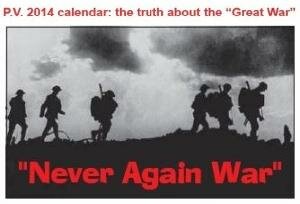
To order a copy of the People’s Voice 2014 Anti-First World War
Calendar, send $15 (includes postage and handling) to
People’s Voice, 706 Clark Drive, Vancouver, BC, V5L 3J1. Contact us at
604-255-2041 or pvoice@telus.net for bulk order prices.
|
People's Voice deadlines: March 1-15 March 16-31 Send submissions to PV Editorial Office,
|
REDS ON THE WEB
http://www.parti-communiste.ca/
peoplesvoice.ca
www.ycl-ljc.ca
www.solidnet.org
|
People's Voice finds many "Global Class Struggle" reports at the "Labour Start" website, http://www.labourstart.org/. We urge our readers to check it out! |
* * * * *
People's Voice
Canadian Publications Mail Sales Product Agreement #205214
ISSN number 1198-8657
People's Voice is published by
New Labour Press Ltd
PV Editorial Office
706 Clark Drive,
VANCOUVER, B.C. V5L 3J1
Phone:604-255-2041
Fax:604-254-9803
email: pvoice@telus.net
Editor: Kimball Cariou : Business Manager: David Au
Editorial Board: Kimball Cariou, Miguel Figueroa,
Doug Meggison, Naomi Rankin, Liz Rowley, Jim Sacouman
* * * * * *
Letters
People's Voice welcomes your letters
on any subject covered in our pages.
We reserve the right to edit for length and clarity,
and to refuse to print letters which may be libellous
or which contain unnecessary personal attacks.
Send your views to:
"Letters to the Editor",
706 Clark Dr., Vancouver, BC V5L 3J1,
or pvoice@telus.net
People's Voice articles may be reprinted without permission,
provided the source is credited.
* * * * * *
The Communist Party of Canada, formed in 1921,
has a proud history of fighting for jobs, equality, peace,
Canadian independence, and socialism.
The CPC does much more than run candidates in elections.
We think the fight against big business and its parties
is a year-round job,
so our members are active across the country,
to build our party and to help strengthen people's movements
on a wide range of issues.
All our policies and leadership
are set democratically by our members.
To find out more about Canada's party of Socialism,
give us a call at the nearest CPC office.
* * * * * *
Central Committee CPC
290A Danforth Ave Toronto, Ont. M4K 1N6
Ph: (416) 469-2446
fax: (416) 469-4063 E-mailmailto:info@cpc-pcp.ca
Parti Communiste du Quebec (section du
Parti communiste du Canada)
5359 Ave du Parc, Montréal, Québec,
H2V 4G9
B.C.Committee CPC
706 Clark Drive, Vancouver, V5L 3J1
Tel: (604) 254-9836
Fax: (604) 254-9803
Edmonton CPC
Box 68112, 70 Bonnie Doon P.O.
Edmonton, AB, T6C 4N6
Tel: (780) 465-7893
Fax: (780)463-0209
Calgary CPC
Unit #1 - 19 Radcliffe Close SE
Calgary AB, T2A 6B2
Tel: (403) 248-6489
Ottawa CPC
Tel: (613) 232-7108
Manitoba Committee
387 Selkirk Ave., Winnipeg, R2W 2M3
Tel/fax: (204) 586-7824
Ontario Ctee. CPC
290A Danforth Ave., Toronto, M4K 1N6
Tel: (416) 469-2446
Hamilton Ctee. CPC
265 Melvin Ave., Apt. 815
Hamilton, ON.
Tel: (905) 548-9586
Atlantic Region CPC
Box 70 Grand Pré, NS, B0P 1M0
Tel/fax: (902) 542-7981
http://www.parti-communiste.ca/
* * * * * *
News for People, Not for Profits!
Every issue of People's Voice
gives you the latest
on the fightback from coast to coast.
Whether it's the struggle for jobs or peace, resistance to social cuts,
solidarity with Cuba, or workers' struggles around the world,
we've got the news the corporate media won't print.
And we do more than that
- we report and analyze events
from a revolutionary perspective,
helping to build the movements for justice and equality,
and eventually for a socialist Canada.
Read the paper that fights for working people
- on every page, in every issue!
People's Voice
$30 for 1 year
$50 for 2 years
Low-income special rate: $15 for 1-year
Outside Canada $50 for 1 year
Send to: People's Voice, 706 Clark Drive, Vancouver, BC, V5L 3J1
You can call the editorial office at 604-255-2041
REDS ON THE WEB
http://www.parti-communiste.ca/
http://www.ycl-ljc.ca/
http://www.solidnet.org/
(The following articles are from the February 15-28, 2014, issue of People's Voice, Canada's leading socialist newspaper. Articles can be reprinted free if the source is credited. Subscription rates in Canada: $30/year, or $15 low income rate; for U.S. readers - $45 US per year; other overseas readers - $45 US or $50 CDN per year. Send to People's Voice, c/o PV Business Manager, 706 Clark Drive, Vancouver, BC, V5L 3J1.)
1) "UNFAIR" ELECTIONS ACT: WHAT'S GOING ON?
People's Voice Commentary
Seventeen long months after promising to clean up Canada's electoral system, the Harper Conservatives finally tabled their "Fair Elections Act" in the House of Commons on Feb. 4. But despite its name, Bill C-23 was immediately condemned by most observers as an attempt to protect and expand the electoral advantages already held by the Conservatives, without addressing the corrupt activities which tainted the 2011 campaign.
This is not the first time a Conservative government has introduced sweeping undemocratic changes to the electoral system. Back in 1993, the Mulroney Tories amended the Elections Act, just months before being reduced to just two MPs in Parliament. That legislation included little-known draconian measures to "deregister" small political parties, seize their assets, bar them from the ballot, and ban them from spending any funds to oppose the entire process. It took a seven-year political and legal campaign by the Communist Party of Canada to overturn the worst aspects of the legislation.
This time around, Pierre Poilievre, the "minister of state for democratic reform", told Canadians that the changes in Bill C-23 will "increase democracy."
Yet this 240‑page bill was tabled one day, and debate forced to begin the next day. Next, the government refused to agree to an NDP motion to send the bill to committee study after First Reading, cutting down on any opportunity for amendments. The indications are that the Tories intend to drive C-23 through all three readings in the Commons as soon as possible, with a minimum number of changes.
This strategy is consistent with the government's track record, including their refusal to consult with Elections Canada (EC) prior to introducing C-23. This was hardly surprising, considering that the Harper clique in the PMO can barely control their disdain for the arms-length body responsible for conducting federal elections. For years, the Tories have used U.S. Republican-style maneuvers to get around or simply ignore Elections Act provisions which cramp their style.
Yet Poilievre brazenly told the House of Commons on Feb. 3 that the government had consulted with Chief Electoral Officer Marc Mayrand. "I did meet with the CEO of Elections Canada some time ago and we had a terrific and a very long meeting, at which I listened carefully to all of his ideas," Poilievre declared.
(Some will recall Mr. Poilievre as the Tory attack dog after the 2006 federal election, when he savaged critics of the "in and out" expense laundering scheme perpetrated by the Conservatives. That scheme was found to be illegal, yet the "law and order" Harper Tories pretend the opposite to this day.)
Poilievre's latest lie was immediately exposed by EC spokesperson John Enright, who pointedly stated that "There's been no consultation on the contents of the bill."
Much of the current animosity directed at EC by the Harper Tories goes back to the so-called "robocall" scandal during the 2011 election. The Conservatives were widely accused of dirty tricks in that campaign, most notably engineering thousands of calls from phony "Elections Canada" representatives to tell voters leaning to the opposition parties that their polling places had supposedly been "moved."
Investigations into that scandal are still dragging on, hampered by Tory foot-dragging. Elections Canada has sought increased powers to deal with similar crimes in future elections. Instead, C-23, would take away power from the independent, arms-length EC, by moving the Commissioner of Canada Elections office to within the Director of Public Prosecutions, i.e. under the government's control.
As an Ottawa Citizen editorial said, "With another election coming soon, Canadians still don't know what really happened in 2011 or who was responsible. Mayrand has said that the Commissioner of Canada Elections should have the power to compel testimony; this bill does not create that."
This editorial actually understands the problem. As the NDP has pointed out, C-23 limits the ability of investigators to force violators to provide testimony; it prevents both the Chief Electoral Officer and possibly the Commissioner of Elections Canada from speaking about possible or suspected fraud; it prohibits the Chief Electoral Office from hiring technical experts or other specialists without the approval of the government; and it does not address the problem of foreign telecommunications service providers hired to get around Canadian laws.
In another Orwellian turn of phrase, Poilievre claims that C-23 "closes loopholes to big money". Yet the legislation actually does the opposite, by raising campaign spending limits a hefty five percent. The bill also raises the maximum donation limit from individuals to parties, from the current $1200 up to $1500. This is a huge benefit to the Tories, who have a wider base of wealthy donors capable of contributing another $300 annually.
The legislation also changes the definition of "campaign expenses" to give the Tories yet another edge. The
costs of calling anyone who donated $20 or more during the past five years will no longer be considered a campaign expense. This change gives the Tories wide scope to campaign among their donors, freeing up thousands of dollars from every constituency campaign budget for other forms of spending.
Among the widely reported changes proposed by Bill C-23 are amendments to make it harder to vote. Again following in the footsteps of their Republican mentors, the Tories seek to use every method to suppress voter turnout among "unfriendly" sections of the population.
The bill proposes to "tighten up" voter identification rules and to eliminate the practice of "vouching" for other voters who lack proper I.D. at polling stations. Not coincidentally, those voters largely include First Nations, students and people who live in poverty.
The 2011 campaign saw 120,000 voters register at the polls through this method, and through expanded acceptance of the EC Voter Identification Cards. These are people who do not have standard or up-to-date I.D. documents, or have no fixed address, or who have recently moved, or otherwise don't meet the requirements of the Elections Act. They are not criminals or fraudsters, just citizens who want to vote. Despite all the right-wing fear-mongering, only a handful of accusations have been made about illegal voting, a pattern similar to the U.S.
And Bill C-23 gets even worse on this point. The legislation actually makes it illegal for Elections Canada to conduct public campaigns urging people to get out and vote. Perhaps uniquely among major capitalist countries, such activities by the body which conducts elections would become a criminal offense.
This sweeping change even extends to the annual Democracy Week conducted by Elections Canada, and its Student Vote Program (SVP), which will now be an illegal program for the Chief Electoral Officer to run. During the 2011 general election, over 500,000 students across Canada cast mock ballots through SVP, an effort designed to encourage them to vote when they turn 18. (The Conservatives usually do very poorly in this mock student vote, while Communist candidates get a much higher vote than their average in the "real" campaign.)
One NDP Member of Parliament has provided an interesting insight into this aspect of C-23: "Well over a year ago, MPs were briefed by the Chief Electoral Officer that, in the 2015 election, Elections Canada would continue to expand its efforts to enhance voter turn‑out by placing polling stations on over 20 university and college campuses across Canada, as well as in or near urban Aboriginal Friendship Centres or similar facilities. I was present with Conservative MPs during this briefing, and I can testify that the faces of several of them went either white or purple upon hearing this news."
Quoting the Ottawa Citizen once again: "One might have thought that when the Conservative government finally got around to reforming election law, it would be to try to prevent the kind of voter suppression and electoral fraud Canada saw in the 2011 election. But when they said they would make it harder to break the rules, it seems they were talking about cracking down on homeless voters, not party bagmen."
When it comes to electoral procedures, the message from the Harper Conservatives is clear. There is no fundamental human or civil right to cast a ballot in Canada or to encourage others to vote; instead, our laws are rapidly being amended to make such activities grounds for suspicion or even criminal charges. It's a scary prospect, and it's taking place right before our eyes.
2) RAISE THE MINIMUM WAGE NOW!
PV Ontario Bureau
Protests across Ontario will be the order of the day February 15th as thousands of activists tell Premier Kathleen Wynne that an $11/hour minimum wage is not an acceptable living wage.
The Liberal Premier promised a year ago to raise the minimum wage, claiming she wanted to be known as "the social justice Premier".
But $11 is not an increase, it's just adding in four years of lost purchasing power due to inflation. Today's $11 has the same purchasing power as $10.25 in 2010. By indexing the minimum wage at its current impoverished level, Wynne is embedding an impoverished minimum wage for the long‑term. No wonder minimum wage workers and activists are mobilizing against the "social injustice Premier".
A mass campaign involving youth, labour, the anti‑poverty and social justice movements, and the Young Communist League and Communist Party, has come together to fight for a $14/hour minimum, a demand that has widespread public support. Many of those involved say $14 is not enough to bring minimum wage workers out of deep poverty, but they are committed to the fight that this campaign has ignited.
The campaign has no supporters in the Legislature, with the Liberals and Tories opposed, and the NDP non‑committal. Only the Communist Party supports the demand for $14, and campaigned in the last election for a $19 minimum wage.
"Corporations in Ontario are sitting on a pool of dead capital worth $750 billion, which is the largesse handed over by Liberal and Tory governments through corporate tax cuts and corporate tax rates that are now the lowest in the industrialized world. That money could have and should have been used to raise wages and living standards and create good jobs for young workers, the working poor and the unemployed," said Liz Rowley, leader of the Communist Party (Ontario). "Substantially raising the minimum wage raises the floor under all wages. Together with job creation in manufacturing, industry, construction, and public services ‑ the real economy ‑ this is the single most important factor in moving the economy towards recovery for working people."
But driving down wages and living standards is exactly what austerity is about, and what corporations are demanding the Liberals, Tories, and NDP deliver. A cacophony of opposition by business organizations large and small has opened up, with the assertion that business and the economy will collapse under the weight of any increase in the minimum wage. It's the same song by business every time the minimum wage comes up.
With a minority government in Ontario, and an election just weeks away, this is the time to push the minimum wage onto the public agenda. Continuing mass protests and escalating action will help set the stage for an election that debates the real, bread and butter issues: more jobs, better wages, and better living standards.
3) SHARP DIVISIONS OVER NEW FIRST NATIONS EDUCATION ACT
PV Vancouver Bureau
The Harper government has finally unveiled the next version of its First Nation Education Act, renamed to give a veneer of "consultation." But the "First Nations Control of First Nations Education Act" has met with a negative response from Indigenous grassroots activists.
The legislation was announced on Feb. 7 by PM Harper during a surprise visit to the Kainai Nation (Blood tribe) High School near Calgary. A large group of First Nations and corporate leaders were in attendance, but word had leaked out about the event. A peaceful rally was held outside the school, and Harper's news conference was briefly interrupted by one protester. Shannon Houle said not all First Nations were consulted on the agreement and it did not have their support.
In a statement issued the day before, Idle No More members of the Blood Tribe condemned the process leading up to the announcement, regardless of the content of what the Prime Minister may promise to First Nations regarding education.
The statement went on to say, "There was no prior information provided to the First Nation Peoples across Canada and given the track record of the Harper government there is no reason to believe or trust the that Prime Minister Harper has the best interests of First Nations in mind. We also condemn the collaboration with the federal government by the Assembly of First Nations (AFN) through National Chief Shawn Atleo and the AFN Executive Committee who are undermining the collective Inherent, Aboriginal and Treaty Rights of the First Nations and organizations who also oppose the proposed federal First Nations Education Act."
Grassroots activist Twyla Singer stated "Information regarding the Prime Minister's visit to our local high school was leaked to our community members the same day the Prime Minister's announcement, press conference and photo opportunity were being confirmed to the national media. Our community members have not been given any advance information about the federal government's plans for the Proposed First Nations Education Act (FNEA). Our people have been left in the dark and left to guess what the details of this announcement will be."
The protesters said that First Nations are concerned about "how the FNEA will impact our Treaty relationship and the promises made under Treaty to respect our control over educating our children. There has been consistent opposition to the FNEA across the country for various reasons, primarily the unilateral imposition of federal legislation ignoring the inherent rights of First Nations to exercise control and jurisdiction over education and the blatant disregard for the Treaty nation to nation relationship. The FNEA is the latest proposed Bill in a suite of unilateral federal Bills amending the Indian Act to assimilate First Nations into the Canadian mainstream while denying First Nations Inherent, Aboriginal and Treaty Rights. The track record of the Harper government leaves no choice but for grassroots peoples to stand up and say `NO to the FNEA and other legislation, agreements and policies' that undermine our sovereignty and right to self‑determination."
"Our people are opposed to the whole approach taken by the Federal Government to make this announcement. Any type of decision that affects our future, our children's future and our Treaty needs to be done openly for our people to be able to provide meaningful input into. No more back room deals without the people knowing" said Rachel CrowSpreadingWings.
The statement concluded, "We want to remind Prime Minister Harper and the First Nation Chiefs that any approach to First Nations education should be based upon the international standard of Free, Prior and Informed Consent, Articles 3 and 14 among others of the UN Declaration on the Rights of Indigenous Peoples and the requirement to include First Nations Peoples in any reforms of education policy or law from the ground up, not the top down."
Meanwhile, educators at a reserve near Maniwaki, Quebec, have also warned that the prime minister's new plan to recognize First Nations control over schooling may have the opposite effect.
The Anishinabeg people have been managing their own education for more than 30 years on the Kitigan Zibi reserve, said director of education Anita Tenasco.
"First Nations have the authority and the jurisdiction to control our education. We have a lot of very important work to do and we're ready to do it," she said.
Tenasco said she was "saddened" that the Assembly of First Nations stood by Stephen Harper as he made his announcement.
Harper promised a funding commitment of $1.9 billion, which includes $1.25 billion over three years for aboriginal schools across Canada beginning in 2016, an amount that he pledged would increase by 4.5 per cent each year. He also announced $500 million for new infrastructure on reserves over seven years starting in 2015, and $160 million for an implementation fund starting in 2015. It remains unclear to what extent these numbers will address the historic underfunding of First Nations students and schools.
The plan also requires that teachers on reserves acquire provincial certification, calls for minimum education standards and allows for the establishment of First Nation education authorities that will act like school boards.
"We do not need any provincial school board or any outside organization or agency to tell us what needs to be done for our youth, for our children and our community," Tenasco said.
The education program on the Kitigan Zibi reserve currently interweaves language and culture into core courses, like English and math, said teacher Lynn Whiteduck. Making sure the community continues to develop its own education program is "vital," she told the Aboriginal Peoples Television Network. "If we're going to serve the students that are in our classroom we have to do it on our terms and that can't be dictated from an external source," she said.
Prominent Mik'maq activist Pamela Palmater was scathing in her response to Harper's announcement.
Presenting a long list of Tory scandals, Palmater says, "I wouldn't want them anywhere near my children or making decisions on their behalf. These people are scary and not the kind of role models we want for our children...If you were a First Nation whose band members had suffered through the rapes, torture, medical experimentation and abuse that occurred in residential schools, would you want the Canadian government running your schools again? If you were a First Nation and the Conservative government was telling you that your choice was status quo under‑funded schools, or extra funding under the condition of federal legislative control, would you feel safe sending your kids to those schools? If you were a First Nation and Harper was standing beside you in a headdress saying "Trust me" ‑ would you?
"The last thing we need is for a federal party, who acts without accountability or any moral compass going anywhere near our kids. We are already suffering the inter‑generational impacts of residential schools ‑ we don't need to hurt our future generations too.
"Say No to FNEA. Stay away from our children. Recognize First Nation control over their own education systems; and properly fund these systems. We have treaty rights and internationally protected rights to fully‑funded education. It's time Canada lived up to its obligations."
APTN National News reports that the Feb. 7 announcement came as a result of negotiations between the AFN and senior federal officials in the PMO, PCO and Aboriginal Affairs.
The government argues that the bill establishes a stable, statutory education funding stream for transition and long‑term infrastructure investment. The bill would also create a "Joint Council of Education Professionals" to advise Ottawa and First Nations on the implementation of the proposed bill. First Nations will also be able to incorporate language and cultural programming into their education systems under the new statutory funding stream.
"I do join in marking the beginning of a new way forward to mark the beginning of a new way of life," said AFN National Chief Atleo. "We can do this in our time."
4) RCMP AND CSIS SPYING ON PIPELINE CRITICS
PV Vancouver Bureau
The British Columbia Civil Liberties Association (BCCLA) has filed complaints against the Canadian Security Intelligence Service (CSIS) and the RCMP, alleging that the agencies illegally spied on community groups and First Nations opposed to the Enbridge Northern Gateway Pipeline project. These groups include ForestEthics Advocacy, Dogwood Initiative, LeadNow.ca, the Idle No More movement, and others.
The BCCLA alleges that the RCMP and CSIS interfered with the freedoms of expression, assembly and association protected by the Charter of Rights and Freedoms. The complaints also claim that the spying activities potentially included illegal searches of private information.
The complaint against CSIS further alleges that the spy agency illegally gathered information on the peaceful and democratic activities of Canadians. The documents released made clear that none of the groups under surveillance posed any threat to the National Energy Board hearings or public safety.
"It's against the law and the constitution for police and spy agencies to spy on the lawful activities of people who are just speaking out and getting involved in their communities," said Josh Paterson, Executive Director of the BCCLA. "This is bigger than an environmental debate - it's a question of fundamental human rights."
"It's intimidating for people to learn that they're being spied on by their own government," said Ben West, Tar Sands Campaign Director for ForestEthics Advocacy. "Regular people are being made to feel like they are on a list of enemies of the state, just because they are speaking out to protect their community from a threat to their health and safety or trying to do what's right in the era of climate change."
One incident recorded in the intelligence‑gathering was a Kelowna, B.C. volunteer meeting co‑hosted by the advocacy organization LeadNow.ca and the Dogwood Initiative, a community action group based in Victoria. Jamie Biggar, the Executive Director of LeadNow, said, "Government spies should not be compiling reports about volunteers literally gathered in church basements to hand‑paint signs - and then sharing that information with oil companies. That puts the interests of a handful of corporations ahead of the privacy rights of Canadians."
Will Horter, the Executive Director of the Dogwood Initiative, added: "We are helping Canadians engage in their communities and in public decision‑making processes for Enbridge and other projects. There is something deeply wrong when holding a story‑telling workshop attracts heat from spies and police forces. It's democracy, not a national security threat."
Grand Chief Stewart Phillip, President of the Union of BC Indian Chiefs, who attended one of the meetings that was spied upon, stated: "I was shocked and disgusted to learn that the police and the National Energy Board colluded to keep track of First Nations people who are simply speaking out, including those who participate in Idle No More. This is the kind of thing we'd expect to see in a police state, and it's a violation of our freedom of speech and freedom of assembly."
Some of the intelligence gathered appears to have been shared with the National Energy Board, as well as with Enbridge and other oil and energy companies. The complaint against the RCMP alleges that this could compromise the fairness of the Enbridge hearings.
West added: "You can't have a fair hearing when the police secretly gather information about our activities and then provide secret evidence to the National Energy Board and Enbridge, one of the other parties."
The activities of CSIS and the RCMP came to light through an access to information request filed by Matthew Millar of the Vancouver Observer. It is unclear whether covert surveillance, wiretaps or other means were used in gathering the intelligence.
5) WILL YOUR MAIL BE SAFE IN A "SUPERBOX"?
By Kimball Cariou
"There is no problem, and if there is a problem, we're fixing it, so don't worry."
That's the argument from Canada Post and the federal Conservative government when it comes to security of the mail delivery system. But the reality is much different.
Canada Post has announced a "restructuring" program to eliminate urban door-to-door mail delivery within the next five years. "Community superboxes" are coming to your neighbourhood, as they already have in rural and many suburban areas.
The public relations campaign to sell this change relies heavily on distorted facts and outright lies. For example, Canada Post's $500,000 a year CEO Deepak Chopra claims that 66% of Canadians already get our mail at community mailboxes. But the actual figure is just 25%, while 33% get door‑to‑door, 25% by apartment lobby mail boxes, 12% general delivery and 5% at rural mail boxes (Thanks to PV reader Joyce Neufeld for those numbers from a 2012 Canada Post report!)
There are also huge questions about the government's inflated numbers for economic losses at Canada Post. We'll return to that topic in a future issue. But for now, there are already serious concerns about the cost of leasing or buying tens of thousands of sites for community mailboxes in urban neighbourhoods where land values are sky-high.
Let's look at a related question raising serious concerns in many parts of the country: the insecurity of the "community mailboxes."
Canada Post and Tory politicians dismiss the epidemic of mailbox theft as trivial ("most of your mail doesn't get stolen"), or as a "British Columbia problem."
Yes, that's right, other Canadians shouldn't worry, because mail thefts are more common in B.C. Those of us who live on the west coast are not reassured by this bland explanation, nor do we necessarily believe it to be true.
Here are some facts. Documents obtained by CBC News through a freedom of information request show that in British Columbia alone, Canada Post has recorded more than 4,800 incidents involving community mailboxes, ranging from vandalism and arson to mail theft. Those incidents took place in over 130 communities between 2008 and 2013.
A quick Google search on this topic shows that the 4,800 number is almost certainly an understatement. Many community mailbox recipients tell local media and police that their boxes have been hit repeatedly by criminals using everything from crowbars to pick-up trucks. There are even reports that some thieves now appear to have keys, eliminating any need for brute strength.
But even taking the 4,800 attacks as accurate, that represents nearly one out of every four community mailboxes in the province. A map on the CBC website shows the attacks clustered in areas such as the Fraser Valley and along every major highway.
As nearly everyone points out, the relatively flimsy aluminum construction of these boxes makes them an easy target. But instead of replacing lightweight theft magnets with sturdier mailboxes, Canada Post claims to be expanding the use of so‑called "bait mail", hoping to catch the crooks in problem areas, such as Surrey.
Canada Post spokeswoman Anik Losier told CBC that "The bait mail is intended to catch those who are doing criminal activities. We know that when they bring that mail with them, it enables our postal inspectors as well as police to catch them."
Losier couldn't say how many bait‑mail operations have been run. A 2010 report from Surrey RCMP noted that a bait mail sting with Canada Post resulted in 39 arrests, but the problem has not gone away.
One Surrey resident told the CBC that his community mailbox has been plagued by "non‑stop break‑ins" over the past decade, often in broad daylight.
"The doors are left wide open - the two big panel doors - and obviously mail missing. Looks like mail fraud‑type people looking for phony IDs."
A new super mailbox with a special anti-pry bar device was installed at that particular site recently, but the break-ins have continued.
The mayor of Belcarra, a Vancouver suburb, says that thieves are using a screwdriver or crowbar to simply pry open individual mailboxes, attacking the vulnerable lock mechanism. There have been at least 375 reported incidents of mailbox tampering in Belcarra and surrounding municipalities in the past five years. Yet residents are rarely informed when their mail has been compromised, putting their personal information at risk.
Despite these reports, Losier says community mailboxes are "very secure" and that the number of incidents is "still incredibly low." Her advice: "never leave mail overnight, because that's where generally most of these incidents occur."
In other words, don't forget your hike to the superbox every day, and never go on vacation.
The Canadian Union of Postal Workers says the theft problems will persist if the company insists on replacing home delivery with super mailboxes in all urban areas.
Can readers share experiences from the rest of the country? Is it true that mailbox crooks prefer to stay west of the Rockies? Let us know!
People's Voice Editorial
The federal Conservatives increasingly use their entire toolbox in the drive to eliminate any effective opposition. With depressing regularity, Harper & Co. keep debate in Parliament to a minimum, wrap up huge piles of reactionary legislation into "omnibus" bills, and send spies and goons to intimidate citizens. Scientists are ordered to shut up, libraries are burned, veterans get flipped the bird, court rulings are ignored, senators are dumped from caucus... the list of arbitrary, arrogant actions of this government seems endless.
The latest example is Bill C-23, the hilariously mis-named "Fair Elections Act." Pundits and opposition MPs have found dozens of clangers in this dangerous legislation, which escalates the Tory strategy to rig the next election to a whole new level. Frighteningly, the strategy just might work - not least by sending the discouraging signal that no amount of public anger will deter the Harper neo-cons from making Canada a more profitable place for transnational corporations.
We can't let them get away with this deliberate voter suppression tactic, but neither can we afford to wait until an election some time in 2015. March 1 offers the next good chance to build the fightback in the streets across Canada. In cities and towns across the country, grassroots organizers are planning "Omnibus Dump Harper" actions, bringing together a wide range of issues: defense of the environment, solidarity with Indigenous struggles, labour and migrant rights, the attack on Canada Post, unchecked militarism, electoral democracy, and much more. Check out your local event and start inviting friends and allies. Unity can defeat the Tory agenda - the time to build it is today!
People's Voice Editorial
This issue appears just before the tenth anniversary of one of the most shameful episodes in Canadian history: the role of our government in the military coup d'etat which overthrew Haiti's democratically elected President Jean-Bertrand Aristide on Feb. 29, 2004.
For a decade, Canadians have been told little about this story. As Haiti solidarity movements point out, there is compelling evidence of Canada's involvement. A year in advance, the Liberal government hosted the Ottawa Initiative on Haiti at the Meech Lake resort near Gatineau, Québec. Canada took an active part in the forced exile to Africa of President Aristide. Soldiers in Joint Task Force 2 were assigned to join local mercenaries and U.S. troops illegally deployed to Port‑au‑Prince to conduct the coup.
Even the Parliamentary opposition of the time raised this matter. On March 10, 2004, Conservative foreign affairs critic asked in the Commons about what criteria were used to take part in a regime change in Haiti.
The coup was followed by several documented massacres and arbitrary arrests of pro‑democracy activists. Haiti's elected government structure was dismantled, and U.S.‑appointed regimes, backed financially, militarily and diplomatically by Canada, are accused of serious human rights abuses. A country with no known cases of cholera for the past century, Haiti now has one of the worst cholera epidemics in the world, thanks to the contamination of water sources by UN occupation troops.
The story is a sickening example of Canada's dirty role in the 21st century imperialist subjugation of developing countries. Readers are encouraged to sign the online apology for Canada's role in this ongoing tragedy.
Look for the petition at www.apologytohaiti.ca.
8) BRAMPTON MEETING SLAMS HIGH AUTO INSURANCE
Special to PV
Brampton residents registered their resistance to the atrocious cost of car insurance by attending a recent public meeting addressed by Elizabeth Rowley, the Ontario Communist leader who is on tour campaigning for a People's Alternative to capitalist globalization.
Rowley criticized the Ontario Liberal government for failing to reduce auto insurance costs, even though they won the last election on this issue. Both the Liberals and the NDP are hand in glove, allowing the insurance companies' profit to hit $4.4 billion last year, and to earn a minimum of 12% on each insurance policy they sell.
Rowley demanded a public insurance policy for Ontario, as in British Columbia, Saskatchewan, Manitoba and Quebec, where people pay less for auto insurance and get more services. She categorically denied the claims by the companies that Brampton is the region where most fraudulent claims are filed, increasing premiums. If that was the case, she asked, why does the profit margin increase every year for the same companies?
She urged residents to form a coalition to fight against the companies, and urged people to call the offices of MPs, MPPs and city councillors, telling them to take action or face repercussions in the next election.
Rowley explained in detail why the Harper government is attacking Canada Post, following the footsteps of Britain and Germany, where postal services are being privatized. The next step, she warned, would be more cuts to health and education.
The Communist Party, said Rowley, will resist the Tories, demanding better health services, including optical and dental care to every citizen, better support for education, a better public transit system, and higher minimum wages.
Dr. Chaman Cheema, a professional accountant and NDP member, expressed his anger over the expensive cost of auto insurance, and told his experience of British Columbia where premiums are lower.
Surjit Sahota, Secretary of the Indo‑Canadian Workers Association, called upon residents of Brampton and the Greater Toronto Area (GTA) to resist the greed of the insurance companies, and pledged his organisation's support.
Prominent media person Anil Kundra urged the South Asian community to show their strength, to make elected Conservative or Liberal MPPs understand the language of people's pressure. He promised to start an aggressive campaign on radio and in the print media to expose the nexus of insurance companies, orthopedic doctors, therapists and chiropractors, who work hand in hand to get fraudulent claims and make money.
Representatives of various peoples' organizations agreed to create a larger coalition, and to meet on March 9 to chart out the next course of action.
9) FMLN WINS BIG LEAD IN EL SALVADOR VOTE
By Larry Wasslen, San Salvador, 5 February, 2014
The Frente Farabundo Marti por la Liberacion Nacional (FMLN) won a significant victory in the first round of the Salvadorian Presidential election on February 2.
Led by Professor Salvador Sanchez Ceren and Oscar Ortiz, the FMLN received 48.92% of the popular vote, well ahead of its main rival Alliansa Republicana Nacionalista (ARENA) at 38.95%, and the right wing coalition UNIDAD, 11.44%.
Two smaller parties also competed in the first round battle, with the Partido Salvadoreno Progresista (PSP) receiving 0.42% and the Partido Fraternidad Patriota Salvadorena (FPS) 0.26%.
While the Frente won 12 of 13 provinces (departamentos) as well as the capital, it fell short of the critical 50% plus 1 vote needed to win in the first round. The FMLN and ARENA will go head to head for the presidency on March 9, when a simple majority will suffice.
The current "government of change" is headed by Mauricio Funes Cartagena, the former TV host of "Frente a Frente", a hard hitting current affairs program that provided space for critical assessments of the neoliberal politics of ARENA governments. The FMLN supported Funes, who won what was considered the first free election in the history of the country, in the first round in 2009.
The Funes/FMLN government has introduced numerous changes supported by large sections of the working class, peasant farmers, students, women's organizations, and seniors.
Among the most popular programs was the "school package" which provided school uniforms, shoes and supplies for all elementary and middle school students free of charge. Another program provided all children with a free glass of milk each school day. In addition, there was investment in building new schools and rebuilding or repairing damaged facilities.
One important result of investing in public education was the reduction of illiteracy from 17.9% under ARENA to 12.5% under Funes and FMLN. These changes have been especially important to working class and peasant families. In his roles as both current Vice-President and Minister of Education, Sanchez Ceren was directly involved in implementing these changes.
The government of change has also made significant advances in the health sector. A new investment of $43 million in a Maternity Hospital is nearing completion and will have a capacity of 401 beds, 154 cribs and 38 examination rooms.
Four other public hospitals damaged in the 2001 earthquake have now been repaired, and $31 million has been invested in the construction and repairing of 91 public health units, while another 22 are currently under construction.
Another extremely important health care initiative was the completion of numerous Community Teams for Family Health ("Equipos Comunitarios de Salud Familiares", ECOS) throughout the country. These centres provide family medicine and specialist services such as obstetrics, pediatrics, nephrology as well as pharmacy, laboratory and health education spaces in numerous villages. Vaccination teams go house to house to ensure all children are protected. All these services, including day care, are provided free of charge in the areas where they are located. In addition, ECOS teams make scheduled visits to smaller communities throughout their geographic areas on a weekly basis, to ensure the health services go to where the people actually live.
The Funes administration also introduced an agricultural packaged aimed at helping peasants improve their standard of leaving. This package includes fertilizer and improved seeds for beans and corn, which make up the most critical part of the Salvadorian diet. This has effectively increased productivity in the agricultural sector, while reducing the influence of Monsanto in the country. Since the introduction of this program, El Salvador has become self sufficient in these two crops.
The FMLN government has been proactive in addressing the needs of women. The main vehicle for this effort was Ciudad Mujer (Women's City). This organization concentrated access to services of more than 30 institutions in one location to provide immediate access to health services, child care, education, women's shelters, and micro‑credit, among many other important services.
It should be noted that the FMLN/Funes government has been enhancing the sovereignty of the people of El Salvador. A symbolic first step was the re‑establishment of diplomatic and commercial relations with Cuba, on the first day of the government of change in 2009. Another important step in the battle for sovereignty is the increasing relations with ALBA. There are now five major ALBA programs in the country including: AlbaAlimentos (Alba Food), Alba Becas (Bursaries), AlbaPetroleo (Alba Oil), AlbaFertilizantes (Fertilizer), and AlbaFinanciero (Microcredit).
Tax reform was another major achievement of the FMLN in its first term. The minimum tax level was increased from $300 to $500, to cut taxes on the poorest people. Some loopholes used by corporations to evade taxation have been closed, and tax subsidies for export corporations were eliminated.
The third place UNIDAD presidential candidate, Tony Saca, an owner of numerous radio stations in El Salvador, copied some aspects of the FMLN platform such as Ciudad Mujer. Saca offered bursaries of up to $100 to learn English as a way of increasing job skills for young people in El Salvador.
ARENA offered the traditional neoliberal policies of "law and order", balancing the budget by cutting social programs, and opening the country for foreign investment. Their main focus was on militarizing the police to combat the "Maras" or gangs which have been a major problem. Organized crime in El Salvador dates back to the early 1990s, and is directly connected to similar gangs in the United States.
Citizens will have a clear choice on March 9 between ARENA, which wants to return to the neoliberal policies of the past, and the FMLN, which pledges to carry on and deepen the important changes that began under the first Government of Change of Funes/FMLN.
People's Voice will provide in-depth analysis of the electoral battle in upcoming issues.
10) UKRAINIAN COMMUNISTS CONDEMN VIOLENCE AND FOREIGN INTERFERENCE
In an open appeal to international communist, workers' and left parties, the Communist Party of Ukraine (CPU) warns that their country is the latest to fall victim to the "colour revolutions".
As the Ukrainian Communists say, "shocking massacres, acts of vandalism, riots and seizures of administrative buildings in Ukraine have been shown to the world media." The clashes have included serious injuries and even deaths to protesters and law enforcement officers, as well as kidnappings and physical violence against parties to the conflict.
These events, according to the CPU, have dispelled the myth that the struggle is between a "criminal regime" and "peaceful European democrats."
In reality, they say, there is a fight for power among oligarchic clans in Ukraine, and for the Presidency in particular. Calling the current events a "coup", the CPU points to the creation of parallel institutions of power by the opposition groups, fuelling the conflict and provoking stronger responses from the authorities.
Little mentioned in the West has been the role of neo‑Nazi and extreme nationalist political forces which provoke violence and confrontation. These organizations, says the CPU, include the Spilna Sprava ("Common Cause"), Trizub ("Trident"), UNAUNSO, "Right sector", the "Freedom" party, etc.
The "Freedom" party occupies a special role in the escalation of the conflict. As a parliamentary party, in power in some Western regions of the country, "Freedom" continues to pursue "a policy of subversion against the constitutional order in Ukraine."
All of these organizations, warns the CPU, follow the example of Nazi collaborators like Bandera and Shukhevych, even using identical slogans. For example, a popular slogan today, "Glory to Ukraine, Glory to Heroes!", was used during the massacre of peaceful Polish and Ukrainian residents in western Ukraine. The neo-Nazi forces have committed numerous acts of vandalism, destroying statues of Lenin and Soviet‑era monuments to the heroes of struggle against fascism.
Fuelling the escalation of the conflict, says the CPU, is the political support of the Western powers in Ukraine. The U.S. State Department constantly demands that the Ukrainian authorities negotiate with the opposition, withdraw all law enforcement officers from Kiev, and allow the "opposition" to seize the government and reverse laws adopted by the Parliament of Ukraine.
Contrary to descriptions in the corporate media, these laws are consistent with similar legislation in the West, such as the requirement that public organizations financed from abroad must register as foreign agents. Many western countries have implemented laws to prohibit protesters from hiding their faces, or from using helmets and shields during demonstrations.
The Communist Party of Ukraine says it believes that "the responsibility for the violence equally rests on Ukraine's leadership, whose actions forced the people of Ukraine to enter the mass protests, and leaders of the so‑called `opposition', the ultra‑nationalist militant organizations and foreign politicians who urged people to `radicalize the protests' and `fight to the bitter end.'"
The CPU is calling for an end to the use of force, non-interference in the internal affairs of Ukraine, and negotiations to end the conflict. The attempts to create parallel structures of authority, they say, threaten to escalate the conflict into civil war and a division of Ukraine.
In these circumstances, the Communist Party of Ukraine presents concrete proposals to resolve the situation:
- Declare a Ukrainian referendum on the definition of foreign economic policy of Ukraine's integration.
- Conduct a political reform to eliminate the presidency and install a parliamentary republic, and significantly expand the rights of territorial communities.
- Return to a proportional voting electoral system.
- Establish an independent civilian "National control" body with the broadest powers.
- Conduct judicial reform and introduce the institution of electing judges.
The CPU also urges international condemnation of extremist actions, fascist propaganda, and external interference in the internal affairs of Ukraine.
11) SPORTS WITHOUT WAR EXPOSES "FORCES APPRECIATION NIGHT"
On Jan 31, the independent social organization Sports Without War published a satirical press release designed to expose the hypocrisy inherent in the annual Maple Leaf Sports and Entertainment (MLSE) "Forces Appreciation Night."
In the fake press release, "MLSE" announced that they would honour not only Canadian soldiers in Afghanistan but also the thousands of Afghan civilians killed in the conflict. The release acknowledged that while Canadian soldiers get much fanfare for fighting in Afghanistan, they are given very little material support upon their return, as they struggle with physical and emotional trauma from the violent occupation. Finally, the press release suggested that both Canadians and Afghans deserve to enjoy sports and entertainment in peace.
The fake press release was designed to say the things that would more closely reflect the values of most Canadians, including many Afghan‑Canadians. Unfortunately, up until now, Forces Appreciation Night has glorified the military mission in Afghanistan, presenting dazzling displays of soldiers rappelling from the rafters with hard rock music pumping, as if the war was uncomplicated and Canada was obviously on the "right" side.
But around 80% of Canadians are opposed to this war, with good reason, and many soldiers themselves come home traumatized and disillusioned from a brutal and disturbing experience.
The people who have participated in the Sports Without War initiative are pretty average Canadians. We are hockey fans; we cheer for the Leafs, the Oilers, sometimes even the Canucks. And we want to know why our hockey teams are promoting a war that most Canadians, even many in the military, do not want.
This showed in the public's response to the press release. Not only did it generate positive responses from fans of Leafs Nation, but American and British veterans of Afghanistan and Iraq also expressed their support upon seeing the fake press release. This shows that there is an audience - the majority of Canadians - who would support MLSE should they take action to properly represent what the war in Afghanistan has meant for the Afghan and Canadian people.
Canadians have paid $18 billion for the war in Afghanistan, even while the average hockey fan is paying more for housing, health care, child care and transportation than ever before. On the other side of the ocean, after 12 years of war in Afghanistan, that country is not safer, not wealthier and not more free. In fact, the Canadian mission has made it worse. Some 70% of Afghans live in extreme poverty, several thousand civilians are killed each year, and the situation for women in Afghanistan has actually worsened since the occupation began in 2001.
Canadians are told that we are helping to "rebuild" Afghanistan. Yet less than 10% of the money spent on this war has been in aid and development, and more than half of that money has gone directly into the hands of Canadian corporations who were granted contracts for this "development."
That leaves only about 5% of the Canadian budget that actually stays in Afghanistan, and that money is typically doled out selectively to allies of the Karzai dictatorship, who often siphon off a big cut for themselves.
The only people who seem to be benefiting from the war are the white‑collar millionaires who sit on the boards of Kilo Goldmines, Lockheed Martin, Canaccord Financial, or SRK Consulting, all firms that are profiting handsomely from the war in Afghanistan.
Perhaps it is no surprise that MLSE, whose board of directors includes some of Canada's biggest corporate bigwigs, are so keen to promote a conflict that is helping their buddies get rich. MLSE board member Dale Lastman, for instance, is also the Chair of Goodman LLP, a law firm whose members testified on the Commission on Wartime Contracting in Iraq and Afghanistan. Another big name on the MLSE board, George Cope, is the CEO of Bell Canada, whose directors have sat on key advisory panels on the war in Afghanistan, and have held cabinet positions in the Harper government.
It starts to feel like we're all being duped. Canadian soldiers are putting their bodies and mental health on the line. Canadian civilians are paying the massive cost of the war. Afghans are being subjected to violence and destruction and dictatorship. MLSE claims that Forces Appreciation Night supports the men and women who fight for Canada abroad. But the event ignores the facts about the actual war they are fighting, and in creating a celebratory military spectacle, it has actually done a disservice to soldiers and civilians in Canada and Afghanistan.
The majority of Canadians don't support this war, and we want our $18 billion back, so we can rebuild our schools and our streets and our subways. We want Canadian troops brought home and given peace jobs. We want to give Afghanistan back to the people who live there, and we want to be a country known for our abilities on the ice, not for destroying other people's lives who we don't even know.
If you want to help us get this message out, send us an email at sportswithoutwar@gmail.com and let's talk.
12) WHEN PETE SEEGER CAME TO KOLKATA
By B. Prasant, PV correspondent in India
The year was 1961. The Congress Party held authoritarian office in Bengal as in the rest of the country. Nehru was the Prime Minister. The Left remained in disarray; there was one Communist Party, weak, lacking a mass base, and bickering counter‑factual arguments the choice between the "China" line and the "Soviet" line in the political‑ideological domain.
The one important forum where all of the Left came together was the peace movement. At an invitation of the Peace Forum, Pete Seeger came to Kolkata, staying for two days in the balmy city winter. On both days he mesmerized the big audience at the Park Circus maidan (open, green grounds) with his inimitable renderings of mass songs, and anti‑war songs.
I shall never forget the wondrous Seeger voice and the litheness of his fingers as he strummed his trusty banjo. He sang "We Shall Overcome", and the entire gathering joined in, some singing confidently off‑key, in English, others belting out the inspiring song in its Bengali and Urdu versions. We thrilled and listened with rapt attention. I was 21.
The Congress government made no secret about its displeasure with the programme, and the bourgeois media chimed in, nodding disapproval ("anarchists" was the "in" word with them) in perfect unison. Seeger left, but mass songs and anti‑war songs, songs of peace, had found their spring of inspiration.
A much‑older Seeger again visited the metropolis in 1996, when the Rabindra Bharati University, known for its strong music departments, classical and modern, conferred on him a degree of D Litt, honoris causa. This time, the singer met a series of Bengali folk singers and mass singers, and held workshops, picking out amongst the singers the best of the generation. His message was: "Think globally, but sing locally."
In 1996, the then Left Front government invited Pete Seeger on the occasion of the mass song fair, but Seeger politely declined, citing his advancing age. He said memorably and sadly that his fingers were no longer strong enough to do the fast strum. Seeger was represented by his grandson, Tao, who kept the listening crowd of Kolkata spell‑bound with his rendition of the grand old man's songs.
Pete Seeger, Kolkata shall miss you.
13) MAC-PAP MEMOIR: TIMELY AND FASCINATING
"Mac-Pap: Memoir of a Canadian in the Spanish Civil War", by Ronald Liversedge, edited by David Yorke, New Star Books, 2013, ISBN 978-1-55420-071-9. Review by Kimball Cariou
The world is full of unsung working class heros, those who live, work, fight and die in obscurity. Despite their remarkable achievements, most remain known only to a handful of family members, friends, and comrades.
But occasionally, one of these heros takes a well-deserved moment in the sun. This is the case with Ronald Liversedge, a veteran of two outstanding struggles of the 20th century - the On to Ottawa Trek of 1935, and the Spanish Civil War.
Liversedge died in 1974, thirteen years after the publication of On to Ottawa, his memoir of the Relief Camp Workers Union's heroic attempt to bring 1,400 unemployed workers from Vancouver to Ottawa by riding the rails. On to Ottawa remains a classic of working class literature, presenting a vivid, engaging picture of a political fight which changed the history of Canada.
Now, we have retired labour activist David Yorke to thank for the appearance of Liversedge's second book, "Mac-Pap: Memoir of a Canadian in the Spanish Civil War," complete with historic photos, an introduction to the author's life, and over forty pages of invaluable footnotes.
While he was still alive, Ron Liversedge tried and failed to get this book published, reflecting the biases of the publishing industry. The first edition of On to Ottawa was printed in the B.C. office of the Communist Party at the Ford building on East Hastings. But for some unknown reason, the Party declined to print Mac-Pap a decade later.
Several copies of Liversedge's manuscript went to his Mackenzie-Papineau Battalion comrades or ended up in various archives. Fortunately, one was given to Yorke, who was finally able to devote his attention to editing and publishing this lost gem.
Mac-Pap is of course considered "too political" by some reviewers, those who are made uncomfortable by the author's proud revolutionary outlook and his willingness to sacrifice his life for the liberation of working people. But People's Voice readers will certainly appreciate Liversedge's fierce commitment to democracy, freedom and socialism. During an era filled with scoundrels and traitors, his clear, radical voice is a breath of fresh air.
Amid fascinating descriptions of the "premature anti-fascist war" in Spain, Liversedge also includes many profoundly lyrical passages: "I was not sorry to leave Albacete. My last memory of the place is of peasant men in canvas shoes, shoulders swathed in large black woolen scarves, like a woman's shawl, silently moving through narrow, fog-bound streets."
In today's Canada, the gutless Tory hacks who run the country are spending millions of dollars to "celebrate" the First World War. Ron Liversedge knew better, as a veteran of both the so-called "Great War" and the Great Depression. His life experience in those tragedies shines through in his writing, and in his decision to go to Spain to defend the young Spanish republic against Franco's fascists, at the age of nearly 40.
This book should be read by every political activist. It is a timely reminder of what we are all fighting for, and of the courage we must find to defeat our 21st century oppressors.