|
|
April 16-30, 2014
Volume 22 – Number 7 $1
Prolétaires de tous les pays, unissez-vous!
Otatoskewak ota kitaskinahk mamawestotan!
Workers of all lands, unite
1) COMMUNISTS SAY: ENVIRONMENT BEFORE PROFITS
2) ONTARIO COMMUNISTS PREPARE FOR ELECTION
3) HALT CHANGES TO ALBERTA PUBLIC SERVICE PENSIONS
4) STOP THE ATTACK ON DEMOCRACY! DEMAND C‑23 BE WITHDRAWN NOW!
5) FROM BIZARRE TO ABSURD – Editorial
6) DEEPAK CHOPRA FEEDS PITNEY BOWES – Editorial
7) ENVIRONMENTAL CRISIS AND CLIMATE CHANGE
8) "INDIGENOUS PEOPLES WILL BE THE NEXT TARGET OF MODI"
9) WIKILEAKS SHOWS NATO'S ROLE IN UKRAINE
10) GREECE SINKING DEEPER INTO CRISIS
11) EXPOSING THE CIA IN LATIN AMERICA
12) VICTIMS OF THE CAPITALIST WORKPLACE
13) "INDUSTRIAL CIVILISATION HEADED FOR COLLAPSE"
PEOPLE'S VOICE APRIL 16-30, 2014 (pdf)

People’s Voice 2014 Calendar
”The Truth About the Great War”
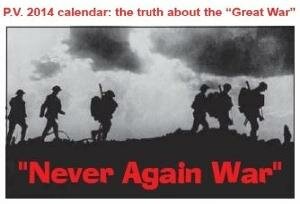
To order a copy of the People’s Voice 2014 Anti-First World War
Calendar, send $15 (includes postage and handling) to
People’s Voice, 706 Clark Drive, Vancouver, BC, V5L 3J1. Contact us at
604-255-2041 or pvoice@telus.net for bulk order prices.
|
People's Voice deadlines: May 1-15 May 16-31 Send submissions to PV Editorial Office,
|
REDS ON THE WEB
http://www.parti-communiste.ca/
peoplesvoice.ca
www.ycl-ljc.ca
www.solidnet.org
|
People's Voice finds many "Global Class Struggle" reports at the "Labour Start" website, http://www.labourstart.org/. We urge our readers to check it out! |
* * * * *
People's Voice
Canadian Publications Mail Sales Product Agreement #205214
ISSN number 1198-8657
People's Voice is published by
New Labour Press Ltd
PV Editorial Office
706 Clark Drive,
VANCOUVER, B.C. V5L 3J1
Phone:604-255-2041
Fax:604-254-9803
email: pvoice@telus.net
Editor: Kimball Cariou : Business Manager: David Au
Editorial Board: Kimball Cariou, Miguel Figueroa,
Doug Meggison, Naomi Rankin, Liz Rowley, Jim Sacouman
* * * * * *
Letters
People's Voice welcomes your letters
on any subject covered in our pages.
We reserve the right to edit for length and clarity,
and to refuse to print letters which may be libellous
or which contain unnecessary personal attacks.
Send your views to:
"Letters to the Editor",
706 Clark Dr., Vancouver, BC V5L 3J1,
or pvoice@telus.net
People's Voice articles may be reprinted without permission,
provided the source is credited.
* * * * * *
The Communist Party of Canada, formed in 1921,
has a proud history of fighting for jobs, equality, peace,
Canadian independence, and socialism.
The CPC does much more than run candidates in elections.
We think the fight against big business and its parties
is a year-round job,
so our members are active across the country,
to build our party and to help strengthen people's movements
on a wide range of issues.
All our policies and leadership
are set democratically by our members.
To find out more about Canada's party of Socialism,
give us a call at the nearest CPC office.
* * * * * *
Central Committee CPC
290A Danforth Ave Toronto, Ont. M4K 1N6
Ph: (416) 469-2446
fax: (416) 469-4063 E-mailmailto:info@cpc-pcp.ca
Parti Communiste du Quebec (section du
Parti communiste du Canada)
5359 Ave du Parc, Montréal, Québec,
H2V 4G9
B.C.Committee CPC
706 Clark Drive, Vancouver, V5L 3J1
Tel: (604) 254-9836
Fax: (604) 254-9803
Edmonton CPC
Box 68112, 70 Bonnie Doon P.O.
Edmonton, AB, T6C 4N6
Tel: (780) 465-7893
Fax: (780)463-0209
Calgary CPC
Unit #1 - 19 Radcliffe Close SE
Calgary AB, T2A 6B2
Tel: (403) 248-6489
Ottawa CPC
Tel: (613) 232-7108
Manitoba Committee
387 Selkirk Ave., Winnipeg, R2W 2M3
Tel/fax: (204) 586-7824
Ontario Ctee. CPC
290A Danforth Ave., Toronto, M4K 1N6
Tel: (416) 469-2446
Hamilton Ctee. CPC
265 Melvin Ave., Apt. 815
Hamilton, ON.
Tel: (905) 548-9586
Atlantic Region CPC
Box 70 Grand Pré, NS, B0P 1M0
Tel/fax: (902) 542-7981
http://www.parti-communiste.ca/
* * * * * *
News for People, Not for Profits!
Every issue of People's Voice
gives you the latest
on the fightback from coast to coast.
Whether it's the struggle for jobs or peace, resistance to social cuts,
solidarity with Cuba, or workers' struggles around the world,
we've got the news the corporate media won't print.
And we do more than that
- we report and analyze events
from a revolutionary perspective,
helping to build the movements for justice and equality,
and eventually for a socialist Canada.
Read the paper that fights for working people
- on every page, in every issue!
People's Voice
$30 for 1 year
$50 for 2 years
Low-income special rate: $15 for 1-year
Outside Canada $50 for 1 year
Send to: People's Voice, 706 Clark Drive, Vancouver, BC, V5L 3J1
You can call the editorial office at 604-255-2041
REDS ON THE WEB
http://www.parti-communiste.ca/
http://www.ycl-ljc.ca/
http://www.solidnet.org/
(The following articles are from the April 16-30, 2014, issue of People's Voice, Canada's leading socialist newspaper. Articles can be reprinted free if the source is credited. Subscription rates in Canada: $30/year, or $15 low income rate; for U.S. readers - $45 US per year; other overseas readers - $45 US or $50 CDN per year. Send to People's Voice, c/o PV Business Manager, 706 Clark Drive, Vancouver, BC, V5L 3J1.)
1) COMMUNISTS SAY: ENVIRONMENT BEFORE PROFITS
By Kimball Cariou
The question of "environment or jobs" has become one of the central debates of the 21st century, including in Canada. At all levels of political discussion in this country, this crucial topic is a matter for sharp disagreements. But does placing the question in such an "either-or" way really help us to understand the options?
On one point, there is a wide consensus, both in Canada and internationally: the Harper Conservatives are one of the most dangerously anti-environmental governments on the planet. At virtually every major global gathering around environment issues, activist movements have condemned Canada's expansion of greenhouse gas emissions, in particular the rapid escalation of tar sands projects. For PM Harper and his clique, tied closely to the profit interests of the major energy monopolies, even to debate these issues is considered treasonous. Popular grassroots movements in opposition to tar sands expansion, natural gas fracking and other forms of CO2 emissions are subject to relentless scrutiny by security services, and the few politicians who dare to speak out against the energy giants are bitterly attacked by the Tories and the corporate media.
The NDP is no exception to this development. Federal leader Thomas Mulcair has moved his party closer to the neoliberal agenda of big capital, with the significant exception of opposition to the tar sands expansion. For this, Mulcair is constantly painted as either naive or as an elitist opposed to the interests of working people. Similarly, the BC NDP is in the process of choosing a new leader, having (incorrectly) blamed their 2013 election defeat on the decision by outgoing leader Adrian Dix to speak out against the unpopular Enbridge Northern Gateway pipeline project.
The emergence of a manufactured "consensus" in favour of oil and gas interests simply avoids the reality that a majority of Canadians are both deeply concerned about the impact of human activities on the global climate, and also that there are many ways to create jobs through environmental protection.
There is one political party which projects such a strategy. The Communist Party of Canada has advanced a wide-ranging set of proposals designed to protect the environment and to create jobs.
This is in sharp contrast to the major opposition parties, including the Greens, which base their policies on "market-based" tinkering with the "real costs" of human economic activities. The Communist Party argues that capitalism itself, a system based on the extraction of maximum profits, is inherently a threat to human survival. The goal of the Communist Party is public ownership of key industries and resources, which would allow for democratic control and economic planning to protect the interests of working people and the environment.
In recent years, the corporate-backed Harper Tories have made Canada a key opponent of global plans to tackle the deepening global climate crisis. The Communist Party demands emergency action on this issue, as well as support for reparations to countries affected by capitalist-driven climate change.
The Communists call for legislation to slash greenhouse gas emissions, including a phase-out of coal‑fired plants. Rejecting the claim that such measures will "kill jobs," the CP urges investments to create jobs through renewable energy and conservation programs. This would include more stringent vehicle emission controls, expanded urban mass transit, and the eliminate of fares by subsidizing fare collections. The Communists call for funding high‑speed rail lines, and the development of a fuel-efficient Canadian car.
Radical change is advocated by the CP, aiming to remove the private profit motive as the driving force behind economic decision-making. The party's platform for the most recent federal election included a call to adopt a People's Energy Plan, based on public ownership and democratic control of all energy and natural resource extraction, production and distribution.
In the short term, the Communists call for a 100% tax on the windfall profits of the oil monopolies, and to "stop and reverse the privatization, deregulation and break‑up of public energy utilities."
The Communists urge a freeze and reduction of energy exports to the U.S., and instead propose to expand shared power flows among provinces through an East‑West power grid. The Party opposes any new development of the Alberta tar sands, and calls to close these operations within five years. Jobs should be guaranteed for workers in more sustainable industries at equivalent wages, and compensation provided for Aboriginal peoples and communities affected by the tar sands. The Party opposes the Enbridge and Mackenzie Valley pipelines, and oil and gas exploration and shipping on the west coast. It calls for a moratorium on the development of shale gas resources in all provinces.
To protect working people hard-hit by declining incomes, the Communist Party supports restoration of the "two price" system, with higher prices for energy exports, and lower prices for domestic uses, especially home heating.
On other environmental issues, the Communist platform includes a ban on "biofuels" derived from feed grains; heavy fines and jail terms against polluters and destructive corporate practices, such as clear-cutting, in‑ocean fish farming, and deep‑sea draggers; and no industrial development in parks.
The Communist Party also calls for action such as income supports to defend family farms and protect Canada's food sovereignty. The Party's platform urges stronger action to support organic farming: reduce the use of antibiotics, fertilizers, and pesticides, a ban on "terminator" seeds, and mandatory labelling of genetically‑modified food products.
2) ONTARIO COMMUNISTS PREPARE FOR ELECTION
PV Ontario Bureau
Ontario Communists are getting ready for a spring election, as provincial Conservatives try to smear the Liberal minority government with charges of criminal corruption.
"It's a classic case of the pot calling the kettle black", said CPC Ontario leader Liz Rowley, describing the last Tory government in Ontario as one of the most corrupt and reactionary ever.
"The Liberals' biggest crime is carrying through the Tory agenda, after decisively defeating it at the polls 10 years ago" she said, "and if that's not criminal and corrupt enough, look at the what the Tories are planning to do to working people if they're elected again this year!"
"You can kiss labour and democratic rights goodbye" she added, referring to Tory leader Tim Hudak's plan to eliminate the Rand Formula and introduce right to work for less laws in Ontario. That cost them votes and seats in recent by‑elections, forcing Hudak to drop it from his election platform, "but he hasn't dropped it off the agenda where it's still top of the list", said Rowley.
"The Tories are the greatest threat to working people in this election, but the Liberals are no solution," Rowley added. "The Liberals want an across the board public sector wage freeze and so do the Tories. Even the NDP supports a wage freeze though they don't support legislation ‑ or at least they didn't a year ago. Only the Communist Party is opposed to these attacks on labour rights, wages and living standards, and only the Communist Party is fighting to raise wages, pensions, incomes and living standards, create good jobs in industry, manufacturing, forestry and construction, and expand public services and social programs, public ownership and democratic control."
Among other demands, the CPC (Ontario) will campaign to substantially increase the minimum wage to $19 (the minimum livable wage), introduce a livable Guaranteed Annual Income, and to expand the Canada Pension Plan by substantially increasing benefits while dropping the (voluntary) pension age to 60.
The party calls for a strong well‑funded, and universal Canada Pension Plan, to provide livable defined benefit pensions to all Canadians, not a patchwork of plans that fluctuate with the markets.
"This election is about bread and butter, jobs, and democracy ‑ all the important things that none of the Big Business parties and wannabes can or will deliver", said Rowley. "Curbing corporate greed and meeting people's needs requires working class parties with big ideas, and big movements to push those big ideas forward. This election, send a message: vote Communist for people needs, not corporate greed."
3) HALT CHANGES TO ALBERTA PUBLIC SERVICE PENSIONS
In our previous issue, we reported on the attack against public sector pensions by Alberta's Conservative government. This April 3 news release from the United Nurses of Alberta sheds new light on this struggle.
A February 2014 report of the Auditor General reinforces and supports the argument of public sector unions that changes to public employee pension plans are premature and have not been properly analyzed.
The approach taken by the PC Government has lacked consultation and testing of outcomes as recommended by the Office of the Auditor‑General in its report. The government has clearly failed to make the case that its proposed changes are needed.
United Nurses of Alberta and the Labour Coalition on Pensions continues to urge Finance Minister Doug Horner to consider the recommendations by the Auditor General and ensure that proper consultation and outcomes testing has taken place before major changes to the plans are introduced.
Unions have consistently recommended changes to governance of the plans that would improve stakeholder involvement in plan design changes to manage risks, as recommended by the Auditor General's report, and that these changes have not been implemented by the government
The Coalition notes specifically that the Auditor General concluded that it is "unclear whether the proposed reforms significantly increase the likelihood of the plans' sustainability."
Among the points made by the Auditor General's report are the following:
‑ The Government of Alberta has not properly engaged plan stakeholders - the employees and employers who pay for the plans
‑ The government has not fully considered effects of the changes it is pushing through
- The government has not planned how any changes would actually be implemented
‑ The "hard cap" on pension contributions proposed by the government can in fact harm the plans' sustainability
The Auditor General's report provides clear evidence the government's rushed process to major pension plan changes needs to be halted until appropriate consultation with stakeholders and rigorous analysis of the impacts of the government's proposals has been completed, a process that cannot happen in a few weeks.
Approximately 300,000 Albertans, about a third of them retirees, and their family members are direct stakeholders in Alberta's public sector pension plans. They are front‑line workers in Alberta's hospitals, schools, cities and towns.
Most of the 30,000 Registered Nurses, Registered Psychiatric Nurses and allied health workers represented by United Nurses of Alberta are members of the Local Authorities Pension Plan.
Visit TruthAboutAlbertaPensions.ca to contact your MLA about the proposed changes to the Local Authorities Pension Plan.
4) STOP THE ATTACK ON DEMOCRACY! DEMAND C‑23 BE WITHDRAWN NOW!
Several of Canada's smaller political parties have organized a news conference in Ottawa on April 11 to speak out against Bill C-23, the "Fair Elections Act." In this statement, the Communist Party condemns this anti-democratic legislation.
The Communist Party of Canada joins with other federally‑registered political parties, labour and community organizations, and hundreds of Canadian and international constitutional experts and scholars in condemning the anti‑democratic character of the so‑called Fair Elections Act (C‑23) and demanding its immediate withdrawal. We urge all democratically‑minded Canadians, unions and people's organizations to act now to defeat this legislation.
The most odious measures under the proposed Act would further erode the integrity of the federal electoral process by:
* Eliminating vouching and the use of Voter Information Cards (VIC) during elections, effectively disenfranchising hundreds of thousands of voters, especially Aboriginal peoples, youth and students, seniors and rural voters;
* Removing the investigative capacity of Elections Canada to monitor and prevent election fraud, placing it instead under the authority of the Director of Public Prosecutions, a Cabinet appointee who is in turn answerable to Cabinet and the PMO, not to Parliament itself;
* Forbidding Elections Canada from promoting democratic participation through "get out the vote" campaigns, and essentially placing a "gag order" on its leading official, the Chief Electoral Officer of Canada; and
* Removing "fundraising" from expenses monitored under election campaign spending limits, an extremely partisan move which would benefit only the largest parties, and especially the Conservatives;
Coming on top of the recent experience of the last federal election in 2011, when the Tories were responsible for a number of serious violations of the Canada Elections Act, most importantly the notorious "robo‑call" [or "voter suppression"] scandal, the misnamed "Fair Elections Act" will disenfranchise even more voters, weaken the already lax enforcement of election rules, and unfairly benefit the large, established Big Business parties - and especially the Conservative Party itself. This will only add to already widespread public scepticism about the utility and "fairness" of the existing electoral process, at a time when voter participation rates continue to tumble.
It is hypocritical in the extreme that the Harper government, with its unbridled penchant for arrogantly lecturing other countries and peoples about the sanctity of "democracy", should dare to introduce such a patently undemocratic and self‑serving piece of legislation.
The attempt of the Harper government to rush this deeply flawed Bill through Committee and Parliament without even consulting with Elections Canada officials or organizing any public hearing process exposes once again its deep‑seated disdain for democratic principles and practices.
If the Conservatives had any real commitment to improving the current electoral system, they would open broad public discussion around genuine reforms to enhance democratic participation in the country, including consideration of proportional (or mixed proportional) representation in Parliament, further restrictions on campaign spending, a return to full voter enumeration before every election, greater and more equitable access to media for all political parties, not just the large, entrenched parties, and other reforms.
The Communist Party demands that Parliament reject C‑23, and instead open a wide, open and transparent discussion across the country on genuine electoral reform, including the convocation of public hearings and citizen meetings in both large and smaller urban centres, as well as rural areas.
The Harper Tories seem convinced that they can force the bill through "come hell or high water", as a set‑up for a Tory victory in the 2015 general election. This is how elections are stolen. But we are quite convinced that this dangerous attack on Canada's electoral system can and must be stopped through mass political action. The Harper Tories must be forced to retreat! Our Party is committed to work with other all other political forces, labour and mass democratic organizations to defeat C‑23!
The Communist Party of Canada (CPC) has a long and distinguished history of fighting for democratic reform. The CPC was the first political party in Canada to call for the introduction of proportional representation, for the citizens' right to recall elected officials, and for the full political equality and rights of Aboriginal peoples. After a 10‑year political and legal battle, our Party won a unanimous ruling at the Supreme Court of Canada [Figueroa v. Attorney‑General of Canada; 2003] declaring unconstitutional several sections of the Canada Elections Act which discriminated against smaller political parties. A summary of that case is available at http://communist-party.ca/?page_id=66http://communist-party.ca/?page_id=66 and the full SCC ruling can be accessed at http://scc-csc.lexum.com/scc-csc/scc-csc/en/item/2069/index.dohttp://scc-csc.lexum.com/scc-csc/scc-csc/en/item/2069/index.do.
People's Voice Editorial
The Harper Conservatives have never been known for understanding facts or science. This is the government which tossed out the long form census a few years ago, even dismaying their business backers. Most readers can recall similar stories, from the trashing of valuable Fisheries and Oceans libraries, to the refusal to join most of the world in recognizing that expansion of greenhouse gas emissions is destroying the planet.
The latest bonehead Tory move is relying on misleading job vacancy numbers. One would think that a rabidly pro‑business government might want to ensure a regular supply of skilled labour to the corporate sector. After all, the same government talks about labour shortages and skills mismatches, even while 1.5 million Canadians are officially counted as unemployed. The Canadian Labour Congress has noted repeatedly that many workers are desperate for jobs, and that these "shortages and mismatches" affect only a few specific regions and occupations. Employment Minister Jason Kenney has even agreed that better data is needed, starting with reliable, timely, and detailed labour market information.
Of course, the fact that right‑wing governments are happy to drive down wages by keeping unemployment high. But it also turns out that the job vacancy data provided by Finance Canada relies, in part, on job postings listed on the Kijiji website, where the same positions get reposted over and over again, and many are complete scams. Recent Kijiji "job postings" include: "Employer looking to hire someone to hand‑feed mini‑marshmallows to pet monkey." (No, we aren't making this up.)
If the Harper Tories were simply embarrassing themselves, none of this would matter. But these corporate thugs are running the country and wrecking the lives of working people. We urge the incoming CLC leadership to go beyond issuing news releases, and instead mobilize Canadians to drive Harper out of office.
6) DEEPAK CHOPRA FEEDS PITNEY BOWES
People's Voice Editorial
While the federal government is busy getting Canada Post ready for privatization, CEO Deepak Chopra is way ahead of the game. Chopra, who is conveniently the former CEO of Pitney Bowes, has cut a sweet deal for this transnational and its corporate customers, who get cut‑rate postal rates because they buy their postage using Pitney Bowes meters.
Just how sweet is that deal? Why it's 50% off, all day, every day! So while you now pay a dollar to mail your letters ‑ or 83 cents each if you're mailing 100 letters - corporate customers are paying just 75 cents each for their metered postage. And Pitney Bowes, which has the monopoly on cut‑rate postage rates thanks to Deepak Chopra, is just lovin' it while raking it all in.
Thanks Harper! This odious scandal is yet another reason to kick out the Tories and save Canada Post, before the threatened elimination of urban door-to-door delivery becomes a nasty reality. And remember this scandal every time you contemplate the future: walking down icy city sidewalks to your new supermailbox, hoping that criminal gangs haven't busted in to steal your private correspondence.
Good postal service at reasonable rates should be the right of all Canadians, both in urban and rural areas. That's especially important for seniors, people with mobility issues, and the millions of Canadians who need postal services, not just email.
To win that right, we need to curb corporate power, dump the Tories, and block the right wing forces imposing their entire privatisation-cutback-profiteering agenda. It's time to demand action on people's needs, and to stop feeding Deepak Chopra-style corporate greed!
7) ENVIRONMENTAL CRISIS AND CLIMATE CHANGE
The Young Communist League of Canada will hold its Central Convention in Toronto from May 23 to 25. This article is an excerpt from the Political Resolution for the convention, online at rebelyouthblogspot.com.
Environmental problems are increasingly urgent crises that are shaping are struggles while operating on a global level.
A major danger is the escalating problem of global pollution, which is driven forward by the very wastefulness that the unplanned capitalist system encourages. Mines, industrial estates, agriculture, smelters and ore processing, pesticide manufacture and storage are all point sources of mercury, lead, arsenic, chromium, and radio nuclides as well as sulfur and nitrogen oxides, carbon monoxide, and particulates. The March 2011 Fukushima Daiichi nuclear disaster is one tragic example which lead to 500 disaster‑related deaths, and released a large amount of radioactive material into the Pacific. Some of this radioactive material is now is the massive oceanic trash vortexes - gyres of floating garbage, toxic sludge and tiny plastic debris, with two in the Pacific, two in the Atlantic and one in the Indian Ocean - are poisoning marine life and the food chain. All these pollutants are sources for major health problems like cancer and death, especially in children. Industrial and urban discharge, runoff and spills and air pollutants affects the health of hundreds of millions of people, equivalent to a global disease epidemic. Water pollution alone causes an estimated 14,000 deaths a day, which is equivalent to the city of Peterborough dying each week. The poorest countries by far have the worst crises.
Scientists are also warning of the steady erosion of species and biodiversity caused by habitat destruction, invasive species, over‑exploitation, genetic pollution and climate change. We are talking here about the results of millions of years of evolution being wiped out in an irreversible catastrophe that has significant impact on humans.
If youth and progressive forces had needed further proof about the relationship between social‑economic crises and the environment, the world food price crisis of 2007‑2008 clearly showed their interconnection. The United Nations (UN) is still warning of a new era of rising prices and spreading hunger, with world grain reserves at their lowest currently since the 1970s and continued danger of low harvests and drought. Food prices as well as deforestation, desertification, loss of biodiversity, food production, and environmental racism were among a host of environmental problems our 26th Central Convention identified, linking to the juggernaut of climate change. In fact, each of the last three decades has been successively warmer, with 1983 to 2013 likely the warmest 30 year period for the northern hemisphere in the last 1,400 years.
News headlines are replete with climate change‑related events like super Typhoon Haiyan last winter, or that Australia has experienced such extreme heat that it had to add a new colour, purple, to its temperature map last January. In fact, last autumn a UN scientific body, the International Panel on Climate Change (IPCC), announced they now had "unequivocal" evidence linking climate change to "human activity" and that the world faced a catastrophe in two or three decades if there are not drastic cuts in GreenHouse Gas (GHG) emissions.
Around the same time, the Mauna Loa Observatory in Hawaii announced atmospheric levels of the main GHG, Carbon Dioxide or CO2, are now at 400 parts per million up from less than 350 ppm just fifty years ago and approaching the danger zone of 425‑450 ppm and a potentially deadly increase of global temperature by more than 2 degrees Celsius. CO2 levels were last this high about 3‑5 million years ago, a long‑term record which shows how sensitive the earth's climate is to CO2 levels. As temperatures rise, unpredictable feedback loops could begin such as what scientists call the "Arctic Methane bomb" when ice sheets melt releasing that powerful GHG in huge quantities.
The crisis we described four years ago as "one of the foremost pressing environmental problems" has thus gotten much worse.
By drastic, the IPCC is floating proposals such as keeping two‑thirds of known fossil fuel resources in the ground. Corporate economists figure such government implemented climate change reforms could trigger another economic crisis as the now‑inflated value of such stranded oil, gas and coal resources would collapse. This "carbon bubble" is both a pretext for fear mongering and foot‑dragging, and an objective contradiction the capitalists resolve the climate change crisis, which is reflected in the complete failure of negotiated agreements so far.
Last year marked the 25th anniversary of a groundbreaking 1988 international policy conference on "the changing atmosphere" in Toronto, which stated that "Humanity is conducting an unintended, uncontrolled, globally pervasive experiment whose ultimate consequences could be second only to a global nuclear war." That conference recommended a drop of 20% below 1988 levels of GHGs by 2005. However, four years later, the UN Rio conference would put into motion the "Conference of the Parties"or COP process leading to the Kyoto Protocol, which set a much lower objective: only 6% below 1990 levels by 2012 and commodified GHGs, introducing the mechanism of carbon trading.
Yet even these levels have not been met and carbon trading has now been proven as totally ineffective. The 2009 fifteenth Conference of the Parties or COP‑15 in Copenhagen forecast that Kyoto was not being achieved, proposed yet again lower targets, and sharply brought forward questions like can developing countries afford to forgo industrial development? Could they control the big transnationals even if they wanted to? How would legally enforceable agreements actually be enforced? And, how can a treaty be reached when the big imperialist countries have not only violated past agreements but done a backslide?
Those youth who have found the resources to attend the COP meetings and tried to engage with the process (civil society groups and NGOs have a 1 minute speaking time allocated to participate at certain points) have found themselves not only excluded but sometimes banned for several COP conferences for their remarks. At COP‑19 in Warsaw last December, 800 members of environmental groups walked out in protest as the meeting refused to set a target schedule, and adopted "nationally determined contributions", instead of "commitments" to reduce GHGs.
The promises of reduced emissions or "mitigation" by the rich countries have not materialized while so‑called "climate aid" funds have either never come or have now dried up.
These "adaptation" plans, trying to deal with the problems created by climate change like rising water levels, were supposed to be funded by the large imperialist countries for basically the rest of the world - loosely organized into the 133‑country "Group of 77" including Brazil, Indonesia, and India as well as the Least Developed Countries group (ie. Haiti, Afghanistan, Mali, Laos, etc.), the African Group, the Alliance of Small Island States (ie. the low lying islands in Micronesia, Fiji, Singapore, Seychelles, Cuba, etc) and China. China's own GHG emissions have been over 20% since 2005, when it surpassed the US as first in the world, although both on an historic and per capita basis China at of 6.2 metric tonnes per capita and 30 years of industrial growth is far behind the contributions of Canada (19.8), the US (17.6) and Japan (9.2) which have all been major industrial polluters for almost one hundred years. China is also the fourth largest producer of wind power globally and the first largest maker of wind turbines and solar panels.
From our perspective, the way forward has to recognize that capitalism created this crisis and that a clear and deep change in paradigm is necessary - not rhetorical but revolutionary in scope. The attack to the sustainability of the environment will never be truly stopped under a capitalist framework. Instead, forms of "market regulation" have resulted in a transfer of GHGs rather than any meaningful reduction. Climate justice means Canada, the US, the European Union, Japan, and major capitalist countries have the first obligation including the unrestricted transfer of eco‑friendly technologies and even climate reparations.
These major aspects of the environmental crisis and climate change cannot be resolved under the capitalist system, making the question of socialism so urgent! As we said in the editorial of the December 2013 Rebel Youth magazine, "given the global character of contemporary capitalism, struggles waged in each country must be combined to an ever greater extent with coordinated regional and global forms of struggle. An international democratic and anti‑imperialist front is urgently required ... based on the principles of peace, non‑aggression, and global disarmament; respect for the sovereignty of all states; for the equality and rights of all nations, large and small, the peaceful coexistence of different social systems, and the Universal Declaration of Human Rights; fair and balanced trade and economic cooperation; respect and promotion of cultural diversity; and protection of the environment." This should act as a framework for understanding our work with international youth coalitions and federations.
8) "INDIGENOUS PEOPLES WILL BE THE NEXT TARGET OF MODI"
By Gurpreet Singh, Surrey, BC
Internationally acclaimed writer and social justice activist from India, Arundhati Roy, has warned that the Adivasis (Indigenous peoples) will be the next target after Muslims if Narendra Modi comes to power as Prime Minister. India's election is being held from April 7 to May 12 across the country.
Roy, who was in Vancouver to attend the annual Indian Summer Festival, said in an interview with this correspondent that the Hindu nationalist Bhartiya Janata Party's candidate poses a threat to the tribal population, which continues to resist the expansionism of the corporate world in central India.
"The corporate firms will be too happy to back anyone in power who can use military force to crush this resistance so that business companies can easily take control over natural resources in the tribal areas," said Roy. "Since Modi has displayed his brutality during the anti-Muslim massacre, the big corporations see him as their best bet to expand their business empire''
Modi, the Chief Minister of Gujarat, is widely blamed for inciting anti-Muslim violence in that state in 2002, following the alleged attack on a train killing 59 Hindu passengers. Although one commission of enquiry found that it was an accident caused by the cooking gas on the train, Hindu nationalists have maintained that it was the result of an attack by Muslim fundamentalists.
Modi is contesting the parliamentary election from two ridings, including Varanasi, the city known for Hindu pilgrimage. His party hopes to oust the Congress-led coalition to come to power with a majority.
According to Roy, Modi has proved that he won't back away from any military adventure, such as Operation Green Hunt, launched by the Congress government to displace tribal populations in the name of fighting against Maoist insurgency, but abandoned under public pressure. She pointed out that many memorandums of understanding signed between the Indian state and corporate firms could not be implemented, creating great desperation among the big businesses.
Over 200 districts of India form the so-called "red corridor" where insurgents are engaged in violent class struggle. These are the tribal areas, where the Maoists enjoy grassroots level support from adivasis, who have endured exploitation and oppression by the ruling classes for years. The area is rich with minerals, which is reason enough to draw corporate interest. Roy travelled to areas declared as liberated zones by the Maoist guerrillas in 2010. Her essay, "Walking With the Comrades," gives a detailed account of this conflict.
Referring to a question on the "selectivity" of the Indian justice system towards minorities, Roy said the law treats Muslims, particularly Kashmiris, differently as compared to the ultra Hindu nationalists. She pointed out that BJP leader Varun Gandhi easily got away with his anti-Muslim rhetoric during the last election, whereas Muslim candidate Imran Masood was promptly charged for making an alleged hate speech against Modi.
Roy participated in a campaign seeking amnesty for Afzal Guru, a Kashmiri militant who was hanged in 2013. She added that the Indian state wanted to satisfy the collective consciousness of the society and show the people of Kashmir that it can do anything, even if it means hanging a wrong person. She was once charged for sedition for suggesting that the disputed territory of Kashmir is not an integral part of India, a statement which outraged the Hindu right-wing forces.
She said the caste-based discrimination system has been entrenched and modernised by globalization, and any suggestion that it has disappeared with "economic liberalisation" is a myth.
Roy's Booker Prize-winning 1997 novel "The God of Small Things" touches upon this sensitive issue. The novel takes a dig at the left parties, which Roy said have also failed to address this issue. She questioned the logic behind celebrating Mahatma Gandhi as a saint and the father of the Indian nation, despite his support for the caste system, which is "worse than the apartheid".
"It's a shame that the Indian society treats caste system as divinely sanctioned," she said.
She recently wrote the foreword for "The Doctor and the Saint", a book based on Dr. B.R. Ambedkar's paper "Annihilation of Caste" and his conflict with Mahatma Gandhi.
"Through Gandhi's own writings I have proved how wrong he was on the issue of caste," Roy said.
Ambedkar was the architect of the Indian constitution and a radical social activist. Born in a Dalit (Untouchables) family, he encountered prejudices at the hands of "upper caste" Hindus, and was locked in a tussle with Gandhi over the issue. Gandhi was opposed to Untouchability, but was not against the caste system. Ambedkar rose to become a leader of the Dalit emancipation movement in India, and is still revered by the oppressed groups.
9) WIKILEAKS SHOWS NATO'S ROLE IN UKRAINE
By Conn Hallinan, People's World
Is the Russian occupation of the Crimea a case of aggressive expansionism by Moscow or aimed at blocking a scheme by the North Atlantic Treaty Organisation (NATO) to roll right up to Russia's western border? WikiLeaks has revealed a secret cable describing a meeting between French and American diplomats that suggests the latter, a plan that has been in the works since at least 2009.
Titled "A/S Gordon's meeting with policy makers in Paris," the cable summarises a September 16, 2009 get‑together between Philip Gordon, then assistant US Secretary of State for European and Eurasian Affairs, and French diplomats Jean‑David Levitte, Damien Loras, and Francois Richier. Gordon is currently a special assistant to President Obama on the Middle East.
While the bulk of the cable covers an exchange of views concerning Iran, the second to last item is entitled "NATO's enlargement and strategic concept." At this point Levitte, former French ambassador to the US from 2002 to 2007, interjects that "[French] President [Nicholas] Sarkozy was `convinced' that Ukraine would one day be a member of NATO, but that there was no point in rushing the process and antagonising Russia, particularly if the Ukrainian public was largely against membership." Gordon goes on to paraphrase Levitte's opinion that, "the Bucharest summit declaration was very clear that NATO had an open door and Ukraine and Georgia have a vocation in NATO."
Levitte is currently a fellow at the conservative Brookings Institute.
At the April 2008 NATO summit in Romania, Croatia and Albania were asked to join - they did so in 2009 - and postponed a decision concerning Georgia and Ukraine until December 2008. But in August, Georgian forces attacked the breakaway province of South Ossetia - possibly under the delusion that NATO would come to their aid - setting off a short and disastrous war with Russia. The vote on Georgia and Ukraine was shelved both by that war and a Gallup Poll indicating that 40 percent of Ukrainians considered NATO a threat, while only 17 percent had a favourable view of the alliance.
The move by NATO to extend the alliance to the Russian border is a controversial one that violates the spirit, if not the letter, of a February 1990 agreement between then Soviet leader Mikhail Gorbachev, US Secretary of State James Baker, and Chancellor Helmut Kohl of Germany.
The issue at the time was Germany and NATO. Under the treaty ending World War II, the Soviets had a right to keep troops in Eastern Germany. The US and the Germans were trying to negotiate a reunion of the two Germanys that would remove the 380,000 Soviet troops in the East, while maintaining US and NATO forces in the West.
The Russians were willing to exit their troops, but only if US and NATO forces did not fill the vacuum. On February 9, Gorbachev told Baker "any extension of the zone of NATO would be unacceptable." Baker assured him that "NATO's jurisdiction would not shift one inch eastward."
The Baker‑Gorbachev meeting was followed the next day by a meeting between Gorbachev and West German Chancellor Helmut Kohl, who assured him that "naturally NATO could not expand its territory" into East Germany. And, in a parallel meeting between West German Foreign Minister Hans‑Dietrich Genscher and Soviet Foreign Minister Eduard Shevardnadze, Genscher told Shevardnadze "for us, it stands firm: NATO will not expand to the East."
But none of the assurances were put in writing and, as the Soviet Union began to implode, the agreement was ignored and NATO forces moved into the old East Germany.
As former New Republic editor Peter Beinart notes in The Atlantic, the decision to expand NATO was considered to be "recklessly provocative" by a number of foreign policy experts. "As eminent Cold War historian John Lewis wrote, "Historians - normally so contentious - are in uncharacteristic agreement: with remarkably few exceptions, they see NATO enlargement as ill‑considered, ill‑timed, and above all ill‑suited to the realities of the post‑Cold War world."
But with Russia severely weakened, Cold War triumphalism took over: President Bill Clinton took NATO to war in Yugoslavia in 1995, and put troops into Bosnia. By 1997 Poland, Hungary and the Czech Republic joined NATO, followed in 2004 by seven Soviet bloc countries, including former Soviet republics Latvia, Lithuania, and Estonia. NATO's "Partnership for Peace" was expanded to include the former Soviet Republics of Ukraine, Georgia, Moldova, Kazakhstan, Armenia, and Azerbaijan.
The recent "bailout" offer to Ukraine by the European Union contained a clause that would have tied Kiev to the EU's military organisation.
In short, Russians feel like they are surrounded by hostile forces, a fact critics of Moscow's moves in the Crimea should keep in mind.
The danger of pushing a military alliance up to the borders of a potential adversary was made clear in early April when NATO began deploying forces in the Baltics and Poland, and the US sent a guided missile destroyer into the Black Sea.
The Pentagon announced it was sending F‑16 fighter‑bombers and F‑15 fighters to Poland and the Baltic States, as well as C‑130 transport planes and RC‑135 aerial tankers. In the case of Latvia, Lithuania and Estonia, this will result in an increase in NATO forces on Russia's northern border.
The USS Truxtun is an Arleigh Burke class destroyer armed with cruise missiles and anti‑ship Harpoon missiles. Cruise missiles can carry a nuclear warhead. According to the US Navy, the Truxtun's mission has nothing to do with the crisis in the Ukraine but is simply carrying out joint manoeuvres with the tiny Romanian and Bulgarian navies.
It is unlikely that the USS Truxtun will go looking for trouble or that the F‑15s and F‑16s will play chicken with Russian MIGs and Sukhois, but mistakes happen, particularly when tensions are high.
10) GREECE SINKING DEEPER INTO CRISIS
According to a report by Panagiotis Grigoriou in the April 7, 2014 issue of Le Monde diplomatique, the economic crisis continues to deepen in Greece.
"The jobs aren't there any more. Anyone lucky enough to find work must accept whatever rate of pay they are offer," says Grigoriou.
He writes that in 2007 a group of young Greeks launched the G700 movement to protest the typical graduate starting salary of 700 euros a month. By 2013 even this low pay seemed a fortune, and the organisation was disbanding: "What we once called the 700 euro threshold has been smashed. 700 a month now seems like a vast sum. Today, our personal quest comes down to survival."
Unemployment in Greece has reached 30%, bringing the percentage of the population not participating in economic life (including the unregistered unemployed and students) to 56.4%. Since 2008 wages in the public sector have fallen by 25%.
The journalist interviewed "Manolis", who ran a small construction firm for more than 20 years, specialising in interior finishing in commercial and industrial buildings.
"I was earning as much as 6,000 euros a month. We were working around the clock, including weekends. Sometimes I even had to turn jobs down," said Manolis.
In 2010 he laid off his three labourers, thinking that business would pick up in a couple of years. In 2011 he had to move house, like many Greeks, because the flat where his family lived was too small for his mother to move in with them; his wife had been made redundant, and they needed his mother's pension of 1,000 euros a month to survive. He finally closed the company in 2012, selling his van to buy a car. Unemployed, with no benefits, Manolis planned to work in the black market, using the car to carry his materials and tools.
Manolis thought he would get by, even if he only worked five days a month; but he didn't get even that much work, except for a month building a hotel in Austria, paid only 60% of what an Austrian would have earned. Today he owes around 20,000 euros in social security insurance, back tax and repayments on bank loans.
And 2014 has not started well. New austerity measures may cut his mother's pension, and like a third of all Greeks, Manolis no longer has health insurance.
Yannis, a journalist with more than 25 years' experience was earning 2,000 euros a month until he lost his job in 2010. For a year, he received benefits of 450 euros a month, and because of compensation paid by his former employer he was able to survive until January 2012, when used the last of his savings. He received one job offer, from former colleagues who set up a self‑financed newspaper cooperative. Joining would involve putting up start‑up money of between 1,000 and 2,000 euros, plus working for three months without pay. He said no.
In 2012 Yannis got a new job at a major daily that had just found an investor, and signed an individual contract for 1,000 euros a month. After four months they stopped paying salaries on time. Before the crisis, the paper had 800 employees; now there are fewer than 200. By the end of 2013, the company owed Yannis and his colleagues five months' pay. The management put forward a rescue plan cutting salaries by 30%. Those who signed up agreed not to take any individual or collective action against the paper until August 2014. When Yannis and others refused, the management stopped their salaries.
Greece is rarely in the North American news these days. But the grim reality of the capitalist economic crisis has not disappeared.
11) EXPOSING THE CIA IN LATIN AMERICA
Raul Capote is a Cuban who in his youth was recruited by the US Central Intelligence Agency (CIA) to conspire in Cuba. But in reality, he was working as a double agent for Cuban national security. The following excerpts are from an interview which Capote gave to Chavez Vive in Havana. The interview was first published in Spanish on Aporrea.org, translated into English by Sabina C. Becker.
What was the process by which you were caught up?
It started with a process of many years, several years of preparation and capture. I was leader of a Cuban student movement which, at that time, gave rise to an organization, the Saiz Brothers Cultural Association, a group of young creators, painters, writers, artists. I worked in a city in southern‑central Cuba, Cienfuegos, which had characteristics of great interest to the enemy, because it was a city in which an important industrial pole was being built at the time. They were building an electrical centre, the only one in Cuba, and there were a lot of young people working on it. For that reason, it was also a city that had a lot of young engineers graduated in the Soviet Union. We're talking of the last years of the 1980s, when there was that process called Perestroika. And many Cuban engineers, who arrived in Cuba at that time, graduated from there, were considered people who had arrived with that idea of Perestroika. For that reason, it was an interesting territory, where there were a lot of young people. And the fact that I was a youth leader of a cultural organization, which dealt with an important sector of the engineers who were interested in the arts, became of interest to the North Americans, and they began to frequent the meetings we attended. They never identified themselves as enemies, or as officials of the CIA...
What conditions did they demand?
They told us: We have the ability to put the markets at your disposal, to put you on the markets of books or sculpture or movies or whatever, but we need the truth, because what we're selling in the market, is the image of Cuba. The image of Cuba has to be a realistic one, of difficulties, of what's going on in the country. They wanted to smear the reality of Cuba. What they were asking is that you criticize the revolution, based on anti‑Cuba propaganda lines, which they provided...
How long were you an agent of the CIA?
We were in this initial story until 1994. Because in 1994, I went to Havana, I came back to the capital and here, in the capital, I began to work for the Union of Cultural Workers, a union which represented the cultural workers of the capital, and I became more interesting yet to them, because I went on to direct - from being a leader of a youth organization with 4,000 members, to directing a union with 40,000 members, just in the city of Havana. And then, it gets much more interesting. Contacts followed. In that period there appeared a woman professor from a new university who came with the mission of kick‑starting the production of my literary work, to become my representative, to organize events.
Can you give her name?
No, because they used pseudonyms. They never used real names. And that type of work, promoting me as a writer, was what they were very interested in, because they wanted to convert me into a personality in that world. Promoting me now, and compromising me with them in an indirect manner.
And then, in 2004, there arrived in Havana a person well known in Venezuela, Kelly Keiderling. Kelly came to Havana to work as Chief of the Office of Press and Culture. They set up a meeting. they arranged a cocktail party, and at that party I met with 12 North American functionaries, North Americans and Europeans. They weren't only North Americans. All of them people with experience, some also inside the Soviet Union, others who had participated in training and preparation of the people in Yugoslavia, in the Color Revolutions, and they were very interested in meeting me. Kelly became very close to me. She began to prepare me. She began to instruct me. I began to receive, from her, a very solid training: The creation of alternative groups, independent groups, the organization and training of youth leaders, who did not participate in the works of our cultural institutions. And that was in 2004‑5. Kelly practically vanished from the scene in 2005‑6. And when I started to work, she put me in direct contact with officials of the CIA. Supposedly, I was already committed to them, I was ready for the next mission, and they put me in touch with Renee Greenwald, an official of the CIA, who worked with me directly, and with a man named Mark Waterhein, who was, at the time, the head of Project Cuba, of the Pan‑American Foundation for Development.
This man, Mark, as well as directing Project Cuba, had a direct link to Cuba, in terms of financing the anti‑revolutionary project, as well as being involved in working against Venezuela. That is, he was a man who, along with much of his team of functionaries of that famous project, also worked against Venezuela at that time. They were closely connected. At times it took a lot of work to tell who was working with Cuba, and who was not, because many times they interlocked. For example, there were Venezuelans who came to work with me, who worked in Washington, who were subordinates of the Pan‑American Foundation and the CIA, and they came to Cuba to train me as well, and to bring provisions. From there arose the idea of creating a foundation, a project called Genesis.
Genesis is maybe the template, as an idea, of many of the things going on in the world today, because Genesis is a project aimed at the university youth of Cuba. They were doing something similar in Venezuela. Why? The idea was to convert universities - which have always been revolutionary, which have produced revolutionaries, out of those from which many of the revolutionaries of both countries came - and convert them into factories for reactionaries. So, how do you do that? By making leaders. What have they begun to do in Venezuela? They sent students to Yugoslavia, financed by the International Republican Institute (IRI), which was financed by USAID and by the Albert Einstein Institute, and sent them, in groups of ten, with their professors.
Do you have the names of the Venezuelans?
No, we're talking of hundreds being sent. I spoke with the professor, and watched one group and followed the other. Because they were working long‑term. The same plan was also in place against Cuba. Genesis promoted, with in the university, a plan of training scholarships for Cuban student leaders and professors. The plan was very similar. Also, in 2003, they prepared here, in Havana, a course in the US Interests Section, which was called "Deposing a leader, deposing a dictator", which was based on the experience of OTPOR in removing Slobodan Milosevic from power. And that was the idea, inside the Cuban university, to work long‑term, because these projects always take a long time in order to reap a result. For that reason, they also started early in Venezuela. I believe as well - I don't have proof, but I believe that in Venezuela it began before the Chavez government, because the plan of converting Latin American universities, which were always sources of revolutionary processes, into reactionary universities, is older than the Venezuelan [Bolivarian] process, to reverse the situation and create a new right‑wing.
Did the CIA only work in Caracas?
No, throughout Venezuela. Right now, Genesis has a scholarship plan to create leaders in Cuba. They provide scholarships to students to big North American universities, to train them as leaders, with all expenses paid. They pay their costs, they provide complete scholarships. We're talking 2004‑5 here. It was very obvious. Then, those leaders return to university at some time. They're students. They go to end their careers. Those leaders, when they end their student careers, go on to various jobs, different possibilities, as engineers, as degree‑holders in different sectors of Cuban society, but there are others who go on constantly preparing leaders within the university. One of the most important missions of the university leaders was to occupy the leadership of the principal youth organizations of the university. In the case of Cuba, we're talking about the Union of Communist Youth, and the University Student Federation. That is, it was not to create parallel groups at that time, but to become the leaders of the organizations already existing in Cuba. Also, to form a group of leaders in the strategies of the "soft" coup. That is, training people for the opportune moment to start the famous "color revolutions" or "non‑violent wars", which, as you well know, have nothing to do with non‑violence....
What was the final task?
Well, to gather the international press, in my capacity as a university professor, and as a writer, and as a leader of that organization, that I go out publicly to ask the government of the United States to intervene in Cuba, to guarantee the lives of the civilians and to bring peace and tranquility to the Cuban people. To speak to the country in the name of the Cuban people. Just imagine that!
That plan fell apart on them. It gave them no result, but as you could see, later, the way the war in Libya went, and the way it was set up. More than 80% of the information we saw, was fabricated. They're doing the same in Syria, and they've done the same in Ukraine. I have had the opportunity to converse with a lot of Ukrainians, since they were in the bases. People in favour of uniting with Europe. I tried to talk with them these days. Trying to find out, what are those processes like? And they were surprised at the images which were transmitted around the world. What happened in Miami, and they themselves said so, but we've been protesting there, but those things that appear on TV, that was a group, or rather, there were sectors, there were places where there were right‑wing groups, of the very far right, where there were incidents of that type, and where they burned things, but the greater part of the demonstrations didn't have those characteristics. Or that this is, once more, the repetition of the scheme, using all the communication media...
When you see what's happening in Venezuela, and you compare it with what you did here [in Cuba], what conclusion can you draw?
It's a new strategy, which they've been developing based on the experience they've had all over the world, but I see, I'm convinced, that they've only gotten results when people in those places don't support the revolution. They managed it with Milosevic, because Milosevic was a Yugoslavian leader whose image had fallen far, thanks to things that happened in Yugoslavia. The same happened in Ukraine, because Yanukovych was a man with very little popular support, and it has given results in other places where the governments had little support from the people. Wherever they have a legitimate government, a solid government, and people disposed to defend the revolution, the plan has failed on them.
And what phase do they enter when the plan fails?
They're going to keep on doing it, they'll go on perfecting it. We are the enemy. That is, Venezuela, Cuba, everything going on in Latin America as an alternative. We are the dissidents of the world. We live in a world dominated by capitalism. Where that new capitalist way of being dominates, so that now one can't even call it imperialist, it's something new, something that goes way beyond what students of Marxism wrote in history years ago. It's something new, novel. It's a power, practically global, of the big transnationals, of those megalopolies they've created. Therefore, we are the enemy. We are presenting an alternative project. The solution that the world proposes to us, is not that. We know how to do it, and Cuba, Venezuela, the ALBA countries, have demonstrated that it can be done, that one or two days more are nothing. The Cuban revolution has been in existence for 55 years, and with political will, it has achieved things that the US government, with all the money in the world, has been unable to do. So that's a bad example.
And I've told my students: Can you imagine that the Indignants in Spain, the thousands and millions of workers out of work in Spain, that the Greeks, that all those people in all the world, know what we're doing? Can you imagine that these people get to know who Chavez is? Or who Fidel is? Or of the things we're doing here? Or the things we're doing with so few resources, only the will to make revolution and share the wealth? What will happen to capitalism? How much longer will capitalism last, which has to spend billions of dollars, every day, to build its image and fool the people? What would happen if the people knew who we really are? What is the Cuban Revolution, really, and what is the Venezuelan Revolution? Because, if you talked to a Spaniard and asked him about Chavez, and he gives you a terrible opinion of Chavez, because it's what they've constructed in his mind. And you meet an unemployed person who tells you that Chavez is a bad guy, because the media have convinced him of that, but if these people knew how things really were! So they can't allow that such formidable enemies as ourselves should be there, at the door...
12) VICTIMS OF THE CAPITALIST WORKPLACE
By Kimball Cariou
April 28 is the annual day to commemorate workers killed and injured on the job, an event mainly marked in Canada by the trade union movement rather than politicians who supposedly represent working people. The Day of Mourning was officially recognized by the federal government in 1991, eight years after it was launched by the Canadian Labour Congress. The Day of Mourning has since won recognition by about 80 other countries around the world.
The Conservative government of Stephen Harper puts the emphasis on other issues, however. The government is providing massive taxpayer funding for construction in the National Capitol Region of a "monument to liberty", honouring the "victims of communism". But as many have pointed out (including the Communist Party of Canada and Green Party MP Elizabeth May), the Tories have no interest in such a tribute to the victims of capitalism, in Canada or on a global scale.
The International Labor Organization (ILO) estimates that each year about 2.3 million workers die from job‑related accidents and diseases, including close to 360,000 fatal accidents and an estimated 1.95 million fatal work‑related diseases. That means an average of nearly 1 million workers will suffer a workplace accident every day, and around 5,500 workers will die due to an accident or disease from their work.
In economic terms it is estimated that roughly four per cent of the annual global Gross Domestic Product, or US$1.25 trillion, is siphoned off by direct and indirect costs of occupational accidents and diseases such as lost working time, workers' compensation, the interruption of production and medical expenses.
Hazardous substances cause an estimated 651,000 deaths, mostly in the developing world. These numbers may be greatly under-‑estimated due to inadequate reporting and notification systems in many countries.
Data from industrialized countries show that construction workers are three to four times more likely than other workers to die from accidents at work. Occupational lung disease in mining and related industries arising from asbestos, coal and silica exposure is still a concern in many countries. Asbestos alone claims about 100,000 deaths every year and the figure is rising.
Some of the most outrageous and widely reported cases of workplace deaths take place in developing countries. Just before the Day of Mourning in 2013, the collapse of the Rana Plaza building in Bangladesh claimed the lives of over 1,000 badly exploited garment workers. The shocking death toll was made far worse by management insistence that workers enter the building, despite obvious signs that it was crumbling and shifting. Many of the transnational clothing companies which source much of their product from Bangladesh are still resisting efforts to make them pay full compensation for the disaster, or to allow their employees to organize into effective trade unions.
Meanwhile, the UK Guardian newspaper has carried detailed reports about the situation in Qatar, where 185 Nepalese workers lost their lives during 2013. Since the Gulf state kingdom was awarded the 2022 World Cup, 382 migrant Nepalese workers have died in the past two years. At least 36 of those deaths were registered in the weeks following the global outcry after the Guardian's original revelations in September, and the numbers are still rising.
The revelations forced Sepp Blatter, the president of FIFA (the International Football Association) to promise that the sport would not turn a blind eye to the issue. Qatar's ministry of labour hired a western law firm to conduct an urgent review, and Hassan al‑Thawadi, chief executive of the World Cup organising committee, said the findings would be treated with the utmost seriousness, vowing that the tournament would not be built "on the blood of innocents".
Nepalese migrants make up about one‑sixth of Qatar's 2 million foreign workers. Verified figures for the 2013 death rates among those from India, Pakistan, Sri Lanka and elsewhere have yet to emerge.
But workplace deaths, injuries and disease are not just a "third world" problem.
For example, the U.S. oil and gas industry - and mining in general - are becoming increasingly dangerous according to preliminary data. The year 2012 saw more on‑the‑job fatalities in the sector than ever, with numbers jumping to 183 compared to 112 in 2011. The figure represents 24.2 fatalities per 100,000 workers. In comparison, agriculture, forestry, fishing and hunting sectors report 21.2 deaths for the same number of employed.
In 2011, according to the U.S. Bureau of Labor Statistics, 4,693 workers were killed on the job - an average of 13 every day - and an estimated 50,000 died from occupational diseases. U.S. workers suffer an additional 7.6 million to 11.4 million job injuries and illnesses each year. The cost of job injuries and illnesses is estimated at $250 billion to $300 billion a year.
The risk varies widely, from a high of from 12.4 fatalities per 100,000 workers in North Dakota, to 1.2 fatalities per 100,000 in New Hampshire. Latino workers continue face increased risk, with a job fatality rate of 4.0 per 100,000 workers in 2011.
Nor is the story much different in Canada, including the province of Alberta, where the resource sector monopolies reap huge profits.
The number of workplace deaths jumped sharply last year in Alberta, from 145 in 2012, up to 188 in 2013. The rise is being attributed to more deaths caused by occupational diseases picked up by exposure to smoke, dust and chemicals ‑ 99 in 2013, compared to 58 in 2012. The 2013 death total falls just short of the 189 miners killed in the tragic Hillcrest mine disaster of 1914 - a year that saw a total of 221 employee deaths, resulting in the creation of Alberta's Workers' Compensation Board.
Alberta Federation of Labour president Gil McGowan says the number of deaths from occupational diseases may be much higher. "If the government and the Workers Compensation Board took the same step with other groups of workers, as they've taken with firefighters, then they'd recognize that there's a heck of a lot more people who are dying from work‑related cancers," he said recently.
A 2010 Alberta Health Services study suggested more than 760 workplace cancers are developed in the province each year and there are about 2,700 Albertans currently living with cancer related to their jobs, McGowan noted.
Over the past decade, Alberta consistently had one of the highest worker fatality rates in the country, but prosecutions of workplace safety violations have been rare, according to a series of articles in the Calgary Herald.
Former Alberta Employment Minister Thomas Lukaszuk said his workplace investigators forward cases to Crown lawyers for review. But Lukaszuk claimed that, as a politician, he could not press for charges, even when safety infractions are found.
"Justice is not a numbers game," the minister said. "At the end of the day, I'm not in the business of generating numbers of prosecutions. I'm not in the business of convictions.
In neighbouring British Columbia, 149 workers died from injuries or diseases during 2013.
There has been wide public anger over the B.C. Criminal Justice Branch decision that no charges would be laid in a deadly sawmill explosion in Burns Lake. Robert Luggi Jr. and Carl Charlie were killed in the January 2012 explosion, which injured another 20 workers at the Babine Forest Products sawmill. Each man left behind three children in their devastated families. The sawmill is majority‑owned by Oregon‑based Hampton Affiliates.
Just three months later, an explosion at a Lakeland Mills plant in Prince George killed two workers and injured 23. WorkSafeBC is expected to hand over that investigation file to the Crown in the near future for potential charges.
The B.C. Federation of Labour and the United Steelworkers want the "Westray Mine provision" in Canada's Criminal Code to be used more often to prosecute companies. That legislation to create the workplace criminal negligence offence was adopted after a 1992 explosion at Nova Scotia's Westray underground coal mine killed 26 men.
In the Westray case, workers were repeatedly sent into the mine by managers who fully knew the dangers of coal dust explosions. The Westray provision was intended to crack down on the most egregious such cases.
But the provision is not working as the labour movement hoped. The threshold for criminal workplace negligence is very high, requiring "wanton and reckless disregard" for the lives or safety of workers, according to the Criminal Code. To prove criminal behaviour in the eyes of Canada's capitalist legal system, some proof of deliberate intent is required, beyond wrongful conduct or omission.
In the Babine Forest Products case, the owners say that a wood dust explosion had never before blown up an entire sawmill in British Columbia. That gives them a loophole to argue that they could not have reasonably foreseen that sawdust would cause a catastrophic explosion, and that they had taken reasonable measures to mitigate hazards they did foresee.
Such technicalities and evasions bring little comfort to the families and friends of the 977 workers who died across Canada in workplace accidents during 2012, up from 919 the previous year. This represents more than 2.7 deaths every single day. Over the 20 year period from 1993 to 2012, 18,039 people in Canada lost their lives due to work‑related causes, an average of 902 deaths per year.
There is no monument to these victims of capitalism, and rarely are their killers brought to justice.
13) "INDUSTRIAL CIVILISATION HEADED FOR COLLAPSE"
From the April 2014 issue of Socialist Voice (Ireland)
Did anyone read about the study partly funded by NASA that says "industrial civilisation is headed for irreversible collapse"? It was reported in the Guardian (London) in March.
Reading through the article, I couldn't but wonder how I had heard all this before. Was it on RTE; maybe the BBC or Sky? - No, I don't think so. The Sun, the Times, or the Independent? - No, not quite. Maybe it was a woman in front of a television camera telling me about the imminent collapse of western civilisation, appealing for help? - No, definitely not.
Then it dawned on me - of course, how did I not see this before! It has been a guiding principle of the communist movement since the time of Marx and Engels. I couldn't believe it: there it was in black and white.
For me the title could just have easily read "Socialism or barbarism." For this was the basic conclusion of the interdisciplinary research project carried out by a team of applied mathematicians and natural and social scientists. Given that this was a study set up by the US government (though NASA has explained that the conclusions in the paper are those of the authors alone and not of NASA), some people might be very sceptical of its findings. Well, the best thing to do will be to lay out some of the main findings and for people to make their own judgement.
[1] "The project identifies the most salient interrelated factors which explain civilisational decline, and which may help determine the risk of collapse today: namely, Population, Climate, Water, Agriculture, and Energy."
[2] "These factors can lead to collapse when they converge to generate two crucial social features: `the stretching of resources due to the strain placed on the ecological carrying capacity'; and `the economic stratification of society into Elites and Masses (or `Commoners')."
[3] ". . . accumulated surplus is not evenly distributed throughout society, but rather has been controlled by an elite. The mass of the population, while producing the wealth, is only allocated a small portion of it by elites, usually at or just above subsistence levels."
[4] "While some members of society might raise the alarm that the system is moving towards an impending collapse and therefore advocate structural changes to society in order to avoid it, Elites and their supporters, who opposed making these changes, could point to the long sustainable trajectory so far in support of doing nothing."
[5] "Collapse can be avoided and population can reach equilibrium if the per capita rate of depletion of nature is reduced to a sustainable level, and if resources are distributed in a reasonably equitable fashion."
If we were to substitute such terms as bourgeoisie, proletariat, working class, class struggle for "accumulation, exploitation, socialisation of the main means of production," then all of a sudden this turns into a loaded document that strikes at the core of the capitalist system.
In a way it does so by the very fact that it clearly states the two main reasons for the impending crisis of industrial civilisation: "the stretching of resources due to the strain placed on the ecological carrying capacity and the economic stratification of society into Elites and Masses," or, as we would describe it, the stratification of society into two main classes, those who own the means of production (the bourgeoisie) and those who must sell their labour power (the proletariat or working class).
The language used is very academic - not surprisingly - but the Marxist sentiment, whether by accident or design, is certainly present. Being an academic paper, it doesn't pretend to give any guidance on the changes needed to avoid a collapse, just that it can be avoided if the "rate of depletion of nature is reduced to a sustainable level, and if resources are distributed in a reasonably equitable fashion."
Marxist publications such as Monthly Review, Marxism‑Leninism Today and the Communist Party of Ireland's Socialist Voice have long insisted that the crisis of the environment, the depletion of resources and the uneven distribution of wealth are due to the very nature of the capitalist system. For the system to survive it needs continuous growth: it needs to expand into old and new markets. Once it has usurped and extracted resources, both raw materials and labour, it must find new sources and new armies of workers to exploit.
The raison d'etre of the capitalist system is the creation of profit. The trajectory of capitalist industries over the past century and a half has been the monopolisation of competitive industries, negating any theoretically utopian capitalist idea of markets being fully competitive and thus being the most efficient system of allocating resources. The benefits of free trade and competition were to be a reward for consumers and society, with prices dropping to an equilibrium point, which meant that companies wouldn't earn long‑term profits but would cover their cost for production, reproduction, and wages.
However, a system designed to maximise profit means that competition will always drive towards monopoly, cartels and collusion as profits and super‑profits are extracted most in monopoly firms. This in turn makes those companies price‑makers (with the price set by the firm) rather than price‑takers (with the price set by the market), thus allowing for a greater proportion of the wealth created by society to be distributed to the owners and shareholders of firms, rather than to the workers or the general population.
Without having a say in what firms should and should not produce, without accountability or sanctions on companies that do exploit and do pollute the environment, without democratic structures in the work‑place as well as in local and central government, without public ownership of the main means of production, and without a system of cross‑subsidisation to finance non‑profitable industries and services, R&D, and renewable energy systems - in short, without a planned economy - industrial civilisation is headed for an irreversible collapse.
This may seem very Doomsdayish; however, this scientific research should not be passed off as irrelevant, or given a typical Irish response: Ah, sure it'll be grand. It is we, the ordinary people and the billions of us sharing the planet, who will be hit first, beginning in the poorest parts of the world.
The study suggests that the elite, because of their wealth, will be the last to feel the effect of this collapse, as they will be best insulated from the economic and environmental catastrophes and so will be the most reluctant to change the system. So, in the end, we are really only left with the choice of barbarism or socialism.
Social democracy and other ideas of bourgeois democracy will only lead us up a blind alley. This is not a time for anarchy but for the tightest organisation of workers into disciplined sections of the working class to challenge and overthrow the power of an elite who are willing to sacrifice modern civilisation to keep their lion's share of the wealth created by society.
I believe it is only within the revolutionary communist and workers' movements that a collapse can be avoided - if the rate of depletion of nature per capita is reduced to a sustainable level, and if resources are distributed in a reasonably equitable fashion; because only a planned economy, with the socialisation and public ownership and control of the main means of production, which is at the core of the ideas of the communist movement, has the capacity to deal with the monumental task ahead in a systematic fashion.