|
|
January 16-31, 2014
Volume 22 – Number 1 $1
Prolétaires de tous les pays, unissez-vous!
Otatoskewak ota kitaskinahk mamawestotan!
Workers of all lands, unite
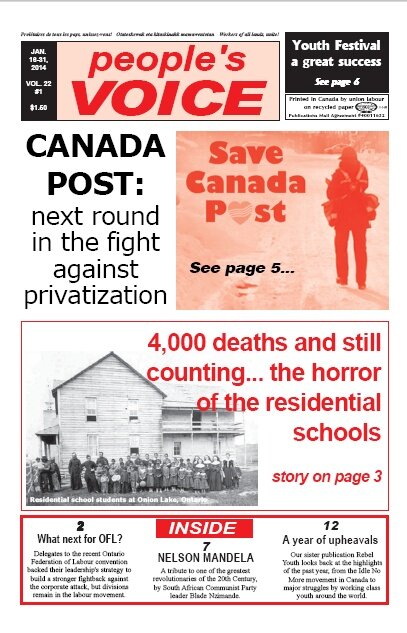
1) COMMUNIST PARTY CONDEMNS ATTACK ON CANADA POST
2) THE ATTACK ON POSTAL WORKERS, CETA, PRIVATIZATION
3) ONTARIO COMMUNISTS CAMPAIGN FOR PUBLIC AUTO INSURANCE
4) OVER 4,000 DIED IN RESIDENTIAL SCHOOLS
5) OFL CONVENTION HIGHLIGHTS CHALLENGES FOR 2014
6) SHAME ON PARLIAMENTARY PARTIES - Editorial
7) NO FACTS PLEASE, WE'RE TORIES - Editorial
8) SUPREME COURT STRIKES DOWN PROSTITUTION LAWS
9) "THE YOUTH FESTIVAL WAS A GREAT SUCCESS"
10) CHEVRON CASE HIGHLIGHTED AT WFYS
11) WE STOOD WITH MANDELA IN THE STRUGGLE TO DEFEAT APARTHEID
12) SOUTH AFRICAN CP TRIBUTE TO NELSON MANDELA
13) NORTHERN IRELAND: A POLITICS BEYOND ANTI-SECTARIANISM
14) SOUTH KOREA PUSHES RAIL PRIVATIZATION
15) MUSIC NOTES, by Wally Brooker
PEOPLE'S VOICE JANUARY 16-31, 2014 (pdf)
People’s Voice 2014 Calendar
”The Truth About the Great War”
To order a copy of the People’s Voice 2014 Anti-First World War
Calendar, send $15 (includes postage and handling) to
People’s Voice, 706 Clark Drive, Vancouver, BC, V5L 3J1. Contact us at
604-255-2041 or pvoice@telus.net for bulk order prices.
|
People's Voice deadlines: February 1-14 February 15-29 Send submissions to PV Editorial Office,
|
REDS ON THE WEB
http://www.parti-communiste.ca/
peoplesvoice.ca
www.ycl-ljc.ca
www.solidnet.org
|
People's Voice finds many "Global Class Struggle" reports at the "Labour Start" website, http://www.labourstart.org/. We urge our readers to check it out! |
* * * * *
People's Voice
Canadian Publications Mail Sales Product Agreement #205214
ISSN number 1198-8657
People's Voice is published by
New Labour Press Ltd
PV Editorial Office
706 Clark Drive,
VANCOUVER, B.C. V5L 3J1
Phone:604-255-2041
Fax:604-254-9803
email: pvoice@telus.net
Editor: Kimball Cariou : Business Manager: David Au
Editorial Board: Kimball Cariou, Miguel Figueroa,
Doug Meggison, Naomi Rankin, Liz Rowley, Jim Sacouman
* * * * * *
Letters
People's Voice welcomes your letters
on any subject covered in our pages.
We reserve the right to edit for length and clarity,
and to refuse to print letters which may be libellous
or which contain unnecessary personal attacks.
Send your views to:
"Letters to the Editor",
706 Clark Dr., Vancouver, BC V5L 3J1,
or pvoice@telus.net
People's Voice articles may be reprinted without permission,
provided the source is credited.
* * * * * *
The Communist Party of Canada, formed in 1921,
has a proud history of fighting for jobs, equality, peace,
Canadian independence, and socialism.
The CPC does much more than run candidates in elections.
We think the fight against big business and its parties
is a year-round job,
so our members are active across the country,
to build our party and to help strengthen people's movements
on a wide range of issues.
All our policies and leadership
are set democratically by our members.
To find out more about Canada's party of Socialism,
give us a call at the nearest CPC office.
* * * * * *
Central Committee CPC
290A Danforth Ave Toronto, Ont. M4K 1N6
Ph: (416) 469-2446
fax: (416) 469-4063 E-mailmailto:info@cpc-pcp.ca
Parti Communiste du Quebec (section du
Parti communiste du Canada)
5359 Ave du Parc, Montréal, Québec,
H2V 4G9
B.C.Committee CPC
706 Clark Drive, Vancouver, V5L 3J1
Tel: (604) 254-9836
Fax: (604) 254-9803
Edmonton CPC
Box 68112, 70 Bonnie Doon P.O.
Edmonton, AB, T6C 4N6
Tel: (780) 465-7893
Fax: (780)463-0209
Calgary CPC
Unit #1 - 19 Radcliffe Close SE
Calgary AB, T2A 6B2
Tel: (403) 248-6489
Ottawa CPC
Tel: (613) 232-7108
Manitoba Committee
387 Selkirk Ave., Winnipeg, R2W 2M3
Tel/fax: (204) 586-7824
Ontario Ctee. CPC
290A Danforth Ave., Toronto, M4K 1N6
Tel: (416) 469-2446
Hamilton Ctee. CPC
265 Melvin Ave., Apt. 815
Hamilton, ON.
Tel: (905) 548-9586
Atlantic Region CPC
Box 70 Grand Pré, NS, B0P 1M0
Tel/fax: (902) 542-7981
http://www.parti-communiste.ca/
* * * * * *
News for People, Not for Profits!
Every issue of People's Voice
gives you the latest
on the fightback from coast to coast.
Whether it's the struggle for jobs or peace, resistance to social cuts,
solidarity with Cuba, or workers' struggles around the world,
we've got the news the corporate media won't print.
And we do more than that
- we report and analyze events
from a revolutionary perspective,
helping to build the movements for justice and equality,
and eventually for a socialist Canada.
Read the paper that fights for working people
- on every page, in every issue!
People's Voice
$30 for 1 year
$50 for 2 years
Low-income special rate: $15 for 1-year
Outside Canada $50 for 1 year
Send to: People's Voice, 706 Clark Drive, Vancouver, BC, V5L 3J1
You can call the editorial office at 604-255-2041
REDS ON THE WEB
http://www.parti-communiste.ca/
http://www.ycl-ljc.ca/
http://www.solidnet.org/
(The following articles are from the January 16-31, 2014, issue of People's Voice, Canada's leading socialist newspaper. Articles can be reprinted free if the source is credited. Subscription rates in Canada: $30/year, or $15 low income rate; for U.S. readers - $45 US per year; other overseas readers - $45 US or $50 CDN per year. Send to People's Voice, c/o PV Business Manager, 706 Clark Drive, Vancouver, BC, V5L 3J1.)
1) COMMUNIST PARTY CONDEMNS ATTACK ON CANADA POST
Central Executive Committee, Communist Party of Canada, Jan. 7, 2014
The Communist Party of Canada joins with the labour movement and its community allies in condemning the federal government's unilateral decision to eliminate home delivery, raise postal rates, and cut thousands of jobs. While the "restructuring" announcement was made by Canada Post Corporation, these measures are orchestrated by the Harper Tories, as part of their overall agenda to privatize public services and to attack the rights and interests of organized workers.
If implemented, these changes would make Canada the first country in the world to completely replace door‑to‑door delivery of urban mail with the "community mail boxes" which were imposed despite major opposition in rural areas across the country. Those negatively affected will include huge numbers of pensioners and people with disabilities who will find it much more difficult to get their mail on a regular basis. The reduction of service levels and staggering price increases to begin next March will also devastate thousands of small businesses and charities which rely heavily on lettermail to maintain contact with customers and pay their bills. The bland reassurances of Canada Post and Harper government cabinet ministers that these are "minor problems" ring completely hollow.
The "restructuring" plan is also an escalation of the government's attack on the workforce at Canada Post. Up to 8,000 jobs of postal workers will be eliminated, and the hard‑won pension rights of all Canada Post employees are also threatened. This is just the latest example of the Harper government's neoliberal agenda, based on protecting corporate profits and making the working class pay the full cost of the economic crisis of the capitalist system.
As many observers have stressed, the reduction of services and the dramatic rise in Canada Post prices are designed to compel Canadians to seek other options to deliver letters and packages. The Harper Tories are setting the stage for further steps towards privatization of all public assets and services, in this case by turning over a huge chunk of this vital service to the big transnational delivery corporations. This trend will become virtually unstoppable with the signing of secretive deals such as the Comprehensive Economic and Trade Agreement (CETA) with the European Union, which aims to prevent any future government from adopting policies or laws which could impact the profits of private corporations.
The "justification" for the "restructuring" includes wildly exaggerated projections of heavy financial losses by Canada Post, as well as a Conference Board of Canada report advocating the changes announced on December 11. The Conference Board recommendations are hardly surprising, since Canada Post CEO Deepak Chopra (who is paid nearly $500,000 a year) is on the board of this so‑called "independent" right‑wing think‑tank, clearly a conflict of interest.
The Communist Party of Canada demands full withdrawal of the unilateral decision to cut delivery services, raise prices and eliminate jobs. We call upon the federal government to act upon the well‑founded proposals by the Canadian Union of Postal Workers to use other policies to build the customer base of Canada Post, such as expanded postal banking which has become a solid source of income for post offices in other countries. We will join with other progressive and democratic movements across the country to help mount a massive public fightback against this reactionary restructuring drive.
2) THE ATTACK ON POSTAL WORKERS, CETA, PRIVATIZATION
By Sam Hammond
Eight thousand jobs under the wrecking crew hammer of Canada Post. Eight thousand families deprived of a living wage, eight thousand victims of the neo‑liberal restructuring of social life. After earlier cuts eliminating home delivery in rural areas, millions of urban residents, including retirees and those with handicaps, will now be denied door‑to‑door delivery of letters and packages. The destruction of what was and should be again a non‑profit, state‑provided service, is the kick‑off attack of 2014. This is an immense assault on services, jobs and Canadian culture.
What is the purpose of this? Even in the corporate greed and self‑gratification of the Canada Post executive strata, how does it make sense to destroy the foundation to save the building? This conundrum only unravels and reveals itself when viewed as a component of the preparation for complete privatization demanded by "Free Trade Agreements", and the neo‑liberal agenda for the destruction of trade unions and collective bargaining.
The Comprehensive Economic Trade Agreement (CETA) has been described as NAFTA on steroids. This is justified, but not entirely accurate. CETA introduces changes which escalate previous giveaways, but adds new conditions of exploitation and penetration of global capital into the Canadian State. CETA is between the European Union and Canada, but the fine print in NAFTA includes automatic adjustments to give the USA all the new conditions negotiated away by the Harper government to European capital. Obviously the CETA negotiations are automatically then a NAFTA upgrade.
The "level playing field" imposed by the neoliberal agenda on workers is a race to the bottom, while U.S. and European capitalists enjoy a race to the top, gaining equal opportunity to plunder Canadian resources and labour power. But the danger to workers is not exclusively from European or U.S. capitalists, but from capital itself. Canadian capitalists are offering up our country and our people as a commodity for sale.
CETA's pervasive expansion of sub‑state procurement provisions make it the deepest and most dangerous penetration of foreign capital, perhaps the strongest blow yet to Canadian sovereignty. The term "sub‑state" describes all municipalities, schools, hospitals, libraries, power and water utilities, and virtually all other public sector bodies and institutions which under present proposals would also be subject to CETA procurement rules. This is the direct link to Canada Post, and to the termination of home delivery services as a preamble to privatization.
This marks a definite escalation of the neo‑liberal tactics of the Harper Tory government. But if this is the tactic, how horrible is the long‑term strategy we face, beyond the term of the Harperites and into the governance of their successors?
The Canadian capitalists have their historical roots as administrators of British Colonial interests, ravagers of indigenous people and environment, managers and purveyors for offshore interests, servants of imperialism. It was a short hop to junior partners of U.S. imperialism, and now to the desire to be global players.
In possession of the second largest geographical resource cache in the world, they claim their place at the planning table of militarism and exploitation of the third world. The membership in this barbaric corporate cabal is purchased with our resources, the privatization of our social programs, and the impoverishment of working people. While the European capitalists have launched wars to ensure their state interests, the section of the Canadian ruling class presently running the ship of state have positioned themselves as brokers of resources and the environment. There is a street level word for this and it starts with "P". The legal definition, viewed from the working class perspective, is treason.
Here's what Karl Marx had to say about the struggle between the old landowners and the new industrialists in England during the "Corn Law" free trade debates: "...what is free trade under the present condition of society? It is freedom of capital. When you have overthrown the few national barriers which still restrict the progress of capital, you will merely have given it complete freedom of action. So long as you let the relation of wage labor to capital exist, it does not matter how favourable the conditions under which the exchange of commodities takes place, there will always be a class which will exploit and a class which will be exploited. .... the only result will be that the antagonism of these two classes will stand out still more clearly."
"So long as you let the relation of wage labour to capital exist," poses the essential problem that must be addressed. Simply put, the destruction of the capitalist state and the creation of the socialist state is the strategy of the Communist Party and the revolutionary forces. That is historically recognized and objectively necessary.
Unfortunately for the non‑communist left, that is often where it ends: reformism or revolution, file closed. But this empirical cop‑out denies dialectical processes such as the propellant of antagonistic opposites, of quantitative and qualitative change, of defense and attack. It denies resistance and struggle as a culture forming‑process that includes our history, our present and our future. If the solutions to exploitation and need exist only in a utopian future, what can militant workers and our unions ‑ existing here and now in this time ‑ do today?
There are choices. First and foremost must be the mobilization of all defenders of public institutions and social justice organizations around the primary potential of the labour movement, the most organized section of the working class. The tactical concepts of unity and resistance are gaining ground, revealing the potential of labour as a catalyst. Take for example the convention decisions of the Ontario Federation of Labour to build a united front of labour, social justice organizations and First Nations to fight extra‑parliamentary struggles as well as preparing for the next Ontario elections.
But at the same time, "business union" forces within the labour movement want to thwart this development, fearing for their places within a tri‑partite collaboration with capital and the capitalist state. Why are the CLC and Ken Georgetti attempting to pre‑empt the Jan. 22 meeting of heads of unions scheduled by the OFL, by calling a hasty meeting earlier under the auspice of preparing for the Ontario elections? Who is representing whom, and in whose interest? We need to know.
We also need to clearly understand the dialectical connections between CETA, the proposed destruction of 8000 jobs at Canada Post, the decline of Canadian manufacturing, and the loss of 500,000 jobs under NAFTA, all related to domestic and global corporate plans, and to the stagnation of imperialism in its last stage. The Postal Workers union, one of the most militant in the country, has supplied part of this analysis, and has started to rally support.
We need to find ways of delivering this analysis, this mother of class consciousness, into the united front movements, into every place where people work, into their strikes and demonstrations, in spite of the blackout from the corporate controlled media. We must build the working class press as an essential part of delivering this analysis.
And immediately, without delay, we need to pitch in and rally to the fight‑back campaign developing under the leadership of CUPW.
3) ONTARIO COMMUNISTS CAMPAIGN FOR PUBLIC AUTO INSURANCE
Toronto - In the lead up to an expected spring election, Communists in Ontario are campaigning for public auto insurance, as part of a transportation policy to put people's needs ahead of corporate greed.
For most drivers, a car is not optional, it's essential to work. Ontario's 9 million drivers pay the highest auto insurance rates in the country, while receiving the poorest coverage and benefits. That's the reality of "no fault" insurance which the Liberal government introduced in 2010 when rates last sky‑rocketed. No fault reduced rates minimally, while reducing coverage and benefits catastrophically. Many policy holders injured in serious accidents are now tied up in the courts, suing insurance companies for the benefits they thought they had.
Canada's biggest insurance companies are laughing all the way to bank, with a $4.4 billion profit in 2012 - up 25% over 2011.
Taxi drivers face even higher rates, so their take home pay is often far below the minimum wage after insurance, gas, licensing, and other fees. Most are forced to work 70 to 80 hours a week just to make ends meet. In response to complaints about the exorbitant fleet rates for taxis, the companies refused to write insurance in some Ontario cities, forcing drivers to either accept the diktat or starve.
The Insurance Bureau of Canada says rates in Ontario are the highest in Canada because of massive fraud by drivers in Brampton, near Pearson International Airport. But there is another, far more believable explanation: Brampton is home to one of the largest South Asian populations in the country, with many new Canadians and residents settling there. A vulnerable population for greedy corporations to exploit, as the super‑profitable insurance companies know so well. These are the real fraudsters, whom successive Ontario governments have allowed to write their own cheques with a built in 12% rate of profit on every policy.
While the companies hold the public hostage, the best the NDP can do is press the Liberals for a 15% rate reduction, which the government now says will be "complicated". The real complication is that the Liberals, Tories and NDP have all received financial contributions from the companies and/or the Insurance Bureau. None are willing to take on the companies, though it's a simmering election issue.
Ontario Communists have been campaigning since October for public auto insurance which would cut rates in half for most drivers, with full benefits and coverage. Public auto insurance already exists in BC, Saskatchewan and Manitoba, where it was introduced more than 40 years ago, and in Quebec in the 1990s.
Public auto insurance cuts out private profit, and the profit motive. Public insurance agencies like ICBC just have to remain solvent, bringing in a bit more in premiums than they pay out in claims. The "bit more" pays for administration. Who benefits? The public.
Public auto insurance is part of a transportation policy that includes public ownership and development of mass urban rapid transit systems, urgent expansion of inter‑city rapid transit using publicly owned and operated rail services like GO Transit, and developing a Canadian car that's small, fuel efficient, environmentally sustainable and affordable for domestic and export sale.
This would create good jobs and pay cheques in Ontario, and should be paid for from substantially increased corporate taxes - not from the farebox. A Canadian car should be developed as a Crown corporation, generating profits for the public treasury which could then also be used for public transit.
Public response to the CPC (Ontario)'s campaign has been very positive. There is a lot of anger at the insurance companies and right‑wing governments that many people feel are robbing them blind. Many voters also connect public auto insurance with the NDP, and the Rae government that campaigned for this policy in 1990 and then abandoned it two years later after the companies held a demonstration on the front lawn of Queen's Park.
The CPC (Ontario) has demonstrated at the offices of Liberal Transportation Minister Glenn Murray in Toronto, and Municipal Affairs Minister Linda Jeffrey in Brampton, among others. The Party has sent an Open Letter and campaign leaflet to Members of the Legislature, indicating that the coming budget must include a transportation policy based on people's needs, not corporate greed.
Campaign stops still ahead include Ottawa on Jan. 30, Brampton on Feb. 2, and Guelph‑Kitchener on Feb. 11 (including a public meeting at 5:30 pm, Room 441, University Centre, University of Guelph). Stops in Hamilton, Sudbury and Windsor are scheduled for mid‑February.
If you'd like to get involved, or find out more about the campaign stops in your area, call the CPC (Ontario) at 416‑469‑2446, or check out the website at publicautoinsurance.ca.
4) OVER 4,000 DIED IN RESIDENTIAL SCHOOLS
PV Vancouver Bureau
After many years of speculation based on anecdotal evidence, some hard facts are emerging about the numbers of deaths in Canada's racist system of residential schools.
The Truth and Reconciliation Commission of Canada (www.tra.ca) has now determined that at least 4,000 aboriginal children died in the church-run schools, which operated from the 1870s until the last one closed in 1996. About 150,000 children were full-time students in the schools, isolated from their families for most of the year. The students were virtually imprisoned, in conditions which made them the victims of fires, disease, and abusers.
Thousands more were day students at such schools, many affected in similar ways. Although the federal government has issued a formal apology and financial compensation for the full-time students, the day students are still fighting for recognition.
The racist nature of the residential school system was revealed by administrators who spoke about "taking the Indian out of the child." The schools banned students from speaking in their own languages or learning traditional skills, instead training them in English or French to become exploited members of the Canadian workforce. This strategy is today universally recognized as a form of genocide, an attempt to destroy a people by wiping out their unique culture.
But this genocide takes on a shocking dimension with the estimated numbers of deaths, based on partial federal government records. Commission officials expect the number to rise as researchers access more files from Library and Archives Canada, and from churches and provincial sources.
"Aboriginal kids' lives just didn't seem as worthy as non‑aboriginal kids," Kimberly Murray, executive director of the Commission, said in a recent interview. "The death rate was much higher than non‑indigenous kids."
The commission has spent the last several years studying what is widely considered Canada's worst historical crime.
A lawsuit against the federal government and churches resulted in a settlement that included payments to those affected. Created in 2008, the Commission's mandate is to hold public hearings for people to tell their stories, and to collect records and establish a national research centre.
The commission has also established "The Missing Children Project" to assemble the names of children who died, how they died, and where they were buried. The names will be contained in a registry available to the public, but researchers say the exact number of deceased children will never be known. As Murray says, "I think we're just scratching the surface."
Most of the 4,000 known deaths fall into several categories. Despite repeated warnings that the schools needed to install proper fire escapes and sprinklers, many students died in fires. Schools routinely locked their dormitories to prevent children from escaping to rejoin their families. Instead of spending money on fire escapes, they often built poles outside of windows for children to slide down, but left the windows locked.
Some children who did run away were found frozen to death near the schools, or drowned in nearby rivers.
In one such tragedy, Allen Willie, Andrew Paul, Maurice Justin, and Johnny Michael fled the Lejac residential school in British Columbia on January 1, 1937, in minus 30 degree temperatures. The four boys were found frozen to death on a lake, one of them wearing only summer clothes, with one rubber boot missing.
These types of deaths were far from rare," said Murray, noting that "there were quite a few examples of children who ran away and died."
Others, malnourished and housed in poorly‑ventilated buildings, died from tuberculosis. Some committed suicide rather than suffer sexual and physical violence from staff members.
There have also been serious allegations of manslaughter and murder in residential schools, by former students who have courageously spoken out against their abusers. While the Commission has not found records confirming such crimes, it seems highly unlikely that such documents would be kept by the perpetrators.
When a child died in a residential school, the body was usually buried nearby, since the schools and the government would not pay to ship it home. Some were placed in marked graves, others in unmarked graves. The families were often never told what happened to such children.
The Commission is scheduled to release its final report by June 2015, including the story of the deceased children. Many survivors and family members are hoping that the report will shed new light on what happened to their beloved relatives and friends.
5) OFL CONVENTION HIGHLIGHTS CHALLENGES FOR 2014
PV Ontario Bureau
Under the theme "Rising Together", the OFL Convention in November adopted a two year Action Plan which aims to "inspire, unite and activate" the labour movement in Ontario. The plan is meant to be the catalyst of a Common Front of community groups, the social justice movement, First Nations and Labour, by charting "A People's Agenda" to counter the corporate "Austerity Agenda" and promote "a progressive vision of the type of society we want to live in".
Delegates spoke of the need to draw inspiration from the Quebec student strike and the Occupy Movement, which helped build unity among workers and community activists.
OFL President Sid Ryan spoke to the media about the need to strengthen the Common Front in every community around the province. "Two years ago we got a mandate to put together the nuts and bolts of a common front," said Ryan. "I think we've deepened the understanding of it now with the delegates by bringing members of community activist groups here to speak. They understand that labour on its own cannot defeat the Tory agenda. What is needed is a broader base and a broader tent, and that's what we're about to do. There is a recognition that we cannot operate in a silo on an island while the Tories are gearing up for the biggest attack on organized labour".
The Action plan instructs the OFL and affiliates to "put forward bold ideas which today may seem distant and radical, but will command public attention and spark new conversations about the future of our province by proposing solutions to our collective economic, environmental, social and political crises. Visionary ideas rooted in progressive values are needed to shift what is deemed acceptable and move people to take concrete action."
According to Ryan, "we have to expand beyond simply fighting for the crumbs off the table. We're still fighting to protect Medicare instead of saying `why aren't we fighting to expand it?' The same with post-secondary education ‑ we should stop talking about freezing tuition rates and start talking about what they've got in Ireland: Free University!"
The anticipated elections for President and other executive officers did not materialize, and the three positions were acclaimed. This was a victory for the majority of delegates who supported the mandate of the leadership to build a united front, and for the proposals on the Common Front and for an engaged and fighting Federation.
But it was a defeat for the right-wing social democratic leaders of some unions, with no mandate from their memberships, whose program is to split and divide the labour movement, including the attempt by OPSEU, SEIU and ONA to create a financial crisis in the OFL by freezing their dues payments.
This coincides with a combined Tory, Liberal and corporate attack, the most serious and deadly since the 1930's. In the main, this group comes from the leadership of the old "pink paper" unions, named after those who destroyed mass escalating action against the Harris government in the 1990s. Many of these leaders want the OFL to exclusively support the electoral ambitions of the NDP, while some are Liberal Party sympathizers.
The main lines of demarcation at the Convention were between those wanting extra‑parliamentary Common Front alliances and struggle, a People's Agenda, parliamentary tactics and a vision of a different Province, and those who see this as a challenge to the NDP and its tepid programs.
The most controversial debate on the floor centered on a constitutional amendment to create an Advisory Executive Committee on Finances, made up of the President, Secretary Treasurer and Executive Officer; the three largest private sector unions (UNIFOR, USW, UFCW); the three largest public sector unions (CUPE, ETFO, PSAC); and three Equity VPs, along with the smaller affiliate VP.
The amendment was intended to create a non‑elected body, CLC style, to hobble the President and table officers elected by the Convention, shifting power to an unelected Executive Committee. The amendment received just slightly more than 50%, less than the two-thirds required to pass.
The Action Caucus worked energetically to explain the undemocratic purpose of this amendment, and helped swing the vote. The Caucus also exposed the right wing's secret meetings and its plan to defeat Ryan in a sudden election. (An article by Helen Kennedy in the Oct. 16-31 issue of People's Voice revealed this agenda.)
Action Caucus members were successful in re‑electing Stephen Seaborn as Vice‑President for Solidarity and Pride, and in electing Denise Martins as VP for Young Workers.
Challenges continue
Defeated on every major issue, the dissident group quickly tried to usurp the Convention decisions and the elected OFL leadership. On Jan. 8, they organized a rump meeting of Ontario heads of unions with the CLC (excluding the OFL), to map out a provincial election strategy.
This was just two weeks before the OFL's Jan. 22 meeting involving heads of Ontario unions and the CLC, called to work out an election strategy and fightback in the province, based on the Convention decisions. The January 8 gathering was clearly intended to preempt the OFL and exclude its elected leadership.
The CLC's role here is a clear violation of their Constitution, and an attack on the OFL leadership and the mass action plan adopted by the Convention. It is a continuation of the effort to split the labour movement in Ontario. In the context of austerity and the all‑out assault on labour and democratic rights, these actions only benefit the Tory agenda, strengthen labour's enemies and weaken labour solidarity.
Ryan responded by calling on Ontario union heads and the CLC to cancel the parallel meeting, and to work together with the OFL to build a united fightback against the employers and reactionary governments.
The CLC would do well to listen, as would the "pink paper" group which now poses the greatest threat to labour unity, and to an effective struggle against a very dangerous government/employer agenda to introduce US style "right‑to‑work" legislation and destroy the Rand Formula.
Thanks to the November Convention of the OFL, the struggle will continue and sharpen with the main enemy being the corporate neo‑liberal agenda. It is becoming clearer that the struggle for democracy within labour, for transparency and implementation of Convention program, is emerging as an important part of the development of fightback and solidarity. The backroom cabal of narrow and partisan political interests is the breeding ground of defeat and betrayal. Their actions threaten the whole labour movement's fight for a decent future for all.
The majority of elected delegates decided where they stand at a democratic convention. The OFL table officers have a mandate, a program and a responsibility to work cooperatively with the Executive Board to forge the unity needed to undertake the action plan.
The financial difficulties at the OFL, created largely by OPSEU, SEIU and ONA who have withheld dues for almost three years, will no doubt continue to be a real area of Executive Board concerns. The financial challenge will need to be addressed with a strategic plan to organize the unorganized and recruit new affiliates.
Ryan emerges as a leader carrying a heavy load and facing many adversaries, but with the mandate to move forward. There will be those who seek to conceal their agenda by making personalities and leadership style the main issue. It is not.
The welfare of the working people is the main issue. Our actions will be judged by how we fight for this. The convention is over, the decisions remain, and all affiliates, if they honour democratic decision making, are bound to implement the Convention decisions and hold leadership accountable to them.
6) SHAME ON PARLIAMENTARY PARTIES
People's Voice Editorial
Rarely has the death of a notorious thug brought such a sickening response from Canada's parliamentary leaders. The Jan. 11 death of Ariel Sharon underscores the sad fact that elected politicians in Canada express nothing but complete support for the policies of the Israeli state.
This so-called "man of peace" bears responsibility for many crimes against the Palestinian and Lebanese people. He personally led brutal massacres in the West Bank, oversaw the expansion of illegal Israeli settlements on Palestinian lands, allowed the slaughter of civilians in the Sabra and Shatilla refugee camps, and much more. As Israeli war resister Miko Peled wrote: "Surely the most absurd thing ever said about Sharon, is that he was a man of peace (who) `gave' Gaza back to the Palestinians." The truth is that this cynical move allowed Sharon to close Gaza like a prison and further suffocate its people.
Not surprisingly, the viciously anti-Palestinian Stephen Harper mourned Sharon as "one of the architects of modern day Israel and one of the nation's staunchest defenders." No other western government expresses such slavish backing for Zionist doctrines, and for the crimes committed by Israeli leaders.
However, the "opposition parties" also praised the butcher of Sabra and Shatilla. The NDP (which remained silent on the death of President Hugo Chavez) called Sharon "a significant figure in world history and an influential leader who dedicated his life to serving his country." And Liberal leader Justin Trudeau expressed "great sadness" at the death of a man who supposedly "recognised that military solutions were insufficient to resolve the Israeli-Palestinian conflict."
For our part, we condemn the crimes of Ariel Sharon, and on this occasion we extend our deepest condolences to all his Palestinian and Lebanese victims.
7) NO FACTS PLEASE, WE'RE TORIES
People's Voice Editorial
The federal government's barbaric destruction of Fisheries and Oceans libraries is just the latest example of the Harper Conservatives' hatred of science. There seem to be two basic varieties of Tory in the PM's caucus: neo‑cons who think the only numbers worth reading are corporate profit lines, and social dinosaurs who believe that all truth is found in ancient religious texts. Often the two overlap, although the Prime Minister does appear to favour neoliberal economic doctrine over fundamentalist dogmatism.
This disdain for science has a wide streak of hypocrisy. After all, Tory cabinet ministers happily enjoy the benefits of 21st century technology. Rarely do we see Jason Kenney riding a horse to Parliament, or Lisa Raitt using an abacus to count railway oil spills. Nor does the Conservative Party's contempt for the long form census prevent them from hiring polling firms which use modern survey techniques.
And yet, hundreds of federal programs and research facilities have been shut down or cut back by this government, which apparently believes that science is much too dangerous to be left to scientists or (gasp) the general public. Compiled by the Canadian Association of University Teachers and the Professional Institute of the Public Service of Canada, the list is heavy on public services which seek to study the environment or to protect Canadians from harm.
The government's tired excuse is that these programs and facilities cost money. But as the saying goes, if you think education is expensive, try ignorance. Canadians will pay dearly for this short‑sighted policy, which threatens to saddle working people with huge long‑range costs for preventable ecological and social catastrophes. Count this as one of the most important reasons to drive the Harperites out of office, before the damage is irreparable.
8) SUPREME COURT STRIKES DOWN PROSTITUTION LAWS
By Jane Bouey, Vancouver
In a unanimous landmark decision on Dec. 20, the Supreme Court of Canada struck down three provisions of Canada's Criminal Code: s. 210 (keeping or being found in a bawdy house), s. 212(1)(j) (living on the avails of prostitution), and s. 213(1)(c) (communicating in public for the purpose of prostitution). The Court found that those provisions violate the right to security of the person protected by the Charter of Rights and Freedoms, and gave the federal government one year to change the laws.
The Bedford case was initiated in 2007 by three Ontario sex workers. Terri Jean Bedford, Amy Lebovitch and Valerie Scott challenged the laws which they believe violate sex workers' constitutional right to security of the person.
The Supreme Court decision stated, "The prohibitions at issue do not merely impose conditions on how prostitutes operate. They go a critical step further, by imposing dangerous conditions on prostitution; they prevent people engaged in a risky ‑ but legal ‑ activity from taking steps to protect themselves from the risk."
Federal and provincial governments had argued that the prohibitions were necessary. Parties granted intervener status supporting the Federal Government included Canada's most socially conservative forces such as the Catholic Civil Rights League, the Christian Legal Fellowship and REAL Women of Canada.
The decision to overturn these provisions was hailed as a great victory by some feminists, and denounced by others. The debate around how our society should treat sex work has become extremely polarized. Even whether one uses the term "sex work" or "prostitution" is seen as a sign of where one stands, i.e. whether one views sex workers as members of the working class.
There is wide agreement with striking down the law against communicating in public for the purpose of prostitution, and agreement that some (if not most) women are forced into sex work because of conditions of economic, social and racial inequality. Most agree that many women engaged in sex work face disproportionate levels of horrific violence and even murder.
However, there is a sharp division over taking legal steps that would allow those in sex work to better organize themselves: does this increase or decrease the security of those sex workers? Not surprisingly, one main epicenter of the debate is in East Vancouver ‑ the killing fields of mass murderer Robert Pickton.
The Women's Coalition for the Abolition of Prostitution (also an intervenor in the case) argues that "laws that prevent men from buying, selling and profiting from women involved in prostitution are important protections that must be retained." The Coalition includes the Canadian Association of Sexual Assault Centres, Native Women's Association of Canada (NWAC), Canadian Association of Elizabeth Fry Societies, Action ontarienne contre la violence faite aux femmes, La concertation des luttes contre l'exploitation sexuelle, Regroupement québécois des centres d'aide et de lutte contre les agressions-caractere sexuel (CALACS), and Vancouver Rape Relief.
The NWAC stated that, "prostitution exploits and increases the inequality of Aboriginal women and girls on the basis of their gender, race, age, disability and poverty."
Those supporting the legal challenge include sex workers who are attempting to organize to protect themselves, women and others who do frontline work alongside sex workers, and those who have taken positions in solidarity with those organizations. This would include many trade union women's committees, community based women's organizations, and some Indigenous women and women from racialized communities. Those groups took the position that all three provisions should be struck down.
Among those celebrating the Bedford decision, Vancouver East NDP MP Libby Davies called it "significant."
"The Supreme Court ruled that bans on street soliciting, brothels, and people living off the avails of prostitution are unconstitutional and create serious risks for sex workers," said Davies. "It has taken many years of advocacy and legal challenge to reach this historic decision, and I was so happy to celebrate the ruling surrounded by those who worked so hard to challenge the status quo."
Pivot Legal Society, an East Vancouver‑based organization which was also an intervenor, welcomed the ruling.
Pivot writes, "Under the current laws, sex workers are subject to severe forms of violence and discrimination. Pivot's commitment to the decriminalization of adult sex work is informed by more than a decade of work with sex workers from the Downtown Eastside, across Canada and around the world. Decriminalization is a necessary step to protecting the safety and rights of sex workers by ensuring that they have full access to legal protections and control over the conditions of their work. In addition to law reform, Pivot is also committed to challenging oppressive social conditions that lead some women and men to get involved in sex work. These social conditions include poverty, homelessness, addiction and colonization. We believe that every sex worker ‑ whether she or he wishes to remain in sex work or move into a different type of work ‑ should be fully supported to do so. All sex workers deserve to have their choices respected and be able to work safely, without fear of violence, discrimination and social stigma."
The debate has now focused on what the Federal Government should do, in particular whether what has become known as the "Nordic Model" should be implemented here in Canada. We will explore that debate in upcoming issues of People's Voice.
9) "THE YOUTH FESTIVAL WAS A GREAT SUCCESS"
People's Voice sat down with Drew Garvie, co‑chair of the Pan‑Canadian delegation to the 18th World Festival of Youth and Students, held Dec. 7-13 in Ecuador, to talk about the experience.
So, finally, how many people attended? Was it a success?
About 8,000 people attended from 88 countries, a very large number, although smaller than past festivals, because of the capacity of the Ecuadorian government. Overall, we would say it was a great success. Delegates got to learn about a host of struggles, ranging from the youth and labour fightback against austerity in Europe, the conflict in Syria, the occupation of Palestine and, in Africa, of Western Sahara, but especially the process of social transformation and battle against imperialism taking place in countries like Venezuela, Chile, Bolivia, Brazil, Colombia, Cuba and, of course, Ecuador.
What were your impressions of Ecuador?
One highlight was the chance to learn more and see first‑hand the political and social changes taking place in the country itself. The Ecuadorian government, led by Rafael Correa's PAIS coalition, calls this process the "Citizen's Revolution". They talk about applying the indigenous concept of "buen vivir" or "good living" as a way to change societies, thinking away from the individualistic values of capitalism and historic domination of the country by the United States, and towards more a social and pro‑people society, with sovereignty over its own affairs.
Could you highlight some of the features of these changes?
Their new constitution, drafted by a citizen's assembly process, expanded democratic rights including recognizing the "plurinational" character of Ecuador with respect to its indigenous nations and enshrining the rights of nature and ecosystems to thrive. Ecuador has greatly increased funding to health and social services, eliminating tuition fees, reducing poverty and illiteracy. It has instituted a foreign policy reflecting respect for sovereignty against imperialist intervention. The country actively supports the regional integration of Latin America through different international agreements and organizations such as the Bolivarian Alliance for the Peoples of Our America (ALBA). These reforms were highlighted in many presentations by the youth of the PAIS coalition, workshops by the Foreign Ministry and even a speech by President Correa at the opening ceremonies.
How has the country felt the effects of the economic crisis?
Like all capitalist countries, Ecuador was negatively effected by the economic crisis but not as hard as many other countries due to the rejection of austerity measures. Correa has enjoyed one of the highest popularity ratings in the Americas. An attempted right‑wing coup in 2010 failed, and electoral support for PAIS has gotten stronger with each election, including in February 2013, with a form of proportional representation. In fact, Correa is the first Ecuadorian president to win two consecutive elections without facing a runoff vote. At the end of his current term he will be the longest uninterrupted elected president in the country's history.
Would you characterize the changes as a socialist revolution?
No, although we met with a number of progressive voices and groups, including left members of the national assembly who believe the revolution needs to develop in that direction. We also met with the Communist Party of Ecuador, who critically support the process, seeing the Citizen's Revolution more as a move towards more sovereignty and economic modernization, than to socialism and working class power.
There are still many contradictions in policy and implementation. For example, there are debates around how to balance development of the economy in favour of the people with the protection of indigenous communities' right to self‑determination and nature's right to regeneration, without allowing big business and mining corporations to pollute in their drive for profit. These are some of the challenges and achievements that thousands of international youth got to see and discuss with a variety of Ecuadorian activists and organizations.
Many real achievements have taken place since Correa and PAIS were first elected in 2008 on the back of mass protests against neoliberal-induced economic crisis. Poverty rates have been halved from 50% during the economic crisis in 1999. to around 25% today. The U.S. military bases have been kicked out of Ecuador, as were the local CIA offices who apparently ran the Quito police. Ecuador's "Dirty Hand" campaign has made important gains in getting Chevron to pay for massive environmental destruction, causing cancer and birth defects in the Amazon.
What about other international campaigns?
A large delegation came from Colombia, highlighting the peace negotiations between the government and the guerilla fighters. The Cuban delegation highlighted issues like the blockade faced by their country and the imprisonment of the Cuban Five. The Festival got considerable international coverage because the Cuban delegation included Elian Gonzalez, who is a member of the Cuban YCL and who spoke eloquently at the anti‑imperialist court, testifying against the experiences of terrorism faced by Cuba.
Since the second round of Chile's election was taking place, only about forty delegates were able to come from that country, but they spoke about the student protests which lasted over a year in their country, and also the current coalition for president, on a platform to make education free and accessible.
Another important case, as in past festivals, was that of Western Sahara, the last colony of Africa which is occupied by Morocco. A number of delegates from the refuge camps in Algeria talked about their continued mistreatment at the hands of the Moroccans, including the displacement of tens of thousands of Sahrawi people from the country, imprisonment and suppression of activists fighting for a referendum on their sovereignty, with 500‑1000 people "disappeared," and abuses in the refuge camps.
How many people attended from Canada?
In total 71 delegates from Canada attended the Festival. The Pan‑Canadian delegation, which included a national committee from Quebec, was a broad reflection of the youth and student movement and included delegates from Victoria to Halifax. Many organizations sent delegates: young trade unionists from the Vancouver District Labour Council, student unions like the Canadian Federation of Students‑Ontario, environmental justice groups like Guelph Anti‑Pipeline Action Group, as well as Idle No More, an Aboriginal rights organization.
The Young Communist League of Canada is a member of the World Federation of Democratic Youth, one of the main international organizers of the Festival movement. The YCL played a key role in organizing the delegation and sent about twenty delegates to Quito. Many young activists also attended as individuals.
What issues did the Canadian delegation raise?
Before the Festival we identified four key areas of struggle: exposing the oppression and genocide directed towards Aboriginal peoples and their struggles for sovereignty and self‑determination; the Quebec Student Strike of 2012 and the fight for accessible public education; the struggle against Canadian mining corporations; and environmental justice struggles against pipeline and tar sands expansion. We were able to raise these in workshop and conference presentations, as well as speaking from the floor, in meetings with other delegations, and at the anti‑imperialist court.
Tell us about the anti‑imperialist court.
The last two days, as in past Festivals, saw the organizing of a very large and unifying event: the Anti‑Imperialist Tribunal, which basically placed imperialism on trial under the slogan "here impunity ends". Many respected Ecuadorian as well as some international activists and lawyers presided over the tribunal and issued the court's judgement. Each delegation had the opportunity to present to the court, giving thousands of delegates many lessons in specific crimes of imperialism around the world.
Janice Makokkis testified on behalf of the Pan‑Canadian delegation. She is an indigenous activist and lawyer, Idle No More delegate, and member of a Cree nation in close proximity to the Alberta tar sands. Janice's testimony spoke powerfully about the hundreds of years of oppression that imperialism, and more specifically the Canadian state, has inflicted on Aboriginal peoples.
Where do things go now?
There will be a number of local report‑back meetings in late January and February. On the last day of the Festival, the full Pan‑Canadian delegation gathered to discuss a joint declaration incorporating what they had learned, and also their diverse experiences in different struggles back home.
The delegation committed itself to continue to fight for the rights of youth in our own country, including peace, democracy, employment, full equity, leisure and culture, and also a democratic, equal and voluntary partnership of youth movements from Quebec, Aboriginal nations, and English‑speaking Canada. The delegation had an extensive discussion about equity concerns as well.
I think the final declaration puts our future work nicely: "throughout the WFYS we expanded our understanding of the world youth's capacity and desire for struggle against imperialism and for peace, solidarity and social transformation. We believe that a better world is both possible and necessary and we pledge ourselves to building this future".
10) CHEVRON CASE HIGHLIGHTED AT WFYS
By Peter Miller
With Ecuador hosting the World Festival of Youth and Students, participants heard about movements fighting against imperialism and for social transformation. One movement highlighted was Ecuador's battle against the oil giant, Chevron.
The festival had panel discussions about the importance of nationalization of energy and oil resources. Countries that use revenue from these resources to combat poverty and to develop infrastructure, health‑care, and education are much better off than countries that allow profits to go to shareholders of large corporations.
Texaco (now Chevron) was drilling in the Ecuadorian rainforest without the consent of indigenous communities from 1964 to 1990. Throughout Texaco's stay, the company dumped more than 18 billion gallons of toxic wastewater, spilled roughly 17 million gallons of crude oil, and left hazardous waste in 916 open pits. Texaco chose to use environmental practices that were illegal in the United States and Ecuador to increase profits. The company saved 3 dollars per barrel of oil produced as a result of its substandard environmental practices in Ecuador.
The result of this capitalist‑made environmental disaster has been the devastation of indigenous and campesino communities that live in the Oriente region of the Amazon Rainforest. Contamination has reduced fish and game stocks and harmed the way of life of indigenous peoples including the Cofan, Siona, Secoya, Kichwa and Huaoran people. Studies have found that there have been at least 1401 excess cancer deaths in the region because of contamination. Communities have experienced an excess rate of birth defects and miscarriages as well.
However, the 30,000 people of the region have not given up. They have organized to have their voices heard and seek justice against the actions of Chevron. In 1993 community members filed a class action lawsuit against Texaco in New York. The case got moved to Ecuador, and 17 years later the Ecuadorian court found Chevron liable for soil and water pollution in Oriente. However, Chevron has said it will not pay the 9.5 billion dollars ordered by Ecuadorian courts because it no longer has assets in the country.
In a case now in New York, the oil giant claims that plaintiffs have been trying to extort money from Chevron with the help of corrupt Ecuadorian courts. Chevron is working hard to not fix its mess, including using substandard practices when testing pollution in the Oriente, blaming pollution on Petro‑Ecuador. The company claims that its remediation from 1995 to 1998 was adequate, when the cleanup ignored many contaminated sites and served to hide contaminated areas.
With Chevron refusing to pay the court judgment, villagers have filed collection actions in Canada, Brazil, and Argentina to seize Chevron's assets in order to generate funds to clean up their lands. Recently an Ontario court has ruled that indigenous communities have the right to attempt to seize Chevron's assets in Canada. A later court will decide if the plaintiffs can seize assets or not.
At the World Festival of Youth and Students, around five delegates from each country biked for justice against Chevron. They rode from the festival grounds to an anti‑imperialist court, where representatives of delegations listed the imperialist crimes against their countries. The representative from Ecuador spoke out against Chevron's crimes.
At one point in the festival, workers from the Ecuadorian Government interviewed participants about the Chevron case. They were particularly interested in the views of the Pan‑Canadian delegation. making sure to stop by our booth. We made sure to speak out in solidarity with Ecuador.
Canada must respect the judiciary of Ecuador, and allow Oriente communities to seize the assets of Chevron. Environmental activists, progressive students, and workers are encouraged to show support for Ecuador outside Canadian courts that will be deciding whether assets can be seized. Call for justice for Ecuador!
(The author was a member of the Pan‑Canadian delegation to the WFYS in Ecuador.)
11) WE STOOD WITH MANDELA IN THE STRUGGLE TO DEFEAT APARTHEID
Statement by the Central Executive Committee, Communist Party of Canada
The death of Nelson Mandela on December 5 marked the loss of an outstanding leader in the struggle for human liberation. But for millions of people around the world, it was also an occasion to celebrate Mandela's remarkable contributions.
Many political activists who came into the Communist Party of Canada and other progressive movements during the past half century or more were dedicated supporters of the anti-apartheid struggle led by the African National Congress, Umkhonto we Sizwe, the South African Communist Party, COSATU, and other organizations.
As working class internationalists, Communists also were deeply involved in campaigns to build solidarity with the peoples of Vietnam, Cuba, Nicaragua, Chile, Palestine, and many other countries. Among these struggles, the fight against the racist regimes of Southern Africa had a special place.
From the 1940s through the '80s, the pages of the Canadian Tribune, Pacific Tribune, Combat, Rebel Youth, and other revolutionary publications carried literally hundreds of articles about the freedom movements in South Africa, Angola, Mozambique, Namibia, and Zimbabwe. Members of our party worked side by side with increasing numbers of other activists, devoting thousands of hours to consumer boycotts of South African products, opposition to sports or cultural events connected with the apartheid regime, and efforts to engage trade unions, churches, students and other movements in solidarity campaigns.
Canadian communists were deeply inspired by the courageous struggles of the ANC and SACP, by the fighters of Umkhonto we Sizwe, and by the heroic prisoners of Robben Island. Whenever we went to leaflet yet another liquor store selling Paarl brandy, or to raise the issue of apartheid at another labour convention, we took courage from the examples of Nelson Mandela and all those who risked death or imprisonment to challenge the racist regime in Pretoria.
In recent days, many platitudes have been printed about the role of certain politicians in ending apartheid. But those "leaders" were nowhere in sight when anti-apartheid activists worked tirelessly to defeat the racist regime. Rarely did Canadian politicians answer letters and petitions calling for a complete political, economic and diplomatic boycott of Pretoria. In fact, many condemned the ANC for mobilizing massive popular resistance and armed struggle against the white supremacist system, instead advocating so-called "constructive engagement" tactics. The same politicians spewed anti-communist attacks against the ANC and Umkhonto for welcoming the concrete solidarity of Cuba, the USSR, the German Democratic Republic and other socialist countries, which helped to defeat South African military forces on the battlefield, forcing the regime to negotiate with Nelson Mandela and the ANC.
This historic trajectory of struggle began with the efforts of Communists and their allies, both inside South Africa and internationally, based on the strategy of building the ANC/SACP/COSATU alliance and the huge mass peoples' movement which became the irresistible force that pushed apartheid off the stage.
Some Canadian politicians such as Brian Mulroney were finally compelled to oppose continued white minority rule. But even then, they acted as imperialist representatives of big business such as mining transnationals, which hoped to ensure that the transition from apartheid did not interrupt the flow of profits or lead towards socialism in the new South Africa.
The Communist Party of Canada takes deep pride in our contributions to the anti-apartheid struggle, from its very beginning to the historic moment of Nelson Mandela's release from the prisons of apartheid, and during the last two decades of democratic, non-racial government. We express our confidence that the working class will carry forward the legacy of comrade Mandela, leading to full emancipation and freedom in a future socialist South Africa.
Amandla ngawethu! Power to the people!
12) SOUTH AFRICAN CP TRIBUTE TO NELSON MANDELA
Delivered by SACP General Secretary Comrade Blade Nzimande, 13 December 2013, Moses Mabhida Stadium, Durban
"The true revolutionary is guided by great feelings of love" (Che Guevara).
The South African Communist Party joins the millions of the people of South Africa, the majority of whom are working class and poor, and the billions of the rest of the people the world over, in expressing our sincere condolences to Ms. Graca Machel, the entire Mandela family, the ANC and our Alliance on the passing away and loss of what President Jacob Zuma correctly described as South Africa's greatest son, our hero, a true revolutionary, President Nelson Rolihlahla Mandela, Tata Madiba.
We also wish to use this opportunity to express our solidarity with the African National Congress, an organisation that produced him and that he also served with distinction for most of his life, as well as all his colleagues and comrades in our broader liberation movement. As Tata Madiba said: "It is not the kings and generals that make history but the masses of the people, the workers, the peasants..."
Mandela was a revolutionary, not a saint!
The passing away of Cde. Mandela marks an end to the life of one of the greatest revolutionaries of the 20th century, who fought for freedom and against all forms of oppression in both their countries and globally. As part of the masses that make history, Cde. Mandela's contribution in the struggle for freedom was located and steeled in the collective membership and leadership of our revolutionary national liberation movement as led by the ANC ‑ for he was not an island. In Cde. Mandela we had a brave and courageous soldier, patriot and internationalist who, to borrow from Che Guevara, was a true revolutionary guided by great feelings of love for his people, an outstanding feature of all genuine people's revolutionaries.
In order to properly commemorate the life and struggles of Cde. Madiba it is important that we also respect and honour the way in which he understood his own role and contribution in the liberation and reconstruction of our country. Cde. Madiba always insisted that he was part of a collective and therefore his own contribution must not be subtracted or placed above the collective that he was part of. This is very important, so that as we remember Cde. Madiba we also remember and honour the many leaders and comrades that he worked with: Lilian Ngoyi, Dora Tamana, Walter Sisulu, Moses Kotane, Yusuf Dadoo, Andrew Mlangeni, Govan Mbeki, Joe Slovo and many others.
Another important lesson to learn out of Madiba's life is that his own personal popularity did not come to his head. Despite this, he never regarded himself as being above the organisations that he served. Madiba had all the qualities
and respect to turn himself into a personality cult. He never did this, and it is therefore important that as we honour Madiba we commit ourselves to fight any attempts or traces towards a personality cult in our movement. As leaders and cadres we must aim to be always humble and serve our people with humility.
Cde. Mandela always insisted that he was no saint, but a cadre of our movement who also, in the course of struggle made mistakes. Madiba occasionally used to admit to his own mistakes. A key feature of genuine revolutionaries is not to make mistakes, but the ability to recognize and admit to those mistakes, and seek ways to correct them. All of us should learn from these profound insights and experiences.
Mandela and the SACP
At his arrest in August 1962, Nelson Mandela was not only a member of the then underground South African Communist Party, but was also a member of our Party's Central Committee. To us as South African communists, Cde. Mandela shall forever symbolize the monumental contribution of the SACP in our liberation struggle. The contribution of communists in the struggle to achieve the South African freedom has very few parallels in the history of our country. After his release from prison in 1990, Cde. Madiba became a great and close friend of the communists till his last days.
The story of Mandela and the SACP has got both personal and organisational dimensions. Mandela's early history with the SACP in the late 1940s into the mid‑1950s was that of hostility towards the SACP, like many other nationalist leaders of the time. But by the time of the Rivonia trial, Cde. Madiba had had a different experience and relationship with the SACP, which he eloquently explained in his speech at the trial:
"It is perhaps difficult for white South Africans, with an ingrained prejudice against communism, to understand why experienced African politicians so readily accept communists as their friends. But to us the reason is obvious... For many decades communists were the only political group in South Africa who were prepared to treat Africans as human beings and their equals; who were prepared to eat with us, talk with us, live with us, and work with us. They were the only political group which was prepared to work with the Africans for the attainment of political rights and a stake in society. Because of this, there are many Africans who, today, tend to equate freedom with communism..."
The relationship between the SACP and the ANC is further captured by Madiba in his message, as President and on behalf of the ANC to the SACP's 9th Congress in Johannesburg in 1995:
"It is not given to a leader of one political organisation in a country to sing praises to the virtues of another. But that is what I intend to do today. If anything, this signifies the unique relationship between the African National Congress and the South African Communist Party.
It is a relationship that has detractors in abundance; a relationship that has its prolific obituary scribes. But it is a relationship that always disappoints these experts. Because it was tempered in struggle. It is written in the blood of many martyrs. And, today, it is reinforced by hard‑won victory.
Individuals and groups who profess to be democrats lose all rationality when gripped by the venom of anti‑communism. We in the ANC are driven by a different logic.
And we do not apologise for the fact that our alliance with the Party is also based on the warm sentiment of experience in struggle against apartheid. It is only natural that we should feel the welling of emotion, when we remember heroes and heroines of the calibre of Bram Fischer, Malume Kotane, Alex la Guma, JB Marks, Moses Mabhida, Yusuf Dadoo, Ruth First and others. Whatever seemingly powerful friends we might have today, the ANC cannot abandon those who shared the trials and tribulations of struggle with us."
Cde. Mandela refused throughout his prison life and thereafter to denounce or distance himself from the relationship between the ANC and SACP, even during difficult times like during the adoption of the policy of GEAR by the ANC government, a policy the SACP considered, and still does so, as inappropriate for our country. We shall forever cherish Madiba's principled stance and commitment to the Alliance, even when faced with problems.
Our Tripartite Alliance
The one major lesson we need to learn from Mandela and his generation of leaders was their commitment to principled unity within each of our Alliance formations as well as the unity of our Alliance as a whole and that of the entire mass democratic movement. Their generation struggled to build and cement the unity of our Alliance, and we therefore owe it to the memory of Cde. Madiba to preserve the unity of our Alliance. Let those who do not understand the extent to which blood was spilt in pursuance of Alliance unity be reminded not to throw mud at the legacy and memory of the likes of Madiba by being reckless and gambling with the unity our Alliance.
The SACP respects Madiba's commitment to our Alliance because he knew, from his own practical experience that our Alliance was built through struggle. His very statement in Rivonia emphasized the importance of our Alliance in taking forward our struggle. In memory of Cde. Madiba and his legacy of commitment to our Alliance let us defend the unity of COSATU! A divided Cosatu can only serve the interests of the bosses. As a special recognition to the sacrifices of Madiba we call upon all union members under the banner of COSATU to defend the unity of the federation and all its affiliates! In honour of Cde. Madiba let us also protect the unity of the ANC and the SACP! As a tribute to Cde. Madiba let us defend and deepen the unity of our Alliance and expose the wedge drivers who want to divide and weaken our Alliance!
Cde. Madiba always knew that it was only a united Alliance that was best placed to lead the effort of building a united, non‑racial, non‑sexist South Africa. Despite the many strides that we have made this task has not yet been achieved. It is therefore important that in his memory we preserve the unity of our Alliance in order to take forward the struggle of Cde. Madiba.
In celebrating the life of Madiba we must all go out to build our organisations. An important part of building our organisations is that of consistently waging mass campaigns for the benefit of the workers and the poor of our country. We need to revive our Alliance `Know Your Neighbourhood Campaign', as a permanent door to door campaign where we live.
The most important and immediate campaign that we should wage in honour of Cde. Madiba is that of the 2014 Election campaign. There can be no better celebration of the life of Madiba than to win next year's elections with the ANC with an even bigger margin. The ANC electoral victories always made Cde. Madiba happy. For Madiba, a life‑long ANC cadre, let us go all out as the Alliance to campaign for an overwhelming ANC electoral victory. The ANC is the only organisation that is best capable of addressing the needs of the overwhelming majority of our people. Its record of governance speaks for itself, and that is why South Africa today is a much better place than it was in 1994!
National reconciliation and the struggle for political and economic equality
The SACP supported Madiba's championing of national reconciliation and nation‑building. But national reconciliation for him never meant avoiding tackling the class and other social inequalities in our society, as some would like to make us believe today. For Madiba, national reconciliation was a platform to pursue the objective of building a more egalitarian South African society free of the scourge of racism, patriarchy and gross inequalities. And true national reconciliation shall never be achieved in a society still characterized by the yawning gap of inequalities and capitalist exploitation.
The SACP condemns in the strongest terms the booing and disruptions that occurred at the FNB stadium on Tuesday, during the official memorial service of comrade Nelson Mandela. The booing was against the values that Madiba stood for, and was certainly not spontaneous but well‑premeditated and orchestrated by an element aimed at embarrassing our President, our people and all decent South Africans. Their behaviour was not only disgusting, but it was treacherous, counter‑revolutionary and an insult to the dignity, sacrifices and the memory of Cde. Nelson Mandela.
The SACP has called upon all its members and structures in Gauteng, to bring to the Party whatever information they might have about who was behind this despicable behaviour, so that these elements are exposed, named and shamed. In particular we need to ensure that we get information of who the ring leaders behind this action were, so that they will also be exposed, named, shamed and be driven out of the ranks of our movement.
We call upon all our people to carry themselves with dignity for the rest of the mourning period, so that we give our hero a fitting send off.
In honour of this gallant fighter the SACP will intensify the struggle against all forms of inequality, including intensifying the struggle for socialism, as the only political and economic solution to the problems facing humanity.
For the SACP the passing away of Madiba must give all those South Africans who had not fully embraced a democratic South Africa, and who still in one way or the other hanker to the era of white domination, a second chance to come to terms with a democratic South Africa founded on the principle of majority rule.
We call upon all South Africans to emulate his example of selflessness, sacrifice, commitment and service to his people. Let's make our own practical contribution towards nation building and a better South Africa:
Let us make sure our schools, FET colleges and our universities are functional!
Let us build safer communities by building community safety forums in our localities!
Let us build better localities by protecting our schools, our clinics and our community halls!
Let us do permanent door to door campaign in order to tackle problems in our communities!
Let us be like Madiba, let us not throw stones, but let everyone of us make a contribution to build a better South Africa!
13) NORTHERN IRELAND: A POLITICS BEYOND ANTI-SECTARIANISM
Commentary from Socialist Voice, newspaper of the Communist Party of Ireland
(Note to Canadian readers: Northern Ireland's main parties have failed to reach an agreement after marathon talks led by US diplomat Richard Haass. According to Haass, all parties support aspects of a proposed agreement to deal with flags, disputed parades and the legacy of the "Troubles", but a number of concerns remain.)
One has the feeling that the visit to Belfast of the American mediator Richard Haass as an "honest broker" on the divisive issues of flags, parades and the past is going to be a recurring event. While there may be minimal changes and a lessening of tensions, there can be no fundamental rupture. This is because the issues at stake are symptoms of an undemocratic sectarian statelet. This itself has to be changed.
Northern Ireland is a deeply divided sub‑state of the British Crown. It is an artificial structure, brought into existence to defy the majority wishes of the Irish people for self-determination. It was therefore a political decision to set it up.
From colonial days Ireland was always governed as one unit. With the rise of the movement for self‑determination the country was partitioned by the British parliament in 1921. The area of the six counties excluded from the Irish state contained a slight majority of Protestants, in the main the descendants of the planters and settlers who replaced the dispossessed native Irish of their lands. In time the new arrivals, never homogeneous in status, rank, or class, became a part of the Irish nation.
That this minority maintained many characteristics of identify, religion, culture and social standing distinct from the indigenous people is nothing new in the formation of nations. What was different in the case of Ireland was that the British ruling class prevented a normal evolution of that process by treating the new minority as a garrison class. But even so success was not guaranteed, for, as with the American Revolution, the colonisers became republicans, in the form of the United Irish movement.
Their class interest, representing nascent capitalism, collided with the parasitic demands of London and the local plutocracy. Moreover, their determination was reinforced from suffering abuse and persecution for their minority religious beliefs from the twin orthodoxy of the Crown and the established church. They saw their future residing in a democratic and independent society, in solidarity with the impoverished Catholic masses.
They paid the price for their rebelliousness, and the Crown, as usual, took measures to ensure that permanent repression would make the "Croppies" lie down and, more subtly, that unionist hegemony would hold sway as an all‑class alliance, through the agency of the Orange Order. But republicanism had been born and has grown beyond a Catholic national identity to one of democracy, secularism, and class‑consciousness.
Is this historical review too simplistic and too reductionistic? There is no doubt that what we have ended up with is a contested statelet, crippled by division more identifiable by religion than by class. Politically, the chasm is between unionism and nationalism or republicanism, with little ground for left and right polarisation.
In a divided society, particular among the working class, the divisions are starkly reflected in separate education, segregated housing, and unequal employment prospects. Since the Belfast Agreement and the demolition of the worst aspects of the Orange statelet there has been progress in rectifying most of its more squalid features and some progress towards equality. All this takes place in the jungle of capitalist "normality," where working people, the unemployed, youth and women suffer disproportionately from the appropriation of wealth.
Sectarianism is not the cause of conflicts in the North: it is only the symptom of a deeper division. That deeper division is the continuation of Orangeism, which believes in the Empire, their role in maintaining the grand order of things, and that Catholics should still know their place. Slippage on any of these could pave the way for a united Ireland; so "Britishness" has to be proclaimed with flags and provocative marches. That its most vocal and violent outpouring comes from the most deprived working‑class areas disappoints and confuses many on the left, particular those seeking practical solutions.
The trade union movement is often expected to have the ability to transform the dynamics of this division, but, given its composition, the best it can be is a bridge to class and social co‑operation. It played a vital role in keeping sectarianism out of the workplaces and elevating the commonality of class interests.
This in itself has been a remarkable achievement in our time; but its political force is limited. Social democracy will always avoid tough, principled decision‑making and will seek consensus politics: hence the failure historically to even sustain a secular Labour Party.
But what is the challenge for the left? The first thing we have to recognise is that the most reactionary force on this island, through its ideology and practice, is Orangeism. While its pivotal organisational role has lessened, its ideas permeate the DUP, unionist parties, and the loyalist paramilitaries. Each plays off the other but is an accomplice in the overall scheme whereby the statelet is dominated by the interests of big business, acting through the agencies of London, the United States, and the European Union.
The hegemony of unionism can only be muted by the politicisation of sections of the working people and some middle‑class elements on issues of class and democratic values. It is no easy task, and no magic wand is going to re‑create the heroic unemployed riots and marches of the 1930s.
While seeking to isolate and neutralise the bigots and mob‑rousers, the left must also be mindful of the historical traditions within Protestantism, flowing from the progressive features of the Reformation and the Dissenter tradition, and help them to resonate again. This is more difficult today when the deindustrialisation of shipbuilding and heavy engineering has destroyed the legacy of a skilled, intelligent, militant proletariat. This feeds the real alienation that encourages hopelessness among loyalists and traps organisations such as the PUP into ineffectiveness.
The continued cultivation of religious sectarianism is a blight on Northern society and has no other purpose than to divide the working class and prolong the union with Britain. It is the main mean for corralling the Protestant section of the working class into a narrow understanding of where their interests lie and for preventing any form of debate within that community about alternative ways forward.
Sectarianism is not solely directed against their Catholic neighbours but is also for control of the Protestant working class itself. It leads the Protestant section of our class into isolation and marginalisation from influencing the wider working‑class debate and struggles.
Equally, nationalists and republicans have to resist ghetto politics, to struggle against Hibernianism and Catholic Actionism and romancing paramilitarism. There is no future in any return to physical force, and those who think so have to be defeated politically and isolated from support.
These are huge tasks in undoing deep divisions, winning space for discussion, dialogue, and debate, making common cause between communities, and elevating respect for rights. The need is for building a new politics, not one based on permanent power‑sharing head counts. It is only the left that has the theoretical grasp of the importance of democracy, rights and class politics and the strategic experience that can make this a reality.
It is a process that will roll back reaction in Ireland, North and South, and pave the way to a national democratic state and a secular society.
14) SOUTH KOREA PUSHES RAIL PRIVATIZATION
By Sean Burton, Seoul, January 8, 2014
December was a wild month for organized labour in South Korea. A strike and a series of demonstrations occurred throughout much of the month, spurred by fear of the Park government's privatization plans.
For some time, concerns were being raised by workers at KORAIL, South Korea's national railway company, of government moves to privatize part of the Korea Train Express (KTX), which provides express passenger service from one end of the country to the other. But the only route considered profitable is the main line being from Seoul to Busan. A new line under construction will run parallel to the current route, but depart from a different location outside of central Seoul. The fear is that this line would have a separate operator, divert resources away from KORAIL, and result in significant layoffs.
The Park government claimed that its plan is to split ownership of the line between KORAIL and government stakeholders; public funds such as the national pension would be used to buy up 59% of the company and prevent private investment. The Korean Railway Workers' Union (KRWU) felt that the arrangement could easily be twisted to allow for a backdoor privatization of the line.
The KRWU began a strike on December 9 under the aegis of protesting privatization. The strike was declared illegal, and the police assaulted the Korean Confederation of Trade Unions (KCTU) head offices on Dec. 23 in a hunt to arrest KRWU leaders. They could not be found, but nearly 130 others were seized, and pepper spray was also employed.
The KCTU called for all‑out support of the railway union with a general strike and demonstration. On Dec. 28, as many as 100,000 people gathered in central Seoul to show solidarity. Groups of university students participated in the events, a show of civil awareness that has been somewhat uncommon in recent years here.
The strike was called off on Dec. 31 as the government prepared a special committee to address the concerns raised by the protests. But there is no explicit promise to prevent a subsidiary from taking over the line in question, and internal KORAIL documents seem to indicate that privatization was the ultimate goal in any case.
KCTU rallies have continued, and the privatization struggle seems to have merged with the issue of the National Intelligence Service interfering in favour of Park Geun‑hye's presidential campaign via Twitter. According to Hankyoreh Shinmun, tweets made by NIS agents amounted to 30% of the total of all tweets by registered Koreans - nearly 22 million were systematically posted and retweeted.
On New Year's Eve, 40‑year-old Lee Jong‑nam stood on a major road near Seoul Station and set himself on fire to demand the resignation of the president. Lee perished from his injuries. Police claimed that he committed suicide due to financial problems, but his diary and subsequent family investigations have discredited that argument.
The KCTU is calling for the president to step down, and events are still touch‑and‑go. The National Assembly passed a reform bill on Dec. 31, meant to stiffen punishments for political interference. But the bill amounts to mere internal guidelines stipulating that agents should only gather intelligence when it is within the law; in other words, little more than a slap on the wrist and a farcical assumption that the NIS will engage in self-corrective behaviour.
15) MUSIC NOTES, by Wally Brooker
Young and Krall rally for ACFN
Many Canadian musicians have already helped to forge the growing alliance between First Nations and environmentalists. Now, two renowned Canadian artists ‑ rock legend Neil Young and jazz diva Diana Krall ‑ are rallying to raise money for the Athabasca Chipewyan First Nation (ACFN) Legal Defence Fund. "Honour the Treaties" is the slogan adopted for concerts in Toronto (Jan. 12), Winnipeg (Jan. 16), Regina (Jan. 17), and Calgary (Jan. 19). The ACFN territory is about a hundred miles north of Fort McMurray, Alberta. The nation is party to Treaty 8, signed in 1899 with the Crown, covering 840,000 square kilometres in Canada's northwest. The AFCN's 2007 court challenge against an oil sands lease given to Shell Canada was struck down in 2011, but it's being appealed to the Supreme Court of Canada. Tickets for the Young‑Krall shows are pricey, but sell‑outs are expected. For more info visit the AFCN's Facebook page.
Esperanza Spalding's Gitmo video
Jazz bassist and singer Esperanza Spalding has emerged as a social justice activist with the release of We Are America, a music video that calls for freedom for scores of illegally‑detained prisoners at the Guantanamo Bay prison camp. Last spring, while on tour with her band, Spalding read Martin Luther King's Letter from a Birmingham Jail. At the same time, she heard about the hunger strikes at Guantanamo and the force‑feeding of uncharged detainees who had been cleared for release. Determined to act in a meaningful way, Spalding produced a punchy and articulate music video that calls on viewers to take action. The prodigiously talented young artist has already won three Grammy awards, including (in 2011) Best New Artist. Esperanza Spalding is the first jazz artist to win in this category, beating out mega‑selling teen heartthrob Justin Bieber. To learn more visit her Facebook page.
Andras Schiff on Hungarian fascism
Hungarian‑born pianist Andras Schiff told BBC Newsworld in December that he would no longer visit his homeland because of the growth of fascism in that country. The occasion was a gala 60th birthday concert in London where the pianist undertook the daunting task of performing both J.S. Bach's Goldberg Variations and Beethoven's Diabelli Variations. Despite the success of the concert, the revelation that he's received threats from anonymous callers to cut off his hands if he returns to Hungary attracted the biggest headlines. Even without the personal threat, says the pianist, he would not visit Hungary because "art and politics cannot be disentangled." Schiff is a well‑known critic of the right‑wing government of Victor Orban, and of the anti‑Semitic and anti‑Roma fascist party Jobbik. He cites the erection in Budapest of a monument to the Nazi‑collaborating strongman Admiral Horthy as a profoundly disturbing development. For more info visit http://www.andrasschiff.com
Palestinian "idol" tours North America
Mohammed Assaf, the 24‑year‑old singing "idol" from the Gaza Strip, gave concerts in Toronto, Ottawa and Montreal last month as part of a North American tour. Last June Assaf won the second "Arab Idol" singing contest, broadcast from Cairo by the Dubai‑based Middle East Broadcasting Centre (MBC). His victory, achieved after overcoming great difficulties just to get to Cairo and into the contest, set off massive celebrations in the occupied territories. Assaf's mastery of Arabic vocal techniques is widely acknowledged, and his repertoire, in addition to traditional love songs, includes patriotic songs of the Palestinian struggle. Assaf is a descendent of Palestinians dispossessed by the 1948 Nakba. He condemns the Israeli occupation, supports the right of return, and frequently performs wearing the keffiyeh scarf associated with the liberation struggle. Let's hope that Mohammed Assaf will continue to give expression to the longings of the Palestinian people. For more info visit his Facebook page.
Four great Mandela‑inspired songs
In his 1995 autobiography A Long Walk To Freedom Nelson Mandela wrote: "It is music and dancing that make me at peace with the world." Indeed, but he also knew that music and dance furthered the cause of the liberation struggle. Here are four great Mandela-related songs from the anti‑apartheid era that can be easily found on YouTube. 1) Sun City (1984). American rocker Little Steven assembled a host of musical celebrities, called them Artists Against Apartheid, and produced this exciting cultural boycott song. 2) Free Nelson Mandela (1984). Special A.K.A. (an offshoot of The Specials) recorded this world‑wide Top Ten dance hit. 3) Bring Him Home (1987). Exiled trumpet star Hugh Masekela kept the flame burning in the dance clubs with this song, featured in the anti‑apartheid Broadway musical Sarafina! 4) Asimbonanga (Mandela) (1987). Singer Johnny Clegg was a pioneer of outspoken racially-integrated music in South Africa. This anthem from his album Third World Child called out for Mandela's release. Enjoy!