Six Nations: barricades stand, solidarity continues
(The following article is from the May 16-31, 2006 issue of People's Voice, Canada's leading communist newspaper. Articles can be reprinted free if the source is credited. Subscription rates in Canada: $25/year, or $12 low income rate; for U.S. readers - $25 US per year; other overseas readers - $25 US or $35 CDN per year. Send to: People's Voice, 706 Clark Drive, Vancouver, Canada, V5L 3J1.)
By Sam Hammond
The Six Nations barricades are still up on the main street of Caledonia and also across Highway #6 that by-passes the town. This makes it necessary to use a few rural roads to get through or around the town if travelling from Lake Ontario to Lake Erie - a trip between Hamilton and Port Dover. This is the only inconvenience suffered by residents of this area of southern Ontario. The Grand River runs through Caledonia spanned by an ancient and ugly two lane bridge that needs replacement. When this happens the effect will be the same on the townspeople. Their main street will be closed. I wonder if this will bring violent racist attacks on the Ontario government and the construction crews?
Originally the Six Nations protesters only shut down the construction site on the disputed land to stop an irreversible development of their land and thereby force negotiations. A March raid by the Ontario Provincial Police against the peaceful protesters was responsible for the retaliatory closing of the roads. If people in Caledonia are upset by the closing of the road they should put blame where it belongs, the result of violence against peaceful protesters. Since then the OPP have behaved with moderation, a compliment to the discipline and determination of native people. The Six Nations people have a tradition of rising to a threat, of kicking the odds up a notch. The levels of government are well aware that this is not just a local protest, this is a time bomb.
Marie Trainer, the Mayor of Haldimand, which includes the town of Caledonia, dishonoured herself and her office by making a stereotypical racist public statement, saying in part "...residents of the town are being hurt economically by the protest and don't have a cheque coming in automatically every month."
The implication is of course that aboriginal people are welfare recipients who live off the state. Imagine saying this to people who are amongst the most famous ironworkers in North America - legends in a legendary trade. Imagine saying this when there are probably more unfortunate people forced onto social assistance in nearby Hamilton than there are residents of the entire Six Nations. Marie Trainer, in making these ignorant inflammatory statements, stands alone among her Haldimand County associates, stands in dark subterranean contrast to the reasoned calm reply of the elected chiefs, and does not in any way represent the majority of the citizens of southern Ontario.
Trainer's statements were discussed later the same day by the Six Nations Elected Council and by members of the Haldimand County Municipal Government. In separate independent discussions both bodies arrived at the same conclusions. The Haldimand County Council, in disassociating themselves from the Mayor's comments, issued an apology to the Six Nations for consideration of the chiefs. They also appointed deputy mayor Tom Patterson as the County Council's official spokesperson on all matters relating to the Douglas Creek dispute. Take that, Marie Trainer.
The elected chiefs reply was reasoned and friendly. These are the bodies that really represent public opinion. There may be a fair amount of confusion because not everyone is a historian. But this should never be interpreted as anti-Six Nations.
I have been to the barricades many times, to take the People's Voice and give support. The people there are friendly and polite. I have never heard a threatening word or seen a threatening gesture. Peaceful solution is in every statement. That is the mood of most people in Southern Ontario. The recruited agenda-driven few hundred who have attempted to stir up attacks are mentioned in almost daily press reports. But these are a dismal minority in an area where perhaps 750,000 people live within forty kilometers. These few hundred losers are probably how many votes Marie Trainer should get in elections this fall.
There are about 600 Aboriginal land disputes currently registered between First Nations and the Canadian Government. The Government addresses about six every year, and the implementation time on these average about ten years. Figure out the math.
Remember the 1990 Oka struggle. The deal that ended the dispute has never been delivered. Another betrayal.
If all the lovers of so-called law and order had to wait at least one hundred years to resolve an issue I wonder how long their faith in the courts would last. This is the conundrum of First Nations. Have faith in a system that has been passive or actively participant in your misery, a virtual burial ground of aspirations and justice, or take whatever actions you can to recruit allies and force the issue. What would anyone do?
What did the working class do over a hundred years of tortuous struggle for a slight portion of justice? Labour has been present at the barricades. Over the last month I have seen Steelworker and CAW flags. I have heard that Postal Workers were turned back by police when they tried to reach the barricades with their flags. The CAW Human Rights Conference passed an emergency resolution of support; Buzz Hargrove has been interviewed several times and his statements have always been supportive. The St. Catharines District Labour Council have been there, and the Palestinian Flag flies proudly with the Mohawk Flag in solidarity. This is indeed a small world. The Six Nations are not alone.
(Contents)
(Home)
(The following article is from the May 16-31, 2006 issue of People's Voice, Canada's leading communist newspaper. Articles can be reprinted free if the source is credited. Subscription rates in Canada: $25/year, or $12 low income rate; for U.S. readers - $25 US per year; other overseas readers - $25 US or $35 CDN per year. Send to: People's Voice, 706 Clark Drive, Vancouver, Canada, V5L 3J1.)
Statement of the Central Executive Committee, CPC, May 6, 2006
The Communist Party of Canada stands with labour and progressive forces across the country in full solidarity with the Six Nations struggle to recover their stolen lands at Caledonia, Ontario. These lands are part of the Haldimand Tract ceded to the Six Nations in 1784 by the British Crown, for their support as allies during the U.S. War of Independence, and remain part of the unceded Six Nations territories. We support the call for an immediate cessation of all construction on Six Nations territory by Henco Industries, and for a negotiated, nation-to-nation resolution to the current standoff. In particular, we demand that the federal and provincial governments refrain from any threats or use of force, and that action be taken to prevent racist elements from inciting violence against the Six Nations. Full justice for the aboriginal peoples, not private profit for developers, must the the guiding principle for the settlement of land disputes at Caledonia and across Canada!
(Contents)
(Home)
Locked into U.S. war machine - Editorial
(The following article is from the May 16-31, 2006 issue of People's Voice, Canada's leading communist newspaper. Articles can be reprinted free if the source is credited. Subscription rates in Canada: $25/year, or $12 low income rate; for U.S. readers - $25 US per year; other overseas readers - $25 US or $35 CDN per year. Send to: People's Voice, 706 Clark Drive, Vancouver, Canada, V5L 3J1.)
People's Voice Editorial, May 16-31, 2006
With virtually no public discussion, the new Conservative government has taken crucial steps to tie Canada into the Pentagon's strategy for global military supremacy. The remnants of Canadian sovereignty are being shredded as part of this process.
The new Tory budget ramps up the massive military spending increases brought in under the 2005 Liberal-NDP budget. And despite public sentiment against Canada's aggressive military role in Afghanistan, the Harper government remains solidly committed to the US-led imperialist occupation of that country.
And now, Parliament has backed the Conservative move to expand the Canada-U.S. NORAD military command. By a vote of 257-30, the House of Commons voted on May 8 to make NORAD a permanent treaty, expanding its terms to include the waters around North America, as well as air and space. In other words, Canada is now completely locked into the US military command structure. On paper, either side can drop out on a year's notice, but in reality, no country ever breaks out of US-imposed military treaties without a massive popular uprising against Yankee domination. It would now take virtually a revolution to pull Canada out of NORAD.
As peace researcher Steve Staples notes, adding maritime responsibilities to NORAD's role can only complicate sovereignty and territorial disputes, especially in the Arctic where the U.S. considers Canada's Northwest Passage as "international waters."
Defence Minister Gordon O'Connor admitted to Parliament that "If there were vessels going through the Northwest Passage, I am not certain we would report that to the United States. That is up for question." he admitted.
Another question: what happened to Stephen Harper's election pledge to stop foreign - including U.S. - submarines from entering into Canadian waters without Ottawa's permission? the expansion of NORAD's role clearly indicates that Harper was never serious about this promise, which was nothing more than a campaign gimmick to give the Tories a thin veneer of credibility on matters of sovereignty.
Researchers also note that providing missile warning information to U.S. commands, as agreed to in the August 2004 NORAD amendment, will lead to Canadian involvement in missile defence and even space weapons. As Staples says, "the government could try to argue that the establishment in Canada of a missile defence X-band radar, used for targeting, is consistent with the NORAD agreement. In fact, the Americans have already scouted a location in Goose Bay, Labrador, for a radar site despite the Canadian government's policy of not participating in ballistic missile defence."
But instead of taking time to allow a full public debate on these and related military issues, the Harper government simply rammed the NORAD renewal and expansion through Parliament.
This dangerous turn of events makes it clear that there is no time to waste in building a stronger extra-parliamentary campaign to defeat the Tories. The Harper government is cleverly using every possible opening to push its agenda, cutting deals with opposition parties and wooing the corporate media. Just as residents of Ontario, Alberta and British Columbia have found, much of the worst damage inflicted by extremist right-wing governments is done early during their terms in office, while the labour and democratic movements are still on the defensive.
Therefore, we renew our call for the trade union movement to take the lead in convening a broad gathering of people's movements which oppose the Harper agenda, to hammer together a fightback plan to stop the Tories in their tracks, using all possible tactics and strategies. If we leave this struggle to the next federal election, the integration of Canada into the imperialist US war machine will be that much closer to completion - and it will be even more difficult to defeat the Tories. The time to unite and move into action is today, not tomorrow!
(Contents)
(Home)
Harsher criminal laws will not work
(The following article is from the May 16-31, 2006 issue of People's Voice, Canada's leading communist newspaper. Articles can be reprinted free if the source is credited. Subscription rates in Canada: $25/year, or $12 low income rate; for U.S. readers - $25 US per year; other overseas readers - $25 US or $35 CDN per year. Send to: People's Voice, 706 Clark Drive, Vancouver, Canada, V5L 3J1.)
A Calgarian with experience in the criminal justice system has sent us a copy of the following letter to Prime Minister Stephen Harper, opposing plans to increase mandatory penalties for crimes:
Newspapers have reported that the present government plans to introduce legislation that would increase penalties for various crimes and increase both the number and the severity of mandatory penalties. I would like to express my very strong opposition to this idea.
In Canada, over the past sixteen years, there has been, in general, a very slow decline in crime. We want to continue in this direction and merely improve the quality and fine-tuning of what we have been doing.
Penalties and jail terms have several purposes:
1. Rehabilitation of those who have not obeyed the law;
2. Protection of society from further harm;
3. Education about the effects of criminal behaviour on our society;
4. A deterrent effect, discouraging further crimes.
These penalties should not be seen as retribution. The penal system is not designed to get even when a crime is committed. The idea of vengeance should not play an important role in our thinking. Even if we exact vengeance, we have not undone the crime. In addition, we should not merely look at the exceptional and much-talked-about cases when making our laws. Laws should not be based on specific, unusual events.
It is clearly not desirable for Canada to follow the lead of the United States in this area. In the United States, penalties are frequently greater for the same crime and a greater number of mandatory penalties are in effect. The government does not have confidence in the decisions made by judges. This general policy has not had the desire effect of decreasing the crime rate or decreasing the amount of violence in that society.
In the United States there are between 500 and 750 persons in jail per 10,000 population, close to the highest number in the world. This is a very expensive system and has not had the effect of decreasing crime rates.
Here in Canada, we have a much lower crime rate, and have approximately 120 persons in jail per 10,000 population. Our youth crime rate is lower than that of the United States and is gradually declining. A similar situation is true for other crimes.
It seems that, in many ways, our policies are effective and should be continued. Increasing the number of people in jail and the length of sentences for various crimes - and increasing the cost of these incarcerations - is not, in a general way, what we need to do.
The Law Commission of Canada states as follows: "Interestingly, an increased reliance on criminal law and punishment has come at a time when the official crime rate has actually decreased. Contrary to calls to `get tough' on criminals by implementing a law and order agenda - and reports that crime is expanding and out of control - official crime data actually suggest there has been a decrease in crime over this period" (from 1989 to the present).
This same report states: "...it appears that a harsh punishment (imprisonment) is no more effective a deterrent than a milder punishment (probation). Careful research has compared the recidivism rates of offenders sentenced to prison or probation... The results indicated that the recidivism rates were about the same, although, according to deterrence theory, people sentenced to prison should be less likely to reoffend than people placed on probation... A proposition that has found widespread support in the literature is that it is not the severity of the sanction that deters offenders, but the certainty of being punished. This is logical: if the probability of being apprehended and punished is close to zero, the severity of the penalty is irrelevant."
In the various countries in the European Union, the number of persons in jail is significantly less than in Canada and they do not have a higher crime rate than we do. These models should be closely looked at before we create new and more severe criminal penalties.
I frequently work in the court system as a translator and am very impressed by the high calibre of our judges and by the quality of their decisions. One of their priorities seems to be to bring about less criminal behaviour, not more. We do not need to start out with the idea that the judges are not doing a fine job, then impose greater penalties and more mandatory penalties from Ottawa. Such an action would be counterproductive. If we send more people to jail for longer periods of time, they will learn to be better criminals while they are in jail.
What we need to do is continue to provide our police and our judges with the best facilities possible and encourage them to continue doing a fine job. We should look at increasing the quality of our rehabilitation services and look at improving the situation for children who do not have adequate foster care. Our goal should be to produce fewer criminals not to deal with the problems after they occur. We could improve facilities provided for our judges and improve the ways in which they can improve their decision make processes.
Certain people might feel good if they think that criminals are severely punished but that is not what is best for the country. What we need are thoughtful ways of encouraging our citizens to respect the law. At the present time, our judges often are able to convey to the people who come before them the sense that they care about the welfare of every individual. People are not treated as robots and machines. Our efforts must go toward improving the quality and the delivery of services in this area.
At the present moment, everything shows that we can have confidence in our legal system and in the competence and quality of our judges. We should seek to use this expertise and this competence for constructive action in the present and in the future.
Our Community Justice Systems have often been effective and should be encouraged and developed - the one in Nipawin, Saskatchewan, for example. This system, properly applied, could make serious inroads in providing better quality services to the Inuit and other First Nations in Canada. It is in this type of initiative that we should place our efforts, not in using a very blunt and ineffective weapon - the increase in mandatory penalties, the length of time spent in jail, and harshness of jail treatments. Depriving people of any right to liberty is a significant punishment. We do not, in addition, need to put them on bread and water and seek ways of demeaning them while they are in jail. We do not need a general movement towards automatic, harsher ways of treating criminals at this time.
(Slightly abridged from the original.)
(Contents)
(Home)
"A disappointment for ordinary working families"
(The following article is from the May 16-31, 2006 issue of People's Voice, Canada's leading communist newspaper. Articles can be reprinted free if the source is credited. Subscription rates in Canada: $25/year, or $12 low income rate; for U.S. readers - $25 US per year; other overseas readers - $25 US or $35 CDN per year. Send to: People's Voice, 706 Clark Drive, Vancouver, Canada, V5L 3J1.)
The Canadian Labour Congress says that Finance Minister Jim Flaherty's May 2 budget "falls short of what working families had in mind when they voted for this Parliament."
"The Conservatives promised to govern in the interests of ordinary working families," the CLC analysis stresses, "but this is a Budget which stresses tax cuts and security issues over virtually all other priorities, and undercuts the ability of the federal government to make a positive difference in people's lives through social programs, over the long-term."
Here are some highlights of the CLC's budget review:
Essentially, the Conservatives have adopted the Liberal government's income tax cut, and added cuts to the GST and to business taxes. They clearly propose to leave most important areas of social spending to the provinces... (T)he new Conservative government has ignored the many voices calling for continuation of one of the key gains from the last minority Parliament - promises of a long-term investment to finally develop a national child care and early childhood education program.
Securing access to high quality, affordable, child care is the first priority of working families, and children, and working parents will be the losers from the decision to scrap this promising new program after this year. The new Conservative child care plan will not create the kind of spaces we need, will not create enough spaces, and will not give the best start in life to many of our children. It will, therefore, not give working families the ability they seek to properly balance their employment and family responsibilities. As expected, the Conservatives have introduced a $1,200 benefit for parents of children under age 6, taxable in the hands of the lower-earning spouse. They have slightly modified a flawed proposal by ensuring that refundable child tax and GST credits based on family income will not be reduced as a result. However, the maximum benefit will still go only to families with a stay-at-home parent, and working single parent and dual earner working families will get much less...
While many of the gains from Bill C-48 - the NDP-Liberal budget deal of last year - are preserved through trust funds for the provinces to spend on higher education, affordable housing, environmental infrastructure and transit - these are only short-term measures. Over the longer-run, the government has set the stage for continuing spending cuts to match the revenues lost through their tax cuts.
Federal program spending will decrease as a percentage of GDP from 13.7% in 2004-05 to 13.0% in 2007-08. The government will not proceed with the $7 billion over five years in spending proposals announced in the Economic and Fiscal Update. The growth of program spending will be kept below the rate of growth in the economy. Tax cuts plus some new spending initiatives are to be funded in part through an immediate cut to federal program spending by $1 billion this year, and another $1 billion next year...
On the spending side, the government has all but turned its back on the Kelowna Accord with aboriginal peoples, promising only modest funding for housing. And funding for implementation of a Kyoto implementation climate change plan has been withdrawn, with no details available on a promised alternative.
The new training agreements with the provinces announced in the 2005 Budget - which have been already translated into Labour Market Partnership Agreements with Ontario, Saskatchewan and Manitoba - are not funded in this Budget. We are left only with vague promises of consultations with the provinces on how to fund workplace skills training, literacy and immigrant settlement, notwithstanding the emergence of major skills shortages in many parts of our economy and major ongoing labour adjustment challenges.
One danger is that a softer economy would require even deeper cuts, since this Budget appears to contain only a modest surplus moving forward. Like the Liberals, the Conservatives will continue to pay down debt to the tune of $3 billion per year...
A Focus on Tax Cuts
The decision to go beyond the GST cut to announce further personal and corporate income tax cuts is troubling because it will significantly shrink the future fiscal capacity of the federal government. As a share of the economy, total federal revenues will fall from 16.4% of GDP in 2004-05 - the year before last year's Liberal income tax cuts - to 15.5% in 2007-08. That 0.9% of GDP sounds small but amounts to more than $10 billion in lost revenues each year. Cutting the GST by 1% reduces revenues by about $5 billion alone. The centre-piece of this Budget is tax cuts. Originally, the Conservatives promised to cut the GST from 7% to 6% (and later to 5%), financed by ending the Liberal personal income tax cuts of November, 2005. (These were made retroactive to all of 2005, in the expectation that tax refund cheques would be arriving just in time for a planned 2006 election.)
In the event, the Conservatives have cut the GST by 1% effective July of this year, as promised, and have also preserved almost all of the Liberal tax cut. In a complicated set of changes, the basic personal income tax rate is to be raised from 15% to 15.5% (this is paid on income up to about $37,000 per year), and the basic personal exemption on which no tax is paid (now close to $9,000) will not increase by quite as much in the short-term as under the Liberal plan. But, the Budget introduces a new Employment Credit (worth 15% of $500 rising to $1,000 per year - or about $150) when fully phased-in.
The net result is that a bi-weekly pay cheque will fall very slightly for the rest of 2006, reflecting an increase of about $4 in federal income tax every two weeks compared to right now, or about $100 per year, with 2007 almost a wash...
Business tax cuts are much smaller than personal tax cuts, but small businesses get a rate cut, the minimum tax on the banks is cut, dividends received by corporations get more favourable tax treatment, the capital tax on large corporations is eliminated ahead of schedule, and, down the road, there will be cuts in the general corporate tax rate, from 21% to 19%, phased in from 2008. In this fiscal year, total business tax revenues will be reduced by about $1.4 billion...
Training and Better Jobs
When it comes to investment in more and better jobs, it is disappointing that federal funding for training and immigrant settlement programs will not be increased in line with the promises of a $3.5 billion investment over five years in the 2005 Economic Statement. This leaves the provinces to deal virtually alone with the challenges of workplace training, literacy, and skills upgrading for new immigrants. However, the Conservatives have delivered on promises to support apprenticeship programs by providing a $2,000 per year credit to employers per apprentice hired (for the first two years), plus a $1,000 per year tax credit to apprentices who enroll in a Red Seal program...
Post Secondary Education
In the area of post-secondary education, the budget confirms a one-time allocation of $1 billion for infrastructure investment, as negotiated in the NDP-Liberal budget deal of 2005. Other than this, the Conservative budget eliminates all the improvements proposed by the Liberals last November to increase access to post-secondary education. This includes an additional $2.2 billion over five years for the Canada Student Loans Program, to increase grants, loans and debt management measures; $550 million to cover up to four years of undergraduate study for low-income students; and $210 million for graduate level scholarships. The Budget does, however, propose to expand eligibility for Canada Student Loans by reducing the expected parental contribution. Essentially what this amounts to is increased debt loads for those choosing to study, and in the longer term, a Canadian workforce less equipped to compete in knowledge and innovation based fields.
Health Care
The government continues with funding allocations contained within the ten-year federal-provincial/territorial health care accord. The budget also allocates $460 million over two years for pandemic preparedness. Except for $52 million allocated annually to the Public Health Agency and Health Canada for cancer research and coordination among institutions, there is no new money added to health care. The Wait Times Guarantee has no money attached to it. Although this government positions itself as increasing accountability, there is no requirement that provinces must disclose the amount of public money spent in private health care.
Military Spending
The Department of National Defence (DND) - and the arms industry - were big winners in this budget. In 2004, DND had a budget of about $13 billion. On top of this base amount, the 2006 federal budget announces a $5.3 billion increase in annual military spending over five years, and this after the 2005 federal budget allocated had already added $12.8 billion to be spent over five years.
Where is this new DND money going? The government claims a variety of areas, from defending arctic sovereignty to preparing for natural pandemics. If DND's 2005 Defence Policy Statement is any guide, however, it will also go into Canada's growing support for the US military operations. DND's latest annual report indicates new recruits are urgently needed to focus on "failed and failing states", and to "root out security problems" before they attack Canadian targets. On overseas development assistance, the Conservatives have pledged an additional $320 million for development aid (though this money is contingent on current levels of government surplus remaining constant). These funds will be targeted towards alleviating disasters caused by AIDS, polio, and financial crisis caused by natural disasters in countries with International Monetary Fund loans. While the $320 million is certainly welcome, it falls well short of the target set by the global Make Poverty History campaign (0.7% of the government budget).
Affordable Housing
The budget provided $1.4 billion for affordable housing to be spent by the provinces over the next three years, down from the $1.6 billion announced as part of Bill C-48 last year. The one time funding is expected to assist in the development of 20,000-30,000 units. A $500 million housing retrofit program for low-income households program will not proceed.
Conclusion
...The only big surprise is the extent to which Liberal income tax cuts were preserved. The scale of the tax cuts will make it impossible to make significant future social investments, particularly if the economy weakens. Spending cuts much deeper than those acknowledged in the Budget will likely be required to square the circle. The intent to devolve responsibility for social programs to the provinces is clear, as is the intent to ramp up the federal government's security role. For ordinary working families, the budget provides small tax cuts and a new child benefit for those with young children. This comes at the cost of what we have lost - a national child care and early learning program, and major new investments in training and environmental sustainability. These choices will dominate political debate in the months ahead.
(Contents)
(Home)
Bob Savage: an inspiration in troubled times
(The following article is from the May 16-31, 2006 issue of People's Voice, Canada's leading communist newspaper. Articles can be reprinted free if the source is credited. Subscription rates in Canada: $25/year, or $12 low income rate; for U.S. readers - $25 US per year; other overseas readers - $25 US or $35 CDN per year. Send to: People's Voice, 706 Clark Drive, Vancouver, Canada, V5L 3J1.)
By Kimball Cariou
The life of Robert "Doc" Savage, last of the eight members of the famous 1935 delegation which confronted Prime Minister R.B. Bennett in Ottawa, was celebrated at a May 6 event in Vancouver. Comrade Savage passed away on Jan. 29 in Quesnel, BC, after a period of declining health.
Born in 1911, Bob was one of the "Home Children" shipped to Canada to rid England of "poor and destitute children." At the age of 13, he was forced into virtual slave labour on an Ontario farm. Among his early experiences, he laboured as a woodworker for ten hours a day at Winfield, Alberta, earning seven cents an hour. "We had no food, and no money," he recalled. "Sixty of us slept in a community hall."
Bob joined the Young Communist League in 1929 and the Communist Party of Canada three years later. He became one of the organizers of the Relief Camp Workers Union in British Columbia. In the book Fighting Heritage (Tribune Publishing Company, Vancouver, 1985), the camps are described in appalling detail, such as the following passage:
It was camp conditions that sparked the first protests. Robert "Doc" Savage - the "Doc" was added as he became known for his first aid skill, developed because of the absence of doctors - remembers an incident at the camp in Squamish touched off, strangely enough, by the dinnerware used in camp.
"We used to have old enamel tin ware and chunks of the enamel were always breaking off. One man - we called him Sinbad - swallowed a piece with his food and got sick over it. We played it up and the men staged a protest over it. We took every one of the dishes and threw them out into the salt chuck," he says. "You'd look out over the ocean and there were cups and plates everywhere, floating and sinking."
The book describes the blacklisting of those who organized the camp workers. Police often came into the camps late at night and picked up "agitators" to dump on the road outside a nearby town. On the cards of these men, the camp authorities would stamp the blacklist words: "Evicted from Camp" and later, the letter "G".
Commenting on this process, Savage said: "When you went back to the relief camp office, you couldn't use your own card or your name, so you made up another - often men had 50 or more names. You might be in camp for a month or a week or maybe just overnight before they kicked you out. But if you were in a camp that was organized, they couldn't just throw you out."
On March 10-11, 1935, the RCWU convened a conference of thirty camp delegates from across BC to consider their course of action to achieve their goal of "work and wages." The conference adopted a series of demands, and called for a mass walkout on April 4.
Doc Savage was in Moran's Camp at Spence's Bridge when the target date came. "We held a meeting the night before and took a vote - there would have been about 180 of us," he said. "Very few voted against the walkout, maybe six or eight, mainly older men who said they were too old to participate. But the camp was empty after we left. At the station, we sat around and waited and when the way freight came, we piled on it. Coming into Vancouver, we ran into others and by the time we got in the freight was like a hill with ants on it - you couldn't have stuck another man on it."
For almost two months, thousands of relief camp workers demonstrated in Vancouver, with the support of most citizens. But it was time to adopt new tactics, and on June 3, the unemployed climbed onto freight trains heading to Ottawa.
By the time the Trekkers arrived in Regina, the federal government was determined to stop their progress. On June 17, 1935, a delegation of eight men - Trek leader Arthur "Slim" Evans, Doc Savage, Tony Martin, Pete Neilson, Red Walsh, Jack Cosgrove, Paddy O'Neill and Mike McCauley - headed to the Saskatchewan Hotel to meet with federal government representatives. This marked a reversal of the government's previous refusal to recognize the RCWU. The government's proposal was to maintain the strikers on relief in Regina while the delegation went to Ottawa to meet with Prime Minister R.B. Bennett and his cabinet.
"We had a suspicion that they were going to use the time to get ready to attack us," said Savage. "But you couldn't say no. Arthur told us, if we ignore the fact that the government says it will negotiate with us, the whole Canadian public will be against us."
It was agreed that the eight men would "ride the cushions" to Ottawa the next morning.
"It was quite a delegation," said Savage. "Packsacks on our backs, some of us wearing overalls donated by the Army and Navy store. Tidy and clean but pretty ragged - probably the most ragged delegation that had ever gone to see the prime minister... When we got to Port Arthur and Fort William, it we could have opened the doors of the coaches, we could have had four or five thousand right there. Tie-hacks, miners, lumber-workers, you name it, they were all there cheering us on."
In Ottawa, the delegation held a stormy half hour meeting with Bennett and eleven of his cabinet members. The meeting ended with Bennett's rejection of the RCWU demands. As expected, the exercise had been planned to give the government time to prepare a crackdown.
Returning to Regina, the eight-man delegation spoke to meetings along the way, urging workers to continue to build a powerful movement. On July 1, 1935, police attacked a peaceful meeting of Trekkers and supporters in Regina's Market Square. Evans and other Trek leaders were arrested, but the demands for unemployment insurance and other reforms could not be stopped. The Bennett government was defeated later that year, and the process of implementing such reforms was gradually begun.
Bob Savage went on to become an engineer, remaining a political activist and a member of the Communist Party. He spent his retirement years in Quesnel, prospecting for gold and organizing the Tim Buck Club of the Communist Party.
In 1985, he was among the twenty or so surviving Trekkers and other labour activists who went to Ottawa to mark the 50th Anniversary of the Trek. The group set up a soup kitchen on Parliament Hill, drawing attention to the growth of unemployment and poverty in the country. The delegation met with Prime Minister Mulroney, who followed in the footsteps of his hated predecessor by refusing to pledge genuine action on these issues.
The sixtieth anniversary of the Trek was also marked by the labour movement. Savage was among those recognized at ceremonies in Regina in 1995 organized by the Saskatchewan Federation of Labour. The next year, the surviving Trekkers were honoured at the CLC Convention held in Vancouver for their outstanding contributions to the labour movement in Canada.
The group of ten, including Bob Savage, Lil Greene (a stenographer for the Communist-led Workers' Unity League who took notes at the meeting with Bennett), Bob Jackson, Bill Davis, George Edwards, Jack Geddes, Rudy Fedorowich, Elof Kellner, Harry Linsley and Matt Shaw, were called "outstanding Canadians" by CLC President Bob White, who went on to say that this recognition "should have come years ago... As we look for inspiration in these troubled times, we need look no further than to this part of our history."
(Contents)
(Home)
Gas nationalization just the start, says Morales
(The following article is from the May 16-31, 2006 issue of People's Voice, Canada's leading communist newspaper. Articles can be reprinted free if the source is credited. Subscription rates in Canada: $25/year, or $12 low income rate; for U.S. readers - $25 US per year; other overseas readers - $25 US or $35 CDN per year. Send to: People's Voice, 706 Clark Drive, Vancouver, Canada, V5L 3J1.)
PV Vancouver Bureau
President Evo Morales ordered the military to occupy Bolivia's natural gas fields on May 1 after nationalizing the industry and threatening to expel foreign companies that do not recognize state control.
Bolivia has the second-largest natural gas reserves in South America after Venezuela, and disputes over how the impoverished country should manage those riches have sparked several popular revolts since 2003.
Morales became president in January on vows to exert more state control over natural resources. He chose May Day to announce the nationalization, which stipulates companies will have to leave Bolivia unless they sign contracts within six months recognizing state control.
"This is just the start ... tomorrow or the day after it will be mining, then the forestry sector, and eventually all the natural resources for which our ancestors fought," Morales told a jubilant crowd in La Paz's main plaza.
Morales ordered the Armed Forces and "battalions of engineers" to occupy energy fields after signing a decree earlier in the day at the San Alberto field in Tarija province, operated by Brazil's state-owned Petrobras.
Officials from state energy company YPFB and the military took control of dozens of installations, including gas fields, pipelines and refineries, and the government said it would guarantee production and exports.
Morales had long pledged to nationalize the sector but said repeatedly he would not expropriate companies' assets. Bolivia's actions echo what Venezuelan President Hugo Chavez, a Morales ally, did in the world's fifth-largest oil exporter with forced contract migrations and retroactive tax hikes - conditions that oil majors largely agreed to accept.
The government decree says "the state recovers ownership, possession and total and absolute control" of hydrocarbons. This means the state will own and sell these resources, relegating foreign companies to operators. Previously, Bolivian law said the state no longer owned the gas once companies extracted it from underground.
YPFB will pay foreign companies for their services, offering about 50 percent of the value of production, although the decree indicated that companies at the country's two largest gas fields would get just 18 percent. The decree also gave YPFB majority control in companies Chaco and Andina, gas transport firm Transredes and two refineries owned by Petrobras.
Petrobras controls more than 45 percent of Bolivia's gas fields. Other top investors in Bolivia's gas industry include Spain's Repsol YPF, France's Total and British gas and oil producer BG Group Plc. YPFB alone has no way of financing the development of gas fields.
Spain's foreign ministry said it was deeply concerned about Bolivia's actions. Repsol said it was too early to evaluate the decree and a Total spokeswoman said the same. BG officials were not immediately reachable.
Petrobras President Jose Sergio Gabrielli told Brazil's Globo Television Network: "The decree is imprecise and is open to various interpretations about how it will be applied. We will take all possible steps to ensure that the Brazilian market is supplied with gas. There's no way that new investment in gas production with 18-percent return can be viable, these conditions make gas operations practically impossible in Bolivia."
South America's poorest nation, Bolivia has reserves of some 48.7 trillion cubic feet and exports most of its gas to Brazil and Argentina. Foreign companies have invested more than $3 billion in the last decade, much of it in exploration.
Bolivian Vice President Alvaro Garcia said the government's energy-related revenue will jump to $780 million next year, expanding nearly sixfold from 2002.
The Communist Party of Brazil (PCdoB), a participant in the left-centre coalition government led by President Lula, issued the following statement:
"The hydrocarbon nationalization decreed by Bolivian President Evo Morales was a fair and courageous decision by the fraternal country's President. It was a historic victory of the Bolivian people, whose wealth was plundered by neoliberal and imperialist governments along many decades. It is a sovereign decision that corresponds to the national interest of Bolivia. All Brazilian progressive forces should welcome this decision and the Brazilian government should respect it, even taking in account that the decision can check Petrobras' commercial interests. Our diplomatic organs should continue to emphasize solidarity and Latin American integration as a strategic option. (President) Lula's administration will find ways to solve the eventual commercial and financial difficulties caused by Bolivian government's decision. The loud voices against President Evo Morales' fair measures are the same that advocate the Free Trade Area of the Americas, neocolonialism, and subordination of Brazil and Latin America to the interests of US imperialism."
Mapuche political prisoners growing weaker
(The following article is from the May 16-31, 2006 issue of People's Voice, Canada's leading communist newspaper. Articles can be reprinted free if the source is credited. Subscription rates in Canada: $25/year, or $12 low income rate; for U.S. readers - $25 US per year; other overseas readers - $25 US or $35 CDN per year. Send to: People's Voice, 706 Clark Drive, Vancouver, Canada, V5L 3J1.)
PV Vancouver Bureau
Four Mapuche political prisoners demanding a review of their cases have been on a hunger strike at Chile's Angol prison since March 13. By late April, Patricia Troncoso, Jaime Marileo, Patricio Marileo and Juan Carlos Huenulao had lost 10 kilos and were suffering from nausea, loss of balance, stomach aches, migraines and muscular pain. These symptoms can rapidly become life threatening health problems.
The strikers were accused of setting a fire in December 2001 that burned 100 hectares of pine plantations belonging to the Forestal Mininco S.A. company on the Poluco Pidenco estate in Ercilla. Invoking a special anti-terrorism law, the court sentenced the four activists to ten years in prison and ordered them to pay the company restitution of 423 million pesos ($822,717).
In a November 2004 report, Rodolfo Stavenhagen, UN Special Rapporteur on the Human Rights and Fundamental Freedoms of Indigenous Peoples, recommended that Chile pardon Mapuche prisoners sentenced under the anti-terrorism law. The International Human Rights Federation also recently issued a report questioning the use of the anti-terrorism law in the Mapuche cases.
But the Chilean government, the local authorities and the official media have largely ignored this situation. Meanwhile, the prison authorities have begun threatening to forcefully hook the prisoners up to intravenous feeding. The government is putting pressure on the Angol prison administration to settle this "problem" themselves.
The four Mapuche hunger strikers are receiving public support inside Chile from the Mapuche communities and cultural associations, which are encouraging people to mobilize in solidarity with the prisoners.
There is also important solidarity stemming from Chilean civil society. On April 18, Socialist Party senator Alejandro Navarro expressed support for the hunger strikers, calling their protest "just." He urged the government of President Michelle Bachelet, also of the Socialist Party, to support an amnesty law to cover the hunger strikers and five other Mapuche activists sentenced under the anti-terrorism law. "The sentences must be annulled, because they violate international human rights law," he said.
International support is also on the increase from Mapuche solidarity groups abroad, and from organizations which campaign for the rights of indigenous peoples. Letters have been sent to the Chilean authorities, and many protests have been organized in front of Chilean Consulates and Embassies, in Quebec as well as across Europe.
Other protests taking place in Chile have been met with the fierce resistance typical of Chilean "democracy." Direct actions have also been taken; at Frontera University in Chile, road blockades interrupted traffic in solidarity with the hunger strikers and with the Mapuche resistance in general.
Alternative media such as community radio stations, independent media and internet-based reporting have played a key role, informing the public on the Mapuche struggle and the hunger strike.
The hunger strikers are putting their lives in critical danger, in hopes that actions will be taken to improve their situation and those of their people.
Stronger pressure is needed to demand that the Chilean government decriminalize actions linked to the Mapuche struggle and to liberate the four prisoners who have been condemned in an unjust and arbitrary manner. Supporters are asked to call the Angol Penitentiary Center to voice their concerns, and to call or write to the Chilean authorities demanding action now on this situation.
In Canada: Ambassador José Miguel Cruz, Chilean Embassy, 50 O'Connor St., Suite 1413, Ottawa, ON, K1P 6L2; tel. 613-235-4402, ext 101; fax. 613-235-1176; email echile@chile.ca.
ANGOL Penitentiary Centre: Pedro Aguirre Cerda No. 80 y Los Confines s/n, Angol, IX Region-Chile; tel. 56-45-718072, - 718560; fax: 56-45-711560.
President Michelle Bachelet Jeria, Palacio de La Moneda, Santiago, Chile; tel. +562-690-40-20; fax +562-699-03-94.
"These too are war crimes"
IN THE NAME OF DEMOCRACY: AMERICAN WAR CRIMES IN IRAQ AND BEYOND, edited by Jeremy Bracher, Jill Cutler and Brendan Smith. New York: Metropolitan Books. ISBN-13:978-0-8050-7962-2. $22,95 (Can). 332 pages.
(The following article is from the May 16-31, 2006 issue of People's Voice, Canada's leading communist newspaper. Articles can be reprinted free if the source is credited. Subscription rates in Canada: $25/year, or $12 low income rate; for U.S. readers - $25 US per year; other overseas readers - $25 US or $35 CDN per year. Send to: People's Voice, 706 Clark Drive, Vancouver, Canada, V5L 3J1.)
Reviewed by Steve Gilbert
In the course of the Iraq war the U.S. has committed innumerable acts which are clear violations of precedents established by the Geneva Conventions, the Convention Against Torture, the War Crimes act of 1996, the Uniform Code of Military Justice, and the Nuremberg and Tokyo tribunals. But, with the exception of a few low-ranking enlisted personnel, no American has been convicted of committing a war crime in Iraq. Why not?
The editors of In the Name of Democracy attempt to answer this question by compiling a meticulously researched anthology of articles describing U.S. war crimes and the evasions, cover-ups and outright lies employed by the Bush Administration. These war crimes are documented in over sixty contributions by human rights groups such as Amnesty International and the American Civil Liberties Union, as well as by distinguished authors and legal authorities including Kofi Annan, John W. Dean, Seymour Hersh, Dana Priest, Jimmy Carter and Daniel Ellsberg.
Leading the list of war crimes are civilian casualties, a subject avoided in public statements by Pentagon spokespersons. When a journalist asked General Tommy Franks about civilian casualties, he replied: "We don't do body counts." In the twisted logic of the Pentagon, all dead Iraqi males are insurgents.
Using the most advanced epidemiological sampling techniques, members of a Johns Hopkins University research team interviewed over 900 Iraqi households and concluded that over 100,000 Iraqi civilians - mostly women and children - had died as the result of aerial bombardment since the invasion.
In addition, vast numbers of children have died as the result of diarrhea, respiratory infections, lack of refrigerated foods, and shortages of blood and medical supplies in hospitals and clinics damaged as the result of U.S. air strikes. Hospitals throughout Iraq report being overwhelmed and unable to cope with the number of injured people requiring emergency care.
Incredibly, the John Hopkins research report (published in The Lancet, October 2004) has been virtually ignored by the US media. The Pentagon has never kept a record of Iraqi civilian deaths, and estimates reported in the media continue to be wildly inconsistent and inaccurate.
U.S. war crimes include the use of outlawed weapons such as depleted uranium, napalm, and cluster bombs.
The use of depleted uranium violates a United Nations resolution which categorizes it as a weapon of mass destruction because it has been shown to cause illness, cancer and birth defects among those who come in contact with it. Former U.S. Army colonel Doug Rokke, ex-director of the Pentagon's depleted uranium project, has called the use of depleted uranium a "war crime." In a recent interview with the Sunday Herald, he said: "A nation's military personnel cannot willfully contaminate any other nation, cause harm to persons and the environment and then ignore the consequences of their actions. To do so is a crime against humanity."
Napalm bombs were dropped on bridges over the Tigris during the invasion in March and April 2003. "We napalmed those [bridges]," said Colonel James Allen. "Unfortunately, there were Iraqi soldiers there. It's no great way to die. The generals love napalm." Napalm was also used by U.S. forces during the attack on Fallujah in November 2004. The use of napalm is a direct violation of the Geneva protocol and the 1980 Convention on Chemical Weapons.
According to a report by Amnesty International published in March, 2003, hundreds of Iraqi civilians have been killed by cluster bombs. Reuters and Associated Press judged videotapes of the victims too disturbing to show on TV, but independent journalists reported that they saw children with severed limbs and babies cut in half. When a cluster bomb explodes, it scatters deadly shrapnel over an area about the size of two football fields. Bombs which do not explode on impact become lethal land mines.
The editors have also selected articles which cover a wide range of other war crimes and related topics. Six articles deal with prisoner abuse and torture at Abu Ghraib, Guantanamo, and other U.S. controlled prisons.
"By 2005," write the editors," the instances of publicly documented torture become almost innumerable."
Washington Post staff writer Dana Priest recently won a Pulitzer Prize for her article titled "CIA Holds Terror Suspects in Secret Prisons." Priest reports that "CIA interrogators in the overseas sites are permitted to use 'enhanced interrogation techniques,' some of which are prohibited by the U.N. convention and by U.S. military law... Some detainees apprehended by the CIA and transferred to foreign intelligence agencies have alleged after their release that they were tortured."ed."
"Torture is illegal in all places and at all times," write the editors. "The Geneva Conventions recognize no circumstance which may be invoked in defense of such abuse."
In subsequent chapters the editors include selections dealing with the problem of determining guilt and accountability in the chain of command, the future of U.S. war crimes, and the precedents set by the Nuremberg trials.
In conclusion, they compare war crimes committed by the U.S. with war crimes committed by Axis leaders during World War II: "Aggression, military occupation, and torture were the war crimes, crimes against peace, and crimes against humanity for which the Axis leaders were prosecuted at the Nuremberg and Tokyo trials... But what about the U.S. attack on Iraq, justified by false charges that Iraq had weapons of mass destruction? What about the levelling of Fallujah and the targeting of hospitals and urban neighbourhoods? What about the torture at Abu Ghraib and Guantanamo? If a single standard is applied, these too are war crimes."
(The following article is from the May 16-31,2006 issue of People's Voice, Canada's leading communist newspaper. Articles can be reprinted free if the source is credited. Subscription rates in Canada: $25/year, or $12 low income rate; for U.S. readers - $25 US per year; other overseas readers - $25 US or $35 CDN per year. Send to: People's Voice, 706 Clark Drive, Vancouver, Canada, V5L 3J1.)
VANCOUVER, BC
Garage Sale fundraiser - 10 am-4 pm, Sunday, May 21, Dogwood Centre, 706 Clark Drive, organized by Mona Morgan Club and Van East Club CPC, call 604-254-9836 for info.
StopWar coalition meeting - Wed., May 24, 5:30 pm, Maritime Labour Centre, 111 Victoria Ave. See http://www.stopwar.ca for info.
Left Film Night - 7 pm, Sunday, May 28, at the Dogwood Centre, 706 Clark Drive. "The Waiting List" (Cuba) and "Social Genocide" (Argentina). Free admission, donations welcome, co-sponsored by Vancouver East Club CPC, YCL, and Centre for Socialist Education, call 604-255-2041 for details.
14th Annual PV Victory Banquet - Sat., June 3, doors open 6 pm, dinner at 7, Russian Hall, 600 Campbell Ave. Guest speaker: PV Business Manager Sam Hammond. Tickets $18 ($8 low-income), call 604-255-2041 or from PV Editorial Office, 706 Clark Drive.
BURNABY, BC
Mother's Day Pancake Breakfast - 10 am - 1 pm, Sunday, May 14 (last call for pancakes 12 noon), at 5435 Kincaid St. Proceeds to PV Fund Drive, $8 adults, $6/under 12, organized by Burnaby Club CPC.
EDMONTON, AB
Cuban-Edmonton Solidarity Committee and local churches sponsor 17th Friendshipment Caravan to Cuba! Support the Caravan Edmonton-style, Wed., June 14, 7 pm, Edmonton Room, Stanley Milner Library. Talks by caravanistas and music. See more info at http://www.pastorsforpeace.org.
WINNIPEG MB
So you think our last job was the fur trade? - Thur., May 25, 7 pm, at 245 McDermot (Ka Ni Kanichihk). Aboriginal story telling & singers, $7 (children under 12 free). Info 233-7116 (Part of the Mayworks Festival, complete program at http://www.mayworks.org).
Red Thirties cabaret - Sat., May 27, 8 pm, at 91 Albert St. Readings of Canadian radical poetry from the 1930s performed by U of Winnipeg English Dept. students, free admission.
Mostly Mandolins - Sat. May 27, Ukrainian Labour Temple, 591 Pritchard Ave. with the Winnipeg Mandolin Orchestra of the AUUC, $10. Info 334-7591
1919 General Strike bus tour - Sun., May 28, 2-4 pm. Leaves from Union Centre, 275 Broadway. Free; reservation required 947-2220.
TORONTO, ON
CCFA-Toronto Annual General Meeting - Thursday, May 25, 7 pm, at 290 Danforth Ave. Reports on last year's work, plans for next year, election of executive, showing of "Nature Cuba" documentary. For info call CCFA at 416-410-8254.
The Global Right to Water - 7 pm, Thursday, May 25, forum with Maude Barlow (chair of Council of Canadians), OISE Auditorium, 252 Bloor St. West (St. George subway). Admission by donation, call 416-657-8345 or e-mail joan.olaney@sympatico.ca or Brian Burch burch@web.ca.
NO to P3s - rally at Queen's Park, Sat., June 3, against P3s and privatisation of public services, organized by Ontario Federation of labour. Ontario Health Coalition members will gather at southern part of the circle in front of Queen's Park at 12:30 pm.
PV Theatre night Fundraiser - "Cringeworthy", by Planet 88 in association with Theatre Passe Muraille, Wed., June 7, at Theatre Passe Muraille, Wed., June 7, at Theatre Passe Muraille, 16 Ryerson Ave. (runs north from Queen St. one block east of Bathurst). Tickets $25, must be purchased in advance. Performance 8 pm sharp, arrive by 7:30 to pick up tickets from People's Voice rep. Contact Dave at 416-535-6586 or leapfwd@sympatico.ca to order tickets.
Montreal, QC
Vigil against occupation of Palestine - Every Friday, noon to 1 pm, at Israeli Consulate, corner of Peel and Rene Levesque. For info: Palestinians and Jews United, 961-3928.
REDS ON THE WEB
http://www.communist-party.ca
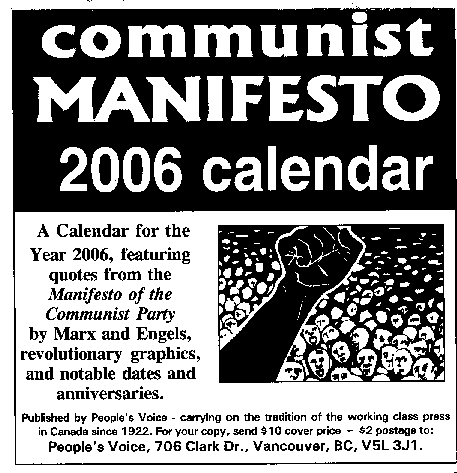
Communist Manifesto 2006 Calendar
PV Fund Drive: Time to make big push
(The following article is from the May 16-31, 2006 issue of People's Voice, Canada's leading communist newspaper. Articles can be reprinted free if the source is credited. Subscription rates in Canada: $25/year, or $12 low income rate; for U.S. readers - $25 US per year; other overseas readers - $25 US or $35 CDN per year. Send to: People's Voice, 706 Clark Drive, Vancouver, Canada, V5L 3J1.)
As usual at this point in our annual People's Voice Fund Drive, it's time to make a big push to start reaching our target. The past two weeks have brought us up to $27,583, or 55.2% of our $50,000 goal. There are several major fund-raisers coming up, and we will also be organizing a special campaign for renewal and contributions over the next few weeks.
The Maritime provinces and Newfoundland & Labrador are closest to their collective goal, with $1150 raised, or 95.8% of their target. No doubt there is another east coast reader sending us a $50 donation to bring your region across the finish line! Saskatchewan is second at the moment, with 80.6% raised, followed by Alberta at 60%, Manitoba at 59.1% and British Columbia with 56.1%.
The Ontario section of the Drive will get a boost from next month's Theatre Night Fundraiser. Part of the price of tickets sold to PV readers for a June 7 performance of "Cringeworthy," by Planet 88 in association with Theatre Passe Muraille in Toronto, will go towards the Fund Drive. For details, see the ad on page 7, or call Dave at 416-535-6586.
Clear your calendars on Saturday, June 3, for the 14th Annual PV Victory Banquet, at the Russian Hall (600 Campbell Ave.) in Vancouver. Doors open at 6 pm, with dinner at 7, followed by special guest speaker Sam Hammond, the Hamilton labour activist who is now our Business and Circulation Manager. Tickets are $18, or low-income $8, available from the PV Editorial Office (706 Clark Drive, 604-255-2041) and press clubs in the Lower Mainland. Sam will be in the Vancouver area for a few days to meet with press builders and to promote the paper among trade unionists and other progressives - we look forward to his visit!
People's Voice will be highly visible on Sunday, June 18, with a display at the Commercial Drive Festival in Vancouver's Grandview Park. Along with other progressive groups, we'll be selling PVs, buttons, t-shirts, and bumper stickers. Give us a call to volunteer.
Also coming up in early July is the annual Lower Fraser Club Walk-A-Thon, which always raises in the range of $2,000 for People's Voice in the Surrey area. Watch for details in our next issue.
PV 2006 FUND DRIVE
Area Target Raised %
British Colombia $22,000 $12,357 56.1%
Alberta $1,700 $1020 60.0%
Saskatchewan $800 $645 80.6%
Manitoba $3,000 $1775 59.1%
Ontario $20,000 $10,180 50.9%
Quebec $500 $110 22.0%
Atlantic Canada $1,200 $1150 95.8%
Other $800 $346 43.2%
Total $50,000 $27,583 55.2%
Court rejects Wal-Mart effort to block unionization
(The following article is from the May 16-31,2006 issue of People's Voice, Canada's leading communist newspaper. Articles can be reprinted free if the source is credited. Subscription rates in Canada: $25/year, or $12 low income rate; for U.S. readers - $25 US per year; other overseas readers - $25 US or $35 CDN per year. Send to: People's Voice, 706 Clark Drive, Vancouver, Canada, V5L 3J1.)
Retail giant Wal-Mart has failed in its application for judicial review of a decision by the Quebec Labour Relations Commission certifying a union at its store in St-Hyacinthe, 60 km east of Montreal.
In an April 6 decision, Quebec Superior Court Judge Nicole Morneau rejected Wal-Mart's contention that because the Commission had wrongly excluded seven auto shop repair workers and the head customer service manager from the bargaining unit, the union was able to win the majority needed to obtain bargaining rights.
Last year, the Commission rejected the employer's contention that the auto repair workers were indistinguishable from other store employees, finding that "there is little mobility between the technicians and the rest of the [employee] group. The automobile technicians can be excluded without difficulty from the requested bargaining unit, without affecting its appropriate nature. They work under different conditions, in a different environment, in a separate location, and their exclusion in no way threatens industrial peace."
The United Food and Commercial Workers Union-Canada has been certified as the bargaining agent for approximately 200 employees at the St-Hyacinthe store, the second Quebec outlet to be organized by UFCW. The first was a store in the Saguenay region, about 250 kilometres north of Quebec City.
Wal-Mart is the largest private sector employer in the world with 1.4 million workers globally. It is almost exclusively a non-union corporation and is universally known for its atrocious record on labour rights. Wal-Mart entered Canada in 1994 and now has about 230 Canadian outlets with more than 50,000 employees.
Labour backs anti-scab Bill
(The following article is from the May 16-31,2006 issue of People's Voice, Canada's leading communist newspaper. Articles can be reprinted free if the source is credited. Subscription rates in Canada: $25/year, or $12 low income rate; for U.S. readers - $25 US per year; other overseas readers - $25 US or $35 CDN per year. Send to: People's Voice, 706 Clark Drive, Vancouver, Canada, V5L 3J1.)
The Canadian Labour Congress is once again throwing its full support behind a private members bill from the Bloc Québécois that would ban the use of scabs and replacement workers during labour disputes under the Canada Labour Code.
"Third time's the charm," says Hassan Yussuff, secretary-treasurer of the Canadian Labour Congress. "To our unions, their activists and their members, I urge you to call your MP and tell them to vote in favour of this anti-scab legislation. Make sure you do it. Make sure a lot of people do it if your MP is Liberal or Conservative.
"With labour support, we son anti-scab laws in both Quebec and British Columbia. And despite several changes of government in those provinces, no government - not even the right-wing government of BC Liberal Premier Gordon Campbell - has touched the anti-scab legislation. That's because it works," says Yussuff.
The use of scabs prolongs disputes and has often provided the flash-point for violence or injury on picket lines. The current strike at the Ekati Mine in the Northwest Territories (see page 11) is a case in point, notes the CLC.
In October, 2003 and April 2005, similar attempts to reform the law were defeated, despite winning the support of a majority of backbench MPs, when Cabinet voted against them as a block. The most recent attempt was defeated by a mere 12 votes.
For the third time in as many years, Parliament has a chance to bring labour relations in this country into the 21st century. With a free vote, support from the three opposition parties plus a significant number of Conservative MPs, we expect this reform to pass," says Yussuff.
Sask. Federation of Labour calls for anti-scab law
(The following article is from the May 16-31, 2006 issue of People's Voice, Canada's leading communist newspaper. Articles can be reprinted free if the source is credited. Subscription rates in Canada: $25/year, or $12 low income rate; for U.S. readers - $25 US per year; other overseas readers - $25 US or $35 CDN per year. Send to: People's Voice, 706 Clark Drive, Vancouver, Canada, V5L 3J1.)
The Saskatchewan Federation of Labour is asking the provine's NDP government to adopt anti-scab legislation and once again it is running into resistance from its allegedly worker-friendly rulers.
While federation president Larry Hubich says such a law would shorten the length of strikes, reduce the number of confrontations on picket lines and raise the productivity of provincial workers, Labour Minister David Forbes responds that it is not a priority for the administration of Premier Lorne Calvert.
Anti-scab legislation exists in two Canadian provinces, Quebec and British Columbia. In both cases, it was approved when other governments were in power but, tellingly, neither province has moved to repeal the legislation, despite election of some labour-hostile regimes.
Only in Ontario, where anti-scab legislation was repealed by the former Mike Harris Conservatives, has such legislation been withdrawn once it has been put in place.
In Ottawa, the federal New Democrats introduced a bill on May 1 - International Workers' Day - calling for a prohibition on scab labour at the federal level. While the Harper Tories will likely oppose it, there is a chance the measure might win enough support from opposition parties to pass if it comes to a vote.
(NUPGE)
"Golden Hand Shake" for FPI boss
PROFITEERS ON THE LOOSE
(The following article is from the May 16-31, 2006 issue of People's Voice, Canada's leading communist newspaper. Articles can be reprinted free if the source is credited. Subscription rates in Canada: $25/year, or $12 low income rate; for U.S. readers - $25 US per year; other overseas readers - $25 US or $35 CDN per year. Send to: People's Voice, 706 Clark Drive, Vancouver, Canada, V5L 3J1.)
Derrick Rowe, the former CEO of Fishery Products International, received about $750,000 in compensation after he resigned last November. FPI announced in April it needs to slash jobs, cut wages and have legislative restrictions lifted to survive. The company is calling for a structural review, which puts hundreds of jobs at risk. Meanwhile, Rowe received a lump-sum settlement of $375,000, the CBC reported April 28, plus 36 monthly installments of $10,417.
Fish, Food and Allied Workers (FFAW/CAW) president Earle McCurdy strongly criticized the deal: "If that's what you get for screwing up the company, imagine the bonus you'd get if you were successful," McCurdy told the CBC.
Allan Moulton, a union representative in Marystown, said the company's latest restructuring will mean many job losses in his town, "We continued to point out through this whole process that we felt that this company certainly has to be more than about putting a lot of dollars in the pockets of a handful of people at the top of FPI," Moulton said. "For those of us who earn a hell of a lot less trying to do what we can to build this company over the years, that's a staggering amount of money," he told the CBC.
(From the CAW website)
Victory for Miami strikers
(The following article is from the May 16-31, 2006 issue of People's Voice, Canada's leading communist newspaper. Articles can be reprinted free if the source is credited. Subscription rates in Canada: $25/year, or $12 low income rate; for U.S. readers - $25 US per year; other overseas readers - $25 US or $35 CDN per year. Send to: People's Voice, 706 Clark Drive, Vancouver, Canada, V5L 3J1.)
After choosing to go on hunger strike rather than bow down before a company which was refusing to grant them dignity at work, 450 poverty-wage janitors at the University of Miami have won the right to form a union.
The LabourStart website reports that "They won because they stood firm, because they were willing to risk their lives in hunger strikes which caught the attention of the world. They won because they were supported by students who joined them in the hunger strike and who helped rally broad community support. They won because they and their union, the SEIU, were able to mobilize far beyond the campus and involved religious leaders, civil rights campaigners and politicians like former Senator John Edwards."
Five thousand messages of protest and solidarity were sent from around the world, representing one of the largest international trade union campaigns LabourStart has been involved in. The campaign reportedly flooded the inbox of the university president with hundreds of messages in the first few hours.
Massive abuses of migrant workers in UAE
(The following article is from the May 16-31, 2006 issue of People's Voice, Canada's leading communist newspaper. Articles can be reprinted free if the source is credited. Subscription rates in Canada: $25/year, or $12 low income rate; for U.S. readers - $25 US per year; other overseas readers - $25 US or $35 CDN per year. Send to: People's Voice, 706 Clark Drive, Vancouver, Canada, V5L 3J1.)
A new report on labour standards in the United Arab Emirates (UAE)) has identified 'massive abuses' of the migrant workers who constitute about 95 per cent of the private sector workforce. The report from the International Confederation of Free Trade Unions says the abuse of migrant workers includes non-payment of wages, extended working hours without overtime pay and unsafe working conditions resulting in death and injury. The report also expresses serious concern about the persistence of the worst forms of child labour in the UAE. It calls for the prosecution of those employing children in hazardous jobs or prostitution.
The UAE government has announced a new law allowing unions, to take effect by the end of 2006. ICFTU general secretary Guy Ryder said "it is essential that foreign workers be allowed to join a union, and that the principle according that unions must be free to decide their own structures, is fully respected in the new legislation."
A dramatic realignment of the hemisphere
(The following article is from the May 16-31, 2006 issue of People's Voice, Canada's leading communist newspaper. Articles can be reprinted free if the source is credited. Subscription rates in Canada: $25/year, or $12 low income rate; for U.S. readers - $25 US per year; other overseas readers - $25 US or $35 CDN per year. Send to: People's Voice, 706 Clark Drive, Vancouver, Canada, V5L 3J1.)
Excerpts from an article titled Bolivia's radical realignment under Evo Morales, by Roger Burback, director of the Center for the Study of the Americas based in Berkeley, California.
Earlier this year, Colombia signed a so called "free trade agreement" with the United States that is particularly harmful to Bolivia. Sixty percent of Bolivia's major agricultural expert, soy beans, currently go to Colombia. The US-Colombian accord means that cheap, subsidized US grains will flood Colombia, driving out Bolivian soy production.
Peru has also just signed a trade agreement with the United States that will have an adverse impact on Bolivian exports to Peru. These accords have ruptured the thirty-seven year old Andean Community of Nations, a trade pact that included Venezuela and Ecuador as well as Bolivia. Hugo Chavez announced in April that Venezuela is withdrawing from the pact because the United States has "fatally wounded" the community. Evo has also stated that Bolivia is reconsidering its membership.
This discontent with the Andean community led to the signing of the People's Trade Agreement between Cuba, Venezuela and Bolivia on April 29th. The accord is particularly favourable to Bolivia as Cuba and Venezuela have agreed to take all of Bolivia's soy production as well as other agricultural commodities at market prices or better. Venezuela will also ship oil to Bolivia to meet domestic shortfalls in production while Cuba will send doctors to Bolivia.
The trade agreement sand the nationalization of Bolivia's natural resources mark a dramatic shift in hemispheric affairs. Morales is serving notice on Washington that he is becoming part of a radical bloc of nations in Latin America that are no longer subservient to the United States.
|