|
|
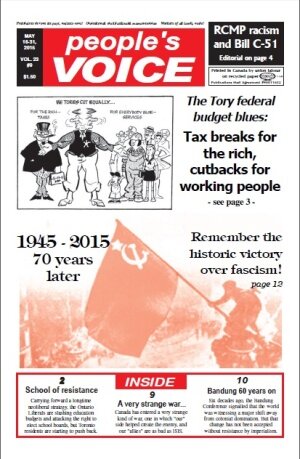
People’s Voice May 16-31, 2015
Volume 23 – Number 9 $1
1) CRITICS SLAM 2015 CONSERVATIVE FEDERAL BUDGET
2) CHALLENGES FACE NEW NDP MAJORITY IN ALBERTA
3) TORONTO’S CAMPAIGN FOR PUBLIC EDUCATION FIGHTS BACK
4) NEW ONTARIO TORY LEADER FUELS CAMPAIGN OF IGNORANCE
5) VICTORIA ACTIVISTS REJECT MLA INTIMIDATION TACTICS
6) VICTORY FOR OMAR KHADR! - Editorial
7) A GLIMPSE INTO OFFICIAL RACISM - Editorial
8) QUEBEC UNION BACKS BDS CAMPAIGN
9) “BRIGADISTAS” RETURN HOME FROM CUBA
10) MAY DAY 2015: CELEBRATIONS AND STRUGGLES ACROSS THE WORLD
11) 70th ANNIVERSARY OF THE VICTORY OVER NAZI-FASCISM
12) WHAT’S REALLY BEHIND THE WAR AGAINST ISIS?
PEOPLE'S VOICE MAY 16-31, 2015 (pdf)
|
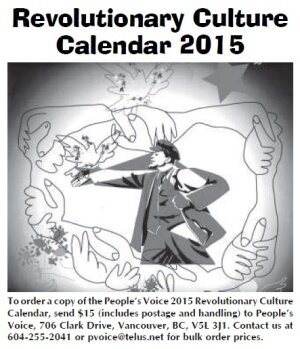
To order a copy send $15 (includes package and handling) to People’s Voice, 706 Clark Drive, Vancouver, BC, V5L 3J1. Contact us at 604-255-2041 or pvoice@telus.net for bulk order prices. |
|
People's Voice deadlines: June 1-15 June 16-30 Send submissions to PV Editorial Office,
|
REDS ON THE WEB
http://www.parti-communiste.ca/
peoplesvoice.ca
www.ycl-ljc.ca
www.solidnet.org
|
People's Voice finds many "Global Class Struggle" reports at the "Labour Start" website, http://www.labourstart.org/. We urge our readers to check it out! |
* * * * * *
Central Committee CPC
290A Danforth Ave Toronto, Ont. M4K 1N6
Ph: (416) 469-2446
fax: (416) 469-4063 E-mailmailto:info@cpc-pcp.ca
Parti Communiste du Quebec (section du
Parti communiste du Canada)
5359 Ave du Parc, Montréal, Québec,
H2V 4G9
B.C.Committee CPC
706 Clark Drive, Vancouver, V5L 3J1
Tel: (604) 254-9836
Fax: (604) 254-9803
Edmonton CPC
Box 68112, 70 Bonnie Doon P.O.
Edmonton, AB, T6C 4N6
Tel: (780) 465-7893
Fax: (780)463-0209
Calgary CPC
Unit #1 - 19 Radcliffe Close SE
Calgary AB, T2A 6B2
Tel: (403) 248-6489
Ottawa CPC
Tel: (613) 232-7108
Manitoba Committee
387 Selkirk Ave., Winnipeg, R2W 2M3
Tel/fax: (204) 586-7824
Ontario Ctee. CPC
290A Danforth Ave., Toronto, M4K 1N6
Tel: (416) 469-2446
Hamilton Ctee. CPC
265 Melvin Ave., Apt. 815
Hamilton, ON.
Tel: (905) 548-9586
Atlantic Region CPC
Box 70 Grand Pré, NS, B0P 1M0
Tel/fax: (902) 542-7981
* * * * * *
News for People, Not for Profits!
Every issue of People's Voice
gives you the latest
on the fightback from coast to coast.
Whether it's the struggle for jobs or peace, resistance to social cuts,
solidarity with Cuba, or workers' struggles around the world,
we've got the news the corporate media won't print.
And we do more than that
- we report and analyze events
from a revolutionary perspective,
helping to build the movements for justice and equality,
and eventually for a socialist Canada.
Read the paper that fights for working people
- on every page, in every issue!
People's Voice
$30 for 1 year
$50 for 2 years
Low-income special rate: $15 for 1-year
Outside Canada $50 for 1 year
Send to: People's Voice, 706 Clark Drive, Vancouver, BC, V5L 3J1
You can call the editorial office at 604-255-2041
<pvoice@telus.net>
REDS ON THE WEB
www.communist-party.ca
peoplesvoice.ca
www.ycl-ljc.ca/
http://solidnet.org/
http://www,rebelyouth-magazine.blogspot.com
(The following articles are from the May 16-31, 2015, issue of People's Voice, Canada's leading socialist newspaper. Articles can be reprinted free if the source is credited. Subscription rates in Canada: $30/year, or $15 low income rate; for U.S. readers - $45 US per year; other overseas readers - $45 US or $50 CDN per year. Send to People's Voice, c/o PV Business Manager, 706 Clark Drive, Vancouver, BC, V5L 3J1.)
1) CRITICS SLAM 2015 CONSERVATIVE FEDERAL BUDGET
PV Vancouver Bureau
Released on April 21, the latest federal budget from the Harper Conservatives has been slammed by the labour movement and progressive economists.
According to the Canadian Centre for Policy Alternatives (CCPA), the budget will do little to revitalize Canada’s sluggish job market at a time when economic growth is slowing due to collapsing corporate investment in the tar sands.
“The federal government could be proactive mitigate Canada’s fragile economy, but has chosen to create budget surpluses instead of jobs,” said CCPA Senior Economist David Macdonald. “In order to boost the economy and create jobs, we need a real commitment to infrastructure today, not in five years time. The government delayed the budget, claiming it needed to assess the impact of the plunge in oil prices but there is little in the budget to suggest the wait made any difference. The government is clearly still crossing its fingers and hoping for an economic miracle."
The CCPA argues that the tax cuts in the budget overwhelmingly benefit the wealthy, not those living in poverty. The much-touted “family tax package” directs a large amount of taxpayer dollars towards higher income Canadians, not those with the greatest need.
“With the economy slowing and population aging staring us down, this government decided to deliver an Economic Distraction Plan - purporting tax cuts, trade and fighting terrorism as the best way to manage the challenges facing our economy,” said Armine Yalnizyan, CCPA Senior Economist. “That’s like putting lipstick on a pig.”
Measures for seniors, including doubling the Tax Free Savings Account (TFSA) and lowering the mandatory withdrawals from the Registered Retirement Income Fund, will primarily benefit wealthier seniors. Only 13% of seniors maxed out their TFSA at the pre-doubling rate, and more than half don’t even have a TFSA. Sixty-five percent of seniors have less than $50,000 in a RRIF or RRSP.
“Like so many other measures in this budget, the majority of the benefits from the TFSA and RRIF changes go to those who need it least. A better way to help seniors would be to cancel the increased age of eligibility in OAS or expand the Canada Pension Plan,” said Yalnizyan. “Let’s not kid ourselves into thinking that either of these measures will have any impact on senior poverty or the retirement savings crisis.”
The federal government will spend $7 billion on the Universal Child Care Benefit (UCCB) and income splitting this year. This untargeted spending could have been used to pay for a national $7/day child care program, but instead, the budget does not create any child care spaces. Forty-nine percent of qualifying families will receive nothing from income splitting, with the greatest benefit going to families that earn over $200,000 a year.
CUPE economist Toby Sanger argues that the 2015 federal budget offers nothing new to workers and the majority of Canadians.
“Once again it includes tax cuts for business and the wealthy, and nothing substantial to create decent jobs or to help Canadians struggling to make ends meet,” says Sanger’s analysis. “In fact, it takes money from workers contributed through the surpluses in the Employment Insurance fund to pay for these tax breaks for the wealthy and corporations.”
He argues that Conservative spending cuts are destroying jobs, squeezing workers’ wages, slowing down economic growth and making it harder for working families to get by.
Examining the “big ticket” new items in the budget, Sanger makes the following points:
* The tax cut for small business (down to 9 per cent by 2019) will cost $2.7 billion over the next four years and over $1.2 billion annually when fully-phased in. This category includes larger corporations up to a size of $10 million.
* Manufacturers get lower taxes by allowing faster depreciation of investments, worth over $300 million annually.
* Increasing the annual contribution limit for TFSAs to $10,000 is “a multi-billion dollar tax break for the wealthiest Canadians”, which together with the regressive income splitting measures will cost the federal government over $13.8 billion over six years.
* Spending on defence and security goes up, including $12 billion more for the Department of National Defence, with much of that to come in future years.
* The budget includes additional funding for public transit, but not for another two years, and only to municipalities which use much more expensive Public-Private Partnerships (P3s).
At the same time, there is nothing in the budget to create jobs, reduce inequality, or to improve pensions or Employment Insurance. Nor is there anything to create affordable child care or to improve public health care.
Despite long waiting lists, five million Canadians without a family doctor, and skyrocketing prescription drug prices, the 2015 federal budget confirms previous cuts of more than $36 billion from health care over the next ten years. The federal share of health care spending is projected to plummet from 20 per cent to 12 per cent.
The Federation of Canadian Municipalities had been seeking $300 million annual to meet new federal wastewater regulations that will cost at least $18 billion over the next decade. However, the budget has no funding to improve water quality.
Nor does the budget address the housing crisis. The federal government’s annual investment of $1.7 billion for social housing is maintained, but not increased, leaving Canada as the only major capitalist country without a housing strategy.
While there is not one mention of climate change in the entire budget plan, there are over a hundred mentions of oil over 500 pages. Instead of reducing the subsidies to fossil fuels, as the International Monetary Fund and the G20 have strongly urged, this budget increases those subsidies by providing a new tax subsidy for facilities that produce Liquid Natural Gas (LNGs). The budget also extends the mineral exploration tax credit and provides tax subsidies for resource companies required to conduct environmental assessments to get approval for resource projects such as pipelines and provides more funding for agencies to help speed up those approvals.
The budget’s few environmental measures are limited to $75 million over three years to help implement the Species at Risk Act, $10 million a year for recreational fisheries and $2 million for the Pacific Salmon Foundation - amounts that are far less than what environmental and conservation organizations had called for.
However, as Sanger points out (and as most people who watch the NHL playoffs have witnessed) the budget is being promoted by massive government spending, with $7.5 million allocated for advertising in May alone. That amount is one-tenth of the federal government’s entire advertising budget for 2013/14.
The CUPE economist also stresses that the Tory “balanced budget” is created by taking from workers to give tax cuts to the rich: “The Conservatives claim they’ve balanced the budget with a $1.4 billion surplus this year - but the reality is it’s a completely bogus balance. They’ve only been able to achieve a surplus on paper by taking $1.8 billion out of the EI fund, another $900 million from cutting sick leave benefits in the federal public, and $2.1 billion by selling their shares in GM.
“The EI surplus funds should have gone into improving the EI program, the $900 million in sick leave benefits will be unfairly appropriated from workers, and the government could have fetched almost a billion more from the GM shares if they’d held onto them for just another year instead of selling them at a discount to Goldman Sachs. As befits Joe Oliver, the former Bay Street banker now Finance Minister, this really is a Robin Hood budget in reverse, taking from workers to give tax cuts to the wealthy and corporations.”
The budget reduces contingency forecasts, down to only $1 billion for the next three years instead of the usual $3 billion. If the economy does not pick up strongly, the new tax cuts for the wealthy and businesses will put any surplus in serious jeopardy.
There has also been considerable controversy around the “balanced budget” legislation which the Tories plan to introduce, requiring future federal governments to freeze operating spending after a recession.
“This is a sure recipe for continuing stagnation,” argues Sanger. “The government’s own figures show that public investment and spending creates far more jobs and provides a much stronger economic boost than tax cuts.”
Among the few measures aimed at working Canadians are a plan to extend the “Employment Insurance Working While on Claim” project for another two years, and to extend compassionate care leave under the EI program to care for a gravely ill family member from six weeks to six months.
But unions have condemned the government for its plan to eliminate existing sick leave provisions for federal public service workers, whether or not an agreement on this is reached at the bargaining table. The government has also refused to improve the Employment Insurance system, which now only provides benefits for less than 40 per cent of the unemployed, by improving eligibility, benefits or services. And of course the budget simply ignores the growing demand by trade unions, students and other groups to increase the federal minimum wage to $15/hour.
Sanger warns that the Tory agenda of “relying on tax cuts and gambling on the resource sector to create good jobs and stimulate growth while squeezing wages and cutting public services has failed, and will continue to fail. There’s been little improvement in unemployment since the Conservatives gained a majority, job quality is now at its lowest level in more than a quarter century and the real wages of working Canadians are stagnant while their debt continues to escalate. Meanwhile CEO compensation has increased by 40 per cent since 2009 and corporate profits are up by more than 70 per cent. As a result, inequality is increasing and our economic prospects keep declining: our economic growth rate is now substantially lower than the U.S. while our unemployment rate is substantially higher.
“By continuing to reduce public sending to finance more tax cuts for business and the wealthy, this budget continues with their failed economic policies and will instead increase inequality, destroy jobs and further slow down the economy.”
2) CHALLENGES FACE NEW NDP MAJORITY IN ALBERTA
By Naomi Rankin
Despite journalistic cartoons of pigs flying and hell freezing over, the May 5 election of a new majority NDP government in Alberta is after all a political and not a magical event. As in Ontario under Bob Rae and BC under Dave Barrett, the NDP has been elected by voters more than thoroughly disenchanted with the economic devastation that comes from right wing governments' incapacity to respond to economic downturns.
And, as in Ontario and BC, the corporate sector and right wing shills are already ramping up the attempt to blame the NDP for the economic mess they have inherited. The mess is significant: an economy lop-sidedly dependent on volatile resource pricing, the potential nest egg of royalties completely frittered away, a $7 billion deficit proposed by the last Tory budget, even with severe cuts in education and health care.
The NDP began this campaign not expecting to form the government. A fair number of their successful candidates are the kind of people who run for a party that's not going to win. Several new MLAs are not just young, but obviously somewhat inconvenienced by finding themselves in a new job. The Tories tried and failed to spook the voters with the prospect of an inexperienced and bumbling new administration, but starting from scratch is not the biggest of the NDP's challenges.
The NDP's victory is not a sign of a sudden leap to the left by Alberta voters. It reflects the eventual tipping point of a gradual demographic change in the cities - younger, more cosmopolitan with immigrants from the rest of Canada and elsewhere - and the switch to the Wildrose Party by rightwing, mostly rural voters angry at the arrogance and entitled attitude of the reigning Tories.
NDP leader Rachel Notley ran a relentlessly centrist campaign, emphasizing her intention to cooperate with the corporate sector, reiterating the conventional wisdom that oil and gas are the foundations of the Alberta economy, and claiming the mantle of Peter Lougheed. She said it again in her victory speech and again the next morning. Informed political commentary, however, is pointing out that, as in Ontario and BC, the corporate sector is likely to gear up for ruthless obstruction, up to and including sabotaging economic development for the sake of expelling the NDP from office, no matter how moderate and limited their reforms: raising corporate taxes from 10 to 12%, raising the minimum wage, safeguarding health and education.
Can the NDP carry out this platform? That depends on another unknown. Will the working class and its potential allies have the class consciousness to recognize and repudiate the self-interested corporate propaganda, and the militancy to demand that the reforms be carried out in spite of economic sabotage?
There are a lot of happy people in Alberta right now, including some who had dropped out of the NDP from discouragement and are now eager to get back into the political life of the province. The organized labour movement, although weakened over decades by splits and loss of jobs, currently has progressive and activist leadership in the AFL and AUPE, the main provincial employees' union. Over the past two years in particular, they contributed to running the Tories out of office by their vigorous resistance to pension cuts and anti-labour legislation. They have a big job ahead of them too.
(Rankin is the leader of the Communist Party-Alberta, and was the party’s candidate in Edmonton Mill Woods; also on the ballot for the CP-A was Bonnie Devine, in Calgary East.)
3) TORONTO’S CAMPAIGN FOR PUBLIC EDUCATION FIGHTS BACK
By Stephen Seaborn, Public Sector Workers Club
Finance ministers are up to their fiscal trickery in Ontario: cooking the numbers to balance their books while our Toronto schools crumble.
After slashing provincial education and health transfer payments back in the mid-80s, the feds further reduced revenues in their April 2015 budget by delivering $5 billion in tax cuts (mostly benefiting the country’s wealthiest 15%). They also snipped $36 billion from healthcare over the coming ten years.
This is what they call neoliberal economics. Essentially we are the ones paying for it and our consolation prize (as one journalist put it) is to “watch all our social programs built over the past 60 years wash away with the winter snow”. Neoliberal thinking (dating back, btw, to the NDP education projections of early ‘90s) is obviously quite firmly entrenched not just in Ottawa, but over at Queens Park.
Here in Ontario, where funding of public education has never recovered from the deep Harris cuts, the province is dealing with its $10.9 billion deficit by selling off public infrastructure, cost-cutting on the backs of public servants and “consolidating” schools. The impact of 20 years of tax cuts in Ontario is that we are missing out on $19 billion in revenue. No surprise that Ontario’s corporate tax rate remains one of the lowest in North America.
No surprise either that the province is playing hardball in contract negotiations with teachers.
No surprise that there’s still no job strategy beyond crappy jobs for kids leaving school.
In the coming years, spending just won’t keep up either with inflation or with population growth. This despite public services needing people to deliver the services, and education needing education workers in schools and communities.
The CCPA, the Canadian Centre for Policy Alternatives, reports that after Ontario’s May 7 budget, education will suffer even more than healthcare from under-funding.
Again, no surprise that Ontario Premier Kathleen Wynne, who’s looking more like Mike Harris by the day, told Toronto’s Campaign for Public Education nine years ago: “There’ll be no more money for education”.
Meanwhile, in Toronto, to implement its cost-cutting plans, the province jumped on an apparent crisis in school board governance just two months following the election of eleven brand new school Trustees, cunningly feeding a public and media perception of serious dysfunction and “infighting” at the TDSB.
Spring brought Torontonians simulated government consultations on both school board governance, and reconfiguring schools as hubs
Toronto residents now face a three-pronged attack by the provincial Liberals on Canada’s largest school board:
1. The Education Minister’s winter “directives” which dramatically reduced Trustee democracy;
2. The forced sale of publicly-purchased school board infrastructure;
3. A consultative panel aimed at sub-dividing the TDSB into four smaller boards, possibly elected at large, not by ward constituents.
On the plus side, community and parent groups in Toronto are not known for taking government attacks on community school facilities lightly. As they begin to pay attention, public awareness, concern and rage is gradually growing across the city. And after 13 years of activism, Toronto’s Campaign for Public Education is still together, effective and busy with a coordinated fightback.
Is it enough? No. Not by a long shot.
But as spring morphs into summer, the CPE, an assembly of community and school based organizations representing a membership including families of over 100,000, has set its sights on Ontario’s MPPs.
For more info, check out CPE’s new flyer to help combat school closures, which is seeing widespread school-community use through elementary teacher networks. Look over the CPE’s paper promoting sample answers for public input to the Hall Governance panel, and its equity/access critique of these consultations. The CPE continues to be guided by its 10 Point Program for Public Education in Toronto. These and other materials are online at campaignforpubliceducation.ca.
4) NEW ONTARIO TORY LEADER FUELS CAMPAIGN OF IGNORANCE
By Liz Rowley, leader, CPC (Ontario)
On May 4th and 5th, 35,000 elementary students – almost 90% - were kept out of school in Brampton and Toronto’s Thorncliffe Park neighbourhood to protest the new sex education curriculum being introduced in health and phys ed classes in September by the provincial government.
As far as protest organizers are concerned, no sex education is the best education for their kids – and yours too.
The protests are the result of a massive disinformation campaign carried out by Campaign Life, the Christian fundamentalist Rev. Charles McVety, fundamentalists in the South Asian community who are the main targets of this campaign, and organizers for the new leader of the Ontario Conservatives and several of his Queen’s Park caucus.
Patrick Brown, elected May 9th with a 61% plurality over Christine Elliott, swept the leadership contest after signing up 40,000 new members across the province, focussing in on new immigrants and racialized groups to build the kind of right-wing movement Jason Kenny built for the federal party. At the core is the Ontario Landowners’ Association, a right-wing rural movement that has elected several MPPs to Queen’s Park, knocking off at least one sitting Tory MPP to do it, pushing the party farther and farther to the right from inside and outside the caucus. This is where the proposal to slash 100,000 public sector jobs came from in the 2014 election, along with right-to-work laws that were eventually dropped from the platform, but not from the agenda.
A party of privilege and money, the new Tories represent a party even father to the right than the Mike Harris government of 20 years ago.
Patrick Brown has no seat in the Legislature and is in the process of resigning his federal seat as an MP from Barrie in the Harper government. But he’s in no hurry to get to Queen’s Park, preferring to root around in the detritus of Campaign Life and Rev. McVety, President of Canada Christian College. Brown and his supporters have not only supported the fundamentalist campaign against sex education in schools, they’re fuelling it.
A massive disinformation campaign about the contents of the curriculum has convinced many parents that their children are being groomed for sexual exploitation, and the “proof” is a disgraced former Deputy Minister charged with possession of child pornography.
Adding to this, the Liberals have decided not to try to educate communities about the real content of the curriculum, which is to protect children and youth against pregnancy, disease, and new dangers like sexting, internet luring and pornography which are easily accessible on any computer. The curriculum teaches consent, that is the right and the ability to say ‘no’ to unwanted sexual advances, and the right to choose when to say ‘yes’. Students are also taught about changes under Human Rights legislation that recognize different types of families, including same-sex families, and single parent families, which are equally valuable, loving and important, especially to their children, and also legally equal.
The Ministry knew full well from previous experience in 2010 that McVety and Campaign Life were very likely to try to whip up fear, homophobia, and prejudice in order to block the new curriculum. But instead of using its staff and resources, and the School Boards’ community school liaison workers to educate communities and families about the benefits of the new curriculum, the Ministry opted to ignore the very large communities of new immigrants, and bull through.
On Steve Paikin’s TV Ontario program on May11, organizers of the school protests claimed that sex education leads to rape. The logic? According to Faras Marish, it’s because boys get charged up talking about sex, cannot control themselves and cannot take no for an answer. That’s just the way it is, so you better not tempt them with all that sex talk. Boys are beasts. And girls are powerless – that’s the second shoe. Another lie.
But in fact the beasts are not children, they’re the right wing politicians and religious fundamentalists that want to ride this issue into power, and never mind the consequences on youth and students, families and communities. They are PC leader Patrick Brown and Rev. Charles McVety who want to turn the clock back 100 years, to a time when equity didn’t exist, where women and racialized communities ‘knew their place’, where LGBTQ people were invisible, and where unions had no rights.
Despite the government’s inept performance, it’s important that progressive people and organizations speak up in support of the new curriculum, for education, knowledge, and liberty, against the backward and reactionary ideas of McVety and Brown, Campaign Life and the PC caucus. Ontario must defeat these ideas and move forward, not backwards.
This is a sign of the dangerous times we are living in.
5) VICTORIA ACTIVISTS REJECT MLA INTIMIDATION TACTICS
By Kimball Cariou
Drivers along the Patricia Bay highway between Victoria and the Swartz Bay ferry terminal on Vancouver Island are familiar with a stretch of closely-packed billboards promoting a range of businesses, charities and social causes. For example, local supporters of Cuban friendship and solidarity often rented a billboard site at this location near Mt. Newton Cross Road, as part of the ultimately successful campaign to free the Five Cuban Heroes from U.S. jails.
Most recently, the Victoria Friends of Cuba joined with the Victoria Coalition Against Israeli Apartheid for a similar project. On May 3, the groups erected a billboard condemning the Israeli state’s racist treatment of Palestinians, along the same stretch of highway owned by the nearby Tsawout First Nation. This band earns important revenue from these billboards, but the business side of the arrangement is contracted out to a few independent companies. As in the past, this deal was signed with the Direct Marketing Group operated by Robert Lynn, who has no role in the content of the billboards.
But on this occasion, “controversy” suddenly erupted. Just four days later, Robert Lynn contacted Randy Caravaggio of the Victoria Friends of Cuba, regarding a letter complaining that the billboard was offensive and hateful, and requesting its removal. The complaint was not from an ordinary citizen, but from Andrew Weaver, the Green Party MLA for the neighbouring constituency of Oak Bay-Gordon Head.
Considering the Green Party’s reputation as defenders of free speech and civil liberties, members of the two organizations were surprised, but refused to meekly back down.
In a letter to supporters, Caravaggio says, “We have received incredible support with letters and phone calls for our action in putting up the billboard. We also received a great number of copies of the letters that many of us have sent to MLA Andrew Weaver. We hope that we continue to receive more of them. We believe that the billboard has given space for open debate on the issue for a wider audience as we had originally intended before erecting the billboard.”
Responding directly to Andrew Weaver (a climate scientist who became the first Green elected to the BC Legislature in 2013), Caravaggio and Edwin Daniel of the Victoria Coalition Against Israeli Apartheid asked, “on what basis did you send your letter of complaint about the content of our billboard to Mr. Lynn? Mr. Lynn had nothing to do with the content of the billboard. He simply rents billboard spaces to anyone who wants to erect a billboard and makes a living from it... We believe that the reason you sent it to Mr. Lynn was that you as an MLA thought you could pressure or sway Mr. Lynn to tell us to remove the billboard. If this is the case (if it isn't please explain), we can only say that your action is entirely inappropriate in an open and democratic society. To use your office and position as an MLA to bully someone to silence debate and quash our freedom of speech is abusive to say the least. Why could you not simply have contacted us to discuss it? We are the ones fully responsible for the billboard and its content. Our name and contact are clearly visible on the billboard. We hid nothing. So why use this sneaky unprofessional manner to try to silence us?”
They also object strongly to Weaver’s claim that “this billboard is offensive as it promotes hatred of a people," pointing out that “Our billboard concerns the state of Israel and NOT a people. The Israeli state is not sacrosanct. Criticism of any state for its wrongful actions or discriminatory laws is the right of each of us. As it is our right to criticize actions and policies of the Canadian government or the Liberal government in BC, so it is our right to criticize the actions and policies of foreign governments, including Israel or the USA. Jewish people in our group are in full support of our billboard and are opposed to the illegal Israeli occupation of Palestine and the apartheid system Israel has imposed.”
Weaver’s letter also argues that "the accusation of apartheid... promotes the disdain and hatred towards those accused of supposedly practicing apartheid."
In response, Caravaggio and Daniel point to “ethnic cleansing of more than 700,000 Palestinians in 1948-9, a more than 400 mile long illegal separation wall, the oppression under military law of Palestinians in the West Bank and East Jerusalem, the illegal imposition of 600,000 Israeli settlers on Palestinian land, the fact that all Palestinians - unlike Israelis - have to carry and show ID cards when they pass through endless check points, ongoing destruction of thousands of Palestinian homes and villages, Israeli only highways, the illegal blockade of Gaza starving nearly 2 million people, the repeated attacks on Gaza with massacres of thousands including women and children, the breaking of over 70 UN resolutions, the racist plan to make Israel a state of the Jewish people...” Do these policies not constitute Apartheid?, they ask.
In conclusion, the two groups express the hope that Weaver will retract the statements in his letter, and extend apologies for such his behaviour.
At PV press time, it remains to be seen whether Weaver will back off from his attempt to censor the billboard.
People’s Voice Editorial
Despite the depressing vote in Parliament to adopt Bill C-51, it would be dramatically premature to declare that Canada is now a fascist state. The battle to defend and expand civil and labour rights, and other democratic freedoms, is long and complicated. The War Measures Act was declared in 1914 to suppress criticism against a brutal and bloody imperialist war, and stayed on the books until 1989, an appalling three-quarters of a century. The infamous Padlock Law, adopted in Quebec in 1937 to ban communist activities, was finally struck down by the Supreme Court of Canada twenty years later. Working class, radical and revolutionary movements continued to function during these periods, and ultimately these draconian laws were overturned.
The release of Omar Khadr from his Alberta prison cell is another indication that it is still quite possible to win victories for freedom and democracy in Canada today. Thanks to the incredible strength and sacrifices by Khadr’s lawyer over many years, this remarkable young man is finally allowed to walk the streets and openly express his views (within certain frustrating limits imposed by the courts), after defeating the attempts of the far-right Harper Tories to keep him in jail.
These examples show that there is never one simple, direct path to freedom. The working people of Canada face a lengthy period of intense struggles against the drive to silence opposition to the ruling class policies of austerity and war. Every victory by another Omar Khadr gives us hope and inspiration to carry these struggles forward, no matter how difficult each challenge seems!
7) A GLIMPSE INTO OFFICIAL RACISM
People’s Voice Editorial
In the sanitized world of right-wing politicians trained in perfect sound bites, we rarely see the full extent of racism, misogyny and other forms of bigotry which permeate the ruling class. But occasionally a glimpse of their reactionary ideology becomes visible.
One such moment came in late 2012, during the courageous hunger strike by Attawapiskat Chief Theresa Spence and the emergence of the Idle No More movement. Desperate to shift attention away from their callous indifference to the deaths of Aboriginal peoples, Tory cabinet ministers spread cowardly lies about Chief Spence, blaming impoverished First Nations bands for the crisis caused by centuries of genocidal colonialist policies.
At the same time, an RCMP official was filing a report saying, “This Idle No More Movement is like bacteria, it has grown a life of its own all across this nation.” RCMP Cpl. Wayne Russett also warned ominously about “flash mobs, round dances and blockades (becoming) much less compliant to laws in an attempt to get their point across.”
The true heroes of that winter were Chief Spence and her colleagues, trying to get clean drinking water and livable homes for their people, and the thousands of Idle No More supporters in the streets and shopping malls. But instead of being lauded for defending human rights, they were labelled “bacteria” and put under constant police surveillance.
This shows why Bill C-51 is so dangerous. This legislation openly encourages security forces to monitor opposition to government policies, supposedly because this might lead somebody, somewhere, to someday “undermine the security of Canada.”
In fact, our security has already been badly undermined, by the very governments and police forces which claim to protect us. Five months from now, we can vote to drive the Harper Tories out of office, and then start to press any new government to repeal this vicious law, and to scrap the racist, anti-working class security forces which have suppressed the peoples of Canada for far too long.
8) QUEBEC UNION BACKS BDS CAMPAIGN
PV Montreal Bureau
A major Quebec trade union has come fully on board with the international Palestine solidarity campaign known as Boycott, Divestment, and Sanctions or BDS. The decision took place in April at a delegate meeting of the Confederation of National Trade Unions (CSN) which represents some 325,000 workers in all sectors across Quebec.
Announcing the decision, the CSN noted the 2005 and 2014 calls of Palestinian unions to support the BDS campaign and pressure Israel to respect international law, end the military occupation of Gaza and the West Bank, respect the rights of Palestinian refugees, and stop racial discrimination against Palestinian citizens of Israel.
The CSN’s decision brings the Quebec organizations of the Coalition BDS-Québec up to twenty-six. Frequent visible and noisy protests forced the Israeli consulate to relocate out of downtown Montreal and into neighbouring Westmount a few years ago. Likewise, consistent weekly picketing recently helped close the local NAOT store, exclusively selling Israeli shoes produced in a West Bank sweat-shop.
“For the CSN, the BDS campaign must be particularly active in Canada and Quebec because of the depth of the ties that weave the Harper government with that of Israel,” their statement said.
“In recent years, the unconditional support given by the Conservatives to Israel and its apartheid policies is outrageous,” said CSN vice-president Jean Lacharité.
Meanwhile, a human rights report has again condemned the exploitation of Palestinian child labour in the Israeli settlements.
The report by Human Rights Watch documents that children as young as 11 earn less than US$20 for a full day in conditions that can be hazardous due to pesticides, dangerous equipment, and extreme heat. The report says the children working on Israeli settlements pick, clean, and pack asparagus, tomatoes, eggplants, sweet peppers, onions, and dates, among other crops.
The child workers begin as early as 5:30 or 6 a.m. and usually work around 8 hours a day, six or seven days a week, often without breaks. They described vomiting, dizziness, and skin rashes after spraying pesticides with little protection, and experienced body pain or numbness from carrying heavy pesticide containers on their back as well as other injuries. Temperatures in the fields often exceed 40 degrees in summer.
BDS is calling for three main demands: stopping all imports of Israeli goods or export goods, cultural or academic activities or productions in Israel; removing investments in Israeli bonds and companies and banks; and supporting the call by Palestinian groups for a military embargo against Israel.
The first labour conference on BDS was held in Ramallah four years ago. The Canadian Union of Postal Workers, CUPE Ontario, as well as the British union Unite and the Congress of South African Trade Unions all support BDS.
9) “BRIGADISTAS” RETURN HOME FROM CUBA
By Drew Garvie
Thirty-eight participants who travelled to Cuba as the 23rd Che Guevara Volunteer Work Brigade have just returned to Canada. The purpose of the annual Brigade, organized by the Canadian Network on Cuba, is to build Canada-Cuba friendship and solidarity by sending delegations on tours of the island. This was a special year for the Brigade, because of the freedom recently won for the Cuban Five heroes, and the groundbreaking negotiations taking place between the United States and Cuba.
The Brigade members themselves were a diverse group of all ages with participation from Vancouver, Kamloops, Kelowna, Winnipeg, Hamilton, Toronto, Ottawa and Halifax. Eight members of the Communist Party of Canada and the Young Communist League attended the tour.
Because of the larger international presence in Cuba to attend May Day, this year’s Brigade was joined by other participants from a variety of countries. A large delegation from Peru and smaller delegations from Chile, Costa Rica, New Zealand, Japan, Austria, El Salvador and Nicaragua, joined the group from Canada. This added to the internationalist flavour of the Brigade, and friendships were made with a shared respect of Cuba’s revolution as the foundation.
As in past years, the Brigade highlights included meetings with youth and student organizations, local members of the women’s federation (FMC), a local Committee for the Defense of the Revolution (CDR), and specialists on the Cuban economy and agriculture. The Brigade was two weeks long, with the first week’s lodging at the “Niceto Pérez camp” about an hour south of Havana, and the second week spent travelling around Matanzas province.
This year’s volunteer work consisted of harvesting sweet potatoes, planting green onions and preparing seedling bags, to show solidarity with the Cuban revolution, and to work alongside Cuban farmers and workers and learn from them directly.
On May First, the Brigade joined over 1000 other international guests to witness over one million Cuban workers march in Havana under the slogan “united in the construction of socialism”. The march was led by the five Cuban heroes, freed last December from US jails. Also leading the parade were hundreds of doctors who recently returned from a successful fight against Ebola in West Africa.
The leader of Cuba’s national trade union federation (CTC), Ulises Guilarte, delivered a defiant and revolutionary address to the crowd of millions: “we are here sending to the world a message of unity of the Cuban people’s massive support for their socialist revolution, for the Party, for Raul and for Fidel.” Venezuelan worker-President Nicolas Maduro attended, next to Cuban President Raul Castro. Thousands of Venezuelan flags and signs demanding an end to US intervention and sanctions in Venezuela were present.
The following day, the CTC hosted an annual meeting of Cuba solidarity activists from around the world. Cuban officials stressed that there is a political struggle to lift the criminal US blockade and normalize relations, but Cubans refuse to achieve this by giving in to US corporate interests through dismantling socialism or abandoning anti-imperialist principles. Kenia Serrano of the Cuban Institute of Friendship of the Peoples asked the solidarity movements to keep up the momentum won by the successful international campaign for the release of the Cuban Five. She asked organizations to continue and deepen the struggle to lift the US blockade, which has cost the country over 1 trillion dollars since it was first imposed, and to push for removal of the illegal US military base in Guantanamo.
At a final meeting with leaders from ICAP on May 8, all Brigade participants expressed positive remarks in relation to this year’s experiences. Having a chance to see first-hand the strength of Cuban socialism, the gains made by the revolution, and the unity of the Cuban people in the face of incredible odds, was an unforgettable experience. Brigadistas returned energized and ready to promote next year’s Brigade, as part of the broader goal of building solidarity with Cuba across Canada.
10) MAY DAY 2015: CELEBRATIONS AND STRUGGLES ACROSS THE WORLD
Special to PV
May First, the international workers’ day, was marked with protests, demonstrations and celebrations in dozens of countries around the world.
In Canada, thousands of demonstrators took to the streets of Montreal and other cities. The protests began during the morning rush hour, targeting big banks and the Quebec Liberal government's austerity measures. One protest at a Montreal building that houses financial and trade institutions forced police to require employees to show their ID passes to get to work inside.
The demonstration brought together a coalition of trade unionists, students and social movements, for a march that ended at the Montreal Stock Exchange, with riot police along the route. Later in the evening, a similar-sized anti-capitalist protest drew a sharper response, including police tear gassing of demonstrators and onlookers, and reports of 84 arrests.
About 500 people took part in the annual May Day march organized on Commercial Drive by the Vancouver and District Labour Council. The event focused on the struggle for a $15 minimum wage, which has been the key demand of BC trade unions and youth groups in recent months. The march was followed by a free evening public concert, during which youth organizers worked to mobilize participation in another street march. Starting close to midnight, this march drew hundreds into a lively protest against police brutality (especially around recent events in Baltimore), and to oppose the Harper government’s anti-democratic Bill C-51.
Toronto’s May Day march drew attention to the racist treatment of migrant workers in Canada, and raised a wide range of traditional working class demands. The following evening, the annual United May Day celebration held at the Steelworkers Hall on Cecil Street featured a powerful and diverse cultural program, and speakers including CLC President Hassan Yussuff and Communist Party leader Miguel Figueroa.
Other May Day events were held in cities including Victoria, Edmonton, Calgary, Winnipeg, Hamilton, Brampton.
Across USA
May Day was marked across the United States, the country where the annual workers’ day began with struggles for shorter working day back in the 1880s. In many U.S. cities, the issues raised in these actions included rights for workers and immigrants, and an end to police brutality in the wake of more killings of black men.
Rallies were held in Minneapolis, Oakland, New York, Los Angeles, Chicago, Seattle, and many other locations.
In Minneapolis, the group Black Lives Matter mobilized high school students to leave classes, and some staged a die-in that briefly stopped local traffic.
The May Day protest outside Oakland's City Hall has swelled to more than a thousand people, one of several demonstrations by labour, immigrant and civil rights activists in cities across California. The protesters condemned racism, police brutality and income inequality in a loud, sign-waving march from the port to downtown. Signs and banners said that "Racism is the Disease," and called for better wages and working conditions.
In Los Angeles, protesters rallied to support President Obama's proposals to protect millions of immigrants in the country illegally from deportation.
Hundreds of people joined in May Day marches in Seattle and Yakima, Washington, in support of the rights of workers and immigrants.
About 1,000 protesters against police brutality marched in downtown New York at a May Day rally that took on a new message amid outrage over the death of Freddie Gray while he was in the custody of police in Baltimore. Demonstrators streamed through blocked-off streets, bearing signs with such messages as "Disarm the NYPD" and "Justice for Freddie Gray.”.
About 400 people marched in Chicago to protest police shootings and to recognize May Day's message of workers' rights.
International
On a global scale, the largest May Day rallies took place in Havana and Caracas, where trade unions and progressive movements mobilized huge turnouts in support of the socialist policies of the Cuban and Venezuelan governments.
But big rallies were also organized across Europe, the Middle East and Asia. In some countries, the corporate media deliberately ignored huge demonstrations against the austerity policies of governments, preferring to focus narrowly on clashes with police.
In Berlin, several thousand people took part in anti-capitalist street parties in the north of the city, and
In Turkey, authorities stationed an army of 10,000 police with water cannons, rubber bullets and tear gas to keep May Day protesters out of Istanbul’s Taksim Square. The square is symbolic as the centre of protests in which 34 people were killed in 1977, and as the focus of massive anti-government protests that rocked Turkey in 2013. Earlier this year, the government passed a security bill giving police expanded powers to crack down on protesters. But despite the police repression and over 200 arrests, many demonstrators managed to get into the square, raising red flags and banners. Large labour rallies were held at other nearby locations in Istanbul, and in many other Turkish cities.
In Taipei, thousands of people took to the streets to demand higher salaries, shorter work hours, and a ban on temporary hiring. Some threw smoke bombs near the Taiwanese presidential offices.
Malaysian activists protested in front of the Kuala Lumpur landmark Petronas Twin Towers during a May Day protest against the GST (goods and services tax) being imposed by the government.
In Manila, protesters set fire to an effigy of Philippine President Benigno Aquino III during a rally near the Presidential Palace. Thousands of workers converged near the palace to call for the resignation of Aquino, demand higher wages, better working conditions, fair export labour policies and a halt to contractualization.
Large crowds took part in the annual May Day march in Trafalgar Square in London, England. This year’s rally focused on the proposed privatisation of the National Gallery, where the staff are on strike.
Migrant workers and protesters marched through Hong Kong calling for better wages and improved workers rights. The plight of maids in Hong Kong was highlighted by the case of Indonesian helper Erwiana Sulistyaningsih, who was beaten and starved by her employer in a case that made world headlines. But the Hong Kong government has yet to address demands by foreign domestic workers for more humane working conditions.
Over 100,000 South Korean workers held two major May Day rallies in Seoul, vowing to wage an all-out general strike if the government pushes through with planned anti-labour “reforms”. President Park Geun-Hye's conservative administration has tabled legisation making it easier to fire workers.
In Bahrain, the Interior Ministry prohibited the General Federation of Bahrain Trade Unions (GFBTU) from holding its annual May Day rally. Though these rallies have always been peaceful, the Ministry cited security concerns and worries that the rally would be used to criticise the government, which has cracked down on independent trade unions since 2011.
In Iran, the government engaged in a wave of arrests leading up to May Day, including Ebrahim Madadi, Vice-President, and Davoud Razavi, board member, of the Syndicate of Workers of Tehran and Suburbs Bus Company, who were arrested and imprisoned on April 29.
In Egypt, the High Administrative Court ruled just before May Day that public employees have no right to strike and those who take part could be punished for impeding the ability of public institutions to deliver services.
11) 70th ANNIVERSARY OF THE VICTORY OVER NAZI-FASCISM
Joint statement signed by a number of Communist and Workers’ Parties, including the Communist Party of Canada
The liberation of Berlin by Soviet troops in May 1945, marks the victory of the peoples in World War II and the defeat of Nazi-fascism – the most violent form of class domination generated by capitalism and the direct cause of the war and of the death of tens of millions of human beings.
The decisive role in the victory of May 9, 1945 was played by the Soviet Union, its people and Red Army, under the leadership of its Communist Party. It was on the Eastern Front that the major battles which determined the outcome of World War II were fought. To mark the 70th anniversary of the Victory is to recall and celebrate the heroism, the courage and determination of millions of Soviet men and women who, at the cost of enormous sacrifice and of over 27 million dead, resisted and fought, giving a decisive contribution to the defeat of the Nazi-fascist barbarity. To celebrate the 70th anniversary of the Victory is to remember and praise the heroism, courage and determination of millions of other resistance fighters and anti-fascist strugglers from all over the world who dedicated and committed their lives to the struggle for Victory.
Nazi-fascism was a brutal instrument of big capital to impose its rule, when confronted with the profound crisis of capitalism which followed World War I, in particular after the big crisis of 1929 and the repercussions of the October Revolution. Anti-communism was always a defining trait of Nazi-fascism. Everywhere, the working-class and popular movements, and especially the Communists, were its first victims. Everywhere, the Communists were in the front ranks of the resistance to fascism and were at the vanguard of the mass and armed resistance which led to the liberation.
Today, the resurgence of the fascist threat and the danger of a new war of great proportions are real and growing. Again, in the context of an ever deeper crisis of capitalism – which results from its irreconcilable contradictions – big capital is attempting to emerge from the crisis by force, imposing brutal levels of exploitation and attacking the peoples' sovereignty and the independence of States on all continents. The big imperialist powers attempt to impose their world-wide hegemony by military means, multiplying their wars of aggression. Ukraine is living the consequences of fascist action, with the active support of the USA and the European Union – and of their military wing, NATO. In the name of “the struggle against Communism”, revisionism and historical forgery, with the shameless equation between fascism and Communism, are leading to a rehabilitation of fascism.
It is therefore of crucial importance to recall the lessons of history, to remember the crimes of Nazi-fascism, its class nature and the complicities which gave rise to its ascent. The tragedy of World War II must not be forgotten, so that another catastrophe may be prevented.
The undersigned Communist and Workers' Parties call upon the workers and the peoples of the whole world to develop their liberating struggle, to make the celebrations of the 70th anniversary of the Victory over Nazi-fascism into a powerful assertion of unity and struggle for peace, and against the threat of fascism and war, which is rooted in capitalism and which represents a danger to humanity, and for democracy, social progress and socialism.
12) WHAT’S REALLY BEHIND THE WAR AGAINST ISIS?
By T.J. Petrowski
The contradictions of imperialism are clear in the West’s war against ISIS. Working people are bombarded with messages of the worldwide threat of ISIS, with the aim of convincing us to sacrifice our civil liberties and democratic freedoms and to support more military interventions in the Middle East. But are Barack Obama, David Cameron, Tony Abbot, and other Western leaders truly interested in countering the threat of ISIS?
The rise of ISIS has its origins in the illegal occupation of Iraq by the US, the UK, and other Western forces in 2003, which caused the deaths of an estimated 5% of the Iraqi population. The Bush and Blair administrations falsely accused the Iraqi regime of harboring weapons of mass destructions, of supporting al-Qaeda, and of having some connection with the 9/11 attacks. But the Bush administration had plans to attack Iraq long before 9/11. What’s more, the US facilitated the rise of Saddam’s regime, and supplied it with weapons in its war against Iran. Unlike Saudi Arabia and other allies of the US in the region, Iraq was a secular state that was violently opposed to the reactionary Islamist ideology of al-Qaeda. The war, if anything, was a boon for al-Qaeda, which was never active in Iraq before the occupation.
In 2011, the US, the UK, France, Canada, and other imperialist states, along with their allies in the region, which include Saudi Arabia, Turkey, and Qatar, allied themselves with militant Islamist organizations in Libya and Syria to overthrow the secular governments of Muammar al-Gaddafi and Bashar al-Assad respectively.
Western imperialism invoked the ‘responsibility to protect’ (R2P) doctrine to justify NATO airstrikes on Libya, killing thousands of civilians. Libya was the wealthiest country in Africa, with the continent’s highest standard of living and with universal healthcare and education. But in the aftermath of NATO’s intervention, the country fell into a state of collapse as rival tribes and Islamist organizations battled to control its wealth. Militant Islamists captured, tortured, and murdered Gaddafi. The intervention in Libya directly facilitated the breakaway of the Azawad and the rise of al-Qaeda in the Islamic Maghreb (AQIM) in Mali. Using the “war on terror” ruse, the US, EU, Canada, and other imperialist states have been actively supporting the Malian regime in its war against Tuareg autonomy and AQIM, which they earlier supported in Libya along with the Libyan Islamic Fighting Group. Libya was virtually handed to al-Qaeda by NATO. With their success in Libya, al-Qaeda and other Sunni Islamic militants quickly mobilized to overthrow the secular government of Syria.
The US policy of supporting hostile Sunni insurgent groups laid the foundation for the rise of ISIS, the Taliban, al-Qaeda, and nearly every single Sunni extremist group that has appeared in the last 40-50 years. In Afghanistan, to undermine the country’s 1978 socialist revolution and spread instability into Soviet Turkestan, US imperialism with its allies in the Persian Gulf and in Pakistan supported militant Islamist groups that would later form the nucleus of al-Qaeda and the Taliban. This policy was given a further impetus following the 1979 Iranian Revolution, where an anti-US, theocratic Shiite regime was established.
Pulitzer Prize-winning journalist Seymour Hersh wrote in 2007: “To undermine Iran, which is predominantly Shiite, the Bush Administration has decided, in effect, to reconfigure its priorities in the Middle East. In Lebanon, the Administration has cooperated with Saudi Arabia’s government, which is Sunni, in clandestine operations that are intended to weaken Hezbollah, the Shiite organization that is backed by Iran. The US has also taken part in clandestine operations aimed at Iran and its ally Syria. A by-product of these activities has been the bolstering of Sunni extremist groups that espouse a militant vision of Islam and are hostile to America and sympathetic to Al Qaeda.”
The “Islamic State” (a term widely rejected by Muslims), was formed in 2006 when al-Qaeda in Iraq merged with other Sunni insurgent organizations. The name was changed to the Islamic State of Iraq and Syria (or Levant) (ISIS) in April 2013 after a second merger, this time between the Islamic State and al-Qaeda’s affiliate in Syria, the al-Nusra Front.
The US, Britain, Canada, and other imperialist states, through their allies Israel, Turkey, Saudi Arabia, Jordan, Kuwait, the United Arab Emirates, and Qatar, have been supporting the “moderate” Free Syrian Army (FSA) rebels with hundreds of millions of dollars in weapons, training camps, and free medical treatment to injured fighters. So how has SIS has managed to defeat the FSA, despite aid from the West and its regional allies?
Only a lunatic would believe that Saudi Arabia and the Persian Gulf States, absolute monarchies run by a small clique of corrupt sheikhs, would support a moderate, democratic, and free Syrian organization. Even to the corporate media it is no secret that these allies of the West fund reactionary Islamist organizations whose interests are antithetical to democracy. The Washington Post reported that “Qatar’s cultivation of African Islamists, principally Somalia’s al-Shabab insurgents, has…troubled the United States,” which is drone bombing Somalia in the name of the “war on terror.” Israel, the region’s “only democracy” we are told, itself supported Hamas to counter the influence of the secular Palestinian Liberation Organization in the 1980s.
Many of these “moderate” FSA fighters have joined the ranks of ISIS. Dozens of outlets have detailed this fact. A Lebanese newspaper quoted an FSA commander as saying, “We are collaborating with the Islamic State and al-Nusra,” and Al-Jazeera reported in 2013 that “hundreds of fighters under the command of the opposition Free Syrian Army (FSA) have reportedly switched allegiance to al-Qaeda-aligned groups.” The World Net Daily quoted Jordanian officials as saying that the rebels trained by US instructors in Jordan have joined ISIS.
There is overwhelming evidence that the US and its allies are both directly and indirectly supporting ISIS. According to a source close to Iraqi intelligence, there is allegedly an ISIS training camp in Turkey, in the vicinity of Incirlik Air Base near Adana, where American personnel and equipment are located. NATO member Turkey is among the most staunch supporters of the rebels. As an ISIS fighter told the Jerusalem Post: “Turkey paved the way for us. Had Turkey not shown such understanding for us, the Islamic State would not be in its current place.”
Former Iraqi Prime Minister and current Vice-President Nouri al-Maliki publicly accused Saudi Arabia and Qatar of bankrolling ISIS. Kuwait, in particular, due to its weak financial laws, has become a financial and organizational hub for Syrian rebel groups. The Brookings Institute in Washington, D.C. reported “evidence that Kuwaiti donors have backed rebels who have committed atrocities and who are either directly linked to al-Qa’ida or cooperate with its affiliated brigades on the ground.”
Evidence exists of direct Israeli support for ISIS fighters. United Nations observers in the Golan Heights reported to the UN Security Council of direct contacts, including Israeli Defense Forces supplying ISIS with unmarked crates and offering medical treatment to wounded fighters. An Israeli officer spoke out in opposition to the war against ISIS, claiming that the US is strengthening what Israel perceives as the real threat, the Shiite alliance of Hezbollah and Iran.
Nearly all of the aid provided to the “moderate” rebels has been captured or sent to ISIS. Not long after the Washington Post reported that aid from the CIA and the State Department, which included dozens of Toyota pickup trucks, were being delivered to rebels on the Turkish-Syria border, the iconic photo of ISIS militants in a convoy of Toyota trucks invading northern Iraq became public. Less than four months after Obama pledged $500 million in weapons and aid to the FSA rebels, ISIS had acquired the same amount of weapons from the FSA. A Syrian fighter told Al-Quds al-Arabi that much of the aid was sold to unknown parties in Turkey and Iraq. And don’t forget about the repeated “accidental” weapon drops by the US in ISIS-controlled territory!
The war against ISIS in the Middle East by Western imperialism is a farce. ISIS continues cause chaos in formerly staunch anti-imperialist states which had the strength to oppose Israel, and to create a force capable of countering Iranian influence.
ISIS is now a “threat” because Western imperialism, in failing to topple the Syrian government, requires a new pretext to continue its aggressive military interventions in the Middle East, in particular to weaken Syria and the Shiite leadership of Iraq, for an attack on Iran. If defeating ISIS was the real objective, the Western powers would form an alliance with Iran, Syria, and Hezbollah, which have relentlessly battled ISIS on the ground, not with Saudi Arabia, Qatar, and Turkey.
By Norman (Otis) Richmond, aka Jalali
Indian Prime Minister Narendra Modi’s arrival in Canada is major news. Modi is being greeted like he is a musical star like Bob Marley or Bruce Springsteen. India has a long history of leaning left and not being a servant of Western interest. It is no surprise that this Asian nation is a foundation member of BRICS.
The new kid on the economic block is BRICS an association of five major emerging national economies: Brazil, Russia, India, China and South Africa. The grouping was originally known as "BRIC" before the inclusion of South Africa in 2010.
They are distinguished by their large, fast-growing economies and significant influence on regional and global affairs; all five are G-20 members. Since 2010, the BRICS nations have met annually at formal summits. Russia currently holds the chair of the BRICS group, and will host BRICS seventh the summit in July 2015.
BRICS countries represent almost 3 billion people, or approximately 40% of the world population. The five nations have a combined nominal GDP of US$16.039 trillion, equivalent to approximately 20% of the gross world product, and an estimated US$4 trillion in combined foreign reserves. Many feel that BRICS is a continuation of the Bandung Conference.
History will record two Bandung conferences. The first took place 60 years ago between April 18-24, 1955 at which 29 African and Asian nations met in Bandung, Indonesia to promote economic and cultural cooperation and to oppose colonialism.
The idea of the Bandung Conference came from Ahmed Sukarno of Indonesia. It was conceived in Colombo, Indonesia, where the Colombo powers – India, Pakistan, Ceylon (now Sri Lanka), Burma (now Myanmar) and Indonesia, the host country – met in April 1954. The Bandung Conference led to the 1961 creation of the Non-Aligned Movement.
At that moment in history Josip Broz Tito was the president of Yugoslavia. The Non–Aligned Movement was founded in Belgrade. The idea for the group was largely conceived by Jawaharlal Nehru, India’s first prime minister. Other players were U Nu Burma’s first prime minister, Sukarno Indonesia’s first president, Gamal Abdel Nasser and Kwame Nkrumah, Ghana’s first president.
The second Bandung Conference took place in 2005. The first head of state to arrive at the 2005 conference was South African President Thabo Mbeki. Ironically, South Africa along with Israel, Taiwan and North and South Korea were all barred from the 1955 conference. In light of recent tragic events, Mbeki visited the tsunami stricken province of Aceh before he proceeded to the conference.
I first heard about the Bandung Conference in the mid-1960s while listening to a speech by El-Hajj Malik Shabazz (Malcolm X) titled "Message to the Grassroots,” first delivered at the King Solomon Baptist Church in Detroit on November 10, 1963. Malcolm talked about places and faces I had never heard of, however, he didn't get it completely correct. There were White people at the Bandung conference. Marshal Tito represented Yugoslavia, and there were American, Australian and numerous members of the European press. In fact, African American journalist Ethel Payne, who was at Bandung, pointed out, “The British had sent just hordes of correspondents, and the Dutch and the Germans and all the European countries."
Africans in North America paid close attention to this historic event. In Canada, Daniel Braithwaite's organization, which had a relationship with the U.S.-based Council on African Affairs (CAA), sent a message of support. Braithwaite was so impressed by CAA co-founder Paul Robeson that he not only started a CAA chapter in Toronto, he named his son Paul in tribute to Robeson. Other Africanists like W.E.B. DuBois, Alphaeus and Dorothy Hunton, along with Robeson, were members of the Council on African Affairs.
At the time of the first Bandung Conference, the North American left, in general, and the African liberation movement inside the United States, in particular were under attack. Senator Joseph McCarthy was looking for a "red under every bed.” Robeson, "the Tallest Tree in the Forest," wanted to attend the conference but couldn't because the U.S. government had taken his passport. Ditto for DuBois. However, several African American politicians and journalists found themselves in Indonesia from April 18-25, 1955. Adam Clayton Powell Jr., Carl T. Rowan, Dr. Marguerite Cartwright, journalist Payne Richard Wright and William Worthy all were there.
Worthy who joined the ancestors on May 4, 2014 at the age of 92 has almost been written out of history was in Bandung. He interviewed President Sukarno at the time.
Powell, the Congressman from Harlem, went to the Conference on a dare. He wanted to attend to represent the interests of U.S. imperialism by talking about the progress the Negro in America was making. "It will mark the first time in history that the world's non-White people have held such a gathering," he told reporters in Washington, D.C., "and it could be the most important of this century." Powell, no matter what we think of him, knew what time it
was. His appeals to President Eisenhower and others in the State Department fell on deaf ears. The flamboyant Powell was told the U.S. government saw no need to send an official observer to Bandung. However, he got there compliment of the African American weekly newspaper, New York Age-Defender. Karl Evanzz pointed out in his brilliant book, 'The Judas Factor', "There was at least one unofficial observer: at the request of John Foster Dulles' brother, CIA Director Allen Dulles, a young African American journalist named Carl T. Rowan covered the conference."
Rowan went on to become the Director of the United States Information Agency. He also went on to alienate a generation of Africans in America after the February 21, 1965 assassination of Malcolm X. Rowan's statement after Malcolm's death was: "All this about an ex-convict, ex-dope peddler who became a racial fanatic."
Of the two female African American journalists at the conference, the well-connected Dr. Cartwright represented a chain of White dailies and the United Nations. The lesser-known Payne was the new kid on the block and represented the Chicago Defender, which was part of John Sengstacke's chain of Black weeklies.
Payne, who went on to be crowned "The First Lady of the Black Press" said she had little or no contact in Indonesia with Dr. Cartwright. Of Cartwright, Payne said, "She had a desk at the U.N. and so she had quite a lot of access that I didn't have." However, Payne did network with writer Richard Wright, a one-time member of the Communist Party USA who went on his own and wrote the book, “The Color Curtain”, about the Bandung Conference. “The Color Curtain” was first published by University Press of Mississippi in 1956. Wright wrote about the faces and places in Indonesia in 1955, and one can feel him learning about what would come to be called "The Third World.”
The first Bandung Conference was attended by 21 Asian, seven African and one Eastern European country. The second was attended by 54 Asian and 52 African nations. The Asian-African Conference has been transformed into the Asia-Africa Summit. A recent re-reading of Robeson's “Here I Stand” made me realize how important these two conferences are to humanity. At both, questions of world peace, South-South cooperation, nuclear weapons and Palestine were discussed.
The great Paul Robeson wanted to attend the Bandung Conference. Robeson summed it up in these words. He said, “How I would love to see my brothers from Africa, India, China, Indonesia and from all the people represented at Bandung. In your midst are old friends I knew in London years ago, where I first became part of the movement for colonial freedom - the many friends from India and Africa and the West Indies with whom I shared hopes and dreams of a new day for the oppressed colored peoples of the world. And I might have come as an observer had I been granted a passport by the State Department whose lawyers have argued that `in view of the applicant's frank admission that he has argued that in view of the applicant's frank admission that he has been fighting for the freedom of the colonial people of Africa . . .the diplomatic embarrassment that could arise from the presence abroad of such a political meddler (sic!) travelling under the protection of an American passport, is easily imaginable!’ So all the best to all of you. Together with all of progressive mankind, with lovers of peace and freedom everywhere, I salute your history-making conference.”
Norman (Otis) Richmond, aka Jalali, was born in Arcadia, Louisiana, grew up in Los Angeles, and came to Canada after refusing to fight in Vietnam. Richmond is currently working as a producer/host of Diasporic Music on Uhuru Radio www.uhururadio.com His column Diasporic Music appears monthly in The Burning Spear newspaper.