|
|
March 16-31, 2014
Volume 22 – Number 5 $1
Prolétaires de tous les pays, unissez-vous!
Otatoskewak ota kitaskinahk mamawestotan!
Workers of all lands, unite
1) "YOUTH HAVE TO PUSH BACK AGAINST CRISIS AND WAR"
2) ONTARIO YOUTH DEMAND ACTION ON JOBLESS CRISIS
3) B.C. TEACHERS OVERWHELMINGLY BACK JOB ACTION
5) STOP THE TORY STEAMROLLER – Editorial
6) R2P: FORMULA FOR WAR – Editorial
7) STOP BILL C-24 - DEFEND THE RIGHTS OF IMMIGRANTS AND REFUGEES!
8) MODERN IMPERIALISM'S "WHITE MAN'S BURDEN"
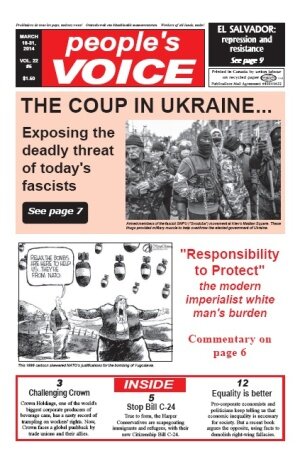
9) CONFRONTING THE RISE OF FASCISM IN UKRAINE
10) NO TO COUNTER-REVOLUTION IN VENEZUELA!
11) OLIGARCHY AND MILITARY DICTATORSHIP IN EL SALVADOR
12) KEEP FOCUS ON GAY RIGHTS, NOT THE NATIONALITY OF THE OPPRESSOR
13) WHY EQUALITY IS BETTER FOR SOCIETY
PEOPLE'S VOICE MARCH 16-31, 2014 (pdf)
People’s Voice 2014 Calendar
”The Truth About the Great War”
To order a copy of the People’s Voice 2014 Anti-First World War
Calendar, send $15 (includes postage and handling) to
People’s Voice, 706 Clark Drive, Vancouver, BC, V5L 3J1. Contact us at
604-255-2041 or pvoice@telus.net for bulk order prices.
|
People's Voice deadlines: April 1-15 Aptil 16-30 Send submissions to PV Editorial Office,
|
REDS ON THE WEB
http://www.parti-communiste.ca/
peoplesvoice.ca
www.ycl-ljc.ca
www.solidnet.org
|
People's Voice finds many "Global Class Struggle" reports at the "Labour Start" website, http://www.labourstart.org/. We urge our readers to check it out! |
* * * * *
People's Voice
Canadian Publications Mail Sales Product Agreement #205214
ISSN number 1198-8657
People's Voice is published by
New Labour Press Ltd
PV Editorial Office
706 Clark Drive,
VANCOUVER, B.C. V5L 3J1
Phone:604-255-2041
Fax:604-254-9803
email: pvoice@telus.net
Editor: Kimball Cariou : Business Manager: David Au
Editorial Board: Kimball Cariou, Miguel Figueroa,
Doug Meggison, Naomi Rankin, Liz Rowley, Jim Sacouman
* * * * * *
Letters
People's Voice welcomes your letters
on any subject covered in our pages.
We reserve the right to edit for length and clarity,
and to refuse to print letters which may be libellous
or which contain unnecessary personal attacks.
Send your views to:
"Letters to the Editor",
706 Clark Dr., Vancouver, BC V5L 3J1,
or pvoice@telus.net
People's Voice articles may be reprinted without permission,
provided the source is credited.
* * * * * *
The Communist Party of Canada, formed in 1921,
has a proud history of fighting for jobs, equality, peace,
Canadian independence, and socialism.
The CPC does much more than run candidates in elections.
We think the fight against big business and its parties
is a year-round job,
so our members are active across the country,
to build our party and to help strengthen people's movements
on a wide range of issues.
All our policies and leadership
are set democratically by our members.
To find out more about Canada's party of Socialism,
give us a call at the nearest CPC office.
* * * * * *
Central Committee CPC
290A Danforth Ave Toronto, Ont. M4K 1N6
Ph: (416) 469-2446
fax: (416) 469-4063 E-mailmailto:info@cpc-pcp.ca
Parti Communiste du Quebec (section du
Parti communiste du Canada)
5359 Ave du Parc, Montréal, Québec,
H2V 4G9
B.C.Committee CPC
706 Clark Drive, Vancouver, V5L 3J1
Tel: (604) 254-9836
Fax: (604) 254-9803
Edmonton CPC
Box 68112, 70 Bonnie Doon P.O.
Edmonton, AB, T6C 4N6
Tel: (780) 465-7893
Fax: (780)463-0209
Calgary CPC
Unit #1 - 19 Radcliffe Close SE
Calgary AB, T2A 6B2
Tel: (403) 248-6489
Ottawa CPC
Tel: (613) 232-7108
Manitoba Committee
387 Selkirk Ave., Winnipeg, R2W 2M3
Tel/fax: (204) 586-7824
Ontario Ctee. CPC
290A Danforth Ave., Toronto, M4K 1N6
Tel: (416) 469-2446
Hamilton Ctee. CPC
265 Melvin Ave., Apt. 815
Hamilton, ON.
Tel: (905) 548-9586
Atlantic Region CPC
Box 70 Grand Pré, NS, B0P 1M0
Tel/fax: (902) 542-7981
http://www.parti-communiste.ca/
* * * * * *
News for People, Not for Profits!
Every issue of People's Voice
gives you the latest
on the fightback from coast to coast.
Whether it's the struggle for jobs or peace, resistance to social cuts,
solidarity with Cuba, or workers' struggles around the world,
we've got the news the corporate media won't print.
And we do more than that
- we report and analyze events
from a revolutionary perspective,
helping to build the movements for justice and equality,
and eventually for a socialist Canada.
Read the paper that fights for working people
- on every page, in every issue!
People's Voice
$30 for 1 year
$50 for 2 years
Low-income special rate: $15 for 1-year
Outside Canada $50 for 1 year
Send to: People's Voice, 706 Clark Drive, Vancouver, BC, V5L 3J1
You can call the editorial office at 604-255-2041
REDS ON THE WEB
http://www.parti-communiste.ca/
http://www.ycl-ljc.ca/
http://www.solidnet.org/
(The following articles are from the March 16-31, 2014, issue of People's Voice, Canada's leading socialist newspaper. Articles can be reprinted free if the source is credited. Subscription rates in Canada: $30/year, or $15 low income rate; for U.S. readers - $45 US per year; other overseas readers - $45 US or $50 CDN per year. Send to People's Voice, c/o PV Business Manager, 706 Clark Drive, Vancouver, BC, V5L 3J1.)
1) "YOUTH HAVE TO PUSH BACK AGAINST CRISIS AND WAR"
The Young Communist League of Canada-Ligue de la jeunesse communiste (YCL-LJC)launched its 26th Central Convention discussion with a special series of workshops held in Toronto this past month. The meeting marked the public release of the main political report and call to the YCL‑LJC Convention, which is rallying behind the slogan "with unity and militancy, the youth will strengthen the fightback!". Rebel Youth magazine recently sat down with Johan Boyden, General Secretary of the YCL‑LJC, to talk about the YCL's convention.
So when and where is the convention taking place?
It is at the University of Toronto, from May 23‑25, and is expected to bring together delegates from across the country and especially Quebec and Ontario. Non‑members are welcome to come and check it out, and you can read the documents on our website and the Rebel Youth blog.
Your documents say the convention comes together at an important time for youth. Isn't this just another tired phrase of the left?
Not at all! What we are saying in the documents is that there is a lot at stake for young people, and a need for a more active, visible and coordinated fight back of youth. With the economic crisis and the growing threat of war, we won't stay in the same place. Either our future is ripped from the current generation by the capitalists and we are thrust further ‑ much further than our parents ‑ into poverty, debt, insecurity, an increasingly dangerous world of imperialist war, and ecological catastrophe. Or we push back.
"Enough is enough"?
Yes ‑ it is not the time to be apathetic or uninvolved. If the youth expand and deepen the positive signs of mobilization we've seen recently, we can build a powerful movement that halts the corporate attack and actually goes on the defensive. And what we are saying is that is possible with an approach which is both militant and united at the same time, and links the youth with the struggles of working people across Canada.
And that brings you in conflict with the current direction of labour and mass movements?
We are critical of the failure of the top brass of labour, influenced by the right‑wing leadership of the New Democratic Party, not to launch a united fight back, and we explain how the idea that the struggle should just "wait to 2015 and vote for Mulcair's NDP" is mistaken. We need a coordinated fight back right now. But this is not in conflict with the people's struggle, it is in the same direction. There are lots of left‑minded young folks who might, currently, not be completely convinced of revolutionary politics but they sure want to fight and get active.
Your document, after the general international section, spends a lot of time talking about immediate strategy.
Yes. But we're not saying that socialism is some distant question that we can deal with eventually. For the youth struggle, only socialism can fulfill and guarantee their demands. Take the demand of the "raise the minimum wage" movement; higher minimum wages are necessary right now. The capitalists will always find some way to erase those gains, and as an anti‑poverty measure higher minimum wages need to be coupled with many other demands, like full employment, access to education, etc. Does that mean we throw up our hands and walk away? Of course not. Fighting for a higher minimum wage is not in contradiction with fighting for socialism.
This is the old reform/revolution debate?
Well, for each generation of youth and student activists it is a very fresh debate. The mistake is to see it as either one or the other, either we fight for reform, or revolution. Actually, it is both opposites together. We need to fight for reforms as part of a revolutionary process, ie. a class struggle where reforms strengthen the side of the people's forces, recognizing the necessity to ultimately defeat capitalism and build socialism. And the experience of socialism shows that further progressive and much deeper reforms can take place after a socialist revolution driven by the people themselves. Cuban healthcare and education is a well‑known example.
So what do you see as the best outcome of your convention?
A successful convention will orient the YCL forward in these difficult times for the youth. A stronger YCL‑LJC will positively impact the youth movement and make that movement much stronger too. The recent developments like the new social movements call out for more protest. They call out for even bigger actions and ever stronger solidarity. They call out for courage and confidence in the youth, not concessions and cynicism. They call out for people's power and open the question of an alternative to capitalism. And they call out for a stronger, bigger and more effective YCL‑LJC, united with the Communist Party of Canada, because we are decisive ingredients in the struggle of working people in our country and around the world.
Johan will be in Kelowna, British Columbia, at the end of March to talk about the struggle of the youth and student movement today.
2) ONTARIO YOUTH DEMAND ACTION ON JOBLESS CRISIS
In response to the deepening youth jobs crisis, young workers from across Ontario met in Toronto recently to present recommendations for the provincial government on how to address youth unemployment and underemployment.
"Too many young people can't find work or are working in low‑wage jobs that don't value their skills," said Ontario Federation of Labour (OFL) Vice‑President for Young Workers Denise Martins. "We're being left behind and if the government doesn't reject discredited austerity measures for good, it will only get worse."
Ontario's youth unemployment was at 16 percent in 2013, more than double the general rate and well above the national youth unemployment rate of 13.7 percent. Making matters worse, those who are employed are too often working in low‑wage, precarious jobs without job security or benefits. One in four young workers in Canada are underemployed and a full one third of university and college graduates aged 25 to 29, many of whom have taken on unprecedented levels of student debt, end up with low‑skilled jobs.
"Just to return to pre‑recession employment levels, over 89,000 jobs still need to be created for youth in Ontario," said Irwin Nanda, OFL Executive Vice‑President. "That's why we are here today demanding bold action to create good jobs and support accessible education and training for young people."
Recommendations prepared by young workers from community, student and labour groups include proposals to link infrastructure spending to youth job creation; expand the Youth Jobs Strategy to create more jobs with decent pay and opportunities for advancement; raise the minimum wage to $14 an hour and eliminate the student minimum wage; reduce tuition by 30 percent over three years; eliminate exploitative unpaid internships; and implement a levy to ensure employers invest in apprenticeships and training.
"We cannot stand idly by while today's youth become the first generation to face a lower quality of life than their parents," said Sid Ryan, OFL President and Chair of the Ontario Common Front. "That is why we are supporting young workers in kick‑starting a campaign to reshape public policy around job creation, equity and opportunity for youth."
The Feb. 27 meeting was hosted by the Ontario Federation of Labour, Ontario Common Front, Unifor, Workers United Canada Council, and the Canadian Federation of Students-Ontario.
3) B.C. TEACHERS OVERWHELMINGLY BACK JOB ACTION
By Kimball Cariou
A dispute reaching back over a decade between the B.C. Liberal government and public school teachers continues to play out, in the wake of two court rulings which found that the province has failed to bargain in good faith.
Over 29,300 British Columbia teachers took part in a March 4-6 vote to authorise strike action if necessary, with 26,051 voting "yes", an overwhelming 89% of the total.
"With this vote, BC teachers have sent a very clear message to the BC government; it's time to negotiate in good faith, take back the unreasonable proposals, and offer teachers a fair deal that also provides better support for students," BCTF President Jim Iker said.
Contrary to "leaked" reports of an imminent strike, Iker stressed that no immediate action is planned.
"Teachers now have 90 days to activate the strike vote with some sort of action," said Iker. "There is no set timing for when we will begin. It will depend entirely on what is happening at the negotiating table and whether or not the government and employers' association are prepared to be fair and reasonable.... We will work very hard to get that negotiated settlement without any job action. A strike vote is a normal process in labour relations and helps apply pressure to both parties during negotiations."
Iker outlined that any initial job action will be administrative, and not include school closures or disruption of learning. Teachers will still participate in extracurricular activities, and report cards and communication with parents will continue.
If talks stall or the government does not move on key areas, at some point job action could escalate into rotating strikes. But any full‑scale walkout would require another province‑wide vote of the BCTF membership.
"Teachers voted so overwhelmingly in favour because the government has tabled unfair and unreasonable proposals that would undo the class size, class composition, and specialist teacher staffing levels we just won back in a BC Supreme Court Ruling," said Iker. "The employer's salary offer is also less than what was given to other public sector workers and ignores how far BC teachers have fallen behind their colleagues across Canada."
Two Liberal premiers, Gordon Campbell and now Christy Clark, have waged continual war against teachers, tearing up negotiated collective agreements during their first term in office. As a result of Liberal underfunding, school boards have closed nearly 200 schools, and thousands of critical teaching positions have not been filled.
Those hardest hit by the cuts include students with language and learning disabilities, since school boards lack the funds to employ enough teachers to address their needs. The court rulings found that the Liberals must bargain on class composition issues, but the government has basically ignored the courts.
One government tactic has been to spread confusion about the average salary of BC teachers, claiming that their incomes are near the Canadian average. This was quickly exposed as a lie, since the phony numbers included principals and other high-paid out of scope staff.
The Liberals have also denied court findings that they deliberately tried to provoke a teacher strike in the previous round of bargaining. However, information from the BC Public School Employers Association (the Boards) reveals that a deal with the BCTF was nearly done when the Liberals stepped in to scuttle such an agreement before last year's provincial election.
A coalition of 22 Prince Edward Island groups has come together to raise concerns about the Canada‑European Union Comprehensive Economic and Trade Agreement (CETA) and to request that the provincial government consult fully with Islanders on the effects of the proposed deal.
At a March 4 news conference in Charlottetown, the groups called the CETA agreement "the most intrusive that Canada has ever signed", with serious consequences for many aspects of life on PEI, especially the province's agricultural industry and health care system. They also believe the deal will limit or remove the government's ability to create jobs, support local businesses and negotiate benefits for Islanders from companies investing in the province's resources.
Speakers at the news conference addressed CETA's negative effects on a wide range of issues; the dairy industry, supply management and local food; the ability of investors and multinational companies to over‑ride decisions made by democratically‑elected governments; the costs of drugs and the operation of the health care system; local economic development and government purchasing decisions; and the fishing industry.
The coalition emphasized that despite its name, CETA is not primarily about tariff reduction, and pointed out that current tariffs on Canadian exports to Europe average only 2.2%. Instead, the agreement is about expanding the rights of multinational companies, while reducing the ability of provincial and municipal governments to pursue policies that benefit local communities and everyday citizens.
Focusing on the secrecy surrounding the negotiation of the deal, the coalition has delivered a formal letter to Premier Robert Ghiz asking that his government support a democratic review of CETA; release the text of the CETA agreement to the public; and hold extensive public hearings across the province prior to a debate and vote in the P.E.I. legislature.
They have also asked the provincial government to outline what exemptions (or "reservations", as they are called in CETA) it has designated to protect important areas - such as renewable energy, public transit and fisheries policies related to owner/operator requirements and fleet separation - from the effects of CETA.
The groups collaborating as part of the coalition include: Council of Canadians; PEI Union of Public Sector Employees; Environmental Coalition of Prince Edward Island; Atlantic Chapter of the Sierra Club of Canada; Breaking the Silence; National Farmers Union, Region 1, District 1; Cooper Institute; CUPE (PEI Division); PEI Federation of Labour; Prince Edward Island Public Transit Coalition; McKillop Center for Social Justice; PEI Health Coalition; Citizens' Alliance of PEI; ALERT; Latin American Mission Program; Don't Frack PEI; Prince Edward Island Food Security Network; PEI Nurses Union; CUPW Charlottetown Local 030; United Food and Commercial Workers; Public Services Alliance of Canada; Save Our Seas and Shores, PEI Chapter.
People's Voice Editorial
A new Angus Reid Global poll finds that most Canadians do not trust the motives of the Conservative government in introducing Bill C-23, the "Fair Elections Act". Nearly two‑thirds (62%) say the Tories are motivated by their dislike of Elections Canada. Less than one-third believe the Tories are making a genuine attempt to improve elections.
Despite such massive public scepticism, Canadians are almost evenly divided over the legislation's dangers and alleged "benefits". Clearly, the Tories will drive ahead with this attempt to steal the next election before the writ is even dropped. Such a strategy fits their overall approach of fanning cynicism and apathy. In Harperland, as with the U.S. Republicans, the ideal form of democracy is the one with the lowest voter turnout.
That's why the Conservatives don't really care that just one in eight (12%) of respondents in the Reid poll say the Harper government has improved the democratic process. Increased public scepticism usually translates into a lower turnout, except among higher‑income right-wing voters.
The contents of Bill C-23 make this strategy crystal clear. For example, the justification for scrapping "vouching" procedures is now an admitted lie; it turns out a Tory MP hallucinated that whopper about people digging voter cards out of the garbage. But the anti‑vouching clause is going ahead, along with other measures to discourage voting.
The Harper recipe includes a mix of threats against critics, sabotage of the electoral system, jingoistic nonsense, and outrageous lies. Many Canadians are working to mobilize resistance against the Harper agenda, but calls to wait for an NDP or Liberal victory undermine these efforts. It's time for the leadership of the labour movement, in particular, to get on board and build grassroots anti‑Conservative sentiments into a powerful struggle to win a genuine People's Alternative.
People's Voice Editorial
The infamous "responsibility to protect" doctrine continues to weaken the potential for a broad and powerful anti‑war movement, leaving considerable room for militarist politicians and corporations to manoeuvre. The latest example comes with the dangerous situation in Ukraine, where nationalist and even outright fascist forces, openly backed by the EU and U.S., have overthrown an elected government.
But many who should know better are lining up to praise the coup in Kiev. For some, including the opposition parties in Parliament, this is simply an exercise in opportunism, based on illusory calculations of vote gains from right‑wing ethnic organizations.
But the problem goes deeper. In country after country in recent years, imperialism has launched similar operations. Having learned from the public relations disaster of the Iraq War, the key imperialist countries now present meddling in the internal affairs of other countries as "promoting the equality of women" or "protecting innocent civilians." In some cases, this strategy veers into the bizarre, such as the campaign to smear the repeatedly-elected government of Venezuela as "dictators" who have supposedly "crushed" the real democratic forces.
For the anti‑war movement to rebuild in Canada, the starting point must be to reject this imperialist game. The U.S. and its allies have zero interest in "defending civilians." Those who focus on "protecting Ukrainians from Russian imperialism" fall into a deadly trap. This is not to defend the reactionary policies of the Putin government; but the anti‑Russian campaign by the U.S. and EU today is based on a geo‑political strategy of encircling and destroying Russia, pillaging its resources, and tightening the noose around China, which could become a counter‑weight to U.S. imperialism. This is the true aim of the R2P doctrine, and the sooner this lesson is grasped, the better.
7) STOP BILL C-24 - DEFEND THE RIGHTS OF IMMIGRANTS AND REFUGEES!
Statement of the Central Executive Committee, Communist Party of Canada, Feb. 26, 2014
The Communist Party of Canada joins with the labour movement and other democratically‑minded people and organizations in condemning the Tory government's new Citizenship Bill C‑24.
Disguised as legislation to combat crime and "rationalize" citizenship criteria, C‑24 extends shocking new powers to the federal Cabinet to strip Canadians of their citizenship rights.
Once this door has been opened, it will become much easier for governments to use such powers for purely political purposes. The effect would be to turn the clock back to the historic periods when Canadian governments openly used racist and reactionary immigration and refugee policies to bar certain categories of people from entering the country, or to deport "trouble‑makers" for refusing to stay silent about abuses of corporate or government power.
Bill C‑24 would have the most serious immediate impact on so‑called "dual citizens" ‑ those who, knowingly or otherwise, are citizens of both Canada and another country. The Bill would allow the government ‑ not the courts ‑ to unilaterally strip citizenship from any Canadian ‑ naturalized or native‑born ‑ who has been convicted in any country of a "terrorist offence" and sentenced to at least five years in jail.
Yet thousands of people born in this country may be dual citizens without even understanding their status. Many countries automatically treat the children or grandchildren of their nationals as citizens, regardless of birthplace. One such country is Egypt, which classifies children of Egyptian‑born fathers as citizens of Egypt, regardless of their birthplace.
This fact is significant because it could be used to strip former child soldier and Guantanamo detainee Omar Khadr of his Canadian citizenship. Khadr has been the target of a vicious vendetta by the Harper government. Now serving an eight‑year sentence after being convicted by a U.S. military court, based on outrageously framed‑up "evidence", Khadr was born in Toronto. Since Khadr's late father was born in Egypt, he could be among the first victims of Bill C‑24. In fact, the government would not even have to prove Omar Khadr is a dual citizen; under the terms of Bill C‑24, he would have to prove he is not a dual Canadian‑Egyptian citizen.
Such absurdities could be repeated with depressing regularity by governments conducting the so‑called "war on terror." To this day, the Conservative government is deporting former members of the FMLN, El Salvador's liberation movement against fascist military regimes, even though Canada has full diplomatic relations with the democratically‑elected FMLN government of El Salvador. Over twenty years after Nelson Mandela walked free from an apartheid jail, the Canadian government still treats diplomats who are members of his governing ANC party as suspicious, often making it difficult for them to enter Canada. These two examples alone prove that the provisions of C‑24 are wide open for arbitrary interpretation and abuse by governments with a far‑right, racist agenda.
There are also serious problems with other changes announced this month by the federal Citizenship Minister. These changes add new barriers to those seeking immigration or refugee status.
The wait period for permanent residents in Canada will be extended, making them wait longer before they can apply for citizenship and become fully participating members of Canadian society.
The very onerous Residence Questionnaire will be imposed on more applicants, adding to long processing delays.
Refugees face an increase in fees, up to $400 effective immediately. Language and knowledge test requirements will be extended to more applicants, now to include all those from 14‑64 years, from the current 18‑54 years.
Such barriers to citizenship have a particular impact on refugees who have suffered persecution and long years of deprivation.
For all these reasons, the Communist Party of Canada urges defeat of Bill C‑24, and the reversal of the growing number of barriers to those seeking refugee and immigrant status.
8) MODERN IMPERIALISM'S "WHITE MAN'S BURDEN"
As this issue went to press, Canadian Peace Congress president Dave McKee was preparing to attend a World Peace Council "Forum for the World of Equals", taking place in Belgrade, on the theme of "Global Peace vs Global Interventionism and Imperialism". The following is an excerpt from Dave McKee's presentation in Belgrade, titled "The `Responsibility to Protect' - Modern Imperialism's `White Man's Burden'".
It is significant that we are examining the question of "peace vs. imperialism" on this 15th anniversary of the 1999 NATO war against Yugoslavia, as many aspects of imperialism's current orientation were developed, tested and codified in the context of that aggression. These features can be roughly encapsulated in NATO's 1999 New Strategic Concept document, which was formally adopted in April of that year, and which the following key policy formulations:
- a shift from focus on "collective defense" of member states in the North Atlantic arena, toward explicit sanction of NATO out‑of‑area action on a range of security and politico‑economic concerns;
- articulation of NATO action as independent from the UN Security Council deliberations, sanction and oversight;
- discarding NATO's 1991 statement that "none of its weapons will ever be used except in self‑defense";
- commitment by NATO members, in their effort to defense of "common security interests", to participate in operations beyond alliance territory;
- reiterated commitment to expansion in Europe.
While these policy statements did not fundamentally change the nature and character of NATO as an aggressive, imperialist military alliance, they represented a dramatic and deliberate shift in how the organization projected its role in the world.
To understand why the NATO states would commit to this sweeping reorientation, it is useful to review the key events of the time. In the early 1990's, most of the capitalist world was struggling with a severe and lengthy economic crisis that had begun around 1987 and continued into the mid‑1990's.
In Canada, this developed into a long period of economic recession, exacerbated by trade liberalization with the United States. In general, capitalist globalization (related to huge developments in technology) was on the rise, and this meant huge changes to economies around the world. The comprehensive economic restructuring meant that, in some national economies, entire sectors were decimated and some new sectors emerged and grew. These developments sparked extensive discourse between corporate boardrooms and imperialist governments, about how to reorient in order to identify and exploit new global opportunities.
Perhaps the central development at this time was the sudden demise of the Soviet Union and socialist community of states, and massive geopolitical changes that followed. Huge areas of the world were now viewed as "opened up" to Western capitalism (whose members were fighting amongst themselves for positions of competitive advantage ‑ for control of resources and markets at the expense of their imperialist competitors).
The end of the Cold War meant the sudden loss of NATO's pretext for existing, and it embarked on a long search for a new identity and role.
In Canada, a key moment in this ongoing discussion about changing foreign policy in the "post‑Soviet" era is represented by the 1999 Symposium of the Conference of Defence Associations (CDA). The CDA is an old and extremely influential advocacy group, whose membership is made up of over 50 military organizations. It is large, well‑funded and well‑connected. Part of its funding comes from the Department of National Defence, so it is clear that when CDA speaks the government listens.
The 1999 symposium was focused on changing strategic assessment within the context of the massive geopolitical changes mentioned above. Specifically, the symposium identified the following strategic issues:
- the pressing need for reorientation in Canadian foreign policy (military and economic) in light of the demise of the Soviet Union;
- the rise of China as a political and economic world power, a rise characterized as "the most serious challenge to Western interests in the Pacific";
- the importance of retaining and developing NATO as a counter-balance to changing geopolitics that challenge Western interests;
- the destabilization of the central Asian states as a strategic and economic opportunity, and specific opportunities for Canada in the vast energy reserves of the Caspian Sea Basin and central Asian region;
- the necessity for Canada to integrate military and economic issues within foreign policy discussions, in order to exert global influence and reap economic benefit;
- the government of Iraq ‑ characterized as a "rogue state" ‑ as a barrier to securing Western interests in the central Asian region.
Virtually all of the above concerns were under discussion at the same time by other Western states. These preoccupations are reflective of two of the key concerns of imperialism: the territorial division and re‑division of the world amongst the most powerful states, and the military force required to achieve, enforce and maintain such a division.
As imperialist states discussed ‑ individually and collectively, in moments of collusion and moments of competition ‑ how to confront the twin challenges of the economic crisis and the geopolitical shifts, Yugoslavia emerged as the immediate practical arena in which new policy directions were tested and clarified. This engagement was continued, in rapid succession, through the aggressions against Afghanistan and Iraq.
The loss of the socialist community of states provided imperialism with a conundrum. On the one hand, two important opportunities emerged. First, a massive region of the world was now deemed to be "opened up" to capitalism ‑ resources, markets and trade routes were available for control and plunder. Second, the absence of the Soviet Union at the international table meant that the main obstruction to imperialist ‑ especially US ‑ expansion was removed.
On the other hand, the end of the Cold War also meant that the "spectre of communism" was lost as an justification for huge military expenditures. The peoples of the NATO countries moved quickly, especially in the context of economic crisis, to demand a "peace dividend" ‑ large reductions in military budgets and reinvestment in social programs and infrastructure. Without the endorsement, or at least passivity, of public opinion, imperialist states would have difficulty in securing the resources necessary for the implementation and consolidation of their new plans.
Imperialism desperately needed to find a new pretext for continued militarism, aggression and war. Part of the answer to this search was provided by the "war on terror". But another part came in the form of the doctrine of "Responsibility to Protect", and this involved a comprehensive rewriting of the foundations of international law.
While the specific doctrine of "Responsibility to Protect" (or "R2P") was codified in 2001, its roots lay in the broad notion of "humanitarian intervention" (or "HI"). HI emerged as a theme in international relations in the early 19th century, in the context of competition among the major European powers for influence and control over the territories of the declining Ottoman Empire. Its use during this period was characterized by depictions of Ottoman repression of minorities, coupled with extensive liberal agitation for military intervention to prevent atrocities. To be effective, HI had to be invoked in a sophisticated manner that could grasp hold of public opinion. Part of this involved highlighting the supposed virtue of the imperialist nation while demonizing the character of the target state, and positing a war of "humanitarian intervention" as a moral duty...
Throughout the 19th century, as humanitarian intervention was repeatedly used by each imperialist state to justify their drive to re‑divide the world, it became deeply embedded in the dominant ideology and had various cultural reflections. One of the most famous imperialist writers of this era was the English poet, Rudyard Kipling. His 1899 poem, "The White Man's Burden", celebrated the seizure of the Philippines by the United States, from Spain. The poem portrayed such colonization as a noble enterprise that carried out the moral responsibility of European and American imperialists ("Whites") to reign over the other peoples of the world. ..
Of course, US seizure of the Philippines did not yield Kipling's imagined goals of social, economic and cultural development. Instead, it resulted in the Filipino‑American War, in which an estimated 1.4 million Filipinos died, followed by decades of occupation and repression. Far from its noble pretext of humanitarianism, the American invasion of the Philippines was clearly motivated by, and enormously important to, the drive by US imperialism to establish and expand its control over foreign resources and markets.
In the course of the 20th century, imperialism continued to use "humanitarian intervention" as a pretext for expansion but was often held in check, to varying degrees, by a range of factors. These included:
- Public opinion: Despite comprehensive and sustained ideological assaults, campaigns against imperialist policies emerged early on and continued to grow. The American Anti‑Imperialist League, for example, was formed in 1898 with the purpose of opposing US seizure of the Philippines. Within a year, it had organized over 100 local committees across the country and had a membership of over 25,000. The League was able to sustain its work against imperialist foreign policies for two decades and is one example among several similar movements, in countries all over the world.
- Institutionalization of state sovereignty in international law: While it is legally rooted in the Peace of Westphalia in 1648, the concept the territorial integrity of states was confirmed and codified by the League of Nations and, to a greater extent, the United Nations. Article 2.4 of the UN Charter, for example, compels member states to "refrain in their international relations from the threat or use of force against the territorial integrity or political independence of any state." Humanitarian intervention routinely violated this article.
- The Soviet Union: As suggested earlier, this was perhaps the single most significant obstacle to imperialist expansion. The October Revolution served as a powerful magnet for workers and progressives, and it inspired the birth of many powerful anti‑imperialist movements all over the world. Furthermore, as the Soviet Union developed, it emerged as a powerful political‑diplomatic force that was capable, to some extent, of containing imperialism.
By the late 20th century, in the wake of the end of the Cold War and in the context of deep economic crisis, imperialism was presented with both the need and the opportunity to reorient.
The NATO states revisited the idea of humanitarian intervention and began updating it. As in the 19th century, the competitive imperialist drive to re‑divide the world was justified through the moral imperative of humanitarian intervention. However, the obstacle of the sovereignty of states remained.
(The conclusion of Dave McKee's presentation will be in the next issue of People's Voice.)
9) CONFRONTING THE RISE OF FASCISM IN UKRAINE
By Anna Pha and Bob Briton, The Guardian (Australia)
Ukraine has been subjected to what is becoming an all too familiar practice of ousting legitimate governments that refuse to submit themselves to the diktat of the US. In Libya and Syria and now Venezuela and Ukraine, a similar formula for regime change can be seen. Anti‑government protests and demands by forces seeking reforms are used as fronts for Western (or Saudi) funded, armed and trained ultra‑right and terrorist/fascist forces.
Western media flood news outlets with graphic images of the victims of terrorist assaults and massacres, falsely accusing government forces of perpetrating the atrocities. Ethnic or religious differences are fanned, and economic sanctions imposed to create economic hardship and increase pressure for a change of government. Attempts by elected governments to use state police and military to defeat the terrorists (including foreign mercenaries) and defend their people and sovereignty are portrayed as "crimes against humanity" while those carrying out the coup and atrocities are held up as being "pro‑democracy".
In Ukraine, the US has installed what it calls a transitional coalition government which is heavily penetrated by neo‑Nazi and other extreme right forces. Members of the Svoboda (All Ukrainian Union) and Pravy Sektor (Right Sector) have control over the armed forces, police and national security. Svoboda was formerly called the Social National Party, a deliberate reference to Hitler's Nazi party.
The US has hardly hidden its involvement in Ukraine's internal affairs. Last December, US Senator John McCain was publicly seen dining with opposition leaders including Svoboda leader Oleh Tyahnybok. US Secretary of State John Kerry and Assistant Secretary of State for Europe and Eurasia, Victoria Nuland took part in the Maidan (city square) demonstrations, openly calling on the people to rise up and bring down their elected government. The role of the US in deciding on the new government was revealed in a secretly taped (private) discussion between Nuland and the US Ambassador to Ukraine Geoffrey Pyatt. It also revealed the involvement of the EU in orchestrating regime change.
"Flowering of fascism"
"The United States and the European Union have embraced the revolution here as another flowering of democracy ..." writes Steven Erlanger, in the New York Times ("After Initial Triumph, Ukraine's Leaders Face Battle for Credibility", 01‑03‑2014). "Flowering of fascism" would have been a more apt description. The two main parties that have been installed by the US, EU and NATO, the Fatherland and Svoboda both pay tribute to Stepan Bandera who led collaboration with the Nazis and who played an active part in the massacre of Ukraine's Jewish population in the Second World War. The fascists are attacking synagogues and Eastern Orthodox Christian churches, xenophobia towards ethnic Russians, Tartars and other minority groups has surged, museums have been looted, Communists and members of Yanukovich's Party of Regions have had their homes raided. The Communist Party of Ukraine's offices have been attacked.
Australia's Prime Minister Tony Abbott fell into line behind the US, telling Russia to "back off", that it is "simply unacceptable" for Russia to interfere militarily in the Ukraine. Apparently, US and EU interference is acceptable. "Let Ukraine get on with being run in a peaceful and democratic manner," Abbott said. What hypocrisy!
The real source of external intervention in the sovereign affairs, the driving forces in the coup in Ukraine are the US, the European Union and NATO with the International Monetary Fund lurking in the background with an austerity program mapped out for the people. They have promoted and supported extreme right‑wing, neo‑Nazi and xenophobic forces and fostered tensions, divisions and conflicts with the aim of installing a compliant government that would give them political, economic and military domination over Ukraine.
The agreement of association with the EU that President Yanukovich had refused to sign is not, as often portrayed by the media, just an agreement to join the EU. It contains a dangerous military component which would have opened the doors to a US/NATO military takeover. Yanukovich's refusal to sign away Ukraine's sovereignty and for it to become the staging point for US/NATO missiles and forces aimed at Russia and others, was the trigger that set in motion the regime change process.
Russia the target
The situation is complex with a number of agendas at play. Ukraine is a strategically important to the US in its attempts to surround Russia with military forces and weapons. It has never let up in its plans to break up the Russian Federation and take control of oil, gas and other resources. The ongoing vilification of Russian Prime Minister Putin and Russia in the Western media is part of the campaign to justify the West's actions. The Crimea, a semi‑ autonomous region of the Ukraine, is of particular strategic importance.
The Russian Black Sea Fleet has been stationed in Sevastopol (Crimea) since the 18th century. Crimea has a rich history of attachment and occupation over centuries. In more recent times it was part of the Russian Federation until Soviet President Nikita Khrushchev transferred it to Ukraine. Following the demise of the Soviet Union, when Russia and Ukraine negotiated arrangements relating to military (including nuclear weapons) forces and weapons, the fleet remained under a new agreement. Russia is now being accused by the West of interfering in Ukraine because of its military presence in Crimea. "We have an arrangement with Ukraine about the stationing of the Russian Black Sea fleet in Sevastopol and we are acting within the framework of that agreement," Russian ambassador to the UN, Vitaly Churkin, told reporters. This agreement, which was extended for 25 years in 2010, includes discounted prices for Ukrainian purchases of gas from Russia.
Crimea is critical to Russia's defence and President Putin and Russia's parliament are determined to retain their presence and maintain their security. They do not recognise the so‑called government that has been installed by the West. The Western propaganda machine has been hard at work with a flood of lies about Russian activity and interference in the Crimea.
In Crimea, where more than half the population are ethnic Russian, there is strong support for President Yanukovich. There have been large protests against fascism and in support of ties with Russia, misreported in Australia's media as being simply anti‑EU. People have set up self‑defence units against the fascists. There is strong opposition to the presence of US or NATO missile and military forces there. Russia's package of a $15 billion debt deal and gas discounts is far larger than the EU's and is not tied up with the IMF austerity and other strings attached to the EU's. But that is not the main question. Russia has responded quickly to defend its interests and ethnic Russians in Crimea.
Changing the balance
Control of Ukraine would give the US and NATO control over the Black Sea. The other countries bordering the Black Sea - Romania, Bulgaria, Turkey and Georgia - are at present firmly in the imperialist camp. Russia has four naval fleets - Black Sea, Pacific, Northern and Baltic. The Black Sea Fleet is the most important because of the links to the Middle East. Sevastopol is a large and deep port. The ports along Russia's coastline with the Black Sea are shallow. It is also Russia's only warm water port. It is vital to Russia's security.
Ukraine is a strategic piece in the US's attempts to encircle Russia, which are well advanced. The US already has Estonia, Latvia, Lithuania, Georgia, Romania, Poland and Azerbaijan at its disposal for military operations. Crimea is only 30 kilometres from Turkey, which the US used as a launching pad for wars in the Middle East. In Afghanistan the US originally trained and armed the Taliban to bring about regime change and install a government hostile to the Soviet Union. US geo‑political meddling hasn't stopped since but it has not gone all their way. Iran is lined up for regime change. The US's anti‑missile shield, with bases in Eastern Europe, is targeted at Russia. Afghanistan and Iran are also critical to the US moves to encircle the People's Republic of China.
The EU is waging war against the Russian Gazprom company which, with its partners, has been battling EU demands regarding a new South Stream pipeline, which would stretch 2,400 kilometres bypassing Ukraine, taking gas to Europe - Serbia, Bulgaria, Hungary, Slovenia, Austria, Italy, Croatia, Macedonia, Greece and Turkey. EU competition policy prevents the same company owning a pipeline and what flows along it, a policy which the Russian government and Gazprom have been fighting. One of the objectives of the EU relates to control of natural gas pipelines and enforcement of "competition" policy on Ukraine and Russia.
While constantly supporting NATO expansion, the US had a setback recently when it lost its Manas base in Kyrgyzstan. NATO responded provocatively with plans to hold military exercises in Georgia, which is strategically placed between the Black Sea and Caspian Sea. The West failed in earlier attempts to break off Chechnya from the Russian Federation but pressure will doubtless be maintained. The Black Sea is important to the US's Middle East plans, including the strengthening of neo‑fascist forces such as the Muslim Brotherhood.
Aid for fascism - threat of war
The open involvement of US, EU and NATO leaders in the build up to the coup exposes it as part of the drive to change the geo‑political balance in Europe in ways that threaten security and peace in Europe and the world. The support accorded to the interim government by the EU leaders will give encouragement to right‑wing and fascist forces across Europe.
The headline of the New York Times article quoted above, "After Initial Triumph, Ukraine's Leaders Face Battle for Credibility" raises an important point. The "revolution" in Ukraine lacks credibility amongst the people. The February 21 agreement reached with Yanukovich and opposition leaders to hold early elections was swept aside with the support of the US and EU. Having trashed the agreement, a bunch of criminals and fascists has been installed. The situation is unfolding quickly and the outcome is by no means certain.
The removal of the Russian fleet from Sevastopol and the installation of Western forces and missiles would seriously weaken Russia's defence capabilities. The US would also like to see Russia lose its veto powers on the UN Security Council and, as a result, we can expect to see the "cold war" against Russia intensify. Any escalation by the West of the situation on the Crimean peninsula raises the prospect of war, which could spread well beyond the borders of Ukraine and Russia.
10) NO TO COUNTER-REVOLUTION IN VENEZUELA!
Statement by the Central Executive Committee, Communist Party of Canada, March 2014
As violent, anti-democratic protests continue in Venezuela, the corporate media in Canada are deliberately spreading lies and confusion about the situation in that country. At this difficult time, the Communist Party of Canada expresses our full solidarity with the people of Venezuela and their freely elected government, and we condemn the vicious campaign of disinformation conducted by right-wing forces in this country against Venezuela.
It is not surprising that the Canadian ruling class joins with U.S. imperialism in supporting the latest attempt to impose a brutal "regime change" in Venezuela. The attitude of the Canadian government was shown clearly last year. At that time, Prime Minister Stephen Harper issued a shocking, insulting statement hoping that the death of President Hugo Chavez would bring "a more promising future for the Venezuelan people... based on the principles of freedom, democracy, the rule of law and respect for human rights."
The response of the Venezuelan government remains completely valid today, stressing that Venezuela "has freely and democratically chosen its Socialist destiny," and that the Bolivarian Revolution has given the country a more promising, independent and sovereign future.
In Venezuela, the majority of voters have democratically supported the Bolivarian Revolution many times at the ballot box. But here in Canada, the Harper Tories were elected in 2011 by a minority of voters, after a campaign marked by the clumsy attempts of Conservative operatives to deny many Canadians the right to vote. It is Canada which should take a lesson in genuine popular democracy from Venezuela, not the reverse.
As with any country which embarks on serious attempts to create a new society on the principles of popular democracy, economic independence, and social justice, Venezuela has had to face challenges from established, wealthy interests. The Canadian media's coverage of the recent protests and the comments of right-wing politicians have ignored this truth, turning it upside down.
The violence in Venezuela today is created by thugs carrying out murderous attacks from their wealthy neighbourhoods, not by the government. The shortage of some commodities is directly linked to profiteering by wealthy business interests, while the government makes strenuous efforts to prioritize the needs of the workers and the poor. The attempt to overthrow the Maduro government is not a struggle for democracy, but rather a deliberate effort to provoke a brutal U.S-backed suppression of the democratic rights of the majority of Venezuelans.
The Canadian and U.S. governments arrogantly claim that Venezuela's Bolivarian Revolution and the ALBA process are "undemocratic" because these projects reject the neoliberal agenda of corporate globalization. The truth is that these corrupt governments are guilty of undemocratically imposing anti-working class economic and social policies such as corporate-driven "free trade" deals, here in North America and across the planet.
The people of Venezuela will not be bullied into surrender by the threats and violence of the "opposition" forces. The Communist Party of Canada renews our commitment to stand in solidarity with the working class and the poor in Venezuela, and with their freely-elected government.
No to counter-revolutionary "regime change" in Venezuela! Yes to the historic advances of the Bolivarian Revolution!
11) OLIGARCHY AND MILITARY DICTATORSHIP IN EL SALVADOR
By Larry Wasslen, Ottawa, part of a series of articles on the history and politics of El Salvador
There has been a long history of close relations between the ruling class and the military in El Salvador, where the privileged minority could only maintain control with the backing of military muscle.
This relationship shifted into high gear in December 1931, when Vice‑President General Maximiliano Sanchez Martinez overthrew President Arturo Araujo. The military would be in direct control until Alvaro Alfredo Magana Borjo was installed by a junta in 1982. The Christian Democratic Party candidate Jose Napoleon Duarte was elected in 1984. To understand the current revolutionary situation in El Salvador, it is important to have a clear picture of the period of direct military rule.
The stage was set by liberal land reforms such as the Ley de Extincion de Ejidos (1882) and the Ley de Extincion de Comunidades (1891) which forced First Nations peoples off their communal lands.
By the turn of the century the conservative and liberal branches of the oligarchy had made peace with each other and developed a cozy power‑sharing arrangement, whereby the presidency alternated between ruling class families. Between 1913 and 1931 the Melendez and Quinonez families rotated in and out of the presidential office.
Pio Romero Bosque, the final member of the Quinonez dynasty, broke with tradition. Although repression continued, Romero Bosque lifted the state of siege, tolerated open trade union organization and refused to name a successor. This set the stage for the election of Arturo Araujo of the Salvadoran Labor Party/National Republican Party. Araujo, a landowner who had travelled extensively in Europe, ran on a platform of "safeguarding everyone's right to the minimum necessities of life" with land reform and social welfare high on his agenda. This concerned both the oligarchy and Washington, while urban and rural workers continued to organize.
The Salvadorian capitalist economy depended almost exclusively on coffee exports. By 1920, 70% of the work force was made up of landless agricultural workers. As long as foreign markets were expanding and the domestic working class could be controlled, life for the 65 leading families remained comfortable, and there was no need for direct military rule.
The crash of 1929 had a direct effect on El Salvador. State finances were hard hit by a drop in the price of coffee. The ruling class cut wages and food allowances to protect their profit margins, and the First Nations, working class, and peasantry fought back.
The Federacion Regional de Trabajadores Del Salvador (FRTS), formed in the 1920s with a strong Marxist perspective, played a key role in the development of the Communist Party of El Salvador (CPS), founded in secret on March 28, 1930. Agustin Farabundo Marti Rodriguez, after whom the FMLN is named, was a founding member of the CPS. The class struggle intensified in El Salvador and 80,000 people marched in the May Day parade in 1930. The CPS was also organizing in rural El Salvador. Respected aboriginal leaders such as Feliciano Ama and Chico Sanchez joined the CPS. Large numbers of First Nations people joined the Party which offered the only possible solution to the economic and land crisis of the 1930s.
Romero Bosque dropped his liberal disguise and banned all demonstrations and left‑wing publications. Mass arrests followed: 600 peasants in Sonsonate and 1200 activists including leading members of the CPS.
By the time Araujo took over, peasant strikes had spread throughout the western provinces. The vital interests of the ruling class were in jeopardy. Martial law was declared after a student demonstration in July. Soldiers in San Salvador went on strike. On December 2, 1931, a group of colonels from the capital staged a coup. General Maximiliano Hernandez Sanchez, Araujo's vice‑president and Minister of War, became President.
Mass agitation expanded, especially in the center and western parts of the country where the CPS had been organizing. Municipal elections called for the first two weeks of January 1932 proved inoperative, as victories by the CPS were either annulled or reversed by fraud.
Armed insurrection was now seen as the only option to defeat the forces of oppression. An uprising was set for January 16, but changed twice (18th and 22nd) to allow for better preparation. The dictatorship discovered the plans, and many of the principal organizers were arrested, including Marti. Several were executed immediately.
The rising that did occur was supported by the CPS even though key leaders were in prison or dead. Local aboriginal leaders, including prominent communists such as Ama, stepped forward to lead the uprising. The main targets were particularly brutal landlords or foremen. A few towns in the western part of the country were liberated, but important centers held out, including San Salvador. By January 24, the regime was able to counter‑attack and retake most of the liberated villages.
What followed can only be described as genocide. Hernandez Sanchez ordered Jose Tomas Calderon to "head the repression". Between 30,000 and 40,000 peasants, mostly from the Pipil First Nation, were rounded up and executed over just a few days. Any aboriginal with a machete was deemed to be a revolutionary. Anyone who spoke Pipil or wore traditional aboriginal clothing was systematically murdered. Militants of the CPS were hunted down and shot. Jose Feliciano Ama was lynched and then hacked to pieces by a racist mob. Marti was executed on February 1.
The "Matanza" slaughter was the calling card of military dictators for the next 50 years. During this period, 14 military governments held political power, giving unflinching support for the landed oligarchy. All these governments used massive repression against workers, peasants, professionals and students who opposed the ruling class. The period was also characterized by a constant series of coups and counter-coups by different elements of the military, and the formation of political parties to provide the appearance of democracy.
The 1970s were a period of repression with promises of reforms by the Partido de Conciliacion Nacional (PCN, National Conciliation Party). The military delivered on repression, and the oligarchy blocked the reforms.
But resistance to oppression was a constant reality. After the Matanza, the CPS went underground, and continued to organize in trade unions, among non‑unionized peasant farmers and in the universities. Various organizations emerged, including the Fuerzas Populares de Liberacion Farabundo Marti (1970), the Ejercito Revolucionario del Pueblo (1972), Resistencia Nacional and the Partido Revolucionario de los Trabajadores Centroamericanos (1975).
A "Revolutionary" junta overthrew the PCN generals on October 15, 1979, and governed until 1982. Meanwhile, the revolutionary forces united to form the Frente Farabundo Marti para la Liberacion Nacional (FMLN) on October 10, 1980.
People's Voice will continue coverage of the revolutionary process taking place in El Salvador today, with an article on the Salvadorian Civil War, the Peace Accords and the current electoral struggle against neo‑liberalism.
12) KEEP FOCUS ON GAY RIGHTS, NOT THE NATIONALITY OF THE OPPRESSOR
By Graham L. Wilson, Seba Beach, Alberta
The signing of a new anti‑gay law by Uganda's president Yoweri Museveni (in a country already criminalizing homosexuality under colonial‑era law), is one of many recent acts against homosexuals throughout Africa. The law comes hot on the heels of the Same Sex Prohibition Act passed in Kenya that goes as far as to ban "gay meetings", Nigeria's new Same Sex Marriage Prohibition Act (which has led to scores of arrests), and a mob attack on a gay rights office in Ivory Coast.
The initial 2009 draft of the Ugandan law proposed the death penalty for homosexual acts, and still provides 14 years for an initial act, and potential life imprisonment for "aggravated homosexuality".
This arrives after Russia last summer passed a law banning propaganda of "non‑traditional sexual relations", whose vague wording could be used as a means to suppress any number of groups.
Rightly, there has been much condemnation of these laws, including from several Western governments. There were even calls to boycott the recent Winter Olympics in Sochi and to suspend development aid to Uganda.
However, there is an often overlooked common thread within these repressions: the support of, if not shared authorship by, conservative evangelical Christians in the United States, such as Scott Lively in Uganda or Brian Brown in Russia. These campaigns, popular among traditionalists in many countries, have been picked up by many leaders as a way of building up key political and electoral support among populations which are often ignorant and fearful of homosexuals. Hate becomes a potent political tool, while giving legal beachheads and legitimacy to prejudice against gays.
The tactical advantage back in the West is less publicized, as rights campaigners direct their efforts on foreign nations, whose cultural and political situations are less widely understood. This has helped produce an air of hostility against the "intolerance" of those in the developing world, taking on almost a racist tone.
The rhetoric aimed at Russia and Africa needs to be balanced by introspection: are we as tolerant in the West as we would like to believe? The United States after all, still has regions where sodomy is still technically criminalized, despite federal court rulings. Recent draft laws in Arizona and Kansas try to actively discriminate against homosexuals.
An unfortunate undercurrent has been apparent. Improved gay rights in the West have been used as justification for imperialist actions in the developing world, while also breeding complacency about social oppression at home. Shifting the debate abroad helps those seeking to promote hate locally.
Racial caricaturing in the West is used to argue for repression of homosexuals, with Museveni attacking the "cultural imperialism" of the United States and European Union, particularly former colonizers such as Britain, France and Belgium.
It is hypocritical to use the improved situation for gays in many countries as a reason for feeling superior over peoples elsewhere in the world. This goes against genuine respect for human rights and human dignity.
The tone of the debate must remain above such attempts to breed racial and national divisions, as it should remain above fostering a rural/urban divide, and so seek to produce mutual tolerance and respect for people around the world.
It is imperative that all campaigners for minority rights resist such divide‑and‑conquer tactics. We must keep the focus on the rights of people, not the nationality of the given oppressor, or the masses of people still ignorant as to the ramifications of such laws.
13) WHY EQUALITY IS BETTER FOR SOCIETY
The Spirit Level: Why Equality is Better for Everyone, authors Richard Wilkinson and Kate Pickett, book review by Peter Kerek
This ground‑breaking book first went to print in 2009, and had a second printing in 2010 with a postscript to rebut its detractors. The findings of the authors, however, do not sit well with the established ruling class of most nations, hence the fairly muted coverage in most media.
Neoliberal economists claim that raising the overall wealth of a society is the best way to increase quality of life for all citizens. In direct contrast to this claim the authors found that societies perform better in all sorts of ways when the distance between the poor and the wealthy are substantially reduced regardless of the overall average wealth of a nation.
The best and most frequently cited example was the USA.
The USA has one of the highest average income levels of any nation in the world, yet the country, as a whole, performs quite poorly in areas of teen suicide, homicide, poor access to education, social mobility, trust, crime, systemic discrimination, pollution, divorce and poverty. The US, in these areas, measures no better than many second and third world countries. The US also has the second‑greatest gap in income between its poor and rich.
The book gives as much attention to differences between all the individual states of the United States as it does different countries. Because there has been so much reliable and comparable data already gathered on Americans, and because there are such great discrepancies between the quality of life in the various states, it gave the authors an opportunity to test their thesis in a "closed" arena; in other words comparing US states to other US states negates claims that the cultural differences between Asian, Scandinavian and English‑speaking countries is somehow skewing their findings. The evidence found in the inter‑state comparisons overwhelmingly supported the findings of their international comparisons.
In measuring the "success" of various societies the authors used many of the same data also used by international relief and development organizations such as UNICEF (United Nations Children's Fund), the WHO (World Health Organization), UNCTAD (United Nations Conference on Trade and Development) and the OECD (Organization for Economic Cooperation and Development).
Included in their areas of analysis were: mental health, human development (including access to education, healthcare, housing), social mobility, social status, teenage pregnancy and births, incarceration, disease, life expectancy, trust of fellow citizens, infant mortality, class, consumption and consumerism, diet, substance abuse, discrimination, divorce, happiness, pollution, unemployment, religion, poverty, sexual activity, homicide and war.
The most important concept put forth in this book is called Social Cohesion.
Social Cohesion describes the connectedness, or feeling of community, between members of a society. When discrepancies in income levels are reduced, the feeling of social cohesion is enhanced. The personal focus appears to change from a "me first" to a "we first" approach to everyday life, as well as a support for a "we first" approach to governmental policy‑making. A person living in a society with high levels of social cohesion is more likely to have similar experiences, dreams and goals as other members of their community. They are also more likely to have affordable access to the basic necessities of life such as food and shelter and have greater access to opportunities based on personal ability rather than wealth and social status.
An argument Capitalists and Libertarians alike have asserted is that income inequality is one of the societal realities that forces people to "innovate" in order to succeed and be more creative than their competition; having lots of incredibly wealthy people around is supposed to be a great motivator for those who have relatively nothing. However, the authors crush that idea as well with an analysis of "patents per million population" and show that while the US, UK, Australia, Portugal and Singapore had the highest levels of inequality, they were all amongst the worst 10 producers of patents. In contrast, the countries with low levels of inequality had much higher rates of patents. For example the rates of patents in Finland are about 30 times greater than those in the US. Amongst the 23 analyzed countries the US has the second highest level of inequality while Finland has the second lowest rate of inequality. This evidence clearly shows that greater income equality is much more likely to foster innovation and creativity.
But the evidence didn't just show quality of life improvements for people at the bottom end of the socio‑economic ladder. The wealthiest people in countries that had greater income equality also reported having a better quality of life; they were more likely to trust their fellow citizens, have better family and community relations, live longer and live in communities with lower rates of crime and lower rates of other negative factors that eventually affect nearly everyone to some degree.
When comparing countries the authors used a list of the 50 richest nations in the world supplied by the World Bank and then struck off nations with less than three million people and countries that didn't have enough comparable data; without enough comparable data the information would have made it much harder to come to any sound conclusions. Many of the smaller nations, such as the Cayman Islands, were ruled out because their wealth is grossly distorted by overtly obvious tax policies that make them little more than tax havens. That left a list of 23 countries. Some truly international studies of every nation on the planet were also utilized in the areas of ecology, pollution and human development.
In short, the book consistently shows a trend that nations with greater social cohesion also perform better: Norway, Sweden, Switzerland, Finland, Denmark, Netherlands and Japan lead the world in many of the factors analyzed. It also consistently showed the US, UK, Australia, New Zealand, Israel, Singapore and Portugal amongst the worst. Canada usually performed somewhere near the middle, in both relative income inequality and positive/negative outcomes, which, again, validates the authors' hypothesis linking income inequality to social cohesion.
Since the book’s publication further studies have produced overwhelming evidence that the wealthier a person is, the more likely they are to lie, cheat, and break the law. These studies were performed primarily in California and accounted for factors like as gender, age and religion. In relation to the Spirit Level's assertions it makes it even easier to see why there would be greater social cohesion in a society that has far fewer individuals lying, cheating and breaking the law.
This book succeeds in making the economic argument that a classless society is a more productive, satisfying, innovative and humane one to live in. It also shows that countries with greater income equality can also be world leaders in reducing their carbon footprint while still providing a rich quality of life. For those who have been preaching this message since the days of Marx and Engels it's good to have a comprehensive 21st century compilation of statistical evidence to validate our theoretical suppositions.
(Peter Kerek is the editor of the Interior Worker and president of the Kamloops and District Labour Council.)
Lee Lorch, a mathematics professor who was renowned for his involvement in a wide range of anti-racism and other progressive movements for decades, died of natural causes on February 28 in Toronto, at the age of 98.
A widely-circulated New York Times obituary presents much of Lee Lorch's life story. Born on Sept. 20, 1915 at in Manhattan to Adolph Lorch and Florence Mayer Lorch, he was a graduate of Townsend Harris High School. He attended Cornell University and the University of Cincinnati, where he earned a doctorate in mathematics.
During World War Two, he served in the Pacific with the U.S. Army Air Corps, and returned home to teach math at City College in New York. Like millions of veterans, he could not find a place to live, until he and his wife Grace and daughter Alice moved into the huge Stuyvesant Town development on the Lower East Side of Manhattan, along with 25,000 other people.
There, the Lorches entered into a lifelong struggle against racism. African-Americans were not allowed to live in the development. He was among the group of 12 tenants calling themselves the Town and Village Tenants Committee to End Discrimination in Stuyvesant Town. By helping to organize tenants, and then inviting a black family to live in his own apartment, Lorch played a crucial role in eventually forcing the Metropolitan Life Insurance Company, which owned the development, to abandon its whites‑only admissions policy.
As often happened in the Cold War era, Lorch paid the price for his activism. The appointments committee at City College blocked his promotion, effectively forcing him to find a job at Pennsylvania State University, which was also then denied. In September 1950, he accepted a new academic post, becoming one of two white professors at Fisk University, the historically black institution in Nashville, Tennessee. At Fisk, Lorch taught three of the first blacks ever to earn doctorates in mathematics.
But his beliefs, including his Communist Party membership, resulted in further harassment. By 1955 he was again fired, finding a new job at tiny Philander Smith College, an all‑black institution in Little Rock, Arkansas.
There, the Lorches became involved in the school desegregation struggle, helping to enrol the "Little Rock Nine" at the previously all-white Central High School. The Lorches were attacked for their activities, as racists burned a cross on their lawn and placed dynamite in their garage.
The college eventually declined to renew Lorch's appointment, forcing him into exile. In 1959, he was hired at the University of Alberta in Edmonton, and then in 1968, by York University in Toronto, from which he retired in 1985.
Lee Lorch maintained his mathematical studies and research, and his activism as a member of the Communist Party of Canada and other groups. He was a member of the Canada-Cuba Friendship Association (Toronto) Executive for many years, and then Honourary President. He was also a corresponding member of the Cuban Academy of Science, and a strong supporter of People's Voice. For his scientific contributions and his pioneering efforts to encourage Blacks and women to enter mathematics, Lorch was often honoured by his fellow mathematicians, receiving an honourary degree from the City University of New York in 1990.
The Central Committee of the Communist Party of Canada has sent deepest condolences to Lee's daughter Alice and her husband Dennis, and to his granddaughters, Natasha and Jessica.