|
|
People’s Voice October 16-31, 2015
Volume 23 – Number 17 $1
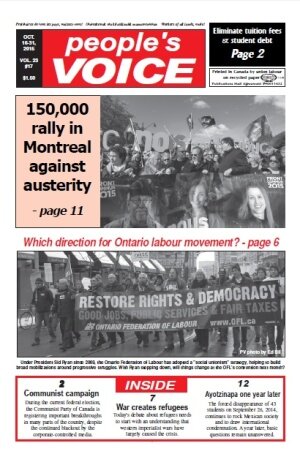
1) FRONT COMMUN RALLY DRAWS 150,000 AGAINST QUEBEC AUSTERITY ATTACK
2) LABOUR UNDER ATTACK BY LABOUR? THE OFL CONVENTION 2015
3) MANY “FIRSTS” FOR COMMUNIST PARTY CAMPAIGN
4) HARPER TOSSES HIS GRENADE - Editorial
5) THE TPP BATTLE IS JUST BEGINNING - Editorial
6) COMMUNIST PARTY: “ELIMINATE TUITION FEES AND STUDENT DEBT”
7) LOOK AT THE FACTS ABOUT HARPER’S RACIST ANTI-NIQAB STRATEGY
8) VANCOUVER TRUCKERS OWED MILLIONS BY COMPANIES
9) ALBERTA LABOUR DEMANDS HIGHER OIL ROYALTIES
10) AYOTZINAPA: ONE YEAR LATER
11) REFUGEES AND WARS: TIME FOR PEACE
12) THE LESSER OF TWO EVILS: GREEK VOTERS ANGRY, DISILLUSIONED
PEOPLE'S VOICE OCTOBER 16-31, 2015 (pdf)
|
To order a copy send $15 (includes package and handling) to People’s Voice, 706 Clark Drive, Vancouver, BC, V5L 3J1. Contact us at 604-255-2041 or pvoice@telus.net for bulk order prices. |

|
People's Voice deadlines: November 1-15 November 16-30 Send submissions to PV Editorial Office,
|
|
|
REDS ON THE WEB
http://www.communist-party.ca
peoplesvoice.ca
www.ycl-ljc.ca
www.solidnet.org
|
People's Voice finds many "Global Class Struggle" reports at the "Labour Start" website, http://www.labourstart.org/. We urge our readers to check it out! |
* * * * * *
Central Committee CPC
290A Danforth Ave Toronto, Ont. M4K 1N6
Ph: (416) 469-2446
fax: (416) 469-4063 E-mailmailto:info@cpc-pcp.ca
Parti Communiste du Quebec (section du
Parti communiste du Canada)
5359 Ave du Parc, Montréal, Québec,
H2V 4G9
B.C.Committee CPC
706 Clark Drive, Vancouver, V5L 3J1
Tel: (604) 254-9836
Fax: (604) 254-9803
Edmonton CPC
Box 68112, 70 Bonnie Doon P.O.
Edmonton, AB, T6C 4N6
Tel: (780) 465-7893
Fax: (780)463-0209
Calgary CPC
Unit #1 - 19 Radcliffe Close SE
Calgary AB, T2A 6B2
Tel: (403) 248-6489
Ottawa CPC
Tel: (613) 232-7108
Manitoba Committee
387 Selkirk Ave., Winnipeg, R2W 2M3
Tel/fax: (204) 586-7824
Ontario Ctee. CPC
290A Danforth Ave., Toronto, M4K 1N6
Tel: (416) 469-2446
Hamilton Ctee. CPC
265 Melvin Ave., Apt. 815
Hamilton, ON.
Tel: (905) 548-9586
Atlantic Region CPC
Box 70 Grand Pré, NS, B0P 1M0
Tel/fax: (902) 542-7981
* * * * * *
News for People, Not for Profits!
Every issue of People's Voice
gives you the latest
on the fightback from coast to coast.
Whether it's the struggle for jobs or peace, resistance to social cuts,
solidarity with Cuba, or workers' struggles around the world,
we've got the news the corporate media won't print.
And we do more than that
- we report and analyze events
from a revolutionary perspective,
helping to build the movements for justice and equality,
and eventually for a socialist Canada.
Read the paper that fights for working people
- on every page, in every issue!
People's Voice
$30 for 1 year
$50 for 2 years
Low-income special rate: $15 for 1-year
Outside Canada $50 for 1 year
Send to: People's Voice, 706 Clark Drive, Vancouver, BC, V5L 3J1
You can call the editorial office at 604-255-2041
<pvoice@telus.net>
REDS ON THE WEB
www.communist-party.ca
peoplesvoice.ca
www.ycl-ljc.ca/
http://solidnet.org/
http://www,rebelyouth-magazine.blogspot.com
(The following articles are from the October 16-31, 2015, issue of People's Voice, Canada's leading socialist newspaper. Articles can be reprinted free if the source is credited. Subscription rates in Canada: $30/year, or $15 low income rate; for U.S. readers - $45 US per year; other overseas readers - $45 US or $50 CDN per year. Send to People's Voice, c/o PV Business Manager, 706 Clark Drive, Vancouver, BC, V5L 3J1.)
1) FRONT COMMUN RALLY DRAWS 150,000 AGAINST QUEBEC AUSTERITY ATTACK
PV Montreal Bureau
Quebec workers were out in force on October 3 for a mass rally of over 150,000 people. Recent mass mobilizations have again brought large numbers of Quebec students into the streets, but this is the biggest demonstration by labour in recent years and continues the trend of giant mobilizations against austerity.
While the main focus of the October 3rd action was against the severe cuts of the Couillard Liberals, labour speakers made reference to the need to kick out Harper on Oct. 19th.
The rally took place at the foot of the Mont Royal massif, which forms a distinctive landmark in the city, and was organized by the Front Commun or Common Front. Together the Front Commun represents over 400,000 public sector workers in health and social services, education, higher education and the public service of Quebec. Their collective agreements expired on March 31st, 2015.
Speaking at an election rally in Toronto, Communist Party leader Miguel Figueroa condemned the corporate media blackout in English-speaking Canada on the demonstration. “The news seeks to hide and obscure people’s awareness of these magnificent protests which our party fully supports,” Figueroa said.
Not one major English-language newspaper gave significant coverage to this action, he noted, adding that the candidates of the Communist Party in Montreal were all present at the mobilization. The Communist Party will be talking about this example as an inspiration during the remainder of the election campaign, Figueroa added, to help break the silence about this struggle.
The workers are fighting against the whole scale dismantling of the Quebec welfare state and a sharp attack on the principle of universality.
"After dozens and dozens of meetings, [the government] continues to turn a deaf ear, they still wants to impoverish us not only today but for the rest of our days, [including] reducing to 40% the pensions of retirees who have dedicated their lives to public service, " said Jacques Létourneau, President of the Confédération des syndicats nationaux (CSN).
"An unacceptable arrogance towards the largest group of workers in Quebec, positions in public services [that are] 75% occupied by women. It should be recalled that the government's attacks on our working conditions occur simultaneously imposing unprecedented austerity policies,” said Carolle Dubé, spokesperson of the Inter-Secretariat of public services (SSSI). “The government would squeeze the lemon, while our members are exhausted […] and that concerns the entire population of Quebec," she added.
The labour leaders issued a call to fight, stating that they intend to use all means at their disposal to make the government respond, including actions of socio-economic disruption across the province. The rally showed workers and public sector workers were mobilized and united, participants told People’s Voice.
"If [the government] continues to turn a deaf ear, the Front Commune will be ready to go further, said Daniel Boyer, president of the Federation of Workers of Quebec (FTQ), “ If the government maintains its contempt and arrogance towards workers and public service workers, we will not hesitate to call a strike across Quebec if necessary.”
Banners were on display from workers in the far north of Quebec close to the border with Labrador. According to the newspaper Le Devoir, no less than 384 buses were chartered for the action. The rally was joined by a variety of community and student groups but it was overwhelmingly trade unionists.
"What the government is asking workers is surreal... This is science fiction," said Andrés Fontecilla, spokesperson of Quebec Solidaire, which also strongly supported the mobilizations.
People’s Voice sat down with Pierre Fontaine, leader of the Parti Communiste du Quebec and a candidate for the Communist Party in Laurier-Sainte-Marie to talk about the action:
People’s Voice: What did you think about the rally?
Spectacular! In fact I just got off the phone with Radio Canada in Nova Scotia talking about this action which was a great achievement by labour. In fact, the demonstration was the biggest in the history of the Common Front, which was first organized in 1972 and has come together several times since then, as a coalition of unions for public sector negotiations. The weeks before there were many votes in the local unions and a major participation from the membership. The votes sent a strong message for a strike – between 85 to 95 per cent. For example, in my former union local over 1,600 people took part, and they voted at 92 per cent.
This came after a series of activities by labour?
Yes. The strike has been building for some time. Most recently, on September 30th, an independent action took place by the elementary and secondary teachers with a one-day strike involving over 30,000 people. The day after, there were picket lines by parents, encircling hundreds of schools.There is clearly a lot of support by parents against the cut backs to education.
And the support of the public is very important to win, because the Couillard Liberal government is still maintaining its position of no concessions regarding wages, working conditions and cuts. There is a threat of a decree, imposing the austerity working conditions and two-year wage freeze, by the government. The support of the public will make the difference and be a critical factor in the workers battle.
Is there a connection with the federal election?
Well, of course we fully support the demands of the workers as we talk to voters. While there is not an obvious direct connection, there is actually a link. In fact the cuts to the federal transfer payments mean that Quebec is missing funds for social programmes. The Quebec government admits this reality, but doesn’t in fact to fight restore the funds. It says nothing about that. Not only labour but all other voices, nationalist forces included, raise this question.
And of course, we are saying this too – to increase all transfer payments and return them at a bare minimum to their former levels. For example we want to increase the transfer for health to a minimum of 25 per cent, something Trudeau’s federal Liberals have refused to do. The NDP has suggested it favours 25 per cent but has not been committal. How can they? They are running on a platform of balancing the budget and keeping military spending the same, so increasing transfers by several billion is impossible. And in the past, the federal role in health care was not 25 but 50 per cent.
Meanwhile, the Harper government is going in the opposite direction. They have refused to negotiate a new health accord, which de facto amounts to a massive cut of several billion dollars, and today in the news is the TPP trade agreement, which will likely increase the costs of medicine and pharmaceutical drugs significantly. This must absolutely be halted and workers across the country need to rise up like labour has in Quebec, with mass united protest, demanding emergency action. One way to send such a message is by voting Communist on October 19th.
2) LABOUR UNDER ATTACK BY LABOUR? THE OFL CONVENTION 2015
Ontario Trade Union Commission, Communist Party of Canada
Can anyone explain how a cabal of “heads of unions” with the active support of the CLC decides the agenda of Ontario Labour prior to an OFL Convention? And can anyone explain the fact that this has been fought out and justified in, and with the participation of, the mainstream capitalist media? And can anyone explain why Hassan Yussuff, president of the CLC, would be involved in bypassing the elected leadership of his Ontario division by taking part in a pre-emptive caucus of “heads of unions” (not all heads of unions, invitation only) to actively intervene with a leadership slate to wrest control of the impending convention?
The “heads of unions” favoured with an invitation into the elite will argue that the slate will have to be democratically elected at convention. But what they won’t say, and what is very well known, is that to stand against the slate, especially if successful, will be an act of suicide for any future in the labour movement. Sid Ryan is the example of what the future holds for anyone who has too much respect for democracy.
Part of the answer is the CLC structure which has evolved as a model of “Business Unionism” as distinct from its rank and file control generations past. That transition is a history of transition into a federated organisation. The formation of a “heads of unions” group to subvert the OFL Convention is merely an Ontario mirror of the CLC constitutional structure called the Canadian Council, the ruling body that rules permanently and is not a creature of, not elected by the CLC Convention.
The over-the-years transition from Convention control of the CLC to the non-convention rule of the Canadian Council is a general view of the decline in democracy in labour, and the transition from “social-unionism” to “business unionism”. Another structural flaw in the CLC allows affiliation to the CLC, but does not require affiliation to its Provincial or Quebec divisions or local Labour Councils. Thus CLC affiliates have the choice to support or starve the provincial or municipal organizations, to support their grass-roots campaigns or not. This is what made possible the Ontario dues strike, withdrawal and late payment tactics, to undermine the stability of the Ontario Federation of Labour.
Because of the financial undermining of OFL stability, and the perceived impossibility of unity, Sid Ryan has stated that he will not stand for re-election as president at the OFL's November 23-27 Convention in Toronto.
Ryan’s announcement was preceded by years of open criticism, usually in the media, harassment on frivolous issues, withholding of dues, withdrawal from affiliation, and general guerrilla warfare that never, even once touched on the main issues: mass organization, street level resistance and social partnership, as opposed to tri-partist acquiescence and farming out labour's political program to the NDP. Even though Sid Ryan is an ardent NDPer, he also is a social-unionist who believes in the independent power of direct worker action. This makes back-room politics and deal-making difficult, so Ryan has to go.
In Ryan’s own words, in his open letter published in the Toronto Star, “If there is one thing that both my strongest supporters and my harshest critics agree on, it is that in mobilizing workers I have often spoken over the heads of labour leaders to reach union members directly. It is a critique that I wear with pride”.
Ryan was elected after the “long sleep” of Wayne Samuelson’s presidency of the OFL that reflected the lethargy of the “pink paper” unions, which issued an attack on the militancy of the “days of action” campaign against the Mike Harris government and its anti-labour, anti-worker policies. Their proposed alternative was published on pink paper, and the “pink paper” unions ushered in a period of drowsiness, sleeping through working class crisis like Rip Van Winkle. After years of slumber, they could not maintain the sleep any longer, and Sid Ryan with an agenda for social unionism and labour action went into the Presidency unopposed in 2009. Ryan was unanimously elected twice more without opposition.
Several large unions went on a “dues strike.” A couple withdrew completely to create a financial crisis in the OFL, and then complain that they could not support the OFL because of financial mismanagement. First create a crisis, and then attack because of it. The method developed by right-wing governments over the last two decades apparently was well learned by labour leaders on the right. Too bad Ryan stepped back from the fight he had started.
Too bad because this fight is really not at all about Sid Ryan. It is a clash between “business unionism” and “social unionism”. Business unionism is the corporate triangular structure of top-down leadership with the membership in a client relationship with staff and top leadership who wield power and deliver services. They are elected, it is true, but in very controlled conventions. Social Unionism is the root from which all labour grew, rank and file driven, mass participation, and with a political vision that represents the needs of all working people, not just the dues payers. Social unionism seeks to lead mass movements and recruit social allies.
The “heads of unions” hosted by Unifor and calling themselves an “election caucus” are not primarily to get rid of Sid Ryan, who has bowed out of the contest already. The main issue is the message to the upcoming convention that if you elect leadership we don’t like, if you adopt policies we don’t like, we will destroy you. We will then have labour unity, the unity of the cowed and controlled.
Everyone has the right to put together a slate and campaign for election, but the implied and demonstrated retribution for a democratic convention that disagrees with the “heads of unions” is undemocratic and will ultimately neutralize and disenfranchise labour to the extent that is has south of the border where “business unionism’ is much more dominant.
That is why recent labour history is marked by two phenomena: the consolidation of power through merger and restructuring, and the decline in membership as a percentage of a growing and increasingly disenfranchised and precarious working class. The contradiction in labour is between what we have and what is needed, between business unionism and social unionism.
3) MANY “FIRSTS” FOR COMMUNIST PARTY CAMPAIGN
By Johan Boyden, Central Organizer, Communist Party of Canada
What are the Communist Party’s campaigners hearing at the doors? In the workplaces, schools and on the street?
We hear that voters think there is a lot at stake in this federal election. Nine years of Harper Conservative rule have been a tragedy – a catastrophe, in fact. People are concerned and angry about the danger of another Harper government. There is a view that this election is a reckoning moment, something that’s been a long time coming.
The Tories are fighting tooth and nail to hold onto power. Their giant war chest is outspending all other political parties, showing the class essence of their anti-people, pro-war and austerity agenda.
Harper’s Unfair Elections act, disenfranchising thousands of voters, will no doubt be coupled with other dirty tricks and voter suppression. Most ridings in the country have been adjusted slightly, and thirty new electoral districts added, overall favouring the Tories.
All this requires a certain sleight of hand, so the Tories have employed Australian-born political consultant Lynton Crosby, the so-called "master" of racist code words. No surprise then that their latest tactic is completely explicit, what I call “social Roundup” spray, or social poison.
The poison of racism, of Islamophobia. “A calamity of terrorists threatens Canada. Niqab-wearing jihadists. Foreign barbarians.”
All this is not-so-thinly disguised as what some commentators are calling “Harper’s crusade to save the oppressed brown women.”
It makes you wonder: are the Conservative “old stock Canadians” those who donned white bed sheets and ignited crosses in the past? To combat this racism and sexism, we need to rip the sheets from these purveyors of fear, exposing and isolating them.
We need a broad, mass, powerful, visible campaign, not narrowly limited on identity politics, but reaching much further to class solidarity, internationalism and peace.
Into all this fray is the Communist Party of Canada’s campaign. The Communist Party is out fighting for a genuine alternative, raising the issue of fundamental change, not just replacing the Tories with “Harper lite,” another party with a similar pro-business agenda.
The Liberals are offering some progressive-sounding rhetoric, presenting polished, tasty, red policies to the voters. But like the fabled witch’s red apple in Snow White, Justin Trudeau’s ideas aren’t as healthy as they look.
The Green Party’s idea about eliminating tuition fees is a welcome proposal in the otherwise stale selection of ideas the big parties are peddling. Yet otherwise their party has little that is significantly different.
In Quebec, the Bloc has brought Gilles Duceppe up from the crypt of independentiste politics, where he should have stayed.
And as for the NDP, they’ve moved to centre-stage, literally and figuratively. A pharmacare plan that isn’t a plan, just a proposal to talk with the provinces. A child care plan that will take eight years. Neoliberal pledges to balance the budget. Stop bombing Iraq, but no cuts to military spending, and no break with NATO. And the Aboriginal NDP candidate who said that indigenous people lived the same experience as Palestine? Close the door on your way out!
So it’s no surprise that the Communist campaigns are getting a good response. Some people may hold their nose and vote NDP, but they’re also saying – good for you for running!
Our candidates are out door-knocking and fighting to get into debates. Running as a communist candidate is no job for the faint of heart, and we have a strong group of public spokespeople. Behind each candidate are committees and local party organizations, as well as friends and supporters, who donate generously and work tirelessly to get out tens of thousands of leaflets.
This is also a campaign of many firsts for the Communist Party. For the first time, we are on the ballot in Newfoundland and Labrador. After years of perseverance, our organization in the province is coming together behind Sean Burton, a first time candidate and also a first rate campaigner.
Before heading down from Montreal to work out of the Toronto campaign office, I was out in Newfoundland. I got screeched in, walked the streets and met a community that’s been fighting to make a living despite years of exploitation by the big transnationals.
Like the central campaign, Sean is active on facebook and twitter, and getting a very good response. This is also a first.
Another first: we have beautiful, professionally designed lawn signs going up right across the country, and they are in hot demand.
There’s more. According to the CBC, the Communist Party is running more self-identified Aboriginal candidates than the entire Tory party with their 330-plus Harper flunkies.
This is truly a grassroots campaign, part of a long-haul fight for voters to recognize their class interest. Kicking out Harper would be an important start in that direction!
People’s Voice Editorial
As People’s Voice goes to the printer, the longest federal election in Canadian history is entering the home stretch. But unfortunately, none of the major contestants has offered much hope for working people who face the prospect of declining living standards and environmental change.
Our view remains that the most dangerous outcome would be another majority for the Harper Tories, the favoured party of big business. Ignoring the norms of “parliamentary democracy,” the Conservative just signed the pro-corporate Trans Pacific Partnership, during a campaign which they may well lose. Harper’s strategy of tossing the TPP grenade into the room aims to shackle any new government with a deal that the ruling class would make virtually impossible to reject. Of course, Justin Trudeau’s big business Liberals would not even consider such an option. The NDP, on the other hand, finally came out against the TPP just hours before the pact was signed, after failing to help build a powerful mass campaign against this treacherous sellout.
In essence, the Tories remain the battering ram of the ruling class, doing the heavy lifting to destroy labour and democratic rights, privatize any remaining public assets, and drive down wages and pensions. The Liberals share the same basic austerity agenda, while also promising to invest public funds in badly-needed infrastructure spending. That tactic may have outflanked both Mulcair’s NDP and the Greens, which present themselves as parties of change which won’t rock the capitalist boat or challenge neoliberal economics.
Only the Communist Party has fought hard for fundamental change in this election, and its candidates deserve increased vote totals. But in most ridings, working class voters face difficult a choice, as they try to block a Conservative victory and also oppose the wider corporate agenda. In our next issue, we will examine the terrain of struggle under a new balance of forces in Parliament.
5) THE TPP BATTLE IS JUST BEGINNING
People’s Voice Editorial
This fight is just starting, but it won’t be easy. Stephen Harper is already crowing about the Trans-Pacific Partnership, the deal to remove barriers to maximum profits for the transnational corporations which dominate the Pacific Rim region.
The only good news is that the TPP must be ratified by the parliaments of all twelve countries which negotiated the deal. This could take up to two years, giving some time to mobilize resistance. Since Canadians will likely have less time if the Tories win a majority on October 19, defeating Harper is a crucial first step to blocking the TPP.
The deal comes with a hefty price tag of $4.3 billion to compensate farmers for the move to weaken marketing boards and allow increased imports of foreign poultry and dairy products. Locally based agriculture and all of rural Canada will take a big hit under the TPP, imposed by the “political friends” of farmers and small town residents. Dairy farmers have already warned that up to 25,000 jobs could be at risk across the country.
Over the next five years Canada will phase out its six per cent tariff on foreign cars imported from TPP countries. Unifor, which represents auto workers in Canada, says this means that 20,000 auto worker jobs face elimination, one-quarter of employment in this sector.
Drug companies will have a monopoly on patents for eight years, forcing the provinces to keep shelling out the second-highest prices in the developed world to the big pharma companies, with only the U.S. paying more. Because the TPP limits the ability of governments to regulate drug prices, efforts to win a public pharmacare system could be crippled.
Whoever wins the election, mass action is needed immediately. This must become an urgent priority for the trade union movement, farmers, environmentalists and all those who oppose the corporate agenda.
6) COMMUNIST PARTY: “ELIMINATE TUITION FEES AND STUDENT DEBT”
The Communist Party of Canada has reiterated its support for the elimination of tuition fees, and for a plan to build a free, accessible, quality, public post-secondary education system in Canada.
“More and more young people are being denied their right to education at the same time as student debt skyrockets and youth unemployment and underemployment rise,” says Drew Garvie, the Communist Party candidate in Toronto’s downtown riding of University-Rosedale.
Garvie, a recent graduate, student activist and leader of the Young Communist League, says young people are faced with a dismal future: “Nine years of Harper Conservative rule has made matters much worse for youth and students. The advice given by the Governor of the Bank of Canada to youth last fall said it all: big business wants youth to work for free, at unpaid internships, while living in their parent’s basement.”
Government funds used to cover up to 80 percent of a post-secondary institution’s operating budget nearly 30 years ago, they now cover around 50 percent. This public funding gap has been filled by increasing tuition fees, drives to restructure education to attract corporate funding, and by attacking the wages, benefits, and working conditions of faculty and other campus workers.
According to the Canadian Federation of Students, in the early 1990s, the average undergraduate tuition fees in Canada were $1,464. Tuition fees have tripled to $5,581 in 2014, more than five times the average rate of inflation. The average undergraduate student now graduates $27,000 in debt.
“Education is a right, but today it is a debt sentence for hundreds of thousands of students,” said Drew. “The Communist Party is demanding that tuition fees be eliminated, student debt be forgiven, loans be replaced by grants, and students be compensated during their studies with a living stipend”.
Communist candidates are supporting a federal Post-Secondary Education Act, modeled after the Canada Health Act, accompanied by greatly expanded dedicated cash transfer funding to roll-back privatization and eliminate tuition fees.
Other policy being put forward by the Communist Party of Canada in this area includes lifting the racist cap on Aboriginal post-secondary education funding, supporting public Indigenous-run post-secondary institutions, banning military recruitment on campuses, reversing the corporatization of campus, ending the harassment of Palestinian solidarity activists by campus administrators, and reversing the trend towards more precarious, part-time, low-paid faculty positions.
7) LOOK AT THE FACTS ABOUT HARPER’S RACIST ANTI-NIQAB STRATEGY
By Kimball Cariou
By early October, opinion surveys indicated that the federal election could hinge on an outrageous piece of political manipulation - the so-called “niqab” controversy.
When this marathon campaign began two months ago, about two-thirds of voters were desperate for change, and the Conservatives faced a steep uphill climb to reach the 35 percent-plus they need to gain another majority. But progressive critics of the Harper regime’s austerity and war policies feared a “game-changing” incident which could be twisted to rouse the reactionary fears within many voters.
At first, it seemed that the refugee crisis which dominated the headlines after the tragic deaths of Alan Kurdi might work the other way, painting the Harper Tories as cold and heartless. Even at that point, however, the growing electoral support in many European countries for racist, anti-immigrant, even fascist political forces was a sobering reminder.
And then, the Tories found the incident they were hoping for: the Federal Court ruling on Sept. 15 that Zunera Ishaq could not be forced to take off her niqab to take part in a citizenship oath ceremony.
The ruling was immediately seized upon by the PM and the Bloc Quebecois to change the discourse of the campaign. Racists suddenly became much bolder, demanding to jail immigrants and keep refugees out of Canada.
The Tories are clearly hoping this ugly backlash may reverse their earlier slide in the polls. The niqab issue has even brought some NDP and Liberal-leaning voters back towards the Conservatives, who have the nerve to paint themselves as “defenders of Canadian values” even while they negotiate the TPP and CETA corporate trade deals which take the sellout of the country’s sovereignty to a whole new level.
Amid the furore over the Sept. 15 ruling, very few media outlets have presented any in-depth factual analysis. One such commentary did appear in the Georgia Straight’s online edition, by Martyn Brown, a former chief of staff to ex-BC Premier Gordon Campbell. (Despite his background, Brown has become a rather effective critic of the current right-wing BC Liberal government led by Christy Clark.)
Brown had the courage to admit that his initial gut reaction was to back the Conservatives, until he did some research which changed his mind. His first response was “incredulity, irritation, anger, and above all, intolerance. It was also unreasoned, unreasonable, and wholly ignorant of the facts. Which is to say, it was wrong and innately imbued with racism, as much as I like to tell myself that bigotry has nothing to do with me.”
“What did I really know about the case in question? Nothing,” Brown writes. “Why was I so put off by the image of someone wearing a veil while taking her public oath of citizenship? My arguments were so much weaker than my inexplicable rancour. What did I know about the citizenship procedure? Zip.”
He admits that he had no clue about the oath-taking process as it was formerly practised, or of how the citizenship judges’ discretionary power was fundamentally undermined by the policy changes. “To my ethnocentric and intolerant eye,” he writes, “those simple pieces of cloth seemed oppressive, coercive and inconsistent with Canada’s idea of women’s equality. Based on nothing but my ignorant suppositions and my unfamiliarity with the niqab’s cultural and religious significance, I felt quite self-righteous concluding that no woman should feel `compelled’ to wear a niqab while giving her oath of citizenship.”
Then he goes on to express “appreciation of the facts that the courts have so ably articulated.”
The case was brought to the Federal Court by Zunera Ishaq, a Pakistani national and a Sunni Muslim who took exception to being forbidden to wear her niqab, a veil that covers most of her face, while reciting the oath of citizenship, during the public citizenship ceremony.
She objected on religious grounds that were previously accommodated by allowing people like her to swear their oaths in private, with or without their niqabs removed, in addition to signing an oath as proof of their commitment to its requirements.
She did not oppose the requirement to be heard saying her oath, nor to removing her niqab to prove her identity, as she did when applying for a driver’s license. She was granted her citizenship in November 2013, after passing her citizenship test and removing her niqab to allow her identity to be confirmed.
Ms. Ishaq’s identity is thus completely irrelevant to the current debate, except that so few Canadians are aware of what actually transpired.
She was firmly committed to taking the oath that is legally required under the Citizenship Act, which states: “I swear (or affirm) that I will be faithful and bear true allegiance to Her Majesty Queen Elizabeth the Second, Queen of Canada, Her Heirs and Successors, and that I will faithfully observe the laws of Canada and fulfil my duties as a Canadian citizen.”
As Martyn Brown concludes, “none of this was never a problem before the Harper government changed the rules, in December 2011.”
At that point, the government insisted that anyone taking the oath must be seen stating the words in public, with no face covering. (Brown points out, “presumably beards and droopy moustaches are just fine.”) And as Federal Court Justice Boswell noted, the new requirement also makes it impossible for a mute person or a silent monk to take the oath of citizenship.
Essentially, the Harper government changed rules which had been in place for decades, for the specific purpose of forcing a handful of Muslim women to violate their religious beliefs by unveiling themselves in public, in front of strangers, as a precondition of Canadian citizenship.
Why? In a CBC interview on December 12, 2011, Immigration Minister Jason Kenney simply stated that it’s “just not possible” to make a solemn commitment to respect Canada’s laws and be loyal to the country “with your face covered.” End of story, and no need for the Tories to accept court rulings that their policy is illegal and contrary to the Citizenship Act and to its regulations!
The real explanation, of course, is that the policy change was a deliberate racist strategy to seek votes by painting Muslims as “un-Canadian”. Fortunately, there has been some push-back, including a resolution adopted unanimously by the Quebec National Assembly to condemn Islamophobia and intolerance. But time is short - all progressive-minded people have to stand up and expose this Tory maneuver before election day!
8) VANCOUVER TRUCKERS OWED MILLIONS BY COMPANIES
PV Vancouver Bureau
The long struggle to win decent wages and working conditions for 1800 truckers who deliver goods into and out of Metro Vancouver’s port just got an important boost with the revelation of an audit that found six container trucking companies had underpaid their workers.
That news is “just the tip of the iceberg”, according to one of the unions that represents port truckers.
“There’s widespread non-payment here for the union and non-union companies,” Garin McGarrigle, B.C. director for Unifor, told the Business in Vancouver website. “We think it’s in the millions that people are owed.”
On Sept. 29, B.C.’s Ministry of Transportation stated that an audit of six companies conducted by Port Metro Vancouver (PMV) found they did not pay drivers the retroactive rates required by an agreement signed last December.
In an email to Business in Vancouver, ministry staff wrote that the province's Office of Trucking Commissioner is still notifying the companies, which could face fines or suspended or revoked licenses.
The long-simmering dispute predates a one-month trucking strike in March 2014 that halted shipments at the port. For years, truckers have become increasingly angry over low wages and a pick-up system that forced them to wait for hours with no pay. The truckers say they were the victims of price undercutting by companies in the industry.
Last December, an agreement mediated by Vince Ready won higher rates for the truckers, retroactive to April 3, 2014.
“Throughout that entire process, it was made very clear to operators and companies that operate at the port that they had an obligation, a legal obligation, to pay their workers what the regulation stipulated,” said BC Transportation Minster Todd Stone. “They all signed statutory declarations indicating that they didn't owe their trucker employees any wages. Clearly, several have been found to be in contravention of that.”
While the Ready agreement was a big victory for the truckers, the companies have largely refused to implement the deal. For their part, the unions objected to the appointment of Andy Smith, a long-time president of the B.C. Maritime Employers Association which speaks for ship owners and terminal operators, as the province’s trucking commissioner. (Smith has recently resigned.)
A new truck licensing system devised by Port Metro Vancouver was designed to reduce the number of trucks and calm the heated competition for jobs that led to rate undercutting. But after most truckers were frozen out of work by the new system, they challenged PMV in court, winning a ruling that the system was unfair to applicants. However, PMV has now introduced a new rule that trucks have to be less than 10 years old, allegedly to reduce air pollution.
In effect, the port is refusing to pay drivers the rates they were owed from 2014, at the same time as it demands that drivers spend tens of thousands of dollars on new trucks.
9) ALBERTA LABOUR DEMANDS HIGHER OIL ROYALTIES
Special to PV
The new government of Alberta has appointed a Royalty Review Panel to consider whether the province is receiving a “fair price” for resources. The Panel is encouraging Albertans to visit letstalkroyalties.ca, where they can ask questions and submit comments on this crucial issue. Panel chair Dave Mowat is on record saying that “we might never have another royalty review again.”
The Alberta Federation of Labour says that “working people have an enormous stake in these discussions. This is our opportunity to encourage the government to negotiate on our behalf to get the best possible framework for Albertans.”
The AFL points out that while industry has “strong, well-funded lobby groups that command a great deal of attention in the mainstream media and behind closed government doors,” Albertans have not been well represented by former governments.
“We give our oil away,” is the labour movement’s argument. In 2012, Alberta collected barely 10 per cent of oil sands revenue in royalties, and just 11 per cent the next year. By contrast, the AFL says, the Lougheed government of 1971-1985 collected 35-40 per cent of industry revenue in royalties. If Lougheed-era royalties had been collected in 2012, the province would have received $12 billion extra in revenue, from an industry that collected more than $42 billion in revenues that year.
“For all of our oil wealth,” laments the AFL, “we have very little to show for it. Primarily because we continue to subsidize one of the most profitable industries in the world. For years, the Alberta Federation of Labour has demonstrated that Alberta has one of the cheapest conventional oil and gas fiscal regimes in North America. The same goes for the oil sands. Past Progressive Conservative governments slashed non-conventional oil revenues, handing industry billions in subsidies at the expense of government revenues and Albertans’ fair share. The AFL estimates that royalty giveaways since 2009 have cost Albertans at least $4.7 billion. It’s no wonder we are in a deficit budget position today.”
Instead, the Federation says, “we need to think like owners,” since Albertans actually own the oil resources (although the First Nations of northern Alberta would view this statement in a very different light).
The goal of Alberta’s energy policy, says the AFL, “should be to maximize returns to the owners in terms of royalties and jobs. This requires a system that is transparent and delivers fair value for the resources that can only be sold once. Selling resources is exactly like selling off anything else we own, such as a building, a car, or a road – once you sell it you can never do so again. Albertans need a royalty system that enables us to put aside the proceeds in a heritage
fund so that we can bequeath the benefits of resource extraction to future generations, and to make the transition to a less carbon intensive economy.”
Among other suggestions, the AFL says working Albertans should demand to make the current royalty system more transparent and consistent, remove handouts and hidden industry subsidies from the royalty framework, and develop value-added projects, including local upgrading and refining to create good paying local jobs.
10) AYOTZINAPA: ONE YEAR LATER
By Matthew Lorenzen, www.counterpunch.org
September 26th marked the one year commemoration of the attack, perpetrated by government security forces in the city of Iguala, in the State of Guerrero, Mexico, against students from the Ayotzinapa rural teacher’s college, in which six people were killed, over 40 were injured, and 43 students were forcefully disappeared.
Large demonstrations demanding truth, justice, that the students be found, and even that the President resign, were held in many Mexican cities. Smaller demonstrations were held in dozens of cities around the world, from London and Paris to Santiago de Chile and Buenos Aires. The march in Mexico City was led by the parents of the disappeared students and many of their classmates. Its starting point was near Los Pinos – the official residence and workplace of the Mexican President – and it ended eight kilometers away, and five hours later, in El Zócalo, the main square in downtown Mexico City.
Similar demonstrations have been taking place in Mexico City on the 26th of every month since the attacks occurred. These marches were massive for the first few months, rallying over 100,000 people from all walks of life. Several ended in police repression after allegedly being infiltrated by government provocateurs. However, turnouts greatly diminished since the beginning of 2015. The Sept. 26 march was once again massive – tens of thousands of people gathered despite the rain – proving that the Ayotzinapa case is still at the centre of public concern.
On Sept. 6, a group of independent experts (the Grupo Interdisciplinario de Expertos Independientes or GIEI), appointed by the Inter-American Commission on Human Rights to conduct a parallel investigation into the attacks, presented their preliminary results, which debunked many crucial points of the official government investigation. According to this official investigation, corrupt municipal police attacked the students, killing six people, and abducted 43 of them. They then handed the students over to members of the Guerreros Unidos drug cartel, who killed and incinerated them in a garbage dump. Their remains were then allegedly put into plastic bags and dumped in a river. The official explanation for the attacks was never clear and was changed several times; the last explanation was that the Guerreros Unidos cartel and corrupt local police had confused the students with members of a rival cartel.
The GIEI denied the possibility that the students were incinerated in the garbage dump and stated that many detained suspects had been tortured by authorities during their interrogation, which casts doubt on the veracity of their confessions. The experts also declared that municipal, state and federal police, as well as military forces, were monitoring the students’ movements in real time, were fully aware of the attacks and were present in the streets of Iguala that night. As a result, the motive for the attacks explained in the official investigation was ruled out, since all of the security forces were well aware of the identity of the students. The GIEI experts also pointed out that important evidence had been destroyed, and that they had repeatedly been denied the possibility of interviewing members of Iguala’s military battalion.
Another important development came on Sept. 16, as attorney general Arely Gómez González declared that the remains, supposedly from the garbage dump, of a second student had been identified by DNA analysis (the remains of a first student were identified in December 2014). However, a group of Argentine forensic experts that has participated in the investigation criticized the attorney general, explaining that the genetic matching between the samples and the student’s family was in fact low in statistical terms. These forensic experts also pointed out that the remains of both students were not found at the garbage dump but apparently in bags in a nearby river, although they were not present during the discovery of these remains and couldn’t vouch for their origin.
Parents of the 43 disappeared students criticized the attorney general for her “lack of professional ethics, violating the agreement reached with the government to give information first to the families and then to the media.” Also, the director for the Americas of Amnesty International stated that: “the Mexican authorities’ unfounded allegations that they have identified the remains of Jhosivani [the second student] smell like desperation and a cruel attempt to show that they are taking action before the first anniversary of the students’ forced disappearance. It seems they are prepared to do anything so as to wash their hands of any responsibility in one the worst human rights tragedies in Mexico’s recent past.”
The last important development was that the parents of the 43 disappeared students met with President Enrique Pena Nieto on September 24th. They made eight demands to the President:
* An acknowledgement of the legitimacy of their search for justice and that the case remain open.
* That the GIEI remain active investigating the case and that their reports and recommendations be accepted.
* That the investigation be redrawn and conducted by a specialized investigative unit, with international oversight. This unit would have two tasks: investigating the whereabouts of the students and investigating the government cover-up.
* Re-launching a search for the students with the use of all technology available.
* Immediate and dignified attention to those injured during the attacks and to the families of the students who were extrajudicially executed.
* Respect for the Ayotzinapa rural teacher’s college and that all attempts to criminalize the students be ceased.
* That mechanisms be put in place for a permanent and respectful communication between the government and the parents of the disappeared students.
* Recognition of the crisis of impunity, corruption and widespread violation of human rights in Mexico, and concrete actions to combat these issues.
The President refused to commit to all of these points, stating that the attorney general’s office and the Secretary of the Interior would study the demands. Instead, he announced six actions: to investigate all of the findings and possible culprits; to incorporate the GIEI’s results and recommendations into the official investigation; to continue to investigate what happened to each of the students; to insure that the victims get proper government attention; to re-analyze evidence in the garbage dump; and to create a special prosecutor’s office to investigate disappearances in general (there are around 26,000 disappeared persons in Mexico, most during the last few years). Also, the GIEI was allowed to continue its investigation for another six months. However, the parents of the disappeared students had asked that the GIEI’s mission be extended a whole year.
The parents denounced the President’s proposal, saying that some of the six points were just rehashed promises or things the government had the responsibility to do, and insisting that they wanted an investigative unit, with international oversight, specifically for the Ayotzinapa case. They also decried the fact that the government continues to avoid recognizing that its investigation was wrong, and that it continues to deny the possibility for the GIEI to interview members of Iguala’s military battalion.
The Sept. 26 protest march also comes after signs of growing international pressure to elucidate the Ayotzinapa case. UK Labour Party leader Jeremy Corbyn wrote a letter to the Mexican ambassador in the UK, expressing his concern about the Ayotzinapa investigation and about human rights in Mexico. The UN office in Mexico called on the government to elucidate the irregularities and redraw its investigation. Even a group of senators from the US expressed concern about these irregularities and asked John Kerry to insist to Mexican authorities that the investigation be accurate and that the GIEI’s findings and recommendations be accepted.
Internal and international pressure will be of the upmost importance for a real investigation, with possible international oversight, to take place. What is certain is that the parents will not rest until they know the truth about what happened to their children, despite the government’s desire to wear them out and to close the case. As one of the parents declared, “If he [the President] wagered on us becoming exhausted, he is losing. If he wagered on us forgetting, he is fucked. Because we, the 43 parents, will continue to fight for the 43 disappeared students.”
The social movement generated by the Ayotzinapa case will not only be long lasting, but it is also set to instill a congregation of many separate social movements, as some intellectuals and prominent activists have been suggesting. The parents of the disappeared students acknowledged this. One of the parents stated that: “We are here not only to demand that our 43 students be found alive, but also to demand justice for over 25,000 disappeared persons in the country. We must also fight for those that have been dispossessed of their lands. Let there never be one more isolated struggle!”
A recent survey in 18 Latin-American countries revealed that Mexicans are the most unsatisfied with “democracy”, and that the Mexican President was one of the worst rated in the whole continent. As Mexicans’ trust in their institutions and in democracy keeps fading, the joining of social movements will be of essence to restructure the grave failings of the Mexican State.
11) REFUGEES AND WARS: TIME FOR PEACE
By Eugene McCartan, General Secretary of the Communist Party of Ireland
Events now unfolding in the Middle East, with the mass exodus of hundreds of thousands of Syrian refugees from the camps in Lebanon, Turkey, and elsewhere, have thrown into sharp relief the plight of the Syrian people, as well as the Kurds.
No-one watching the scenes of people with few possessions walking along roads, climbing over barbed-wire fences, scrambling out of boats, or the scenes of bodies floating in the Mediterranean, could fail to be moved to help. The heartfelt response of so many ordinary people throughout Europe, offering a welcome to the refugees, is in stark contrast to the cynicism of governments, which “can weep with one eye and aim a gun with the other,” as Assad put it.
People are fleeing Syria because they are being bombed and butchered by forces directly paid and armed by the West and its allies. Thousands are fleeing Libya because of the complete chaos inflicted on that country.
Yet this was all predictable and has been repeated for decades, just in different places with different faces, mostly unrecorded. The discourse of the establishment media and the liberals was equally predictable. With all the images and the endless debates on radio and television, the central fact of what has led to the present state of affairs was kept well in the background: the aggressive war being waged in Syria by the Western proxy forces of ISIS and Al Nusra.
The ephemeral, allegedly democratic “Free Syrian Army” of Western propaganda is not a serious force but only serves as a disguise for the imperialists and their allies in attempting to overthrow Assad by any means. These allies are the mediaeval tyrannies of Saudi Arabia and Qatar, the Zionist apartheid state of Israel, and Turkey, which itself has an Islamist government.
All these see secular Arab nationalism as their main enemy in the region. The Syrian government is the last one standing—however far it may be from the original independence struggle.
What is even more disturbing is the position adopted by the Socialist Workers’ Party and the peace movement it controls, the Irish Anti-War Movement. It is a very strange peace movement that is indistinguishable from the position of the aggressive Western powers.
This opportunism is not confined to the SWP but is expressed by other leftist forces in Ireland. A similar opportunist position was adopted by left forces in France. Their initial support for the Western military intervention in both Libya and Syria was nothing more than opportunism, leading to a great deal of confusion about the real nature of the forces operating in both those countries.
The horrific crimes of the “Islamic State,” its massacres of Shia Muslims and Christians, its enslavement of women, its destruction of ancient monuments, cannot be endorsed by our Western “democratic” states, or even Saudi Arabia, although they are responsible for its existence. They have declared war on it—a war they are not pursuing with any energy, for their main war aim is the defeat of the Syrian government, even if this means the destruction of Syria, like the destruction of Libya and Somalia. They have supported these backward forces for decades, for their own strategic aims, regardless of the consequences for the societies where they operated.
Even the atrocities that have been committed in their own countries, from the World Trade Center to Charlie Hebdo, they consider a price worth paying. They may even welcome the anti-Muslim bigotry thus generated.
Western government are attempting to use the humanitarian crisis to pursue their wider strategic agenda. Germany wanted to use the wave of refugees to fill up labour shortages in crucial areas, as well as helping overcome its concerns about an ageing population. Employers and monopoly corporations can use the large number of refugees and migrant workers to push down the unit costs of labour throughout the EU. We know from experience that “human rights” mean little or nothing to these political and economic forces.
But the scale of the movement of people panicked the Germans, which has led to the present debacle throughout Europe. Britain and Turkey, on the other hand, wanted to use the refugee crisis for “mission creep,” in pushing ahead with their long-held desire to establish a “no-fly zone” and “safe havens” inside Syria. This would give them, and the United States, greater scope for attacking the Syrian government and bringing down Assad.
It is well known by now that the military-industrial complex in the United States, along with the Israeli government, have being lobbying for a confrontation with Iran, and also with Russia. For this reason neither country can afford to allow the defeat of the Syrian government, especially not at the hands of Islamist extremists, who constitute a threat to both countries.
The Russian government has learnt the lesson of Libya, when, by acquiescing in a “no-fly zone,” it enabled a furious bombing campaign that handed the country over to the barbarous jihadis who now fight each other for control of that unfortunate country. Because of that strategic error they are now faced with a similar situation much nearer to home. Russia, therefore, continues to give support to the Syrian government, and is also actively pursuing a peace settlement.
Not alone was the Syrian government a thorn in the side of the United States for many years, it was also greatly opposed to, and rejected by, both Israel and the United States because of its (sometimes inconsistent) support for the Palestinian cause. Some of that support, and at times lack of support, for the Palestinians was born out of self-interest rather than any principled anti-imperialism.
Certainly the people of Syria had important issues with their government. They were experiencing great economic difficulties and a fall in their living standards, largely because of the economic reforms dictated by the IMF. The government had been trying for years to cosy up to the United States, even in its “extraordinary rendition” of prisoners—all to no avail.
There were indeed popular demonstrations making demands on the government, against its repression. How quickly these turned into violence, regardless of who fired the first shot, shows what dark forces were involved, ready to take advantage of the crisis.
12) THE LESSER OF TWO EVILS: GREEK VOTERS ANGRY, DISILLUSIONED
By Steve Mavrantonis, The Guardian, newspaper of the Communist Party of Australia
The results of the snap elections in Greece, held on September 20, confirmed what had become obvious during the short pre-election period that the people being tired, dissatisfied, confused and disillusioned opted for “the lesser of the two evils”.
What had transpired since the last elections, in January this year, was an initial general public euphoria based on the false hope and expectation that the then new SYRIZA government would change the intolerable situation in the country that had existed for the last five years. It was hoped that some of the acute problems would be alleviated by taking measures to satisfy some of the demands of the popular masses.
One of the major demands by the people was to do away with the tight grip on the country’s economy by the creditors and the European Union institutions. Instead of that however, the economic controls and demands by the EU and the IMF became more suffocating, pensions and wages levels were not restored, as promised, further cuts were initiated and unemployment levels reached unprecedented heights.
The accumulated anger led the people to reject the new agreement offered by the creditors with a resounding NO in the referendum organised by the government last July.
What followed the referendum was almost beyond description. Instead of the government honouring the people’s will and rejecting the new agreement (memorandum) it completely capitulated to the demands of the leading EU forces and signed a new memorandum, much worse than the previous two.
The Greek people saw their hopes and expectations disappear fast and became frustrated, disillusioned and confused. SYRIZA was promising the people that their left government would change things. All of a sudden people realised that not even a left government can bring about a change.
This concept of hopelessness was a major factor in alienating a high percentage of people from the election process and in shaping the election result. Hopelessness and the fear that the others might be worse, determined the outcome of the elections that returned SYRIZA to government with 35 percent of the votes and 145 members of Parliament. It will be a coalition government again with the Independent Greeks who managed to elect 10 members.
In the atmosphere of uncertainty and confusion the neo-fascist Golden Down managed to poll 7% and will now be the third party in parliamentary strength. PASOK, which contested the elections in coalition of the Democratic Left and some other groupings, managed only 6%, confirming the prevailing view that this party which ruled Greece for 25 years has been politically annihilated.
The Communist Party of Greece (KKE) scored 5.6% of the votes the same as in the January elections and had the same number of deputies elected (15).
These elections demonstrated an alarming fact which will no doubt adversely affect the political developments in the near future. The fact that SYRIZA, masquerading as a left force, has done the greatest disservice to the working class movement for progressive change by conditioning people’s minds that there is no alternative, that they are all the same, that there is no way of getting rid of capitalism and its barbarity.
This negative frame of mind is now the most serious problem the working class movement in Greece faces; that the KKE and all other class oriented forces have to struggle against and defeat. The sooner this poisonous trend is overcome, the sooner the working class movement is free of illusions and does not seek salvation by means of a “more efficient management” of capitalism, the sooner the mass struggles of workers will be developed and strengthened and challenge the power of capitalist domination, in favour of a socialist society.
For this to happen however, parliamentary processes are not enough. For the working class movement to acquire the determination to seriously challenge the ruling class it must participate in daily struggles in places of work, in the localities, in schools and universities, to face the forces of oppression, to put forward advanced demands for a life worth living.
Only through the road of determined mass struggle will the workers be fully emancipated and acquire the level of social consciousness that will prevent their systematic brain washing and stop the neutralisation of their collective power.
This of course is not an easy process, but is the only way forward to a brighter future for the Greek people and indeed for any people in the world.