|
|
June 1-15, 2014
Volume 22 – Number 10 $1
Prolétaires de tous les pays, unissez-vous!
Otatoskewak ota kitaskinahk mamawestotan!
Workers of all lands, unite
1) MINORITY GOVERNMENT THE BEST OUTCOME FOR ONTARIO
2) BC LIBERALS CREATE ANOTHER EDUCATION CRISIS
3) FULL SOLIDARITY WITH B.C. TEACHERS
4) NEW PRESSURES FOR MURDERED AND MISSING WOMEN INQUIRY
5) DEMAND FULL INQUIRY INTO MURDERED AND MISSING WOMEN
6) THE SPECTRE OF FASCISM – Editorial
7) OMINOUS RESULTS IN EURO-ELECTIONS – Editorial
8) LITTLE HAS CHANGED SINCE KOMAGATA MARU, SAY ADVOCATES
9) NATO ACTIONS IN UKRAINE RISK NEW COLD WAR
10) MUSIC NOTES, by Wally Brooker
11) U.S. POLICY ON UKRAINE: FOLLOW THE MONEY
12) KIDNAPPED GIRLS BECOME TOOLS OF US IMPERIAL POLICY
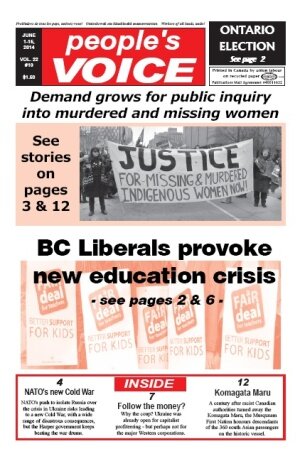
PEOPLE'S VOICE JUNE 1-15, 2014 (pdf)
People’s Voice 2014 Calendar
”The Truth About the Great War”
To order a copy of the People’s Voice 2014 Anti-First World War
Calendar, send $15 (includes postage and handling) to
People’s Voice, 706 Clark Drive, Vancouver, BC, V5L 3J1. Contact us at
604-255-2041 or pvoice@telus.net for bulk order prices.
|
People's Voice deadlines: June 16-30 July 1-31 Send submissions to PV Editorial Office,
|
REDS ON THE WEB
http://www.parti-communiste.ca/
peoplesvoice.ca
www.ycl-ljc.ca
www.solidnet.org
|
People's Voice finds many "Global Class Struggle" reports at the "Labour Start" website, http://www.labourstart.org/. We urge our readers to check it out! |
* * * * *
People's Voice
Canadian Publications Mail Sales Product Agreement #205214
ISSN number 1198-8657
People's Voice is published by
New Labour Press Ltd
PV Editorial Office
706 Clark Drive,
VANCOUVER, B.C. V5L 3J1
Phone:604-255-2041
Fax:604-254-9803
email: pvoice@telus.net
Editor: Kimball Cariou : Business Manager: David Au
Editorial Board: Kimball Cariou, Miguel Figueroa,
Doug Meggison, Naomi Rankin, Liz Rowley, Jim Sacouman
* * * * * *
Letters
People's Voice welcomes your letters
on any subject covered in our pages.
We reserve the right to edit for length and clarity,
and to refuse to print letters which may be libellous
or which contain unnecessary personal attacks.
Send your views to:
"Letters to the Editor",
706 Clark Dr., Vancouver, BC V5L 3J1,
or pvoice@telus.net
People's Voice articles may be reprinted without permission,
provided the source is credited.
* * * * * *
The Communist Party of Canada, formed in 1921,
has a proud history of fighting for jobs, equality, peace,
Canadian independence, and socialism.
The CPC does much more than run candidates in elections.
We think the fight against big business and its parties
is a year-round job,
so our members are active across the country,
to build our party and to help strengthen people's movements
on a wide range of issues.
All our policies and leadership
are set democratically by our members.
To find out more about Canada's party of Socialism,
give us a call at the nearest CPC office.
* * * * * *
Central Committee CPC
290A Danforth Ave Toronto, Ont. M4K 1N6
Ph: (416) 469-2446
fax: (416) 469-4063 E-mailmailto:info@cpc-pcp.ca
Parti Communiste du Quebec (section du
Parti communiste du Canada)
5359 Ave du Parc, Montréal, Québec,
H2V 4G9
B.C.Committee CPC
706 Clark Drive, Vancouver, V5L 3J1
Tel: (604) 254-9836
Fax: (604) 254-9803
Edmonton CPC
Box 68112, 70 Bonnie Doon P.O.
Edmonton, AB, T6C 4N6
Tel: (780) 465-7893
Fax: (780)463-0209
Calgary CPC
Unit #1 - 19 Radcliffe Close SE
Calgary AB, T2A 6B2
Tel: (403) 248-6489
Ottawa CPC
Tel: (613) 232-7108
Manitoba Committee
387 Selkirk Ave., Winnipeg, R2W 2M3
Tel/fax: (204) 586-7824
Ontario Ctee. CPC
290A Danforth Ave., Toronto, M4K 1N6
Tel: (416) 469-2446
Hamilton Ctee. CPC
265 Melvin Ave., Apt. 815
Hamilton, ON.
Tel: (905) 548-9586
Atlantic Region CPC
Box 70 Grand Pré, NS, B0P 1M0
Tel/fax: (902) 542-7981
http://www.parti-communiste.ca/
* * * * * *
News for People, Not for Profits!
Every issue of People's Voice
gives you the latest
on the fightback from coast to coast.
Whether it's the struggle for jobs or peace, resistance to social cuts,
solidarity with Cuba, or workers' struggles around the world,
we've got the news the corporate media won't print.
And we do more than that
- we report and analyze events
from a revolutionary perspective,
helping to build the movements for justice and equality,
and eventually for a socialist Canada.
Read the paper that fights for working people
- on every page, in every issue!
People's Voice
$30 for 1 year
$50 for 2 years
Low-income special rate: $15 for 1-year
Outside Canada $50 for 1 year
Send to: People's Voice, 706 Clark Drive, Vancouver, BC, V5L 3J1
You can call the editorial office at 604-255-2041
REDS ON THE WEB
http://www.parti-communiste.ca/
http://www.ycl-ljc.ca/
http://www.solidnet.org/
(The following articles are from the June 1-15, 2014, issue of People's Voice, Canada's leading socialist newspaper. Articles can be reprinted free if the source is credited. Subscription rates in Canada: $30/year, or $15 low income rate; for U.S. readers - $45 US per year; other overseas readers - $45 US or $50 CDN per year. Send to People's Voice, c/o PV Business Manager, 706 Clark Drive, Vancouver, BC, V5L 3J1.)
1) MINORITY GOVERNMENT THE BEST OUTCOME FOR ONTARIO
By Liz Rowley, leader of the Communist Party (Ontario)
The only thing clear in the June 12 Ontario election is that the NDP's strategy to crush the Liberals and move up to government or official opposition, has come apart at the seams.
A palace revolt involves Michelle Lansberg, Gerry Kaplan, and 32 other prominent NDP members who signed an open letter accusing Andrea Horwath of shifting the party hard right, exposing the crisis of social democracy, and Horwath's support of big capital and austerity policies.
The labour movement too has attacked the NDP for forcing an election in which the Tories have the most to gain, and the working class the most to lose.
At issue is the platform of Tory leader Tim Hudak, who promises to lay off 100,000 public sector workers, slash wages, enact right to work (for less) laws and eliminate the Rand formula and the closed (union) shop. Hudak is committed to raise tuition fees by 30% and privatize everything in the province that isn't nailed down.
100,00 public sector layoffs will generate 50-60,000 layoffs in the private sector, enough to tip the province into deep recession.
These facts are frightening voters, but Hudak's main promise is to create a million jobs out of the detritus of the massive layoffs and the destruction of public services and programs. His direct appeal is to the approximately one million unemployed, the impoverished and marginalized, the bankrupt small business owners. His invitation is to vote for a party leading the attack on unions and unionized workers, on foreign temporary workers, on youth, women, and racialized communities who are held up to be responsible for the current economic crisis, for mass unemployment, and falling living standards. It's a toxic poison.
This election has made Ontario ground zero in the fight to stop the corporate/government offensive to break the back of the trade union movement in Canada.
Trade union leaders publicly urged the NDP to support the May Liberal budget and prevent an election that could give the Tories a free pass to power, while the NDP and Liberals fight over Official Opposition status.
The public mood is to punish the NDP for throwing the dice, and for abandoning minimum wage workers while promising tax cuts to corporations. The NDP are falling in the polls where they are likely to remain on election day.
Meanwhile the Liberals are fighting on two fronts, and advancing a platform based on massive privatization to pay for the $29 billion infrastructure program and jobs they say they will deliver. Their promised provincial pension program has turned out to be a jumped-up RSP plan ‑ not the defined benefit plan with fixed pay‑outs promised in the budget, such as the Canada Pension Plan.
Public disillusionment has increased, with many people declaring they will not vote because "they're all the same," and because none address their real concerns about social and economic security and about civil, labour and democratic rights.
In this scenario, the best outcome would be a minority government in which the NDP and Liberals cooperate to hold the balance and the Tories are shut out of government altogether.
Into this mix, the CPC (Ontario) has advanced a political and economic plan to generate a real economic and social recovery for working people, that hinges on curbing corporate power and redistributing wealth through progressive tax policies based on ability to pay.
This would generate the capital needed to directly invest in areas such as an emergency jobs program for youth, a massive social housing construction program, a public and quality provincial childcare system that's accessible and affordable everywhere in Ontario. The CPC (Ontario) calls for investment in public hospitals and healthcare to enhance and expand Medicare and reverse privatization; for a single, secular public education system open to all; and for free tuition and a debt amnesty for debt‑burdened post-secondary students.
The Communists call for a real universal, defined benefit pension plan, whose benefits would be increased and made fully accessible to recipients at age 60.
We are fighting for an industrial strategy that would expand value added manufacturing and secondary industry in Ontario, and to pull out of trade deals that stand in the way of sustainable and needed economic development and job creation.
Good jobs, higher wages, and rising living standards are the way out of the economic crisis, and towards a genuine economic and social recovery for the working class and working people.
In this election, there has been more interest in the CPC (Ontario). Many voters say they have had it with the NDP and want the platform we are advocating. Requests for lawn signs are keeping our campaigns busy, along with requests for information and applications to join. There is a distinct change in the political atmosphere, reflecting big changes in people's thinking, about themselves, the economy, social democracy, and about the "right populism" of Tim Hudak, Stephen Harper and Rob Ford.
A vote for the Communist Party is a vote for a future where the needs and interests of working people trump the greed of the big corporations and the wealthy. Voting Communist is a vote for class and social solidarity, and for a struggle that will continue after the election.
Making your vote really count, means going beyond the current dead‑end bourgeois political box of austerity and impoverishment. Voting Communist is a vote for a broad‑based and militant fight to get real change. Much more than a vote, it is a declaration of an emancipation still to come.
2) BC LIBERALS CREATE ANOTHER EDUCATION CRISIS
PV Vancouver Bureau
Despite a barrage of lies, half-truths and outright scaremongering, the BC Liberal government has failed to move public opinion into line for their attack on teachers. After two decades of underfunding, mostly under the Liberals since Gordon Campbell came to office in 2001, British Columbia's public education system is under tremendous stress. School closures have hit many districts, and school boards have been compelled to download a wide range of cutbacks into classrooms.
The Liberal government has twice been handed stinging legal defeats in the courts over their heavy-handed tactics, but still refuse to bargain in good faith. In their latest move, the Liberals have imposed a confusing, contradictory set of lockout guidelines, threatening to punish teachers with big salary cuts if they refuse to knuckle under to Premier Christy Clark's bullying tactics.
Teachers began a series of four one-day rotating walkouts on Monday, May 26, shutting down schools in different districts to strengthen their demand for a reasonable collective agreement. Across the province, there have been growing indications that students, parents, teachers and even school boards are rejecting the Liberal mantra of "no money for education" - a claim which is at odds with the government's $2 billion-plus annual cuts to taxes for the rich and the corporations since 2002.
The BC Teachers Federation warns that the government's attempt to make good on their threat to roll back teachers wages during job action "will have significant impacts on students for the rest of this school year."
Michael Marchbank, Premier Clark's appointed head of the BC Public School Employers, Association, says that because teachers are starting rotating strikes, the government intends to claw back 10% of their wages. The pay cut will be in effect even on days when teachers are in their classrooms working with students to meet their needs.
To justify the pay cuts, the government is imposing a series of partial and full lockouts. Starting Monday, May 26, teachers are prohibited from being at school more than 45 minutes before and after class time, or from working during recess or lunch hour. All secondary teachers will be locked out on June 25 and 26, and both elementary and secondary teachers are to be locked out on June 27.
Teachers could be disciplined for helping a struggling student at lunch hour, extra‑curricular activities including clubs, drama, music, sports will be cancelled, graduation ceremonies will be impacted, and final exams for some senior secondary students will not be marked. As the BCTF says, none of these impacts would have occurred under the teachers' job action plan.
"We were careful to ensure that already scheduled extra-curricular and volunteer activities continued. We wanted to minimize the impact on students," said BCTF President Jim Iker. "During rotating strikes, teachers would continue all volunteer activities four out of five days a week."
While Premier Clark says that children should not be put in the middle, she is imposing significant disruptions to the education system. Some secondary school teachers will be locked out on the day their students graduate.
Iker said that the directive prohibiting teachers from interacting with students during the lunch hour will have possibly the most wide‑ranging impacts.
The lockout will mean teachers would be insubordinate if they helped a struggling student or a child with special needs during the lunch hour, Iker points out. For many teachers, this is valuable time when students can have important one‑on‑one time to ask questions.
Iker called on the BC government to come to the bargaining table with resources to reach a fair collective agreement.
"Smaller classes, more support for children with special needs, extra one‑on‑one time with all kids, and fair wages - these are our key goals in this round of negotiations," he stated. "That's how we will get a deal and that's how we can end this crisis in education."
This spring, as school districts announced mass layoffs and deep program cuts to balance their inadequate budgets, teachers and parents were demanding reinvestment in public schools. In many places, they took to the streets, protesting at MLAs' offices, turning up the heat on trustees, and using social media to make their concerns heard.
In Port Coquitlam a May 23 rally was spurred by a school district budget that required $13.4 million in cuts and resulted in the layoff of more than 600 teachers and 200 support workers.
Vancouver parents and students, along with other supporters of public education, came out in the hundreds to budget consultations, calling for the Vision-led school board to keep the cuts out of the classroom. This Board, chaired by Patti Bacchus, has been among the most outspoken critics of Liberal underfunding, but it too faces enormous deficits as more and more unfunded costs are downloaded by the province.
In Mission, parents rallied in support of teachers on May 21 in front of their Liberal MLA's constituency office, demanding better education for their children.
In Port Moody, as several trustees voted against the board's final operating budget, more than 100 parents, teachers and support workers turned out for the budget meeting which ended weeks of consultation with stakeholders.
The story has been the same across the province, as the depth of the crisis sinks in to the public. Often the protests have taken the form of impassioned speeches at budget consultations, but in many places, demonstrations have been organized.
All this comes just months after teachers across BC celebrated the latest ruling by the BC Supreme Court, reaffirming that provincial legislation limiting teachers' bargaining rights is unconstitutional. The January ruling restored collective agreement provisions stripped in 2002, and ordered the province to pay $2 million in damages plus court costs.
The legislation was already declared unconstitutional in 2011, and the judge gave the government one year to rectify the situation. However, the government simply reintroduced the same unconstitutional provisions. By removing class‑size limits and class‑composition guarantees, the Premier did significant damage to learning conditions in schools.
"Children who were in Kindergarten when those bills were passed are now in Grade 12, and have spent their entire school careers in larger classes with fewer resources," Iker said at the time. "For the past 12 years, thousands of children couldn't get the services they needed because government broke the law."
The legislation removed provisions that guaranteed smaller classes, support for students with special needs, and services from teacher‑librarians, counsellors, and other specialists. The government then cut hundreds of millions of dollars a year from public education budgets, forcing school boards to cut programs and close more than 200 public schools. More than 3,500 teaching positions, including 1,500 specialist teachers, were also cut.
"If government had respected the Charter, teachers would not have had to spend the past dozen years fighting for our rights," Iker said. "Now we expect that government will do everything necessary to demonstrate respect for the court"s ruling and make the situation right. Restore our smaller classes, rehire our specialist colleagues, and help us rebuild the excellent public education system that British Columbians expect for their children."
But Iker's words were not heeded. Instead, Premier Christy Clark has provoked yet another crisis in the province's public schools.
As the Communist Party of BC points out, this is not just a personal vendetta by the Premier: "The entire public health and education sector is under ruthless attack, not only in BC and Canada, but across the entire capitalist world. In country after country, austerity policies have been imposed on an unwilling population, with devastating results for employment and the quality of public services. All this is being done as part of a broader attempt to shift wealth produced by working people into the hands of transnational corporations and their wealthy shareholders."
The CPBC warns that the Premier and her friends in the corporate sector aim to destroy British Columbia's public education system, deliberately creating crisis after crisis, even as they increase taxpayer funding for private schools.
The government's goal, the CPBC says, is to gut the public school system, compelling working people to shift into profiteering private schools.
The CPBC has urged full support on the picket lines for the teachers as this crisis deepens. Full solidarity is needed to help win a fair collective agreement with BC teachers, including salaries in line with other provinces, and smaller class sizes.
3) FULL SOLIDARITY WITH B.C. TEACHERS
Statement from the Communist Party of BC, May 26, 2014
Yet again, the BC Liberal government has moved to attack the collective bargaining process and generate confusion and chaos across the provincial public education system. The Communist Party of BC condemns Premier Clark's "partial lockout" of BCTF members, which marks a serious escalation of her relentless attack against teachers and other education workers, and in fact against students, parents and the entire public school system in British Columbia. We call for full mobilization of the labour movement and its allies in defence of the BCTF. The recent protests by students in Chilliwack and other cities against the lockout, and the wave of public anger against the BC Liberal education cuts across the province, are indications that a wider resistance can be mobilized to defeat the government's agenda. Such a broad fightback can and should become the starting point for a powerful struggle to roll back the entire Liberal assault on public services.
It would be tempting to portray this latest struggle as just another chapter in the long‑term vendetta by Premier Clark against the teachers of BC and their elected union leadership. The truth is that Christy Clark was the education minister in the early years of Gordon Campbell's Liberal government, which imposed devastating education cutbacks and illegally ripped up the collective bargaining agreements negotiated by the BCTF. In her political and broadcasting careers, Clark has consistently demonized public school teachers and their union, in a blatant but mostly unsuccessful attempt to turn parents against the education system. Clearly, there is a strong personal motive behind the Premier's actions.
But this explanation misses the wider point, which is that the entire public health and education sector is under ruthless attack, not only in BC and Canada, but across the entire capitalist world. In country after country, austerity policies have been imposed on an unwilling population, with devastating results for employment and the quality of public services. All this is being done as part of a broader attempt to shift wealth produced by working people into the hands of transnational corporations and their wealthy shareholders. The cry by the BC Liberals that "there is no money" for schools is exposed by the fact that their taxation cuts for the rich and the corporate sector have cost the public treasury of this province over two billion dollars annually for the past twelve years. There is in fact considerable wealth in this province to reverse the underfunding of education and the health care system, to give a desperately needed 50% increase in social assistance rates, to build housing for all the homeless living in our streets, and to do much more to improve the lives of working people and the poor. The decision not to take these steps is purely a political choice by the Liberals, similar to governments everywhere which act in the interests of the 1 percent, against the vast majority of working people.
Instead, the Premier and her friends in the corporate sector aim to destroy our high‑quality public education system, deliberately creating crisis after crisis, even ignoring the courts and public opinion as they attempt to wipe out the BCTF and the entire collective bargaining process. Their true agenda is shown by the ever‑increasing amounts the Liberals pour into private schools. Their ultimate goal is clearly to reduce the public school system to a shadow of its former self, the last resort for the poor to educate our children, while the rest of the population are compelled to pay ever increasing fees to profiteering private school operators.
This must not be allowed to happen! We urge every parent, every student, every school trustee, everyone who is concerned for the future of our province to join the teachers on their picket lines. Our message must be: roll back the education cuts! Negotiate a fair collective agreement with BC teachers, including salaries in line with other provinces, and smaller class sizes!
4) NEW PRESSURES FOR MURDERED AND MISSING WOMEN INQUIRY
By Kimball Cariou
Two new reports from very different sources have turned up the heat on the federal government, which faces growing demands to call a public inquiry into the cases of murdered and missing Aboriginal women across Canada.
The May 12 report by James Anaya, the United Nations rapporteur on indigenous rights, says that the human rights situation of Aboriginal peoples has reached "crisis proportions."
In a related development, a new RCMP report provides numbers on the total of murdered and missing women, including statistics showing that Aboriginal women are far more likely to become victims of violence.
Anaya's wide‑ranging report raises many issues, from education to energy projects and the missing or murdered women. It comes at a time of rising tensions between Aboriginal peoples and a federal government which is deeply distrusted.
"It is difficult to reconcile Canada's well‑developed legal framework and general prosperity with the human rights problems faced by indigenous peoples in Canada that have reached crisis proportions in many respects," writes Anaya. "The relationship between the federal government and indigenous peoples is strained, perhaps even more so than when the previous special rapporteur visited Canada in 2003."
The government delayed Anaya's recent visit to Canada, which finally took place last year over a nine day period. He travelled to reserves and cities in several provinces, witnessing first‑hand the dire levels of poverty and racism faced by Aboriginal peoples.
After meeting with First Nations representatives and government officials, Anaya identified serious shortfalls in education, housing and health, as well as the need for genuine consultation on major energy projects, such as the Northern Gateway pipeline from Alberta to the British Columbia coast. He added his support to the call for an inquiry into cases of Aboriginal women and girls who have been murdered or gone missing in the past 30 years.
In response, Aboriginal Affairs Minister Bernard Valcourt agreed that "more work needs to be done", but claimed the government is taking steps to give indigenous peoples the same access to safe housing, education and matrimonial rights as non‑aboriginals.
One of the most controversial disputes between the Canadian state and First Nations concerns resource projects and economic development. The Supreme Court has upheld the necessity of genuine consultations, but without specifying a full veto power to First Nations communities which oppose such projects on their traditional territory.
The Anaya report urges Canadian governments and industry to win aboriginal consent before proceeding with such developments. The Special Rapporteur stressed that Aboriginal peoples have expressed concerns over resource projects that will pollute their traditional lands, including Enbridge's Northern Gateway, Kinder Morgan's TransMountain expansion, and Line 9 in southern Ontario.
"The way it's supposed to work is that whenever these rights are affected, there needs to be consultation and agreement about any decision that would limit those rights in order to, in the end, protect them," Anaya said in an interview with the Globe and Mail. "Whenever someone goes onto someone's land, there needs to be permissions sought and some kind of agreement."
Art Sterritt, executive director of Coastal First Nations, a coalition of nine British Columbia bands opposed to the Northern Gateway project, agrees with Anaya's interpretation.
"First Nations in British Columbia have many options in front of us and certainly the courts are the preferred option," he told the Globe and Mail. "But if the prime minister approved this, and Enbridge tries to ram it through, there will be people out there to stop this until these questions are answered."
A National Energy Board review panel recommended approval of Northern Gateway last December, with a list of 209 conditions. Harper is widely expected to approve the tar sands pipeline this month, despite massive opposition among communities along its route and on the B.C. coast. His government argues that the resource sector employs 32,000 First Nations people, and that Aboriginal communities benefit economically from resource projects.
The pipeline would deliver 525,000 barrels per day of diluted bitumen to an export terminal in Kitimat, B.C., where it would be loaded onto super‑tankers to be transported through the stormy waters of the narrow Douglas Channel.
Environmentalists warn that any significant pipeline leak or super‑tanker spill would have disastrous consequences for the ecology, and that energy companies are not required to pay for most of the huge costs of any potential clean‑up. Observers expect that the project could be tied up for years by legal challenges and public opposition.
Meanwhile, RCMP Commissioner Bob Paulson has released a report listing 1,026 deaths and 160 missing‑persons cases involving aboriginal women since 1980, hundreds more than some previous estimates.
The report says Aboriginal women have been much more prone to violent death than non‑natives, but also claims that murder cases have been solved for both groups at almost the same rate.
The 22 page report gives an overview of poverty, unemployment and other factors. Speaking at a news conference in Winnipeg, an RCMP spokesperson said there are still many unanswered questions, but that the research project is a first step in that direction.
The report notes that Aboriginal women make up 4.3% of the Canadian population, yet account for 16% of female homicides and 11.3% of missing women. Murdered Aboriginal women are more likely than average to be unemployed and to have consumed intoxicants just before their deaths. A small minority of missing and murdered aboriginal women had been involved in the sex trade, twelve percent versus five percent among non‑native women. The "solve" rates are 88% for aboriginal women and 89% for others.
The Manitoba Metis Federation said the report requires concrete action, including more services for women, in communities across the country.
The Assembly of First Nations said an inquiry would force the government to address the issue by, among other things, boosting women's shelters and other programs.
"While there have been many reports and findings to date, a national public commission of inquiry would demand immediate action, build on existing data and address the reasons why existing recommendations haven't been already implemented," Cameron Alexis, AFN regional chief for Alberta, said in a written statement.
Anaya said even though some steps have been taken, "The Federal government should undertake a comprehensive, nationwide inquiry into the issue of missing and murdered aboriginal woman and girls, organized in consultation with indigenous peoples."
His report comes as the Assembly of First Nations is in disarray after the resignation of its national chief, Shawn Atleo. The government's proposed changes to First Nation education are in limbo until the assembly clarifies its stance.
The Tories say that Bill C‑33, the "First Nations Control of First Nations Education Act", meets five conditions outlined by the AFN during a secret meeting last December.
Many First Nations groups, and grassroots activists connected with Idle No More, say the legislation would strip away their rights and give the federal government too much control over the education of their children. They also point out that the December agreement was essentially a backroom deal reached without any broad consultation.
5) DEMAND FULL INQUIRY INTO MURDERED AND MISSING WOMEN
Statement by the Central Executive Committee, Communist Party of Canada
The anti‑human agenda of the Harper Tories has been exposed yet again by their latest refusals to call a full public inquiry into the cases of murdered and missing women across Canada. In the wake of the more extensive revelations about this shocking reality, the Communist Party of Canada renews our demand for such an inquiry as a matter of extreme urgency.
A new report issued by the RCMP lists 1,026 deaths and 160 missing‑persons cases involving Aboriginal women since 1980, hundreds more than some previous estimates. The report confirms that Aboriginal women are disproportionately likely to be the subject of violent attacks. While Aboriginal women make up 4.3% of all women in Canada, they account for 16% of female homicides and 11.3% of missing women. Poverty, unemployment and other forms of racist inequality are major factors in this ongoing tragedy. Murdered Aboriginal women are more likely than average to be unemployed and to have consumed intoxicants just before their deaths. But contrary to racist stereotypes, only a small minority of missing and murdered aboriginal women had been involved in the sex trade, twelve percent versus five percent among non‑native women. While the RCMP report calls for action on the social factors at play in this ongoing tragedy, the force also tries to cover its own responsibility, claiming that the "solve" rates are 88% for aboriginal women and 89% for others.
The callous response of the federal Conservative government is deeply shocking. We join with many others in pointing to the obvious conclusion: if 25,000 non‑Aboriginal women had been murdered or gone missing across Canada over the past thirty years, of course there would be swift action, including public inquiries and immediate steps to end such a wave of criminal terror. Instead, the Harper Tories continue to duck the rising tide of public pressure, shuffling responsibility onto other levels of government and police forces. At lower levels, other governments are also evading their responsibilities; in British Columbia, for example, where the largest numbers of deaths have taken place, the province still refuses even to begin a shuttle bus service along the infamous "highway of tears" from Prince George to Prince Rupert, where many Aboriginal women have gone missing and are presumed killed.
We must point out that this issue is deeply are rooted in the historic legacy of colonialism and racism in Canada. The conquest of North America by European powers beginning 500 years ago was accompanied by ruthless genocidal policies and actions, leading to the deaths of tens of millions. The genocide against indigenous peoples in the western hemisphere, and the trans‑Atlantic slave trade, were justified by horrendous racist doctrines declaring the lesser status of non‑Europeans. These white supremacist doctrines were used to justify the theft of indigenous territories, to ban the languages and cultural practices of Aboriginal peoples, to impose shocking low wages and abysmal living standards. Together with the ideology of male supremacy, these were the conditions which led to the centuries‑old racist treatment of Aboriginal women, right up to the present day, when police forces and the Canadian state dismissed the disappearances of these woman as not worthy of serious attention. By rejecting the growing demands for a full public inquiry, the Harper government is continuing the legacy of this racist policy, at a time when more deaths and disappearances are being reported.
More and more movements and organizations, and even the opposition parties in Parliament, are now raising the demand for such an inquiry. This demand must continue to be front and centre in the struggle to overcome the historic oppression of Aboriginal peoples within the Canadian state, along with other crucial issues raised in the recent report by UN Special Rapporteur on Indigenous Rights, James Anaya: genuine and meaningful consultations over resource and economic projects which affect First Nations tradtional territories; control over the educational system for Aboriginal children; an end to the abysmally‑low standards of health, housing, social development, and housing for Aboriginal peoples.
These struggles are integral to the overall struggle by the working people of Canada for our future, since they are crucial to the fight to end the domination of our economic and political life by the big transnational corporations. Unity in the fight for a genuine People's Alternative to the neoliberal agenda must begin with full support for the equality of Aboriginal peoples and Quebec, including a unifying fightback strategy by the new leadership of the Canadian Labour Congress. Our Party pledges to do everything in our power to help achieve such unity.
People's Voice Editorial
The governments of the NATO countries ‑ including Canada ‑ are ignoring the potential for disaster in Ukraine, as a macabre chorus of anti‑Russian boasting emanates from Washington, London and Ottawa. This bizarre political game even compares Russia with Nazi Germany, aiming to convince the public that the enemy of democracy and freedom in the Second World War was the Soviet Union. The truth is that Hitler fascism launched the war and slaughtered millions in its death camps, while the Soviet people, under the leadership of the Communist Party, played the decisive role in the military liberation of Europe.
This history is relevant today, in light of the attacks against trade unionists, Communists, and members of minority groups in Ukraine. We draw particular attention to the attempt to ban the Communist Party of Ukraine (CPU), a major political force in that country since the dissolution of the USSR, as a so‑called "threat to national security."
Virtually the first act of the Nazi regime was to ban the Communist Party. That was followed by a reign of terror against social democrats, trade unionists, progressive religious leaders, the Jewish and Roma populations, homosexuals, and other "enemies" of the Third Reich, in Germany and then across occupied.
Behind today's attack on the CPU is an attempt to deprive Ukrainian citizens of their right to freedom of speech, and to freedom of demonstrations and assembly. This effort to mute voices which oppose the ultra-nationalist agenda aims at blocking dialogue around restoration of peace and concord in Ukraine. Those who support the coup regime in Kiev ‑ and here we include the NDP and Liberal opposition parties in Parliament ‑ must be held to account. We urge all peace‑loving and democratic forces to call upon Parliament to speak out against the descent into fascism in Ukraine, before it is too late.
7) OMINOUS RESULTS IN EURO-ELECTIONS
People's Voice Editorial
Confirming a trend which has emerged since the financial crisis of 2007‑08, the European Union elections held May 22‑25 saw rising support for both so‑called "Eurosceptic" and anti‑austerity parties. Some far‑right parties drew millions of votes with their xenophobic policies, while establishment pro‑European parties paid a price for their imposing their anti-people Lisbon Treaty.
Most shocking, France's far‑right National Front scored its first victory in Euro Parliament elections, with 25 per cent of the vote. The right‑wing Danish People's Party topped the polls, as did the governing right‑wing Fidesz party in Hungary with 52 per cent and 12 seats. For the first time, the fascist Golden Dawn party in Greece elected a member of the European Parliament. In Britain, the "eurosceptic" UK Independence Party, home to many far‑right elements, defeated Labour and the declining Conservatives. Overall, such parties elected over 60 members of the European Parliament (MEPs), with their biggest gains in the UK and France.
On the other hand, Greece's Syriza party topped the polls with more than 27 per cent and 6 MEPs, and the more radical Greek Communist Party climbed back to 6% and elected two MEPs after losing ground in previous elections. In Spain, the ruling conservative Popular Party and the "Socialists" lost ground to smaller parties on the left. In the Irish Republic, Sinn Fein elected two MEPs, plus another in Northern Ireland. Overall, the parties belonging to the European United Left/Nordic Green Left grouping, which includes a number of Europe's communist and workers' parties, won 6% of the total vote, electing a record 51 MEPS, a gain of 16.
The lesson? Years of economic upheaval and insecurity can generate support for revolutionary ideas, but also create the breeding grounds for fascist ideology. Much more needs to be done to expose the fascist menace as the deadliest weapon in the arsenal of the ruling class.
8) LITTLE HAS CHANGED SINCE KOMAGATA MARU, SAY ADVOCATES
Over a hundred South Asian advocates, artists, social workers, labour unions, academics and community groups have issued a joint statement marking the centenary of Komagata Maru's arrival in Vancouver harbour on May 23rd, calling for permanent immigration status for temporary foreign workers.
"The Komagata Maru is not just a historic incident that can be washed away by commemorative stamps," says Toronto-based workers rights organizer Sonia Singh. "We need to seriously change the course of Canadian immigration policy and include access to permanent residency for poor and working class migrants now rather than wait 100 years to apologize for the mistreatment of migrant workers."
Harsha Walia, author and activist based in Vancouver adds, "The expansion of the temporary worker program is a direct legacy of the racist exclusion of the Komagata Maru. Restrictive immigration and refugee laws continue to make it impossible for refugees, family members, and skilled workers to live in Canada permanently. And the calls to deport and exclude migrant workers echo the same sentiment as one hundred years ago."
Montreal-based South Asian Women Centre's Dolores Chew agrees. "Today we need to reflect on how Komagata Maru's legacy continues in the current immigration system rather than put it aside as a now dealt with historical incident."
The following is the full statement, which can also be found online at http://komagatamarulegacy.tumblr.com/
On May 23rd, we commemorate the immense injustice that was the turning away of the Komagata Maru. We remember our elders in Vancouver and across Coast and Straits Salish Territories that raised money, and attempted to defy the blockade to take supplies to those trapped aboard the ship. We honor those that were jailed, and murdered upon their return to a colonized India. This May 23rd, we mark one hundred years of resilience and resistance against racisms and oppression, despite which our communities continue to live and flourish here.
For us, the Komagata Maru is not a historic "incident" but one step in an ongoing history of exclusion of our communities.
We have seen the mass arrest of migrants aboard the MV Sun Sea and the drumming up of racist hysteria against the Tamil community. Recent anti‑immigrant and anti‑refugee policies have made it impossible for most of us to reunite permanently with our parents, grandparents, spouses and children. Conditional permanent residence requirements for some spousal sponsorships mean that women facing abuse may be forced into further vulnerability or risk losing status. Fewer members of our communities doing lower wage jobs are able to come here with full immigration status. Even those that do arrive with permanent immigration status and higher qualifications often end up de‑skilled or living in poverty.
On April 24th, a moratorium was placed on temporary foreign worker jobs in the food sector. Now nearly 50,000 migrant workers are locked into potentially abusive jobs with even less ability to move within the industry. Workers that have paid thousands of dollars to unscrupulous recruiters to get jobs in Canada are also severely impacted. Those working in the food sector are almost entirely racialized, and many of them are South Asian.
Many organizations are calling for the ban to be extended to all migrant workers. These demands are part of the ongoing legacy of exclusion that the Komagata Maru embodies. Just as the Komagata Maru's arrival was accompanied by racist trumpeting from governments, and mainstream voices, we see our newspapers today filled with the claim: "Foreigners are taking our jobs". There are rallies against migrant workers in Alberta today, just as there were against the Sikh, Muslim and Hindu families from Punjab aboard the Komagata Maru in 1914.
The Refugee Exclusion Act, the so‑called Human Smuggling Act, Labour Market Opinions, Work Permits, Quotas and Moratoriums are the legal tools of exclusion today, just as the Chinese Exclusion Act, the Head Tax and the Continuous Journey regulations have been before.
The Komagata Maru is not a failure of the past that can simply be recovered through apologies and commemorative stamps. Those are important steps in a process of reconciliation that has barely begun. But, it is imperative that we stop exclusionary laws and policies now, rather than wait for apologies from future governments.
We call on the Government of Canada to immediately reverse the moratorium on migrant workers in the food sector. The temporary worker program is undoubtedly a racist and classist program, but recent calls to deport and exclude migrant workers denies their mobility rights and basic humanity. Instead of exploiting migrant workers as cheap and deportable labour, federal and provincial governments must ensure access to permanent residence, a living wage, rights and benefits for poor and working class migrants and their families.
As South Asians, as migrants, and as allies, we refuse divide‑and‑conquer strategies that pit unemployed citizens against migrant workers and newly arrived migrants against those who have lived here for generations. We commit to working together, and in solidarity with all those that deserve and demand fairness and dignity, particularly, low‑income, migrant and Indigenous communities.
It is time to stop the injustice personified in the Komagata Maru.
Signing organizations include (as of May 22): 8th March Committee of Women of Diverse Origins/le Comité 8 mars des Femmes de diverses origines; Alliance for South Asian Aids Prevention; Asian Canadian Labour Alliance; Association of Filipino Parents in Quebec; CERAS (Centre sur l'asie du sud) Montreal; Coalition of South Asian Women Against Violence; Council of Canadians; Fraser Valley Peace Council; Health and Racism Working Group, Mississauga; Justice for Migrant Workers; Migrante Alberta; Migrante Canada; Newcomer Women's Services Toronto; No One Is Illegal-Toronto; No One Is Illegal‑Vancouver Coast Salish Territories; PINAY‑Quebec; Q? Y Art? Project; Siraat; Shameless Magazine; South Asian Legal Clinic of Ontario; South Asian Network for Secularism and Democracy; South Asian Visual Arts Centre; South Asian Women's Centre ‑ Toronto; South Asian Women's Community; Centre (SAWCC), Montreal, Occupied Kanienkehaka Territory; Trikone Vancouver; UBC Race, Autobiography, Gender and Age; United Food and Commercial Workers Union; Vancouver Status of Women.
9) NATO ACTIONS IN UKRAINE RISK NEW COLD WAR
Guest commentary by Dave McKee, President of the Canadian Peace Congress
At the time of writing, the media in Canada is swirling with stories about the presidential election in Ukraine, which has apparently been won in the first round by "Chocolate King" Petro Poroshenko. Most of these corporate media reports offer little more than a rehash of this carefully crafted NATO‑EU narrative: following the ouster, by popular uprising, of former president Viktor Yanukovych, the Russian government moved quickly to meddle in Ukraine's delicate and unstable internal affairs; the referendum in Crimea occurred under the direct threat of Russian military intervention, thereby rendering the result as unsurprising but utterly invalid; Russia has proceeded to organize, equip and support bands of separatist militants who use terrorist tactics to destabilize Ukraine and enable Russian annexation.
This narrative concludes that the people of Ukraine have the opportunity to bring stability to their country by providing a single‑round election victory to Poroshenko.
Amidst this sometimes desperate‑sounding fable of "colour revolutions and confectionary rulers", the truth has conveniently been distorted or omitted entirely. This, of course, is also part of the NATO‑EU narrative.
Why?
Because the last thing that imperialist organizations and governments (including Canada's) want their people to remember is that Viktor Yanukovych was a democratically elected president of a sovereign country, whose decision about the political and economic direction for Ukraine sparked massive interference in Ukraine's internal affairs. They don't want us to consider that countries of the EU and NATO, who have dedicated decades to eastward expansion and encirclement of Russia, are responsible for backing and guiding the violent coup in February in which neo‑fascist forces played a key role. We are not to know that the referendum in Crimea was rooted in that region's historical status as an autonomous republic, both in the Soviet Union and in Ukraine. The corporate media definitely want to avoid any discussion of the May 2 massacre at Odessa, in which dozens of anti‑government protestors were trapped by reactionary, pro‑coup forces and burned alive.
The people in imperialist countries are not to know these facts, because such knowledge is a key basis for building opposition. A Canadian public which recognizes the Harper government's foreign policy as aggressive, imperialist, militaristic and undemocratic is also a public that will question Canada's support and contribution to the current military buildup in eastern Europe. It is a public that will not support or accept massive increases in Canada's military budget, but will instead demand military spending cuts and the redirection of public money toward job creation, health and social programs, and the environment.
Austerity and war are two sides of the same coin. In the context of an ongoing and deepening global economic crisis, imperialist states and organizations are becoming more aggressive in their drive to divide and redivide the world, to control markets and resources and outmaneuver their rivals. At the very same time that imperialist governments are inflicting brutal austerity measures against the people and attacking labour and democratic rights, they are seeking and using new and old pretexts for interference, provocation, and war.
Such a huge contradiction, with such enormous and immediate stakes for so many people in Canada, could not be maintained if not for the massive campaign of misinformation. Imperialism's increased aggressiveness includes an intense effort to ideologically soften and confuse the population, to try to justify policies that place militarism as a most noble cause to which all social needs are secondary. We witnessed this during the Cold War, when imperialism generated anti‑Soviet and anti‑communist panic and used it to vindicate a costly and destructive arms race, countless military coups and deadly dictatorships.
Which brings us back to the Ukrainian presidential election, an event as orchestrated by imperialist powers as any. Whatever the formal outcome, it is clear that stability, sovereignty and democracy will remain elusive to the people of Ukraine as long as their country is a pawn in the NATO‑EU game of European realignment.
For people who truly care about the rights of the Ukrainian people - and all peoples - to peace, self‑determination and quality of life, the task is clear. We must work to expose the truth behind the crisis in Ukraine, to isolate the policies and actions of NATO and the EU as the main factor that provoked the current crisis, and to assert that it is the sole right of the peoples of each country to determine the path of their social, economic and political development, free from foreign interference.
The risk of a new Cold War is real, and responding to that risk is a test of our internationalism. To avoid our responsibilities, and to instead pretend that international relations occurs in a geopolitical vacuum, means we will have failed the test.
10) MUSIC NOTES, by Wally Brooker
David Rovics planning fall Canada tour
Negotiations are underway to bring renowned singer‑songwriter and activist David Rovics back to Ottawa next October for a fund‑raising concert to send an Ernesto Che Guevara Work Brigade volunteer to Cuba. In a recent announcement to supporters, Rovics has outlined a "crowd sourced plan" for a fall tour of the USA and Canada. He hopes to hear from at least 30 individuals or groups who live in the USA, or anywhere in Canada within 200 miles of the US border, and willing to commit to organizing a concert. By late June he'll begin mapping out a continent‑wide tour. Other artists use similar methods to organize tours, but what's striking about Rovics is his enduring and seemingly tireless commitment to the life of a radical grassroots troubadour, and his ability to bring first‑hand reports of local struggles from around the world to each community that he visits. For access to his music and information on how to organize a David Rovics show scroll down to the bottom of his website www.davidrovics.com
.
Folk Alliance abandoning principles?
Folk Alliance International (FAI), the umbrella group for the North American folk music community, has come under scathing criticism from two prominent members who accuse it of abandoning its principles. Music critic Dave Marsh, a life member and former director, lashed out in a special issue of his newsletter Rock Rap Confidential, taking aim at the group's recent embrace of Al Gore, who was invited to give his presentation "The Future: Six Drivers of Global Change" at the annual FAI conference in Kansas City in February. Marsh observes that Gore's approach to solving the environmental crisis privileges venture capital firms like AOL, Amazon and Google, as well as companies he himself owns. "It's just the liberal version of the conservative lie that a rising tide lifts all boats," Marsh writes. "It never asks whether everybody has a boat, or whether the boats we do have will carry all the people now living, let alone coming generations". Shortly after the conference, FAI co‑founder and board member Art Menius resigned, lamenting the board's endorsement of Gore's "faux-progressive platform". He criticized the board for drifting toward a business and entertainment model and forsaking its mandate to educate the public about the core values of the folk music movement and its identity as part of the left.
"Seeger Fest" to be held July 17‑21
Since Pete Seeger's death on January 27th, people across this continent have organized scores of song circles, concerts, and film screenings in his honour. Now, the Seeger family and friends have got in on the act with a series of commemorative events. "Seeger Fest" is a free five‑day festival from July 17‑21, celebrating Pete and his partner of 70 years, Toshi Ohta Seeger. It begins on Thursday evening with a screening of the 2007 documentary Pete Seeger: The Power of Song at Pier 46 on the Hudson River. Next day, there's a memorial gathering at Bardavon Opera House in Poughkeepsie, NY. On Saturday, there's a square dance at the Ashokan Center (in the Catskills Mountains), a song circle/potluck in the couple's hometown of Beacon, NY, and an exhibit of their film‑work and photography at El Taller Latino Americano in Manhattan. On Sunday, there's a concert in Damrosch Park with Tom Chapin, Guy Davis, Holly Near, Peter Yarrow, and Emma's Revolution. Finally, there's "New Songs of Justice", a concert in Central Park, featuring Amanda Palmer, Anti‑Flag, Steve Earle and Rebel Diaz. It's all free! Check the website for details (http://www.seegerfest.org/).
Fred Ho 1957‑2014
Saxophonist, composer, bandleader, writer and activist Fred Ho died on April 12 after a long battle with cancer. Of Chinese descent, Ho was born Fred Wei‑han Houn in Palo Alto, California. He changed his name in 1988, after establishing himself as an outstanding baritone saxophonist and revolutionary cultural worker. Ho is often linked with the avant‑garde jazz world and the Asian American jazz movement. His work resonated with those influences, but he rejected the use of the term "jazz", because he believed it was a pejorative term used by white Americans to denigrate African American music. Nevertheless, much of his work fused the legacies of traditional Asian and African music with what many people would call jazz. Ho's music was vibrant, uncompromising, and uplifting. He recorded 15 acclaimed albums as a leader and wrote or co‑edited several books on music including Legacy to Liberation (2000), in which he described his personal aesthetic vision, calling for an art based upon "imaginative critical realism". Fred Ho wrote several books about his struggle with colorectal cancer, including Diary of a Radical Warrior: Fighting Cancer and Capitalism at the Cellular Level. Watch the trailer of the documentary "Fred Ho's Last Year" at http://discoverfredho.org
.
11) U.S. POLICY ON UKRAINE: FOLLOW THE MONEY
By Stephen Gowans
A favoured leftist explanation of the United States's and European Union's intervention in Ukraine revolves around the geopolitical imperative for Washington of containing a US military rival, Russia, and bringing NATO up to its borders by integrating Ukraine into the US‑led military alliance. What's rarely mentioned is that the role played by the United States and its European subalterns in supporting the Maidan uprising and the consequent rise to power of the pro‑Western coup government has also been motivated by the goal of building a more congenial climate in Ukraine for the profit‑making activities of Western corporations and investors.
While Ukraine's economy is understood by leftists to be capitalist and therefore not to raise a red flag at the US State Department, it is far from true that Ukraine's economic policies under the ousted former president Victor Yanukovych were warmly accepted, even tolerated, in Western foreign policy circles. Indeed, from the point of view of the West, Ukraine's economy left much to be desired. It needed, IMF managers said, to be reorganized by "structural reforms" to "improve the business climate." (Interview with Reza Moghadam: Ukraine Unveils Reform Program with IMF Support, IMF Survey, April 30, 2014)
What's important here is not that Ukraine was viewed as infertile ground for capitalist profit‑making - but that it was viewed as infertile ground for the profit‑making activities of Western corporations specifically.
The Heritage Foundation‑Wall Street Journal 2014 Index of Economic Freedom rates Ukraine's economy as "repressed" along with those of such perennial US regime change targets as North Korea, Cuba, Zimbabwe, Venezuela and Iran - all unfriendly to the idea that economic policy should be formulated to pad bank accounts and bottom lines in New York, London, Frankfurt and Paris.
Ukraine's economic freedom - that is, its adherence to the free enterprise, open markets, free trade agenda favoured on Wall Street - is even ranked behind that of Belarus, a country reviled in Western foreign policy circles for its nostalgic attachment to Soviet economic forms. Of 43 countries in Europe, the US ruling class foundation and newspaper rank Ukraine's friendliness to Western corporate interests dead last, and only a little better than that of communist North Korea and Cuba, socialist Venezuela and economically nationalist Zimbabwe and Iran. So where, in the view of the West's corporate elite, has Ukraine gone wrong?
The Heritage Foundation and its Wall Street Journal partner have a number of complaints. "Contracts are not well enforced, and expropriation is always a possibility." "The labor code" they grouse, "is outmoded and lacks flexibility," meaning it offers too many protections to workers. Government procurement policies are denounced for sometimes favouring domestic firms, and hence, limiting the profit‑making opportunities of North American and European corporations. Exception is taken to Ukraine's state‑owned firms, which crowd out private (mainly Western) enterprise, and Kiev's restrictions on foreign investment, which give a leg up to domestic businesses but cut foreign corporations out of the action.
Some of these noxious‑to‑Wall‑Street barriers to Western profit-making would have been dismantled had Yanukovych not backed away from an agreement with the European Union that would have seen Ukraine get preferential access to EU markets in return for turning over Ukraine's labor, markets and resources to Western business interests. But, alas, Yanukovych balked and Washington took advantage of the ensuing protests to foment an uprising to bring a biddable pro‑foreign‑investment stooge to power, backed by fascists and militant Russophobes.
The coup government quickly signed on to an IMF economic reform program which promises to replace the set of economic policies Washington and Brussels have long derogated for being unfriendly to Western investors with one aimed at pushing Ukraine into Wall Street's good books. Reza Moghadam, director of the IMF's European Department, explained that "the program ... is expected to ... help restore confidence among private investors," to which he might have added, investors of the sort who own mansions in and around New York City and other Western financial capitals.
Moghadam adds that "Ukraine needs to undertake deep‑reaching structural reforms" to improve Ukraine's business climate. That roughly translates into holding the line on wages, laying off public sector workers, gutting protections for employees, hiking taxes on ordinary people while bringing them down for businesses, rolling back social services, and throwing open the doors of the economy to Western corporations.
Here are the details. Public sector wages will be held in check while increases in the minimum wage will be capped. At the same time, "expenditure restraint will be exercised through the suspension of" (what the IMF calls) "unaffordable wage and pension increases planned by the previous" (i.e., Yanukovych) "government, public employment reduction ... and rationalization of social assistance spending." So far this is shaping up to mean that "24,000 state workers and 80,000 police officers nationwide are set to be laid off," with more austerity to follow.
And while public expenditures are being reined in in the interests of creating an improved business environment, tax revenues will be hiked, not through increases in corporate taxes and income tax, but on regressive consumption taxes, which fall most heavily on those with the lowest incomes. The wealthy will be spared the burden of contributing to state coffers by measures to "facilitate value‑added tax refunds for businesses." And while ordinary Ukrainians are being squeezed to give more to businesses and investors, a new procurement law will be adopted to deny domestic firms preferential treatment in the awarding of government contracts. North American and European firms will be the principal beneficiaries.
The coup government's principals, explains Moghadam, "believe there is a window of opportunity for bold and ambitious reforms in order to transform Ukraine" into "a vibrant business environment" - yes, and one that pays dividends to foreigners on the backs of Ukrainians. The sole reason for the existence of Ukrainians (and most of humanity) under the logic of the US‑superintended system of global capitalism is to be screwed over in order to make a thin upper layer of Western society fabulously wealthy.
If we accept that the United States's wealthiest citizens as a class exercise inordinate influence over public policy - a point supported by research presented in an upcoming paper in Perspectives on Politics by Martin Gilens and Benjamin Page - it follows that the principal function of the US State Department and the Pentagon is to support the overseas profit‑making activities of US corporations. Hence, what likely lies at the root of US interventions abroad is the defense and promotion of US investor and corporate interests contra the economic nationalist (Ukraine, Zimbabwe, Iran), socialist (Venezuela) or communist (Cuba and North Korea) economic policies of foreign states. Yanukovych's government gave too many breaks to Ukrainian investors, businesses, and even ordinary citizens, and therefore committed the cardinal sin in the church of US global hegemony: interfering in the profit‑maximization of US corporations. That, perhaps more than US geopolitical and military interests, explains why the United States backs the coup in Kiev and opposes the forces arrayed against it.
Russia's repatriation of Crimea - backed by the peninsula's largely Russophone population, as it had also been overwhelmingly backed in a 1991 plebiscite - was simply a defensive reaction by Moscow against the danger that the coup government in Kiev would seek to eject it from its naval base on the Black Sea. It was not the aggressive act Western figures of state and their mass media echo‑chambers have made it out to be. The true aggressor here is US foreign policy in pursuit of its principal function of promoting the overseas profit‑making interests of corporate America.
12) KIDNAPPED GIRLS BECOME TOOLS OF US IMPERIAL POLICY
By Glen Ford, Information Clearing House
A chorus of outraged public opinion demands that the "international community" and the Nigerian military "Do something!" about the abduction by Boko Haram of 280 teenage girls. It is difficult to fault the average US consumer of packaged "news" products for knowing next to nothing about what the Nigerian army has actually been "doing" to suppress the Muslim fundamentalist rebels since, as senior columnist Margaret Kimberley pointed out the three US broadcast networks carried "not a single television news story about Boko Haram" in all of 2013.
But, that doesn't mean the Nigerian army hasn't been bombing, strafing, and indiscriminately slaughtering thousands of, mainly, young men in the country's mostly Muslim north.
The newly aware US public may or may not be screaming for blood, but rivers of blood have already flowed in the region. Those Americans who read - which, presumably, includes First Lady Michelle Obama, who took her husband's place on radio to pledge US help in the hunt for the girls - would have learned in the New York Times of the army's savage offensive near the Niger border, last May and June. In the town of Bosso, the Nigerian army killed hundreds of young men in traditional Muslim garb "Without Asking Who They Are," according to the NYT headline.
"They don't ask any questions," said a witness who later fled for his life, like thousands of others. "When they see young men in traditional robes, they shoot them on the spot," said a student. "They catch many of the others and take them away, and we don't hear from them again."
The Times' Adam Nossiter interviewed many refugees from the army's "all‑out land and air campaign to crush the Boko Haram insurgency." He reported:
"All spoke of a climate of terror that had pushed them, in the thousands, to flee for miles through the harsh and baking semidesert, sometimes on foot, to Niger. A few blamed Boko Haram - a shadowy, rarely glimpsed presence for most residents - for the violence. But the overwhelming majority blamed the military, saying they had fled their country because of it."
In just one village, 200 people were killed by the military.
In March of this year, fighters who were assumed to be from Boko Haram attacked a barracks and jail in the northern city of Maiduguri. Hundreds of prisoners fled, but 200 youths were rounded up and made to lie on the ground. A witness told the Times: "The soldiers made some calls and a few minutes later they started shooting the people on the ground. I counted 198 people killed at that checkpoint."
Extrajudicial killings
All told, according to Amnesty International, more than 600 people were extrajudicially murdered, "most of them unarmed, escaped detainees, around Maiduguri." An additional 950 prisoners were killed in the first half of 2013 in detention facilities run by Nigeria's military Joint Task Force, many at the same barracks in Maiduguri. Amnesty International quotes a senior officer in the Nigerian Army, speaking anonymously: "Hundreds have been killed in detention either by shooting them or by suffocation," he said. "There are times when people are brought out on a daily basis and killed. About five people, on average, are killed nearly on a daily basis."
Chibok, where the teenage girls were abducted, is 80 miles from Maiduguri, capital of Borno State.
In 2009, when the Boko Haram had not yet been transformed into a fully armed opposition, the military summarily executed their handcuffed leader and killed at least 1,000 accused members in the states of Borno, Yobe, Kano and Bauchi, many of them apparently simply youths from suspect neighbourhoods. A gruesome video shows the military at work.
"In the video, a number of unarmed men are seen being made to lie down in the road outside a building before they are shot," Al Jazeera reports in text accompanying the video. "As one man is brought out to face death, one of the officers can be heard urging his colleague to `shoot him in the chest not the head - I want his hat'."
These are only snapshots of the army's response to Boko Haram - atrocities that are part of the context of Boko Haram's ghastly behaviour. The military has refused the group's offer to exchange the kidnapped girls for imprisoned Boko Haram members. (We should not assume that everyone detained as Boko Haram is actually a member - only that all detainees face imminent and arbitrary execution.)
None of the above is meant to tell Boko Haram's "side" in this grisly story, but to emphasise the Nigerian military's culpability in the group's mad trajectory - the same military that many newly‑minted "Save Our Girls" activists demand take more decisive action in Borno.
The bush to which the Boko Haram retreated with their captives was already a free‑fire zone, where anything that moves is subject to obliteration by government aircraft. Nigerian air forces have now been joined by US surveillance planes operating out of the new US drone base in neighbouring Niger, further entrenching AFRICOM/CIA in the continental landscape.
Serving policy purposes
The Chibok abductions have served the same US foreign policy purposes as Joseph Kony sightings in central Africa, which were conjured‑up to justify the permanent stationing of US Special Forces in the Democratic Republic of Congo, Uganda, Rwanda, the Central African Republic and South Sudan, in 2011, on humanitarian interventionist grounds. The United States (and France and Britain, plus the rest of NATO, if need be) must maintain a deepening and permanent presence in Africa to defend the continent from Africans.
When the crowd yells that America "Do something!" somewhere in Africa, the US military is likely to already be there.
Barack Obama certainly needs no encouragement to intervention; his presidency is roughly coterminous with AFRICOM's founding and explosive expansion. Obama broadened the war against Somalia that was launched by George Bush in partnership with the genocidal Ethiopian regime, in 2006 (an invasion that led directly to what the United Nations called "the worst humanitarian crisis is Africa").
He built on Bill Clinton and George Bush's legacies in the Congo, where US client states Uganda and Rwanda caused the slaughter of six million people since 1996 - the greatest genocide of the post War World II era. He welcomed South Sudan as the world's newest nation - the culmination of a decades‑long project of the US, Britain and Israel to dismember Africa's largest country, but which has now fallen into a bloody chaos, as does everything the US touches these days.
Most relevant to the plight of Chibok's young women, Obama led "from behind" NATO's regime change in Libya, removing the anti‑jihadist bulwark Muamar Gaddafi ("We came, we saw, he died," said Hillary Clinton) and destabilising the whole Sahelian tier of the continent, all the way down to northern Nigeria. As BAR columnist Ajamu Baraka writes, "Boko Haram benefited from the destabilisation of various countries across the Sahel following the Libya conflict." The once‑"shadowy" group now sported new weapons and vehicles and was clearly better trained and disciplined. In short, the Boko Haram, like other jihadists, had become more dangerous in a post‑Gaddafi Africa - thus justifying a larger military presence for the same Americans and (mainly French) Europeans who had brought these convulsions to the region.
If Obama has his way, it will be a very long war - the better to grow AFRICOM - with some very unsavoury allies (from both the Nigerian and American perspectives).
So, why are we to believe that they are really so concerned about the girls of Chibok?