|
|
July 1-31, 2014
Volume 22 – Number 12 $1
Prolétaires de tous les pays, unissez-vous!
Otatoskewak ota kitaskinahk mamawestotan!
Workers of all lands, unite
1) THE STRUGGLE AGAINST NORTHERN GATEWAY CONTINUES!
2) C-24 EXPANDS TORY ATTACK ON HUMAN RIGHTS
3) CELEBRATE THE SUMMER OF WORLD PRIDE!
4) SAFER SCHOOLS COALITION WINS MAJOR VICTORY
5) BRIEF HISTORY OF THE KOMAGATA MARU EPISODE
6) NEWS FOR PROFITS, NOT PEOPLE - Editorial
7) C-24 FIGHT NOT OVER YET - Editorial
8) COMMUNIST PARTY OF CANADA CONDEMNS BILL C-36
9) THOUSANDS EXPECTED AT PEOPLES' SOCIAL FORUM
10) THE HUMAN COST OF THE FIFA WORLD CUP
11) A WHIRLWIND TRIP TO CHIAPAS
12) FRENCH RAIL WORKERS ON THE FRONTLINE AGAINST PRIVATIZATION
13) MUSIC NOTES, by Wally Brooker
PEOPLE'S VOICE JULY 1-31, 2014 (pdf)

People’s Voice 2014 Calendar
”The Truth About the Great War”
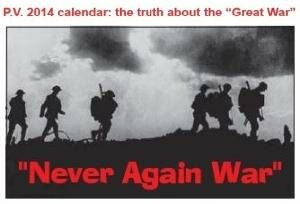
To order a copy of the People’s Voice 2014 Anti-First World War
Calendar, send $15 (includes postage and handling) to
People’s Voice, 706 Clark Drive, Vancouver, BC, V5L 3J1. Contact us at
604-255-2041 or pvoice@telus.net for bulk order prices.
|
People's Voice deadlines: August 1-31 September 1-15 Send submissions to PV Editorial Office,
|
REDS ON THE WEB
http://www.parti-communiste.ca/
peoplesvoice.ca
www.ycl-ljc.ca
www.solidnet.org
|
People's Voice finds many "Global Class Struggle" reports at the "Labour Start" website, http://www.labourstart.org/. We urge our readers to check it out! |
* * * * *
People's Voice
Canadian Publications Mail Sales Product Agreement #205214
ISSN number 1198-8657
People's Voice is published by
New Labour Press Ltd
PV Editorial Office
706 Clark Drive,
VANCOUVER, B.C. V5L 3J1
Phone:604-255-2041
Fax:604-254-9803
email: pvoice@telus.net
Editor: Kimball Cariou : Business Manager: David Au
Editorial Board: Kimball Cariou, Miguel Figueroa,
Doug Meggison, Naomi Rankin, Liz Rowley, Jim Sacouman
* * * * * *
Letters
People's Voice welcomes your letters
on any subject covered in our pages.
We reserve the right to edit for length and clarity,
and to refuse to print letters which may be libellous
or which contain unnecessary personal attacks.
Send your views to:
"Letters to the Editor",
706 Clark Dr., Vancouver, BC V5L 3J1,
or pvoice@telus.net
People's Voice articles may be reprinted without permission,
provided the source is credited.
* * * * * *
The Communist Party of Canada, formed in 1921,
has a proud history of fighting for jobs, equality, peace,
Canadian independence, and socialism.
The CPC does much more than run candidates in elections.
We think the fight against big business and its parties
is a year-round job,
so our members are active across the country,
to build our party and to help strengthen people's movements
on a wide range of issues.
All our policies and leadership
are set democratically by our members.
To find out more about Canada's party of Socialism,
give us a call at the nearest CPC office.
* * * * * *
Central Committee CPC
290A Danforth Ave Toronto, Ont. M4K 1N6
Ph: (416) 469-2446
fax: (416) 469-4063 E-mailmailto:info@cpc-pcp.ca
Parti Communiste du Quebec (section du
Parti communiste du Canada)
5359 Ave du Parc, Montréal, Québec,
H2V 4G9
B.C.Committee CPC
706 Clark Drive, Vancouver, V5L 3J1
Tel: (604) 254-9836
Fax: (604) 254-9803
Edmonton CPC
Box 68112, 70 Bonnie Doon P.O.
Edmonton, AB, T6C 4N6
Tel: (780) 465-7893
Fax: (780)463-0209
Calgary CPC
Unit #1 - 19 Radcliffe Close SE
Calgary AB, T2A 6B2
Tel: (403) 248-6489
Ottawa CPC
Tel: (613) 232-7108
Manitoba Committee
387 Selkirk Ave., Winnipeg, R2W 2M3
Tel/fax: (204) 586-7824
Ontario Ctee. CPC
290A Danforth Ave., Toronto, M4K 1N6
Tel: (416) 469-2446
Hamilton Ctee. CPC
265 Melvin Ave., Apt. 815
Hamilton, ON.
Tel: (905) 548-9586
Atlantic Region CPC
Box 70 Grand Pré, NS, B0P 1M0
Tel/fax: (902) 542-7981
http://www.parti-communiste.ca/
* * * * * *
News for People, Not for Profits!
Every issue of People's Voice
gives you the latest
on the fightback from coast to coast.
Whether it's the struggle for jobs or peace, resistance to social cuts,
solidarity with Cuba, or workers' struggles around the world,
we've got the news the corporate media won't print.
And we do more than that
- we report and analyze events
from a revolutionary perspective,
helping to build the movements for justice and equality,
and eventually for a socialist Canada.
Read the paper that fights for working people
- on every page, in every issue!
People's Voice
$30 for 1 year
$50 for 2 years
Low-income special rate: $15 for 1-year
Outside Canada $50 for 1 year
Send to: People's Voice, 706 Clark Drive, Vancouver, BC, V5L 3J1
You can call the editorial office at 604-255-2041
REDS ON THE WEB
http://www.parti-communiste.ca/
http://www.ycl-ljc.ca/
http://www.solidnet.org/
(The following articles are from the July 1-31, 2014, issue of People's Voice, Canada's leading socialist newspaper. Articles can be reprinted free if the source is credited. Subscription rates in Canada: $30/year, or $15 low income rate; for U.S. readers - $45 US per year; other overseas readers - $45 US or $50 CDN per year. Send to People's Voice, c/o PV Business Manager, 706 Clark Drive, Vancouver, BC, V5L 3J1.)
1) THE STRUGGLE AGAINST NORTHERN GATEWAY CONTINUES!
Statement from the BC Provincial Committee, Communist Party of Canada, June 21, 2014
The Harper Conservative government's June 17 approval of Enbridge's Northern Gateway project is not the end of the struggle against tar sands extraction and exports in western Canada, just the signal that the next stage has begun.
As the Communist Party said in our submission to the Joint Review Panel hearings into the Enbridge Northern Gateway (ENG) pipeline, this struggle represents "a historic clash between two different visions for the future of Canada."
Opposition to the ENG proposal brings together growing numbers of Aboriginal peoples, environmentalists, and working people, who understand the grave environmental, economic and social dangers posed by this project, including the global crisis of climate change fuelled by greenhouse gas emissions arising from fossil fuel consumption. Despite the overwhelming propaganda campaign by Enbridge, the majority of British Columbians and growing numbers of Albertans are opposed to tar sands expansion, new pipelines and expanded tanker traffic.
This project does not meet the criteria of being "required" and "in the public interest." Rather, it is intended to generate huge new profits for the oil and gas monopolies.
Aboriginal peoples along the pipeline corridors, many of whom have never ceded inherent indigenous title to their traditional lands and waters, call the ENG project a direct attack on their national rights. Instead of meeting legal and constitutional obligations to engage in meaningful consultations with First Nations, the pipeline proponents and its political backers set up phony pro‑pipeline groups and pay so‑called aboriginal leaders to issue supportive statements. The response to these corrupt tactics has been to strengthen opposition by First Nations people across B.C.
The Northern Gateway pipeline would be constructed across some 1,000 rivers, streams and bodies of water, bringing bitumen to load onto supertankers in the narrow Douglas Channel, one of the most environmentally fragile areas of the west coast. Despite its expensive greenwash propaganda, Enbridge's record of more than 800 leaks over the past decade proves that the only real question is the frequency and scale of more such disasters.
But the transnational energy monopolies and the federal and Alberta governments remain determined to proceed. The Harper Tories have used their parliamentary majority to remove key legal barriers to the rubber‑stamping of controversial energy projects.
This is not a new debate in Canada. Natural resources such as fossil fuels, lumber, water and minerals could provide the material base for a publicly‑owned "value‑added" economic structure, focused on creating good jobs and meeting people's needs, without destroying the natural environment. Instead, starting with the colonial seizure of Aboriginal lands, vast resources within the borders of the Canadian state have been grabbed by transnational (especially U.S.) capital. Canada has become a key supplier of raw materials for the U.S. military‑industrial war machine. "Free trade" sellouts ensure that the First Nations and the peoples of Quebec and the rest of Canada are still denied any genuine sovereignty over our economic future. The Enbridge project is another nail in the coffin of Canada's declining domestic manufacturing base.
The ENG project, the twinning of the Kinder‑Morgan pipeline to Burnaby, and massive natural gas fracking in northern BC, all feed into the global imperialist pattern of fossil fuel dependence and domination. This relentless capitalist expansion not only threatens British Columbia's coastline, it has grave health consequences for human beings and wildlife, and contributes to the deadly spiral of global warming and climate change.
The Communist Party opposes the policy of exporting unprocessed raw materials. Instead, we call for a People's Energy Plan, based on a sustainable, conservation-based economy; full respect for the inherent rights of First Nations over their traditional territories and resources; and public ownership of the energy industry, as the material basis to rebuild Canada's industrial and manufacturing sector and to create jobs.
Blocking the Northern Gateway pipeline and other forms of tar sands expansion will require more than legal actions or even civil disobedience, although such tactics will be part of a wider resistance strategy. Victory will require united, massive, and militant mobilizations. We urge the labour and democratic movements to build united solidarity with the Aboriginal peoples and environmentalists, both to kill this dangerous project, and to create a genuine people's alternative plan for economic development, based on the needs of people and the environment, not corporate greed!
2) C-24 EXPANDS TORY ATTACK ON HUMAN RIGHTS
By Kimball Cariou
Passed in June by the House of Commons, Bill C‑24, the new "Strengthening Canadian Citizenship Act (SCCA)," imposes new requirements to obtain citizenship, and makes it easier for the government to revoke it.
Human rights groups are planning a legal challenge to the SCCA, which effectively creates two classes of Canadian citizens, each with very different sets of rights. The Bill allows the federal government to strip the Canadian citizenship from dual nationals convicted of some offences. The law could apply in cases where Canadians are convicted in foreign courts, and even to people born in Canada if they also have citizenship elsewhere, such as through their parents.
Amnesty International, the Canadian Association of Refugee Lawyers and the B.C. Civil Liberties Association say that giving the government the power to revoke people's citizenship is the same as banishing them into exile. They argue the legislation does not include enough safeguards to protect Canadians. Opposition MPs and other advocacy groups, including the Canadian Bar Association, have also objected to the bill.
The new revocation provisions are "divisive and buy into and promote false and xenophobic narratives about `true' Canadians and others, which equate foreignness with terrorism," says an analysis released by Amnesty International Canada.
The SCCA will also make it much more difficult, expensive and time‑consuming to become a Canadian citizen. Among other provisions, the costly language and knowledge tests which immigrants must pass is extended to include those aged 14‑64 (currently, only those aged 18‑55 take the test), and the citizenship application fee price is tripled. Immigration officers are given the authority to deny citizenship if an applicant even speculates that they may not reside in Canada in the future. The residency requirement during which an applicant must be in Canada as a Permanent Resident is lengthened from 3 to 4 years, and applicants are no longer allowed to count any time spent in Canada (as a student, a worker or a refugee) prior to obtaining permanent residency.
The right to appeal a negative decision is removed, along with the right to an oral hearing in front of a judge for those who are having their citizenship revoked. Citizenship can be removed from those who did not obtain citizenship by birth, if an official believes that the person never intended to live in Canada.
When C‑24 was introduced last February, the Canadian Association of Refugee Lawyers (CARL) warned that "In Canada, citizenship has always been secure. Whether native‑born or immigrant, once you are granted Canadian citizenship, you are secure. Under the current system, you cannot lose your citizenship unless you obtained it by fraud, and even then, a Federal Court judge must make that decision after a full court hearing. Under the current system, if you do not agree with the judge, you have a right of appeal. Under the new law, there will be several ways to lose your citizenship. As well, the decision as to whether you lose your citizenship will be made by a government bureaucrat who will inform you in writing with no opportunity for a live hearing to defend yourself."
The changes will impose particular hardships on older immigrants, who often have more difficulty passing the language tests. Children and grandparents without documents to prove their language ability will have to pay to take the language test. Currently, applicants wait 4‑6 years to become citizens due to government delays and inefficiency. With the new law, it could take eight to ten years in total to become a citizen from the date a person becomes a permanent resident.
The CARL says the new law divides Canadians into first class Canadians who hold no other citizenship, and second class "dual citizens" who can have their right to live in Canada taken away from them. Even those born in Canada are at risk, including those who may not know that they possess another citizenship. People who have a spouse, parent, or grandparent who is a citizen of another country may have a right to citizenship there without ever having applied for it. This allows the Immigration Minister to assert that they could possess or obtain another citizenship, making it easier to take away their Canadian citizenship, especially affecting those who study, work or reside in another country.
The changes could create a new class of naturalized Canadians who have fewer rights than those born in the country, according to Zool Suleman, a Vancouver immigration lawyer, speaking to the Georgia Straight weekly paper.
Suleman continued, "There has always been a gradation between a citizen, a resident, and someone who is here on a temporary basis. But I think what is happening now is a cleavage is opening up where more and more people are being left in this indeterminist status."
The Canadian Bar Association says some of the proposed changes are "likely unconstitutional". A 31‑page brief prepared by the CBA's national immigration law section states that the citizenship‑revocation process outlined in Bill C‑24 will "primarily be a paper one", wherein a hearing before a Federal Court judge will only be granted "in limited circumstances".
Lysane Blanchette‑Lamothe, NDP critic for citizenship and immigration, takes issue with provisions that allow for the revocation of citizenship without avenues for remediation. "A lot of lawyers have argued against the constitutionality of this bill because there is no appeal process possible," she told the Straight.
Blanchette‑Lamothe called attention to the potential for Bill C‑24 to create a different set of rules for citizens new to Canada. "There should not be two tiers of citizens, where one citizen can have access to our judicial system and another one cannot because their parents are Egyptian, for example," she said. "That's a very dangerous path."
3) CELEBRATE THE SUMMER OF WORLD PRIDE!
Pride 2014 Statement from the Communist Party of Canada and the Young Communist League
The Pride 2014 summer season is here, including World Pride in Toronto and hundreds of events in cities and towns right across Canada! This is a time to celebrate the gains by LGBTTQ+ communities, and to reflect on the challenges we still face. The past year has seen some remarkable victories, but also ominous signals of a dangerous pushback from anti‑equality forces. More and more countries are recognizing same‑sex marriage and other fundamental LGBTTQ+ rights. In Canada, the struggle to end discrimination based on sexual orientation and gender expression/identity has seen new progress.
The latest major victory was the adoption of an updated LGBTTQ+ policy by the Vancouver School Board, after a vitriolic hate campaign was defeated by VSB trustees and the new, broad‑based BC Safer Schools Coalition.
The continued expansion of queer‑positive environments in the popular media, the labour movement and other areas of society is particularly significant. In the arena of professional sports, the coming out by Michael Sam, drafted by the NFL's St. Louis Rams, and the overwhelming rejection of a few bigoted reactions, signals that yet another barrier is being shattered. The many legal, political and cultural victories of recent years are the hard‑won results of decades of efforts by the LGBTTQ+ community and our allies.
But fear and hatred have not disappeared, as seen by last year's anti‑equality protests in France, the Russian Parliament's ban on so‑called "propaganda of non‑traditional sexual relations", and attempts to reverse same‑sex marriage rights in some U.S. states. On June 14, Ulrike Lunacek, Co‑President of the LGBT group in the European Parliament, was assaulted by a bigot while being interviewed at the Vienna Pride parade. In many countries, gays, lesbians, and trans* people still face threats, violence, imprisonment or even death. But the lie that equality rights can only be won in the wealthy capitalist west is shattered by progress in countries such as Cuba, Brazil, and South Africa, and by the reality that homophobic and racist views are being deliberately exported from North America and Europe. This year's World Pride in Toronto will include events with Mariela Castro Espin, the director of Cuba's National Centre for Sex Education, who has led the movement for gay, lesbian and trans* rights in Cuba, showing that "machismo" and other anti‑equality ideologies can be overcome with the support of progressive governments.
Here in Canada, we cannot be complacent, as seen by attempts in British Columbia to reverse pro‑LGBTTQ+ policies at the school district level. Anti‑equality forces have powerful friends in Harper's Conservative caucus, despite their hypocritical condemnation of Russia's anti‑gay laws. For example, the Conservative‑dominated Senate has still not given approval to Bill C‑279, which amends the Canadian Human Rights Code by adding "gender identity" to hate‑crime legislation provisions. Canada's corporate‑driven "austerity" cuts to social spending, and the attacks on unions, heavily impact women, Aboriginal peoples, and racialized groups, and make it far more difficult to implement significant advances towards equality. The most marginalized members of the LGBTTQ+ community, including trans*, two‑spirited, racialized queers and young people, are those hardest‑hit by the austerity cuts.
The trans* community is still struggling to achieve many equality rights. This is not a "marginal" issue; trans* people are 10% of the LGBTTQ+ population, and face huge medical costs, higher unemployment, less access to housing, widespread intimidation at work, and lack of legal protections. Right‑wing forces continue to scapegoat the LGBTTQ+ community along with racialised groups and other minorities.
Homophobia and transphobia, just like racism, sexism, and national chauvinism, are weapons to divide working people in the struggle for a better world. Today, the ruling class uses the economic crisis, the so‑called "war on terror", and now Stephen Harper's Cold War anti‑communism to justify the assault on workers' rights and social equality. But "an injury to one is an injury to all." Our unity will be strengthened by adopting full legal and political protections for sexual orientation and gender expression, and gender identity.
This unity is a vital element of the broad democratic and social resistance against the corporate agenda of austerity and war. Together, we must build a powerful movement to put people's needs before corporate greed. Our LGBTTQ+ community must be a key player in a efforts to build a "People's Coalition" of labour, Aboriginal peoples, youth and students, women, seniors, farmers, immigrant and racialized communities, environmentalists, peace activists and many other allies.
Ultimately, mass resistance in our communities and workplaces, in the streets and at the ballot box, can defeat the Harper Tories and help open the door to a "people not profits" government. The goal of the Communist Party is to win fuller social equality and genuine people's power in a socialist Canada, where our economy and resources will be socially owned and democratically controlled.
This historic advance will make it possible to eradicate the intersecting forms of exploitation and oppression which we face today. We urge you to join the Communist Party and the Young Communist League to achieve a liberated society in which, as Karl Marx said, "the freedom of each is the condition for the freedom of all."
(NOTE: In this statement, the acronym LGBTTQ+ refers to "lesbian, gay, bisexual, trans*, two‑spirited, queer and others." The debate over this and other terms continues.)
4) SAFER SCHOOLS COALITION WINS MAJOR VICTORY
PV Vancouver Bureau
Five months ahead of the November 2014 civic elections, a new coalition of pro‑equality activists has won a major victory over right‑wing forces attacking the Vancouver School Board. As reported in the June 16‑30 issue of PV, at stake was a set of specific measures to make schools safer for trans* students. The "Proposed Policy Revision on Sexual Orientation and Gender Identities" had become the target of a group of homophobic Christian fundamentalists, looking for a "wedge" issue to attack the Board on allegedly "pro‑family" grounds.
The policy update addresses serious harassment problems faced by a growing number of students who identify as trans*, gender creative, or gender non‑conforming. Many such youth face threats or violence for attempting to use washroom facilities which match their own identity. The arbitrary gender division of some school activities has also created problems. Most of these issues have been dealt with in a compassionate and understanding way by teachers and school staff over the past several years, and the policy update was developed by the VSB's Pride Committee to reflect this reality.
However, a small group of opponents immediately launched a disinformation campaign and a petition. Led by Conservative Party operative Cheryl Chang and two trustees with a track record of homophobic views, the group spread alarmist falsehoods about the policy. Much of the mainstream media initially fell for the group's claim that the policy was "racist" since it allegedly offended the cultural values of the Chinese‑speaking community.
It was true that opposition was mobilized in some Chinese Christian fundamentalist churches. But some of the most homophobic speakers at VSB hearings were of European origin (including Chang herself). On the other hand, many supporters of the Safer Schools Coalition came from Asian cultural backgrounds, including several high school students and recent grads. Not a single student, Asian or non‑Asian, spoke against the policy.
In the end, over 100 presenters took part in the VSB hearings, making it the most comprehensive policy consultation in many years. Those in favour of the update included representatives of Vancouver Coastal Health Authority, the Vancouver high school student union, the UBC Faculty of Education, and many others. Hardly a single organization opposed the update, other than a few front groups hastily formed by opponents.
After a flurry of media coverage, Chang's group was increasingly seen as hostile to the complex problems faced by students who do not fit the "binary" norm. By the end of the hearings, it was apparent that they did not represent any "silent majority," just a very angry group of fundamentalists.
The final straw came on June 13, when the two Non‑Partisan Association trustees opposed to the policy, Ken Denike and Sophia Woo, held a bizarre news conference to claim that unnamed real estate agents had warned them about the negative impact of the policy update. Within hours, they had been drummed out of the NPA's caucus of elected officials, and denied any possibility of a nomination in this fall's election. This will likely end Denike's three decade career on the Board, except for the 2002‑2005 term when he lost to a COPE landslide. First elected in 2011, Woo has no chance of keeping her position as a single‑issue independent candidate. NPA trustee Fraser Ballantyne endorsed the policy and kept his party's backing, but the episode has damaged the pro‑business NPA's campaign.
The policy was adopted by a 7‑2 vote on June 16, to wild applause from a room full of Safer Schools Coalition supporters, and angry booing from a handful of opponents. Each of the seven in favour spoke about the crucial importance of the updated policy, turning the Board meeting into a celebration of human rights.
As Coalition supporters said afterwards, the struggle now will turn to implementation of the new policy. The renewed harassment of some trans* students during the extended public debate shows that much work lies ahead in Vancouver schools. This will be difficult, because the deep crisis of provincial underfunding makes it increasingly problematic for school boards to maintain non‑classroom staff positions.
The Safer Schools Coalition is now considering its next steps. One priority may be to help defeat candidates backed by anti-equality forces. Another may be to pressure the province to mandate all school districts to go beyond the "anti‑bullying" policies which the Premier touts, and implement programs to promote genuine inclusivity of all students.
For more information, visit www.bcsaferschools.com.
5) BRIEF HISTORY OF THE KOMAGATA MARU EPISODE
Abridged from an article in Radical Desi
East Indians began migrating to North America in the early 20th century. Many had served in the British army and came to the US and Canada as British subjects. Over 75 percent of them were Sikhs, and around fifty percent were ex‑soldiers in the British army. They were predominantly peasants from rural Punjab, which was annexed by the British in 1849.
Most of these immigrants came to British Columbia for economic reasons and found jobs in the lumber industry, railway construction and canneries. Others moved to the US to work in farms. The hostility against these men mainly came from the white labourers, who believed that these people were being imported as cheap labour to weaken their bargaining power. Many employers used East Indians immigrants to keep wages low and weaken the workers' unions. The pressure was intense from labour groups who were not progressive as today and sought exclusion of the Hindus.
This hostility was also visible in the mainstream press as newspaper cartoons frequently mocked East Indian immigrants. After all, the 1867 speech in Parliament of the first Prime Minister, John A. Macdonald, proclaimed Canada to be a "white man's country", laying the foundation of an institutional racism.
The British Columbia government disfranchised East Indian voters on March 26, 1907. In an atmosphere charged with anti‑Asian sentiments, race riots broke out across the US border. On September 4, 1907, a mob of white workers attacked and drove out over 250 South Asian workers from the lumber mills in Bellingham, Washington. Many were forced to take refuge in Vancouver. The municipal politicians used the episode to argue that South Asian immigration must stop.
The bitter experiences of racism and discrimination shaped their political views. In the light of these hostilities, the Khalsa Diwan Society was established in Vancouver in 1906.
Since the Sikhs dominated the group of East Indian immigrants, the society was formed to govern a Sikh temple that actually became a nerve center of secular political activities for Hindus and Muslims too. While the upper part of the temple was used for religious gatherings, the lower part of the building was used for public meetings every Sunday. One of the hotly debated issues was how to bring families to Canada. It is not surprising that East Indian immigrants were not allowed to bring their families in Canada to prevent permanent settlement of Asian men.
As if this was not enough, the Canadian government passed a controversial order‑in‑council or the Continuous Journey Law on January 8, 1908. It stated: "All immigrants must come to Canada via a through ticket and by continuous journey from their country of birth or citizenship". A tone for the Komagata Maru standoff was formally set as direct passage was virtually impossible for East Indians sailing to Canada.
There was also an attempt to relocate East Indian immigrants to British Honduras. The official line was the Hindus were not suited for the climate of Canada. Community leaders resolutely challenged the plan and the conspiracy was foiled. A public meeting at the temple on October 6, 1908 resolved to send a petition to challenge attempts to relocate East Indians. The resolution was co‑signed by Bhaag Singh who was the Secretary of the temple.
Bhaag Singh served the Khalsa Diwan Society in different capacities and became its president in 1910. He came to Canada in 1906. He had earlier served in the British Army's cavalry. He was indoctrinated by at least two prominent and well‑read radical leaders of the Indian freedom struggle: Taraknath Dass and G.D. Kumar. Das published the first East Indian newspaper, Free Hindustan, from Vancouver, and Kumar was instrumental in publishing the first Punjabi newspaper of Canada, Swadesh Sewak.
Bhaag Singh also became a member of G.D. Kumar's Hindustan Association, and the United India League formed by Husain Rahim. Rahim consistently opposed the anti‑immigration laws and was arrested for defying the ban on East Indians from voting during the March 1912 provincial election.
Bhaag Singh was instrumental in encouraging ex‑soldiers to burn their medals and uniforms and sever all ties with the British Empire. On October 3, 1909, he consigned his own uniform and an honourable discharge certificate to the flames. It was a very radical action, as the Sikhs were largely known as pro‑British and were used to suppress the first Ghadar or mutiny against the British in 1857. The Sikh landlords were duly honoured by the British government for their services.
Across the border too, the flames of rebellion were growing. An extremist group named Hindustan Association of the Pacific Coast of America that believed in an armed struggle against the British Empire was formed. The association soon came to be known as the Ghadar Party after its newsletter, Ghadar, was launched on November 1, 1913 from San Francisco. The Ghadar literature clearly reflects that it was not just a war against imperialism, but a resistance against racial discrimination too. While the Ghadar members were predominantly Sikhs, the party asked them to keep their religious beliefs out of the party affairs.
Bhaag Singh openly helped the Ghadar Party in fundraising and inspired many in Vancouver to join the movement. Soon, their activities came to the notice of the authorities. On December 30, 1913 the Dominion Immigration Inspector for British Columbia, Malcolm Robert James Reid wrote a confidential letter to H.H. Stevens, a Member of Parliament from Vancouver, providing him with translations of the Ghadar newspaper.
William Charles Hopkinson was another immigration inspector who kept a watchful eye on the Ghadar activists. Born in Delhi, he understood local languages of India. Before coming to Canada in 1907 or 1908 he served as a police inspector in Calcutta. He was hired by the Canadian government in 1909 as an immigration inspector and interpreter, but continued working for the Indian police. He also reported to the Deputy Minister of the Interior in Ottawa, the Agent of the Government of India in London, and shared intelligence with the American Immigration service.
Hopkinson had roped in 50‑60 East Indian supporters who helped him in information gathering. This group was widely identified as a pro‑British "Immigration faction". Bela Singh was the main leader of this group. Known as Hopkinson's tipster, he was on the government payroll for $62.50 a month, identifying Ghadar activists whose names were to be sent to British officials to prevent mutiny in India.
It would be wrong to presume that the Ghadar activists did not exhaust other peaceful channels. A three‑member delegation left for England to petition for the right to bring families in Canada, but British officials snubbed them. A separate deputation sent to Ottawa drew the attention of the authorities to their loyalty towards the British rulers.
As these skirmishes continued, a much bigger fight was about to begin which would not only change the course of the Canadian history but also galvanize the Ghadar movement.
Komagata Maru episode
The role of Gurdit Singh, who charted Komagata Maru, a Japanese vessel that brought 376 East Indian passengers to Vancouver on May 23, 1914 remains debatable.
Some historians describe him a freedom fighter who challenged Canada's controversial Continuous Journey law. Others maintain that it was purely a business venture that eventually turned into an important chapter of the history of struggle against colonialism and racism due to mistreatment meted out to those aboard the vessel, who came to Canada as British subjects.
The vessel picked up passengers from different countries before reaching Vancouver. Not surprisingly, there was an uproar in British Columbia when the ship arrived. Premier Richard McBride said, "To admit Orientals in large numbers would mean in the end the extinction of the white peoples and we have always in mind the necessity of keeping this a white man's country."
The Khalsa Diwan Society came to the rescue of the passengers. It hired Edward Bird, a white lawyer associated with Socialist Party of Canada, to challenge the government in court. Bird had to endure threats and intimidations from white supremacists.
Minutes of a public meeting held in Dominion Hall, Vancouver on June 23, 1914 give an insight of the anti‑Asian mood that prevailed in British Columbia. H.H. Stevens pulled no punches: "I hold, and I think I hold it in common with every member from British Columbia, that the Government of Canada ‑ the Parliament of Canada ‑ should pass legislation of a distinct and definite type, excluding Orientals (applause)."
In the end, the Komagata Maru was forced to return on July 23, 1914. But this did not happen smoothly. On July 19, the police and immigration officials tried to siege the vessel with help of a tugboat named "Sea Lion". The fight that ensued left about 20 people injured, according to the official version of the story. One of the bricks thrown by irate passengers on the officials is now preserved at the Vancouver Museum.
In the meantime, Bhaag Singh was arrested along with two more accomplices in the US where he went to buy weapons for the ship passengers. These leaders were thinking of sending arms to India for a mutiny. Mewa Singh also accompanied these men, as he confessed in a statement after his arrest for carrying concealed weapons. He admitted that they went to Sumas on July 16, and purchased four revolvers the next morning. Coming back to Canada with one revolver and three boxes of ammunition, Mewa Singh was arrested. He stated, "....from what I could understand it was the intention of these people to try and convoy these weapons to the Komagata Maru."
Bhaag Singh was released a week after the Komagata Maru departed. What added fuel to the fire was a shootout near Calcutta, that left 22 people dead, including a British police official after the ship reached there in September 1914. The trouble started when the police tried to forcibly send these passengers to Punjab through a special train waiting at the Budge Budge rail station. The authorities suspected that the men were Ghadar activists.
The whole episode coincided with World War I. Thinking that it was the right time to strike against the British Empire which was now engaged in a conflict with Germany, the Ghadar leaders gave a call for rebellion, provoking many to return to India. Over 14 Ghadar activists from Canada alone were killed during the uprising after returning to their home country.
Murders and mayhem
Tension filled the air in Vancouver as soon as the Komagata Maru departed. A confidential report reveals that the Ghadar activists were seeking revenge against Reid and Hopkinson. A document dated July 8, 1914 reported a controversial conversation between Husain Rahim and two other men, Sohan Lal and Mohamed Akbar, in which a possibility of harming Reid and Hopkinson was discussed.
Merely five days before Komagata Maru's departure, Rahim was attacked with a sword by Bela Singh's supporter. Though Rahim survived the assault it started a wave of murders. Two supporters of Bela Singh were murdered. Harnam Singh was found murdered with throat cut on August 31, while Arjan Singh was shot to death on September 3.
On September 5, Bela Singh went to the Vancouver Sikh temple and pumped bullets into the bodies of Bhaag Singh and Badan Singh. Badan Singh, who participated in different campaigns led by Bhaag Singh, was shot when he tried to resist. The two men succumbed to their injuries the next day.
Both Bhaag Singh and Badan Singh in their deathbed dispositions charged Bela Singh with the shooting, while those injured also supported the allegation.
These bloody events took a shocking turn when Hopkinson was shot dead on October 21 in the provincial courthouse by Mewa Singh. The Sun headline screamed, "Fifth Local Victim of Komagata Insp. Hopkinson Added to List".
The police suspected a larger conspiracy behind the murder. They arrested three people including Husain Rahim on October 23. Rahim was accused of inciting Mewa Singh to murder Hopkinson, but was later acquitted for lack of evidence. Following Hopkinson's murder, Reid was transferred to the East as the federal government felt that his life was in danger.
Meanwhile Mewa Singh openly admitted his crime, revealing that he could not bear the personal tragedy of two small children of Bhaag Singh who were left orphaned with his death. Bhaag Singh's wife passed away early that year. He squarely blamed Reid and Hopkinson for these incidents, and claimed that Bela Singh and Hopkinson were intimidating him to implicate Bhaag Singh and others after his arrest for bringing weapons from the US.
As Mewa Singh awaited his death sentence, Bela Singh was acquitted by a jury on November 18, 1914. Bela Singh claimed that he fired in self‑defence. Several witnesses testified that members of the other faction were having a meeting inside the temple where the killings of Reid and Hopkinson were advocated. The judge pointed out to the jury that Bela Singh was one of the men who stood for law and order in the community.
Mewa Singh was hanged on January 11, 1915. He chanted prayers when he was taken to the scaffold inside the New Westminster jail. Outside the prison a small group of Sikhs gathered, while over four hundred showed up at the temple.
6) NEWS FOR PROFITS, NOT PEOPLE
People's Voice Editorial
These days you can't turn on the TV, go out to a movie, or read a mainstream newspaper without getting blasted by energy industry propaganda. Big Oil is desperate to pummel Canadians with the idea that unless we build a bigger network of pipelines, the economy will soon collapse.
But it turns out that paid advertisements for the oil industry often masquerade as editorial content on corporate news websites ‑ and the body in charge of regulating the industry apparently has no problem with this sleazy manipulation of public opinion. That is exactly what has happened with the Vancouver Sun and Regina Leader‑Post, owned by the Postmedia "news" empire.
Environmental organization DeSmog Canada says it filed a complaint with Advertising Standards Canada on March 4, regarding a story published on the Vancouver Sun website on Dec. 4, 2013, with the headline "Born to the Challenge: Janet Holder's B.C. roots make her the perfect lead on Northern Gateway."
Everyone knows Janet Holder, our down home friend who rose to became Enbridge Corp.'s vice‑president of Western Access. Holder is responsible for marketing the Northern Gateway oil tanker and pipeline project. In last December's story, Holder repeated her frequent claim that Canada is losing $50 million a day due to limited export markets.
Economist Robyn Allan disagreed, and submitted an opinion piece in response. But Allan was told her article would not be used, since the "news article" was actually a paid advertisement. The original web page was set up to look like arms length reporting, which led Allan to ask: was it news or propaganda?
DeSmog's complaint to Advertising Standards Canada cited that body's rule against "Disguised Advertising Techniques," which states: "No advertisement shall be presented in a format or style that conceals its commercial intent." Two months later, ASC declined to issue a ruling against Postmedia.
And there you have it. "News" for profits, not for people.
People's Voice Editorial
Last February, when the Harper government introduced Bill C‑24, a wide range of democratically-minded people and organizations warned that this legislation extends shocking new powers to the federal Cabinet to strip Canadians of their citizenship rights. The recent passage of this bill opens the door for politicians to turn the clock back to shameful periods when Canadian governments used racist and reactionary immigration and refugee policies to bar certain categories of people from entering the country, or to deport radical "trouble-makers".
Bill C-24 targets those who are citizens of both Canada and another country. Many thousands of people born here may be dual citizens without even understanding their status, since some countries automatically treat the children or grandchildren of their nationals as citizens, regardless of birthplace. As we noted in February, former child soldier and Guantanamo detainee Omar Khadr has been the target of a hateful slander campaign by the Harper government. Now serving an eight-year sentence in Canada after being framed up in a U.S. military court, Khadr was born in Toronto, but his late father was born in Egypt. He could well be among the first victims of Bill C-24.
But probably not the last. This government still harasses immigrants who are former members of El Salvador's FMLN liberation movement (now the government of that country), and often makes it difficult for diplomats from South Africa's ruling ANC to enter Canada. These examples prove that Tory immigration policies are wide open for abuse by cabinet ministers with a far-right agenda.
Just as significant, Bill C‑24 makes it much more difficult, expensive and time‑consuming for immigrants to become citizens. Such barriers have a particular impact on refugees who have suffered persecution and long years of deprivation.
Fortunately, protests continue against this appalling legislation, and civil rights groups are already preparing a legal challenge. The battle to stop C‑24 is far from finished!
8) COMMUNIST PARTY OF CANADA CONDEMNS BILL C-36
Statement from the Central Executive Committee, Communist Party of Canada
In response to the Supreme Court's December 2013 ruling in the Bedford case, which struck down several key Criminal Code provisions regarding prostitution, the Harper Conservatives have introduced Bill C‑36, the "Protection of Communities and Exploited Persons Act ".
The Central Executive Committee of the Communist Party of Canada condemns Bill C‑36, which gives police forces sweeping new powers, and creates Criminal Code provisions to make it more difficult and dangerous for those who sell sexual services to carry out their activities. While the government claims it wants to assist women to leave prostitution, the legislation allocates a pittance of $20 million over five years for this purpose, at a time when governments are slashing spending and support for social programs. The Communist Party restates our longstanding demands for fundamental social reforms which would offer the best possible options to help those who wish to leave the sex trade, especially massive job creation programs, higher wages, free post‑secondary education, affordable housing, free universal child care, and mental health supports, drug treatment and harm reduction programs for those facing addictions. The federal government should be taking decisive action to combat poverty, discrimination, racism and other factors which push people into the sex trade; instead, the Harper Tories are cynically using this important issue as a wedge tactic to seek votes in the next federal election. We therefore demand that this legislation be withdrawn immediately.
9) THOUSANDS EXPECTED AT PEOPLES' SOCIAL FORUM
By Darrell Rankin
Nearly 80 years after the 1935 On to Ottawa Trek which demanded work or wages for unemployed workers during the Great Depression, thousands of activists are expected to gather in Ottawa to discuss social change strategies, August 21‑24.
This time, it is less likely that a Conservative government will be able to stop people from attending, like the Bennett Tories did by staging the "Regina Riot." Still, the people who attend will be Harper's worst nightmare.
It would be fair to say that the Peoples' Social Forum in Ottawa marks another stage in the long‑awaited renewal of peoples' movements for social and national emancipation in Canada.
Veterans of Idle No More, Quebec's student strike, and the G8 protests in Toronto, the resistance to Corporate Canada's shackles, will meet in Ottawa August 21‑24. Organizers are preparing to host thousands of people.
It is useful to compare these movements with the last large upsurge in the 1980s which were concerned with preventing nuclear war, free trade and wages, connected to a far higher level of strikes.
People today are beset by a perfect storm of problems, from justice for Aboriginal peoples to peace, from poverty to jobs, from energy to climate change.
Regardless of the level people have reached in understanding these crises, it is vital to awaken them to action for real change, translating the science of fundamental social change into the language of today.
The forum is expected to strengthen existing campaigns, spark new ones and promote unity and cooperation. Issues such as pipelines, treaty rights (nation to nation relations), and defeating the big business agenda will be part of the discussion.
Take Back the CLC activists will also be at the forum to strengthen the militant wing of the labour movement across Canada. Hassan Husseini's bid for president at the May CLC convention is clearly not the end of the TBC's contribution to organize the labour movement's growing militancy.
The large strike vote‑mandates by Safeway and Superstore workers in Western Canada (99.7% and 98%) show that younger workers are fed up with low wages and part time jobs. Reflecting the deep crisis of youth unemployment and barriers to higher education, many activists will be on the younger side.
Organizations with decades‑long experience will also be presenting workshops, such as the Canadian Peace Congress. The Congress will raise the discussion about Canada's role as an imperialist country.
Nearly every major city across Canada is preparing to send dozens of its best activists.
In Winnipeg, preparations include a Building a Peoples' Movement forum on July 5, with workshops on treaty rights, pipelines, job creation, defeating the Harper big business agenda, and defeating the neoliberal education model.
The Social Forum process is modeled after the World Social Forum which each year attracts thousands of people to discuss problems of social change. The world forums are a response to the narrow, selfish global corporate agenda which each year is honed at places like Davos, Switzerland.
You can reach the PSF at http://www.peoplessocialforum.org or a local organizing committee near you listed on the website.
10) THE HUMAN COST OF THE FIFA WORLD CUP
By T.J. Petrowski
As the world watches the 2014 FIFA World Cup, people are protesting the cost and the human rights violations being committed by police and security forces to protect this corporate investment.
Working people in Brazil are understandably frustrated with the public cost of the World Cup, an estimated $14 billion. When compared to spending on social services, the cost of the World Cup is the equivalent of 61% of funding for education, or 30% of the funding for healthcare. Private companies, including those in the services and construction industries, will be the main beneficiaries of this public money. Adding to this cost is the forced evictions of the poor living in the favelas (slums) and the dispossession of indigenous people from their lands to build stadiums and parking lots.
Over one million people in Brazil have protested the cost of the World Cup, the cutbacks and increased costs of social services, forced evictions, and other human rights violations.
The state security services have cracked down viciously on all anti‑FIFA demonstrations across the country. At least a dozen or more people have been killed and hundreds have been arrested. On the first day of the World Cup, 47 people were arrested, and police shot rubber bullets at medics helping the wounded. The state security services have been accused of killing of the poor and homeless, including children, to "clean up" the favelas prior to the start of the World Cup. To justify this violent response, the federal government has pushed to pass legislation that would criminalize all anti‑FIFA protests as "terrorism", with 12 to 30 year prison sentences for those convicted.
The state has deployed more than 200,000 troops, armed with such weapons as Israeli drones, German anti‑aircraft tanks, and rooftop missile defense systems, to protect the World Cup from protestors. The infamous American mercenary company, Blackwater, known for its role in the U.S. occupation of Iraq, is allegedly in Brazil helping with security for the World Cup.
The financial and social cost of events like the World Cup and the Olympics to working people are enormous.
During the London 2012 Olympics, 10,000 police officers and 13,000 troops, more than all British forces in Afghanistan, along with ships in the Thames, fighter jets, and surface‑to‑air missile defense systems, were deployed to protect the $11 billion event. At a time when 2 million are unemployed, 27% of children live in poverty, and austerity budgets are being forced on working people, $11 billion came at a significant cost to working people.
The Sochi Winter Olympics cost a staggering $51 billion, even though 18 million Russians live in poverty and migrant workers were paid less than $2/hour to build the necessary infrastructure.
In 2022 Qatar will host the FIFA World Cup, and already hundreds of migrant workers have died working on the World Cup infrastructure. Over 400 Nepalese and 700 Indian workers have been have are already among the casualties. The conditions migrant workers are forced to work in have been compared to slavery. Robert Booth for the Guardian explains: "Workers described forced labour in 50C (122F) heat, employers who retain salaries for several months and passports making it impossible for them to leave and being denied free drinking water. The investigation found sickness is endemic among workers living in overcrowded and insanitary conditions and hunger has been reported. Thirty Nepalese construction workers took refuge in the their country's embassy and subsequently left the country, after they claimed they received no pay." The International Trade Union Confederation estimates that 12 workers will die each week and around 4,000 will have died before the event starts.
The social and financial cost of these international corporate events should be fought by working people around the world at a time where millions are being forced into unemployment and are denied their basic needs, democracy is being eroded, the environment is being destroyed, and the threat of war is increasing.
11) A WHIRLWIND TRIP TO CHIAPAS
By Darcy Robinson, Kamloops
I took a recent whirlwind trip to Chiapas, with a Volkswagen that I rented in the white wealth inspired tourist area of Cancun. The drive, while long and exhausting, gave a good comparative analysis of southern Mexico and the Chiapas and Zapatista region. I had studied the Zapatistas years ago in university, but nothing would compare to even a short visit to this amazing place.
The week before I arrived, Sub-commandante Marcos had officially stepped down as spokesperson for the Zapatistas. He felt his image had become too much of a focus in the struggle, and a new leadership and voice needed to be developed. On May 26, 2014, following the 20th anniversary of the Zapatista uprising "The voice of the Zapatista National Liberation Army [EZLN] will no longer come from my voice... Marcos no longer exists."
I drove directly through the alto (high) zone where Zapatistas still control about a third of the territory of Chiapas. The road was extremely bad and patchy throughout. A group of Zapatistas came out with a rope gate and demanded a small toll of 20 pesos, which I gladly paid. There were no guard rails, as I drove high in the mountains nearly 11,000 feet above sea level. This ancient Mayan road was only paved in the 1980s to provide for a Mexican military base, not for the benefit of the Mayan people. The drive was stunning and terrifying.
The immediate difference was the sense of dignity that I felt in the area. People were very focused on what they were doing. Children seemed to be everywhere with their parents or friends, and they seemed dignified in a way I haven't experienced in indigenous communities enough.
I arrived in San Cristobal, the most refreshing place I have ever been in Mexico. The liveliness and diversity was amazing. It had the cheapest and best kept hotels, the food was fresher than anywhere else in Mexico. At a free medical clinic, the sign was in English so I assumed it was free for all people.
Growing up in Canada, it is hard to find indigenous people as a vast majority in any environment. What separates the Zapatistas from many modern socialist movements is the component of "liberty and recognition of indigenous culture." I had never experienced indigenous people as the vast majority in this way before. In Canada the language is being wiped out daily, while most Mayans still speak their native tongue as a first language. Despite genocide and colonization, indigenous people of America will never go away, but will live forever.
12) FRENCH RAIL WORKERS ON THE FRONTLINE AGAINST PRIVATIZATION
By Adrien Welsh, PV correspondent in France
The last two elections in France were catastrophic for progressive people and workers. The right and the ultra‑right obtained the highest votes, reflecting anger against the austerity agenda of the Socialist Party.
In the Euro elections held in May, the FN (National Front), an ultra‑right and xenophobic party, gained almost 25% of the votes, electing the largest French group to the EU Parliament. The right (UMP) came second with just less than 21%.
In municipal elections, the right won almost 46% of popular support, and the ultra‑right around 7%. The right won about half the cities of more than 9 000 inhabitants, while the ultra‑right now rules 9 cities and elected around 1200 councillors. Over one-third (36.45%) of French voters did not vote in the municipal elections, for which the population is usually the most mobilised.
With just 15% of popular support, Hollande now has nothing to lose by implementing anti‑social policies. Following the municipal elections, he named Manuel Valls, a representative of the "right" of the Socialist Party, as Prime Minister to succeed Jean‑Marc Ayrault. Valls is also known for his expulsion policies towards Roma people in the country. This indicated that the Government would not take any left turn, but would stay on the path of austerity policies, such as the territorial reform and the Railway Reform.
We are seeing a recomposition of the left, with the so‑called left wing of the Socialist Party, led by Arnaud Montebourg, as the main representative of social democracy. The project aims to gather all progressive forces unhappy with the Socialist Party's policies into a broad "left" front, like in Greece with Syriza or in Germany with Die Linke. A first meeting was convened on June 7, to which all the political forces that supported Hollande's election in 2012 were invited. That large spectrum starts from the centre party led by Francois Bayrou, the MoDem, over to the Communist Party.
The struggle against Socialist policies, however, goes beyond political manoeuvres. On June 10, railway workers began a two-week long national strike, the biggest since 1995, against the "Railway Reform" put forward by the government. More than 50% of workers responded positively to the strike call of the CGT (the union historically linked to the Communist Party) and SUD trade unions. In some sectors like in Paris East, the rate exceeded 80%, a historical high, especially since some unions like UNSA and CFDT (a supporter of the reform and linked to the Socialist Party) opposed the strike.
The reason for this movement is to be found in the anti‑people orientation of the Socialist Party. This reform is a step towards the privatisation of SNCF, the national corporation of railways of France, a public monopoly since 1936 when the Popular Front government was elected following massive mobilisations and strikes.
Railway privatisation began in 1997 with the split of SNCF into two different entities: the passenger transportation side, which was open to privatisation; and another publicly owned side of SNCF infrastructures. The totality of SNCF's debt was then transferred to the latter. This move was part of the global strategy of privatising profits and nationalising losses. Then in 2006, freight transportation was privatised and subcontracted.
It is worth noting that since 2000, i.e. since the application of these reforms, around 30,000 jobs were lost within SNCF.
The new reform is presented by the corporate media as a reunification of the two entities. It is actually an attempt to "reunify in order to better separate". The government presents the creation of a new public structure overseeing the two railway organisms, a cynical manoeuvre since it is totally incompatible with European Union directives to be followed by the Socialists. The public structure will be eliminated as soon as it is created! The two establishments will be totally independent in juridical and financial terms.
The goal of this reform is to break the railworkers union to help achieve SNCF's total privatisation by 2019, as required by European Union directives on opening markets - another example showing the impossibility of "reforming" the EU. The government's proposal is to force rail workers to sign a collective agreement for each branch. But railway workers are not fooled. They know that what they sign now with the State will be null and void.
Politically, this move is at the core of Hollande's anti-social policies to fulfill European Union requirements. The right (UMP) globally supports the project. A UMP deputy urged his colleagues to vote for the text "as is" in order not to complicate the task of the government and to end the strike movement quickly.
The reform also aims to isolate one of the most combative sections of working class, just like Thatcher did with mineworkers, by breaking their unique status.
The right was never able to go so far in privatisation measures. The government tested the reaction of labour unions several times, waiting until June to introduce this measure, just before vacations.
Indeed, this strike was far from being spontaneous. The labour movement has been trying to negotiate with Guillaume Pepy, SNCF's director, and Frederic Cuvillier, Minister of Transport, as well as with President Hollande and Prime Ministers Ayrault and Valls. Several one‑day strikes, rallies and actions, were called, one of which gathered about 22,000 rail workers.
The movement is much more powerful than estimated by the government and the ruling class. Their representatives urged strikers to go back to work, and tries to turn the population against the rail workers through demagogy such as declaring that "because of the strike", national exams for high school students were in danger; or by saying that the rail reform is necessary for economic recovery.
The French population and especially the rail workers are not fools. They know that the reform will not create more jobs nor provide better service. In England, where the privatisation of railway industry is at the most advanced stage in Europe, problems were not solved. Since 1996, the situation is even worse than in France. Users have to pay twice as much for a poor service (an average of one train out of six is late) with lax security (the Landgrove Broke accident in 1999, where 31 people died and about 500 others were injured, is a tragic example). The UK rail service debt is 40% higher than in France, since the privatisation of the industry.
The struggle of French rail workers is closely linked to the global capitalist crisis, which is used as a pretext by the bourgeoisie to sharpen its attacks on the people by dismantling social outcomes and public services, just like Canada Post is doing in our country.
It is easy to find similar examples in the rail industry. Capitalist South Korea's government had to deal last winter with one of the country's longest strikes (22 days) against the further privatisation of the railways. The movement was supported by 45% of Korean rail workers, and more specifically by young people (60%). A one day general strike organised by the KCTU union was violently repressed by the authorities, and a 78 year‑old woman was killed.
In Sweden, often cited as an example of social democracy, the rail workers are engaged in a lengthy strike against the French corporation Veolia, the main operator in the southern part of the country. After the first attempts to split the public monopoly in 1988, there are now eight subsidiaries, some of which are privatised. However, 70% of the Swedish population is in favour of a public monopoly.
In France, more localised struggles arose in recent months, especially in the postal and health sectors.
All this shows the importance of the fight for the SNCF's integrity, and to protect the unique status of rail workers. French railworkers are not alone. Maintaining public services and assets is in the interest of the people. The government however is more and more isolated.
13) MUSIC NOTES, by Wally Brooker
Historic solidarity concert in Toronto
Toronto's Common Thread Community Chorus joined forces on May 31 with local Chilean musical ensemble Proyecto Altiplano for two performances of the Cantata Santa Maria de Iquique by the composer Luis Advis (1935‑2004). The 1969 work, composed for the renowned Chilean group Quilapayun, uses classical forms and indigenous folkloric traditions to tell the story of a nitrate miners' strike in the northern Chilean province of Iquique in 1907. The dispute led to the massacre, by the Chilean army, of more than 2,000 workers. In preparing for the concerts the organizers worked closely with the Mining Injustice Solidarity Network and Mining Watch Canada. Approximately 75% of the global mining industry is based in Canada, so it is fitting that speakers from these groups were invited to address the audience. Congratulations to all of the participants for an inspiring use of culture to build awareness and solidarity with exploited communities throughout the world. For info on mining justice visit www.solidarityresponse.net/ and www.miningwatch.ca/.
Musicians unite to save Alaska salmon
The campaign to protect Alaska's salmon fisheries from the devastating effects of the proposed Pebble Mine has achieved real success in the past year. Notably, on Feb. 28, the Environmental Protection Agency announced that it will protect Bristol Bay, using its authority under the Clean Water Act. A significant role in achieving these positive results has been played by Musicians United to Protect Bristol Bay (MUPBB), a resourceful solidarity group whose public face is the American folksinger and organizer, Si Kahn. This spring MUPBB released its annual report. It's an inspiring catalogue of movement tactics, including: booking concerts and workshops by members at all Alaska folk festivals; organizing booths and workshops at national and regional folk festivals; soliciting and publishing songs on the struggle; recording and promoting Si Kahn's best‑selling Cd "Bristol Bay"; sponsoring a contestant in the 975‑mile "Mushing for Bristol Bay" wilderness race; plus numerous TV and radio appearances and print media stories. More than 400 musicians have joined the campaign including two well‑known artists from western Canada: Connie Kaldor and Maria Dunn. The fight to protect Bristol Bay is being won, but it's not over. Unless it's declared a federally protected area, the EPA decision can be undermined by a future federal administration. For more info visit http://musiciansunited.info/.
Anti‑Flag on Justice for Cecily McMillan
Justin Sane, co‑founder and lead singer of the popular punk rock band Anti‑Flag, has released a YouTube statement in defence of activist Cecily McMillan. McMillan, 25, was arrested at an Occupy Wall Street protest at Zuccotti Park on March 17, 2012. She was accused of elbowing a police officer who, she claimed, had grabbed her breasts from behind while police were clearing the park of protesters. The farcical trial resulted in McMillan being sentenced to 90 days in prison and a five‑year probation for giving the officer "a black eye." She was also ordered to undergo mandatory mental health evaluation and treatment. Since the altercation McMillan, a socialist activist with a demonstrated commitment to non‑violence, has lost not only her freedom, but school, work, friends, and family. Justin Sane, in his statement, noted that her case highlights the problem of police brutality and the injustice of a legal system that is set up "to protect the powers that be and trample on the rights of anyone that questions their authority." It illustrates, he adds, "the way in which the police, and those who command them, use intimidation to create a chilling effect." For more info on the Cecily McMillan case visit www.justiceforcecily.com.
Seeger's FBI files to be released
The death of Pete Seeger on January 27 was followed by a flood of requests for his FBI files from journalists, researchers, and the general public. Thanks to the sheer volume of Freedom of Information Act applications, the National Archives and Records Administration (NARA) has announced that thousands of Seeger files will be released online. NARA spokesperson Miriam Kleinman said in a May 27 interview that the archive is waiting for a review to be completed, adding that it will publish the documents "as soon as possible." As is usually the case with Freedom of Information requests, documents will be screened for information that is "exempt from disclosure" (i.e. redacted). NARA was initially going to release individual files on request, for a hefty and prohibitive "administration fee" of $2000. FBI and CIA files on Pete Seeger go back to the 1940s and never really stopped. Redacted or not, it should be interesting to find out what nefarious behaviour the FBI snoops were monitoring. So far, my own search of the NARA website has not come up with any FBI documents on Pete Seeger. For the source of this story visit www.america.aljazeera.com.