|
|
October 1-15, 2014
Volume 22 – Number 15 $1
Prolétaires de tous les pays, unissez-vous!
Otatoskewak ota kitaskinahk mamawestotan!
Workers of all lands, unite
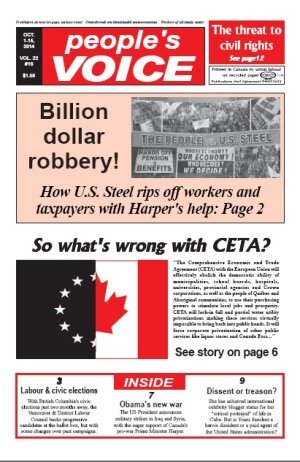
1) THE CONTINUING TRAGEDY OF ONTARIO STEEL
3) WITHDRAW BILL 3 ATTACK ON QUEBEC MUNICIPAL PENSIONS
4) CHANGING SCENARIOS IN VANCOUVER CIVIC RACE
5) SALUTE TO B.C. TEACHERS: THE FIGHT TO DEFEND PUBLIC EDUCATION CONTINUES
6) C-377 BACK FROM THE GRAVE – Editorial
7) THE CETA FIGHT IS FAR FROM OVER – Editorial
8) PARTY BUILDING, MASS ACTION TOPICS AT MONTREAL EVENT
9) THE CONTINUING ATTACK ON DEMOCRATIC AND CIVIL RIGHTS MUST BE REVERSED
10) UKRAINE MOVES TO AN EARLY ELECTION
11) CANADA OUT OF IRAQ: NO NEW IMPERIALIST INTERVENTION
12) FOUR MYTHS ABOUT OBAMA'S WAR ON ISLAMIC STATE
PEOPLE'S VOICE OCTOBER 1-15, 2014 (pdf)
People’s Voice 2014 Calendar
”The Truth About the Great War”
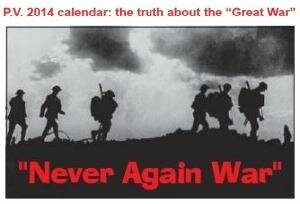
To order a copy of the People’s Voice 2014 Anti-First World War
Calendar, send $15 (includes postage and handling) to
People’s Voice, 706 Clark Drive, Vancouver, BC, V5L 3J1. Contact us at
604-255-2041 or pvoice@telus.net for bulk order prices.
|
People's Voice deadlines: October 16-31 November 1-15 Send submissions to PV Editorial Office,
|
REDS ON THE WEB
http://www.parti-communiste.ca/
peoplesvoice.ca
www.ycl-ljc.ca
www.solidnet.org
|
People's Voice finds many "Global Class Struggle" reports at the "Labour Start" website, http://www.labourstart.org/. We urge our readers to check it out! |
* * * * *
People's Voice
Canadian Publications Mail Sales Product Agreement #205214
ISSN number 1198-8657
People's Voice is published by
New Labour Press Ltd
PV Editorial Office
706 Clark Drive,
VANCOUVER, B.C. V5L 3J1
Phone:604-255-2041
Fax:604-254-9803
email: pvoice@telus.net
Editor: Kimball Cariou : Business Manager: David Au
Editorial Board: Kimball Cariou, Miguel Figueroa,
Doug Meggison, Naomi Rankin, Liz Rowley, Jim Sacouman
* * * * * *
Letters
People's Voice welcomes your letters
on any subject covered in our pages.
We reserve the right to edit for length and clarity,
and to refuse to print letters which may be libellous
or which contain unnecessary personal attacks.
Send your views to:
"Letters to the Editor",
706 Clark Dr., Vancouver, BC V5L 3J1,
or pvoice@telus.net
People's Voice articles may be reprinted without permission,
provided the source is credited.
* * * * * *
The Communist Party of Canada, formed in 1921,
has a proud history of fighting for jobs, equality, peace,
Canadian independence, and socialism.
The CPC does much more than run candidates in elections.
We think the fight against big business and its parties
is a year-round job,
so our members are active across the country,
to build our party and to help strengthen people's movements
on a wide range of issues.
All our policies and leadership
are set democratically by our members.
To find out more about Canada's party of Socialism,
give us a call at the nearest CPC office.
* * * * * *
Central Committee CPC
290A Danforth Ave Toronto, Ont. M4K 1N6
Ph: (416) 469-2446
fax: (416) 469-4063 E-mailmailto:info@cpc-pcp.ca
Parti Communiste du Quebec (section du
Parti communiste du Canada)
5359 Ave du Parc, Montréal, Québec,
H2V 4G9
B.C.Committee CPC
706 Clark Drive, Vancouver, V5L 3J1
Tel: (604) 254-9836
Fax: (604) 254-9803
Edmonton CPC
Box 68112, 70 Bonnie Doon P.O.
Edmonton, AB, T6C 4N6
Tel: (780) 465-7893
Fax: (780)463-0209
Calgary CPC
Unit #1 - 19 Radcliffe Close SE
Calgary AB, T2A 6B2
Tel: (403) 248-6489
Ottawa CPC
Tel: (613) 232-7108
Manitoba Committee
387 Selkirk Ave., Winnipeg, R2W 2M3
Tel/fax: (204) 586-7824
Ontario Ctee. CPC
290A Danforth Ave., Toronto, M4K 1N6
Tel: (416) 469-2446
Hamilton Ctee. CPC
265 Melvin Ave., Apt. 815
Hamilton, ON.
Tel: (905) 548-9586
Atlantic Region CPC
Box 70 Grand Pré, NS, B0P 1M0
Tel/fax: (902) 542-7981
http://www.parti-communiste.ca/
* * * * * *
News for People, Not for Profits!
Every issue of People's Voice
gives you the latest
on the fightback from coast to coast.
Whether it's the struggle for jobs or peace, resistance to social cuts,
solidarity with Cuba, or workers' struggles around the world,
we've got the news the corporate media won't print.
And we do more than that
- we report and analyze events
from a revolutionary perspective,
helping to build the movements for justice and equality,
and eventually for a socialist Canada.
Read the paper that fights for working people
- on every page, in every issue!
People's Voice
$30 for 1 year
$50 for 2 years
Low-income special rate: $15 for 1-year
Outside Canada $50 for 1 year
Send to: People's Voice, 706 Clark Drive, Vancouver, BC, V5L 3J1
You can call the editorial office at 604-255-2041
REDS ON THE WEB
http://www.parti-communiste.ca/
http://www.ycl-ljc.ca/
http://www.solidnet.org/
(The following articles are from the October 1-15, 2014, issue of People's Voice, Canada's leading socialist newspaper. Articles can be reprinted free if the source is credited. Subscription rates in Canada: $30/year, or $15 low income rate; for U.S. readers - $45 US per year; other overseas readers - $45 US or $50 CDN per year. Send to People's Voice, c/o PV Business Manager, 706 Clark Drive, Vancouver, BC, V5L 3J1.)
1) THE CONTINUING TRAGEDY OF ONTARIO STEEL
By Sam Hammond, Hamilton
The Steel Company of Canada (Stelco) inaugurated what became the longest Company's Creditors Arrangement Act (CCAA) supervised restructuring, lasting from 2003 until its sale to US Steel in 2007. During that four year period, a fraud was perpetrated that would make any organized crime syndicate green with envy. But as we will see, that was only the warm‑up to the present debacle.
Under the aegis of the CCAA, hotly contested by Local 1005 USW, Stelco wiped out its shareholders, and under the adroit footwork of the chief of restructuring officer Rodney Mott (representing a cabal of vulture capitalists) was purchased by these self‑same cannibals for a measly $150 million. Eighteen months later it was purchased by US Steel for $1.1 billion. Not a bad profit for doing nothing but shuffling cards.
Later, the judge who had presided over the transaction went to work for Stelco's law firm. The Union distinguished itself throughout the whole grab by tenaciously exposing the fraud and just as tenaciously defending its members and pensioners. This short history brings us to the process that began in 2007.
In 2007 the Harper government allowed the foreign takeover of Stelco by US Steel under the guarantee of certain conditions. Imposed under the Investment Canada Act, these conditions basically guaranteed the maintenance of over 3000 jobs at two plants, the solvency of the pensions, the investment of $200 million in upgrades, and the continuing production of steel. US Steel never met these obligations. In the last seven years it shut down and resumed operations, locked out workers in Hamilton and Nanticoke three times, cut the work force, imposed concessions, and in late 2013 announced the end of steel making altogether in Hamilton.
The Investment Canada Act and US Steel were on a collision course. The Feds imposed $10,000 per day fines on US Steel. The company appealed to the Supreme Court of Canada that the fines were unconstitutional, but the Court rejected the appeal. US Steel was losing hands down. But the Harper government intervened at the eleventh hour and brokered a secret deal behind closed doors that over‑rode the original agreement and wiped out the fines. Only parts of that deal have ever been disclosed, but the government saved US Steel from the win‑win court case that would have guaranteed jobs and continued steel production, and protected the taxpayers.
Under the partially disclosed parts of the 2012 back room deal, the company agreed to keep producing steel in Canada, operate its Nanticoke and Hamilton plants until 2015, invest $50 million by 2015, keep its original pledge to invest $200 million by October 2014, and donate $3 million to community and educational projects in Hamilton and Nanticoke. The problem was (and is), the secret parts of the deal might contain escape clauses for all these grandiose commitments. This is more than a suspicion because of events unfolding since August, when US Steel filed restructuring proposals under the Canada Business Corporations Act (CBCA) to essentially ignore all previous commitments and obligations.
The proposal is to break up US Steel Canada (USSC) into six entities. Each entity would be a stand-alone company with no revenue from USSC after 2015. USSC would provide $250 million in financing until the end of 2015, at which time the six companies would stand or fall according to their own balance sheets. There would be four Hamilton companies: Hamilton Land (over 100 acres), Hamilton Coke Ovens, Hamilton Finishing and Hamilton Other. At Lake Erie Nanticoke, there would be: Lake Erie Land (6600 acres of unused land) and Lake Erie Works. In addition USSC would ask the Ontario government to forgive a $150 million loan made at 1% interest in 2007.
In mid‑August, USSC tried to involve the participation of Local 1005 in its diabolical scheme. The attempt drew this withering reply in a letter to Jodi Koch, Director of Human Resources: "Local 1005 USW hereby informs you that its Negotiating Committee is not mandated by the membership to participate in any discussions that do not address the core interests of steelworkers and pensioners ... Local 1005's Negotiating Committee and US Steel have now met several times in August ... Local 1005 notes that these meetings have also revealed what is, in the opinion of Local 1005, a CBCA conspiracy on the part of US Steel to defraud Hamilton pensioners of their pensions, the Province of Ontario of its $150 million loan it made at 1% interest in 2007, and Canadians of their right to have polluted grounds and waters cleaned up by the corporation responsible for polluting them."
This correct response from the Union is based on a true understanding of what the company is trying to accomplish, on behalf of their members, pensioners and the Canadian public. Under the proposal, the pension responsibilities could be shifted to one of the new companies that would go bankrupt. A mergers and acquisitions process could be initiated by US Steel (Pittsburgh), who would purchase Lake Erie Land and Lake Erie Works from itself, thus maintaining the newest and most profitable, while allowing 103 years of ecological damage in Hamilton to fall on the heads of the taxpayers, who would inherit the bankrupted Hamilton companies and land.
Further to the above, on Sept. 16, US Steel Canada formally filed for Creditor Protection under the Companies' Creditors Arrangement Act. This is another act in a multi‑level corporate drama. As Thomas Walkom wrote in the Toronto Star, "From the Federal government came a deafening silence."
There is so much more as this tragedy unfolds. The corporate mentality, coupled with the opaque secrecy and contempt of democracy displayed by the Harper government throughout the decade of the Steel saga, provides a frightening window into what to expect if and when the Comprehensive European Trade Agreement (CETA) deal with the EU becomes visible. Watch our pages for further on Steel in Ontario.
Central Committee, Communist Party of Canada, September 13‑14, 2014
Every government and advocates of "Free Trade Agreements" have dangled the illusion of jobs and prosperity. These have never materialized. Indeed the opposite is true. Hundreds of thousands of jobs have vanished through NAFTA, and experts predict at least another 50,000 jobs will be lost through CETA, the latest and most dangerous of these agreements.
Shrouded in secrecy, the Harper Conservative government, the European Union, and major trans‑national corporations recently concluded the final round of negotiations for the largest free‑trade agreement in Canada's history since NAFTA. Although there have been setbacks in the German Parliament over the dispute mechanism, the Harper government are still pushing for a signing, at least in principle, in September 2014. CETA would take effect after it has been ratified by the EU member states, and also by the federal and provincial governments of Canada. This makes the fightback agenda very urgent; just as the MAI (Multilateral Agreement on Investments) was defeated, blocking CETA is still possible, through a strategy of mass mobilizations and by making this sellout a key issue in next year's federal election.
The history of the Comprehensive European Trade Agreement is a story of lies, secrecy, and corporate toadying to craft the most dangerous attack on Canadian sovereignty and democracy to date. The CETA agreement will put Canadian governance, from federal, provincial and municipal levels, effectively under the rule of Canadian and European corporations. CETA goes far beyond NAFTA, but because of the preferred nation clauses in NAFTA, it will be upgraded to CETA standards so that everyone can join the corporate feast. What the Tories and later the Liberals couldn't sell under NAFTA will be automatically accomplished in CETA and the NAFTA upgrades. Thus the untouchables (so the public thought) of water, healthcare and procurement are on the chopping block for CETA.
Disgruntled civil servants, in Canada and Europe, have leaked information to the public on both continents, through the draconian screen of security, secrecy, misinformation and outrageous lies perpetrated by the negotiators. This is how we know of an "invitation only" scoping meeting convened in 2009, where Canadian and European corporations drew up their "wish list" for a neo-liberal trade agreement. If not for whistle blowers, even parliamentarians would have no knowledge of this. The news really became public in 2012, when it was learned the negotiations had been going on for years and were apparently nearing completion.
This outraged important sectors of labour, progressive researchers and NGOs, to the point where the Federal government was compelled to hold some fake hearings and receive submissions in November 2013. The submitters were forced to base their submissions on hearsay, sketchy government documents prepared for this purpose, and leaked documents. Under this farcical duress, they were heard by a government that knew everything but officially admitted nothing. Nevertheless the submissions exposed some of the most inherent dangers.
Early in the negotiations, the EU made full access to public procurement a fundamental and necessary part of the deal. They got what they wanted. Procurement has little to do with trade, but everything to do with corporate access to every level of public spending right down to city councils, school boards, etc. Although the government says health care is not in danger, it definitely is. The current existence of P3s, the complicated integrations of public/private services and long‑term care facilities, is ample ammunition for corporate complaint mechanisms. Under CETA no government or public body will be able to develop procurement policies that favour local or regional suppliers to promote local jobs or development. All municipalities and public bodies will have to submit their procurement policies and plans to the federal government, and these will be available to all corporations. Any corporation can challenge the practices as unfair advantage, able to file charges that will not be heard in any Canadian courts, but in an as yet unspecified international tribunal made up of unspecified appointees.
Canadian water will be on the corporate agenda if it has previously been commercialized. This means that any bottled water, for instance, that is taken from a public resource and sold commercially, will provide the conditions for the water to be privatized and commercialized. CETA will privatize drinking water (including municipal procurement of water services like sewers and sanitation) by comprehensively covering these items for the first time in Canadian trade negotiations.
CETA will effectively abolish the democratic ability of municipalities, school boards, hospitals, universities, provincial agencies and Crown corporations, as well as the people of Québec and Aboriginal communities, to use their purchasing powers to stimulate local jobs and prosperity.
CETA will lock‑in full and partial water utility privatizations making these services virtually impossible to bring back into public hands. It will force corporate privatization of other public services like liquor stores and Canada Post.
CETA will allow corporations to crack into the gold mine of post‑secondary education, and threaten the integrity of research programs allowing corporations to sue students who whistle‑blow unethical research practices.
CETA will attack Aboriginal peoples' treaty rights , sovereignty and self‑determination. with the agreement's sweeping scope allowing foreign industries access to First Nations, Inuit and Métis lands, territories and water.
In all these agreements, the "Preferred Nation Status" clauses provide a diabolical method of upgrading each one to the status and conditions of the last negotiated deal. As bad as CETA is, the "Transatlantic Trade and Investment Partnership" (TTIP) negotiations now underway between the US and the EU will provide upgrades from negotiations in which Canada has no part.
It's not a secret that Canada mostly sells raw materials to Europe, which mostly sells value‑added, finished products back to Canada. This has created an extraordinary $28 billion manufacturing trade deficit with the EU. This deficit can only get worse if we make it easier (and cheaper) for European firms to ship finished goods into Canada, and easier (and cheaper) for Canadian firms to ship resources into Europe.
Part of the summary of the Unifor submission to the hearings in November of 2013 contains the following, "We're granting rights to private investors and corporations that are unheard of. We're granting private investors and corporations the right to challenge democratic policy decisions made by our national and sub‑national governments if those decisions infringe on their right to profit. What about the rights of workers to decent jobs? What about the rights of citizens to democratic decision‑making?"
Why would any Canadian government negotiate away sovereignty, hand legislative and judiciary powers over to a cabal of international corporate representatives, put municipal and provincial governments under the jurisdiction of foreign corporations, and rob Canadians of decision making in our own country? Because CETA will effectively implement the neo‑liberal agenda of privatization without parliamentary decision‑making.
The Harper government will accomplish the corporate agenda through a trade deal that was negotiated in secret and will be a fact before anyone, including members of parliament, have seen a complete manuscript. The opposition parties, and particularly the NDP, have disgraced themselves in their support for what is primarily an act of treason. There has been some opposition from labour but the major exposures and opposition have come from forces such as the Canadian Centre for Policy Alternatives, the Council of Canadians, social movements in Quebec, municipalities, healthcare organizations, environmental organizations and First Nations.
The Communist Party has been deeply engaged in all the struggles against previous corporate trade deals, from the FTA to NAFTA and others, and we continue to be part of this crucial fight. We call for the urgent formation of an all‑in resistance block of the labour movements in English‑speaking Canada and Quebec, First Nations, environmental and women's groups, social movements, political parties and municipal organizations, to inform the public of the dangers, and to formulate an emergency fightback to stop this dangerous sellout.
3) WITHDRAW BILL 3 ATTACK ON QUEBEC MUNICIPAL PENSIONS
Central Committee, Communist Party of Canada, Sept. 13‑14, 2014
The Communist Party of Canada supports the municipal employees of Québec and demands the withdrawal of Bill 3 which attacks their pension rights.
Citing the fear of pension fund deficits due to the improved life expectancy of workers, Bill 3 would tear up collective agreements, and force renegotiation by setting advance concessions that workers must accept. With good reason, the unions argue that such imposed negotiations will be artificial, and that the Bill is an attack on freedom of association and collective bargaining.
Bill 3 covers all Québec municipalities, affecting 170 retirement plans, 50,000 retirees and 122 000 participants, even though these plans are not actually in financial difficulty.
Notably, the bill affects retired workers, by suspending indexation of their pensions. In addition, it imposes a limit on contributions paid by municipal employees to fund their pension plans, and requires them to pay half of the deficits accumulated by their employers.
If there is a deficit in these pension plans, the true causes are poor financial returns caused by the economic crisis of 2008, and the contribution holidays given to employers. By giving municipalities the authority to pay their employees their contractual debts, the government is engaged in robbery, retroactively imposing lower wages.
On the other hand, a firm of independent actuaries, the only one to report during parliamentary committee hearings on Bill 3, disputes the method of calculating municipal pension deficits used by the government. According to the company, the plans are not at all in the red.
In reality, by filing Bill 3, the Couillard government is rushing to meet the wishes of municipalities, especially the mayors of Montreal and Québec City, to reduce their payrolls. The government admits that this is only the beginning, since negotiations will begin shortly for renewal of the collective agreements of 500,000 public and para‑public sector employees in Québec. In its latest austerity budget, the government has made clear its intention to freeze its payroll.
To support its attack against the municipal employees pension fund, the government is trying to pit workers in the public sector ‑ who are largely unionized ‑ against those in the private sector who are not. Premier Couillard claims that the pensions of public sector employees are privileges, forcibly paid by the majority of non‑unionized private sector workers who do not receive any supplemental pension plan. But this is an illusion since the attack against unionised public sector employees is actually the prelude to a general attack against the entire working class in Québec.
The supplementary pension plans are funded, often exclusively, from the contributions levied on the wages of the employees. The benefits often leave recipients in poverty. The average pension of retired blue‑collar workers in Montreal amounts to only $24,000 per year, including benefits from the Québec Pension Board and the Federal Security pension old age.
When the public pension plans were established in the 1960s, the financial companies and employers were strongly opposed to government programs which would provide a greater share of income. They wanted to establish private supplemental plans that would provide large reserves of financial liquidity, and allow them to exercise greater control over their employees . Governments were quick to comply.
Consequently, public plans, annuities, Old Age Security and Guaranteed Income Supplement together currently only amount to 44% of the average wage in Québec. Canada is one of the lowest countries in the OECD, where the average coverage is 54%.
The cynicism of the government has no limit. As he is about to rob the working people, Couillard plans to increase remuneration for Members of the National Assembly by $46,000, in exchange for reducing their generous pension plan and eliminating their golden handshakes. Recall that the pension plan for MNAs is one of the most generous in Canada. Currently, a member may withdraw at age 60, with a full pension of up to 100% of the base salary (about $90,000 per year), plus other remuneration for participation in various parliamentary committees.
The fight has only just begun and will intensify. The City of Montreal, with the support of the Québec government, is using intimidation tactics to stop the mobilization. They recently laid criminal charges and took disciplinary action, including suspensions and dismissals, against dozens of demonstrators, who broke into the Hotel de Ville in Montreal on August 18 to show their anger at City Council. The City has specifically targeted Michel Parent, president of Montreal blue collar workers, who was present to speak during public time provided to council. The very militant Montreal union of blue collar workers has declared its intention to oppose Bill 3 by any means necessary, even an indefinite general strike.
The Communist Party demands:
- The withdrawal of Bill 3;- The withdrawal of all criminal prosecutions and disciplinary actions related to the demonstration of August 18, 2014 at Hotel de Ville of Montreal;
- The establishment of a system of universal public pensions from age 60, guaranteeing a decent income for all.
Bill 3 is part of the general neoliberal attack against the pension rights of all workers in Québec and Canada. Mobilizations against this agenda should be stepped up ‑ the way forward is unity in struggle.
4) CHANGING SCENARIOS IN VANCOUVER CIVIC RACE
PV Vancouver Bureau
For progressive activists in Vancouver, September 16 was an important date, as Vancouver and District Labour Council delegates debated recommendations for the Nov. 15 civic election. The outcome was very different than in previous campaigns.
The Coalition of Progressive Electors was formed at the initiative of the VDLC in 1968. But this year, delegates gave their support to just two of the party's eighteen candidates, Gayle Gavin for City Council and Anita Romaniuk for Park Board.
Instead, the delegates endorsed all candidates of Vision Vancouver, the centrist party which won majorities at every level in 2008 and 2011. This includes Mayor Gregor Robertson and eight Council candidates (seven of these being incumbents), School Board chair Patti Bacchus and six other Trustee candidates, and six candidates for Park Board (mostly first-timers).
The VDLC also endorsed the new One City party's council candidate R.J. Aquino, who ran in 2011 for COPE; two School Trustee candidates nominated by the Public Education Project, Jane Bouey (a COPE Trustee in 2002-2005 and 2008-2011, and vice-chair of the board in the latter term), and Gwen Giesbrecht, the former chair of Vancouver District Parent Advisory Committee. All three have strong pro-labour track records.
The Labour Council endorsations help candidates to approach trade unions for financial support. Also, the VDLC traditionally sends a "slate card" to residences across the city, urging votes for these candidates. For One City and the Public Education Project, this is a major boost to their first campaigns.
COPE mayoralty candidate Meena Wong told the Vancouver Sun that she was "shocked" at the decision by "union bosses," using a common right-wing phrase.
But the outcome was no surprise to most observers. Several members of the current COPE leadership have long been hostile to the trade union movement in Vancouver, after the painful divisions which rocked the organization after its sweep in the 2002 civic election. Since that time, the VDLC and some major affiliates, such as CUPE locals representing civic workers, have supported a common slate of Vision and COPE candidates, to block the right-wing NPA at Council and School Board.
The NPA, which is heavily backed by major resource corporations and developers, did win majorities in 2005, and forced civic workers into a lengthy strike two years later. That bitter experience was a factor in convincing most COPE members to back a combined slate again in 2008 and 2011.
Such a tactic was not in the cards this year, as resentment grows over the Vision city council's close links with developers, and its attempts to "manage" citizen consultations around zoning and other policy issues. (On the other hand, the Vision trustees on School Board have been strong critics of the BC Liberal government's attacks on public education.)
In recent years, COPE has become dominated by forces which want to scrap the organization's historic city-wide coalition with labour and sections of the left, such as the Communist Party. Instead, the focus is on building a narrower geographic and political base in the poverty-stricken Downtown Eastside.
Some executive members even welcomed the departure of long-time COPE elected officials, claiming that this would "clarify" issues. They often denied that COPE needed financial or political support from the labour movement, and very few of COPE's current candidates have any links to trade unions.
This strategy will be severely tested in the November 15 election. Recent opinion polls indicate that COPE is running fourth among local civic parties, far behind Vision, the NPA, and the Green Party.
In upcoming issues, People's Voice will analyze the campaign in Vancouver, and present our views on the huge field of candidates.
5) SALUTE TO B.C. TEACHERS: THE FIGHT TO DEFEND PUBLIC EDUCATION CONTINUES
Statement from the Communist Party of BC, Sept. 19, 2014
The teachers of British Columbia deserve a huge vote of appreciation for standing on the picket lines to defend public education and collective bargaining rights. The Communist Party of BC salutes their determination to resist the attacks and provocations of the Liberal government, and to win the support of parents, students, and all who value public education. This courageous struggle goes all the way back to the first Liberal term in office, and the budget slashing and union‑bashing launched by Gordon Campbell and Christy Clark. We pledge to continue our solidarity with teachers and all education workers in this fight, which has now entered a new stage following the ratification of a new six‑year collective agreement. The teachers will go back to classrooms with justifiable pride that unlike the government, they made the interests of students their priority in this dispute.
After months of government threats and bullying, the final negotiated settlement was reached thanks to the solidarity of community groups, parents and students, and by the financial and moral support and of trade unions across the country and even internationally. Having made huge sacrifices, many teachers were understandably reluctant to accept a deal which leaves them with just 7.25% pay increases over a period of eight years, and with only minor gains on the crucial issues of class size and composition.
Some pundits want to add up figures to declare that the BCTF "lost" this strike. But we say: the teachers won by beating back Premier Clark's insistence on concessions, by winning new funds ‑ however limited ‑ to help improve working and learning conditions, and most of all by rallying huge numbers of British Columbians against the Liberal assault on public services. This historic strike has improved the terrain for future rounds of the fightback against the Liberal agenda of cutbacks, privatisation and union bashing. The teachers showed that it is possible to say no to this reactionary government, with the solidarity of thousands who organized rallies, sit‑ins, and other actions. By winning the battle of public opinion, the BCTF and other unions in the education sector have shown the way towards a wider coalition of labour and community groups in upcoming provincial budget debates and around other issues. In our view, such a fightback coalition must go beyond demonstrations and other mobilizations with a defensive character.
This strategy can only succeed by challenging the neoliberal dogma of constant corporate tax cuts and "balanced budgets" ‑ an ideology which is rarely questioned by the NDP. The heart of the Liberal agenda is the deliberate program of massive tax cuts for the wealthy and the corporations, costing the provincial government more than $2 billion in lost revenue every year. This is a cynical tool to gut the entire public sector, from education to health to social services, with the aim of creating constant new crises, undermining public confidence, and pushing their privatization agenda. The teachers' strike shows that this government will never relent in its efforts to push families out of the public system, and into private for‑profit schools, which are heavily subsidized by the working class through our taxes.
The struggle to roll back Campbell's tax cuts remains the single most crucial element of the fight to put people's needs before corporate greed in British Columbia today. The next stage begins with the municipal elections taking place this fall. The election of more Trustees and School Boards actively committed to demand full funding for public education is vital to turn up the heat on the Liberal government. We urge the BC Federation of Labour convention in November to take the initiative to build a powerful united movement for policies which will reverse more than a decade of Liberal damage to working people and our communities.
People's Voice Editorial
Over a year ago, trade unionists heaved a sigh of relief when 16 Conservative senators helped kill Bill C-377. Sponsored by Tory MP Russ Hiebert, with the support of PM Harper, the private member's bill required unions to publicly disclose any spending of $5,000 or more and any salary of more than $100,000. Together with other onerous provisions, C-377 aimed at making it nearly impossible for the labour movement to effectively act on behalf of the interests of union members.
The leader of the Senate revolt was Hugh Segal, who called C-377 "badly drafted, flawed, unconstitutional and technically incompetent" legislation. Segal and his colleagues amended the bill by raising the spending disclosure threshold to $150,000 and the salary threshold to $444,000. Parliament was prorogued before the House of Commons could debate the amendments, and the legislation died.
But not forever. Segal has unfortunately retired to Massey College, and this dangerous legislation has returned in its original form. Back under Harper's thumb, Tory senators have reduced debate on private members' business, just as C-377 climbs out of the grave.
This legislation infringes on provincial jurisdiction over labour issues, violates charter guarantees of freedom of speech and association, and invades privacy rights. None of that matters to the Harper government, which specialises in violating human rights. But it should matter to everyone who supports the rights of trade unions to bargain collectively and to defend the broader interests of working people.
The Canadian Labour Congress is also warning against Bill C‑525, which makes it harder for federally regulated workers to join a union and easier to decertify a union. Mass mobilization is needed to resist this assault. The Sept. 20 rally by over 50,000 people in Montreal to defend municipal workers pensions shows what can and must be done!
7) THE CETA FIGHT IS FAR FROM OVER
People's Voice Editorial
As this issue of PV goes in the mail, Stephen Harper will be shaking hands in Ottawa with European Union representatives, and signing the Comprehensive Economic and Trade Agreement (CETA), before we see a word of the official text. Just as shocking, the big opposition parties in Parliament support in principle this odious corporate sellout of Canadian sovereignty. So much for democracy in 21st century Canada.
That's the bad news. The good news is that this fight is still in the middle rounds. While politicians are reluctant to even ask timid questions, many of their counterparts in Europe are prepared to say "no way" to unelected corporate rule. The parliaments of all 28 countries of the European Union must approve CETA. That process that could take two years, with no guarantee of the outcome. In Germany, France, Italy and Belgium, citizens and legislators alike are outraged that corporations will be granted the right to sue governments if local, provincial or federal regulations put the interests of people and the environment ahead of capitalist profiteering.
The next federal election in Canada is scheduled for October 2015. And that means that Stephen Harper, Justin Trudeau and Thomas Mulcair will have to face hard questions for voters across the country over the next twelve months.
That gives time for the labour movements in both English‑speaking Canada and Quebec to bring together a broad coalition of Indigenous peoples, environmental groups, municipalities, and all those who understand the dangers of this deal. Resistance must include wide ranging public education, petitions, sit‑ins, and other forms of mobilization, in an all‑out effort to make rejection of CETA a top political priority. A big anti‑CETA campaign in Canada is the best way to signal the peoples of Europe that this deal must never take effect!
8) PARTY BUILDING, MASS ACTION TOPICS AT MONTREAL EVENT
We are happy to share news about one of the first events in the Communist Party's new "Build the Fightback, Join the Communist Party" campaign.
Members and friends of the Parti Communiste du Québec met to discuss the political situation internationally and the fightback in Canada at a Sept. 21 event in Montréal. Elizabeth Rowley, the Ontario leader of the Communist Party, was joined by Québec labour activist and writer Robert Luxley, who talked about the protest of 50,000 people the day before against the municipal pension reform in Québec.
The meeting launched the Québec component of the Communist Party's new recruitment campaign. Three new members joined the party at the end of the meeting.
Rowley highlighted the dangerous developments within NATO, and applauded the labour and peace forces in Québec which have taken up the call to get Canada out of this imperialist alliance. This key struggle for peace must be taken right across the country, she said.
Canada, added Rowley, must make a 180 degree turn and implement a new, independent Canadian foreign policy with the objective of a free Palestine. The Parti Communiste du Québec is making "Fire (Foreign Minister John) Baird, Free Palestine" pins ‑ the first in a series coming out of the PCQ's new button press.
Rowley was happy to learn about the recent Saturday closure of a shoe store on rue Saint‑Denis, which has been picketed by local Boycott, Divestment, Sanctions (BDS) campaigners for several years. The Israeli‑based NAOT chain is known for maquiladora‑like exploitation at its factories in the occupied Palestinian West Bank. While the store remains open on other days, rue Saint‑Denis is at its busiest on Saturday. The BDS campaign in Québec has been joined by a broad section of labour and progressive movements, including the PCQ and CPC.
The meeting also heard about developments in the Québec pension fightback. Robert Luxley said that the reforms amount to a theft of workers' wages and a form of super‑exploitation.
Contrary to the corporate media's perspective, municipal workers in Québec do not receive golden pensions, and retirees generally live below the poverty line and below most other OECD countries. Luxley, who edits the PCQ's quarterly newspaper Clarté, noted that the latest issue which exposes this situation is being well received by working people.
The Sept. 20 mass protest at Parc Lafontaine and other actions by trade unions come at the same time as the re‑formation of the Common Front for public sector negotiations. After some division in their analysis towards the minority Parti Québecois government, the labour and people's movements are clearly re‑mobilizing to fight the new Liberal regime, which is a welcome sign and must go further, Luxley said.
Rowley spoke about renewed public interest in the Communist Party, along with positive signs in the fightback, like the recent People's Social Forum and the defeat of right‑wing business trade unionist Ken Georgetti in the Canadian Labour Congress elections.
The necessity to build the fightback on the streets and get rid of Harper was very urgent, Rowley said, together with building the Communist Party as a decisive ingredient in the class struggle. Visibility is key to recruitment. Almost every club of the Party in Ontario gained new recruits during the June provincial election, which saw campaigns by eleven Communist candidates in five cities.
Dave McKee, the first Party candidate in London, Ontario, after many years, helped galvanize friends and supporters into action around the Communist "People's Alternative" platform. A new Party club will be chartered in London this fall.
The clubs of the PCQ resolved to win more new members, expand the Clarté subscription list, and hold a mass public event celebrating the life of Cuban Revolutionary Che Guevara between now and January. That's when the campaign will come to a close, and the Québec communists will hold their National Congress.
(In coming issues we will profile new and long‑term members of the CPC and why they think the Communist Party is important.)
9) THE CONTINUING ATTACK ON DEMOCRATIC AND CIVIL RIGHTS MUST BE REVERSED
Statement adopted by the Central Committee of the Communist Party of Canada, Sept. 13-14, 2014
The Communist Party of Canada's Central Committee calls for democratic‑minded people to join in the condemnation of Montréal municipal bylaw P‑6 and support the ongoing court challenge against this law. Montréal is on the front line of a much broader, reactionary attack on democratic and civil rights which must be reversed.
Bylaw P‑6 was created during, and in response to, the Québec student strike of 2012. Refusing to negotiate in good faith, and responding to the outpouring of public support, the provincial Charest Liberal government imposed draconian legislation under the title of Bill 78 which grossly violated civil and democratic rights by effectively outlawing all student protest and blocking any attempt of solidarity actions by the labour movement.
It is well known that this tactic further discredited the Charest Liberals. Public pressure helped trigger an election in which the Liberals were defeated, and the new minority Parti Québecois government struck Bill 78 from the books.
What is not well know is that on the municipal level, both Montréal and Québec City either adapted or adopted city bylaws mirroring Bill 78 ‑ and that these were never struck from the books.
In Montréal the city substantially amended bylaw P‑6, "a bylaw on the prevention of disturbances of the peace, public security, and public order, and on the use of public space." (This bylaw was originally the notorious Règlement 3926 from 1969, in response to the police and firefighters' strike of that year.) In Québec City the bylaw was entitled RVQ 1091 "for peace and good order." The key provisions of both bylaws are an escalating series of fines (in Montréal, starting at over $600) for the first offense and continuing to several thousand dollars. Participants in a any gathering of more than three people which impedes traffic, did not submit its route for advance approval to the police, or whose faces are covered ‑ including a puppet costume, winter scarf, etc. ‑ can be fined. (The police can also refuse the route given to them).
To enforce this bylaw the police use the internationally condemned form of mass arrest known as "kettling." Kettling is a type of detention and usually lasts for two to four hours or longer surrounded by police. The arrested are squeezed tightly together by police lines, denied water or toilet access, subject to intrusive and abusive police searches, and kept out in the cold ‑ or heat. Often kettling will begin before the protest actually starts. This means that, whether or not the person is proven innocent or guilty in the end, a certain level of punishment has already been handed out, for a legal infraction equivalent to a parking ticket. The law has no justification and is often accompanied by police brutality.
Literally thousands of protesters have now been kettled and fined now in the city of Montréal, in a wide range of protests which have in common basically one basic theme, that they were organized by young people. Late this summer, a total of eight class‑action lawsuits against the city of Montréal on behalf of over 1,600 ticketed protesters were approved to go forward to the Québec Superior Court. (This is just a small part of the total people who have been detained or arrested under these laws). Included in the court challenge are members of the Parti Communiste du Québec and la Ligue de la jeunesse communiste.
Since the approval, charges were suddenly dropped for some 518 students arbitrarily arrested under P‑6 during the student strike. While not compensating for the violation of their rights, it does show that the bylaw is illegal and unconstitutional. The next step must be getting rid of the law itself, which is the joint demand of many organizations from across Québec including trade unions, student groups, feminist organizations, housing activists, human rights groups and the Québec Bar Association.
The Communist Party expresses its continued and long‑standing full support in the struggle for democratic and civil liberties, and the necessity for people's movements to be able to mobilize on an immediate basis with "permission". All across the country, labour and social movements face reactionary city governments and police forces which attempt to restrict the Canadian Charter of Rights and Freedoms ‑ whether it comes to putting up a poster, to picketing on a public sidewalk, or marching down a street.
Heavy‑handed police tactics are increasing across Canada. Last fall there was public outcry when members of the Elsipogtog First Nation protesting shale gas were assaulted by more than a hundred camouflage‑clad tactical police with assault rifles and attack dogs. Similarly, the mass arrests, "caging" and effective imposition of martial law for three days in the streets of Toronto during the G20 resulted in a limited investigation by the Ontario Ombudsperson, which called abolishment for the legislation supposedly justifying that big scoop. Four years later, the Public Works Protection Act remains on the books, and is still a danger, while a class‑action law suit for the G20 arrestees is still slowly proceeding through the courts.
Further, as the Council of Canadians has exposed, since 2007 the RCMP has been operating an intelligence clearing house called the Government Operations Centre which monitors all known demonstrations across the country, no matter how mundane, and with special emphasis on aboriginal actions.
Therefore Communist Party of Canada calls for mass united action to turn around the serious and intensifying attack on civil and democratic rights:
* Abolish P‑6 and all corresponding municipal bylaws across Québec; * Drop all associated charges and bail conditions for those charged during the student strike under P‑6, the Highway Traffic Code, and various sections of the criminal code;
* Grant amnesty for the protesters who released a small smoke bomb in the subway and have been subsequently charged with the never-before used sections of the Anti‑Terrorism Act, "Hoax regarding terrorist activity";
* Abolish all laws on the municipal, provincial and federal level prohibiting freedom of assembly, including those requiring special permits or otherwise criminalizing so‑called "spontaneous" protests;
* Require police to explicitly affirm that even when protests are strictly considered "unlawful," they are equally protected by the right to freedom of peaceful assembly;
* Launch an independent public inquiry into recent crowd control techniques, mass arrests and police violence across Canada ‑ including during the Québec student strike with events like the police riot at Victoriaville, where several protesters sustained traumatic injuries including jaw fractures, permanent blindness and deafness;
* Strengthen and enforce sanctions against police officers convicted of using excessive force;
* Stop the use of agents provocateurs and all forms of entrapment and coercive police techniques;
* Enact a Parliamentary moratorium banning the use of plastic bullets, stun grenades and tasers, and strictly regulating all other so‑called "non‑lethal weapons" such as pepper spray and tear gas;
* Abolish all forms of profiling such as political profiling and the notorious racial‑profiling tactic;
* Abolish the Government Operations Centre and stop "lawful access legislation" which allows online spying without a warrant or safeguards to rights such as covert, real‑time surveillance and access to personal or private information;
* Crackdown on police violence by enacting legislation to put police under public control in every jurisdiction;
* Provide civilian and community control bodies legislative "teeth" to independently investigate and enforce real civilian controls, including over detention and arrest, the use of force, and search and seizure.
The Communist Party has long proposed guaranteeing civil and democratic rights by enshrining them in a radically new Constitution actually written by the peoples and nations of Canada ‑ not big business and its reactionary political parties ‑ and protecting the habeas corpus right, so the people cannot be arbitrarily deprived of liberty.
10) UKRAINE MOVES TO AN EARLY ELECTION
By Wilfred Szczesny
Ukraine is heading for elections on October 26, 2014, years ahead of the normal 2017. On that day, proclaimed by President Petro Poroshenko, Ukrainians will elect new deputies to the Verkhovna rada (that is, members of parliament to the Supreme Council).
Why the rush?
At the end of May 2014, following the ouster of President Yanukovich, Petro Poroshenko was elected President of Ukraine. Arseniy Yatsenyuk, Barack Obama's and Angela Merkel's "our boy", became Prime Minister with the support of a coalition of right‑wing parties.
With a very few exceptions, the deputies elected in 2010, including those of the Communist Party of Ukraine and the Party of Regions, remained in place. The Communist Party of Ukraine came under immediate attack, as did the Party of Regions, with increasing tension in eastern Ukraine. There were repeated demands that the deputies from these parties be expelled from their parliamentary seats and that the CPU be banned.
However, the right wing in parliament was unable to gain enough support to enact these demands. The solution, as President Poroshenko and his advisers saw it, was to change the composition of the Supreme Council.
On July 24, in collusion with the President of Ukraine, two parties (UDAR and Svoboda) withdrew from the governing coalition. Unable to pass two vital pieces of legislation (one to fund the government forces in eastern Ukraine, the other to impose austerity measures demanded by international moneylenders), Prime Minister Yatsenyuk and his entire Cabinet resigned.
A week later, the Supreme Council met to consider the resignations. The resignations were rejected, with 125 members of a 450‑seat parliament voting. (The rest abstained or were absent.) The two pieces of legislation were passed.
The Prime Minister was left in place, but lacking a majority in parliament. Under the Ukrainian constitution, parliamentarians had 30 days to cobble together a majority bloc. After that, the president was able to call an election. In the meantime, the chairman of the Supreme Council (somewhat akin to a speaker of the House of Commons in Canada) serves as acting prime minister.
Immediate mission accomplished - on August 25, the October election was announced, and at the earliest opportunity October 26 was announced as the day.
Will the longer term mission (the elimination of the CPU and the PR from parliament) be accomplished? Probably, at least in large measure. Ukraine has a system of mixed proportional representation. There is a 5% threshold for representation in the 225 seats elected on party lists. The other 225 seats are filled by a first‑past‑the‑post system.
The Democratic Initiative Foundation estimates that as many as half of CPU and PR supporters in the 2012 election would not participate in the 2014 election. With the Crimea out of the picture, as well as much of eastern Ukraine, the CPU may be shut out, and possibly the PR as well.
That would open the door for banning either party, or both. The result could be even more determined opposition, particularly in the east, to the highhandedness in Kyiv.
11) CANADA OUT OF IRAQ: NO NEW IMPERIALIST INTERVENTION
Statement of the Central Committee, Communist Party of Canada, Sept. 13-14, 2014
The Communist Party of Canada opposes the renewal of imperialism's war in Iraq, under the pretext of fighting the Islamic State (IS), and calls for Canada's immediate and complete withdrawal from the US‑led military intervention.
The doctrine of Responsibility to Protect is being fed to the people of Canada in order to justify a new war in Iraq. In this narrative, intervention is promoted as necessary to save the people of Iraq and Syria from IS terrorism.
But this argument obscures the fact that the main and most immediate threat to peace and to the people of the Middle East is from imperialism. It was the United States, together with its allies in NATO and Israel, who spearheaded the invasion of Iraq in 1990, and who carried out the murderous sanctions through the decade of the 1990s, and who again invaded and occupied the country from 2003 on. It is the imperialist states who have waged a terrorist war against the people of Syria, in which 100,000 people have died and millions displaced. It is imperialism that has supported Israel's occupation of Palestine, the apartheid policies against the Palestinian people, and Israel's repeated military strikes against Gaza.
The horrors of the Islamic State reflect the legacy of US‑led, imperialist invasion and occupation of Iraq, an aggression that imposed sectarianism and national division on that country.
It is no accident that imperialism's sudden and intense interest in Iraq has developed in the wake of its failure to topple the government of Syria and just as NATO concludes its departure from Afghanistan. A renewed war on Iraq will enable the US and its allies to maintain huge military bases in the region and will provide a pretext for renewed military intervention in Syria.
It is the sole right of the people of a country to determine the path of their political, social and economic development, free from foreign interference. Instead of seeking new pretexts to justify new intervention in Iraq, the US and its allies should withdraw completely from the Middle East.
In Canada, the Harper Conservative government has voiced its support for imperialist military intervention and has already begun deployment of Canadian military personnel and equipment to Iraq. The massive antiwar mobilizations of 2002 and 2003 prevented the Chretien government from officially participating in the invasion and occupation of Iraq. That important victory must not be forgotten now.
The Communist Party denounces the Harper government's support for a renewed war on Iraq, under any pretext, and calls on all progressive and peace‑supporting people to actively oppose Canadian military deployment.
12) FOUR MYTHS ABOUT OBAMA'S WAR ON ISLAMIC STATE
From Fairness and Accuracy in Reporting (FAIR), Sept 12, 2014, http://fair.org/take‑action/media‑advisories/four‑myths‑about-obamas‑war‑on‑isis/
With Barack Obama's September 10 announcement of a military plan to launch strikes against the Islamic State in Iraq and Syria (ISIS), many pundits might be breathing a sigh of relief. The White House is finally taking the kind of military action they have been recommending for months. But there are some serious questions that should be asked‑about the threat posed by the Islamic State and about some of the assumptions guiding the debate.
"Striking the Homeland"
The idea that ISIS poses an immediate threat to the United States ‑ as opposed to its non‑Sunni Muslim neighbors ‑ has been a consistent theme in the media, encouraging the public to support war. Rep. Michael McCaul (R.‑Texas) declared on ABC's This Week (8/24/14) that the Islamic State is "intent on hitting the West and there are external operations, I believe, underway." When CBS's Face the Nation host Bob Schieffer (9/7/14) asked Republican Sen. Marco Rubio if he thought they posed a "threat to the homeland now," Rubio replied: "I do. I believe they do." Democratic Sen. Dianne Feinstein said the threat to the country was "potentially very serious." ABC This Week host Martha Raddatz (9/7/14) explained that if the options are leaving Syrian President Bashar al‑Assad in power or the threat from the Islamic State, the White House was "clearly siding with the threat to the homeland."
On ABC World News (8/16/14), reporter Terry Moran told viewers that "a new US intelligence assessment says that ISIS poses a direct threat to the American homeland. So, what happens here in northern Iraq...matters a lot back home." But experts do not see an immediate danger, which is coming through in some media coverage. As the New York Times (9/11/14) put it: Some officials and terrorism experts believe that the actual danger posed by ISIS has been distorted in hours of television punditry and alarmist statements by politicians, and that there has been little substantive public debate about the unintended consequences of expanding American military action in the Middle East. The Times added that "when American counterterrorism officials review the threats to the United States each day, the terror group is not a top concern." And the Washington Post's Adam Goldman (9/10/14) reported that the day Obama delivered his speech laying out his plan, "top US intelligence officials told Congress on Wednesday that the organization does not pose an immediate threat to the country."
Obama, the Reluctant Warrior
One clear message from corporate media has been that Barack Obama is unusually reticent about using military force. Asked to comment about Obama's "reluctance to take the fight against ISIS to Syria," correspondent Richard Engel said on Meet the Press (8/31/14): Well, I speak to military commanders. I speak to former officials. And they are apoplectic. They think that this is a clear and present danger. They think something needs to be done. And this "reluctance" is seen in Obama's foreign policy generally (FAIR Blog, 8/26/14). As the Washington Post (9/10/14) put it, Obama is "six years into a presidency devoted to ending US wars in the Muslim world." The Associated Press (9/11/14) presented Obama's Islamic State decision as a dramatic turn, calling him "the president who wanted to end America's wars."
But Obama's actual record conflicts with this picture. In Iraq, Obama tried to keep more troops in Iraq than the Bush administration had agreed to in the withdrawal plan it had negotiated. Obama's substantial achievement in Afghanistan was a massive escalation of that war (FAIR Blog, 5/27/14). His administration greatly increased the number of drone attacks in Yemen and Pakistan, resulting in the deaths of hundreds of civilians (FAIR Blog, 8/30/13). And Obama used the US military to help overthrow the government of Libya‑though the disastrous outcome of that operation is seldom cited as evidence that Obama is too eager to intervene.
Congress gets in the way
The decision to consult Congress on the matter of starting a war ‑ as required by the Constitution ‑ is often treated as a weakness. As the New York Times (9/9/14) put it: A year ago this month, in one of the more embarrassing episodes of his presidency, bipartisan opposition to airstrikes in Syria forced the president to withdraw his request for authorization to strike the Assad government. NPR reporter Scott Horsley (9/10/14) recalled this incident as a moment of failure: "It quickly became clear Congress had no stomach for that, and Obama had to back down. That was a real body‑blow to the president's prestige." The implication is that respecting public sentiment opposing war is a sign of weakness‑and that presidents should be more concerned about their "prestige" than about the Constitution.
Finally intervening in Syria
Throughout the past year, hawkish critics of the White House and many pundits have insisted that the Obama administration should have intervened long ago. To many pundits, if the US had only attacked Syria sooner, none of this would have happened. As ABC's Cokie Roberts (8/10/14) said: We're not acting like a superpower, that's the problem.... I agree with Hillary Clinton, as you quoted her earlier, saying, well, if we had gotten into Syria when the rebels were begging us to come in, and saying, here we are, trying to secure our freedom, where is America, then you wouldn't have had this group filling the vacuum. Other media accounts (Washington Post, 8/11/14) argue that more US support for the armed opposition in Syria would not have been decisive in either removing Bashar al‑Assad from power or preventing the rise of the Islamic State.
And some of these arguments rest on the assumption that US policy towards Syria can be characterized as one of nonintervention. As the New York Times (9/10/14) reported: Mr. Obama has resisted military engagement in Syria for more than three years, out of fear early on that arming the rebels who oppose Assad would fail to alter the balance in the civil war while more direct military intervention could have spillover effects in the volatile region.
This is seriously misleading‑and contradicted by the Times' own reporting. Under the headline "CIA Said to Aid in Steering Arms to Syrian Opposition" (6/21/12), the paper reported that the US government was playing a very active role in supporting the armed revolt, with CIA officers in Turkey helping to deliver weapons to particular opposition groups. Days earlier, the Wall Street Journal (6/13/12) was reporting that the CIA was working with opposition groups to "develop logistical routes for moving supplies into Syria and providing communications training."
As Patrick Cockburn reports in his new book The Jihadis Return, the arms that the CIA was "steering" to Syrian rebels were instrumental in enabling ISIS to expand the territory it held in Iraq: An intelligence officer from a Middle Eastern country neighbouring Syria told me that ISIS members "say they are always pleased when sophisticated weapons are sent to anti‑Assad groups of any kind because they can always get the arms off them by threats of force or cash payments."... Arms supplied by US allies such as Qatar and Turkey to anti‑Assad forces in Syria are now being captured regularly in Iraq. ISIS came into being as a result of the US invasion of Iraq (CounterSpin, 8/15/14), and was greatly strengthened by the US‑backed destabilization of Syria.
Since it is US intervention that has gotten us where we are today, the false assumption that the White House has failed to do anything at all makes any serious analysis of what to do now impossible. (The idea that doing something effective about the real threat ISIS poses to its neighbors means a military attack was challenged by IPS's Phyllis Bennis in a column for The Progressive‑9/10/14; the reverse, she argues, is actually the case.)
What seems abundantly clear is that the media's coverage of the threat posed by the Islamic State ‑ and the group's savvy dissemination of appalling propaganda ‑ have produced some shift in public opinion. As journalist Glenn Greenwald (Intercept, 9/8/14) remarked: It's as though ISIS and the US media and political class worked in perfect unison to achieve the same goal here when it comes to American public opinion: fully terrorize them.
13) MUSIC NOTES, by Wally Brooker
Standing on the edge of a revolution?
Nickleback is one of the most successful rock bands in the world. The slick quartet from Alberta has sold more than 50 million records and raked in a slew of awards, all despite receiving mostly hostile reviews from rock critics. They've been derided for their overuse of that most time‑honoured of rock themes: sex, drugs and rock & roll. While occasionally the band engages social issues (e.g. spousal abuse), they've steered clear of political commentary. However, in a surprising turn this summer, Nickleback released Standing on the Edge of a Revolution, a single from their upcoming new album No Fixed Address. In the video, we find the band in a dimly‑lit classroom, performing before students, with a succession of protest images and slogans projected on a screen behind them. They incite the kids with references to the privileges of Wall Street banksters, domestic spying by the NSA & CIA, and images of the Occupy protests. As the kids grow increasingly angry and start overturning desks and throwing paper in the air, the band leads them in a call‑and‑response chant for revolution. Sadly, it's a little deflating to see the students, fists in the air, defiantly repeating that pathetically unspecific advertising slogan: "We want change!"
British musicians support BDS
While supporters of the cultural boycott of Israel failed to persuade rocker Neil Young to sign on this summer (he cancelled his Tel Aviv concert for "security" reasons), the BDS campaign continues to attract prominent musicians in Europe. On July 25, during the IDF assault on Gaza, the U.K. Palestinian Solidarity Campaign delivered an open letter to Prime Minister David Cameron calling for an end to Britain's arms trade with Israel. Visiting Canadian rock star Bryan Adams was among the signatories, who also included Bobby Gillespie of Primal Scream, and Robert Del Naja of Massive Attack. Speaking of Massive Attack, the popular English band headlined Ireland's Longtitude 2014 music festival earlier that month. Their spectacular concert displayed pro‑Palestinian LED solidarity messages. On July 27, more than 50,000 people attended a Gaza solidarity march in London. Speakers included composer Brian Eno and guitarist‑producer Dave Randall (of Faithless and Slovo fame). Irish singer Sinead O'Connor sent greetings and added her name to the growing list of musicians who have pledged not to perform in Israel until justice for Palestine has been realized. For more info: http://refrainplayingisrael.blogspot.co.uk/.
Native rapper takes on sports mascots
Sports fans are often attached to symbols associated with their favourite team, but can be oblivious to the racist implications of those symbols. In recent years, Native Americans have stepped up their fight to compel offending teams (e.g. Cleveland Indians, Atlanta Braves, Chicago Black Hawks) to acknowledge the pain that abuse of their identity as sports mascots has caused. At the centre of the controversy is the team with what may be the most egregious name: the National Football League's Washington Redskins. The campaign picked up steam in August when CBS and NBC sports broadcasters Phil Simms and Tony Dungee declared that they will no longer use the word "Redskins" on the air. On Sept. 2 the sports network ESPN dedicated an episode of its show "Outside the Lines" to the controversy. It opened with a performance by the popular 25‑year‑old Native American rap star Frank Waln (from the Rosebud Sioux reservation in South Dakota) and his band Nake Nukla Waun ("I am always ready, at all times, for anything"). A podcast can be accessed at the ESPN website. For info about Frank Waln check out an interview at www.peoplesworld.org and look for his outstanding video "Hear My Cry" on YouTube.
U.S. musicians respond to racist shooting
American musicians joined in the condemnation of the August 9 slaying of unarmed teenager Michael Brown in Ferguson, Missouri, by white police officer Darren Wilson. In a Huffington Post interview, prominent Brooklyn rapper Talib Kweli, on the front lines in Ferguson after the killing, responded sharply to efforts by authorities to defuse the justified anger of the town's black community. "We're getting killed out here in the streets," he said. "We cannot afford to put peace above justice. We work towards peace, that's the end goal, but it's about organization, it's about strategy, it's about tactics. It's not about calming down." Outspoken R&B singer Lauryn Hill responded to the killing with a new song, "Black Rage". The song takes the melody of the Rogers and Hammerstein standard "My Favourite Things" but replaces the sugar-coated lyric with a bitter satire that evokes Billie Holiday and Nina Simone. Radical singer‑songwriter David Rovics also responded. "His Hands Were in the Air" is a typically hard‑hitting Rovics broadside. These are only a few of the many interventions by musicians in the Michael Brown case.