|
|
September 1-15, 2014
Volume 22 – Number 14 $1
Prolétaires de tous les pays, unissez-vous!
Otatoskewak ota kitaskinahk mamawestotan!
Workers of all lands, unite
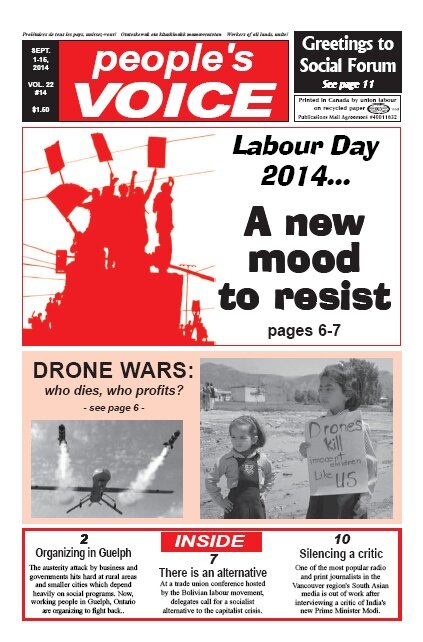
1) LABOUR DAY 2014: A NEW MOOD TO RESIST!
2) CITIZENS IN GUELPH FIGHT THE AUSTERITY AGENDA
3) ANTI-WOMEN AGENDA OF HARPER TORIES SEEN AT U.N.
4) ONTARIO TEACHERS AND EDUCATION WORKERS FACE TOUGH BARGAINING
5) KAMLOOPS LABOUR ACTIVIST JOINS CIVIC RACE
6) SONA CASE JUST SCRATCHES SURFACE - Editorial
7) TAKING MEDICARE TO COURT - Editorial
8) GTA RAIDS TARGET IMMIGRANT WORKERS
9) COUNCIL OF CANADIANS SAYS CETA WILL NOT SURVIVE PUBLIC SCRUTINY
10) PROMINENT JOURNALIST REVEALS PRESSURE TO SUPPORT INDIA'S PM MODI
11) THE PROFITS BEHIND DRONE WARFARE
12) COLOMBIA RESUMES PERSECUTION OF LILIANY OBANDO
13) COMMEMORATE BHAAG SINGH'S MARTYRDOM IN A REAL SENSE
14) HASHTAG GENOCIDE: WHY GAZA FIGHTS BACK
15) MUSIC NOTES, by Wally Brooker
PEOPLE'S VOICE SEPTEMBER 1-15, 2014 (pdf)
People’s Voice 2014 Calendar
”The Truth About the Great War”
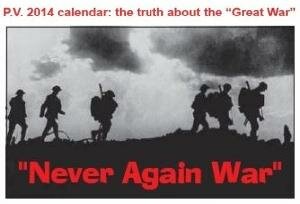
To order a copy of the People’s Voice 2014 Anti-First World War
Calendar, send $15 (includes postage and handling) to
People’s Voice, 706 Clark Drive, Vancouver, BC, V5L 3J1. Contact us at
604-255-2041 or pvoice@telus.net for bulk order prices.
|
People's Voice deadlines: September 16-30 October 1-15 Send submissions to PV Editorial Office,
|
REDS ON THE WEB
http://www.parti-communiste.ca/
peoplesvoice.ca
www.ycl-ljc.ca
www.solidnet.org
|
People's Voice finds many "Global Class Struggle" reports at the "Labour Start" website, http://www.labourstart.org/. We urge our readers to check it out! |
* * * * *
People's Voice
Canadian Publications Mail Sales Product Agreement #205214
ISSN number 1198-8657
People's Voice is published by
New Labour Press Ltd
PV Editorial Office
706 Clark Drive,
VANCOUVER, B.C. V5L 3J1
Phone:604-255-2041
Fax:604-254-9803
email: pvoice@telus.net
Editor: Kimball Cariou : Business Manager: David Au
Editorial Board: Kimball Cariou, Miguel Figueroa,
Doug Meggison, Naomi Rankin, Liz Rowley, Jim Sacouman
* * * * * *
Letters
People's Voice welcomes your letters
on any subject covered in our pages.
We reserve the right to edit for length and clarity,
and to refuse to print letters which may be libellous
or which contain unnecessary personal attacks.
Send your views to:
"Letters to the Editor",
706 Clark Dr., Vancouver, BC V5L 3J1,
or pvoice@telus.net
People's Voice articles may be reprinted without permission,
provided the source is credited.
* * * * * *
The Communist Party of Canada, formed in 1921,
has a proud history of fighting for jobs, equality, peace,
Canadian independence, and socialism.
The CPC does much more than run candidates in elections.
We think the fight against big business and its parties
is a year-round job,
so our members are active across the country,
to build our party and to help strengthen people's movements
on a wide range of issues.
All our policies and leadership
are set democratically by our members.
To find out more about Canada's party of Socialism,
give us a call at the nearest CPC office.
* * * * * *
Central Committee CPC
290A Danforth Ave Toronto, Ont. M4K 1N6
Ph: (416) 469-2446
fax: (416) 469-4063 E-mailmailto:info@cpc-pcp.ca
Parti Communiste du Quebec (section du
Parti communiste du Canada)
5359 Ave du Parc, Montréal, Québec,
H2V 4G9
B.C.Committee CPC
706 Clark Drive, Vancouver, V5L 3J1
Tel: (604) 254-9836
Fax: (604) 254-9803
Edmonton CPC
Box 68112, 70 Bonnie Doon P.O.
Edmonton, AB, T6C 4N6
Tel: (780) 465-7893
Fax: (780)463-0209
Calgary CPC
Unit #1 - 19 Radcliffe Close SE
Calgary AB, T2A 6B2
Tel: (403) 248-6489
Ottawa CPC
Tel: (613) 232-7108
Manitoba Committee
387 Selkirk Ave., Winnipeg, R2W 2M3
Tel/fax: (204) 586-7824
Ontario Ctee. CPC
290A Danforth Ave., Toronto, M4K 1N6
Tel: (416) 469-2446
Hamilton Ctee. CPC
265 Melvin Ave., Apt. 815
Hamilton, ON.
Tel: (905) 548-9586
Atlantic Region CPC
Box 70 Grand Pré, NS, B0P 1M0
Tel/fax: (902) 542-7981
http://www.parti-communiste.ca/
* * * * * *
News for People, Not for Profits!
Every issue of People's Voice
gives you the latest
on the fightback from coast to coast.
Whether it's the struggle for jobs or peace, resistance to social cuts,
solidarity with Cuba, or workers' struggles around the world,
we've got the news the corporate media won't print.
And we do more than that
- we report and analyze events
from a revolutionary perspective,
helping to build the movements for justice and equality,
and eventually for a socialist Canada.
Read the paper that fights for working people
- on every page, in every issue!
People's Voice
$30 for 1 year
$50 for 2 years
Low-income special rate: $15 for 1-year
Outside Canada $50 for 1 year
Send to: People's Voice, 706 Clark Drive, Vancouver, BC, V5L 3J1
You can call the editorial office at 604-255-2041
REDS ON THE WEB
http://www.parti-communiste.ca/
http://www.ycl-ljc.ca/
http://www.solidnet.org/
(The following articles are from the September 1-15, 2014, issue of People's Voice, Canada's leading socialist newspaper. Articles can be reprinted free if the source is credited. Subscription rates in Canada: $30/year, or $15 low income rate; for U.S. readers - $45 US per year; other overseas readers - $45 US or $50 CDN per year. Send to People's Voice, c/o PV Business Manager, 706 Clark Drive, Vancouver, BC, V5L 3J1.)
1) LABOUR DAY 2014: A NEW MOOD TO RESIST!
Labour Day Message from the Central Executive Committee, Communist Party of Canada
There is a new mood in the Canadian labour movement - the mood to resist. This was the propellant at the May CLC Convention, where incumbent president Ken Georgetti was narrowly defeated, and a groundswell replaced the inertia of rest with the demand for action. The winner, Hassan Yussuff, was successful after adopting the action program of Hassan Husseini and the "Take Back the CLC" movement which captured the discontent that has been maturing for years. The defeat of Georgetti, moving Hassan Yussuff to the helm, the re-election of Barb Byers and Marie Clark Walker, and adding prominent CUPW activist Donald Lafleur, was the delegate mandate for militant action.
In Ontario, following the dormancy of the Samuelson years, the OFL under the leadership of Sid Ryan displayed concretely what can be accomplished if labour takes the bull by the horns and implements independent political action. There is no doubt that the decisive defeat of the Hudak Tories in the Ontario election was due in large part to the campaigning and mobilization of the labour movement. This was not just a defeat for a political candidate, but for the reactionary agenda of the "Right‑to‑work" pro-corporate movement. The blow struck by Ontario labour will weaken the whole anti‑labour agenda. Nevertheless labour is under siege across the country. From the BC teachers to Québec municipal workers to the Nova Scotia nurses, the pattern is the same. The corporate sponsored attack on social programs, pensions, education and Medicare is an assault on those who provide and defend those programs. Labour must not rest to relish success. The Ontario fightback should be a game plan for a major defeat of the federal Tories in 2015.
The attack on workers which ushered in almost thirty years of relative wage stagnation in Canada was escalated after the 2008-09 recession, as the corporate elite escalated their offensive and plundered wages, working conditions, government treasuries and public property to refinance their own coffers and maintain their super‑profits. Under the guise of mutual necessity, they re‑tooled their manufacturing and replaced their bank accounts at taxpayers' expense, put thousands out of work, forced concession bargaining and escalated the commodification of human lives and labour.
Preceding this attack, the disastrous "Free Trade" agreements led by NAFTA cost 557,000 jobs in manufacturing alone between 2002 and 2013. The current and more dangerous CETA pact with the European Union has been stalled by elements in the German Parliament balking at the complete corporate control and dispute mechanisms within it. This unfortunately is just a temporary respite.
The dedication of the Harper Tories to the corporate agenda is so complete that in 2008, to kick off the CETA negotiations, they co-hosted a meeting of Canadian and European corporations to set down a "wish list" around which to formulate the content of the giveaway. Of course at the time this was kept secret, but has emerged through the revelations of the Council of Canadians, the Canadian Centre for Policy Alternatives and several trade union research papers. CETA will effectively put the economic activities of all levels of government under the control of transnational corporations, governed by a corporate dispute mechanism residing outside the country, with more authority than Canadian courts and elected bodies. According to the clauses in NAFTA, it will have to be revised to ensure a level exploitation field. Say goodbye to what's left of sovereignty.
This is only the tip of the iceberg, as the global corporate agenda applies its tactics to each country in the quest for empire, led by the United States with NATO as its military arm. The foreign policy of Canada becomes increasingly pro-war, reflected domestically by the attack on democratic institutions, social justice organizations, equity groups, environmental movements, and most intense of all, the trade unions. To ensure the continued existence of a historically redundant capitalist system, it is necessary to destroy the institutions of the people, and switch from a hegemony of bribery and concessions to a hegemony of war and brutalization. The attack on Gaza and the revival of fascism in Ukraine are dress rehearsals for all of us.
Organized labour in Canada, even after a ten percent decline in density since the 1970s, is still better situated than our American sisters and brothers to mount defense and fight back. Our 32% organized (17% in private sector), compared to the collapse of US labour to 12% (6% in private sector), gives us a better springboard if we do not allow our leadership spectator status.
Labour has not yet attained unity in the face of attack, but unity is growing despite those who feel threatened by it. Unity is not an abstract dream, but a concrete necessity that can only be achieved around program and mutual goals. The very concept of "an injury to one is an injury to all" is a political class concept that extends ideologically beyond economics and plant floor issues. It is a rejection of narrow "business trade unionism". It is a concept of social being that in its very nature must deal with social existence. In the here and now, this means it must deal with class struggle, with recognition of the need for class struggle. The capitalists understand this very well. In the words of the ridiculously wealthy Warren Buffet, "Of course there is a class struggle and our class is winning it."
The reality of the class struggle, for something and against something, demands the concept of a future alternative. If this concept is not inherent in the struggle, to what end and what strategy are our tactics formulated? We know where we've been, but where are we going?
From June 30 to July 2 an important "Ant‑Imperialist International Trade Union Conference" was held in Bolivia, hosted by the Bolivian Workers Central, the World Federation of Trade Unions and the government of Evo Morales. It was attended by over 1000 delegates from every corner of the world.
The impressive final Document should be studied. The following quote from Evo Morales sets the tone for all of us: "I want to propose something that concerns the social movements of this world: how can we, in a united fashion, confront capitalism? I am convinced that we must elaborate a new thesis to save the planet, a doctrine in support of life."
The North American media do everything in their power to obscure the vision of Evo Morales, the fact that our dilemma is global, that the attack on our labour movement is part of a global attack, that the resistance is seething, that millions are fighting the same dragon.
The confrontation with capitalism is the socialist alternative. The harnessing of capital and its ultimate replacement is a necessity for the protection of habitat and humanity's advance to a higher level free from war, hunger, disease and terror.
Solidarity and Unity to all workers in all countries this Labour Day 2014!
(For a copy of the final document from the "Anti-Imperialist International Trade Union Conference" e-mail your request to sh72645@gmail.com.)
2) CITIZENS IN GUELPH FIGHT THE AUSTERITY AGENDA
PV Guelph Bureau
On August 6th, a group of concerned citizens in Guelph, under the banner of SOS‑Save Our Services, organized a public forum about the importance of defending the quality of our social services. People's Voice co‑sponsored this event, along with representatives of two unions defending the bus drivers and the postal workers of the city of Guelph: the Amalgamated Transit Union (ATU) Local 1189, and the Canadian Union of Postal Workers (CUPW) Local 546.
Cutbacks hit small cities, rural areas
In the current context of the drive to the right and the loss of jobs and public services, small cities and rural areas are suffering the most. Cutbacks in Crown corporations, like Canada Post at the federal level, have severely impacted the quality of service. But cutbacks don't come alone. In 2012 the government locked out Canada Post workers, demanding concessions such as two‑tier wages, benefit cuts, and increasing the years of work needed to achieve full pensions.
Shelley Sillers, President of CUPW Local 546, was interviewed by People's Voice, before the SOS‑Save Our Services event in Guelph. Sillers noted her union "is active in many areas, in addition to the door‑to‑door delivery campaign". She confirmed that "working conditions have hardened, in the last years", and at the same time, Canadians have seen a deterioration of the mailing system, by removing daily delivery, establishment of community mailboxes and the sharp increase in postage prices on March 31st.
Regarding the community mailboxes, Sillers pointed that "it is just a matter of time before the end of door‑to‑door service reaches Guelph, as community mailboxes already exist in Acton, Milton and Georgetown".
In response to Canada Post's declarations of poverty, Sillers explained that "it is not true that Canada Post lost money in 2012, and over the years they have been making money, they have been even renewing the machinery for mail sorting. Canada Post does not need to run profits, there is no need to turn millions of dollars over to the government every year. Taxpayers do not pay for Canada Post. As a public service and Crown company it just needs to serve the citizens".
Sillers was accompanied by Elaine McMurray, a retired postal worker, and current President of the Congress of Union Retirees of Canada, who stated that Canada Post is undermining the employee pension plan, just as the government is doing with the Canada Pension Plan.
"By raising the (retirement) age and not increasing the amount, they've left many seniors in precarious financial situations. Never mind Freedom 55," McMurray said. "Good luck retiring at 65. You may have to work longer than that."
Leon Bouvier, a regional officer with CUPW, pointed to the extreme difficulties, such as covering 100 km to pick up mail, that people in Northern Ontario will face with full implementation of the community mailboxes. He noted that Canada Post is the first postal company in the world doing this. In addition, he said that the government's agenda is privatization, breaking unions, and hiring temporary contract workers who don't receive benefits or pensions.
Furthermore, postal workers display a great deal of social responsibility, and they know the importance of their services for the most vulnerable.
"In Guelph, we have a good number of elderly and disabled people that will have problems after discontinuation of the door‑to‑door service", Sillers said. "Postal workers feel proud of what they do, and would like to see the continuation of the service."
Transit workers secure new contract
In Guelph, local City Councillors and the Mayor, after some initial negotiations, imposed a lockout and demanded bus drivers accept concessions. Once more, the lockout was the tool used by City Council to hamper negotiations with the ATU Local 1189. Speaking at the SOS meeting, ATU President Andrew Cleary declared that "bus drivers had often been denied the most basic human rights, such as the lack of accessible washrooms, public phones, and a lunch room at the (new) Guelph Central Station".
In addition, schedules are tight, and drivers have a very limited timeframe to meet them. "Today's attack on labour is about making concessions, not about gains," Cleary said. "For us it's not about money but human dignity".
Cleary noted the importance of this service to Guelph's citizens, who had been left high and dry by Council's decision and its lack of social responsibility. Again, vulnerable people received the hardest blow. The elderly and people who relied on public transportation had to seek alternatives, often at much greater cost. Taxis were much busier during the two‑week long lock‑out, and the streets had a much denser traffic than usual.
Before finally securing an acceptable contract, ATU 1189 workers twice voted to reject the City's concessions offers, and by big margins. In the words of Cleary to the Guelph Tribune, bus drivers "had been (through) a difficult process, but ended up in a better place". He said the language in the agreement was crucial, and that "we're on good footing with the city and we can repair this relationship. All parties committed to moving forward".
The reaction of Mayor Karen Farbridge in the Guelph Tribune seemed to hide the impacts created by her council's decisions: "while we expect to restore transit service in our community by Friday (Aug. 8th), this isn't a celebration. Guelph's transit riders and, in particular, the working poor have endured a tremendous hardship throughout this disruption. Tomorrow, the hard work continues as we work to repair the relationship between city administration and our transit employees".
The Mayor had tried to blame transit workers for the lockout, and whip up anti‑union sentiment. It had some of the same characteristics as the strikes and lockouts in Windsor and Toronto, where the employers tried to create a big public crisis rather than bargain. The fact that October 27 is election day in Ontario cities, no doubt added gasoline to the fire lit by the city and fanned by Mayor Farbridge.
It is important, however, to stress the high degree of responsibility displayed by Guelph bus drivers, amidst the pressures from the employer. The ATU 1189 President declared that "We ratified for the citizens of Guelph", after 80% of members accepted the third tentative agreement.
Cleary explained some details of the new contract to the Guelph Tribune. This includes wage increases up to 6.8% over four years, passing from the current $26.49/hr to $28.85/hr in June 30, 2017. Long‑term disability payments were reduced from 75% to 70% of salary, effective on January 1, 2015. A cap on blanked lieu time was set at 50 hours per calendar year, for all employees. Dental and health benefits were maintained. The grievance resolution process was enhanced, and a letter of understanding will be also made regarding working conditions.
SOS‑Save Our Services to fight job cuts and privatization
A significant outcome of the struggle against attacks on the working class and their social services, such as those brought by Canada Post workers and Guelph bus drivers, has been the response of more and more Canadians. In Guelph, SOS‑Save our Services organisers carried out intense days of face‑to‑face conversations with people to increase awareness, and to help empower the citizenry. This led to the formation of a new collective group aiming to defend our most basic social services. If this kind of example spreads, the tasks set forward by CUPW, ATU and other unions across Canada could be amplified through the unity of citizens in an important network of social organizations.
3) ANTI-WOMEN AGENDA OF HARPER TORIES SEEN AT U.N.
By Kimball Cariou
Canada's federal government faces sharp criticism for its weak positions at sessions of the UN Human Rights Council dealing with sexual violence against women.
The episode reveals the anti-equality ideology of the Harper Tories, even as they hypocritically use Bill C-36 to pose as defenders of the rights of women. That legislation, which the Tories claim is intended to protect women by banning the purchase of sexual services, actually criminalizes sex workers while providing a tiny pittance to help them leave the industry.
Despite its rhetoric, the Harper government stubbornly rejects the growing demands for a public inquiry into the murders and disappearance of hundreds of Aboriginal women in recent decades. And while Harper keeps the most virulently anti-choice members of his caucus on a short leash (apparently fearing a voter backlash), his government is waging a stubborn fight against women's sexual and reproductive rights on a global scale.
One of the leading organizations concerned with these issues, Action Canada for Population and Development (ACPD), has participated in the UN sessions. As the ACPD reports, "Governments and civil society organizations are once again calling into question Canada's leadership on the Violence Against Women (VAW) resolution at the UN Human Rights Council."
At the June 2014 session of the Council, Canada chaired the negotiations of a resolution titled "Violence against women as a barrier to women's political and economic empowerment".
"Due to Canada's actions," says the ACPD, "the final resolution once again fails to guarantee access to a comprehensive package of sexual and reproductive health information, goods and services to women and girls. This not only represents a barrier to women's health, rights and well‑being, but also to their ability to freely participate in political and economic activities."
At the session, Canada consistently declined proposals to strengthen the resolution from numerous states, including the annual resolution's traditional co‑sponsors.
The ACPD notes that "The concerns raised by Canada's traditional allies arose initially when Canada tabled a weak first draft, which did not contain any references to sexual and reproductive rights and health. States continued to express disappointment in the process as Canada repeatedly disregarded their constructive proposals.... which aimed to meaningfully integrate sexual and reproductive rights and health into the text. Canada blatantly ignored previously agreed upon sexual and reproductive rights‑related language, in favour of watered‑down text."
The final text includes the recognition that "respecting and promoting sexual and reproductive health, and protecting and fulfilling reproductive rights in accordance with the Programme of Action of the International Conference on Population and Development, the Beijing Platform for Action and the outcome documents of their review conferences is a necessary condition to achieve gender equality and the empowerment of women." It also calls on states to reduce "barriers to women's social, economic and political empowerment, including by promoting and protecting sexual and reproductive health and reproductive rights."
But these references were the result of efforts by countries such as France, Germany, Belgium, Denmark, Finland, Ireland, Netherlands, Norway, Switzerland and Uruguay, among others. Canada would not have voluntarily proposed even these weakened versions of previously agreed upon language.
Canada's traditional allies delivered a joint statement expressing deep concern regarding Canada's approach to facilitating consensus on the resolution.
The United States said the "resolution should have contained specific references to sexual and reproductive health services which ... are crucial because the risk of pregnancy is also an important possible outcome of rape."
Other international documents recognize the need for survivors of violence to have access to emergency contraception, safe abortion, and post‑exposure prophylactics for HIV and other sexually transmitted infections.
On numerous occasions, South Africa raised with Canada its concerns about the lack of "tangible interventions" to address violence against women in the resolution.
As a result, only about 80 out of 193 United Nations member states co‑sponsored the resolution, showing the Harper government's growing isolation from the international community, in contrast to its single-minded focus on pro-corporate investment deals.
The ACPD concludes, "it is time for Canada to consider relinquishing its role of chair of this annual resolution should it continue to block reference to effective strategies to eliminate all forms of violence against women."
4) ONTARIO TEACHERS AND EDUCATION WORKERS FACE TOUGH BARGAINING
By Liz Rowley
The passage of Bill 122 last April created a new two‑tiered bargaining platform for Ontario's teachers and educational workers. Major money issues like wages will be bargained provincially, and local issues with local School Boards. For many, this seemed to be a step forward, since the previous Tory government stripped School Boards of their taxing powers, while imposing balanced budget legislation. The thinking was: the province has the purse strings, let's bargain where the money is.
But the Liberal government has just been re‑elected after campaigning on a budget that promised an across-the-board public wage freeze, along with privatization of public services, and the sell‑off of public assets. The Premier didn't spend a lot of time talking about these items, preferring to focus on a provincial pension plan and a 10-year infrastructure plan. But the wage freeze and privatization is at the core of the plan to pay for it all, while corporate taxes will continue to fall to a CIT rate of 10%. (The provincial Tories are pressing for an 8% CIT rate.)
Teachers and education workers are first up at the plate, with the Bill 115 contract imposed by former Liberal Premier Dalton McGuinty expiring at the end of August. Bill 115 suspended free collective bargaining in the education sector two years ago, removing $2 billion from the pockets of teachers and support staff. That prompted massive province‑wide demonstrations which eventually forced McGuinty to resign, proroguing the Legislature for almost six months.
His successor, Kathleen Wynne, won last June's election by divorcing herself from McGuinty and Bill 115, with the promise "never again". Wynne could easily have lost, if not for the far right policies of the Hudak Tories, and the right‑wing NDP campaign. In fact, the Liberal platform appeared much more progressive than the other two.
Now the Liberals' teeth are showing as they attempt to force another round of cuts. Mid‑August gatherings of the Elementary and Secondary Teachers' Federations jeered and scoffed when the Premier addressed them with her message of austerity and cuts.
Federation Presidents Sam Hammond (ETFO) and Paul Elliott (OSSTF) told media they don't want a repeat of the struggle two years ago, but their members will not accept a wage freeze. It was a polite way to say the ball is in the government's court to bargain fairly and prevent a strike or workplace action ‑ which this time could be province‑wide.
The Premier is kidding herself if she thinks teachers and education workers have forgotten their bitterness against the Liberals and Bill 115, just below the surface. It wouldn't take much to rekindle that anger.
Wynne's response through the media was that the envelope for education funding was sealed, but the funds inside could be moved around. It was an invitation to use some of the funds for special education, capital funding, and other under-funded pieces of the education pie, to buttress wages and benefits instead. This offer to rearrange the deck chairs on the Titanic was a trap to pit workers against students and community.
But the unity of teachers, educational workers, students, parents, and the community can stop the government from its wage cuts and austerity. It's important to win Round One of this fight, since the nurses and healthcare workers are next. This is where the pattern is set.
Left out so far are the School Boards, the gate‑keepers of education in cities and towns across Ontario. For too long, too many of them have functioned as willing accomplices in imposing austerity and cuts. Some Trustees are too timid, and some too anxious to be "team players" for future political benefits. Some Trustees and Boards, including those in Hamilton, Windsor, Ottawa and Toronto, have distinguished themselves by standing up to right-wing governments and refusing to implement devastating cuts. That was ten years ago. But those are exactly the kind of Boards and Trustees we need today.
October 27 is election day in Ontario, a good time to change the composition of the Boards. We need to elect progressive majorities who will fight for quality public education, including good wages and benefits for the workers in the system, and a needs-based funding formula to deliver quality education to Ontario's children and adult learners. It's a package: teachers' working conditions are students' learning conditions. Quality education matters to all of us ‑ now and in the future.
School Boards embody local autonomy and local democracy in every city and community. That's why they're relevant, that's why we need them. The Boards must speak out for free collective bargaining, and stand by teachers and educational workers, students and parents, who want the government to negotiate a deal and let the teachers teach and the support workers support.
Some of the candidates who should be elected this time include Howard Kaplan, running for re‑election in Toronto's North York, Juanita Burnett in Guelph, and Harinder Pal Singh Hundal in Brampton. They have good track records in their community of fighting austerity, and standing up for good services. Take a good look at your candidates and watch what they do in the next few weeks. That's how you will know who to vote for by October.
5) KAMLOOPS LABOUR ACTIVIST JOINS CIVIC RACE
Kamloops and District Labour Council President Peter Kerek will be seeking a seat on Kamloops City Council this fall. The 41‑year‑old labour activist hopes that other progressives will join him in helping Kamloops become a more responsible community.
"This is a region that has great potential for sustainable development," says Kerek. "We have strength in a diversity of industries at our doorstep ‑ mining, forestry, construction, agriculture, tourism, education, healthcare ‑ there's no need to become a one‑trick pony and lose the economic diversity that has thus far enabled us to withstand the woes of crisis capitalism."
Kerek points to the AJAX copper mine proposal as an idea that would forever change the ecology of the Kamloops area.
"First Nations people around here lived sustainably off the land for thousands of years before the arrival of the Europeans. It's only in the last couple hundred years that industries like forestry and mining have appeared. It would be a terrible mistake to take such a risky gamble on a development that will have a permanent negative effect on the landscape while providing, at best, a short‑term, unsustainable, neutral effect on the overall local economy."
Having listened to a variety of experts in the fields of economics and health, as well as those who have worked and continue to work in the mining industry, Kerek is decisively against the giant mine development. He's also unimpressed with the revised proposal announced last May.
"KGHM hoped that a couple million dollars in brochures, PR staff, and charitable donations would have been enough to quell the mine opponents and have everyone accept Plan A. That didn't work, so they've revealed Plan B, which will cost $800 million more than Plan A, and this new plan is supposed to help reduce airborne toxins.
"So, you must wonder, did they not know how bad the air pollution would be in Plan A until protestors pointed it out? Or, did they know how bad it would be, but thought that if they threw around enough money, everyone would just jump for joy and accept the hush money thereby avoiding the much bigger expense of $800 million?
"I don't think it's hard to conclude that KGHM has no interest in doing what's best for Kamloops so long as they can carry out their plans in the most profitable way possible. They've been very crafty in their messaging with elements of truthiness and generosity around supporting local charities, but they've also shown significant vagueness around the negative health and economic impacts of their proposals."
Among the current seven councillors, only Tina Lange and Donovan Cavers have stated they oppose the mine development. As Kerek says, "folks should be alarmed when something as big as the AJAX mine proposal arises and the majority of their city's council can't seem to form an opinion based on the evidence and risk."
Kerek graduated with a B.A. from UBC in 1997, and then received a Journalism degree from Thompson Rivers University in 2003. He refuses to place optimism ahead of the facts.
"Glossy brochures and meaningless promises are no replacement for the dearth of information already available about the negative health impacts related to open pit mining. We should never forget that multi‑national corporations will always place the needs of their shareholders over the needs of our community ‑ it's their legal obligation to their shareholders."
Kerek also intends to support efficiencies in transportation infrastructure, improved food security, and poverty reduction.
"Federal and provincial governments have been shirking their responsibilities for the last 20 years and, increasingly, municipalities have been forced to tidy up their failures. This is the unfortunate reality communities across the country face, and we shouldn't keep crossing our fingers, hoping that the next government in Victoria or Ottawa will fix things, we need to take action when and wherever possible, including right here at city council."
For more information, phone 250‑819‑5900, or join Kerek's Facebook page: www.facebook.com/pages/Elect-Peter-Kerek-for-Kamloops-City-Council/681848835217146
6) SONA CASE JUST SCRATCHES SURFACE
People's Voice Editorial
While welcome, the guilty verdict against Tory slimeball Michael Sona leaves many questions about the 2011 election, when the Harper Conservatives won a majority with less than 40 percent of the popular vote. As the Council of Canadians points out, electoral fraud was observed in 246 federal ridings, not just Guelph where Sona and his robocall buddies gleefully sabotaged the right to cast a ballot. Legal challenges in six other ridings may yet give a clearer picture of Conservative tactics in that campaign.
The Federal Court found in 2013 that fraudulent calls misdirected non-Conservative voters in dozens of ridings, most likely using the Conservative Party's database. The Tories are widely suspected of using U.S. Republican-style voter suppression strategies.
The Un"Fair" Elections Act, which was adopted in June, is a prime example. Despite some important amendments after a public outcry, the law forbids Elections Canada from promoting voting, and tightens the guidelines on proving residency to vote. The Act targets sections of the population who are least likely to vote Conservative, including students, Aboriginal people, and low-income earners, and makes it harder for the Chief Electoral Officer to report on complaints from voters. The Act will be challenged in court, hopefully in time for the 2015 campaign.
But there are other huge hurdles to electoral democracy, especially the first-past-the-post system. Without some form of proportional representation, voters in many ridings have little incentive to even go to the polls. Just as important, the corporate media almost universally refuses to report on smaller political parties, making it difficult for voters even to learn about alternative candidates on their ballots.
Without serious reforms, the electoral system will remain heavily tilted in favour of the ruling class. That's not a reason to boycott elections, but it is a reason to demand real democracy in Canada.
7) TAKING MEDICARE TO COURT
People's Voice Editorial
Believe it or not, Canadians may be at risk of losing our universal Medicare system.
On September 8, a legal challenge to Medicare opens in a British Columbia courtroom. The outcome could be the nightmare of a two-tier, US‑style health care system. The challenge comes from Canada's leading health privatizer, Dr. Brian Day, owner of Vancouver's for‑profit Cambie Surgery Centre. Launched in 2008, this case targets legislation that limits the for‑profit delivery of medically necessary services, allegedly because these rules violate the Charter of Rights and Freedoms. In reality, Day's clinic often charges clients far more than the cost of procedures carried out under Medicare. But the case will almost certainly be appealed up to the Supreme Court of Canada.
As the B.C. Health Coalition warns, a victory for Day would open the gates to a US‑style system, where private health insurance through employers costs $16,000 for an average family of four, with a $2,000 deductible. The actual cost to Canada's public Medicare system for such a family is just $8,000, paid through taxes. The administration of our Medicare system takes just 1.3% of health care costs, compared to 31% of health care spending in the U.S.
This case is a serious threat to Canada's public health, education and social programs. Carrying out the corporate-driven austerity agenda, governments keep slashing spending, using the "create a crisis" strategy to attack the entire public sector. It's true that our schools and hospitals are far from perfect, but scrapping universal access to health and education would only help the wealthy elite and the big corporations. We join Health Coalitions across Canada in urging readers to help push back against Brian Day and his fellow privatizers, by demanding that governments put the health of the people ahead of private profits.
8) GTA RAIDS TARGET IMMIGRANT WORKERS
From No One Is Illegal
More than 50 people were arrested on their way to work in the Greater Toronto Area (GTA) during the week of August 11-15. The undocumented workers were ambushed by armed officers in a series of early morning sweeps. They face separation from their families, indefinite detention, and deportation.
"This is an outrage," insists Syed Hussan, organizer with No One Is Illegal-Toronto, a migrant justice advocacy group. "Why is immigration enforcement stopping people from going to work and tearing them away from their families? This is about spreading fear and forcing hundreds of thousands of vulnerable undocumented people to work deeper in the shadows just to be able to eat."
Geraldine Ortiz, a family member of one man picked up in an August 14 raid adds, "My brother‑in‑law was waiting to get his papers in order. Now he's in detention. We are hopeful that he will get out, but so many families are frightened right now. While visiting him at the detention centre, I saw a small girl speaking on the phone to her father through the glass. They were both crying. This is just so wrong. Why don't we give people immigration status?"
Over several days, immigration enforcement officers, along with Toronto Police, some in Ministry of Transportation vans, pulled over undocumented day‑laborers on their way to work under the guise of a traffic stop. Everyone in the car was coerced into giving up their IDs and many were detained at the Toronto Immigration Holding Centre at 385 Rexdale. The raids occurred in the Jane‑Wilson, Keele‑Wilson and Weston‑401 areas.
"It's clear that these raids are relying on racial profiling to make these immigration related arrests. As such the legality of the raids is extremely questionable. CBSA officers need to stop breaking the law and find something useful to do rather than terrorizing migrant communities of colour," adds immigration consultant Macdonald Scott. "The involvement of Toronto police should be condemned, this goes against the spirit of Toronto's Sanctuary City policy. City Council has promised that undocumented people should feel safe in Toronto, instead they are being raided on the way to work."
In a legal opinion released in July, the United Nations stated that Canada's system of indefinite detention is in violation of international laws and conventions. The UN found that Canada's system is arbitrary, unfair, and lacks a clear limit on the length of detention, leading some people to be detained for over 10 years without charge. Since the current federal government came to power, over 85,000 migrants have been detained without charge or trial.
Suzanne Narain of the Jane Finch Action Against Poverty (JFAAP) adds, "Our communities are being targeted for being poor, and for the colour of our skin. We see too many cops, and not enough services. Without decent jobs, people are forced to work in these dangerous jobs as day labourers, just to put food on the table. Immigration enforcement and Toronto Police should be ashamed of themselves for tearing people away from their families."
9) COUNCIL OF CANADIANS SAYS CETA WILL NOT SURVIVE PUBLIC SCRUTINY
The Council of Canadians says it is pleased that the Canada‑EU trade deal, the Comprehensive Economic and Trade Agreement (CETA), has seen the light of day after German television show Tagesschau provided the full text online.
Throughout the process, this agreement and its devastating impacts have been kept locked away from legislators and the public, shielded from a democratic process. Finally, it comes to light, probably because people in Germany are fed up with the secrecy and fed up with being taken hostage by companies,ö says Maude Barlow, Council of Canadians national chairperson.
The Harper government has celebrated the completion of the agreement, setting a signing date of September 26. CETAÆs investor‑state dispute settlement provisions have been on the radar in Germany, where there is opposition to them. They would allow corporations to sue countries for lost profit. The Vattenfall decision, where a company sued Germany for pulling out of the nuclear industry, is fresh in GermanyÆs mind after the Fukushima nuclear accident.
Obviously, the Harper government is tone deaf when it comes to relations with Germany and the growing opposition to CETA. We are committed to working with the opposition in Europe to kill this æcorporate bill of rights,Æö remarked Barlow.
Responding to the news, the Council of Canadians also warned that this text (and earlier versions of it) should have been made public to give the public the appropriate amount of time to read it, discern its contents and comment on it fully. The whole CETA negotiation process has been undemocratic, and has failed in terms of transparency.
In other observations, the group says the 25‑page investor‑state section "appears to be a standard investor‑state dispute settlement: a three‑person panel that would make decisions rather than the mature court systems. This probably will not placate Germany."
The 30‑page procurement section "appears to give no consideration to the numerous Canadian municipalities that requested to be exempted from its provisions."
The Council also warns that "the EU language was adopted on resolution of pharmaceutical patent disputes. This will open the flood gates to pharmaceutical companiesÆ law suits. This will lengthen patent lengths and delay generics coming to market. In the end, this could severely increase public health care costs by $900 million to $1.7 billion."
After the signing ceremony, the ratification process will include translation of the complex deal into 23 languages, which could take up to two years or more. That process, according to various news reports, involves ratification by the 10 provincial legislatures (and possibly the three territorial legislatures), the 751‑member European Parliament, the EU's 28 member states, and the European Commission. Implementation of the deal is scheduled for mid‑2016.
Both the NDP and Liberals have made public statements supportive of the deal, while seeking details.
In sharp contrast, the Communist Party has stated bluntly that "The Harper Tories are setting the stage for privatization of all public assets and services... This trend will become virtually unstoppable with the signing of secretive deals such as the Comprehensive Economic and Trade Agreement (CETA) with the European Union, which aims to prevent any future government from adopting policies or laws which could impact the profits of private corporations. CETA introduces changes which escalate previous giveaways, and adds new conditions of exploitation and penetration of global capital into Canada."
The NDP says it has long maintained that "Canada should have deeper economic relations with the European Union... (but) unfortunately, Conservatives have kept Parliament and Canadians in the dark throughout the negotiations with talks conducted in secret and without any transparency."
And the Liberals say, ôWe have been supportive of the deal from the start. Canada is a small country. The world economy is huge. And if we want our middle class to be prosperous û which is the core of our agenda û having trade deals with the world is absolutely essential.... ItÆs important to say this is a great step, but also we really need to start seeing some details."
This support, says the Council, "comes despite the evident inclusion of the highly controversial investor‑state dispute settlement mechanism in the deal and intellectual property rules that would increase the cost of pharmaceutical drugs by billions of dollars for provincial governments across the country."
The Council of Canadians was the first organization to challenge CETA. See www.canadians.org/blog/ceta-will-likely-be-signed-it-will-also-implode for more information.
10) PROMINENT JOURNALIST REVEALS PRESSURE TO SUPPORT INDIA'S PM MODI
PV Vancouver Bureau
One of the best-known radio and print journalists in British Columbia's South Asian community has resigned from his job rather than bow to management pressures to censor criticisms of India's Prime Minister Nardendra Modi.
Gurpreet Singh had worked at Surrey-based Radio India for about 13 years, hosting a popular morning news and talk show with a wide range of guests in both Punjabi and English. His is also a frequent contributor to the free Vancouver weekly Georgia Straight, and to People's Voice. Earlier this year, he led the initiative to begin publication of Radical Desi, a monthly magazine which explores issues from a left perspective.
But Gurpreet Singh's employment at Radio India has come to an abrupt end, in a dispute with management over coverage of responses to the upcoming U.S. visit by Modi.
As Singh explains in a Georgia Straight commentary, "Modi was earlier denied entry by the U.S. because of his government's complicity in the anti‑Muslim pogrom in the state of Gujarat in 2002. Modi was chief minister of Gujarat when police allowed thousands of Muslims to be murdered by mobs led by Hindu fundamentalist leaders. Following the change of guard in India after the last election, the U.S. is now inviting Modi without caring for concerns raised by human‑rights groups."
The "Modi lobby" appears to be pressuring the South Asian media in North America. A search of such media outlets shows little criticism of the new PM, but considerable positive coverage.
As Singh reports, "August 5 ... was my last day as news broadcaster and talk‑show host with Radio India. I was told by my former employer that we should start endorsing Modi's proposed visit to the U.S. instead of giving voice to anyone who opposes it.
"The provocation was my live interview with the spokesman of Sikhs For Justice, which has launched a petition asking the U.S. government to cancel Modi's visit. I was told that Sikhs For Justice supports a theocratic Sikh state and under no circumstances such groups should be given any kind of legitimacy.
"I do not agree with the agenda of Sikhs For Justice and being a secularist myself, I can never support any kind of theocracy. But being a journalist, I was only trying to give voice to a group that has launched an initiative on a very pressing issue.
"I had to explain that Modi's proposed visit is not just being opposed by Sikhs For Justice but other non‑Sikh activists too. But all my arguments fell on deaf ears. I was rather told that if I cannot do this, the nature of my duties can be changed. I therefore adamantly decided to quit rather than continue working there."
Initially thinking that the incident might be related to "internal conflicts" at the radio station, Singh asked to have his employment terminated, but the manager refused to fire him, essentially forcing him to resign.
Singh decided to go public about "the threat of an undeclared censorship in India and its impact overseas."
He points out that Modi's Hindu nationalist Bhartiya Janata Party (BJP) opposed the state of emergency and media censorship imposed on India by the Congress party in 1975, when Modi himself went underground to avoid arrest. Ironically, since Modi was elected last May with a majority in Parliament (but only about 30% of the popular vote), a wave of attacks on free expression has begun.
He gives a number of examples, including the arrests of 13 students in Kerala state, for mocking Modi in college magazines. In one case, students were arrested for including Modi in a list of "negative faces", such as Adolf Hitler, Osama Bin Laden, and George W. Bush. In another, a Marxist youth activist was arrested in August for allegedly defaming Modi on Facebook.
A mocking comedy play named after the BJP's election slogan "Ache Din Aane Wale Hain" ("Happy days are coming") was banned in Chandigarh, which is represented in parliament by Kiron Kher, a film actor turned BJP MP.
As Singh writes, "Obviously, a sense of fear and intimidation prevails among the members of civil society in India due to these incidents. There is also a feeling that this may spill over to Canada and the U.S., especially in areas with sizable South Asian communities."
"I have no animosity against my former employer, who has always helped me in the past, first by hiring me and allowing me freedom on many occasions," says Singh. "But how he has succumbed to such pressure now can only be explained by him.
"For me the bigger issue is a challenge coming from fascist forces that are blatantly attacking free expression under a right-wing government. All we need is a strong initiative against fascism and the sophisticated ways it can muzzle independent voices."
Radical Desi held a meeting in Surrey on August 9, with representatives from progressive groups and media outlets. Among them was Tejinder Kaur, who said that she was fired by a Punjabi radio station under similar circumstances.
Many other groups expressed their support for initiatives to defend free expression, including the Committee of Progressive Pakistani Canadians, East Indian Defence Committee, Progressive Cultural Center, Communist Party of Canada, Fraser Valley Peace Council, Watan Magazine, Rationalist Society, Aam Aadmi Party, Chetna Association, and South Asian Review.
People's Voice will report on further developments in our next issue. For Gurpreet Singh's full commentary, visit www.straight.com.
11) THE PROFITS BEHIND DRONE WARFARE
By T.J. Petrowski
The use of drones, or unmanned aerial vehicles (UAVs), to murder men, women, and children around the world, including American citizens, continues to be a secretive and highly controversial issue in the U.S. Despite the abundance of articles denouncing the immorality and illegality of the use of drones under international law, less examination has been given to the profit motivations behind the use of drones, under the pretext of the "War on Terror", by U.S. imperialism.
The manufacture and maintenance of UAVs as well as the systems used in UAV warfare are highly profitable to private corporations. UAVs are much less risky for their political representatives than conventional warfare, which has frequently been used to transfer public money into the private hands of the ruling class. UAVs offer the advantage to corporations of continuing to profit from a permanent war economy during capitalist crises, and to corporate political representatives by eliminating the media backlash caused by soldiers killed in action.
Modern UAV warfare was pioneered by Israel in its 1982 invasion of Lebanon, where it used UAVs to monitor troop movements, and more recently to intimidate and control Palestinians in Gaza. Israel continues to have a controlling share in the market, responsible for 41% of the UAVs exported worldwide between 2001 and 2011.
However, UAVs have expanded far beyond Israel, with many Western weapons manufacturers taking a slice of the market for themselves. The largest corporations that manufacture UAVs or UAV technology are Boeing, General Atomics Aeronautical Systems Inc., Lockheed Martin, Northrop Grumman, AeroVironment Inc., Prox Dynamics AS, Denel Dynamics, SAIC, Israel Aerospace Industries, and Textron Inc.
The infamous "Predator Drone" that President Obama loves to make provocative jokes about is manufactured by General Atomics for the U.S. Air Force for $4.5 million each. Predator UAVs have been used in combat in the Balkans, Iraq, Libya, Somalia, Pakistan, Yemen, Afghanistan, and elsewhere. The Hellfire missile often attached to Predator UAVs, manufactured by Lockheed Martin, costs on average around $110,000 each. Statistics collected by various non‑profit organizations show that the almost 400 UAV strikes in Pakistan alone have cost $33 million to $44 million, and killed between 2,000 and 3,000 people. The cost of flying time for both the Predator and its $12 million successor, the Reaper, is $2,500 to $3,500 per flight hour. General Atomics had a revenue of almost $700 million in 2012. On average, the U.S. spends $4.8 billion annually on UAVs and UAV technology, and it is expected to spend $23.9 billion in the next five years.
The market for UAVs in the U.S. is not strictly for the military; the Department for Homeland Security and police services are increasingly using UAVs. Homeland Security has spent more than $200 million on UAVs to patrol the U.S.‑Mexican border to prevent undocumented immigrants from entering the U.S. and to fight the "War on Drugs."
Outside of the U.S. the UAV market is highly profitable for corporations. The U.K. military spent $30 million on UAVs from the Norwegian manufacturer Prox Dynamics AS; Northrop Grumman, an American corporation, sold $1.2 billion in UAVs to South Korea; and General Atomics sold $197 million worth of UAVs to the United Arab Emirates.
In fact UAVs have become so profitable that some corporations, such as Textron, have started to develop unmanned underwater vehicles to be used by navies.
War is a highly profitable investment for corporations, especially in times of capitalist economic crises. Any examination of the illegality and immorality of imperialist military activities should start with an examination of the capitalist system itself.
12) COLOMBIA RESUMES PERSECUTION OF LILIANY OBANDO
Special to PV
A human rights activist known by many Canadians has been imprisoned yet again by the Colombian government.
The International Network in Solidarity with Colombia's Political Prisoners has sharply condemned the latest jailing of Liliany Obando, the renowned Colombian trade unionist, documentary filmmaker, academic and human rights defender who was first taken into custody on August 8, 2008.
The INSCPP says that Obando "was one of 12 leftist political figures named as part of an offensive called `FARC‑politica' against the political opposition to the Uribe and now Santos governments. Thus began a 6‑year‑long ordeal for Liliany Obando beginning in Buen Pastor women's prison. Liliany spent almost 4 years in prison until 1st March 2012 when she was put on provisional release due to an `end of terms' determination and international pressure. While on provisional release, the Criminal Court Judge 9 sentenced Liliany Obando to 70 months imprisonment plus a US$400,000 fine. This was ratified by the Superior Court of Bogota in October 2013. The decision of the Court noted that Liliany is a single mother of two children and could serve the balance of her sentence in home detention as she did not represent a risk to society...
"Liliany's family has suffered these torments along with her. Their distress was heightened dramatically when on 5th August she was taken back into custody at the same time lawyers were mounting an appeal against a warrant for her to be taken back into detention for the remainder of her sentence. A staff strike in the Judiciary means that she is currently stuck in a holding cell or bunker at the Fiscalia (Prosecutor's Office) in Paloquemao, Bogota with extremely limited access for family or lawyers' visits.
"Again, a trial by media has been launched with misrepresentations being made that she is facing a new charge of aggravated `rebellion' ‑ the catch all charge that is used to intimidate opponents of Colombia's pariah government....
"We call on all solidarity organisations to speak out against this new injustice against Liliany and other academics, human rights campaigners and their families."
Earlier this year, the Justice for Colombia website printed Obando's reflections on the legal persecution which she has faced, and her life since her provisional release.
As she wrote, "Over these two years of provisional freedom I have tried, not without difficulty, to move ahead with every area of my life: political, as a human rights activist, as a mother, a daughter, a student, a professional, etc. I was going through the motions of a `normal' life under the constant pressure and uncertainty over the unresolved judicial case....
"Since prison, the process of coming back to life has been as complex as it was to get used to being denied my freedom. I lived, like many others, with my family, in a situation of unease and solitude, broken by a few unforgettable demonstrations of solidarity, especially from abroad.
"Since I've regained my freedom I have carried on my work, trying to contribute what I can to the dream of a fair and peaceful society, without forgetting those who remain behind bars. But my family and I carry on living as perpetual hostages, threatened, photographed and followed by state security and others... There was no time for individual or group therapy which would help us to deal with this existence. The problem of safety and risk to my family because of my presence got so difficult that I had to make a drastic decision, to avoid my family from being harassed. Few people know what it's like for a mother with young children to have to leave them once again, even if only temporarily, to avoid putting them in danger. This second separation to protect lives, which I endured for a while, created indescribable pain within my family....
"My commitment and dream of finding peace with social justice and building a new country, remain unchanged. And as a female human rights activist, my commitment to revolutionary political militancy around women's issues has been strengthened. The abuses faced by women are an affront to human dignity and in prison thousands of women endure indifference and invisibility.
"This woman, who the irrational logic of war wanted to silence and bury, is now more alive and free than ever. Once again the revolutionary Phoenix returns from the ashes in our struggle..."
For more information: www.inspp.org/news
www.justiceforcolombia.org/news/article/1624/liliany-obando-a‑political-prisoner-in-colombia
13) COMMEMORATE BHAAG SINGH'S MARTYRDOM IN A REAL SENSE
From Radical Desi magazine (abridged)
This fall marks 100 years of the martyrdom of Bhaag Singh, the towering leader of the Sikh community in Canada, who was assassinated on September 5, 1914.
Respectfully known as Bhai Bhaag Singh within the local Sikh community, he headed the Khalsa Deewan Society, the oldest Sikh religious body formed by the community elders to resist racism and discriminatory immigration policies. The Vancouver Sikh temple governed by the body also provided space for political activism. Those who assembled there believed in secularism and a just society. The Khalsa Deewan Society never discriminated against non-Sikhs, and leaders belonging to other faith groups received equal respect.
Bhaag Singh was shot inside the temple by Bela Singh, a government spy. The shootout also claimed the life of Badan Singh, who tried to stop the assassin. The tragedy happened shortly after the Komagata Maru episode. The Japanese vessel carrying over 300 South Asian passengers was forced to return under a racist immigration law on July 23, 1914. The episode led to a bloody conflict between the political activists and pro-establishment elements of the South Asian community. These killings led to the assassination of William Hopkinson, a controversial immigration inspector, by Mewa Singh, who was hanged in 1915. Hopkinson was widely blamed for the temple shootout by the political activists. Bela Singh was acquitted on the grounds of self-defence, but was later killed in India by the revolutionaries. Bhaag Singh was associated with the same network of revolutionaries who murdered Bela Singh in 1933.
Bhaag Singh openly supported the Ghadar Party, a group of radical activists established in 1913 in North America to oppose racism and the British occupation of India. Both India and Canada were British colonies, and people like Bhaag Singh (who had previously served in the British army) migrated to Canada as British subjects. They all believed in the fairness of the British Empire. But they were soon disillusioned when the British Consulates refused to come to their aid in a situation of racial violence.
Men like Bhaag Singh realized that the root cause of their sufferings in North America was "slavery" back home. As a result, the Ghadar Party was formed to launch an armed rebellion against the British Empire. Bhaag Singh had already encouraged former Sikh soldiers to burn their medals and certificates to sever loyalties with the Empire. At a bonfire ceremony organized in 1909, he consigned his own uniform and discharge certificate to the flames. This was a very militant act of its time, as the Sikh clergy in India was largely pro-British. He strongly believed in peoples' unity and often asked the modernist and orthodox Sikhs to work together to fight against the power.
He was in the forefront of the campaign for the right to bring in their families. The Canadian government back then did not let South Asian immigrants bring their families, to discourage them from permanent settlement. To achieve this goal, Indian immigrants were also disfranchised in 1907.
Bhaag Singh also supported the cause of the Komagata Maru passengers. He was arrested in the US for buying weapons for those aboard the vessel, with an idea of engineering an armed revolt in India once they returned. In a nutshell, Bhaag Singh was a targeted man and was assassinated to weaken radical activism in the South Asian community.
100 years later, the struggle he started for social justice must be kept alive. The rights all immigrant communities have received over the years must not be taken for granted. Thanks to the radical activism of Bhaag Singh and his comrades, South Asians now have the right to vote and electoral representation in legislatures and the House of Commons. These rights are under severe attack from a right-wing Conservative government, and political activism is strongly needed to oppose these assaults.
Shamefully, the temple leaders and the gatekeepers in the Sikh community who use the name of the Khalsa Deewan Society for their own survival continue to ignore these real issues. Interestingly, both the camps of the modernist and the orthodox Sikhs are generally on the same page, trying to outdo each other in pleasing the establishment and remaining silent over controversial immigration policies, such as Bill C‑24 which empowers the authorities to take away citizenship. Their sharp ideological fight has not only divided the community, but also the prospects of coming together against discriminatory and draconian laws. It is time that they come together to challenge white supremacy that still exists in this country.
Bhaag Singh and the Ghadar activists believed in international solidarity and worked together with the socialists and revolutionaries from other nations. Today's community leaders must actively participate in campaigns against Israeli aggression in Palestine and the imperial designs of the world powers. The systemic racism against the indigenous peoples in Canada and neo- colonialism on their traditional lands must also be questioned by South Asians. After all, the two communities share a history of colonialism and racism.
Instead of indulging in symbolic commemorations of Bhaag Singh's martyrdom, the community gatekeepers should support initiatives such as Idle No More, a grassroots level movement of the indigenous activists. Lastly, on the occasion of Labour Day, South Asian activists should pay a real tribute to Bhai Bhaag Singh by showing support to the labour movement, standing with striking BC teachers and the Save Canada Post campaign.
14) HASHTAG GENOCIDE: WHY GAZA FIGHTS BACK
By Ramzy Baroud, from the Morning Star (UK)
My old family house in the Nuseirat refugee camp in Gaza was recently rebuilt by its new owner into a beautiful three-storey building with large windows adorned by red frames. In Israel's most recent and deadliest war on Gaza, the house sustained significant damage. A large hole caused by Israeli missiles can be seen from afar, in a part of the house where our kitchen once stood.
It seems that the original target was not my house, however, but that of our kindly neighbour, who had spent his entire working life toiling between manual jobs in Israel and later in life as a caretaker for UN‑operated schools in Gaza. The man's whole life savings were invested in his house, where several families lived. After "warning" rockets blew up part of his house, several missiles pulverised the rest.
My entire neighbourhood was also destroyed. I saw photos of the wreckage‑filled area by chance on Facebook. The area where we played football as little kids was filled with holes left by missiles and shrapnel.
The shop where I used my allowance to buy sweets was blown up. Even the graveyard where our dead were meant to rest in peace was anything but peaceful. Signs of war and destruction were everywhere.
My last visit there was about two years ago. Underneath the shady wall of my old house I caught up with my old neighbours on the latest politics and the news of who was dead and who was still alive.
One complained about his latest ailments, telling me that his son Mahmoud had been killed as he had been a freedom fighter with a Palestinian resistance movement. I couldn't fathom the idea that Mahmoud, the child I remembered as running around half‑naked with a runny nose, had become a fierce fighter with an automatic rifle ready to take on the Israeli army. But that he was, and he was killed on duty.
Time changes everything. Time has changed Gaza. But the strip was never a passive place of people subsisting on handouts or a pervasive sense of victimhood.
Being a freedom fighter preceded any rational thinking about life and the many choices it had to offer growing up in a refugee camp and all the little kids of my generation wanted to join the Fedayeen.
But options for Gazans are becoming much more limited than ever before, even for my generation. Since Israel besieged Gaza, with Egypt's help and co‑ordination, life for Gazans has become largely about mere survival.
The strip has been turned into a massive ground for an Israeli population control experiment. Gazans were not allowed to venture out, fish or farm, and those who got even close to some arbitrary "buffer zone," determined by the Israeli army within Gaza's own borders, were shot and often killed.
With time, the population of the strip knew that they were alone. The short stint that brought Mohammed Morsi to power in Egypt offered Gaza some hope and a respite, but it soon ended. The siege, after the overthrow of Morsi, became tighter than ever before.
The Palestinian leadership in Ramallah did very little to help Gaza. To ensure the demise of Hamas, Mahmoud Abbas's Palestinian Authority carried on with its "security co‑ordination" with Israel, as Gaza suffered a draconian siege. There was no question that after all the failed attempts at breaking the siege and the growing isolation of Gaza, Gazans had to find their own way out of the blockade.
When Israel began its bombardment campaign of Gaza on July 6, and a day later with the official launch of the so‑called Operation Protective Edge, followed by a ground invasion, it may have seemed that Gaza was ready to surrender.
Political analysts have been advising that Hamas has been at its weakest following the downturn of the Arab Spring, the loss of its Egyptian allies and the dramatic shift of its fortunes in Syria and, naturally, Iran. The "Hamas is ready to fold" theory was advanced by the logic surrounding the unity agreement between Hamas and Fatah - and unity was seen largely as a concession by Hamas to Abbas's Fatah movement, which continued to enjoy Western political backing and monetary support.
The killing of three Israeli settlers in the occupied West Bank in late June was the opportunity for Israeli Prime Minister Benjamin Netanyahu to test the misleading theory on Hamas's weakened position. He launched his war that eventually mounted into a genocide, hoping that Hamas and other resistance groups would be forced to disarm or be completely eradicated - as promised by various Israeli officials.
But it didn't. From the very first days of the war it became clear the resistance could not be defeated, at least not as easily as Netanyahu had expected. The more troops he invested in the war on Gaza, the more Israeli army casualties increased.
Netanyahu's response was to increase the price of Palestinian resistance by inflicting as much harm on Palestinian civilians as possible. He killed over 1,900, wounded nearly 10,000, a vast majority of whom were civilians, and destroyed numerous schools, mosques, hospitals and thousands of homes, thus sending hundreds of thousands of people on the run. But where does one run when there is nowhere to go?
Israel's usual cautious political discourse was crumbling before Gaza's steadfastness. Israeli officials and media began to openly call for genocide.
Middle East commentator Jeremy Salt explained: "The more extreme of the extreme among the zionists say out loud that the Palestinians have to be wiped out or at the very least driven into Sinai," he wrote, citing Moshe Feiglin, the deputy speaker of the Israeli Knesset, who called for "full military conquest of the Gaza Strip and the expulsion of its inhabitants. They would be held in tent encampments along the Sinai border while their final destination was decided. Those who continued to resist would be exterminated."
Israeli commentator Yochanan Gordon flirted with genocide in his article "When genocide is permissible." And Israeli politician Ayelet Shaked advocated the killing of the mothers of those who resist and are killed by Israel.
"They should follow their sons. Nothing would be more just. They should go, as should the physical houses in which they raised the snakes. Otherwise more little snakes are raised," he wrote on Facebook.
References to genocide and extermination and other devastatingly violent language are no longer "claims" levied by Israeli critics but a loud and daily self‑indictment made by the Israelis themselves. The Israelis are losing control of their decades‑long hasbara, a propaganda scheme so carefully knitted and implemented that many the world over were fooled by it.
Palestinians, those in Gaza in particular, were never blind to Israel's genocidal intentions. They assembled their resistance with the full knowledge that a fight for their very survival awaited.
Israel's so‑called Protective Edge is the final proof of Israel's unabashed face, that of genocide. It carried it out, this time paying little attention to the fact that the whole world was watching.
Trending Twitter hashtags which began with #GazaUnderAttack, then #GazaResists, quickly morphed to #GazaHolocaust. The latter was used by many that never thought they would dare make such comparisons.
Gaza managed to keep Israel at bay in a battle of historic proportions. Once its children are buried, it will once again rebuild its defences for the next battle.
For Palestinians in Gaza, this is not about mere resistance strategies but their very survival.
Ramzy Baroud is a PhD scholar in people's history at the University of Exeter. His latest book is My Father Was a Freedom Fighter: Gaza's Untold Story (Pluto Press, London).
15) MUSIC NOTES, by Wally Brooker
Camp Naivelt celebrates Pete Seeger
Camp Naivelt, perched between a golf course and a conservation area on the Credit River just west of Toronto, has long been an incubator for progressive, grassroots culture. The camp, run by the Toronto chapter of the United Jewish People's Order, has been at this location since 1935. Over the years, it has nurtured popular musical groups like The Travellers and Sharon, Lois and Bram, and hosted some of the most important progressive artists of our times, including Pete Seeger, Paul Robeson, Phil Ochs and Leon Rosselson. Cultural programming at Naivelt has always combined respect for the heritage of people's culture with a determination to pass the torch to the next generation. Events at the camp this summer demonstrate that this tradition is alive and well.
This writer had the opportunity to participate in a week of musical activities at Camp Naivelt, culminating in three special events on the Civic Holiday weekend. It began with the annual week-long music camp, led by two outstanding musician‑educators: clarinettist Martin Van De Ven and blues/folk singer Faith Nolan. Under their tutelage, instrumental musicians and singers of all ages and levels were brought together to experience the joys of music‑making in a nurturing, non‑competitive atmosphere. They showed their stuff at a joyous Saturday evening concert of klezmer music, folksong and other musical delights.
The next day, hundreds of visitors came to remember Pete Seeger. The ceremonies began with the annual Peace Tea, held on the lawn in front of the Lazowsky Centre (the camp's hall). Writer and activist Ronnee Jaeger explained the origins of this annual event, which observes the anniversary of the 1945 bombing of Hiroshima and Nagasaki. Guest speaker George Auerbach, a native of New York City, paid tribute to that exemplary peace activist and teacher, Pete Seeger. Faith Nolan led a spirited singalong, joined at the end of her set by B.C. banjoist‑folklorist Danny Bakan, and Sharon Hampson and Bram Morrison (of Sharon, Lois & Bram fame).
In the evening, the atmosphere inside the Lazowsky Centre was festive, as a capacity crowd assembled for the gala Pete Seeger tribute. The hall was decorated with flowers, banners, and a special motif: dozens of cut‑out banjos (template compliments of cartoonist and Naivelter Mike Constable), all uniquely painted by young and old, and symbolizing Seeger's unconquerable justice-seeking spirit. Performers included Toronto folk‑revival trio Where Have All the Folksongs Gone?, Neil Sharp & Hugh Hunter (from the nearby Brampton Folk Club), Safety in Numbers (Naivelt's own community band), a trio consisting of trumpeter David Buchbinder, jazz pianist Dave Restivo and vocalist Roula Said, and the aforementioned Faith Nolan, Danny Bakan and Sharon & Bram.
As the concert drew to a close, Sharon & Bram led a singalong of "Kisses Sweeter Than Wine" and performed Sally Rogers' eloquent 1995 Seeger tribute "Pass Them On", before stepping back and introducing a recording of an elderly Seeger singing his 1958 tribute to departed friend John T. McManus: "To My Old Brown Earth". (To my old brown earth/And to my old blue sky/I now give these last few molecules of "I"/And you who sing/And you who stand nearby/I charge you not to cry). Following this poignant moment, all of the performers, accompanied by the camp children's chorus, returned to the stage to lead the house in rousing versions of "We Shall Overcome" and "Goodnight Irene".
Met Opera unions fight cutbacks
Unions at New York's Metropolitan Opera could be hitting the bricks any day now. General Manager Peter Gelb is demanding that the opera's workers accept $180 million in pay cuts. He's threatening to impose a lockout and file for bankruptcy if the unions don't cooperate with his plan to eliminate a $2.8 million deficit. Unions involved include the American Guild of Musical Artists, AFM Local 802, and IATSE locals 1 (carpenters & stage hands), 751 (ticket sellers), 764 (costume shop workers), 794 (broadcast technicians), 798 (stylists) & 829 (artists & designers). They charge the Met with bloated management salaries and repeated cost overruns, citing Gelb's pay and compensation ($1.8 million last year) and the $169,000 spent on painted poppies for a recent production of Borodin's Prince Igor. Local 802 President Tino Gagliardi estimates that non‑pay demands by management (i.e. health insurance & work rules) translate into actual cuts for orchestra members of 25%‑38%. At press time the dispute is in mediation. The Met's 2014‑2015 season is scheduled to begin on Sept. 22, and its popular HD simulcast series is scheduled to begin on Oct. 11.
Noteworthy new songs for Palestine
Two of the finest radical English‑language singer-songwriters have contributed timely new songs in support of the struggle of Palestinians for peace and justice: Leon Rosselson's The Ballad of Rivka and Mohammed and David Rovics' Gaza (from his new album Falasteen Habibti) can both be found on YouTube.