|
|
June 16-30, 2014
Volume 22 – Number 11 $1
Prolétaires de tous les pays, unissez-vous!
Otatoskewak ota kitaskinahk mamawestotan!
Workers of all lands, unite
1) STOP KIEV'S BLOODY OFFENSIVE AGAINST CIVILIANS!
2) HARPER SHOULD APOLOGIZE TO THE PEOPLE OF CANADA
3) DRAMATIC CONTRADICTIONS: 2014 REPORT OF UN SPECIAL RAPPORTEUR
4) CHILLING CRITICS INTO SILENCE – Editorial
5) FIGURES DON'T LIE, BUT.... – Editorial
6) QUEBEC BUDGET SLAMMED BY LABOUR, LEFT, INDIGENOUS GROUPS
7) POLITICAL STORM OVER VANCOUVER LGBTQ+ POLICY UPDATE
8) COMPLETE SOLIDARITY WITH B.C. TEACHERS
9) OTTAWA STATEMENT ON MASS SURVEILLANCE IN CANADA
10) A CANADIAN OBSERVER IN EL SALVADOR
11) THE UKRAINE CRISIS AND THE NEW COLD WAR
13) CAPTAIN AMERICA FIGHTS AT HOME
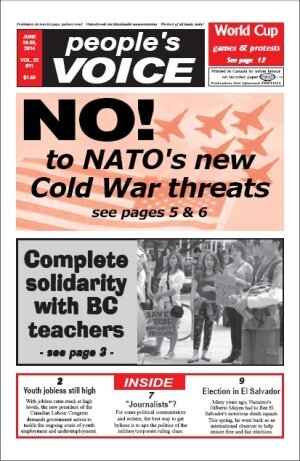
PEOPLE'S VOICE JUNE 16-30, 2014 (pdf)
People’s Voice 2014 Calendar
”The Truth About the Great War”
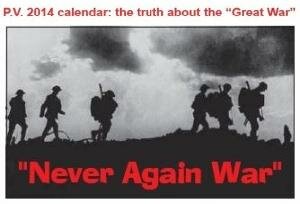
To order a copy of the People’s Voice 2014 Anti-First World War
Calendar, send $15 (includes postage and handling) to
People’s Voice, 706 Clark Drive, Vancouver, BC, V5L 3J1. Contact us at
604-255-2041 or pvoice@telus.net for bulk order prices.
|
People's Voice deadlines: July 1-31 August 1-31 Send submissions to PV Editorial Office,
|
REDS ON THE WEB
http://www.parti-communiste.ca/
peoplesvoice.ca
www.ycl-ljc.ca
www.solidnet.org
|
People's Voice finds many "Global Class Struggle" reports at the "Labour Start" website, http://www.labourstart.org/. We urge our readers to check it out! |
* * * * *
People's Voice
Canadian Publications Mail Sales Product Agreement #205214
ISSN number 1198-8657
People's Voice is published by
New Labour Press Ltd
PV Editorial Office
706 Clark Drive,
VANCOUVER, B.C. V5L 3J1
Phone:604-255-2041
Fax:604-254-9803
email: pvoice@telus.net
Editor: Kimball Cariou : Business Manager: David Au
Editorial Board: Kimball Cariou, Miguel Figueroa,
Doug Meggison, Naomi Rankin, Liz Rowley, Jim Sacouman
* * * * * *
Letters
People's Voice welcomes your letters
on any subject covered in our pages.
We reserve the right to edit for length and clarity,
and to refuse to print letters which may be libellous
or which contain unnecessary personal attacks.
Send your views to:
"Letters to the Editor",
706 Clark Dr., Vancouver, BC V5L 3J1,
or pvoice@telus.net
People's Voice articles may be reprinted without permission,
provided the source is credited.
* * * * * *
The Communist Party of Canada, formed in 1921,
has a proud history of fighting for jobs, equality, peace,
Canadian independence, and socialism.
The CPC does much more than run candidates in elections.
We think the fight against big business and its parties
is a year-round job,
so our members are active across the country,
to build our party and to help strengthen people's movements
on a wide range of issues.
All our policies and leadership
are set democratically by our members.
To find out more about Canada's party of Socialism,
give us a call at the nearest CPC office.
* * * * * *
Central Committee CPC
290A Danforth Ave Toronto, Ont. M4K 1N6
Ph: (416) 469-2446
fax: (416) 469-4063 E-mailmailto:info@cpc-pcp.ca
Parti Communiste du Quebec (section du
Parti communiste du Canada)
5359 Ave du Parc, Montréal, Québec,
H2V 4G9
B.C.Committee CPC
706 Clark Drive, Vancouver, V5L 3J1
Tel: (604) 254-9836
Fax: (604) 254-9803
Edmonton CPC
Box 68112, 70 Bonnie Doon P.O.
Edmonton, AB, T6C 4N6
Tel: (780) 465-7893
Fax: (780)463-0209
Calgary CPC
Unit #1 - 19 Radcliffe Close SE
Calgary AB, T2A 6B2
Tel: (403) 248-6489
Ottawa CPC
Tel: (613) 232-7108
Manitoba Committee
387 Selkirk Ave., Winnipeg, R2W 2M3
Tel/fax: (204) 586-7824
Ontario Ctee. CPC
290A Danforth Ave., Toronto, M4K 1N6
Tel: (416) 469-2446
Hamilton Ctee. CPC
265 Melvin Ave., Apt. 815
Hamilton, ON.
Tel: (905) 548-9586
Atlantic Region CPC
Box 70 Grand Pré, NS, B0P 1M0
Tel/fax: (902) 542-7981
http://www.parti-communiste.ca/
* * * * * *
News for People, Not for Profits!
Every issue of People's Voice
gives you the latest
on the fightback from coast to coast.
Whether it's the struggle for jobs or peace, resistance to social cuts,
solidarity with Cuba, or workers' struggles around the world,
we've got the news the corporate media won't print.
And we do more than that
- we report and analyze events
from a revolutionary perspective,
helping to build the movements for justice and equality,
and eventually for a socialist Canada.
Read the paper that fights for working people
- on every page, in every issue!
People's Voice
$30 for 1 year
$50 for 2 years
Low-income special rate: $15 for 1-year
Outside Canada $50 for 1 year
Send to: People's Voice, 706 Clark Drive, Vancouver, BC, V5L 3J1
You can call the editorial office at 604-255-2041
REDS ON THE WEB
http://www.parti-communiste.ca/
http://www.ycl-ljc.ca/
http://www.solidnet.org/
(The following articles are from the June 1-15, 2014, issue of People's Voice, Canada's leading socialist newspaper. Articles can be reprinted free if the source is credited. Subscription rates in Canada: $30/year, or $15 low income rate; for U.S. readers - $45 US per year; other overseas readers - $45 US or $50 CDN per year. Send to People's Voice, c/o PV Business Manager, 706 Clark Drive, Vancouver, BC, V5L 3J1.)
1) STOP KIEV'S BLOODY OFFENSIVE AGAINST CIVILIANS!
Demand a negotiated political solution to the crisis in Ukraine
Issued by the Central Executive, Communist Party of Canada, June 9, 2014
The crisis in Ukraine continues to deepen with every passing day, and the danger that this conflict could spread beyond its borders and spark a direct confrontation between the U.S./NATO forces and the Russian Federation - both with vast nuclear arsenals - is very real. It is absolutely vital therefore that the peace forces across Canada and around the world act in unison to demand that the NATO military build‑up in Eastern Europe, and in the Baltic and Black seas be stopped and reversed immediately. The peace forces must act to block the threat of a new Cold War, and to call for a negotiated political solution to the current crisis, to prevent any further escalation and to preserve world peace.
The conflict in Ukraine stems from the unconstitutional power‑grab which ousted the previous, elected government at the end of February. As our Party has already noted, the crisis was precipitated by an orchestrated campaign by right‑wing opposition and neo‑fascist forces inside Ukraine - with massive financial backing and guidance from Washington and other Western imperialist powers - to overthrow the government of President Yanukovich and seize power. Far from being a popular, pro‑democracy "people's uprising", this coup d'Θtat was a highly organized operation, carried out with military precision, and masterminded from abroad, with the aim of bringing Ukraine entirely under the influence and domination of the Western imperialist centres. This has been a longstanding imperialist objective which, among other things, would weaken the Russian Federation economically and politically, and give US and NATO another firm foothold along Russia's sensitive Southern flank, strengthening the military/strategic encirclement of this rival power.
The coup in Kiev has been met by increasing popular resistance. The people of Crimea voted by an overwhelming majority to secede, and have since joined the Russian Federation. In other parts of Eastern Ukraine, pro‑autonomy forces have taken over more than 20 cities and towns in defiance of the pro‑Western putschist regime in Kiev, and are now facing a brutal military offensive by the regime to regain control. Artillery barrages and air strikes have been launched against Slovyansk, Luhansk, Mariupol and other centres in the East, killing a large number of unarmed civilians.
Furthermore, a number of atrocities have been committed by the newly‑formed Ukrainian "National Guard", made up largely of pro‑Nazi and neo‑fascist "volunteers. In one of the most outrageous examples of these war crimes, supporters of the illegitimate Kiev government - including members of the violent extremist Right Sector party ‑ surrounded peaceful anti‑government protestors in the southern city of Odessa who had taken refuge in the city's main union hall on May 2. The right‑wing crowd then set the union hall on fire, and 46 people died by being burned alive or jumping to their deaths trying to escape. Civilian casualties are climbing as residential areas, hospitals, schools and kindergartens come under artillery attack during this punitive and bloody offensive.
The U.S. Canadian and other NATO governments are virtually silent about this spreading humanitarian tragedy, as is the corporate‑controlled mass media. Indeed the Western imperialist camp has given its "go‑ahead" to the Kiev regime to carry out this assault, and is providing funds and increasingly sophisticated weaponry to undertake it.
Meanwhile, the NATO military build‑up of both personnel and advanced weapons systems is expanding in Eastern Europe right up to the Russian borders. NATO warships are plying the Baltic and Black seas, and Canadian and other NATO countries are carrying out surveillance overflights inside Ukraine on behalf of the Kiev regime.
Recently, the United Electrical Workers of America (UE) issued a brave statement expressing the union's deep concern about the conflict in Ukraine, the inclusion of fascist and neo‑Nazi parties in the new Kiev government, and the danger of a "return of the Cold War and the threat of a much hotter war" between the U.S./NATO countries and the Russian Federation.
"We favour peace and friendly, equitable economic relations between nations. We favour negotiations rather than military confrontation to resolve disputes, including this one. We believe the countries that defeated Nazism in World War II, including the U.S. and Russia, should work together against any resurgence of racism, anti‑Semitism and fascism in Europe," the UE statement concluded.
Our Party warmly welcomes this statement, and calls on the broad peace force, the trade union movement and all concerned citizens to follow this example by speaking out against the deepening Ukrainian crisis and to demand a peaceful, political solution.
At this critical moment, the Communist Party of Canada:
╖ condemns the military offensive by the Kiev regime in the Eastern part of the country and demands its immediate cessation;
╖ demands that NATO stop its provocative military build‑up in areas and countries adjacent to the Russian Federation, and remove its naval presence in the Black Sea;
╖ calls on the UN Security Council to intervene to stop the aggression inside Ukraine and prevent a humanitarian disaster;
╖ supports the call for political negotiations to reach a settlement in Ukraine that addresses the legitimate concerns of the peoples in the east and their desire for greater autonomy, while maintaining the territorial integrity of the country;
╖ demands that Canadian CF‑18s be withdrawn and that the Canadian Government end its belligerent stand and rather speak out for a peaceful political solution to this crisis.
‑ demands that Canada withdraw from the aggressive NATO military alliance.
2) HARPER SHOULD APOLOGIZE TO THE PEOPLE OF CANADA
Statement from the Central Executive Committee, Communist Party of Canada, June 9, 2014
At a May 30 dinner in Toronto hosted by far right political activists, Prime Minister Stephen Harper launched a vicious Cold War‑style attack against communism. The Communist Party of Canada condemns Mr. Harper's lies and baseless accusations. His slanderous speech aimed to build support for the growing NATO military build‑up against Russia, and to create the political conditions for accelerating the wide‑ranging Conservative attack on the trade union movement and democratic rights and freedoms in Canada. We call upon all Canadians to reject the Prime Minister's anti‑communist rhetoric, and to rally in defence of peace, democracy, labour rights and civil liberties.
Mr. Harper spoke at a fundraising event held by the so‑called "Tribute to Liberty" organization. The Conservative party's support for this group goes back years, to the start of their campaign to erect a "monument to the victims of communism" in the National Capital Commission area of Ottawa. Unable to raise sufficient funds privately, the group will be given millions of taxpayer dollars by the Conservative government for their highly political project, in violation of the principles of the NCC.
The Communist Party of Canada has spoken out against this reactionary initiative on several occasions. As we stated recently, "the monument project is a throwback to the sordid era of the Cold War, which resulted in a wave of anti‑communist frenzy, RCMP spying, witch‑hunts, blacklisting, social ostracism, imprisonment and deportations against many progressive‑minded Canadians. Such policies had a terrible chilling effect on public discourse and sharply curtailed the freedom of expression and associated democratic and trade union rights of all Canadians. The sponsors of this monument are now attempting to revive this tragic McCarthyist era of red‑baiting, which had been tossed into the dustbin of history."
The "Tribute to Liberty" organizers spread many outrageous falsehoods, most notably by including the 25 million Soviet citizens who died in the Second World War in their bizarre count of the supposed "victims of communism." By repeating these lies, the Prime Minister aligns himself with those who still believe that it would have been better for the world if Hitler Germany had defeated the Soviet Union on the eastern front. This view is a shocking attack on the families of the 47,000 Canadian soldiers who died fighting as allies of the Soviet people in the war against Hitlerism. Harper's statements are a brutal boot in the face for all who suffered under fascism, including the millions of Jews, Roma, people with disabilities, homosexuals, Communists, anti‑fascists and others murdered in the Nazi death camps. By falsely equating communism with fascism in his May 30 speech, the Prime Minister callously slandered all those who gave their lives to liberate Europe and the entire world from the menace of fascism.
We therefore call upon the Prime Minister to issue an immediate full apology to the people of Canada for his historical lies and his support for the pro‑fascist forces in the "Tribute to Liberty" group.
But his May 30 speech has further frightening implications.
By using this occasion to repeat his support for the coup regime which overthrew the elected government of Ukraine several months ago, the Prime Minister signalled again that he backs the spread of ultra‑right movements in Europe. The shock troops of the NATO‑backed February coup in Kiev were violent activists of neo‑fascist parties, which were immediately rewarded with cabinet posts and other official positions. The US. Canada, and other NATO powers are whipping up today's crisis in Ukraine, with the strategic aim of isolating Russia and crushing any geopolitical alternative to the military‑economic domination of the NATO‑EU imperialist countries. This is an important factor behind Mr. Harper's ludicrous accusation that Prime Minister Putin - a strong backer of the new capitalist class in Russia - is supposedly a Communist. Ever since the October Revolution of 1917, such accusations by leaders of the imperialist powers have been used to prepare public opinion for military interventions, blockades, trade embargoes and other forms of "big stick" intervention against countries which refuse to follow the agenda of transnational capital. We condemn the Prime Minister's dangerous Cold War militarist blustering, which raises international tensions and increases the threat of a catastrophic war in Europe. We also condemn the opposition NDP and Liberal parties in Parliament, which have eagerly joined Harper's Russia‑bashing in their opportunist grovelling for voter support.
The other element behind Mr. Harper's May 30 speech is the Conservative party's relentless propaganda campaign against working people, in particular the organized sections of the working class in Canada, which has the organizational strength to be at the centre of a broad‑based people's resistance movement against the Tory corporate agenda.
It is no accident that the Prime Minister vented his rage against communists - those who led many historic struggles to build the trade union movement in Canada, and who played key roles in the fights to win unemployment insurance, universal public medicare, old age pensions, pay equity, and other key elements of the social safety net. Several times in Canadian history, the ruling class banned the Communist Party, jailed its leaders and seized its assets, trying repeatedly to crush a party which spoke out fearlessly for democratic rights and civil liberties under the most difficult circumstances. Mr. Harper's speech was a transparent attempt to divide and weaken the opposition against his reactionary agenda, just as Cold War red‑baiting and blacklisting was a key tactic in the ruling class drive to smash the most militant trade unions and to weaken public resistance to the imperialist assault of the post‑WWII years.
In today's conditions, Mr. Harper's Conservatives at both the federal and provincial levels are moving to smash the trade union movement, impose "right to work for less" laws, destroy the remaining elements of the social safety net, and to privatize all public assets such as the Post Office and the CBC. For Stephen Harper to accuse the Communists of being "undemocratic" is the height of hypocrisy, since he and his government are the real threat to democracy, human rights and the living standards of working people in Canada. It was Mr. Harper, not the Communist Party, who attempted to remove voting rights for hundreds of thousands of Canadians, in a brazen attempt to steal the next federal election before the campaign even begins. The Tory party, not the Communists, are conducting massive surveillance operations against those who dissent against their agenda.
Much more needs to be said about the Prime Minister's cowardly, bullying speech at the May 30 dinner. We join with many others in pointing out, for example, that Canada does need a monument - to the victims of capitalism. The history of capitalism in Canada and the western hemisphere is a story of mass murder by the colonial powers, a genocide which cost some 90 million lives of indigenous peoples. The slave trade and the imperialist occupation of colonies in Africa and Asia resulted in similar slaughters. During the 20th century, tens of millions of people died in wars launched by capitalist powers in their relentless imperialist re‑division of the planet. Every year, some two million workers die as a direct result of job "accidents" and diseases related to the work environment. Most recently, hundreds of coal miners in Turkey were killed in a massive explosion caused by the profiteering of capitalist owners. In Canada, the annual death toll of workplace accidents is nearly one thousand. Relentless capitalist expansion in pursuit of higher corporate profits threatens the entire global environment, endangering billions of human beings.
Why is there no talk by Mr. Harper's government about a monument to these victims of an economic, social and political system based on exploitation for the sake of private profits?
To ask the question is to know the answer. Mr. Harper is the representative of big capital, of the big banks and resource corporations which rake in enormous profits at the expense of the working class of Canada and other countries. His anti‑communism is nothing but a tactic to confuse the public and to smash popular resistance against the neoliberal corporate assault. Our answer will be to expose Harper's lies, and to redouble our efforts to help build a powerful People's Coalition against the right‑wing agenda. Our goal remains a socialist Canada, based on the collective interests of working people and the environment, rather than the murderous pursuit of private profit.
3) DRAMATIC CONTRADICTIONS: 2014 REPORT OF UN SPECIAL RAPPORTEUR
By Pamela Palmater, from indigenousnationhood.blogspot.com
In May, the United Nations Rapporteur on the rights of Indigenous Peoples in Canada James Anaya released his advanced, unedited report on "The Situation of Indigenous Peoples in Canada". The Rapporteur based his report on research, various sources, a visit to Canada in October 7‑15, 2013, meetings with federal and provincial government officials, and meetings, visits with and submissions from Indigenous peoples.
There is a disturbing underlying theme in the report - one which speaks of "dramatic contradictions":
(1) The continued "abysmal" social conditions in First Nations in the context of increasing wealth and prosperity in Canada; and
(2) The numerous laws and protections for First Nation rights versus the many human rights violations committed against First Nations.
Anaya noted that while some First Nations have risen up against these injustices with the Idle No More movement, others are starting to give up attempts to resolve their claims. Anaya concluded that the relationship between Canada and First Nations has become much worse since the last visit to Canada in 2003. It doesn't take a rocket scientist to figure out that this is during Prime Minister Harper's term.
Anaya's most serious concerns relate to the "striking" statistics related to the poverty in many First Nations. Of the bottom 100 communities in Canada - 96 are First Nations. "The most jarring manifestation of these human rights problems in the distressing socio‑economic conditions of indigenous peoples in a highly developed country."
He found that there has been no improvement in the gap between First Nations and Canadians in terms of housing, health care, education, welfare and social services. Given the significant needs of First Nations, Anaya had expected that the cost of social services would have been higher and was shocked to find that it was lower. He cited Canada's own Auditor General who pointed out that the failure to address poverty on reserve is due to the lack of appropriate funding from the federal government.
This led Anaya to conclude: "One of the most dramatic contradictions indigenous peoples in Canada face is that so many live in abysmal conditions on traditional territories that are full of valuable and plentiful natural resources."
It's not like there isn't enough money to go around. Canada is one of the wealthiest countries in the world because of the lands and resources which belong to Indigenous peoples. The mining industry alone brought in $44 billion in 2013.
That figure doesn't include the hundreds of billions in other natural resources that come straight from Indigenous lands. Anaya noted that while governments and private interests are the ones that profit from resources on Indigenous lands, it's the Indigenous peoples who suffer all the negative consequences in health, economy and culture that comes with the resulting environmental degradation.
This situation is not just an unfortunate, but inevitable consequence of western "progress" - it's a calculated policy choice to impoverish First Nations for the benefit of others. Anaya notes that Canada's consistent failure to consult with First Nations, take unilateral actions against their rights and portray them in negative light to the public is an "affront" to Canada‑First Nation relations. Anaya explains that the federal public discourse on First Nation rights is presented as a burden to tax‑payers instead of educating Canadians about the "vast economic benefit" they receive from First Nations. Harper's continued negative comments against First Nations risks "social peace".
First Nations could be completely self‑sufficient economically if they controlled only a fraction of their lands and resources. Yet, in pursuit of maximized profit, Canada continues to ignore the legal rights and interests of First Nations. Canada (both federal and provincial governments) maintain their legal and physical blockades against First Nations to prevent them from accessing and benefitting from their own lands and resources. Anaya notes that despite the fact that treaties are constitutionally protected and allows Canadians to enjoy immense wealth, 30% of Justice Canada litigation is fighting treaties. Canada uses all of it power - its laws, policies and programs to maintain First Nations in poverty, while partnering with private interests to maximize government and corporate profits.
Part of the dramatic contradiction which is so striking to outside observers. As noted by Anaya: "It is difficult to reconcile Canada's well‑developed legal framework and general prosperity with the human rights problems faced by indigenous peoples in Canada that have reached crisis proportions in many respects."
Canada presents a facade of human rights but commits numerous violations against Indigenous peoples - with apparent impunity. Although Anaya did not do a complete accounting of which laws and violations, he noted several human rights violations that have received "insufficient" attention by governments including the well‑being gap, housing crisis, murdered and missing women, over‑representation in Justice system, gender discrimination in Indian status, and lack of education to name a few.
Anaya concluded that Canada could address these human rights violations if it wanted to do so. Let's hope Canadian officials take a good hard look at Anaya's observations and recommendations and take the necessary action to end these human rights violations against Indigenous peoples.
A highlight of some of Anaya's key recommendations:
‑ Sufficient funding for education, health, and child welfare;
‑ Focus on Indigenous‑run social and judicial services;
‑ Urgent, increased funding to address the housing crisis;
‑ Enhance education, funding and consult on any proposed legislation;
‑ Comprehensive, nation‑wide inquiry into murdered and missing Indigenous women and girls;
‑ Consent for all laws impacting Indigenous peoples;
‑ Address gender discrimination in the Indian Act;
‑ No resource development without free, informed and prior consent of Indigenous peoples; and
‑ Maximize Indigenous control and benefit from any extractive operations on Indigenous lands.
"Indigenous peoples concerns merit higher priority at all levels and within all branches of Governments, and across all departments."
4) CHILLING CRITICS INTO SILENCE
People's Voice Editorial
Virtually every day, disturbing new evidence emerges regarding the vast scale of government/corporate/police surveillance into the lives of Canadians. In one sense, this phenomenon is nothing new; in the late 1940s, the RCMP was tasked with compiling an enormous database of Communist leaders. "PROFUNC", as the operation was called, expanded to 50,000 names over the next three decades, including almost anybody who came into contact with the Communist Party or other progressive movements.
PROFUNC was finally cancelled, but its roots were never eradicated. Speaking to a gathering of far-right organizers in Toronto on May 30, PM Stephen Harper dug up the Cold War to rail against Communists and "terrorists", a term which seems to cover nearly anyone opposed to the corporate destruction of Canada. His chilling speech coincided with revelations that the government and police forces aim to gather reports about every single demonstration which takes place in this country. In other words, whether you rally against the tar sands pipelines or in solidarity with striking workers, expect to be photographed and catalogued as a potential threat to national security.
Some supposed "threats" are already feeling the impact of this brutal attack on civil rights and democratic liberties. Here's just one case. On June 3, 16 cops raided a house in East Vancouver, under the pretext of investigating the "crime" of people spraying anti-pipeline graffiti during 2013. The four residents, and a guest, were removed one by one at gunpoint. While the state is targetting "radicals" (such as indigenous activists), the real intention of such tactics is to terrify any voices of resistance into silence and submission. We condemn every such action as an escalation of the capitalist state's psychological and political war against the people of Canada. Freedom and democracy must be defended against this attack - before it's too late!
People's Voice Editorial
The so‑called "independent" Parliamentary Budget Office, headed up by PM Harper's pal Jean‑Denis Fréchette, tells us that Conservative tax cuts have "saved" Canadians $30 billion, including personal income tax reductions of $17 billion, and the federal share of revenue loss GST/HST of $13 billion. That works out to about $800 per resident of Canada.
However, figures can be twisted for a political agenda. Canadians for Tax Fairness notes that the top 20 per cent of income earners got $10.9 billion, or 36 per cent of the total. Meanwhile, while the bottom 20 per cent got $1.9 billion, or only six per cent. The lowest income group gain less than $500 in tax reductions annually, while the top 20 per cent rake in almost $2,000 a year.
Nor did the Budget Office suggest that $30 billion could pay for affordable child care or housing, or cut post‑secondary tuition, or improve our medicare system, or provide clean drinking water for Aboriginal communities. Sadly, none of the parties in Parliament used the report to raise such ideas. Instead, even the NDP remains committed to the neoliberal dogma of tax‑cutting and 'balanced budgets", which allow the wealthy and the corporations to keep widening the income gap.
And it gets worse. That $30 billion figure does not include the ongoing impact of the huge tax cuts brought in by (then) Finance Minister Paul Martin in 2000. Nor does it count Conservative cuts to corporate taxes. Canadians for Tax Fairness calculates that the total lost revenues from all these sources adds up to nearly $80 billion annually. The federal government today has annual revenues of about $230 billion ‑ not the $310 billion which it could be receiving. In our next issue, we'll examine what could be done with that amount of extra revenue. Until then, PV readers can probably come up with some excellent suggestions!
6) QUEBEC BUDGET SLAMMED BY LABOUR, LEFT, INDIGENOUS GROUPS
By Johan Boyden, Montreal
Québec`s new Liberal budget, unveiled in early June, has received a strong condemnation by the major trade union confederations, social movements, and the left political party Québec Solidaire. The budget, delivered by Finance Minister Carlos Leitao, comes after a landslide victory for the Liberals led by new leader Philippe Couillard in the April 7th Québec election.
Pushing out the incumbent Parti Québecois, who saw their lowest share of the popular vote since the PQ's first election in 1970, the Couillard Liberals re‑captured a majority with 70 seats. The far‑right Coalition Avenir Québec also made gains in the National Assembly, while left‑wing Québec Solidaire fought several hard battles in Montreal ridings coming out with three seats in total.
Calling it his "budget of hope," the centerpiece of Leitao's financial plan is to impose close to $3 billion in cuts to the public service by a staffing freeze and reducing small and medium business tax rates. The Liberals will also re‑launch plans for economic development in northern Québec - Plan Nord - which is as controversial as it is extensive.
Plan Nord is in many ways complimentary with the federal Harper Conservative framework of increasing export of primary resources and opening up new corridors and routes to the transportation of raw materials. The plan was originally launched in 2011 under then‑Premier Jean Charest's Liberal government, and re‑branded "the North for all" by the PQ. It aims to "open up" the vast northern regions (72% of the province) with new railways, roads, deep sea ports, and massive forestry and mining exploration.
But while "Québec is open for business," as Leitao told Global News, both previous plans were rejected by many Aboriginal communities, nicknaming the project "Plan Mort" (plan death). Protests and actions by First Nations and other indigenous peoples groups have drawn attention to the unilateral disregard for treaty rights and Aboriginal sovereignty as well as the crisis of fresh drinking water, unemployment, housing, and other living conditions in northern reserve communities. Ecological and social movements have also expressed concern about the environmental impact of these major mines and highways.
In general, the new Couillard Liberal budget met with praise from employers and business lobby groups like the Manufacturing and Export association, but was condemned by labour and social movements.
The budget "keeps the cap squarely on austerity" the president of the Confederation of National Trade Unions (CSN), Jacques Létourneau said in a release. "It hides significant reductions in public services that will hit hard the people of Québec this year... The government continues to talk about productivity gains of 2% of payroll. But what is it talking about? Schools and hospitals are not assembly lines and statistics health and safety show exhausted workers."
The left party Québec Solidaire called the budget "a passport to permanent austerity."
"This is science fiction to believe that this budget will not affect services to the population.... To be clear, the people waiting for months to meet with a psychologist or a speech therapist in the public system will have to wait much longer!", QS co‑spokesperson and MNA Francoise David said. "What the majority of Québecers wishes for are not tax cuts, but the public service they pay for!"
The budget has also been condemned by the Parti Communiste du Québec which will present analysis in its forthcoming edition of the newspaper Clarté.
7) POLITICAL STORM OVER VANCOUVER LGBTQ+ POLICY UPDATE
PV Vancouver Bureau
With five months left until the Nov. 15 municipal elections across British Columbia, another political storm is raging at the Vancouver School Board (District 39). This time, it's not over the impact of funding cuts and downloaded costs imposed on school boards by Christy Clark's Liberal government.
The latest battle is over a long‑awaited revision of the VSB's policies to protect the rights and interests of LGBTQ+ students. Adopted by the COPE‑led school board during its 2002‑2005 term, the policy was a groundbreaking step to help achieve a safe and welcoming learning environment for all students. Now, the revised policy has become the target of a group of right‑wing, homophobic Christian fundamentalists, hoping to find a wedge issue to win more political influence over the Board.
After 2005, it became clear that more action was necessary to address the serious problems faced by students who identify as trans or gender non-conforming, particularly around access to washrooms, or assignments to gender-divided sports teams. Many trans and gender‑variant youth face threats and even violence for attempting to use facilities which match their own identity. Some even avoid going to the bathroom for the entire school day, to avoid the dangers of harassment in such locations.
Former COPE school trustee Jane Bouey led the effort to adopt the original policy during her 2002‑2005 term. Elected again in 2008, she took the initiative to press for an update, a process involving in‑depth consultations with the Board's broadly‑based Pride Advisory Committee. An initial draft was submitted to the Trustees in mid‑2011. But Bouey did not win re‑election that fall, and progress on the revised policy slowed down.
This spring, the Advisory Committee was finally able to present the Board with a "Proposed Policy Revision on Sexual Orientation and Gender Identities". The draft is grounded in the existing policy, with updated guidelines to protect trans and gender‑variant youth.
This sparked a backlash by a fundamentalist Christian group led by Cheryl Chang, chair of the Parent Advisory Committee at Lord Byng Secondary in Vancouver. Chang is also an outspoken Conservative activist.
Taking the name Protecting All Children In Schools (PACIS), this group accused the VSB of inadequate consultations. Public hearings into the draft, initially slated for one evening at a VSB Committee 3 meeting, stretched over three nights during May. Chang circulated a public letter on behalf of the Lord Byng PAC, attacking the policy update but without even consulting that body. PACIS also circulated a petition containing a wide range of falsehoods and misstatements about the policy.
Initially, much of the media coverage of the issue was sympathetic to the claim that "the process was too rushed", despite having been several years in preparation. As the hearings continued, it became clear that PACIS is deeply opposed to policies which aim to improve safety for LGBTQ+ students.
Another argument is that the city's large Chinese-speaking population is being bullied into accepting policies which conflict with their "cultural norms". But at the hearings, a number of powerful speakers in favour of the policy update were of Chinese ethnic backgrounds.
Supporters of the new B.C. Safer Schools Coalition also mobilized to attend the hearings and make presentations. While PACIS urged the Board to ask the BC College of Physicians and Surgeons to consider the update, a wide range of medical and psychological experts spoke eloquently about the importance of adopting the changes. Not a single speaker with medical credentials opposed the update.
Chang was dealt a devastating rebuke at a May 20 meeting of the Lord Byng PAC, when a huge turnout of parents voted overwhelmingly to direct her to withdraw the letter which sparked the controversy.
The next step in the process is a June 11 meeting of Committee 3, which will consider recommendations for further amendments to the policy update. A June 16 full meeting of the VSB's nine trustees will vote on these recommendations and then adopt or reject the policy. Given their track records, it appears that the vote will likely split between six Vision trustees who support improving the current policy, versus three right‑wing NPA trustees in opposition. However, important provisions to protect the confidentiality of students who approach school staff for advice on sexual orientation and gender identity questions may be watered down.
Whatever happens on June 16, it seems certain that the issue will spill over into the civic election. Two of the NPA trustees, Ken Denike and Sophia Wu, used the 2011 election to launch a stealth campaign to mobilize voters from various fundamentalist churches. The current controversy seems tailor‑made for a similar tactic, with the strategic goal of taking advantage of a growth in anti‑Vision sentiment around civic development issues to help the NPA take over the VSB. Such an outcome could threaten the Board's commitment to safer schools for LGBTQ+ students. It would also remove the most powerful voice against Liberal education policies among B.C.'s sixty school boards.
8) COMPLETE SOLIDARITY WITH B.C. TEACHERS
Statement from the Young Communist League-Vancouver, June 5, 2014
There has been a troubling current in the student movement's response to the current labour dispute between the British Columbia Teachers Federation (BCTF) and the BC Liberal government, most obvious in the June 4th "BC Student Walkout for Students." Many students view themselves as caught in middle of a battle between equally powerful and dangerous camps, when in reality nothing could be further from the truth! In every set of collective bargaining talks between the BCTF and the government since the Liberals took power in 2001, the government has been the aggressor and has made it their explicit mission to curtail and even destroy teachers' bargaining rights.
Earlier this year their actions were ruled unconstitutional by the BC Supreme Court (and not only in the case of teachers: the Supreme Court of Canada ruled against BC legislation restricting the collective bargaining rights of health care workers in 2007!), and the government is at it again this time around. The fundamental goal of the government and its right wing agenda is to privatize the education system and to privatize health care. In Coquitlam alone, 632 teachers are getting layoff notices. One of the intentions of this act is to initiate bigger classroom sizes with fewer resources.
Additionally, nearly 200 schools have been shut down as a result of government cuts in education. Therefore, students have fewer schools in their neighbourhood, fewer teachers and fewer resources to help with their education. Students that require more needs and more resources for learning are especially hurt by the cuts because there are fewer resources for them to use and fewer educators in departments for students who require more assistance. BC has been targeted more than any other province in Canada.
This means that it is harder for children to learn and harder for parents to ensure quality education for every student in this province. While those with money can afford top notch private education, the majority of families cannot provide that for their children. Meanwhile, the government is still providing funding for private schools while cutting funding for public education. For these reasons, education is becoming less accessible for the people of British Columbia. These cuts are not just an attack on teachers but a direct attack on students who need their teachers for an education. The problem stems more than just decreased wages but taking away the rights of the workers all over Canada, particularly in British Columbia.
It is clear that this is not just about "balancing the budget", or whatever other excuses the government has parroted out ‑ it is about attacking public sector workers and obliterating their rights to organize and fight for better working conditions! But what does this mean for students?
In capitalist economies, education has two basic functions. The first is the one we're most familiar with: the accumulation of different kinds of knowledge that will help us navigate the social worlds that we inhabit. The second, however, is the more important objective. The education system is designed to invest youth, in the form of skills and knowledge, with the social capital necessary for developing our labour‑power and entering the workforce. The capitalist mode of production, the same basic framework that all of us work under, creates value, and thus wealth, by extracting labour‑power (the time and energy that a worker puts into her work) from the worker and embodying it in the commodity that is being produced.
This commodity can be steel at a foundry, t‑shirts at a factory, or even the relationships and knowledge offered by a teacher in a classroom. The most important thing is that no matter what commodity is produced, the owners have to pay their workers less than what the workers have produced so as to turn a profit. In Marxist terms, this is called exploitation.
All workers under capitalism are exploited. In order for workers to fight this exploitation and make better lives for themselves, all workers must band together in solidarity. As students, you may not have jobs yet, but you are still an essential element in the cycle of capitalist production and reproduction. Soon enough, you will be waged workers. Recognize the common situation that you find yourselves in and take a stand with teachers now. There is strength in numbers! Only together can we create a more just and equitable world!
Young Communist League‑Vancouver, YCL_BC@outlook.com
9) OTTAWA STATEMENT ON MASS SURVEILLANCE IN CANADA
This statement was crafted May 9-10 in Ottawa, where an international group of academics and advocates met to debate strategies for challenging mass surveillance, protecting civil liberties and advancing democratic rights.
We are entering an age of big data and ubiquitous surveillance. We know:
- That governments and private corporations routinely collect and sort massive amounts of personal data for multiple reasons from national security to marketing;
- That there is extensive targeting and profiling of individuals and groups on grounds of race and ethnicity, political and religious views, social class, age, gender, sexual preference and disability;
- That Canadian privacy and data protection laws and regulations are regularly bypassed, undermined or broken, and are inadequate for dealing with information and privacy rights in the age of big data and ubiquitous surveillance.
We the undersigned are agreed:
1. That all levels of government in Canada must fully respect the Canadian Charter of Rights and Freedoms including the right to privacy, freedom of thought and expression, freedom of association and peaceful assembly, and security against unreasonable search and seizure.
2. That all proposals for changes to information and privacy rights must be presented, justified and debated in a transparent manner. No changes to information and privacy rights and statutory privacy law should ever be embedded in omnibus bills or otherwise hidden in legislation relating to other issues.
3. That the extension of "lawful access" regimes allowing government bodies to collect and/or purchase and store personal data without specific judicial permission, should be halted. All such proposed changes must be subjected to tests of necessity, proportionality, minimality and effectiveness, with the burden of proof being on the government. In addition, security vulnerabilities in communications systems must be addressed and fixed rather than exploited by government agencies.
4. That the powers of provincial and federal privacy commissioners should be commensurate with the quasi‑constitutional status of privacy law. Commissioners should have extended powers and appropriate financing and staffing, to initiate investigations, as well as react to complaints, and prosecute and fine state bodies and private companies for breaches of that law.
5. That all state security, intelligence, policing and border agencies must be brought fully under proper legal regulation, judicial authorization, transparency and democratic accountability. While it is necessary for the government to have some secrets and conduct some secret activities, this does not mean that these should be governed by secret law or exceptions from law. In particular:
- That government agencies must fully disclose the legal definitions of the terms employed for surveillance, the kind of data they gather and the full justifications for surveillance and data gathering.
- That the government must publically acknowledge all secret international security treaties, agreements and memoranda that require the sharing of personal data, affect free movement and personal security, or place Canadian state surveillance in the service of other sovereign states, international agencies or the private sector.
- That the government must implement the recommendations of the O'Connor Inquiry into the case of Maher Arar including the introduction of integrated oversight and review mechanisms.
6. That negotiations for all new international treaties, agreements and memoranda, including international trade agreements, which might affect information and privacy rights, must be transparent, consistent with the Canadian Charter of Rights and Freedoms and privacy law, subject to parliamentary and public scrutiny, and if necessary referred to the Supreme Court.
7. That a full, transparent and participatory public process must begin to create a comprehensive legal framework for information and privacy rights and freedoms, built on the Canadian Charter of Rights and Freedoms and acknowledging the United Nations' reaffirmation of privacy as a fundamental human right.
Signing organizations include: OpenMedia.ca, B.C. Civil Liberties Association, National Council of Women of Canada, Surveillance Studies Centre at Queen's University, Amnesty International Canada, Canadian Internet Policy and Public Interest Clinic, FACIL, International Civil Liberties Monitoring Group, Privacy and Access Council of Canada, National Council of Canadian Muslims, Privacy International, North American Association of Independent Journalists, Free Dominion, B.C. Library Association, B.C. Freedom of Information and Privacy Association, Pirate Party of Canada, Canadian Civil Liberties Association, Green Party of Canada, Ontario Humanist Society, John Wunderlich & Associates, Inc, Canadians Defending Democracy. The Communist Party of Canada has added its name to this list.
10) A CANADIAN OBSERVER IN EL SALVADOR
By Alan Boyden, Nanaimo
In February and March of this year Gilberto Mayen, a member of the Nanaimo Club of the Communist Party of Canada, served as an International Observer during the first and second rounds of the presidential elections in El Salvador.
Gilberto was born in the small village of La Libertad, close to San Salvador. During the bloody clampdown by the military he was a union leader; however, he was compelled to seek asylum in Canada after his son, a teenager at the time, had been "detained" by the dreaded National Police. Hundreds of "detainees" had become "desaparecidos" so it was a terrifying time. Thanks to the courage of a doctor, a very close friend, the young man was released.
In December 2013, shortly after campaign started, Gilberto was contacted by the Electoral Tribunal and asked to become an official international observer. He accepted without hesitation and soon received the necessary papers, becoming one of about 500 observers selected. (Eight were from B.C. and included Kevin Neish from Victoria.)
Upon arriving in El Salvador the observers underwent procedural training to ensure that the elections would be free, fair and democratic. They also received a copy of the National Constitution and the "togs for the job" i.e. the official vest (not bullet-proof), hat, shoulder bag and accreditation certificate.
Gilberto was assigned to a north ward of Santa Ana, the second largest city in El Salvador, for the Feb. 2 first round of voting and the March 9 second round run off. His work was ultimately rewarding, but not without frustrations, and real and implied dangers.
While the electoral process itself was apparently free and fair, the circumstances leading up to the voting were more than subtly skewed against the FMLN, the left-wing governing party. The mass media in El Salvador is almost completely controlled by corporate entities notoriously hostile to the aims and aspirations of the FMLN. Thus, the people receive information or, more commonly, misinformation from private radio, television and newspapers which receive generous corporate funding. This is particularly true of the three leading national newspapers: El Mundo, El Diario d'Hoy and La Prensa Graphica. The only objective reporting is found in the co-op newspaper, the Diario Co. Latino.
The bias in the media facilitated manipulation of the electoral rules by ARENA (the opposition), enabling the right wing to present its political platform under the guise of five apparently different parties. These morphed into ARENA in the final round of voting, allowing them to siphon off votes from some easily guiled and unsuspecting center left voters.
This worked against the FMLN which had been ten points higher than ARENA in round one. Big money, as always, was able to "persuade" and/or bribe poor people. Various gifts were given or promised, such as t‑shirts, bottles of drinking water with the ARENA logo, children's toys, gizmos, kitchen brooms etc., all bearing the ARENA colours and slogans. In some villages every household received a "free" chicken.
Larger gifts included lucrative jobs and even pickup trucks. Bribes of cash were offered in the usual way; the recipient was given a small down payment with the promise of much more money to follow after an ARENA victory.
Where these ploys were unlikely to work, strong arm and thuggish tactics were applied. In a country where decades of violence has resulted in hundreds of thousands of dead and disappeared, this approach was cruelly effective. The unfortunate individuals were warned that their jobs would disappear if they voted for the FMLN, or they or a family member would "disappear". This may have caused votes to leach away from the FMLN in some areas, but it did not prevent thousands of loyal FMLN supporters in dangerous areas from casting their ballots.
On the election days there were many irregularities. "Ballot stuffing" was tried, and attempts at voter list tampering occurred at some polling stations. Some ARENA voters tried to cast ballots under assumed names ‑ even the dead were "resurrected" for this purpose.
Gilberto, being politically astute, didn't just witness these attempts at electoral fraud, but was able to photograph many of them. A "nice" lady has her handbag checked ‑ oh dear! Some extra ready-marked ARENA ballots are inside! An angry ARENA lady is caught as she tears down the official list of registered voters ‑ not so fast young lady! Some toughs in ARENA t‑shirts and waving party banners are flexing their muscles under the noses of little people right outside a polling station! Looks impressive, but it is a violation of the rules, so please move on.
These were just a few examples in one area in north Santa Ana. It was heartening to see though how many people were obviously delighted to cast their votes at stations where there were international observer teams. Gilberto recorded many dozens of positive comments.
One disappointing aspect of the final tally was the much lower than expected acceptable ballots from the expatriate community. This is mainly composed of families who fled from the violence perpetrated by the National Army, National Police and associated right‑wing vigilante gangs. (During this period an estimated 500,000 people were brutally killed.)
The expatriates are spread throughout Latin America and other, mainly Spanish-speaking parts of the world. (The USA only accepted less than 4% of the total number of refugees from the death squads.) For obvious reasons, the "out‑of‑country" people eligible to vote support the FMLN.
However, language and semantic problems related to the way in which the official instructions for "out‑of‑country" voters was couched resulted in widespread errors. Over half of the estimated 10,337 voters failed to understand that the marked ballot for the first round had to be sent in a separate envelope from the ballot for the second round. In their enthusiasm many FMLN supporters sent their ballots in the same envelope, thereby invalidating both votes. This resulted in the loss of more than 60% of the important external support for the FMLN.
Despite this major set‑back, the "nail biting" final count resulted in a victory for the FMLN and for the freedom‑loving people of El Salvador.
Gilberto was ecstatic! Surrounded by family, and by old and new friends, they started celebrating.
The grand victory celebration was held in San Salvador on Saturday, March 15th, attended by over a million people. Gilberto walked through throngs of happy people, past lines of buses which brought supporters from the west and north lining the pavements. The Electoral Tribunal declared that the election was the most free, fair and transparent ever in the history of El Salvador. For all involved it had been very hard work. Long distances had to be walked to numerous polling stations in weather which was frequently in the 34 degree range.
An exhausted but happy Gilberto returned to Canada on March 18, to the great relief of his family, friends and comrades.
11) THE UKRAINE CRISIS AND THE NEW COLD WAR
Statement from the United Electrical, Radio & Machine Workers of America (UE, www.ueunion.org), May 27, 2014
On February 22, the elected president of Ukraine was overthrown in a coup which was supported by the Obama administration. Since then, the country has been torn apart and violence has escalated. On May 2 in the southern city of Odessa, supporters of the new unelected Kiev government, including members of the violent extremist Right Sector party, surrounded peaceful, unarmed anti‑government protestors who had taken refuge in the city's main union hall. The right‑wing crowd then set the union hall on fire, and 46 people died by being burned alive or jumping to their deaths trying to escape.
We are troubled by this horrific atrocity, and by the fact that mass murder was committed by burning a union hall. We are concerned about the conflict in Ukraine, by the massing of Russian troops near Ukraine's eastern border and U.S. and NATO troops and planes in neighbouring Poland, Lithuania, Latvia and Estonia, which signal the return of the Cold War and the threat of a much hotter war.
A defining period in the history of UE was our union's courageous opposition to the Cold War. At the end of World War II there was great hope among union members and other Americans for a continuation of FDR's New Deal, with progressive social and economic policies including national healthcare, expanded Social Security, and progress against racial discrimination in employment. What we got instead was the anti‑union Taft‑Hartley Act and the Cold War. Military spending, including the nuclear arms race, continued to trump all other priorities. Local conflicts all over the world were treated as global showdowns between the U.S. and the USSR. In the name of "fighting communism," the U.S. sided with the French and British colonial empires against independence movements, and backed many brutal dictators against their own people. The 40‑year‑long Cold War included some very hot wars - notably Korea and Vietnam. The CIA organized coups that overthrew democratic governments that dared to disagree with the U.S. government or corporations. On the domestic front, the Cold War was a massive attack on civil liberties and an effort to wipe out organizations, including UE, that refused to enlist in the Cold War.
UE said the U.S. government should direct its resources toward making life better for its own people. UE favoured negotiations to resolve differences between the U.S. and the Soviets, and to end conflicts such as Vietnam. UE said the arms race robbed human needs on both sides of the Cold War divide. As UE President Albert Fitzgerald often said, "You can't have guns and butter."
The Cold War supposedly ended with 1991 breakup of the Soviet Union and the Warsaw Pact, which had been composed of the U.S.S.R. and its Eastern European allies. A key event was the 1990 agreement between the U.S., West Germany and the Soviet Union allowing the reunification of Germany. In those negotiations, President George H.W. Bush promised Soviet President Mikhail Gorbachev that NATO - the U.S.‑led anti‑Soviet military alliance - would not expand any further east than Germany.
Yet despite that promise, and despite Russia and its former allies no longer having communist governments, NATO has moved steadily eastward toward Russia. NATO now includes the former socialist states of Hungary, Poland, the Czech Republic, Slovakia, Slovenia, Romania and Bulgaria, as well as three former republics of the U.S.S.R. which border Russia - Lithuania, Latvia and Estonia. Two more former Soviet republics, Ukraine and Georgia, have been promised eventual NATO membership. NATO is now clearly an alliance against Russia, sitting on Russia's doorstep.
In late 2013 the U.S. began expressing hostility toward Ukrainian President Viktor Yanukovych, and sympathy with the often violent anti‑government protestors in Kiev. Yanukovych was not an exemplary leader - we now know that he'd been feathering his own nest - but he was elected in a fair election, and the U.S. supports many governments that are more corrupt and undemocratic than his.
What made Yanukovych a target for regime change was his decision in November to reject harsh loan terms from the European Union (EU) and International Monetary Fund (IMF) - including the kind of pension cuts and austerity that have driven Greece into poverty. Yanukovych instead accepted a more favourable offer of economic aid from Russia. His proposal that Ukraine have good economic relations with both Russia and the EU was rejected by the EU and the U.S., which wanted a Ukrainian government hostile to Russia.
U.S. Assistant Secretary of State Victoria Nuland met in December 2013 with Oleh Tyahnybok, head of the far‑right Svoboda Party. In a 2012 resolution the European Parliament had called Svoboda "racist, anti‑Semitic and xenophobic" and appealed to democratic parties in Ukraine "not to associate with, endorse or form coalitions with this party." In May 2013 the World Jewish Congress labeled Svoboda "neo‑Nazi" and called for the party to be banned. Svoboda leader Tyahnybok has called for ridding Ukraine of the influence of "the Moscow‑Jewish mafia." Svoboda is also anti‑gay, anti‑black, and hostile to equal rights for women.
But since the overthrow of Yanukovych, Svoboda holds four cabinet ministries in Ukraine's "provisional government" (including deputy prime minister.) In a Feb. 4 conversation caught on tape, Nuland and the U.S. ambassador to Kiev discussed who would get which positions in the new government, including cabinet seats for Svoboda.
In Europe since the end of World War II, there has been a political taboo against allowing fascist and neo‑Nazi parties into any government. The Obama administration has now broken that taboo and allied our country with fascists in Ukraine. According to German media reports, about 400 elite mercenaries from the notorious U.S. private security firm Academi (formerly Blackwater) are taking part in Ukrainian military operations against anti‑government protesters in southeastern Ukraine. News that Vice President Joe Biden's son Hunter Biden has joined the board of directors of Ukraine's largest private gas company adds the element of conflict of interest. Obama's policies toward Ukraine and Russia have significantly increased the chances of military confrontation between the U.S. and Russia, the world's two nuclear superpowers. This threatens world peace.
It is unclear whether the presidential election conducted on May 25, under conditions of near‑civil war, will help to defuse the crisis in Ukraine.
We reaffirm UE's historic position. We favour peace and friendly, equitable economic relations between nations. We favour negotiations rather than military confrontation to resolve disputes, including this one. We believe the countries that defeated Nazism in World War II, including the U.S. and Russia, should work together against any resurgence of racism, anti‑semitism and fascism in Europe.
Bruce Klipple, General President; Andrew Dinkelaker, General Secretary‑Treasurer; Bob Kingsley, Director of Organization
By Zoltan Zigedy, Tuesday, June 3, 2014 (Excerpts from the original, which can be read in full at mltoday.com)
...The concentration of media corporations coupled with the centrality of profitability and the narrow band of dissent offered by the two‑party system result in a uniformity and conformity in the media that would be the envy of any banana republic.
We can thank media critics like Extra! ‑ the magazine of Fairness and Accuracy in Reporting ‑ for serious disclosure of the most egregious abuses of independence and objectivity... But they often overlook the commonplace banality of media's slavish conformity to the government line and corporate dictate. While we all enjoy reading about the big lies, it is the everyday boot‑licking that holds the US myth together.
* On May 29, the Los Angeles Times published a news story reporting Edward Snowden's NBC News interview. The author, Richard Serrano casually writes that "The disclosures have sparked outrage in some countries..." Have they? Where? And why? Serrano relies on the readers gullibility to slip in what appears to be a reasonable assumption, but an assumption nonetheless. While the reader will likely find the claim believable, no reason is actually given to believe the claim. Could it be that Serrano means that US officials are outraged?
In the same article, Serrano reports accurately that Snowden claimed he was a "spy" for US security agencies, using aliases and working undercover. Serrano adds: "Those agencies routinely issue aliases for Americans working overseas, and his work for them [CIA, NSA] was previously known." Serrano is dismissive of the revelations because they were "previously known." Once again, by whom? How is the fact that someone unnamed knew about Snowden's previous clandestine work relevant to reporting on the interview? Serrano's claim about the "routine" use of aliases leaves the interesting, newsworthy question of who works for the agencies and why and when do they need aliases unanswered. There is not a hint of distrust of US security agencies' motives. He only injects the comment in order to minimize the importance of Snowden's interview and not to share any newsworthy information.
Serrano cannot resist stirring antipathy towards Snowden. His editors can't either.
* In an Associated Press dispatch the same day, Peter Leonard writes dateline Donetsk, Ukraine that "While there is no immediate indication that the Kremlin is enabling or supporting combatants from Russia... Moscow may have to dispel suspicions that it is waging a proxy war..." Why does Moscow need to dispel suspicions when there is admittedly no evidence for those suspicions?
Following good journalistic practices, Leonard seeks to locate the Ukrainian crisis in a context, in recent events. Unfortunately, he slants that context to coincide with the US/EU interpretation of those events. He notes the "election" of a billionaire candy mogul to the Ukraine's presidency without mentioning that Eastern Ukraine strongly opposed the election and rejects Popochenko's legitimacy. Instead, he innocuously states: "He replaced the pro‑Moscow leader who was driven from office in February."
[D]riven from office? By referendum? By the Supreme Court? By Parliament?
Or, as the historical record would confirm, by violent street actions that physically threatened the former president. Demonstrations richly endowed with Western funding. Actions encouraged by the West and betraying a recent agreement brokered with the EU. But to cast doubt on the legitimacy of what could justifiably be called a coup would cast the so‑called "pro‑Moscow insurgency" in a different light.
Leonard goes on to explain the sequence of events: "That ouster led to Russia's annexation of the Crimean Peninsula in southern Ukraine, which triggered the sanctions, and a violent pro‑Moscow insurgency in the east." Describing Ukrainian events in this deceptive way is akin to describing the US Revolutionary War as a violent pro‑French insurgency spawned by the defiance of Parliament's trade policies. Interpretation is posing as reportage.
Surely it is notable that the previous violence in Kiev's Maidan Square ‑ Molotov cocktails, street fighting, baiting security forces ‑ are characterized blandly ("driven from office," "ousted") while defensive acts on the part of anti‑Kiev activists resisting the military and police in Eastern Ukraine are characterized as participating in a "violent...insurgency."
Like the entire Western media, Leonard characterizes the opposition in Eastern Ukraine as "pro‑Russian" (a recent picture in the Wall Street Journal characterized two armed men in fatigues pausing for a smoke as "pro‑Russian," as though the caption writer could read that allegiance from their faces). The truth is that the May 11 referendum, which, whether the West likes it or not, appeared to express a strong sentiment for the establishment of independent, peoples' republics, counts as the best available indicator of the most current views of the Eastern populace. Without contrary evidence, responsible journalism would designate the opposition as "anti‑Kiev" or "pro‑independence" rather than in the fashion of US State Department handouts. Not surprisingly, Western journalists have resisted the tendency of consistently calling the actions and actors on the other side as "pro‑US." To do so would betray their sanctimonious posture as serving only the interests of the Ukrainian people....
* By the profoundly low standards of US journalism, a Washington Post article datelined May 29 from Yarze, Lebanon established a new low. The aptly named Liz Sly twists events prior to the Syrian election beyond recognition. The reigning assumption held by Western reporters portrayed Syrian refugees as fleeing the evil Bashar Assad. Thus, it came as a shock when refugees in Lebanon flocked in overwhelming numbers and with enthusiastic Assad partisanship to the Syrian embassies in order to vote ahead of the domestic elections. Despite police thuggery and long lines, Syrians spent long hours to cast votes. Most observers conceded that it took on the appearance of an Assad election rally.
As Sly affirms: "...desperate people fought to gain admission to the embassy grounds... Roads were clogged for miles by people arriving in buses, in cars and on foot... Many voters were diehard Assad supporters who showed up in convoys, honking horns, waving the president's picture and shouting slogans."
Undeterred by what appeared to contradict the State Department line on the sentiments of Syrian refugees, Ms. Sly wrote: "Syrians thronged their embassy in Lebanon on Wednesday to cast ballots for President Bashar Assad, offering a forceful affirmation of his tightening grip on power after three years of conflict." Never mind that Sly never explains how she determined the refugees' vote prior to the vote tally. But how does the refugees' enthusiasm for Assad ‑ while presumably residing safely in a separate country ‑ affirm "his tightening grip on power"? What power does he have over them in Lebanon?
But there is more... a "rumour" serves to address the question: "The large turnout was spurred in part by a widespread rumour that those who do not vote will not be allowed to return home..." So we must believe that those who do not show up will not be able to return to Syria, but those who do and choose to vote for one of the two other candidates will not be similarly punished by Assad. This is indeed a strange twist. Moreover, if the refugees are really anti‑Assad, but intimidated by his "tightening grip," why would they want to improve his electoral fortunes by voting for him?
Sly concedes that "Syrians did not say this would be the case, but with all voters having to submit their identity papers to the embassy for registration, it is feasible that the government will know who voted and who did not." But this is absurd. Certainly the government could know who voted if they simply record the names that are on identity documents, but how could they possibly know who didn't vote from an amorphous community of refugees? And surely it makes sense to ask for identity papers to keep Lebanese citizens (and US and Israeli agents!) from voting in a Syrian election. Sly witnessed a common sense procedure and not a conspiracy.
Astoundingly, Sly contradicts herself twelve paragraphs further: "The rules for voting were lax, with many people casting multiple ballots." Casting multiple ballots? Lax rules? Would that not make it impossible for Syrian officials to determine who will be allowed to repatriate and who will not? Does consistency matter to Liz Sly?
Should we be surprised at Liz Sly's sly attempt to swap a demonization of Syria's Assad for an inconvenient truth?
Not really. Liz Sly was the Washington Post writer who brought to world attention the plight of the unfortunate gay woman in Damascus who was supposedly brutally oppressed by the Assad regime. On June 7, 2011 she wrote "Gay Girl in Damascus Blogger Detained", a news article that merged claims from a blog post with what appeared to be independently gathered facts in a way that suggested that youthful, attractive Syrian‑American, Amina Arraf, was grabbed off the street along with 10,000 other Damascus citizens by the evil Assad forces. On June 8, the Washington Post retracted the story and on June 10, a 40‑year‑old US citizen confessed that the person, the story, and the blog were a hoax that he concocted. The damage had been done ‑ liberals recoiled from Assad's brutality ‑ few saw the retraction....
May 29 was little different from any other day in the hustle of news in the Western media ‑ no better, no worse. It is important that we do not minimize these sins by laying them only at the authors' doorsteps. Editors and management accept and encourage this servility to the US government line, endorsing biased articles that belong on the op‑ed pages and not in the news section. It is the institutional acquiescence that makes a mockery of a free, independent, and objective media.
It is the nuances ‑ the word play ‑ that infect nearly every news article in our press: the lost subjects ("It is believed that..." It is thought that..." By whom?), the anonymous sources ("Many believe...", "Some say..."), the stealth use of the passive voice ("hundreds were killed in the confrontation" Who killed them?), the simple, slanted labels ("pro‑Russian," "anti‑American," "insurgents," "militants," "opposition"), the speculative leaps, and the tortured logic.
Mindful that these sins are castigated in high school journalism classes, their ubiquitous commission in the monopoly mass media signals an unprincipled, opportunistic obedience to power and wealth, a calculated fealty to the seats of power matching the worst days of the Cold War.
13) CAPTAIN AMERICA FIGHTS AT HOME
Captain America: Winter Soldier, review by Manuel E. Yepe, a CubaNews translation. Edited by Walter Lippmann.
Captain America: Winter Soldier, is one of those blockbuster movies in vogue, such as Oblivion, Ender's Game, The Hunger Games, and Star Trek: Into Darkness, which critically denounces the trend that is leading the country to become a repressive police state from its proclaimed war against terrorism. Only this one has the peculiarity of focusing the fight against Fascism as an internal phenomenon rather than unloading it on external enemies.
According to political scientist Lucas Bowser on his website Victory Post, "It is exciting that a very symbolic and mainstream franchise is carrying such a heavy political load, as it juxtaposes the modern U.S. national security state with Nazi Germany. The messages of the film point neither toward the political left or right, and instead easily reach out to dissenters from multiple orientations having common concerns about the degradation of civil liberties and abuse of power. Rather than serving as a tool of state propaganda by fighting foes from the list of Washington's contrived enemies in the real world, Captain America is instead fighting fascism where it poses its greatest threat: `here at home'."
Captain America is a fictional character created in the 1940s by Marvel Comics for its cartoons and comic strips which were distributed in many countries as propaganda for the United States during World War II. In several Latin American countries, children of my generation knew him as "Capitan Maravilla" or "Captain Marvel"; perhaps to conceal the obvious propaganda purpose in favour of one of the contenders in the war.
The protagonist is Steve Rogers, a fragile young man changed to human perfection by an experimental serum that turns him into Captain America, a superman who helps the United States in the war. Captain America was the most famous comic strip character during the war, but when it ended the popularity of the character faded and it was discontinued in 1950. This film is a sequel to Captain America: The First Avenger (2011).
The main story in Winter Soldier is that the dominant intelligence structure has fallen into the hands of fascist forces that act as a network within the government trying to establish an authoritarian and totalitarian empire, euphemistically identified as the "New World Order." Thus, the plot centers around the rogue network orchestrating the implementation of a long term agenda for such a "New World Order".
The chronicles of Captain America have been incorporated into real world events and politics since the comic's creation in 1941; but in this new film the superhero awakens to a more sophisticated conception of patriotism in the face of the monumental corruption of power which mirrors modern America.
Naturally, this superhero movie ‑ one we could classify as a political conspiracy/spy thriller ‑ touches many current issues: drone warfare, helicarriers to spy satellites designed for pre‑emptive punishment of threats, state‑secret whistleblowers, Obama's targeted assassination list, mind controlled government assassins, NSA‑style surveillance, the U.S. government's operation for recruiting former Nazi scientists, and the ever‑present proposition of sacrificing liberty for the promise of security.
The film talks about Project Insight, essentially a system of interlinked mega‑drones which collect and analyze the population's private information in order to designate people as future threats and to preventively kill them. Steve Rogers becomes a fugitive from the government, and is forced to fight the very system he worked for in previous films and comics.
I must warn you that this 2 hour and 16 minute movie with a 170 million dollar budget, produced by Marvel Studios and distributed by Walt Disney Studios, has many of the characteristic sins of Hollywood entertainment: especially the belief that problems and crises are caused by individuals and not by the system; or that the solutions will come from the heroes and not the masses.