|
|
May 16-31, 2014
Volume 22 – Number 9 $1
Prolétaires de tous les pays, unissez-vous!
Otatoskewak ota kitaskinahk mamawestotan!
Workers of all lands, unite
1) HISTORIC CLC CONVENTION ELECTS NEW PRESIDENT
2) ONTARIO BUDGET: PEOPLE'S NEEDS, NOT CORPORATE GREED!
3) SALUTE TO YCL/LJC CONVENTION - Editorial
4) HUDAK THREATENS ONTARIO WORKERS - Editorial
5) SERIOUS SHORTCOMINGS REMAIN IN BILL C-23
6) TELCOS ASKED TO DISCLOSE SUBSCRIBER DATA EVERY 27 SECONDS
7) LIBERAL TFWP PLAN "NO SOLUTION TO TORY MESS"
8) MAY DAY RALLIES DRAW MILLIONS INTO THE STREETS
9) THE IRISH PEACE PROCESS IN CRISIS
10) U.S. MILITARY OPTION WORST RESPONSE TO NIGERIA CRISIS
11) CAPITALISM AND THE SEWOL DISASTER
12) WORLD PEACE COUNCIL DENOUNCES ODESSA MASSACRE
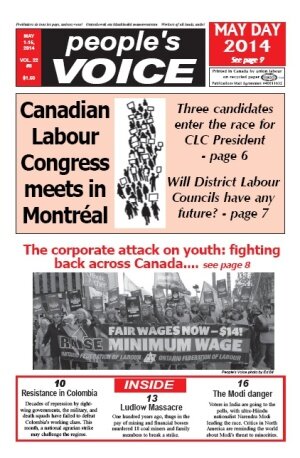
PEOPLE'S VOICE MAY 16-31, 2014 (pdf)
People’s Voice 2014 Calendar
”The Truth About the Great War”
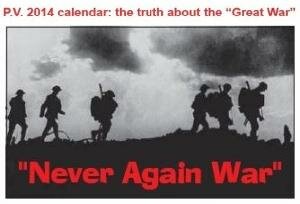
To order a copy of the People’s Voice 2014 Anti-First World War
Calendar, send $15 (includes postage and handling) to
People’s Voice, 706 Clark Drive, Vancouver, BC, V5L 3J1. Contact us at
604-255-2041 or pvoice@telus.net for bulk order prices.
|
People's Voice deadlines: June 1-15 June 16-30 Send submissions to PV Editorial Office,
|
REDS ON THE WEB
http://www.parti-communiste.ca/
peoplesvoice.ca
www.ycl-ljc.ca
www.solidnet.org
|
People's Voice finds many "Global Class Struggle" reports at the "Labour Start" website, http://www.labourstart.org/. We urge our readers to check it out! |
* * * * *
People's Voice
Canadian Publications Mail Sales Product Agreement #205214
ISSN number 1198-8657
People's Voice is published by
New Labour Press Ltd
PV Editorial Office
706 Clark Drive,
VANCOUVER, B.C. V5L 3J1
Phone:604-255-2041
Fax:604-254-9803
email: pvoice@telus.net
Editor: Kimball Cariou : Business Manager: David Au
Editorial Board: Kimball Cariou, Miguel Figueroa,
Doug Meggison, Naomi Rankin, Liz Rowley, Jim Sacouman
* * * * * *
Letters
People's Voice welcomes your letters
on any subject covered in our pages.
We reserve the right to edit for length and clarity,
and to refuse to print letters which may be libellous
or which contain unnecessary personal attacks.
Send your views to:
"Letters to the Editor",
706 Clark Dr., Vancouver, BC V5L 3J1,
or pvoice@telus.net
People's Voice articles may be reprinted without permission,
provided the source is credited.
* * * * * *
The Communist Party of Canada, formed in 1921,
has a proud history of fighting for jobs, equality, peace,
Canadian independence, and socialism.
The CPC does much more than run candidates in elections.
We think the fight against big business and its parties
is a year-round job,
so our members are active across the country,
to build our party and to help strengthen people's movements
on a wide range of issues.
All our policies and leadership
are set democratically by our members.
To find out more about Canada's party of Socialism,
give us a call at the nearest CPC office.
* * * * * *
Central Committee CPC
290A Danforth Ave Toronto, Ont. M4K 1N6
Ph: (416) 469-2446
fax: (416) 469-4063 E-mailmailto:info@cpc-pcp.ca
Parti Communiste du Quebec (section du
Parti communiste du Canada)
5359 Ave du Parc, Montréal, Québec,
H2V 4G9
B.C.Committee CPC
706 Clark Drive, Vancouver, V5L 3J1
Tel: (604) 254-9836
Fax: (604) 254-9803
Edmonton CPC
Box 68112, 70 Bonnie Doon P.O.
Edmonton, AB, T6C 4N6
Tel: (780) 465-7893
Fax: (780)463-0209
Calgary CPC
Unit #1 - 19 Radcliffe Close SE
Calgary AB, T2A 6B2
Tel: (403) 248-6489
Ottawa CPC
Tel: (613) 232-7108
Manitoba Committee
387 Selkirk Ave., Winnipeg, R2W 2M3
Tel/fax: (204) 586-7824
Ontario Ctee. CPC
290A Danforth Ave., Toronto, M4K 1N6
Tel: (416) 469-2446
Hamilton Ctee. CPC
265 Melvin Ave., Apt. 815
Hamilton, ON.
Tel: (905) 548-9586
Atlantic Region CPC
Box 70 Grand Pré, NS, B0P 1M0
Tel/fax: (902) 542-7981
http://www.parti-communiste.ca/
* * * * * *
News for People, Not for Profits!
Every issue of People's Voice
gives you the latest
on the fightback from coast to coast.
Whether it's the struggle for jobs or peace, resistance to social cuts,
solidarity with Cuba, or workers' struggles around the world,
we've got the news the corporate media won't print.
And we do more than that
- we report and analyze events
from a revolutionary perspective,
helping to build the movements for justice and equality,
and eventually for a socialist Canada.
Read the paper that fights for working people
- on every page, in every issue!
People's Voice
$30 for 1 year
$50 for 2 years
Low-income special rate: $15 for 1-year
Outside Canada $50 for 1 year
Send to: People's Voice, 706 Clark Drive, Vancouver, BC, V5L 3J1
You can call the editorial office at 604-255-2041
REDS ON THE WEB
http://www.parti-communiste.ca/
http://www.ycl-ljc.ca/
http://www.solidnet.org/
(The following articles are from the May 16-31, 2014, issue of People's Voice, Canada's leading socialist newspaper. Articles can be reprinted free if the source is credited. Subscription rates in Canada: $30/year, or $15 low income rate; for U.S. readers - $45 US per year; other overseas readers - $45 US or $50 CDN per year. Send to People's Voice, c/o PV Business Manager, 706 Clark Drive, Vancouver, BC, V5L 3J1.)
1) HISTORIC CLC CONVENTION ELECTS NEW PRESIDENT
By Stuart Ryan, Ottawa
The 27th Constitutional Convention of the Canadian Labour Congress, held May 5-9 in Montreal, was, to borrow a phrase from Hassan Husseini, a very "unconventional convention". Some very significant firsts made this convention untypical.
For the first time in fifteen years, incumbent president Ken Georgetti was deserted by his other executive officers in their refusal to run on a slate with him. It was the first time a CLC president was forced to put together a slate of relatively less known newcomers, the first time an Executive Vice‑President, Marie Clarke Walker, circulated an open letter alleging abuse by the CLC President, and the first time that an incumbent CLC President was defeated.
It was the first time that an election debate occurred as part of the convention agenda, resulting from a motion to amend the agenda which was overwhelmingly endorsed by delegates. It was the first time that delegates voted at polling booths, rather than at their desks, allowing all the delegates to express their wishes by a truly secret ballot.
These important events were initiated by a young experienced trade unionist, Hassan Husseini, who had the courage and vision to announce a challenge to Ken Georgetti for President and to launch, with his supporters, a "Take Back the CLC Movement". Although he pulled out of the contest at the leadership debate the day before the election and threw his support behind Hassan Yussuff, Husseini's platform clearly placed the issues, captured the undercurrents of discontent rippling through the labour movement, and set the stage for Yussuff's candidacy and the defeat of Georgetti.
Husseini's program "What We Stand For" was sub‑titled: "Make the CLC Work For Workers, Beyond Fairness: Developing an Independent Labour Vision, Build Grassroots Workers Activism". This program set the parameters for the Yussuff campaign and will remain a challenge for the post‑convention period and the new leadership.
Husseini's support for Yussuff was based on commitments by the new President to mobilize the rank and file and to put equity at the heart of all of the CLC's work.
It is clear in hindsight that Georgetti was caught off guard by the impact of Husseini's candidacy and the palace revolt of his fellow executive officers. He was late in rather hastily assembling a slate consisting of Nathalie Stringer (CUPE) who stood for Secretary‑Treasurer, and Laurie Antonin (Teamsters) and Kelly Murphy (NUPGE), who ran for the Executive Vice President positions. They called their slate "Team Win," and together they lost.
There were 4625 voting delegates for the presidential race, the biggest CLC Convention ever, at least for a day. Yussuff defeated Georgetti by only forty votes. Barb Byers was elected Secretary‑Treasurer, Marie Clarke Walker was re‑elected Executive Vice‑President, and long‑time CUPW Executive member Donald Lafleur was elected as Executive Vice‑President.
Only 2000 delegates voted for the latter three executive positions, an indication of how many were bussed in or recruited simply for the presidential vote by the unions supporting Yussuff or Georgetti.
The new Table Officers include three members of the previous CLC Executive, no longer under the thumb of Georgetti, and a new representative of one of the most militant unions in the country.
It will be very interesting, and possibly a source of future analyses to see if the convention initiates grater unity or greater rivalry. In any case it surely signals the potential for more fight‑back and more independent labour political action.
The forces in the "Take Back the CLC" movement are encouraged by the results, but are not resting on their laurels. At a May 9 Action Caucus meeting, they decided to throw support behind the Save Canada Post campaign, and to meet at the People's Social Forum in August in Ottawa to strengthen their network and to continue to build an effective fight‑back movement within the labour movement.
2) ONTARIO BUDGET: PEOPLE'S NEEDS, NOT CORPORATE GREED!
Election Message from the Communist Party (Ontario)
The 2014 provincial budget was clearly an election budget aimed to position the Liberals to the left of the NDP on a range of social policy issues. These include the proposed defined benefit pension plan, increases to the child benefit program and the extension of free dental services to impoverished children, cost of living increases to the minimum wage, a small increase to single recipients of Ontario Works, and small wage increases to Personal Support Workers.
The 10 year, $29 billion investment in infrastructure renewal and jobs, a portion of which were to be earmarked for youth employment, would have provided significant economic stimulus and jobs, and improved urban and inter‑urban public transportation. $11.4 billion was set aside for hospital construction, and another $11.1 billion for School Boards to repair aging schools and build new ones.
The budget also proposed a miniscule corporate tax increase, eliminating the tax break of 7% on the first $500,000 of income (currently taxed at the small business tax rate of 4.5%). It also projected a small tax increase for the 2% of the population with incomes over $150,000.
But the budget was clearly a Big Business budget, with privatization at the core of the funding proposals, the transformation of many public services into private public partnerships (AFR's), and the promise of future deep cuts to the corporate tax rate, from the current 11.5% down to 10%. Public sector layoffs and wage cuts are built‑in, implicit in a package that contains continued restraints to operating budgets in hospitals and healthcare, public and post‑secondary education, and social programs. This is the Drummond Report, implemented over 10 years.
The Tories opposed the budget because they are ideologically opposed to any and all progressive measures, and they wanted more privatization, more cuts, and more corporate tax cuts. They also wanted to force an election, win it, and then introduce massive austerity measures with right‑to‑work legislation, mass privatization, de‑regulation, and inter‑provincial free trade to knock down any remaining obstacles to the free reign of capital. Wages, living standards and pensions would drop down to the basement in no time, and labour, social and democratic rights would virtually disappear.
The NDP's stated reason for opposing the budget and bringing down the government was the gas plant scandal and government corruption. In fact they had nothing to say about the budget, or about the NDP's agenda for Ontario. It's true the Liberals can't be trusted, but why didn't the NDP use its clout to hold the government's feet to the fire in this minority government to secure deliver of the progressive proposals and scuttle privatization?
On the face of it, the NDP has no major disagreements with the budget; and is mainly focused on defeating the government by defeating Liberal MPPs, securing more (Liberal) parliamentary seats for itself, and moving up to Official Opposition or government. A very short‑sighted tactic and a failed strategy that the NDP used in the last federal election, and which helped open the door to one of the most right‑wing Tory majority governments in Canadian history.
For working people, youth, women and the unemployed, the main danger in this election is the election of a Hudak Tory government. Their agenda is no secret, and it starts with smashing labour and democratic rights and turning the clock back 75 years in Ontario. By forcing an election now, the NDP is playing a very dangerous game, as leaders of the labour and people's movements have indicated in their responses to the budget.
For our part, the Communist Party will continue to warn of the dangers of a Tory government in the first instance, and to campaign for complete reversal of the pro‑corporate, anti‑people austerity and privatization policies introduced by both Tory and Liberal governments, and supported by the NDP caucus on too many occasions. Working people and youth can count on the Communist Party to fight for real restraints on corporate power and to deliver an agenda that serves people's needs and curbs corporate greed. Another Ontario is possible! Electors can make their vote really count in this election by casting a vote for the policies and objectives below.
The CPC (Ontario) and its candidates will fight for a People's Agenda:
* Good jobs, better pensions, a livable minimum wage
* An industrial and manufacturing strategy for Ontario
* Affordable housing and rent controls
* Quality public services, healthcare and hospitals
* One universal, quality, secular education system
* A quality, affordable public childcare system
* A healthy, sustainable environment
* Public auto insurance & improved public transit
* Public power and lower rates
* Strong labour, democratic and equality rights
* Democratic electoral reform
* Tax relief for working people ‑ tax corporations and the wealthy
For the detailed Communist Party (Ontario) platform and candidates, visit www.communistpartyontario.ca
3) SALUTE TO YCL/LJC CONVENTION
People's Voice Editorial
The May 24‑25 weekend will see a unique gathering in Toronto - the 26th Central Convention of the Young Communist League/Ligue de la jeunesses communiste du Canada. The editorial Board of People's Voice sends warmest greetings to YCL/LJC delegates from across Canada, who represent the revolutionary potential of youth to challenge the domination of big capital.
The Young Communist League has never had an easy path in Canada. Yet the organization has played a critical, even leading role in many historic struggles. During the Thirties, YCLers were prominent in the On to Ottawa Trek and the Mackenzie‑Papineau Battalion which fought fascism in Spain. After WW2, Young Communists helped to organize workers in basic industries across the country, and to resist the integration of Canada into US imperialism's war machine. They played important roles in solidarity campaigns with the people of Vietnam, Cuba, southern Africa, Nicaragua and Palestine. YCL members were key activists in the progressive student movement, from the formation of the Canadian Federation of Students to the anti-tuition uprising of 2012 in Quebec. The YCL takes a principled stand against racism, sexism, homophobia, big nation chauvinism and other divisive ruling class ideologies.
Young people today face a grave and uncertain future, with the dangers of war, economic crisis, environmental catastrophe, and "free trade" deals imposed by big capital. To defeat these threats will require much more than spontaneous, small scale acts of resistance. Ultimately, winning a socialist alternative will require collective, mass struggle, uniting millions around demands for real change, and a coherent strategy to overcome the combined powers of the capitalist state. As the YCL celebrates its 90th anniversary, we are confident that it has the political strength and the revolutionary ideology to win the support of youth in all parts of Canada for these ideals!
4) HUDAK THREATENS ONTARIO WORKERS
People's Voice Editorial
While the Liberals feint to the left, and the NDP race to the right, the Tories have unleashed a campaign for another right‑wing "revolution" in Ontario. Tim Hudak is trumpeting his plan to lay off 100,000 public sector workers, slash wages, and demolish public services and social programs. He aims to bust unions with US right‑to‑work (for less) laws that would drive down wages and living standards across the province, as Ontario becomes the test tube for eliminating the Rand formula and the closed union shop across Canada. And oh yes, Hudak wants more corporate tax cuts, because 11.5% (the lowest CIT rate in the industrialized world) is way too high.
Hudak's promise? To create a million jobs. Details: scanty, but directly connected to stripping the so-called "fat cats": the unions and the public sector. His target? The one million unemployed workers and never-employed youth, bankrupt business owners, dispossessed farmers, people falling through the huge cracks who are desperate for some kind of job and security.
And Hudak has some traction. Polls show the Liberals and Tories in a tight race, with NDP in the basement. No orange wave here as the NDP openly embraces austerity, tax cuts, and sops to Big Business. NDP leader Andrea Horwath is gambling that a Liberal collapse will elevate her party to Official Opposition, as in the federal election. But the high price paid for those seats was a Tory government, and it could be again.
The OFL has mounted a well organized campaign against Hudak's attack on labour and democratic rights. Unions are split in their support for the Liberals and NDP, but are focused on getting out the vote to defeat the Tories at all costs.
The Communist Party's candidates are mounting campaigns across the province, and gaining traction with voters worried about the right turn by Ontario's political parties. For more information, contact the CPC (Ontario) campaign at www.CommunistPartyOntario.ca.
5) SERIOUS SHORTCOMINGS REMAIN IN BILL C-23
Statement by the Central Executive Committee, Communist Party of Canada
The Conservative federal government has finally announced significant changes to Bill C‑23, its undemocratic "Fair Elections Act." While the legislation is still being debated in Parliament, and serious shortcomings still need to be addressed, these amendments represent an important partial victory for advocates of electoral democracy in Canada.
Serious concerns regarding Bill C‑23 were raised by the Communist Party of Canada and other registered political parties currently without representation in the House of Commons, which met on April 10‑11 in Ottawa. As the joint statement issued by that meeting stressed, the legislation had been condemned almost universally by Canadian and international elections officials and experts, and supported only by Conservative politicians who stood to benefit from its worst provisions. We warned that Bill C‑23 would help criminals get away with election fraud, create confusion and delays on Election Day, and deprive hundreds of thousands of Canadians of their right to vote.
The government's proposed amendments include: allowing the Chief Electoral Officer and the Commissioner to speak more freely with the public and with one another; elimination of the "fundraising loophole" which would enable the political parties (especially the Conservatives) to evade spending caps; retaining a form of the "vouching" procedure; removing the proposal that the winning political parties nominate central poll supervisors; and extending the retention of voter contact data from one year to three years.
Voters whose personal identification lacks a street address would be able to sign a written oath of residence, which must be co‑signed by another voter with full ID (both name and address). This change could reduce the disenfranchisement of eligible voters, but the government must consult closely with advocates for First Nations, seniors, students, and homeless citizens to include guarantees to safeguard the right to vote for these citizens. The proposed ban on using Voter Information Cards must be lifted, since this form of ID is important to protect the constitutional right to cast a ballot for all citizens.
A significant omission from the proposed amendments is the failure to provide the Commissioner with the power to compel witness testimony. This will seriously impede investigations from finding all the facts in criminal abuses of the electoral system.
And while the Chief Electoral Officer would be permitted to speak with the public and to continue to work with school educational programs, the proposed amendments do not allow Elections Canada to engage in advertising campaigns to reach out to all citizens affirming their right to vote, and encouraging eligible voters to exercise their franchise.
Despite these serious weaknesses, the proposed amendments have been achieved through weeks of public pressure by supporters of electoral rights and democratic freedoms. This campaign succeeded in dividing the Conservative caucus in the Commons and Senate, forcing PM Harper and so‑called "Democratic Reform" minister Pierre Poilievre to retreat on key provisions of C‑23.
This retreat represents an important partial victory. The attempt by the Harper Conservatives to use U.S. Republican‑style tactics to rig the next federal election has met a serious setback. But efforts must continue to protect every Canadian's right to vote in fair and honest elections, free of voter suppression schemes and fraud, watched over by an independent and effective Elections Canada.
We will continue working with the other smaller political parties to raise this demand in the courts, in the streets, in elections, on social media, in class rooms ‑ wherever Canadians who believe in democratic rights are present.
6) TELCOS ASKED TO DISCLOSE SUBSCRIBER DATA EVERY 27 SECONDS
Dr. Michael Geist is a law professor at the University of Ottawa. He is an internationally syndicated columnist on technology law issues with his regular columns in the Toronto Star and the Ottawa Citizen.
April 30 ‑ Every 27 seconds. Minute after minute, hour after hour, day after day, week after week, month after month. Canadian telecommunications providers, who collect massive amounts of data about their subscribers, are asked to disclose basic subscriber information to Canadian law enforcement agencies every 27 seconds. In 2011, that added up to 1,193,630 requests. Given the volume, most likely do not involve a warrant or court oversight (2010 RCMP data showed 94% of requests involving customer name and address information was provided voluntarily without a warrant).
In most warrantless cases, the telecommunications companies were entitled to say no. The law says that telecom companies and Internet providers may disclose personal information without a warrant as part of a lawful investigation or they can withhold the information until law enforcement has obtained a warrant. According to newly released information, three telecom providers alone disclosed information from 785,000 customer accounts in 2011, suggesting that the actual totals were much higher. Moreover, virtually all providers sought compensation for complying with the requests.
These stunning disclosures, which were released by the Office of the Privacy Commissioner of Canada, comes directly from the telecom industry after years of keeping their disclosure practices shielded from public view. In fact, the industry was reluctant to provide the information to even the Privacy Commissioner.
According to correspondence I obtained under the Access to Information Act, after the Commissioner sent letters to the 12 biggest telecom and Internet providers seeking information on their disclosure practices, Rogers, Bell and RIM proposed aggregating the information to keep the data from individual companies secret. The response dragged on for months, with Bell admitting at one point that only four providers had provided data and expressing concern about whether it could submit even the aggregated response since it would be unable to maintain anonymity.
The correspondence also confirms that the telecom providers were concerned about how the government and law enforcement would react to public disclosures. In one email, Bell says that "we are walking a delicate line between supporting privacy and not antagonizing Public Safety/LEAs [law enforcement agencies], so the materials will be pretty factual, not much commentary."
While the current situation, which amounts to disclosure of subscriber information thousands of times each day often without a warrant, is enormously problematic, the situation is about to get even worse.
First, Bill C‑13, the government's lawful access bill that heads to committee this week, will expand warrantless disclosure of subscriber information to law enforcement by including an immunity provision from any criminal or civil liability (including class action lawsuits) for companies that preserve personal information or disclose it without a warrant. The immunity provision makes it more likely that disclosures will occur without a warrant since the legal risks associated with such disclosures are removed.
Second, Bill S‑4, the newly‑introduced Digital Privacy Act, proposes extending the ability to disclose subscriber information without a warrant from law enforcement to private sector organizations. The bill includes a provision that allows organizations to disclose personal information without consent (and without a court order) to any organization that is investigating a contractual breach or possible violation of any law. This applies both past breaches or violations as well as potential future violations. The disclosure occurs in secret without the knowledge of the affected person.
Third, the industry has steadfastly refused to address the lack of transparency concerns regarding its practices. Providers admit that they do not notify customers that their information has been requested, thereby denying them the ability to challenge the demand in court. Moreover, documents released earlier this year suggested that companies such as Bell have even established a law enforcement database that may provide authorities with direct access to subscriber information.
The systems may create great efficiencies for law enforcement ‑ click, access subscriber data, and receive a bill from the telecom company ‑ but they suggest a system that is entirely devoid of oversight with even the Privacy Commissioner excluded from ensuring compliance with the law.
7) LIBERAL TFWP PLAN "NO SOLUTION TO TORY MESS"
Toronto - The Migrant Workers Alliance for Change (MWAC), Canada's largest migrant worker coalition, believes that the 5‑point demands issued by the Liberal Party of Canada on the Temporary Foreign Worker Program (TFWP) fail to respond to the needs of migrant workers or the Canadian labour market. Discussions on the TFWP must include the voices of migrant workers. MWAC calls for the following short, medium and long‑term steps:
‑ Short term: The Federal and provincial governments must ensure that migrant workers can exert their rights at work. This means: open work permits, TFW specific anti reprisal protections, equal access to social entitlements and strengthening labour legislation for all workers
‑ Medium term: Full immigration status for migrant workers in Canada as we justly transition to a long term solution;
‑ Long term: Permanent immigration status for all migrants coming into Canada, including workers in low‑skilled occupations and the Seasonal Agricultural Workers Program.
"The Liberal plan fails to recognize that it is provincial and federal laws together that work to make migrants a second‑class category of workers that are then pitted against unemployed citizens and permanent residents," explains Tzazna Miranda Leal, organizer with Justice for Migrant Workers, member organization of MWAC. "The solution is to simply remove those exclusions from labour protections for all workers, thus making migrant workers and unemployed citizens allies in the fight for better jobs and stronger communities."
Vinay Sharma, Human Rights Director for UNIFOR, Canada's largest private sector union and MWAC member adds, "Once the provinces and the feds have cleaned up their act, we need to account for migrants already here. We can't just get rid of them. Migrant workers in Canada need full immigration status. That's the next step."
"The Liberal demands fail to recognize the expansion of TFWP as part of a dangerous shift in Canadian immigration policy towards temporariness and exclusion," explains Perry Sorio, member of Migrante Canada, an MWAC member. "Permanency and stability are necessary to build healthy communities. We need to overhaul the entire immigration system and re‑institute access to permanent status for immigrants in low‑skilled occupations."
Syed Hussan, MWAC Coordinator agrees. "Our members are a fundamental part of the labour market and economy. To treat them as a separate entity as the Liberals and Tories do makes no economic sense, and continues the divisiveness drummed up over the last month. Migrants are our friends and family, not just a market‑input brought in when needed. Workers need to be at the table, making joint decisions."
Migrant Workers Alliance for Change www.migrantworkersalliance.org
includes Asian Community AIDS Services, Caregivers Action Centre, Justicia for Migrant Workers, Legal Assistance of Windsor, Migrante‑Ontario, No One Is Illegal-Toronto, Parkdale Community Legal Services, Social Planning Toronto, South Asian Legal Clinic of Ontario, UNIFOR, United Food and Commercial Workers, and Workers Action Centre.
8) MAY DAY RALLIES DRAW MILLIONS INTO THE STREETS
PV Vancouver Bureau
This year's May First actions brought millions of working people into the streets, at rallies large and small across the planet.
As always, one of the biggest demonstrations was in Havana, the capital city of socialist Cuba. An estimated one million Cubans and foreign guests took part in the annual rally at Che Guevara Square, showing their support for the country's revolutionary alternative to capitalism.
It was a far different scene in Istanbul, Turkey, where police used water cannons and tear gas against thousands of protesters who sought to march in Taksim Square. The square was the focal point of weeks of protests last summer, in defiance of Prime Minister Recep Tayyip Erdogan and his administration.
After lifting a 32‑year ban on May Day celebrations in Taksim Square in 2010, the Turkish government reinstituted the ban last year. Erdogan had warned that he wouldn't allow protesters in the square. The prime minister has cast both last summer's street protests and a corruption scandal dogging his government since December as part of a plot to undermine him. The demonstrators in Istanbul were met by about 40,000 police officers, who blocked roads, fired tear gas canisters and used water cannons in an attempt to prevent access to the square. Some 40 people were hospitalized and around 160 detained, according to the Progressive Lawyers Association.
Meanwhile, Cambodian protesters also clashed with police in Pnomh Penh, in defiance of a ban on demonstrations that has been in place since January. In Rostock, Germany, riot police had to forcibly remove sitting protesters, who were blocking the streets.
But in most countries, authorities allowed protests and demonstrations to take place without direct police brutality.
About 100,000 workers paraded on Moscow's iconic Red Square. The largest May Day demonstration in recent years in the Russian capital had a strong anti‑fascist flavour, as participants condemned the recent wave of far right violence in Ukraine. May Day was a key date in the Soviet calendar, but in recent years, the annual demonstrations have been relegated to a city highway. Trade union leaders said about two million people had turned up for May Day rallies across Russia.
Protesters were out in force in many European countries including France, Italy and Greece, marching against unemployment and austerity policies. In Greece, thousands rallied in the two main cities of Athens and Salonika against an austerity drive following a disastrous debt crisis that led to mass lay‑offs.
In Italy's Turin, scuffles broke out between police and hundreds of protesters. Activists lobbed smoke bombs after police charged demonstrators in the northern industrial city, which has been badly hit by a painful two‑year recession.
Thousands marched in France, with the biggest rallies in Paris and other major cities such as Bordeaux and Toulouse targeting the Socialist government's budget cuts to rein in the deficit.
Rallies also took place across Asia, including in Hong Kong, Jakarta, Kuala Lumpur, Singapore and Taipei.
In Indonesia, protestors carrying portraits of Che Guevara, Fidel Castro and the country's first president Sukarno, marched to the state palace in Jakarta. Some sang and danced as others carried a three‑metre‑long toy octopus wearing a red hat with the words "Capitalist Octopus, Sucking the Blood of Workers."
More than 1,000 protesters gathered in Hong Kong's landmark Victoria Park to walk towards the government headquarters waving colourful flags and placards, while singing a Chinese version of "Do You Hear the People Sing?" from the musical Les Miserables, while calling for better working conditions and wages. Domestic helper rights groups, which made up a large portion of the rally, wore masks with a picture of Erwiana Sulistyaningsih, an Indonesian maid who was allegedly abused by her employer for months, while shouting: "We are workers, we are not slaves".
Malaysian workers celebrated the first of May in the streets of Kuala Lumpur, reminding employers and the government of the need for better pay and working benefits. Tens of thousands flocked to a massive protest around Dataran Merdeka, the original planned venue, which was cordoned off. They were rallying against the Goods and Services Tax (GST) which will be implemented in April 2015. Malaysians are worried that the GST will be an added burden, particularly for the working class and the poor, who are already reeling from an inflationary onslaught.
The huge public response to the May Day rally in Kuala Lumpur prompted the government to warn that civil servants found participating in anti‑GST protests would face stern action, including sacking. One government adviser insisted that university students involved in the rally should be punished, and religious leaders called on Muslims to support the GST. These warnings, however, were widely seen by critics as a mere bullying tactic.
More than 10,000 workers marched to the labour ministry in Taiwan's capital Taipei demanding wage hikes and a ban on companies hiring cheap temporary or part‑time workers.
In Singapore, a rally of around 400 protestors chanting slogans calling for the long‑ruling People's Action Party to step down.
in South Korea, around 5,000 workers rallied outside Seoul railway station, but the traditional May Day trade union gathering was overshadowed by the ferry disaster that claimed the lives of hundreds of people, many of them schoolchildren. The workers marched to City Hall to pay their respects to the victims of the April 16 tragedy at a temporary memorial.
May Day events were generally smaller in North America, but took place in dozens of cities across the U.S. and Canada.
Thousands joined New York City's leading labour unions, and immigrant and community organizations for a massive rally in lower Manhattan. Sponsored by the Labor Rights, Immigrant Rights, and Jobs for All Coalition, the rally demanded an increase in the minimum wage; fair contracts for city employees; putting a halt to unjust deportations and enacting national immigration reform and the New York State DREAM Act; and building all construction projects with union labor and preserving the state's "scaffolding law," while also calling for universal pre‑kindergarten and raising taxes on Wall Street and the richest 1%. The rally began with speeches and live music at City Hall Park and culminated with a march to Wall Street.
"May Day is about all workers," said Vincent Alvarez, president of the New York City Central Labor Council, AFL‑CIO. "The city's labor movement is a microcosm of our larger society, representing workers from all cultures and economic backgrounds, who are standing up for the issues that affect all of us. The fight for better wages isn't just for low‑wage workers, just like the fight for a path to citizenship doesn't only concern immigrant workers. On May Day and every day, we must band together for justice for all working men and women."
Thousands of people arrived in downtown Los Angeles to support immigrant rights. Themed "Keeping families together," the march emphasized the goal of ending deportations that split parents from their children. Other issues brought forward included increasing the federal minimum wage and immigrant worker rights.
"It's the day that we remind the American public and the government that there's a great debt to our community," said Angelica Salas, executive director of Coalition for Humane Immigrant Rights of Los Angeles. "We work hard in every single industry, yet we don't have the recognition or the respect that we deserve."
May Day marches took place in a number of Canadian cities, including along Vancouver's Commercial Drive, where hundreds took part in the annual event sponsored by the Vancouver and District Labour Council.
Thousands took the streets of Toronto to celebrate May Day and to fight poverty and capitalism.The 9th annual "May Day of Action" was Coordinated by a coalition of community groups including No One Is Illegal ‑ Toronto, May 1st Movement and Ontario Coalition Against Poverty.
In Venezuela, a familiar sea of red shirts, large banners and a revolutionary sing‑along soundtrack marked International Workers Day in Merida City, part of Caracas. The celebratory atmosphere was due in part to the April 30 announcement by President Nicolas Maduro a 30% increase in the national minimum wage. The higher turnout came as local activists reacted to the lifting of three months of blockades, violent attacks and assassinations by anti‑government groups representing the interests of the wealthy class.
9) THE IRISH PEACE PROCESS IN CRISIS
By John Wight, the Morning Star (UK), May 6
Is the conflict in the north of Ireland over?
The question is relevant given the arrest last week of Sinn Fein leader Gerry Adams ù the man who played the key role in steering the republican movement onto the path of peace and away from violence. He spent four days in police custody being questioned in connection with the abduction and murder of Jean McConville in 1972 at the height of the Troubles.
If the premise at the heart of the 1998 Good Friday Agreement was not to ensure that there would be no more killing, no more grieving children and families, such as McConvilleÆs, what was the point of it?
And if the trajectory of the peace process ù which prior to the arrest of Adams was already in a fragile state ù is going to be determined by the families and loved ones of those who lost their lives in the conflict, what hope can there possibly be of it succeeding?
The most basic and brutal truth at the heart of any political solution to a civil conflict, which leaves the kind of deep scars as did the one that raged in the six counties for 30 years, is that hard compromises have to be made for the sake of peace.
The Irish republican movement did not and still does not believe that the armed struggle they waged in the cause of ending British rule in the north of Ireland, and with it the partition of the island of Ireland, was illegitimate. On the contrary, they believed and still believe that they were engaged in a national liberation struggle that was morally justified in response to partition and oppression, based on the truism that when injustice becomes law, resistance becomes a duty.
This injustice was enshrined in a gerrymandered loyalist statelet wherein the minority Catholic/nationalist population suffered discrimination when it came to housing, employment, services and political representation.
Yes, there is no doubt that, within those parameters, acts of violence were carried out that could never be justified, with the abduction and murder of McConville by the IRA indisputably one of them. But such unjustifiable acts of violence were by no means confined to republicans. British crown forces, whether the British army or the RUC (now PSNI), were also responsible for heinous acts of violence and murder during the Troubles ù as were, of course, loyalist paramilitaries.
In light of the arrest and detention of Adams, it is pertinent to ask why we have yet to see the arrest of any former members of the British Parachute Regiment in connection with Bloody Sunday, anyone in connection with the murders of Belfast solicitor Pat Finucane and Irish human rights lawyer Rosemary Nelson, and anyone in relation to collusion between British security forces and loyalist paramilitaries ù a factor attributed to the Finucane and Nelson murders?
Of particular anger to republicans will be the decision by Secretary of State for Northern Ireland Theresa Villiers, just a few days prior to the arrest of Adams, to deny the families of the victims of the Ballymurphy Massacre in 1971, when 11 people were shot dead during an operation by the Paras in West Belfast ù the same regiment who later carried out Bloody Sunday in Derry to set up an independent panel to re‑examine the evidence.
The one‑sided nature of the hunger for retroactive justice we are now seeing take place in the six counties feels more like vengeance. Even if not intended to be so, itÆs certainly the growing perception within the republican and nationalist community.
The peace process was already in a fragile state prior to the arrest of Adams. The absence of conflict and peace are not always the same thing, and reconciliation has taken place a decade and a half on from the signing of the Good Friday Agreement in 1998. In this context, who knows the lasting damage that this event will result in going forward?
The courage and vision of Adams in leading the republican movement away from violence into a political process cannot be overstated. Many on his own side turned against him in protest at what they saw as his leadershipÆs unacceptable compromising of the aims of the armed struggle ù i.e. forcing the British out of the North and ending partition. He sacrificed many close friendships and alliances along the way, not least of which his friendship with Brendan Hughes, a man who enjoys iconic status within republicanism and whose taped testimony to Boston College academics before his death in 2008 as part of an oral history project led to AdamsÆs arrest this past week.
A line has to be drawn somewhere if the peace process can move forward. As hard as it may be, the grieving families of the victims of the conflict, on both sides, cannot determine the future in the six counties. Otherwise, the deep scars already left will only succeed in producing more scars, as the process remains stuck in the past instead of leaving it behind.
The glaring omission with regard to the Troubles and the end of the conflict has been the absence of a mechanism to bring some sort of closure to the pain left behind, such as a South African‑style truth and reconciliation committee. Arresting and potentially charging a key figure responsible for ending the conflict over 15 years after it ended is, however, not the way to bring this closure.
The main beneficiaries of this episode has not been justice but dissident republicans, who will now be able to boast, “We told you so.”
Adams leads the largest nationalist party in Ireland. He and they have a mandate not only in the North of Ireland but also increasingly in the South. It is ludicrous to imagine that the thousands who cast their vote for Sinn Fein and Adams do so unaware of the Troubles that gave rise to both.
In this context the arrest of Adams will be viewed by many within republican and nationalist communities as an attempt by the PSNI to delegitimise their votes and, worse, their right to the parity of esteem so long denied them prior to the start of the Troubles in 1968.
The peace process is in crisis.
10) U.S. MILITARY OPTION WORST RESPONSE TO NIGERIA CRISIS
By T.J. Petrowski
The "War on Terror" has provided Western imperialism with too many benefits for it to end in the near future, and to continue to feed the terrorism industry to justify interventions abroad, the corporate media will exploit what are no doubt tragic events to further Western imperialism's militaristic ambitions around the world. The April 14 abduction of girls by Boko Haram from a secondary school in Nigeria's Borno state ‑ a criminal mass violation of the rights of women and girls ‑ is an example of this.
The abduction has received international condemnation, with top U.S. officials such as U.S. Secretary of State John Kerry pledging to do "everything possible" to support the Nigerian state and President Barak Obama saying he hopes the international community will take action against Boko Haram.
The corporate media and Western officials are depicting the conflict in Nigeria has a æGood vs. Bad' scenario, of allegedly al‑Qaeda in the Islamic Maghreb (AQIM)‑associated Muslim fundamentalists (don't all conflicts now involve "al‑Qaeda‑associated" insurgents?) terrorizing a population to enforce its extreme interpretation of Sharia. However the truth about the conflicts in Nigeria and Western imperialism's role in creating the conditions for these conflicts is much more complicated than that.
Boko Haram started as a non‑violent indigenous resistance movement to the forced imposition of Christianity and Western‑education from the south, which many Muslims of northern Nigeria view with suspicion, remnants of the era of British colonialism in the lower Niger River region. The desire for the imposition of Sharia law in Nigeria (Sharia law already exists in northern Nigeria) is not only a cultural sentiment; it reflects the desire for a more just system. Western corporations have looted Nigeria's natural resources, including the second largest oil reserves in Africa after Libya, while many Nigerians still live off less than $2 a day.
The ruthless response towards suspected members of Boko Haram by the Nigerian security forces, with the support of Western imperialism, created the conditions for a violent response. Under President Umaru Musa Yar'Adua alone more than 700 people were killed, some being publicly executed. It is worth noting that the use of kidnapping as a warfare tactic by Boko Harm did not start until Nigerian security forces started taking as prisoner the wives and children of suspected Boko Harm members.
Now Western imperialism will use this latest tragedy to continue its exploitation of Africa's resources. The statements made by U.S. and other Western officials should be viewed with suspicion; the same state that John Kerry will do "everything possible" to support in its conflict with Boko Haram is the same state that tortured and outright shot those protesting oil giant Shell's exploitation of the Niger River Delta. Where was the international community's outrage then?
In fact, Western oil corporations steal more than $140 billion of oil wealth from Nigeria annually, but most of Nigeria's 100 million people live on less than $2 a day and few have access to basic medical care and education. Yet Nigeria has the largest and best equipped military in West Africa, and we are told is a model of "economic development" and "democracy" in Africa, that is despite being ruled by Western‑backed military dictatorships for much of its independence.
As tragic as this latest episode is the solution does not lie with a U.S. military response. What is needed is a democratic, non‑violent settlement between the various parties in Nigeria to bring peace and economic justice to the country. The international community should support such an initiative, not more military responses.
11) CAPITALISM AND THE SEWOL DISASTER
By Sean Burton, Seoul, May 11 2014
The sinking of the Sewol ferry off the southwest coast of the Korean peninsula on April 16 has been a stab in the heart of this country. Weeks later, long lines of people continue to form at memorial sites for the victims of the sinking, many of them high school students from a Seoul suburb en route to a field trip on the southern island of Jeju.
Almost immediately, there were questions directed at the conduct of the crew and captain Lee Joon‑seok. South Korea's President Park even went so far as to call their actions "murderous".
It's easy to put the blame on individuals. Certainly, any misconduct ought to be punished. However, Koreans are not buying the story that all fault lies with the crew. There have been ongoing calls for the government to take more responsibility for what the public views as a botched rescue operation. Some officials, including the prime minister, have already resigned. On May 9, family members of the victims gathered near the presidential residence demanding a face‑to‑face meeting with Park, only to be blocked by police.
The Sewol sinking is South Korea's worst ever maritime loss of life. The disaster does in fact hint at something rotten in the status quo. A systemic analysis strongly suggests that the fault is capitalism's, not Captain Lee's.
Chonghaejin Marine, the owner of the vessel, was apparently in considerable debt. This led to a series of measures to boost profit from the venture. First, the vessel itself had been purchased from a Japanese company, and had already been operating there since 1994. Additional weight was added to make space for more cabins. In addition to increasing the passenger capacity, the company seemed to make a habit of overloading the cargo. Cost‑cutting measures were also pursued where the crew was concerned. Few if any were actually full‑time professionals. Most were serving on a short‑term contractual basis, including the captain. Thus it is difficult to say how familiar the crew actually was with the vessel.
These conditions are hardly unique to the Sewol. Indeed, overloaded cargo was a contributing factor to the last major shipping disaster in 1993 with the sinking of the MV Seohae. Sloppy enforcement of regulations can be seen in other aspects of South Korean society. Police will scarcely bat an eye at vehicles running red lights. Cheap one‑room apartments thrown up in a month end up with mold growing on the walls soon after; but that's just life!
Even the rescue operation has been singled out for shortcomings. There was confusion about rescue responsibilities and an overall lack of coordination between the Coast Guard, Navy, and other medical support groups. In its report on the situation, the Coordinating Committee of the Asia‑Wide Campaign Against US‑Japan Aggression noted the cynical fact that these organizations have no problems working together when engaged in anti‑North Korean operations. Recently, one of the divers in the rescue operation also died. With so much pressure to recover the bodies, and the dangerous workaholic mentality of South Korean capitalism, that diver too is a victim.
These structural problems are not state secrets. Those in power here know all too well where the fault lies, and so far the people are not accepting the surface accusations. Memory of this event may well bring down the Park government, and in any case will provide another sad example in the case against neoliberal capitalism.
12) WORLD PEACE COUNCIL DENOUNCES ODESSA MASSACRE
Statement of the WPC regarding the massacre of Odessa and the developments in Ukraine
The WPC denounces strongly the recent massacre of Odessa where reactionary fascist groups, set on fire the locked Trade Union building of the city, with hundreds of protesters seeking protection inside the building on Friday 2nd May 2014. The clear murderous attempt was completed when the protesters were trying to escape from the fire by jumping from the windows of the mentioned building and the armed gangs were beating and shooting these people to death.
The Kiev interim regime, which came to power by a Coup d’état and by the open imperialist intervention of the USA and the EU clearly favours and supports such actions and armed groups. The hypocrisy and double moral reached highest levels when the USA and EU refer to the “rule of law and respect of the constitution”
After having trampled everything through an armed coup. The regime has even sent troops to several cities in the eastern part of Ukraine to combat people in protest to the authoritarian and fascist regime, who express their discontent with the regime generally and its attitude towards ethnic and language minorities along with the revanchist actions against the history and monuments of the resistance, restoring the rule and symbols of the collaborators of the Nazis in Ukraine.
We denounce firmly the authoritarian harassment of political parties and leaders who oppose the regime, which led even to the exclusion of the Communist Party of Ukraine from Parliament sessions, after earlier attempts to physically attack its leaders and the occupation of its Head office.
The European Union and its governments, hand in hand with the US administration bear heavy responsibilities for the developments in the Ukraine, pushing the country into an internal armed conflict for their geostrategical interests and competitions with Russia in the region. The open support to fascist and chauvinist forces and policies is aggravating the situation which is provoking the sentiments of the Ukrainian people and the whole region, stimulating ultranationalist feelings by many people.
The US administration is further escalating the tension by the remarks of the Secretary of State John Kerry on 29th April in Washington who openly invokes in the case of Ukraine the article 5 of the NATO treaty which refers to “an armed attack against one or more of them in Europe or North America shall be considered an attack against them all”, considering the Ukraine NATO territory, when it is not a member of it! The WPC observes with deep concern the military preparations of NATO in several neighbour countries, while many US and European military agents are already in the country triggering the tensions in support of the Kiev regime.
We express our solidarity with the Ukrainian people, the peace loving and anti-imperialist forces who oppose the affiliation of their country to NATO and their inalienable right to decide freely and democratically about the future of Ukraine, free from any foreign political or military intervention and domination.
The peoples of Ukraine and of the region can live in peace together!
NATO and EU out of the Ukraine!
World Peace Council Athens, 8th May 2014 ●