|
|
November 16-30, 2014
Volume 22 – Number 19 $1
Prolétaires de tous les pays, unissez-vous!
Otatoskewak ota kitaskinahk mamawestotan!
Workers of all lands, unite
1) MASS PROTESTS RENEWED IN QUEBEC
2) DIFFERENT TRENDS IN ONTARIO CIVIC ELECTIONS
3) B.C. - CAPITALISM IS STILL NOT WORKING
4) DEFEND CIVIL LIBERTIES AND DEMOCRATIC FREEDOMS
5) WORKING PEOPLE LOSING TRUST IN MANITOBA NDP
6) SLIGHT SHIFT TO LEFT IN WINNIPEG ELECTION
7) TO ACHIEVE CLIMATE JUSTICE, PHASE OUT CAPITALISM - Editorial
8) NO CAUSE FOR CELEBRATION - Editorial
9) B.C. TAX DOLLARS FLOW TO BIG OIL
10) CBA BACKS AWAY FROM CHEVRON CORP.
11) THE WORLD DENOUNCES ILLEGAL U.S. BLOCKADE
12) ATTACKS ON YOUNG COMMUNISTS - GROWING FASCIST THREAT
13) "THE JIHADIS RETURN": CANADA'S NEW WAR IN CONTEXT
14) THE OCTOBER REVOLUTION WAS PART OF A PROCESS
15) INDIGENOUS PEOPLES' DAY: AN IMPORTANT SYMBOLIC CHANGE
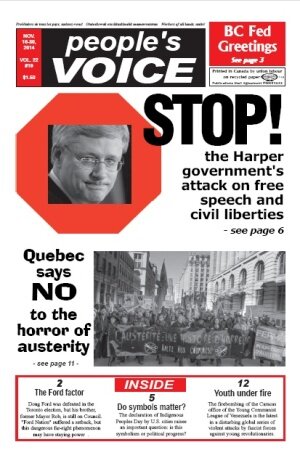
PEOPLE'S VOICE NOVEMBER 16-30, 2014 (pdf)
People’s Voice 2014 Calendar
”The Truth About the Great War”
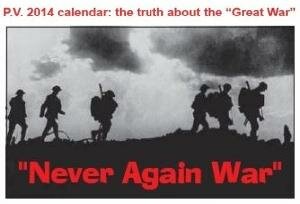
To order a copy of the People’s Voice 2014 Anti-First World War
Calendar, send $15 (includes postage and handling) to
People’s Voice, 706 Clark Drive, Vancouver, BC, V5L 3J1. Contact us at
604-255-2041 or pvoice@telus.net for bulk order prices.
|
People's Voice deadlines: December 1-31 January 1-31 Send submissions to PV Editorial Office,
|
REDS ON THE WEB
http://www.parti-communiste.ca/
peoplesvoice.ca
www.ycl-ljc.ca
www.solidnet.org
|
People's Voice finds many "Global Class Struggle" reports at the "Labour Start" website, http://www.labourstart.org/. We urge our readers to check it out! |
* * * * *
People's Voice
Canadian Publications Mail Sales Product Agreement #205214
ISSN number 1198-8657
People's Voice is published by
New Labour Press Ltd
PV Editorial Office
706 Clark Drive,
VANCOUVER, B.C. V5L 3J1
Phone:604-255-2041
Fax:604-254-9803
email: pvoice@telus.net
Editor: Kimball Cariou : Business Manager: David Au
Editorial Board: Kimball Cariou, Miguel Figueroa,
Doug Meggison, Naomi Rankin, Liz Rowley, Jim Sacouman
* * * * * *
Letters
People's Voice welcomes your letters
on any subject covered in our pages.
We reserve the right to edit for length and clarity,
and to refuse to print letters which may be libellous
or which contain unnecessary personal attacks.
Send your views to:
"Letters to the Editor",
706 Clark Dr., Vancouver, BC V5L 3J1,
or pvoice@telus.net
People's Voice articles may be reprinted without permission,
provided the source is credited.
* * * * * *
The Communist Party of Canada, formed in 1921,
has a proud history of fighting for jobs, equality, peace,
Canadian independence, and socialism.
The CPC does much more than run candidates in elections.
We think the fight against big business and its parties
is a year-round job,
so our members are active across the country,
to build our party and to help strengthen people's movements
on a wide range of issues.
All our policies and leadership
are set democratically by our members.
To find out more about Canada's party of Socialism,
give us a call at the nearest CPC office.
* * * * * *
Central Committee CPC
290A Danforth Ave Toronto, Ont. M4K 1N6
Ph: (416) 469-2446
fax: (416) 469-4063 E-mailmailto:info@cpc-pcp.ca
Parti Communiste du Quebec (section du
Parti communiste du Canada)
5359 Ave du Parc, Montréal, Québec,
H2V 4G9
B.C.Committee CPC
706 Clark Drive, Vancouver, V5L 3J1
Tel: (604) 254-9836
Fax: (604) 254-9803
Edmonton CPC
Box 68112, 70 Bonnie Doon P.O.
Edmonton, AB, T6C 4N6
Tel: (780) 465-7893
Fax: (780)463-0209
Calgary CPC
Unit #1 - 19 Radcliffe Close SE
Calgary AB, T2A 6B2
Tel: (403) 248-6489
Ottawa CPC
Tel: (613) 232-7108
Manitoba Committee
387 Selkirk Ave., Winnipeg, R2W 2M3
Tel/fax: (204) 586-7824
Ontario Ctee. CPC
290A Danforth Ave., Toronto, M4K 1N6
Tel: (416) 469-2446
Hamilton Ctee. CPC
265 Melvin Ave., Apt. 815
Hamilton, ON.
Tel: (905) 548-9586
Atlantic Region CPC
Box 70 Grand Pré, NS, B0P 1M0
Tel/fax: (902) 542-7981
http://www.parti-communiste.ca/
* * * * * *
News for People, Not for Profits!
Every issue of People's Voice
gives you the latest
on the fightback from coast to coast.
Whether it's the struggle for jobs or peace, resistance to social cuts,
solidarity with Cuba, or workers' struggles around the world,
we've got the news the corporate media won't print.
And we do more than that
- we report and analyze events
from a revolutionary perspective,
helping to build the movements for justice and equality,
and eventually for a socialist Canada.
Read the paper that fights for working people
- on every page, in every issue!
People's Voice
$30 for 1 year
$50 for 2 years
Low-income special rate: $15 for 1-year
Outside Canada $50 for 1 year
Send to: People's Voice, 706 Clark Drive, Vancouver, BC, V5L 3J1
You can call the editorial office at 604-255-2041
REDS ON THE WEB
http://www.parti-communiste.ca/
http://www.ycl-ljc.ca/
http://www.solidnet.org/
(The following articles are from the November 16-30, 2014, issue of People's Voice, Canada's leading socialist newspaper. Articles can be reprinted free if the source is credited. Subscription rates in Canada: $30/year, or $15 low income rate; for U.S. readers - $45 US per year; other overseas readers - $45 US or $50 CDN per year. Send to People's Voice, c/o PV Business Manager, 706 Clark Drive, Vancouver, BC, V5L 3J1.)
1) MASS PROTESTS RENEWED IN QUEBEC
PV Montreal Bureau
Labour, student and social movements are trying to shake the earth again across Quebec, as mass protests have hit the streets rejecting the new Couillard Liberal provincial austerity agenda.
Tens of thousands of people came together on Halloween in many cities and towns. The largest demonstration was in Montreal with between 40,000 and 50,000 protesters. Dressed in colourful costumes, large numbers of students filled the streets. Students have often been in the front lines of the movement and a total of 82,000 students also walked out of classes on a one‑day strike.
The day of action was the latest in a series of mobilizations that began this summer, after the provincial election, and was the largest popular mobilization in Quebec since the student protest of 2012. Demonstrations have continued in dozens of cities into November, with a mass rally of over 10,000 workers and parents opposing rate increases for day care the following weekend in Montreal.
"The government justifies its fiscal policy by citing the interests of future generations but now it is destroying the social safety net from which these generations could benefit," said Veronique Laflamme, co‑spokesperson for the Coalition Main Rouge (the "Red Hand" coalition) which called the Halloween action.
The Coalition has been organizing broad opposition to a series of significant cutbacks, privatizations, and other attacks on workers at the provincial and municipal level. The three main trade union centrals ‑ including over 100 firefighters ‑ all participated on October 31st.
The Red Hand Coalition includes over 80 labour, student and community organizations. It together some years before the Quebec Spring of 2012, and helped link that fight for access to education with the Charest‑Liberal austerity agenda.
Public sector unions in Quebec have also agreed to form a new Common Front for the 2015 negotiations. In the past, this united tactic of labour has been at the core major social mobilizations. And, since the late summer, a coalition of municipal labour groups has formed to demand free collective bargaining about their pensions, instead of the unilateral theft of pension funds the Liberals are imposing through Bill 3.
But Bill 3 is just one of several pieces to the austerity agenda imposed by the Couillard Liberals.
Quebec's universal rate of $7.35 per day child care ‑ by far the most affordable in Canada ‑ will be replaced by an income‑based price model. While the rate increase is said to touch less than half of the province's families who are the wealthiest, critics say there is no need to create a two‑tier system. Nor do they believe the government promise that it won't quickly re‑adjust the user‑pay levels to affect everyone, now that this fee has been introduced.
Quebec's daycare programme is well‑known for increasing women's participation in the workforce (to the point that these new women workers pay sufficient increased tax revenue to fully fund the programme) as well as benefiting poor children, and helping single parents especially.
"Today the increase affects families earning $75,000 a year, but who will it effect next year?" Francoise David, spokesperson for the left party Québec Solidaire, said in a release. The cuts also will also layoff daycare workers, eliminate proposed funding and reduce access to new spaces in the future.
In many ways the cuts will particularly hit women who both predominate as workers in the service sectors, and will be especially hurt by changes in family social programmes, increasing inequality.
Adding up to $3.2 billion, the cuts have also attacked health care, the community clinics (CLSC system), as well as other public services and social programmes, and will privatize Quebec's public liquor stores. This is all being done under the Liberal's mantra of "Zero Deficit."
Behind the slogan, what is becoming clear is the Couillard Liberal's agenda: destruction of the principle of universality in the Quebec social welfare system.
Speaking to People's Voice, Pierre Fontaine, leader of the Parti Communiste du Quebec, said that the Liberal attack has serious implications not just for Quebec, but the whole of Canada. "The Red Hand coalition is calling for a different direction, at the centre of which is progressive taxation ‑ and especially increasing corporate taxes ‑ and have long made similar proposals."
More action is planned for the winter, and the students have launched the site Printemps2015.org. Labour is planning continued work‑place actions and disruptions into December. Clarté, the newspaper of the Parti Communiste du Quebec, will cover these actions in a new winter issue exposing the class danger of the attack on universality.
"A key question is how the trade union movement will respond, and in our view their initial steps are very much the right direction ‑ there needs to be much more mobilization and united action," Fontaine said. "There is no doubt that austerity, as the protesters said on Oct 31st, is truly a horror story ‑ a social emergency."
At the end of the Oct 31st rally, protesters chanted outside the private Club sélect 357c, which has been exposed as the base for an old‑boys network linking major provincial and civic politicians with big investors and the Mafia ‑ and benefiting from P3 privatization. While the protest route was published in newspapers, the demonstration was declared illegal by the police: the organizers, refusing to respect the P6 bylaw, did not report this information directly to the police. But no dispersal was ordered, the police simply followed the river of protestors in the streets and did nothing more.
2) DIFFERENT TRENDS IN ONTARIO CIVIC ELECTIONS
People's Voice looks at some results of the Oct. 27 municipal elections across Ontario
In Toronto, Ward 5 Public School Trustee Howard Kaplan was re‑elected with 48% of the vote, cruising to victory ahead of six contenders on the political right. Kaplan campaigned against budget cuts, school closures and land severances, and for a new needs‑based funding formula to deliver quality education for students and tax relief for homeowners and tenants.
Kaplan's campaign to pay for education from provincial general revenues was well received by voters who are fed up with rising taxes and continuing cuts to programs and staffing in TDSB schools.
Almost half of the TDSB Trustees are new, with a majority on the progressive side. Parents, students and educators hope this Board will oppose more budget cuts, and that bargaining will be fairer than in 2012 when the McGuinty Liberals suspended free collective bargaining and removed $2 billion from wages and benefits under Bill 115.
Premier Kathleen Wynne, herself a former TDSB Trustee and advocate of a new needs‑based funding formula, has shifted to provincial bargaining on the key issues of wages and working conditions, leaving School Boards to negotiate local issues only. The big issues of a new funding formula and tax reform were raised by progressive candidates across the province.
In Guelph Juanita Burnett finished third in a field of six, supported by CUPE and the local Labour Council.
In Brampton, Harinderpal Hundal ran a very strong campaign with broad community support, but was out‑spent by a slate of NDP candidates and the provincial NDP machine, which is trying to make inroads in the Greater Toronto area leading into next year's federal election.
In Ottawa, Larry Wasslen campaigned for a City Council seat in an election mainly
about unrestrained development and the need for a new financial deal for cities.
Ford Dumped
The Toronto City Council is virtually unchanged with only one right-wing incumbent dumped by voters. The new faces are mainly right‑wingers replacing right‑wingers who stepped down or retired. Council continues to be dominated by a right wing majority, so the lines are drawn for more budget battles and struggles against layoffs and privatization of city services.
Establishment choice John Tory defeated Doug Ford and NDPer Olivia Chow for Mayor. Chow's uninspired campaign said little on the big issues like taxation and municipal finance, and nothing to indicate that she would fight for working people.
Doug Ford on the other hand, played directly to the poor, the unemployed and the unorganized, small business, and those of the edge of financial disaster. He framed the campaign as a choice between John Tory as the candidate of power and privilege, and himself as the fighter for the underdog, the common people, workers. By focusing on Tory's background, and by avoiding public debates in favour of press conferences, Ford evaded questions about his record as a leader of one of the most vicious right‑wing majorities on Council in decades.
During the last four years, both Doug and brother Rob Ford slashed and privatized services, raised taxes, attempted to close libraries and homeless shelters, fired the Board of Toronto Community Housing, sold off public housing stock, cut transit routes and raised fares, laid off hundreds of municipal employees, and locked out city workers. But this record was rarely discussed. In fact, most of Ford's campaigning took place in the poorest neighbourhoods, where too many gullible voters sucked up the lie that Ford would fight for them.
The media gave Ford a free pass, dutifully reporting his lies. When the Ford campaign got underway in September, Chow was left in the dust.
John Tory had the massive financial and political support of Big Business for almost a year before election day. Their strategy was to paint Ford as a danger, and to convince voters that it was a two‑way race between Ford and Tory. This resulted in a massive shift of Liberal votes from Chow to Tory in the last weeks of the campaign. Tory won about 40% of the vote, while Ford finished with 35%, and Chow only 21%.
But the 35% of Torontonians who voted for Ford are likely to be a force in the 2015 federal election, linking the Ford brothers to Harper and the Tory Party leadership in Ontario. Far right "Tea Party" partisans are coming out of the woodwork, a dangerous development for democracy, and for labour, civil and social rights.
What's needed is a strong labour-led People's Coalition with alternatives to mass unemployment, falling wages and living standards, mass privatization, deregulation, and "free trade". Working people and the unemployed are desperate for real solutions and real leadership, by working class partisans willing to fight. The consequences of not acting will be serious indeed, as the Toronto election so clearly demonstrated.
3) B.C. - CAPITALISM IS STILL NOT WORKING
Labour Bureau, Communist Party of British Columbia, November 2014
The Communist Party of Canada extends warm greetings to delegates attending the 56th Biennial Convention of the BC Federation of Labour. As your community's leading labour activists, you are certainly aware of the continuing global economic crisis. You understand this is a crisis brought on by the greed of the 1%. The origins of this greed are not abstract; they are rooted inextricably in the capitalist system.
Karl Marx identified over a hundred years ago the cyclical nature of economic crises. An historical look at the economies of the developed capitalist countries since that time bears out his observations and conclusions. The present crisis has its roots in the 1970s, when capital was faced with falling rates of profit from manufacturing. In response, capitalists sought out new and higher sources of profit. In general terms, this meant a shift of capital from the manufacturing to the financial sectors of the economy.
A second attempt to spur profits was to close plants in the U.S. and Canada, and to open new branch plants in the Maquiladora zone or in the "free economic" zones of China, Vietnam or wherever labour costs were cheap. This had the desired effect on the rate of profit, but created higher permanent unemployment in Canada and British Columbia. This means tougher competition for jobs and a harder negotiating climate for unions, and eventually declining real wages. A more recent trend is the expansion of the "Temporary Foreign Worker Program", designed to increase unemployment. This is not the fault of workers who seek employment to feed themselves and their families, but of the corporations and governments which want to reduce labour costs.
Allegedly to stimulate spending and boost the economy, significant tax cuts were carried out for the wealthy and for corporations, as well as large‑scale bailouts of banks and corporations facing bankruptcy. This lowered federal government revenues, and reduced transfer payments for education and health. Having also reduced taxes, provinces facing deficits then downloaded expenses to municipalities, who in turn passed them on to working people. Municipal infrastructure and services suffered because there are limits to property taxes that people can pay.
However, there always seems to be enough money for the military ‑ F35's, warships, sending troops overseas ‑ but not for First Nations housing or other crucial services for the poor and marginalized. There is also corporate welfare; the IMF reports that annual subsidies to the oil and gas industry alone in Canada are over 34 Billion dollars. (Mitchell Anderson, 15 May 2014, TheTyee.ca.)
Working class reaction
Over the last few years, mainly in Europe and Asia, but also in Canada and the US through the "Occupy Movement" and campaigns to organize fast food workers and raise the minimum wage, there has been major resistance against cutbacks, corporate bailouts, and austerity. The state reaction has primarily been police and tear gas.
In many cases these governments include (or are even led by) social democrats or "socialists" who are complicit with European Union and European Central Bank demands for major "reforms" to protect the integrity of the European Union itself. At best, their goal is only to moderate capitalism, not to replace it with a better economic model. They fail to recognize that the interests of the bosses are opposed to those of workers, and that capitalism cannot be reformed to serve working people. There is a similar danger in Canada and in BC, where the NDP lost the 2013 election after failing to campaign for a decisive break with the neoliberal policies of the Liberals.
Organized labour in BC and Canada has been slow to organize a fightback against the corporate/government onslaught. But there are signs of change. A new, more dynamic leadership at the CLC is opening up the possibility of more militant participation of labour in peoples' struggles. The "Common Front" in Ontario, and the unity of the Quebec labour movement against the Couillard government's austerity attack are positive signs of a new attitude of struggle. The courageous strike by the BC Teachers, and the struggle of the Richmond IKEA workers, are examples of how to build a united labour-community fightback in this province.
The incoming leadership of the BC Fed needs to seek out partners to join in such a fightback. The success of the Teachers in gaining public support proves that right‑wing governments can be compelled to back down. Reaching out to our natural allies ‑ Aboriginal peoples, students, anti‑poverty and social justice groups, environmental movements, seniors, anti‑war groups ‑ is the best way to move this process forward.
What's to be done?
At this convention delegates should pressure the incoming leadership to develop labour's own program, independent of all political parties. Such a program could include the resistance against austerity, the use of BC resources for BC jobs, an end to private public partnerships, stopping and reversing privatization, and more.
Regardless of who is elected as President and Secretary‑Treasurer, the delegates determine the political policy and line of the BC Federation of Labour. Arming the Executive Board with strong, militant working class policies would enable them to start building a massive, united peoples movement, to take back our province from the corporations; to protect our environment from the oil and gas barons; to rebuild our fishery and to establish large scale value added manufacturing, instead of the current policies of exporting our resources to be processed elsewhere. Labour is the essential ingredient in such a movement, it is the glue that will hold it together and the engine that will move it forward.
Mass pressure is needed on all parties to adopt such policies now ‑ not when politically expedient. A real fightback plan cannot be limited to lobbying. We need action, from teach‑ins to sit‑ins, rallies, marches, pickets, and strikes.
We also need to ensure that the labour movement represents, and fights for, the entire working class ‑ not just those with union cards. It must be activist oriented, and rooted in solidarity and struggle, not business unionism. We need to discard the mistaken beliefs that the interests of workers and bosses can be reconciled, or that the labour movement's role is to help "better manage" the capitalist system. Fighting for immediate reforms that will better the lives of working people is an important task for labour and its allies. The struggle for these reforms must move beyond the realm of collective bargaining and become the basis to unite all workers behind a political program to bring about meaningful political change.
What we need is Socialism ‑ a society in which the value produced by labour is used by society rather than expropriated by corporations and sold for profit. This of course means democratic public ownership of banks, major resources, and producers, and placing political and economic power in the hands of working people.
If you support these ideas, contact us to find out about joining the Communist Party, the party of the working class, which fights for a socialist Canada!
4) DEFEND CIVIL LIBERTIES AND DEMOCRATIC FREEDOMS
Statement of the Central Executive Committee, Communist Party of Canada, October 23, 2014
The Communist Party of Canada warns against the attempt by the federal Conservative government to use the recent events in Ottawa and St‑Jean‑sur‑Richelieu as justification to restrict civil liberties and democratic freedoms. Even before these unconnected incidents the government had been preparing new so‑called "anti‑terrorism" legislation to expand the legal scope for CSIS and other security agencies to spy on the activities and communications of Canadians, and to allow "disruption" tactics - a euphemism for the authority to arrest anyone considered a potential threat, even those who have not engaged in any illegal activity. This chilling legislation will be brought before Parliament shortly, perhaps in an even more draconian form.
Ever since taking office, the Harper Conservatives have directed state security agencies to profile and focus on those they consider "enemies", such as environmentalists opposed to the expansion of the tarsands and hydraulic fracking, Aboriginal movements which resist the destruction of their traditional territories by governments and resource corporations, or groups CSIS vaguely labels "multi‑issue extremists". CSIS already operates beyond the reach of Parliament and exists to suppress political dissent. The expansion of police state powers will accelerate this drive to label Canadians as "potential terrorists," creating a basis for even more severe police spying and repression against, the labour and democratic movements and grassroots opposition forces.
Such domestic activists are the main target of the Conservative security state agenda, as has been the case for every federal government since Confederation. For nearly 150 years, every attack on civil rights and democratic freedoms has been accompanied by ominous speeches by politicians, warning of "dire threats". This has been a key excuse for repeated waves of repression, such as the mass arrests during the Winnipeg General Strike of 1919, the trials and internments of Communist leaders during the 1930s and '40s, the blacklisting of thousands of militant labour activists during the Cold War era, the mass suppression of democratic rights during the 1970 October crisis, the mass arrests during the G‑20 Summit in Toronto and the student protests in Quebec, the criminalization of Aboriginal land defender movements, and many other occasions. Allowing the "pre‑emptive" arrest of "potential terrorists" would open the door to police actions against virtually any movement or organization critical of government policies. This legislation must be condemned by democratic forces in Canada, especially trade unions, Aboriginal peoples, environmentalists, defenders of immigrant rights, civil liberties groups, and all those who want to protect the Charter rights to freedom of speech, expression and assembly. Instead of supporting the Harper government's repressive agenda, the opposition parties in Parliament must also unequivocally oppose the attempt to gag and silence Canadians.
No clear connection has been drawn between the homicides in Quebec and the homicides in Ottawa, which left two soldiers and their two attackers dead. Nor is there any clear evidence of links with other organized groups. In fact it seems the perpetrators acted as individuals.
But these events take place in the context of the Canadian government's enthusiastic participation in war‑making and militarism as a key partner in the US‑led NATO alliance. The Communist Party restates our long‑held view that war‑making by the Canadian state - including the Harper government's decisions to take part in the bombing of Islamic State forces, to back the Israeli occupation of Palestine, and to support the far ultra‑right coup regime in Kiev ‑ inevitably become part of a deadly global spiral of violence and militarism. The most aggressive and powerful terrorist force on our planet has been U.S. imperialism, which has repeatedly overthrown governments and invaded countries which it considers unfriendly to the interests of transnational capital. Joining wars launched by the U.S. will only exacerbate crises rather than resolve international problems.
The Communist Party condemns the efforts to criminalize dissent, and calls upon the labour and democratic movements to defend the rights to free speech and expression, assembly, privacy, legal due process and citizenship protected by the Canadian Charter of Rights. The Communist Party particularly condemns the tendency by the corporate media and politicians to use inflammatory rhetoric like "lone wolf terrorists," racialize these incidents, and vilify Muslims and the Islamic faith. We will strenuously combat all attempts to victimize or marginalize any national, ethnic, religious or political minority or community in Canada. We call on all labour, progressive and democratic forces to defend democracy and the cause of peace, and oppose all efforts to eliminate these rights in the name of "fighting terrorism".
The Communist Party demands an independent foreign policy based on peace and disarmament, and calls for full support for mass protests against participation in the new war in Iraq and Syria in cities across Canada on October 25‑26 and beyond. We cannot be silent.
5) WORKING PEOPLE LOSING TRUST IN MANITOBA NDP
By Darrell Rankin, Leader, Communist Party of Canada-Manitoba
The remarkably low vote for a prominent NDP politician in Winnipeg's mayoralty race on October 22 is triggering dissension within Manitoba Premier Greg Selinger's NDP government.
The mayoralty result is just another sign that the NDP is losing the trust of workers in Manitoba.
Mayoral candidate Judy Wasylysia‑Leis led opinion polls until four days before the election. On election night, her vote declined by 36% compared to the 2011 total. She finished well behind Tory-affiliated Brian Bowman. This triggered panic in Selinger's cabinet.
It took only a day or two for several ministers to blame Premier Selinger for the debacle, notably his decision in 2013 to increase the provincial sales tax to 8%.
Normally in such circumstances, a working class party would recognize the need for a credible self‑critical review of its policies to find out why it is losing the confidence of working people, and change course.
But the Premier's self‑criticism was that he could have better "unrolled" a provincial sales tax hike in 2013, not that it was regressive and unpopular. Five cabinet ministers who resigned from his cabinet blamed Selinger's unwillingness to listen, a message echoed in the media.
The shallow, opportunist nature of the bickering in the Legislature and media is consigning the NDP to a heavy defeat at the polls in 2016, if it lasts that long. A far more profound discussion is needed.
The fact is that working people are in dire straits. They are feeling the effects of years of economic crisis. Twice since 2008, Manitoba lost more than 10,000 manufacturing jobs.
They are feeling the effects of pro‑corporate policies by the NDP and right‑wing governments, and they are displaying resentment. Sixty‑nine per cent of Manitoba workers live from pay cheque to pay cheque, far higher than the 52% rate for Canada.
The fact is that the Business Council of Manitoba proposed the sales tax hike in 2011, and the NDP ‑ not just Premier Selinger ‑ caved in to the idea in 2013.
The fact is that the NDP already hammered workers with a two-year "wage pause" for public sector workers in 2010, a measure eagerly copied by all municipal governments and school boards.
Public sector workers lost close to one billion dollars over the last four years because wages have not caught up to inflation. This did not stop many union activists from campaigning for the NDP's re‑election in 2011 (one‑third of delegates to the MFL convention indicated they helped out).
Wasylysia‑Leis's campaign was strike three against the NDP. She enthusiastically campaigned for annual 3.5% property tax increases until 2017, well above historic wage growth, at a time when resentment was building against the NDP.
The present debacle makes it clear that the NDP will never unite workers to march forward under banners like regressive taxes, wage cuts and corporate tax cuts amounting to more than 1 billion dollars since 1999.
The NDP's regressive taxation model will never create a fairer society, create job security or blunt the corporate attack on workers. NDP taxes and the mistreatment of public sector workers are part of the corporate attack.
The NDP will lose trust among working people until it arrives at such a conclusion. The discussion that now prevails in the NDP, faithfully reported in the bourgeois press, is limited and opportunist.
A full discussion in the labour movement about the failings of the NDP will deepen the understanding that working people need an alternative of their own, that the labour movement cannot contract‑out its political thinking to the NDP and expect better economic and social conditions.
Such a discussion will raise the awareness of working people well beyond the trade union movement and help move them into action in a broad struggle to improve their conditions and rights. It's time for a big wage increase.
6) SLIGHT SHIFT TO LEFT IN WINNIPEG ELECTION
By Darrell Rankin
In the Winnipeg civic election on Oct. 22, working people voted to shift City Council slightly towards the left. Left and centre Council members will find it easier to win votes at Council meetings.
However, right wing councillors could still win some votes demanded by their big business and developer backers, such as gutting pensions for 9,000 civic workers as promised by Mayor‑elect Brian Bowman.
Mass action may help block such votes. The dire economic condition of working people was an important factor in creating increased scrutiny of platforms.
By far the most important development was the rise of a significant minority of voters who understood the need for fundamental change. They promise to be an important influence outside City Hall when it comes to important issues.
This is reflected in the combined vote for Robert-Falcon Ouellette (37,000) and David Sanders (4,000), or a combined 17.3% of voters. Both ran for mayor on policies that stood for working people regarding taxes, labour and social policy.
The two largest trends among candidates' platforms were, firstly, the policies of continuity and regressive taxation, reflected in NDP and Liberal‑backed campaigns.
The most prominent example of this was Wasylycia‑Leis' platform of four years of property tax hikes, ahead of the historical rate of wage increases, while freezing business taxes. Her campaign was widely acknowledged to include both NDP and Liberal party activists.
Secondly, there was the big business‑backed trend, advertising promises that were vague and enticing (Bowman and other right wing candidates). The promises were intended for the gullible and uneducated, and helped to hide reactionary threats such as attacking pensions.
Today, the main question the NDP must be grappling with is how will it win in 18 months provincially with only 58,000 more or less solid NDP voters who voted for Wasylycia‑Leis, in contrast to Bowman's 112,000?
It is clear that the NDP in Manitoba requires a fundamental review to examine why it is losing the trust of workers. It will be important to see if such a rethink happens and how widespread the self‑criticism will be, if it occurs.
Wasylycia‑Leis' called herself the most fiscally‑conservative candidate. It is not wrong to have a balanced budget, but too often social democrats have balanced budgets on the backs of workers, not just in Europe, but here (sisters and brothers, remember Bob Rae!).
Thanks to mayoral candidate David Sanders, workers were aware that Winnipeg is facing a serious fiscal crisis. It is no wonder people stayed away from Wasylycia‑Leis after her pronouncement of being fiscally conservative.
By rejecting the idea she was the most pro‑union candidate, union supporters began to look for the best alternative. The Winnipeg Labour Council endorsed Wasylycia‑Leis, but it did not seem to mean much to her. Both Ouellette and Sanders benefited from her comment about unions.
7) TO ACHIEVE CLIMATE JUSTICE, PHASE OUT CAPITALISM
People's Voice Editorial
The UN's Intergovernmental Panel on Climate Change has issued a "stark" report, warning that unrestricted use of fossil fuels should be phased out by 2100 to avoid "severe, pervasive and irreversible" climate change. The good news from the IPCC is that most of the world's electricity could be produced from low‑carbon sources by 2050, at a cost far less than the damage caused by inaction.
But while people and even many governments grasp the need to slash greenhouse gas emissions, the major imperialist powers remain in the grip of a military-industrial-energy complex which opposes such radical change. Despite the occasional fine rhetoric of President Obama, the U.S. and its allies cling to the historical anachronism known as the private profit system of capitalism.
At the 1992 Earth Summit in Rio, Cuba's Fidel Castro prophetically warned that "An important biological species - humankind - is at risk of disappearing due to the rapid and progressive elimination of its natural habitat. We are becoming aware of this problem when it is almost too late to prevent it. It must be said that consumer societies are chiefly responsible for this appalling environmental destruction..."
The drive for increased corporate profits is at the heart of "consumerism". Putting it bluntly, the big energy and arms monopolies, and the leaders of the imperialist governments they support, are not role models or agents of change. They are simply criminals. Why? Because they defend a capitalist system which will turn billions of people into desperate, hungry, homeless refugees within our own lifetimes.
Our world still has the time and resources to turn away from disaster. But to succeed, the struggle for climate justice must be combined with economic, social and political justice - with a socialist alternative based on meeting the needs of people and the environment, not on the greed of a tiny minority.
People's Voice Editorial
For a few days this month, we were all stuffed into Mr. Peabody's wayback machine, watching bizarre celebrations of the 25th anniversary of the "fall of the Berlin Wall." Please forgive us for trying to pop the balloon of capitalist triumphalism.
First, the destruction of socialism in Europe was accompanied by a solemn promise that the US and NATO would not expand eastwards. Yet several of these countries are now NATO members, as U.S. military bases inch closer to Russia's borders. War and fascism are on the march across Ukraine, seventy years after the Wehrmacht was demolished by the Red Army and heroic partisans. Spitting on the Canadian soldiers who sacrificed their lives to defeat Hitler fascism, our Prime Minister praises the ultra-right and pro-Nazi coup parties in Kiev. In effect, removal of the Anti-Fascist Protection Wall (to use the German Democratic Republic's term) opened the door to 21st century fascism and a new Cold War.
Some will reply: at least the East Germans gained their freedom! Only if one accepts the narrow definition that freedom means access to a vast range of expensive consumer goods. In exchange, the people of the GDR surrendered the gains of socialism: full employment, housing, free education, health care and child care, major progress towards gender equality, and much more.
Yes, socialist East Germany also had real shortcomings, in part due to huge obstacles which limited its successes. But we do smile at one more "AHA" criticism: the GDR spied on its own citizens! Here in Canada, our elected government admits that every protest demonstration and every form of communication is monitored by the police and security agencies. The difference? In our "free" country, this is done to help preserve capitalist rule, not to prevent the restoration of capitalism. Aha, indeed.
9) B.C. TAX DOLLARS FLOW TO BIG OIL
Doing business with the energy industry has cost British Columbians about $1.25 billion in royalty revenues over the last five years, even before most of the product has been extracted. The incentives to the industry were highlighted by B.C. auditor general Carol Bellringer in her 2013‑2014 summary of the province's financial statements.
According to a Vancouver Sun report, Bellringer also noted how much money the government made from selling assets, and how much it paid in interest on debt accumulated through public‑private partnerships.
The incentive credits to the energy sector are designed to encourage production of oil and gas, but in effect subsidize corporations at taxpayer expense. The industry has accumulated $1.25 billion in credits, and last year alone that figure hit $587 million.
"When these producers claim their incentive credits, that money will be deducted from the royalties that they owe, thereby reducing the amount of money government will generate," Bellringer wrote in her report.
When it came to the sale of provincial assets, land and buildings, the government made $601 million last year, allowing the government record a $353 million surplus.
The province also paid higher interest rates, ranging from 4.42% to 14.79?, on the debt it accumulated through public‑private partnerships. The interest rate on taxpayer supported debt averaged about four per cent.
10) CBA BACKS AWAY FROM CHEVRON CORP.
Facing resignations and protests, the Canadian Bar Association (CBA) has decided not to make an intervention at the Supreme Court of Canada in a case involving Chevron's contamination of the Ecuadorian rainforest.
In a letter to members, CBA president Michele Hollins stated "The [Legislation and Law Reform] Committee concluded that while the factum was well‑drafted and of a high standard of quality, it did not meet the specific requirements of CBA's Intervention Policy... and would be withdrawn."
In an interview with teleSUR, Santiago Escobar, a member of the Anti Chevron Committee of Canada, stated "The CBA won't admit this but they withdrew because of the protests they were facing. They knew that they couldn't be seen supporting a corporation that has negatively affected the lives of so many Indigenous people in Ecuador."
The CBA's environmental, aboriginal, and civil litigation committees had opposed intervening on behalf of Chevron. Lawyers in Canada were upset that the CBA board had authorized a law firm with ties to Chevron, Blake Cassels & Graydon LLP, to submit the brief.
Ecuadorian plaintiffs want to seize the assets of Chevron Corporation in Canada in order to collect a USD $9.5 Million judgment against the company for contamination it caused in the Lago Agrio region. Arguing that courts in Canada have no jurisdiction in this case, Chevron has appealed to the Supreme Court of Canada, which will hear the case in early December. Should the Supreme Court rule against Chevron, the full judgment could be collected and paid to the Ecuadorian plaintiffs.
The Anti‑Chevron Canada Committee has welcomed the CBA decision to withdraw its application for intervener status in the case.
"This is clearly the right decision and we are indebted to member lawyers who had the courage to speak out and uphold justice," says a recent Committee statement. "Through the collective action of these courageous lawyers, the forthright commitment to justice principles of law students, and the actions of concerned community members, the Association was pressured to do the right thing. Together these groups proved not only that the requirements of the Intervention Policy of the CBA were not met, but also that corporate law interests do not come before human rights.
"The acts of Chevron affect us all. Chevron polluted the Amazon rainforest, regarded as the world's botanical treasure, which contains unknown pharmaceutical possibilities and is considered the lungs of the world. More than 20 percent of the world's oxygen is produced here. Chevron Corporation is operating within one global entity and therefore, their corporate social responsibility should be enforced globally.
"The hundreds of oil wells and pools of waste left behind by Chevron Corporation in Ecuador also continue to negatively affect the lives and wellbeing of the Indigenous people living in this region. By North American standards this is a public health crisis of immeasurable proportions: water that is essential for daily activities is contaminated and continues to affect thousands of people. The high prevalence in rates of cancer, miscarriages and other illnesses show that the careless dumping by Chevron was a violent act inflicted on innocent people.
"Chevron Canada was created by Chevron Corp capital and operates in Canada trading under the same symbol (CVX) on the Toronto Stock Exchange. Chevron operates transnationally, picking and choosing its countries of interest, and packing up and leaving when convenient. Justice must function equally across and within national borders."
The legal case has wide implications. In the unceded Wet'suwet'en territory of northern B.C., for example, Indigenous people at the Unis'tot'en Camp are blockading Chevron and other companies, and many other communities globally have been negatively impacted by Chevron's practices.
11) THE WORLD DENOUNCES ILLEGAL U.S. BLOCKADE
By Adrien Welsh, Chair of the YCL‑LJC International Commission
On October 29, for the 23rd time, the world rejected the criminal blockade imposed on Cuba in 1962. The outcome of the vote during the session of the United Nations on this topic couldn't have been more clear: out of the 193 member countries of the United Nations, 188 voted in favour of the abolition of the blockade, and only 2 voted against the motion (not surprisingly the US and Israel). Since the first vote in 1992, a majority of the member countries have supported this motion. The change is that the support has become increasingly unanimous: in 1992, while only three countries voted against the end of the embargo, there were still 46 countries that abstained.
Despite all this, this criminal blockade keeps being imposed on the Cuban people, causing a loss of over 3.9 billion dollars this year, and 1.1 trillion since the beginning of the blockade. As a consequence, not only can Cuba not trade with the US, but also it cannot use US dollars in its international financial transactions, nor can it access bank credits from US institutions or their subsidiaries. Moreover, since 2004, fines to both US‑based and foreign entities who have traded with Cuba, total over 11 billion dollars.
As the Cuban Minister of Foreign Affairs, Bruno Rodriguez, called for a dialogue with the US to solve the problem, the United States justified their position in an evasive way, referring to the "lack of freedom of speech" in Cuba, especially concerning restrictions over the internet.
Lack of freedom of speech, really? This is quite amusing to hear when we know that the US has supported all the bloodiest dictatorships in the region and around the world. They are behind the civil wars that have torn the Latin American continent apart, whether it be in Guatemala, Colombia or in El Salvador. They are the ones who fund narcotrafficking warlords who terrorize the Latin American population even in exile. It is a particularly pathetic accusation when we know that the US funds the most reactionary religious sects that force more and more people to live in conditions as backward as in the Middle Ages, as well as being an unconditional ally of Saudi Arabia, which is not what we could call a good example in terms of their record on freedom of speech! In comparison, Cuba hosts the biggest book fair in Latin America, and UNESCO's headquarters for Latin America are located in Havana.
But Cuba's openness to the world doesn't end here. Its literacy rate is considerably higher than every other country in Latin America. Actually, with a literacy rate of 99.9%, it is slightly superior to the US rate (99%). Cuba's openness to the world is not only about culture, but also about technology. When science in capitalist countries is determined by capitalist trusts, in socialist countries like Cuba, it is aimed to respond to people's needs. This is how and why Cuban scientists have achieved overwhelming results in finding a treatment for some cancers.
With a rate of 6.7 doctors per 1000 inhabitants, Cuba has one of the highest doctor‑patient rates in the world. In comparison, the US only counts an average of 2.5 doctors for 1000 inhabitants. This has allowed the small island to play an active role in the development of many countries, without demanding anything in return, contrasting sharply to the foreign policy of capitalist states. For instance, Cuba was the first country to send 165 doctors to Africa when the Ebola crisis started, whereas the US has used it as a pretext to send up to 3000 soldiers!
And for Cuba, this is nothing exceptional: not only are thousands of doctors permanently deployed around the world, but also school teachers, sports coaches, and plenty of other humanitarian staff. Cuba played a frontline role during the last Cholera crisis in Haiti and its humanitarian workers were sent to the most remote villages of Pakistan during the last earthquake. Even during hurricane Katrina, Fidel Castro offered Cuba's help to the US population, which was, of course, rejected. The Bush government wasn't able to respond correctly to this crisis, resulting in over 1830 deaths, with most of the victims being African American working‑class residents of New Orleans. Some of the hurricane's victims are still homeless to this day.
We should also recall the role of the Cuban people in the national liberation struggle of Angola, which paved the way for the end of Apartheid in South Africa, as Mandela himself recognized.
In addition to that, Cuba has been, and still is, playing an important role in the development of third world countries by opening their classrooms to their students. This is why, right now, in Cuba, there is a significant number of students from the refugee camps of Western Sahara and Palestine, as well as others from the Philippines or Vietnam, studying in Cuba.
And finally, we should recall that Cuba does all this with a GDP that represents no more than 0.3% of the US's.
Canada, as we can see, didn't oppose the motion, but it is in no way a sign of any particularly strong links of friendship between the two governments. On countless occasions Harper has qualified the Cuban government as dictatorial, but perhaps the most significant example was Harper's opposition to Cuba's participation in the 2012 Summit of the Americas. Obama and Harper were the only member states to oppose their inclusion. Even the not-so-progressive president of Colombia, Juan Manuel Santos, said this exclusion was based on an "ideological blockage".
Harper's hypocritical positions, based on safeguarding Canadian imperialist interests by keeping good trade relations with Cuba without losing face with its US ally, have to be denounced. This is why campaigns for a genuine solidarity with Cuba and its anti‑imperialist struggles have to be reinforced in our country. Also, we should keep in mind, that the most effective way would be by reinforcing our own anti‑imperialist struggles. As Che Guevara once said, "if you want to help the Cuban Revolution, make the Revolution in your own country."
http://rebelyouth-magazine.blogspot.ca
12) ATTACKS ON YOUNG COMMUNISTS - GROWING FASCIST THREAT
By Drew Garvie, General Secretary, YCL‑LJC of Canada
In late October, the World Federation of Democratic Youth, a global anti‑imperialist federation of youth organizations founded after the fascist defeat in Europe in 1945, issued two statements condemning fascist violence in both Venezuela and Yugoslavia. These attacks had occurred in the preceding weeks.
In the early morning hours of October 21st in Caracas, members of the Communist Youth of Venezuela (JCV) were finishing their work at their central offices. Several firebombs were launched at the building and a fire was started in their meeting room. Fortunately no comrades were injured in the attack and the fire was extinguished.
The JCV Executive Committee released a statement contextualizing the attack against them: "This deed occurs within the framework of violence imposed by fascism since February of this year carried out by mercenaries and paramilitaries serving the extreme, pro‑imperialist right." This references an upsurge in right‑wing protests that took place from February through June, which led to the deaths of 43 people. Most recently, Robert Serra, the youngest parliamentarian elected in Venezuelan history, and a member of VenezuelaÆs Socialist Party (PSUV), was murdered with Colombian paramilitaries being implicated.
The World Federation of Democratic Youth (WFDY) condemned the "terrorist and fascist attack against JCV at the same time that it calls for international solidarity with the people of Venezuela". The Communist Party of Venezuela and the President of Venezuela, Nicolas Maduro, both immediately condemned the attack. Maduro called on all political forces of Venezuela to join him and offer solidarity. The objective of these attacks, "was to bring our country into an atmosphere of confrontations and hatred that leads to chaos", said President Maduro.
The attack on the JCV offices were accompanied by more disturbing events in Europe, also taking place this October. Several activists of the League of Communist Yugoslav Youth (SKOJ) and the New Communist Party of Yugoslavia (NKPJ) were physically assaulted in Belgrade and Novi Sad.
One of the targets was Aleksander Djenic, the General Secretary of SKOJ, who has played an important role in student protests against the European Union's "Bologna reforms", which have attacked their education system. Two members of the neo‑fascist group "Serb Action" attacked Djenic in Belgrade. The police arrived almost immediately and promptly arrested Djenic for his actions in self‑defence.
On October 11th, a fascist gang attacked students at the Faculty of Philosophy in Novi Sad, including a SKOJ activist. Simultaneously, elsewhere in Novi Sad, another SKOJ activist was attacked.
The NKPJ and the SKOJ responded with a statement saying that these were not isolated incidents, "but a clearly orchestrated campaign, with the goal of intimidating and threatening the lives" of their members. In contrast to the state's response to the violence in Venezuela, the SKOJ has had to demand that police stop being complicit in fascist violence: "What is worrying, immoral and hypocritical is that members of neo‑fascist organizations are treated by authorities as victims."
The WFDY called for action against the violence and expressed "solidarity with SKOJ and to the comrade Aleksandar Djenic, and [WFDY] also supports NKPJ and SKOJ in their demand for the dismissal of the charges against comrade Aleksandar Djenic...The World Federation of Democratic Youth condemns all the aggressive attacks of clerical ultra right‑wingers against NKPJ and SKOJ members, and understands that the attacks have to do with ideological and political beliefs."
In addition to the events in Serbia, on October 23rd, comrades from the Young Communist Movement of France (MJCF) were also the victims of an attack by an ultra‑right group in the city of Aix‑En‑Provence, near Marseille. The young communists were organizing a film night when approximately 15 individuals from the ultra‑right group "Action Francaise" entered and physically attacked the crowd. Action Francaise, is an old organization known for its monarchist and ultra‑right, racist, xenophobic and religious positions. One of their slogans during the attack was "down with the republic" and in 1934, while admirers of Hitler and Mussolini, they tried to reinstate the monarchy.
Since the election of Francois Hollande, France has witnessed an increase in the ultra‑right's activity. The Social Democratic government of Hollande has imposed harsh austerity measures that even the traditional right would have trouble enacting. With the failure of Social Democracy to act with the people resisting the austerity assault of the French and EU capitalists, the road is paved for the ultra‑right to spread its toxic message, depicting all political parties as the same, promoting xenophobia, violence, anti‑communism and anti‑unionism. But fascism, behind its populist rhetoric, plays the role of supporting the capitalist system by shifting the burden of the crisis onto the shoulders of the working people by force, while eliminating democratic rights.
Fascism is even better established in Eastern Europe, especially in countries where counterrevolutionary forces won victories in the 1990s, such as in the case mentioned above in Serbia. In many of these countries, attacks on the communist movement have even been led by the government. Hungary, Lithuania, and Moldova have all banned or attempted to ban Communist symbols such as the hammer and sickle or the red star in recent years. The most recent case is the attempted ban on the Communist Party of Ukraine by the extreme nationalist, NATO backed, coup government in that country. We should also remember the ban on the KSM, the Communist youth of the Czech Republic in 2006 which was defeated by popular mobilization, including the WFDY's international solidarity campaign. It is not a coincidence that Ukraine and the Czech Republic are two countries in Eastern Europe that have a relatively strong communist movement, and as such were targeted.
The rise of European fascism and the imperialist backed violence in Latin America are not disconnected. These events even have an expression right here in Canada. The Young Communist League of Canada at its Central Committee meeting this July, made note of the global right's drive to rejuvenate anti‑communism as a weapon to be used in the context of the current economic and environmental crises of capitalism. The violence and rhetoric aimed at communist and progressive forces "aims to reinforce the myth that `there is no alternative' to capitalism." Referencing Prime Minister Harper's anti‑communist tirade at a fundraiser dinner for a "monument to the victims of communism" in May of this year, the YCL‑LJC wrote: "far from being pro‑democratic, anti‑communism is also a smoke screen used to create the political conditions for accelerating Tory attacks on the trade union movement and democratic rights and freedoms in Canada."
Harper's appeals to anti‑communism, and in the past couple of weeks against "homegrown terrorism", not only opens the door to more surveillance and repression from the state, it also gives fascist groups more room to manoeuvre. As the Tory government promotes Islamophobia, xenophobia and fear mongering against "eco‑terrorists", "multi‑issue extremists" and "Communists", the ultra‑right benefits. Here in Canada we need to keep a close eye on anti‑communism and fascism abroad, stand in solidarity with those resisting around the world, and make sure fascism is unable to consolidate here.
13) "THE JIHADIS RETURN": CANADA'S NEW WAR IN CONTEXT
The Jihadis Return: ISIS and the new Sunni uprising, by Patrick Cockburn, OR Books 2014 [September], 144 pages, no index, two maps. $US15 pb; $10 e‑book. Review by Doug Meggison
What the right wing columnists do not tell or analyze, Patrick Cockburn, Middle East correspondent for The Independent [UK] does.
Cockburn has written a splendid articulate short book which "... trace[s] the swift rise of ISIS, the growing anger of the Sunni community in Iraq, and the government's inability to combat a powerful new insurgency. In Syria I wanted to stress that the armed opposition was now dominated by Jihadi movements while the moderates, whom the West is seeking to boost, have little influence on the ground."
Just after the book's publication, Harper's Canada joined the unholy coalition of bombers who are haphazardly trying to rationalize war on Iraq III.
The information most Canadians receive is exemplified by Postmedia News columnist, Matthew Fisher, a war monger who nevertheless provides some interesting information on Canada's crusade in the bombing of ISIS targets from above 6,000 metres high at night.
On November 4, his commentary Canadians prowl Fallujah's skies stated, "Forcing Islamic State out of western and northwestern Iraq and re‑establishing the Iraqi government's control there is the announced goal of Canada and the coalition." Savour that ‑ Canada and the coalition. In fact, every bit of this is controlled by the US Central Command, run out of Qatar and Tampa, Florida.
Fisher continues, "A spring offensive that will combine western air power and retrained Iraqi ground forces is anticipated." The six-month Canadian mission will have to continue longer in other words.
The murderous aerial bombing campaign will not work to secure imperialist/USA objectives because ISIS, as Cockburn analyzes, is well dug in, well‑funded and well‑motivated after its spectacular victories that have taken place under the nose of western governments and media.
Besides, western objectives are completely muddled. What of the Kurds and Kurdistan? Now the US is supporting Assad in Syria? Malaki has been removed but can a Shia government dominate Iraq again?
Cockburn writes, "In the second half of 2013 I started to write about the way in which jihadis were taking over the Syrian armed opposition; at the same time there was mounting evidence that ISIS, formerly al‑Qa'ida in Iraq, was rapidly increasing in strength. [ ... ] [O]n January 3, 2014 ISIS moved into Fallujah and the government proved unable to recapture it."
Cockburn pungently observes, "... on June 10, Mosul fell without a fight. Every derogatory story I had ever heard about the Iraqi army being a financial racket in which commanders bought their posts in order to grow rich on kickbacks and embezzlement turned out to be true. The ordinary soldiers may have run away in Mosul, but not as quickly as their generals, who turned up in civilian clothes in Erbil, the Kurdish capital."
Significant battle hardened Iraqi military, excluded by the post‑2003 governments, are part of ISIS now, Cockburn writes. It is impossible to create new "retrained Iraqi ground forces."
Patrick Cockburn concludes, "It had become apparent over the previous year that ISIS was run with a chilling blend of ideological fanaticism and military efficiency. Its campaign to take northern and western Iraq was expertly planned, choosing soft targets and avoiding well defended positions, or, as ISIS put it, moving "like a serpent through the rocks."
Events in the Middle East are moving fast. The Jihadis Return will not be outdated for a while, but Cockburn's latest views can be found online in the London Review of Books and The Independent.
14) THE OCTOBER REVOLUTION WAS PART OF A PROCESS
By Rob Gowland, The Guardian, weekly newspaper of the Communist Party of Australia
The October Revolution was not in any way an isolated event. It was at all times part of a continuum, part of a process. Its origins can be traced back to the ferment of ideas thrown up by the American and French Bourgeois Revolutions. In the decades that followed those two signal events, there were more uprisings and revolts, notably in France and Britain in the 1830s.
In 1831, a strike by iron workers in Merthyr Tydfil, against redundancies, rising prices and bailiffs, led to several thousand workers demonstrating and - for the first time in Britain - marching behind the Red Flag.
In 1848, there was revolution all over Europe. In Australia, two years later, the diggers at Ballarat revolted against the harsh and repressive regime imposed on them by British officialdom and colonial bigwigs. The diggers built a stockade at Eureka and declared their intention to defend their rights. The colonial ruling class crushed the revolt, but the people sided with the diggers and it was not long before they had won almost all their demands.
Meanwhile, imperialism was not sitting idle either. Britain and Russia fought a war in the Crimea for control of the Black Sea and Russia's lucrative trade in raw materials.
A few years later, and the capitalist North of the USA fought a major war with the comfortably feudal South, because the relations of production in the slave‑owning South were holding back the economic development of the whole country.
All around the world, capitalism was entering its imperialist phase, when the opportunities for investing profits at home were no longer sufficient, requiring surplus capital to be sent abroad - exported - if it was to be invested.
The colonial possessions that the Great Powers had seized all over the "undeveloped" world in the previous 200 years now assumed even greater importance: as sources of raw materials for the colonial powers' industries and as markets for the products of those industries.
However, Germany and Austria‑Hungary were short of colonies while Britain and France, the two largest colonial empires, were disinclined to share. In 1905, Japan attempted to establish an eastern empire by seizing part of Russia's Siberian possessions. The Tsar's government sent a large fleet from the Baltic and the Black Sea half way round the world to engage the Japanese at Port Arthur. Ill‑led and ill‑equipped, the Tsar's navy suffered a devastating defeat.
Shock at the magnitude of the defeat and the loss of life sparked a revolution within the Russian Empire. It was mostly short-lived, however - except in the South where Stalin managed to maintain a resistance against the Tsarist regime for the next two years.
During the period of imperial expansion, its outspoken opponent the socialist movement also grew. The socialist or social‑democratic parties, all of which claimed in one form or another to follow the teachings of Marx, were grouped in the Second International. They were vehement in their expressed opposition to war for capitalist profits.
Nevertheless, as the empires took sides in readiness for a war to redistribute the world's colonies and markets, the various European socialist parties were found wanting. When war ultimately broke out, most of these supposedly socialist parties abandoned their previous positions and joined in the chorus of patriotic shouting, enthusiastically voting war credits for their various imperialist governments.
Only two parties held out: Lenin's Bolsheviks in Russia and Karl Liebknecht's Spartacus League in Germany. Lenin was so disgusted by the ideological betrayal by the leaders of the various social‑democratic parties that he declared that in future he would no longer identify himself as a social‑democrat but instead would be known as a Communist.
The Great War destroyed a generation and reached all parts of the globe. Popular opposition to a war for markets manifested itself very early, in the famous - and spontaneous - Christmas Truce. Later it was seen in the frequent mutinies among French troops on the Western Front and the repeated defeats in Australia of attempts to introduce conscription.
But only the Bolsheviks seriously undertook to try to turn the war from an imperialist war into a war against imperialism. By 1917, the disasters that had befallen the hapless armies of the Tsar and his aristocratic generals, combined with the timely and well‑organised propaganda of the Reds had made mass opposition to the war into a tangible, even potent, force.
Soldiers' committees were springing up every where; troops were deserting the front in droves and heading either home to their farms or to Petrograd to demand that something be done to end the war. The ruling class tried compromise and lies, ditching the Tsar and installing a capitalist government, telling the people that everything would be all right now that they had "democracy".
The Bolsheviks saw through this ruse and the ruling class then tried to crush them. Lenin had to go into hiding. However, the revolutionary process continued to develop and by November (October in the old calendar) Lenin judged that it was now or never. The Provisional Government, still intent on fighting the war against Germany, was arrested and the workers took control of Petrograd.
The Revolution quickly spread to other Russian cities and towns. Unlike in Petrograd, where it had been largely bloodless, the revolution in Moscow was hard fought and bloody.
The Revolution also spread quickly to other countries. During 1918, it broke out in Germany and Hungary. The Kaiser fled to Holland, the emperor Franz Josef was deposed. The German troops occupying parts of Russia tied red ribbons to their caps, slung their rifles over their shoulders with the barrels pointing to the ground and began heading home. In Hungary, the Communist Bela Kun established the Republic of Councils [i.e. Soviets], and in France mutinies mushroomed.
A badly frightened imperialism, anxious to have loyal troops to send against "the scourge of Bolshevism", moved abruptly to stop the world war. A hasty armistice was agreed to so that troops could be freed to crush the revolutions in Hungary, Germany and Russia. All three were invaded, but Russia - helped by its sheer size - was able to hold out and eventually defeat the Intervention.
But it was already too late for imperialism. The genie of revolution was out of the bottle. The power of the people had been demonstrated as never before. Soon, a new society was being successfully tried out.
Imperialism has ever since been trying to convince us that socialism failed. It did not. The fact that the Revolution succeeded and Socialism succeeded is why imperialism is at such pains to convince the world's people that both failed.
For the imperialists know that socialism is the future.
15) INDIGENOUS PEOPLES' DAY: AN IMPORTANT SYMBOLIC CHANGE
By Kimball Cariou
There has been considerable media attention to a recent decision by Seattle City Council to support a proposal from indigenous activists to rename Columbus Day, traditionally celebrated as a U.S. federal holiday on the second Monday of October. In Seattle and Minneapolis, this is now Indigenous Peoples' Day.
Columbus Day marks the arrival in the western hemisphere of Christopher Columbus, the Italian‑born sailor who led a three‑ship expedition across the Atlantic Ocean in 1492. In the popular understanding encouraged by governments and the education system, this is usually considered the so‑called "discovery of America".
In reality, of course, the "Americas" were first discovered by the human beings who arrived in Turtle Island from Asia at least 14,000 years ago, and possibly as long as 40,000 years. These ancient travellers are the ancestors of the indigenous and Aboriginal peoples who spread throughout the hemisphere, using sophisticated skills and knowledge to create hundreds of societies and languages. An estimated 70‑110 million people lived in this hemisphere at the time of Columbus ‑ whose voyage came hundreds of years after various other Europeans, such as Nordic explorers who established settlements in Newfoundland, and Portuguese fishing fleets. There is also credible evidence that some ships arrived on the west coast from destinations in east Asia during the centuries prior to Columbus.
There is strong justification to recognize "Italian Heritage Days", considering the many contributions by this community. But the arrival of Columbus marked a horrifying conquest of the so‑called "New World". In their search for gold, silver and other treasures of the original peoples, the conquistadores and their fellow invaders from England, France and elsewhere conducted a well‑documented and ruthless slaughter. Plunder, murder and disease on a shocking scale led to the extermination of some indigenous peoples, an overall population decline of about 80% by around 1900, and permanent poverty for most of the survivors. As Communist Party leader Tim Buck said from the dock during his 1931 trial on trumped up "sedition" charges, the bourgeois state in Canada was created "first to enforce the robbers' will on the suppressed Indians, and later on the working class."
To this day, Aboriginal peoples in Canada face lower standards of living, shorter life expectancies, and sharper repression of their democratic and civil rights than the rest of the population. Renaming a holiday will not change this oppression.
But it would be simplistic to view this move from one single perspective. The struggle for recognition of the inherent rights of indigenous peoples has been gaining momentum for over a century. This struggle takes place simultaneously in the political arena, in the courts, in the realm of popular culture, and so on. Every step forward, large or small, contributes to the overall progress of this epic campaign.
In this sense, symbolic gestures can reflect wider social trends. For example, the name change of the Strait of Georgia and associated waterways to "Salish Sea" is a welcome reminder that those of us in southwest British Columbia live in the unceded traditional territories of the Coast Salish peoples.
On the Prairies, the defeat of the Métis Resistance of 1885, and the brutal hanging of Louis Riel in a Regina barracks, marked the beginning of decades during which the Métis people (including some of my ancestors) were driven to the margins of society, living in extreme poverty and not allowed to organize or speak out.
This began to change by the 1930s, but the racist legacy of the Canadian state's military victory at Batoche lives on. Decades of grassroots community organizing has won important social progress, and the Métis are recognized by the Canadian Constitution as one of the Aboriginal peoples of Canada.
But the Métis still face stubborn resistance against even symbolic moves to recognize our crucial role in history. Manitoba finally declared "Louis Riel Day" on the third Monday in February, which is the "Family Day" statutory holiday in some other provinces. But Riel's birthday, October 22, 1844, which is highly significant for the Métis, is still ignored by mainstream Canadian society. Just as telling, Métis people and our allies have rarely succeeded in having streets, buildings, parks and other public places named after our heroes. Riel and his military commander Gabriel Dumont are still considered "traitors" for their armed resistance against the Canadian state's theft of Métis lands, and therefore unfit to be honoured. So like many others, I dream of a time when I can celebrate Louis Riel Day by walking down Jim Brady Avenue in Regina, to relax at Gabriel Dumont Park, looking at statues of these leaders.
Yes, symbols do matter. The declaration of Indigenous Peoples Day in Seattle will not eliminate the terrible poverty faced by Native Americans. But this is one more step along the road to a society in which the legacy of colonialism is truly eradicated (though never forgotten), and in which equality is a reality rather than a dream.
(An earlier version of this commentary was published in Radical Desi magazine.)