|
|
September 16-30, 2014
Volume 22 – Number 14 $1
Prolétaires de tous les pays, unissez-vous!
Otatoskewak ota kitaskinahk mamawestotan!
Workers of all lands, unite
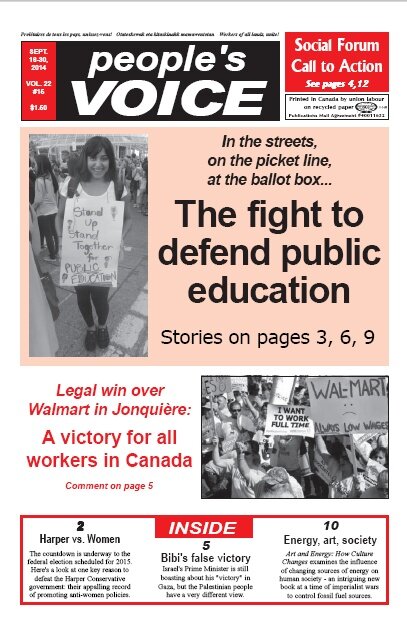
1) LABOUR MUST LEAD ESCALATING FIGHTBACK IN SOLIDARITY WITH BC TEACHERS
2) BCTF CALLS FOR BINDING ARBITRATION
4) PUBLIC EDUCATION PROJECT CANDIDATES IN VANCOUVER
5) LEGAL CHALLENGE AGAINST MEDICARE DELAYED SIX MONTHS
6) IT'S ABOUT RESPECT, NOT DOLLARS – Editorial
7) UNITED TO DEFEND PUBLIC SERVICES – Editorial
8) JONQUIERE WALMART RULING: VICTORY FOR WORKERS' RIGHT TO ORGANIZE
9) SOCIAL FORUM MARKS NEW STAGE FOR MOVEMENTS
10) PEOPLE'S SOCIAL FORUM ISSUES "CALL TO ACTION"
11) MADURO ANNOUNCES "FIVE BIG REVOLUTIONS" IN VENEZUELA
12) SCOTLAND'S REFERENDUM: THE COMMUNIST VIEW
13) A STUDY OF ENERGY, ART AND HUMAN SOCIETY
PEOPLE'S VOICE SEPTEMBER 16-30, 2014 (pdf)
People’s Voice 2014 Calendar
”The Truth About the Great War”

To order a copy of the People’s Voice 2014 Anti-First World War
Calendar, send $15 (includes postage and handling) to
People’s Voice, 706 Clark Drive, Vancouver, BC, V5L 3J1. Contact us at
604-255-2041 or pvoice@telus.net for bulk order prices.
|
People's Voice deadlines: October 1-15 October 16-31 Send submissions to PV Editorial Office,
|
REDS ON THE WEB
http://www.parti-communiste.ca/
peoplesvoice.ca
www.ycl-ljc.ca
www.solidnet.org
|
People's Voice finds many "Global Class Struggle" reports at the "Labour Start" website, http://www.labourstart.org/. We urge our readers to check it out! |
* * * * *
People's Voice
Canadian Publications Mail Sales Product Agreement #205214
ISSN number 1198-8657
People's Voice is published by
New Labour Press Ltd
PV Editorial Office
706 Clark Drive,
VANCOUVER, B.C. V5L 3J1
Phone:604-255-2041
Fax:604-254-9803
email: pvoice@telus.net
Editor: Kimball Cariou : Business Manager: David Au
Editorial Board: Kimball Cariou, Miguel Figueroa,
Doug Meggison, Naomi Rankin, Liz Rowley, Jim Sacouman
* * * * * *
Letters
People's Voice welcomes your letters
on any subject covered in our pages.
We reserve the right to edit for length and clarity,
and to refuse to print letters which may be libellous
or which contain unnecessary personal attacks.
Send your views to:
"Letters to the Editor",
706 Clark Dr., Vancouver, BC V5L 3J1,
or pvoice@telus.net
People's Voice articles may be reprinted without permission,
provided the source is credited.
* * * * * *
The Communist Party of Canada, formed in 1921,
has a proud history of fighting for jobs, equality, peace,
Canadian independence, and socialism.
The CPC does much more than run candidates in elections.
We think the fight against big business and its parties
is a year-round job,
so our members are active across the country,
to build our party and to help strengthen people's movements
on a wide range of issues.
All our policies and leadership
are set democratically by our members.
To find out more about Canada's party of Socialism,
give us a call at the nearest CPC office.
* * * * * *
Central Committee CPC
290A Danforth Ave Toronto, Ont. M4K 1N6
Ph: (416) 469-2446
fax: (416) 469-4063 E-mailmailto:info@cpc-pcp.ca
Parti Communiste du Quebec (section du
Parti communiste du Canada)
5359 Ave du Parc, Montréal, Québec,
H2V 4G9
B.C.Committee CPC
706 Clark Drive, Vancouver, V5L 3J1
Tel: (604) 254-9836
Fax: (604) 254-9803
Edmonton CPC
Box 68112, 70 Bonnie Doon P.O.
Edmonton, AB, T6C 4N6
Tel: (780) 465-7893
Fax: (780)463-0209
Calgary CPC
Unit #1 - 19 Radcliffe Close SE
Calgary AB, T2A 6B2
Tel: (403) 248-6489
Ottawa CPC
Tel: (613) 232-7108
Manitoba Committee
387 Selkirk Ave., Winnipeg, R2W 2M3
Tel/fax: (204) 586-7824
Ontario Ctee. CPC
290A Danforth Ave., Toronto, M4K 1N6
Tel: (416) 469-2446
Hamilton Ctee. CPC
265 Melvin Ave., Apt. 815
Hamilton, ON.
Tel: (905) 548-9586
Atlantic Region CPC
Box 70 Grand Pré, NS, B0P 1M0
Tel/fax: (902) 542-7981
http://www.parti-communiste.ca/
* * * * * *
News for People, Not for Profits!
Every issue of People's Voice
gives you the latest
on the fightback from coast to coast.
Whether it's the struggle for jobs or peace, resistance to social cuts,
solidarity with Cuba, or workers' struggles around the world,
we've got the news the corporate media won't print.
And we do more than that
- we report and analyze events
from a revolutionary perspective,
helping to build the movements for justice and equality,
and eventually for a socialist Canada.
Read the paper that fights for working people
- on every page, in every issue!
People's Voice
$30 for 1 year
$50 for 2 years
Low-income special rate: $15 for 1-year
Outside Canada $50 for 1 year
Send to: People's Voice, 706 Clark Drive, Vancouver, BC, V5L 3J1
You can call the editorial office at 604-255-2041
REDS ON THE WEB
http://www.parti-communiste.ca/
http://www.ycl-ljc.ca/
http://www.solidnet.org/
(The following articles are from the September 16-30, 2014, issue of People's Voice, Canada's leading socialist newspaper. Articles can be reprinted free if the source is credited. Subscription rates in Canada: $30/year, or $15 low income rate; for U.S. readers - $45 US per year; other overseas readers - $45 US or $50 CDN per year. Send to People's Voice, c/o PV Business Manager, 706 Clark Drive, Vancouver, BC, V5L 3J1.)
1) LABOUR MUST LEAD ESCALATING FIGHTBACK IN SOLIDARITY WITH BC TEACHERS
Statement by the Communist Party of BC, Sept. 3, 2014
British Columbians are dismayed and increasingly angry that public schools across the province are closed as the 2014‑15 academic year begins, with no end in sight to the labour dispute imposed on students and teachers by Christy Clark's Liberal government. The Communist Party of BC stands in solidarity with the BC Teachers' Federation in their courageous struggle for a fair collective agreement, the right to negotiate class size and composition, and a funding formula which reverses many years of cutbacks, layoffs and school closures across the province.
Over the summer, many remained hopeful that the government would eventually back down from its refusal to engage in real collective bargaining, and find a way to reach an agreement with the BC Teachers Federation by Labour Day. Now, it is clear to both critics and supporters that the Premier's long‑range goal is to use this dispute in order to gut the public education system across the province and to smash the BCTF.
Premier Clark's determination to push this agenda has not changed since her first period as Education Minister under Gordon Campbell, when the Liberals illegally ripped up collective agreements, slashed funding for education and other vital programs, and launched a vitriolic propaganda campaign against teachers and other public sector workers. On two different occasions, the courts have ruled that the Liberals violated the constitutional collective bargaining rights of teachers, and even that their actions were intended to provoke a strike and shut down the school system.
As the Communist Party of BC pointed out last spring, "The entire public health and education sector is under ruthless attack. In country after country, austerity policies have created higher unemployment and slashed the quality of public services, as part of a drive to shift the wealth produced by working people into the hands of transnational corporations and their wealthy shareholders. BC Liberal taxation cuts for the rich and the corporate sector have cost the public treasury over two billion dollars annually for the past twelve years, enough to reverse the underfunding of education and the health care system, to boost social assistance rates by 50%, to build housing for all the homeless living in our streets, and to do much more to improve the lives of working people and the poor.
"The Liberals, similar to capitalist governments everywhere, support the wealthy and the corporations, not the vast majority of working people. The goal of the BC Liberals is to create endless crises in the public education system, not to improve schools. They want to impose a form of unofficial privatization by forcing British Columbians to turn to profiteering private school operators to educate our children."
This analysis has been proven correct by developments over the summer, especially the government's decision to offer parents $40 per day for each student under 13 for the duration of this dispute. This is a further big step towards a US‑style voucher system, in which corporations extract huge private profits from public education. The Fraser Institute has advocated such policies for decades, and this fanatically pro‑corporate think tank has enormous influence over the Liberal provincial government. The current dispute was deliberately engineered by the government to declare that this artificially‑created crisis justifies a complete restructuring of the public school system. There should be no illusions ‑ such an outcome would inevitably expand in the direction of wider austerity, privatization and contracting out across the entire public sector in British Columbia, with disastrous consequences for working people and our communities.
The moment has arrived for the labour movement and its allies ‑ all those who stand against the privatization of public assets and social programs ‑ to take a decisive, powerful collective stand against this government and its far‑right agenda. The resistance against this corporate‑driven attack must move quickly towards escalating mobilization by both public and private sector unions, using a wide range of tactics including massive demonstrations, occupations, job actions, and labour/community strikes. Labour has everything to gain and little to lose by deciding to step up the fightback immediately, while public opinion is still largely on the side of the teachers. The alternatives ‑ leaving the teachers alone on the picket line, or surrendering in faint hopes of an NDP victory in some future election ‑ are simply a recipe for an historic defeat which would weaken the entire labour movement in British Columbia.
The moment has come for decisive action by the entire trade union movement and its community allies. Every possible form of pressure must be exerted now to force Premier Clark to enter genuine collective bargaining and to fund the public school system properly, so that all B.C. students can receive the high quality education they need and deserve. The Communist Party of BC urges the BC Federation of Labour to respond to this urgent crisis with an immediate solidarity summit meeting of all unions and community groups to begin building powerful, united fightback movement against the Liberal government's corporate agenda.
2) BCTF CALLS FOR BINDING ARBITRATION
On Sept. 5, in an effort to find a fair settlement for all parties involved, open schools, and get children and teachers back into classrooms, the BC Teachers Federation called for binding arbitration in their labour dispute. While the Liberal provincial government has rejected this offer, BCTF members were voting on the proposal on Sept. 10, after this issue went to print. We reprint here excerpts from comments at a Sept. 5 news conference by BCTF President Jim Iker.
... Earlier this week, I outlined a simple, pragmatic, and practical way forward to ensure all parties involved reach a fair settlement so we can get schools open...
Throughout this dispute, BC teachers have led the way in trying to reach a fair deal that gives our students more support. We have made moves, proposed creative ideas, and taken job action only when absolutely necessary.
In return, the government has put up road blocks. Their focus has been on delay tactics, a $40‑a‑day payout scheme, and attack ads on Twitter. I hope that all comes to an end today.
This week, the BCTF Executive Committee met with our provincial Bargaining Team and we are proposing another way forward to get students and teachers back in the classroom.
Today, we are not closing any doors, just opening a new one. Mediation with Vince Ready in our view is still a viable option. However, BCPSEA [BC Public Schools Employers Association] and government made it clear last weekend that they were not ready or willing to get the job done. They did not respond in any meaningful way to any of the significant moves teachers made.
Today, we are putting forward another option for all of us - government and teachers to resolve this dispute and reach a fair settlement. The BCTF is calling on BCPSEA and the BC Liberal government to agree to binding arbitration.
If the BCPSEA agrees, the BCTF will quickly put the question to our membership for a province‑wide vote to end the strike.
It is the fastest and most fair option that will see schools open and kids back in classrooms. Teachers want to be in the classrooms teaching. I think parents and students will agree - and I hope government does as well.
For this option to work, the BCTF is proposing to send matters of compensation, benefits, and preparation time to binding arbitration.
We will also ask government to leave the matters currently before the court, and related to the court ruling, to the courts.
BC teachers remain 100% committed to improving the learning conditions of our students. And, we will continue to stand up for our Charter rights. But we don't think arbitration is an appropriate avenue for matters before the courts.
As you know, their attempt to bargain their way out of their two court losses has been the biggest obstacle to a settlement. They must drop E80 and negotiate a new fund that will provide meaningful improvements to students' learning conditions in the interim.
The government's current Learning Improvement Fund does not meet the needs of our students. It's just the same money they keep re-announcing. The status quo isn't good enough.
Everyone knows our schools are underfunded. We must take action now.
Two days ago Premier Clark called class composition her number one priority. Parents and teachers will hold her to that.
It's time to see more investment throughout the public education system to improve the learning conditions of all students - those with special needs, those learning English, those who just need some more one‑on‑one time - all children.
Every single one of our students deserves more than this government is currently giving them.
By Marianne Breton Fontaine, Montréal
Rape culture, discrimination, poverty, violence, etc.; the list of evils of patriarchy is long. One might think that every year, the status of women is improving in Canada. But it's not, and it's not just women's groups and the left that say so. According to the World Economic Forum, Canada's place on the international gender equality index has steadily declined from 7th place in 2004, to 25th in 2009. This is not a coincidence; it is the result of clear policies enacted against the advancement of women's equality. Yes, Harper is anti‑women!
Funding for women's groups
Since Stephen Harper took power in 2006, the Conservative government gradually eliminated funding for groups that promote women's rights. For example, he has closed 12 of the 16 regional offices of Status of Women Canada. The Conservatives have made significant changes to the funding criteria of women's organizations, saying that they will only fund groups that are "directly involved" with women. In other words, groups that were doing research on issues affecting women, defending feminist positions or lobbying on women's issues are no longer considered eligible for funding. Harper did not stop there. He also removed the word "equality" from the ministry's objectives. Thus, groups such as the Victoria Status of Women Action Group (SWAG) and the Coalition for Pay Equity in New Brunswick saw their funding cut drastically, and in some cases these groups have had to close their doors permanently.
In 2010, 12 women's groups including the Council of Intervention for Quebec's Women's Access to Work (CIAFT) and the Network of Regional Women's Groups had their funding eliminated overnight. Many saw the move as punishment, since these groups were opposed to the anti‑choice views of Harper. He also eliminated the Court Challenges Program, which supported legal action on the part of victims of gender discrimination.
Social programs and women's poverty
We know that the economic and social policies of the Conservatives are devastating to the majority of the people. But we often forget that these measures preferred by the economic right (also enacted on behalf of global capital internationally by social democratic governments) disproportionately affect women. Women are poorer because of the patriarchal system in which we live, and tend to depend more than men on public services and the "social safety net" that was built through years of popular struggles. Canadian women earn on average 71 cents for every dollar made by a man. It's even worse for Aboriginal women in Canada who earned an average of 46 cents for every dollar earned by other workers, in 2006. Cuts in social services have also specifically targeted Aboriginal women since Health Canada has made large cuts to health care for Aboriginal peoples.
The Conservatives also prey on elderly women by imposing substantial cuts to public pensions. Older women already face a more difficult retirement since low wages and job insecurity prevents many women from earning decent pensions during their working lives.
Against workers
The possible abolition of the Rand formula; the mandatory disclosure of financial statements of unions to ensure that they do not finance "political" groups; special back‑to‑work legislation; compulsory voting for unionization: Harper hates unions, and these recent measures prove this beyond a doubt. Labour has long been a major player in the struggle for feminist demands. Unions have also helped to drastically improve living conditions for their members. Unionized women in Canada earn 39% more than non‑unionized women. They are also twice as likely to receive a pension and have better benefits, greater protections for human rights and superior job security.
The Tory reform of Employment Insurance is another attack against workers, but especially for women. First, women work at part‑time jobs more often than men because of family burdens and systemic discrimination in the labour market that predisposes women to insecure jobs and at lower pay. Women have less access to Employment Insurance and will be more prone to EI investigations, while with lower wages than men, they are already disadvantaged by the system. The EI system was already sexist; it is now even more sexist with the Conservative reforms.
Why stop there? The Conservative government has questioned the right to pay equity for workers in the public sector. That is to say, Harper has removed the right of women occupying positions in the federal public service to turn to the courts in order to demand equal pay for work of equal value. He also stopped recognizing the "invisible work" of women by eliminating questions around unpaid work in the census. Thank you Harper!
The anti‑choice agenda of the Conservatives
Harper stopped Canada's funding of abortion services through international aid. Under his government, the introduction of bills that have challenged women's right to choose has increased. Fortunately, none of these bills have passed, but we are not fooled. According to a list of anti‑choice MPs compiled by the Coalition for Abortion Rights in Canada, two‑thirds of the Conservative caucus are anti‑choice. While the Harper government is thinking of re‑criminalizing abortion, many forget that the pro‑choice struggle is far from complete. It's not all women in Canada who have access to abortion services. For example, in Prince Edward Island, there are absolutely no such services.
Harper complicit in violence against women
Harper has implemented restrictions in the immigration system that penalize refugees and female victims of sexual and homophobic violence. He has worked hard to abolish the firearms registry. Remember that women are a minority among gun owners, the vast majority being men. At the same time, women are three times more likely to be victims of homicide committed by their spouses.
He still refuses to launch an inquiry into the 1200 missing and murdered Aboriginal women despite calls from the international community, requests for the Auditor General, demands coming from all directions, and the cries of Aboriginal families. To add insult to injury, in 2010, Harper eliminated funding for the database project of Sisters in Spirit, an Indigenous group that had supported these women.
Women with disabilities ignored
We saw all the measures the Conservatives have taken against women, but violence is also perpetuated by inaction when it comes to women with disabilities. The Harper government has ignored repeated requests for the development of a national strategy for people with disabilities who face serious problems of poverty, exclusion and marginalization. Harper's restructuring of government funding criteria also endangers support for groups of people with disabilities.
Women, stay home!
First note that there are fewer women in politics in the Harper government. They represent only 17% of the Conservative caucus. This is not a coincidence. In the ideology supported by Harper, women's place is in the home. He has supported income tax splitting for couples. Not only does this measure favour the rich, but it also provides a strong incentive for wealthy families to keep women at home. He also abandoned the national childcare program and replaced it with a taxable allowance of $100 per month per child under school age. Another incentive for women to stay at home.
REAL Women, religious and ideological influences
But from whom does Harper get his charming political advice when it comes to public policy affecting women? He relies heavily on a group called "REAL Women." To give you an idea of what this group stands for, they said they were very pleased with cuts of $5 million to Status of Women Canada: "This is a good start, and we hope that the Status of Women will eventually be eliminated entirely since it does not represent "women", but only represents the ideology of feminists."
This group believes that the nuclear family is the most important unit in Canadian society, and the fragmentation of the Canadian family is a major cause of social disorder. They lobbied the government for legislation to promote what they believe to be the Judeo‑Christian model of family life, and for the support housewives. It is also opposes feminism, abortion, LGBT rights and same‑sex marriage. REAL Women was outraged when Foreign Affairs Minister John Baird criticized the Russian anti‑gay hate law.
This is a group advising Harper. But there are several others. For example, anti‑choice lobbyists have privileged access to the offices of the Prime Minister. Lobby groups such as the religious Defend Marriage Coalition boast of their unprecedented access to the Parliament in Ottawa. How reassuring!
(This article is published in Issue 17 of the new Rebel Youth magazine, http://rebelyouth magazine.blogspot.ca. To buy a copy or subscribe, rebelyouthmag@gmail.com or snail mail 290A Danforth Ave, Toronto, ON, M4K 1N6. A three issue/year subscription is $12 CDN, or $20 International. $4 per issue sent by mail.)
4) PUBLIC EDUCATION PROJECT CANDIDATES IN VANCOUVER
One of Vancouver's most outspoken defenders of public education will be on the ballot for school trustee on November 15. Jane Bouey has served two previous terms as a Vancouver School Board trustee, in 2002-05 and again in 2008-11, when she was the vice-chair of the VSB. Starting with her first campaign for trustee in 1996, Bouey was consistently among the top vote-getters for the Coalition of Progressive Electors.
This fall, Bouey and Gwen Giesbrecht, the former chair of the Vancouver District Parent Advisory Committee, will be candidates for the Public Education Project. This group was created to address the tendency for Vancouver civic elections to focus exclusively on City Council issues, virtually ignoring public education.
September began with teachers across British Columbia on strike against a government which stubbornly refuses to engage in serious collective bargaining. In Vancouver alone, the dispute affects 3500 teachers and many other school staff, and over 50,000 students and their families. Liberal Premier Christy Clark hopes to use the dispute to inflict further damage on the public education system, by encouraging families to move to private schools.
Speaking to People's Voice, Bouey explained why she has decided to run again for VSB trustee during this unprecedented attack against public education.
I believe in the enormous democratic potential of a well-funded public education system. Having served two terms on the Vancouver School Board, I feel there is a lot that I was unable to accomplish, and much I still want to do.
The Liberals have systematically and intentionally undermined public education. When I was first elected in 2002, Christy Clark had rammed through legislation that illegally ripped up contracts with teachers, and instituted a policy of "Choice". Teachers, students, education workers, parents, and some school boards effectively pushed back much of the Fraser Institute inspired agenda.
However, public confidence in the school system, teachers' morale, and the quality of education itself have suffered. The greatest victims have been students with challenges such as learning disabilities, English as an additional language, those living in poverty, and those who face racism, homophobia, and transphobia.
What are the key issues facing the Vancouver School District?
Among the critical issues facing the school district in Vancouver, underfunding is number one. The VSB has calculated that "since 2002‑03, $47 million in education services have been cut in the Vancouver school district because provincial government funding increases have not kept pace with rising costs." This figure is a conservative one, but includes $31.5 million in lost staffing (including 524 entry level teachers) and $15.5 million in cuts to educational supplies and services.
These cuts disproportionately impacted students with special needs. The BC Teachers Federation has calculated that the number of specialist teachers in special education dropped by 769 FTE from 2001 to 2012. Class size and composition must be fairly negotiated.
The massive cuts to maintenance budgets, and layoffs of CUPE, IUOE, and trades people, mean that despite the hard work by those still employed in the district, our schools are not as clean and well‑kept as they need to be. This negatively impacts the health and safety of employees and our students.
The seismic upgrading of schools still lags behind the promises made by the provincial government. This puts all students at risk. The threat of school closure is ongoing. Layoffs mean increased workloads, and lower employee morale. Most important, students don't receive the quality of education they deserve.
Underfunding also means that school districts, administrators, and even individual teachers and parents desperately try to find revenue to make up what has been lost. COPE and Vision school boards have tried to reign in various fees that parents pay.
But fundraising, and donations by teachers, greatly subsidize our system. Districts compete to attract International Students and online students, and to set up academies and mini‑schools to compete with publicly-funded private schools.
Districts are under growing pressure to look to corporate funding, P3s, contracting out, and selling of land. So far, in Vancouver, this neo‑liberal agenda has been largely pushed back. The COPE school board of 2002‑05 that I served on even "contracted‑IN" cafeterias. But the pressure to move in this direction is enormous. It is essential to elect a Vancouver School Board that will not buckle.
Declining enrollment is also a serious issue in Vancouver, a district that has many private alternatives. Underfunding and the rising cost of living ‑ in particular housing ‑ are also major factors. Many folk are forced to move to the suburbs in the search for affordable places to live. This also raises the issue of a living wage, which I support.
There are other important issues, such as standardized testing, the new BC Ed Plan, the even newer B.C. Skills for Jobs Blueprint. Public education must be defended from moves that would lessen the role of critical thinking.
How do you relate public education and equity issues?
I am proud that the COPE and Vision/COPE boards to which I was elected took a leading role in advocating for public education, attempting to keep cuts away from classrooms, to win more support for inner city students, and to defend fair collective bargaining, improve aboriginal education, and work for safer, more welcoming schools for all students.
In 2002‑2003 public hearings were held across the province, to develop the Charter for Public Education. I participated in this process, and our COPE board of 2002‑05 formally endorsed the Charter. I fully endorse the principles contained in that document, which calls public education a "sacred trust." The Charter stresses that "as a community we promise to prepare learners for a socially responsible life in a free and democratic society, to participate in a world which each generation will shape and build. We promise a public education system which provides learners with knowledge and wisdom, protects and nurtures their natural joy of learning, encourages them to become persons of character, strength and integrity, infuses them with hope and with spirit, and guides them to resolute and thoughtful action."
It recognizes that "Everyone has the right to a free, quality public education," and that "Each first nation has the right to be recognized and respected by those within the educational institutions located in their traditional territory."
The Charter emphasizes that government must be responsible to fully fund all aspects of a quality education, and that strong local democratic governance is necessary within the provincial education system. It demands equitable access for communities to programs, resources, experiences and opportunities for learners, regardless of geographic location or socio‑economic status.
I came to education politics through a history of involvement in the struggle for equity. I was on the national executive of the National Action Committee on the Status of Women, and had been active in the areas of anti‑poverty, LGBTQ Rights, needs of students with developmental disabilities and anti‑racism coalition work. The VSB's work in combatting discrimination based on sexual orientation and gender identity/expression has been outstanding and comprehensive. I played a key role in the formation and adoption of an LGBTQ policy and action plan back in 2004. I continued to be involved, sitting on the national education committee of Egale, and on the VSB Pride advisory committee between terms. In 2008‑11, again a trustee, I worked with other members of the Pride Advisory to develop the first drafts of the revised policy that was just adopted by the Board this spring. I worked to build a coalition of support for that revised policy.
There is a strong correlation between equity concerns and underfunding. Equity policies require funds for in‑service training and professional development, for resources, for counsellors and teachers who have time to meet the individual needs of students.
Programs such as Junior Kindergarten ‑ which was cut in Vancouver ‑ make a huge difference in the struggle for equity. Initiatives such as the Inner City and Community Link funded programs (hot lunches, additional targeted staffing) face constant downward funding pressures.
Vancouver did have an excellent Adult Education program for those who struggled to complete their schooling. That program is now a shell of what it was prior to provincial policy changes and resulting cuts.
In our diverse city, the majority live in a household for whom English is an additional language, yet the District struggles to maintain adequate ESL learning in schools. This too is a funding and provincial policy issue.
Teachers and support workers do amazing work to build inclusive schools, with diminishing resources. But there are still huge barriers for students with special needs, those who live in poverty, for whom English is a second language, who are Aboriginal, who deal with racism, who experience homophobia and transphobia.
The Vancouver School Board must focus resources disproportionately in these areas, in order to achieve equitable outcomes. Teachers have to be supported, in efforts to modify their curriculum to meet individual students' needs.
How should school trustees respond to the provincial austerity agenda?
After more than a decade of devastating cuts, I believe that school districts should seriously consider just saying "no" to more cuts. This was seriously considered by the Boards that I served on. We were told by parents and unions that we needed to stay in office and fight the province, and do the best we could with what we had. But how can School districts make the case that these cuts are untenable, if we keep making them and continue to operate? Doesn't this make us susceptible to the province's accusation that we just "cry wolf"? Knowing the cumulative impact of these cuts, I cannot justify voting for a compliance budget that fails to meet the true learning needs of our students.
The VSB needs to continue to be a strong voice in support of adequate funding. It would be great to hear more trustee voices, in Vancouver and around the province, demanding increased funding. The VSB should join with parents, students, unions and the community to build strong coalitions in support of public education.
If elected, there principles will guide my work as a Trustee, in close cooperation with students, teachers, staff, parents and all supporters of public education across British Columbia.
5) LEGAL CHALLENGE AGAINST MEDICARE DELAYED SIX MONTHS
A dangerous legal challenge against Canada's universal Medicare system, which had been scheduled to go to trial on Sept. 8 in B.C. Supreme Court, has been put on hold. The judge hearing the case granted a request from the legal team representing the plaintiff, private clinic owner Dr. Brian Day, for a six-month delay of the trial in order to pursue a resolution with the defendant, the government of British Columbia.
As reported in the Sept. 1-15 issue of PV, Day's challenge targets legislation that limits for‑profit delivery of medically necessary services, allegedly because these rules violate the Charter of Rights and Freedoms. In reality, Day's clinic often charges clients more than the cost of procedures carried out under Medicare. It had been expected that an eventual ruling would be appealed up to the Supreme Court of Canada.
A victory for Day would open the gates to a US‑style system, where most residents have to pay for private health insurance through employers. Health Coalitions across Canada have campaigned to push back against health industry privatizers, by demanding that governments put the health of the people ahead of profits.
The BC Health Coalition and Canadian Doctors for Medicare welcomed the possible resolution of the charter challenge.
"We are pleased that Day seems to be finally recognizing the need to abandon a law suit that never had any merit, and was no more than a stalling tactic that has allowed him to flout the basic rules of medicare, rules that virtually all other Canadian doctors respect and comply with," said Rick Turner, BC Health Coalition co-chair. "The case has cost far too much time and taxpayer money already."
Both groups, which have intervener status in the charter challenge, are calling on the BC government to ensure that any resolution of the case protects equitable access to care for patients.
"The request for a resolution is a positive first step but we are quite disappointed that, as of yet, we have not heard Dr. Day make a commitment to actually stop unlawfully billing patients," said Dr. Monika Dutt, chair of Canadian Doctors for Medicare.
"A 2012 BC government audit of Day's Cambie and Specialist Referral clinics revealed that these clinics extra‑billed patients $491,654 in roughly a 30 day period," said Dutt. "Even more outrageous is the fact at the same time, claims appear to have been submitted by the clinic to the Medical Services Plan for services provided to some of these same patients."
The BCHC and CDM argue that the province should insist that Day cease charging patients for services covered by the MSP.
*"I'm hoping to see this case end once and for all," said Turner. "It is a distraction that prevents us from focusing on real solutions to issues like long wait times that will not compromise Canadian values of equitable access to health care based on need not ability to pay and responsible management of public funds."
6) IT'S ABOUT RESPECT, NOT DOLLARS
People's Voice Editorial
The federal Conservative government faces growing pressure to call a full public inquiry into the huge numbers of missing and murdered Aboriginal women and girls across Canada. After building for decades, this crisis is highly visible to the international community. UN Special Rapporteur James Anaya has made a wide range of recommendations on the situation faced by indigenous peoples in Canada, including for such an inquiry. This is the position of almost all Aboriginal organizations, the provincial premiers, the Opposition parties in Parliament, the labour movement, and many others.
Yet the Harper Tories, backed by a few corporate columnists and their legion of rabid social media trolls, stubbornly refuse. Over and over, they claim that an inquiry would be a waste of time and resources better spent on improving the lives of Aboriginal women.
But why can't a country as wealthy as Canada afford both? If the federal government can spend tens of billions on new fighter-bombers and a heavily armed fleet of ships, why can't it spare a tiny fraction of that amount on clean drinking water, decent housing, free education, and job creation for the poorest and most heavily oppressed people in Canada? Plus a few million dollars more to find out why Aboriginal women face such shocking risks of violence and murder?
This is not about dollars, it's about respect. The government is obligated to take immediate action on this just demand, because it comes from the indigenous peoples of Turtle Island. Just once, Stephen Harper should shut his patronizing, patriarchal, racist mouth, call off his attack hounds, and simply do the right thing.
7) UNITED TO DEFEND PUBLIC SERVICES
People's Voice Editorial
The Call to Action by the recent Peoples' Social Forum in Ottawa includes these words: "it is more necessary than ever to work together to counter the current federal Government and the dominant elites' savage attacks to our collective and individual rights, our jobs, our pensions, our public services, our environment, to immigrants, the poor, people of colour and, ultimately, to our future and that of future generations."
This Call is very timely. The new government of Quebec is launching a major austerity blitz, and working people are already resisting, including municipal workers in Montreal fighting to defend their hard‑won pensions. On the west coast, Christy Clark's Liberal government is sabotaging the public education system with the aim of encouraging parents and students to switch to taxpayer-funded private schools, but parents, students and teachers are rallying together in huge numbers. In Ontario, newly re‑elected Premier Wynne campaigned on a budget that promised an across-the-board public wage freeze, privatization of public services, and the sell‑off of public assets. Wynne didn't talk much about her neoliberal agenda, allowing Tim Hudak's Tories to corner the market on far‑right ideas, but the emerging labour/community coalition in Ontario has a big job to stop this assault. Everywhere, governments keep slashing taxes on the rich and the corporations, drying up revenue that could be used to improve and expand desperately needed public services.
The ideological poison behind this attack is the concept that as "consumers" we should pay as private individuals for health care, education, or pensions. That view is deliberately promoted to undermine decades of social gains achieved by working people in the wake of the Great Depression. Similar collective action is desperately needed today, to stop the right‑wing steamroller, and to win the struggle for a better future. The fight to defend public services is a great place to start building a united, powerful resistance.
8) JONQUIERE WALMART RULING: A VICTORY FOR WORKERS' RIGHT TO ORGANIZE
Issued by the Central Executive Committee, Communist Party of Canada, September 3, 2014
A decade ago, Walmart workers in Jonquière, northern Québec, made international media headlines and won the attention of the labour movement around the world. In August 2004, the workers became among the first Walmarts to unionize in North America.
Winning a certified union was a small but significant advance against a notoriously vicious anti‑labour mega corporation ‑ and a breakthrough for organizing the unorganized in general. After a hard struggle, the workers joined Local 503 of the United Food and Commercial Workers (UFCW).
Walmart, however, refused to negotiate a collective agreement in good faith and after several months, the UFCW was forced to demand that an arbitrator settle the collective agreement. Just days after, Walmart announced it was closing the Jonquière store, throwing nearly 200 workers into unemployment and tearing up Québec labour law. There was immediate broad public outcry across Québec and the rest of Canada against Walmart's attack on the workers democratic right to organize.
Now, after a protracted legal battle by the UFCW and great determination, tenacity and perseverance by the Jonquière workers who filed many complaints, court cases and appeals, the Supreme Court of Canada (SCC) has historically ruled largely in their favour with a 5‑2 decision authored by Justice Louis LeBel. (The workers also beat out a former major multi‑national Canadian law firm, expert on labour law, where various former Prime Ministers like Trudeau and Chretien have worked).
The struggle to win the ruling shows how hard workers must fight just to win enforcement of the existing provincial labour code. While a victory, the workers have still lost their jobs. Nor is their fight for compensation completely over. Walmart will have to pay the union's legal fees, and an arbitrator will impose what LeBel very generally called an "appropriate remedy."
That not withstanding, LeBel's ruling is positive and should be used to the maximum advantage by the labour movement.
Specifically, the SCC ruling agreed with the workers that Walmart shutting down their store was a drastic change in their "working conditions" ‑ which is forbidden by s. 59 of Quebec's labour code while the collective agreement is being negotiated ‑ and saw this action as a violation of the workers right to have negotiations in good faith, and their fundamental human rights including freedom of association. Further, the SCC ruling explicitly says that "The mechanism codified in s. 59 is by no means specific to Quebec, as it exists in all provinces of Canada and at the federal level."
The SCC ruling therefore reinforces workers' legal right to organize, at a moment when existing labour law is under an unprecedented attack in Québec and federally by the Harper Conservative government (Air Canada, Canada Post, EI, etc.) It helps not only the Jonquière and Walmart workers but workers in general. If other corporations temporarily lay off employees, dismiss them, or close‑up an entire shop after an organizing drive, they will most likely also be forced to pay. The SCC ruling may not prevent shop closures during organizing and collective bargaining, as companies can still close a shop, but that cause must now be proven. Although big business has considerable time to demonstrate such just cause, this proof is the burden of the corporation not the union.
The Communist Party of Canada has always supported any strengthening of all workers' right to organize (including foreign workers, part‑time, "on call," domestic, agricultural, contract workers, etc.) The Communist Party also opposes mass layoffs and shop closures, and demands they be prevented through legislation with teeth ‑ including the employer giving two years notice and also public tribunals on any large shop closures, with the power to nationalize the shop.
Furthermore, the Communist Party has long proposed that a Bill of Rights for Labour be enshrined in a new Constitution, drafted by a constituent assembly of the peoples and nations of Canada, which should extend and protect the political rights of labour as well as the rights to collectively organize, to free collective bargaining, and to strike.
9) SOCIAL FORUM MARKS NEW STAGE FOR MOVEMENTS
By Darrell Rankin, Manitoba leader of the Communist Party
Canada's first Peoples' Social Forum marked a new stage in the renewal of Canada's labour and democratic movements. The forum was a challenge to our time of few victories, where strikes are few even for economic demands, where most people are not on the streets or organized.
It was a blow against the oppressive dread produced by inactivity. Close to 5,000 people attended the four‑day forum which ended on August 24 in Ottawa.
Hundreds of people at the closing assembly approved a Call to Action with the aim of freeing society from "neoliberal capitalism, imperialism, patriarchy, colonialism, racism, heterosexism, and ... the domination of large companies on Peoples."
The forum was a movement of movements, a showcase of 500 workshops and assemblies for activists, and a snapshot of the state of the peoples' movements in Canada at a time of growing crises. Crucially important was the prominent participation and respect for the Aboriginal rights movements.
"Capitalism still continues to wreak havoc," said Hassan Husseini at the Take back Labour assembly. Husseini's bid for CLC president last spring helped consolidate the growing involvement of unions in the political struggle.
From rank and file activists to newly‑elected CLC president Hassan Yussuff and leaders of CUPW, CSN and UNIFOR, labour's presence was prominent. The financial support of several CLC affiliates made the forum possible.
From the standpoint of resistance and renewal in heavy defensive struggles, dangers and setbacks, the forum represents an advance in some important areas, such as recognizing the need for movements of all nations in Canada to work together, to develop a peoples' agenda, and for organizing and action.
The closing assembly opened with the comment that "2015" was in the background of the entire forum ‑ the need to defeat the Harper Conservatives and their agenda, "even for those who do not believe in electoral politics."
The Take Back Labour assembly report disclosed vast challenges: to democratize the labour movement, organize the unorganized and marginalized, develop a militant left agenda, become action‑oriented, work with a broad range of groups and to de‑colonize the labour movement.
Also in the background was socialism with tables and newspapers promoting a range of left and Marxist views. The Young Communist League was well‑represented, hosting two workshops against austerity and war.
It was a forum where you could ask labour economists like Jim Stanford or anyone else: "Is capitalism getting better or worse?" The answers ‑ or absence thereof ‑ showed that socialists are on the right track and it's time to brush up on Marxism.
As reflected in the Call to Action, the forum was not socialist in content. However, the Call contains demands that fundamentally challenge capitalism.
For people entering political life, the forum was an enriching experience, especially for those with instincts to attend the more crucial workshops. The best workshops were those where people had a chance to participate in the discussion, such as the democratic convergence assembly with small group discussions on topics such as developing a peoples' agenda.
The months ahead will see the development of various peoples' agendas. This can only be welcomed as the start of a more serious discussion about theory and tactics to realize these programs with the support of millions.
For those of us who believe in fundamental social change, this is a great opportunity to raise the discussion "how would such a new society differ from socialism?"
The next peoples' forum will be held in Montreal in 2016. By then, the discussion may allow one of the assemblies to be devoted to socialism, or socialism and the peoples' agenda.
10) PEOPLE'S SOCIAL FORUM ISSUES "CALL TO ACTION"
The Peoples' Social Forum drew thousands of activists to Ottawa from August 21-24, taking part in rallies, workshops, assemblies, and networking. The gathering concluded with the adoption of a "Call to Action" at a final convergence assembly. While the Call may be amended to include recommendations from thematic assemblies held earlier, it represents an important advance towards broader unity of progressive movements across Canada. This includes significant support from the labour movements (Canadian Labour Congress, la Confédération des syndicats nationaux-CSN, la Fédération des travailleurs et travailleuses du Québec-FTQ), Idle No More, Defenders of the Land and other groups to continue meeting for strategic planning. Here is the text of the Call to Action:
We participated in the Peoples' Social Forum because it is urgent to stop the attacks on democracy, and to free our societies of neoliberal capitalism, imperialism, patriarchy, colonialism, racism, heterosexism, and of the domination of large companies on Peoples. The Peoples' Social Forum process has allowed us to intensify a convergence of an unheard diversity between our movements.
The unified and unprecedented social movement that we build is more necessary than ever to work together to counter the current federal Government and the dominant elites' savage attacks to our collective and individual rights, our jobs, our pensions, our public services, our environment, to immigrants, the poor, people of color and, ultimately, to our future and that of future generations.
We do not want a State that supports the Canadian mining companies here and abroad. A State that tramples the rights of the Palestinian people by supporting the Israeli regime's Apartheid, in spite of the numerous international resolutions. We do not want a State that oppresses the First Peoples. We do not want a State increasing militarization and criminalizing dissent.
During this social forum, we have shared the sprouts of a new vision of society, based on social and environmental justice, self‑determination of Indigenous Peoples, human rights, democracy, equality between individuals and between Peoples, the inclusion of all generations, solidarity, and a new economic paradigm serving people, not the opposite.
We want a society that fights against the disparities between the rich and the poor, men and women, whites and people of color. We want to defend and widen our public services and social programs to respect social, economic and cultural rights.
We know the importance of promoting, loudly and clearly, a different model of society. It is not only a question of opposing the Conservatives, our movement must go beyond this electoral deadline because it is also a question of regaining control over our
collective future.
However, in the short run, we must propel the social movements' current convergence towards an active, non‑partisan role and lead a combative campaign against the Conservatives. As long as the Conservatives impose their idea of society, we will not be able to protect our rights and the environment, and we will not be able to carry out an open debate on what would be a society fair, viable and respectful of its Peoples'.
We commit ourselves to maintain dynamic and durable ties throughout the structures that the Peoples' Social Forum bequeaths us (caucuses, regional commissions, networks created for workshops and convergence assemblies). The fire within us as we leave this meeting must live on!
The systems of oppression and domination are closely intertwined and that is why it is necessary to fight them all. Each of the attacks against one of our movements is thus an attack against us tall and weakens the movement in general. We are responsible for fighting the oppression within our movements, and for showing solidarity to people at the margins of our struggles. We are also responsible for working together to express our solidarity to all of the other Peoples of the Earth. We must recognize in our movements the reality of the Canadian colonialism that differentiates, within the movement, the First Peoples.
This forum has given us hope in our capacity to surpass our limits and to, together, overcome. We are politically united and shall be active in every corner of the territory where we are present. We call for demonstrations throughout the country, actions, and concerted reactions from various movements to conservative attacks. We must counteract in a creative and massive way. They must understand that we will not leave them to their own devices without reacting. They must feel the weight of our convergence!
We must show that another vision for our society is not only possible, but necessary. The PSF's conclusions are a collective responsibility. This urgent call for social movements to converge is embodied in action. The solutions belong to us, organizations and individuals. The change we wish to see is our responsibility. The scale of this change depends on our involvement!
Our call is wide and is addressed to all the population and the other movements. It is a call to work together to beat the Conservatives. A call to work together to defeat conservatism and neo‑liberalism. A call to rebuild a healthy democracy and to think of another system, not based on oppression and exploitation, but on an economy valuing life and the well‑being of people and the earth.
11) MADURO ANNOUNCES "FIVE BIG REVOLUTIONS" IN VENEZUELA
With files from TeleSUR English ‑ venezuelanalysis.com
The government of Venezuela is stepping up its efforts to respond to the unrest which shook the country earlier this year, with a combination of structural changes and economic measures.
On Sept. 2, Venezuelan president Nicolas Maduro announced what he described as "five revolutions", as part of a need to "improve our service to the people."
Maduro said the revolutions would be a "a new way of functioning" for the government, and emphasized the need for a more "efficient" government.
The following five revolutions, he said, "should be united, and should define the government policies, giving power to the people, it will be the people who push government policy."
The first revolution that Maduro outlined is the economic revolution, promoting production, "in order to guarantee stability".
"All the efforts of the government should be concentrated on this, to make this revolution successful," he said.
The second revolution is the knowledge revolution, involve science, technology, and culture. "I call on all of Venezuela, on the youth, students, teachers, to be part of this revolution, to be part of the country's social development, its spiritual development, forming a new ethics for a new society," Maduro said.
The missions are the third revolution. Maduro emphasized their importance in "building socialism, creating the new society, where social rights and life are guaranteed."
The fourth revolution involves state policies and "creating a new state, one that's really democratic, one that's about justice, and rights." It aims to transform all governmental structures, and end with what "remains of the bourgeois state." Maduro emphasized the importance of the fight against corruption.
In this fourth revolution he also announced a range of new ministers and structures. Maduro announced a timeline for social movements to elect "popular presidential councils", including for communes, women, youth, culture, and workers. Elections will be held during September and October.
In terms of the new ministries, they will be restructured, with some combined, and many falling under "vice‑presidencies". The vice‑presidency of economy and finances, for example, will group together six ministries. Of these, the minister for petroleum will no longer be Rafael Ramirez, who becomes the foreign minister.
Maduro said the fifth revolution was one of "territorial socialism". He explained that it was about consolidating the communal model, and creating a "new eco socialist model".
"It's not about environmentalism, its about ecosocialism, environmentalism isn't enough," Maduro stated.
Meanwhile, the "biometric system" now installed in 11 major supermarket chains nationwide to combat scarcity has produced immediate results. All supermarkets will have the system installed by Nov. 30.
"The eternal lines have grown shorter.... and products that used to be considered `a big find' are ever‑increasing upon the shelves," read a recent headline in Zulia state's largest private newspaper, Panorama. The state's capital and Venezuela's second largest city, Maracaibo, has been the center of the government's pilot program since August.
The system is composed of fingerprint scanners stationed at check‑out counters, to track how much each individual buys, blocking customers from making over‑large or over‑frequent purchases. It comes in the latest wave of reforms to eradicate scarcity and speculation.
The measure will only be directed at 23 basic products, among them milk, flour, and beef, which are the most common objects of smuggling. If a customer is not purchasing one of these 23 items, they are not required to scan their fingerprint.
It is estimated that 40% of Venezuelan products are smuggled illegally out of the country to be sold for a profit. Internally, the system will avoid the schemes of street vendors, known as buhoneros, who hoard basic items to be re‑sold for hugely inflated prices when they grow scarce.
In Maracaibo, supermarket owners report that since the system's installation, products which used to be swept off the shelves in hours are lasting over four days.
In border areas, the biometric system will replace the previous slower method of taking down each customer's identification number. Smuggling mafias would easily steal people's ID numbers to bypass this previous system.
But not everyone is impressed. Caracas mayor and hardline opposition advocate Antonio Ledezma warned that the scanners were a sign of the further "Cubanization" of government policy. The opposition Democratic Unity Roundtable (MUD) upped the ante by declaring a campaign against the system, starting with a nationwide cacerolazo (public banging of pots and pans) in resistance to what MUD spokesperson Cristobal Fernandez Dalo calls a "repressive" operation.
Vice-president Jorge Arreaza has asked that Venezuelans not be "manipulated" by the opposition, insisting that the system will not "restrict consumers... only help to identify those who speculate, steal, and profit from the food of our people."
Other opponents of the system believe it only skims the surface of the real issues at hand. Caracas resident Alexis Yanes told reporters that he agreed with the new measures but, "it would be good if companies increased production and improved distribution as well. That [sector] is very impaired right now."
On the other side of the struggle against smuggling, the Venezuelan National Guard has been cracking down on the Colombian border since August 12th. Two weeks later, 148 people linked to smuggling had been arrested, and 641 tons of food, 413,854 liters of gasoline, and 301,440 medicines had been seized while being transported illegally out of the country.
12) SCOTLAND'S REFERENDUM: THE COMMUNIST VIEW
A long-awaited referendum on whether Scotland should become an independent country will be held on Sept. 18. The following statement on this issue was adopted in March 2014 by the Scottish Committee of the Communist Party of Britain.
The Scottish Committee of the CPB defends the right of nations to self‑determination and condemns the Coalition government for its threats of non‑cooperation.
If a majority of the Scottish people vote for independence in the 2014 referendum, then their decision should be respected. Our commitment to the right to self‑determination is one of principle. At the same time, the Communist Party maintains its other principle of judging the exercise of that right in terms of the class interests of the Scottish people and of those of working people in Britain and internationally.
On this basis, Communists do not believe independence on the terms proposed is in the interests of working people today any more than it was in the 1970s. At that time Communists and the Left in the trade union led the way in the fight for a Scottish parliament with powers to intervene in the economy, to develop public ownership and increase labour's power over capital ‑ powers that would in turn strengthen the bargaining power of working people across Britain.
It is our conviction that independence as proposed in the White Paper would weaken such bargaining power and strengthen that of big business and of its state machine at both British and Scottish level. Membership of the sterling area would subordinate Scotland to current neo‑liberal policies without any power to change them ‑ at the same time as seriously eroding the opportunity for united working class action across the nations of Britain to do so.
Worse still, membership of the EU would oblige Scotland to incorporate in any written constitution the terms of the 2012 Treaty on Stability, Coordination and Governance. This Treaty requires even tougher controls on government spending than the Stability and Growth Pact ‑ with the same objective: using unemployment as the market regulator to curb the trade union movement.
While it is conceivable that some of the most reactionary aspects of the White Paper, such as NATO membership and reducing Corporation Tax, might be reversed as a result of subsequent political mobilisation by the Left, we judge it to be extremely unlikely that there would be a reversal of positions on Sterling and EU membership.
The transition to independence will take place at a time of diminishing oil revenues and unfavourable economic circumstances ‑ allowing any Scottish government, and the big business controlled media, to call for fiscal "stability" in face of adverse market reactions. Left‑wing supporters of independence need to think through the consequences. The socialist Left does not possess anything like mass support in Scotland today.
Election results show this. The inevitably rancorous negotiations over the division of resources will harden nationalist attitudes. Yet these years, 2015‑2017, will be precisely when the terms of the new written Scottish Constitution will be determined and the SNP's White Paper demonstrates a clear intent to do so on the terms set by big business and Scotland's own finance capital sector.
This is why Communists oppose this White Paper on Independence. Instead we continue to call for radical federalism as the best way of developing class cohesion across the nations of Britain: national parliaments with powers of economic intervention, ownership and control and a federal parliament with overall powers over economic policy and a constitutional obligation to redistribute in terms of social need.
We believe that this provides the best framework for uniting working people on class terms against the state power of big business. Currently that power is concentrated at British level and represents above all the interests of the City of London.
Under a "White Paper" Scottish Constitution, big business will continue to exercise this power through its disproportionate ownership of the Scottish economy and the binding requirements of its instruments, the Bank of England and the EU Treaties.
A No vote in the referendum has to be made the springboard for remobilising the working class movement at British level to demand real constitutional change.
The fight for radical federalism, as outlined in Red Paper, must begin now. At the same time the fight for the objectives of the People's Charter and the People's Assembly, backed by the united trade union movement in England, Scotland and Wales, must be stepped up. Radical Federalism will only be won on the basis of class mobilisation across the nations of Britain.
13) A STUDY OF ENERGY, ART AND HUMAN SOCIETY
Art and Energy: How Culture Changes, by Barry Lord, AAM Press 265 pp. Review by Wally Brooker
Barry Lord's new book Art and Energy: How Culture Changes is about the influence of changing sources of energy on aesthetic culture, as well as the influence of aesthetic culture on the pace of adapting new energy sources. While sources of energy from earlier eras are still necessarily with us (firewood, coal, wind, etc.), there is always, he says, a cutting edge source of new energy that transforms the social‑economic environment and the resulting cultural values.
Commenting on the Greek poet Hesiod's description of Zeus' rage after learning that Prometheus had given fire to human beings, Lord writes, "such a god's‑eye view of the fires of many communities gives us a glimpse of the prehistoric and ancient world's primary cultural centre, the hearth". Fire allowed humans to gather together in the evening to tell stories, invent songs and dances, and reinforce their values. The use of tallow lamps enabled the astonishing cave paintings found in Africa, Spain and Southern France, painted by artists some 30 millenia ago.
The kiln was a further application of fire, fostering the craft of pottery. Later came the forge, which introduced bronze and iron, transforming the weapons of war and the tools of agriculture, and harnessing animals for domestic use. In a vivid passage, Lord contrasts the tamed animals depicted on the walls of Egyptian tombs with the energetic animals of prehistoric cave artists.
Co‑operation & Slavery
Lord asserts that co‑operation in the workforce is also a source of energy, with the earliest co‑operation being the division of labour between women and men. Once the advantage of co‑operation was understood, collective identity followed, and the acknowledgment of individual leaders. Large‑scale collective labour made it necessary to store and distribute surpluses over a wide area, making armed guards necessary, as well as taxes, marketplaces, and writing.
Slavery became a vital source of energy in the ancient world. Total control of agricultural labour gave economic and military advantages to slave society elites. This mode of production made standing armies possible, as well as a leisure class that engaged in philosophy and literature, and invested its surplus in ambitious works of architecture, and monuments that served to proclaim and maintain its dominance. Slave artisans were disciplined to provide exquisite pieces of jewelry, furniture, bronze, ceramics and glass.
Wind Power
In the period of European civilization known as the "Renaissance" cultural change was powered by technological developments in sailing. New methods of rigging made it possible to harness wind energy to explore the globe and exploit other peoples and resources. Human energy was organized for the exchange of surplus, an activity that required the invention of an abstraction: the international exchange rate.
Lengthy trading expeditions were risky and expensive affairs (as Shakespeare dramatized in The Merchant of Venice). To spread the risk, joint stock companies were formed, followed soon after by stock exchanges. The age of sail coincided with the growth of competition between merchant empires. Artists began to celebrate heroic individuals and wealthy patrons, rather than religious themes. A new individualism emerged in the arts with the rise of genres like portraiture (Rembrandt), and the novel (Cervantes, Defoe).
Coal: The Culture of Production
The decline of the age of sail was precipitated by an energy crisis in Europe. By the 18th century, many countries were experiencing deforestation. The solution to the crisis was found in the "underground forest". Coal emerged as the cutting edge energy. It reorganized workplaces and concentrated a growing population into cities. Coal stoked the industrial revolution, fuelling steam engines, cotton mills, and railroads. It made overnight postal service and daily newspapers possible, and global mass markets for cultural works, like the phenomenally popular novels of Dickens and Hugo.
Some artists, like the poet Baudelaire, responded to the new mass culture by embracing alienation. Others, like the painter Van Gogh, gave a new dignity to industrial and agricultural labourers. More radical new ways of seeing were pioneered by Turner and the impressionist painters, with their interpretations of the steam and smoke of the industrial environment.
Electric Transformations
In Lord's scheme of energy transitions, electricity is an anomaly. It is an application, rather than a source of energy. Electricity brought about qualitative change. The culture of production was transformed by power grids and circuits. Electrical appliances changed the nature of housework and the role of women, and the phonograph, cinema, and radio transformed social and cultural awareness.
During the age of coal the industrial proletariat became aware of itself as a class and launched its epic struggle for workers rights. However, it is arguably the coming of electricity in the late 19th century that inspired mass socialist and communist parties and the world's first socialist revolution. Lenin famously said that "communism will be the Soviets plus electricity." But while working class organizations grew rapidly in this era, artists too, felt that they could change the world.
Electricity inspired international modernism, a movement for the transformation of art and society that included the architecture and design of the Russian constructivists, the Bahaus school, the cubism of Picasso, the epic theatre of Brecht, the abstract music of Schoenberg, surrealism and the anti‑art of Dada, the revolutionary muralists of Mexico, and the cinema of Chaplin. It was an age that favoured innovation over imitation.
Oil & Gas: The Culture of Consumption
Since 1900, the internal combustion engine has driven an era of oil and gas, transforming landscapes into highways and parking lots, and leaving behind an ever‑increasing carbon footprint for subsequent generations. Ford's offer of a Model T on easy credit to his workers dramatically enabled consumer culture. In the mid‑20th century, working‑class solidarity countered consumerism, but neo‑liberalism, symbolized by Thatcherism in the 80's, partly succeeded in replacing the social identity of unions with that of the individual consumer. Contemporary governments continue to promise high consumption levels, whatever the cost.
Post‑modern philosophy corresponds to consumer culture, as opposed to class identity, in that it offers a "marketplace of ideas," and eschews "grand narratives". Artistic disciplines are characterized by a smorgasbord of alternative styles and meanings. Artists themselves are encouraged to develop their art as a brand. Ubiquitous corporate sponsorship imposes brands on cultural institutions and festivals. Large‑scale international art fairs like the Venice Biennale confirm the culture of consumption and the growing wealth and power of the top‑tenth of art dealers and auction houses.
Nuclear Energy: The Culture of Anxiety
Nuclear power was the first energy source to arrive as a weapon. The bombing of Hiroshima and Nagasaki (as well as the application of industrial methods by Nazi Germany to exterminate Jews, Roma and other peoples) caused many artists and intellectuals to re‑evaluate their ideas about the nature of humanity. Borrowing from a popular 1947 poem by W.H. Auden, Lord characterizes this phenomenon as "the culture of anxiety." The mood was expressed after the war by absurdist writers like Camus, Ionesco and Beckett, and filmmakers like Resnais and Antonioni.
In recent decades, new causes of anxiety have emerged with fear of nuclear meltdowns and global warming. Fears actively fomented by governments in the metropolitan centres of capitalism include growing anxiety about "security" and "austerity". Lord provides examples of the efforts of several contemporary multi‑media artists to warn of the corrosive effects of this culture of anxiety.
Some contemporary artists, reacting to the wasteful and environmentally destructive culture of consumption, are reflecting a "culture of scarcity." They advocate impoverished art, made from discarded or low‑cost materials. But, says Lord, this "frightens the haves and discourages the have‑nots." He names his vision of the emerging sustainable world "the culture of stewardship". Its key values are storage, access, and sustainability.
Lord rightly celebrates electronic archives (libraries and museums) as creative cultural and media centres, but his description of digital data as "congealed energy" calls out for fuller explanation. When he writes approvingly of new museums designed by architects with sustainability in mind (living green roofs, geothermal wells), and art galleries that offer immersive experiences, one might well ask, who is this for? Where are the visions of sustainability for the 99%?
While he argues that digitization has weakened the collective identities that formerly supported transformative causes, he nevertheless concludes on an optimistic note, predicting that the time will come when the culture of consumption will be a distant memory. But we can't build a sustainable future on hope alone. Where is the human agency to bring about these changes?
These criticisms aside, Art and Energy is thought‑provoking and highly readable book.
Barry Lord and his partner Gail Dexter Lord are international museum consultants. Together they've published a series of widely-used manuals for museums, as well as an important contribution to cultural theory: Artists, Patrons, and the Public: Why Culture Changes (2010).