
|
|
March 1-15, 2014
Volume 22 – Number 4 $1
Prolétaires de tous les pays, unissez-vous!
Otatoskewak ota kitaskinahk mamawestotan!
Workers of all lands, unite
1) "EQUALITY FOR WOMEN IS PROGRESS FOR ALL"
2) DWAYNE'S HOME FIRE RAISE HUGE QUESTIONS
3) PUBLIC AUTO INSURANCE: FAIR TO YOUNG DRIVERS, TAXI FLEETS
4) OMINOUS EVENTS IN KIEV – Editorial
5) STOP THE "UNFAIR ELECTIONS ACT" – Editorial
6) SAVE ONTARIO PUBLIC SCHOOLS: ONE SECULAR, PUBLIC EDUCATION SYSTEM NOW!
7) MUSIC NOTES: Remembering Pete Seeger
8) ON THE REACTIONARY DEVELOPMENTS IN UKRAINE
9) VIOLENCE IN VENEZUELA PERPETRATED BY OPPOSITION
10) VENEZUELA: WHO'S THE BULLY?
11) PEACE CONGRESS CONDEMNS PLANS FOR "REGIME CHANGE"
12) FROM CONQUISTADORS TO OLIGARCHY
13) ANNIE BULLER: WORKING CLASS HERO
14) KICKING OFF OUR 2014 FUND DRIVE
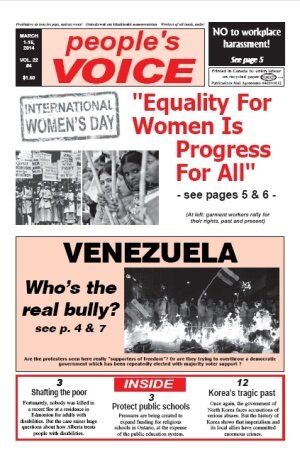
PEOPLE'S VOICE MARCH 1-15, 2014 (pdf)
People’s Voice 2014 Calendar
”The Truth About the Great War”
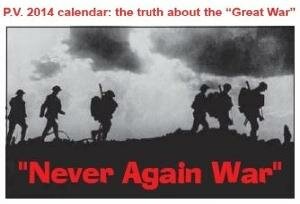
To order a copy of the People’s Voice 2014 Anti-First World War
Calendar, send $15 (includes postage and handling) to
People’s Voice, 706 Clark Drive, Vancouver, BC, V5L 3J1. Contact us at
604-255-2041 or pvoice@telus.net for bulk order prices.
|
People's Voice deadlines: March 16-31 April 1-15 Send submissions to PV Editorial Office,
|
REDS ON THE WEB
http://www.parti-communiste.ca/
peoplesvoice.ca
www.ycl-ljc.ca
www.solidnet.org
|
People's Voice finds many "Global Class Struggle" reports at the "Labour Start" website, http://www.labourstart.org/. We urge our readers to check it out! |
* * * * *
People's Voice
Canadian Publications Mail Sales Product Agreement #205214
ISSN number 1198-8657
People's Voice is published by
New Labour Press Ltd
PV Editorial Office
706 Clark Drive,
VANCOUVER, B.C. V5L 3J1
Phone:604-255-2041
Fax:604-254-9803
email: pvoice@telus.net
Editor: Kimball Cariou : Business Manager: David Au
Editorial Board: Kimball Cariou, Miguel Figueroa,
Doug Meggison, Naomi Rankin, Liz Rowley, Jim Sacouman
* * * * * *
Letters
People's Voice welcomes your letters
on any subject covered in our pages.
We reserve the right to edit for length and clarity,
and to refuse to print letters which may be libellous
or which contain unnecessary personal attacks.
Send your views to:
"Letters to the Editor",
706 Clark Dr., Vancouver, BC V5L 3J1,
or pvoice@telus.net
People's Voice articles may be reprinted without permission,
provided the source is credited.
* * * * * *
The Communist Party of Canada, formed in 1921,
has a proud history of fighting for jobs, equality, peace,
Canadian independence, and socialism.
The CPC does much more than run candidates in elections.
We think the fight against big business and its parties
is a year-round job,
so our members are active across the country,
to build our party and to help strengthen people's movements
on a wide range of issues.
All our policies and leadership
are set democratically by our members.
To find out more about Canada's party of Socialism,
give us a call at the nearest CPC office.
* * * * * *
Central Committee CPC
290A Danforth Ave Toronto, Ont. M4K 1N6
Ph: (416) 469-2446
fax: (416) 469-4063 E-mailmailto:info@cpc-pcp.ca
Parti Communiste du Quebec (section du
Parti communiste du Canada)
5359 Ave du Parc, Montréal, Québec,
H2V 4G9
B.C.Committee CPC
706 Clark Drive, Vancouver, V5L 3J1
Tel: (604) 254-9836
Fax: (604) 254-9803
Edmonton CPC
Box 68112, 70 Bonnie Doon P.O.
Edmonton, AB, T6C 4N6
Tel: (780) 465-7893
Fax: (780)463-0209
Calgary CPC
Unit #1 - 19 Radcliffe Close SE
Calgary AB, T2A 6B2
Tel: (403) 248-6489
Ottawa CPC
Tel: (613) 232-7108
Manitoba Committee
387 Selkirk Ave., Winnipeg, R2W 2M3
Tel/fax: (204) 586-7824
Ontario Ctee. CPC
290A Danforth Ave., Toronto, M4K 1N6
Tel: (416) 469-2446
Hamilton Ctee. CPC
265 Melvin Ave., Apt. 815
Hamilton, ON.
Tel: (905) 548-9586
Atlantic Region CPC
Box 70 Grand Pré, NS, B0P 1M0
Tel/fax: (902) 542-7981
http://www.parti-communiste.ca/
* * * * * *
News for People, Not for Profits!
Every issue of People's Voice
gives you the latest
on the fightback from coast to coast.
Whether it's the struggle for jobs or peace, resistance to social cuts,
solidarity with Cuba, or workers' struggles around the world,
we've got the news the corporate media won't print.
And we do more than that
- we report and analyze events
from a revolutionary perspective,
helping to build the movements for justice and equality,
and eventually for a socialist Canada.
Read the paper that fights for working people
- on every page, in every issue!
People's Voice
$30 for 1 year
$50 for 2 years
Low-income special rate: $15 for 1-year
Outside Canada $50 for 1 year
Send to: People's Voice, 706 Clark Drive, Vancouver, BC, V5L 3J1
You can call the editorial office at 604-255-2041
REDS ON THE WEB
http://www.parti-communiste.ca/
http://www.ycl-ljc.ca/
http://www.solidnet.org/
(The following articles are from the March 1-15, 2014, issue of People's Voice, Canada's leading socialist newspaper. Articles can be reprinted free if the source is credited. Subscription rates in Canada: $30/year, or $15 low income rate; for U.S. readers - $45 US per year; other overseas readers - $45 US or $50 CDN per year. Send to People's Voice, c/o PV Business Manager, 706 Clark Drive, Vancouver, BC, V5L 3J1.)
1) "EQUALITY FOR WOMEN IS PROGRESS FOR ALL"
IWD 2014 greetings from the Communist Party of Canada
For over a century, March 8 has been the international day to honour the women in all countries who strive to achieve full equality. On IWD 2014, the Communist Party of Canada sends our warmest greetings to all women in the fight against poverty, austerity, violence, misogyny and war. As the United Nations has declared for this year's IWD, "equality for women is progress for all."
Here, the ruling class claims that Canada is a country of equality, fairness and social justice. Yet recent years have seen huge struggles around issues such as access to education, pay equity, union rights, jobs, devastation of the environment, deportations of migrants. Women have played a leading role in the Quebec student strike, the Idle No More movement, grassroots environmental struggles, and defence of labour and social rights.
IWD is particularly significant for working class women, oppressed by the "double burden" of exploitation in the workplace and the major share of domestic labour. Women's unequal status in Canada is reflected in a 30% "wage gap" and other indicators.
Aboriginal women and girls suffer the racist burden of higher rates of poverty, unemployment, and incarceration, and dramatically shorter life spans. Hundreds have been murdered or disappeared, and appalling conditions in many First Nations communities have been condemned internationally.
The rights of all women to a decent job, education, child care, employment insurance, etc. are increasingly undermined by the corporate/government neoliberal agenda. Across the capitalist world, women are paying the price for bailouts of the banks and major corporations, austerity cuts to social programs and public services, and massive tuition increases.
Yet the Harper Conservative government dares to pose as "defenders of women's equality rights", internationally and at home. For example, the Tories say they want to "protect" women, yet they have slashed virtually every federal agency or service which supported women's equality, closed Status of Women Canada offices, eliminated funding of women's organizations which engage in advocacy, and blocked legal avenues to fight for pay equity. Governments refuse to provide adequate funding for emergency shelters and support services for victims of violence and abuse.
Women are disproportionately affected by changes to prevent unemployed workers from accessing EI benefits, and the "restructuring" of Canada Post will cost thousands of jobs now held by women. If the Conservatives win another majority in the 2015 election, the growing power of the most extreme anti‑women forces in Parliament could pose a serious threat to reproductive rights.
The attack on equality extends to the provincial arena, including cuts to welfare, health care and legal aid, abolition of women's equality ministries, tuition increases, and unaffordable child care.
The unequal status of women has been condemned by virtually every United Nations body that reviews Canada's human rights performance, including the CEDAW Committee, the Committee on Economic, Social and Cultural Rights, the Human Rights Committee, and the Human Rights Council.
On a global scale, women and children are the most frequent civilian victims of war and armed conflicts. From the Middle East to Afghanistan to Colombia, wars fuelled by transnational corporations, western imperialist powers and local elites increasingly create health catastrophes through the destruction of power plants, water supply systems and hospitals. Trillions of dollars are wasted on militarism instead of providing education and economic opportunities, clean water, health care, and more human rights protection, including personal security, choice in marriage, and reproductive choice.
Global environmental devastation impacts women and children, from those near Alberta's tar sands, to millions living in drought stricken sub‑Saharan Africa. Changing material conditions goes hand in hand with changing social attitudes.
We express our full solidarity with all women involved in the struggle for survival under difficult conditions, such as the heroic women garment workers of Bangladesh, who are fighting for a living wage, safe working conditions, and the right to organize into trade unions. We demand that Israel abandon its apartheid policy of territorial expansion, violence and economic strangulation of Palestine, which imposes terrible hardships upon the women of Gaza and the West Bank. We condemn the drive for new wars against Iran and Syria, and the U.S.‑backed attempt to launch a coup against the progressive and democratically elected Bolivarian government of Venezuela.
A united fightback can win
In recent years, the popular fightback against the Harper/corporate attack has been hampered by the lack of a truly pan‑Canadian voice for women's rights. The organized women's movement has been deeply wounded by systematic cuts to funding.
There have been important struggles by women's and pro‑equality movements, and the Canadian Labour Congress's Women's conferences have helped keep the fight for women's rights alive. But the re‑establishment of an organization like NAC, to bring together women from labour, youth and students, and Aboriginal and racialized women, and from organizations that fight for legal rights, reproductive rights, disability rights, and child care, would be an important advance.
We welcome the development of initiatives to identify barriers and current issues relating to women in the labour movement. Moving these findings into action can help to reinvigorate a more democratic and equity‑ driven labour movement.
The response to the economic crisis by working people of all genders and backgrounds must be to build a People's Coalition to demand a genuine alternative to corporate greed. Led by the labour movement and its allies, such a Coalition could fight to win sustainable jobs, improve social services and gain increased opportunities for women. To protect jobless workers and their families, EI payments must be set at 90% of previous earnings. Evictions and utility cutoffs against all families affected by unemployment must be banned. The labour movement must focus on organizing unorganized women, the most important way to combat poverty and income disparity.
But while capitalism survives, it will always generate poverty, inequality, exploitation, environmental degradation and war. These outrages are inherent in a system based on maximizing profit in private hands. Only socialism, based on democratic, collective ownership and working class power, can liberate the enormous creative and productive potential of the people for human needs.
The real alternative for gender equality and human survival is socialism. As the tiny island of Cuba demonstrates, when social equality is a priority, huge advances in the status of women can be achieved. Unlike Canada, for example, Cuban women are elected to almost 50% of seats in their National Assembly.
For a century, since IWD was adopted by a Socialist International women's conference in Copenhagen in 1910, the full participation of women has been essential for the success of working class and democratic movements.
On March 8, the Communist Party of Canada extends our warm solidarity to all those who stand for peace, equality, democracy and social progress. A better world is both possible and necessary ‑ the world of socialism, which can guarantee full equality and a future for humanity!
2) DWAYNE'S HOME FIRE RAISE HUGE QUESTIONS
By Corinne Benson, Edmonton
On February 12, there was a fire at Dwayne's Home, a hotel in Edmonton that has been converted into a transitional housing facility for 130 people, who are probably all on AISH, Alberta's "assured income for the severely handicapped" program.
These individuals are in the category of homeless and considered hard to house. I know one of them because the community of the disabled are highly ghettoized, and my daughter, also disabled, is friends with her. As I was listening to the radio, my sobbing was stilled when it was announced that all 130 had escaped the fire, and only one had been taken to the hospital.
The people involved were displaced for two and a half days, and most were returned to their units since the fire involved the top corner of the hotel. Forty firefighters and fourteen pieces of equipment and vehicles were involved with extinguishing the fire. The front page of the Edmonton Sun showed a major blaze.
The first question that outraged me was why so many high‑needs disabled people were being housed under such concentrated conditions. We had never been allowed to visit. It seemed to me that it didn't take a lot of imagination to conclude that this might be a recipe for disaster. The newspapers said this was a third fire at Dwayne's Home. People to whom I spoke said the first two fires were waste basket fires.
When I speak for my daughter's friend I am speaking for someone whose ability to speak for herself is not the best. She has fetal alcohol syndrome, developmental delay, and schizophrenia. Last summer she attended a demonstration to protest the cutting of funding by the provincial government to PDD, Persons with Developmental Delay.
Since the cutting of this budget her life has spiralled severely downward. She was cut her staffing for the weekend although her weekday staffing remained the same. Her fetal alcohol syndrome makes social decisions difficult. She is easily led and since many disabled people are comorbid with a lot of drug and alcohol involvement, combined with the fact that much of the disabled community live and associate in a ghetto, she is frequently making poor decisions led by the men she associates with. Since the loss of her PDD weekend staff, she has become evicted from her apartment. While in Dwayne's Home she was not able to make the decision to not accept a ride with a stranger on a bitterly cold night, and from what she could tell me, was raped. Now she was temporarily displaced because of this fire.
From the two days that I housed her I can tell she is extremely disabled and needs every dollar she was getting, as do all the staff and administration who deal with her. There is no excuse for her or anyone like her having their funding cut.
Being of Aboriginal background, the source of her disability has the potential to be traced to Canada's residential school policy, but I will never know that with any certainty. But I do know that disability costs big time, and if we created this problem we should not shirk our responsibility.
The other question that looms so large is why we ask the budget to be balanced on the back of people so disabled, while those who can pay don't. Why are the oil royalties so low and the defenceless asked to pay?
3) PUBLIC AUTO INSURANCE: FAIR TO YOUNG DRIVERS, TAXI FLEETS
By Liz Rowley
Young drivers and taxi fleet drivers in Ontario are among those hardest hit by greedy auto insurance companies. Instead of paying premiums based on their records, these drivers pay the highest premiums in the province.
The insurance companies write their own ticket in Ontario. Their 2012 profits of $4.4 billion (up 24% from 2011) are testament to their greed.
No fault insurance, brought in by the Ontario Liberals in 2010 to bring down sky‑high premiums affecting all drivers, slashed benefits in half, while reducing premiums by a fraction. Accident victims are paying the highest price, with many forced to sue their own insurers for the benefits they need and thought they had.
But young people, especially men under 25, are targeted by the insurance companies. Some pay premiums as high as $1,000 per month. They have no choice. In many parts of Ontario, a car is essential if you work, and insurance is compulsory, not an option.
Ontario's public transportation systems are not workable for anyone travelling any distance to go to work. For these people, a car is a tool of work.
Why do the insurance companies charge so much? Because they can. The Ontario government allows them to build a 12% profit into every policy.
Last spring the Wynn government promised to make insurance companies reduce premiums by 15%. But in December, the reduction was only 4% according to news reports, and not in premium cuts, but in so‑called fraud reduction.
Meanwhile, insurance companies refused to insure cab fleets in Hamilton until they accepted rates that have some drivers paying $1,000 a month or more. The insurance companies essentially starved them out until they capitulated. The result? Most cab drivers make less than the minimum wage and work 72 to 84 hours a week. Now that's slavery.
The biggest fraudsters are the insurance companies, which the government refuses to confront, let alone control. The Premier says it's too complex and she's afraid the companies will refuse to write insurance ‑ like they did in Hamilton.
In the four provinces with public auto insurance, premiums are about 50% lower than in Ontario, and benefits are generous. Furthermore, premiums have nothing to do with age or address, they're based solely on driving record. No more sky‑high premiums for young drivers and fleet drivers.
As an added bonus, these crown corporations are able to generate surpluses for the public treasury, much as the LCBO generates about $2 billion annually for Ontario's public purse. This money could be used to build public transit in Ontario, to expand GO transit and other rapid inter‑urban rail service, and to reduce transit fares.
Public auto insurance could be part of the solution to reduce gridlock and cars in Ontario ‑ which would be good for people and the environment.
Recent calls to privatize public transportation, including the TTC in Toronto, combined with Premier Wynn's determination to utilize tolls, taxes and user fees to fund transportation upgrades, are a logical extension of government policy that has put corporate greed ahead of people's needs for many years. Liberal, Tory, and NDP governments have all contributed actively or passively to this mess. That's why Ontario is now facing a crisis in transportation.
Now, Chrysler ‑ a very profitable multi‑national corporation ‑ is demanding $460 million in public money to maintain its car plants and 4,600 jobs in Windsor and Brampton. They also want wage, benefit, and pension concessions from Chrysler workers.
Instead of bending to blackmail, federal and provincial governments should tell Chrysler to invest or not, but the plant and equipment must stay in Canada for development of a Canadian car that's small, affordable, fuel‑efficient and environmentally sustainable.
The solution is not more privatization, but more public ownership and more public control. More democracy, and less corporate greed.
This should include public auto insurance, and a strong public urban and inter‑city transportation system geared to meet the needs of working people and the public.
If right wing governments and corporations are unwilling to move in this direction, they should be moved out of the way in the coming election.
Public auto insurance, investment in public transit, lower fares, and unionized well‑paid transportation jobs are at the core of a progressive people's transportation policy. This will be a critical issue in the coming Ontario election.
Liz Rowley is leader of the Communist Party of Canada (Ontario) and a candidate in the coming provincial election.
People's Voice Editorial
The latest so-called "colour revolution" has led to a coup against the elected government of Ukraine. This development brings new dangers for Ukraine and for the entire region.
The circumstances of the coup are not identical to the imperialist attempts to overthrow the governments of Syria or Venezuela. As the Ukrainian communists have made clear, the ousted President Yanukovych and his party represent the interests of one section of the oligarchic clans in that country, associated with anti-working class policies and corruption.
But there are serious reasons to fear the outcome of the struggle which has rocked Kiev and other cities in recent months. One is the open participation within the "opposition" forces by a wide range of fascist, racist, and even pro-Nazi movements. Aligning with the "nationalist" groupings which occupied the Maidan square in Kiev, these elements included violent thugs who battled the government's police and soldiers. The fascist groups will help to provide stormtroopers for the new regime's attacks on the working class of Ukraine.
While some in Ukraine may believe that a tilt towards the European Union will bring economic prosperity, other countries have gone through a very different experience. Membership in the EU has not meant privileges for the workers of Greece, Portugal, Italy or Spain. Through this entire region, EU-imposed austerity cuts have resulted in skyrocketing unemployment, lower wages, and the gutting of public services. Any "bailout" from the EU will come with the same strings attached, wiping out Ukrainian sovereignty.
Not least, a new pro-western government in Kiev will strengthen the US-led NATO war alliance, and increase military tensions in eastern Europe.
Make no mistake. The "revolution" in Kiev aims at crushing the Ukrainian working class, selling out the country to European capital, and tightening the imperialist noose around Russia. None of this is any reason for working people to celebrate.
5) STOP THE "UNFAIR ELECTIONS ACT"
People's Voice Editorial
Like a runaway freight train, the so‑called "Fair Elections Act" will be difficult to stop, and the results could be just as disastrous. In a typical example of Tory double-speak, when Bill C-23 was tabled in Parliament by the minister of state for "democratic reform", Pierre Poilievre, he claimed the changes will "increase democracy." One day later, Poilievre moved to cut off the first round of debate in the House of Commons.
By now, everyone knows that the Conservatives blatantly lied about holding "consultations" with Chief Electoral Officer Marc Mayrand about this legislation. The bill denies Elections Canada the powers it needs to investigate election fraud such as the Tory robocalls and other abuses of the 2011 campaign.
In fact, the Unfair Elections Act is intended to facilitate the Conservative "voter suppression" strategy, borrowed directly from the U.S. Republican party. Bill C-23 will make it more difficult for hundreds of thousands of Canadians to cast a ballot, especially Aboriginal people, students, low-income seniors, and others who often lack all the valid ID required to vote. The legislation even gives the Tories an extra edge in fundraising, raising the maximum individual donation limits by another $300.
Yet the Harper government has refused Opposition demands for public hearings across the country. Why? Because, as Mr. Poilievre admits, such hearings would reveal massive rejection of this fundamentally anti-democratic legislation.
In short, an attempt is underway to steal the 2015 federal election, right before our eyes. In response, we urge union locals, community groups and other organizations to demand full public hearings. Bill C-23 must be stopped, before it's too late!
6) SAVE ONTARIO PUBLIC SCHOOLS: ONE SECULAR, PUBLIC EDUCATION SYSTEM NOW!
The Communist Party of Canada (Ontario) is calling on the Ontario government to take immediate steps to develop a single, universal and secular, public education system in the province.
In a Feb. news statement, the CPC (O) urged all progressives in Ontario to raise this demand, along with the introduction of a needs‑based funding formula, as the most effective means for saving and improving public schools and delivering universal, quality public education.
The statement continues, "Specifically, the Ontario government must end the public funding of the provincial Catholic school system. Governments have tried to justify this through references to constitutional education rights for Catholics. In reality, however, this is an outdated, regressive and discriminatory practice that the public cannot afford, from either a financial or a democratic viewpoint. Ontario is now the only province in Canada to publicly fund a parallel system of religious education."
"The practice of publicly funding the Catholic school system has twice been condemned by the United Nations, in 1999 and again in 2005," stated Elizabeth Rowley, CPC(O) leader and a former public school trustee. "The UN stated very clearly that Ontario needs to eliminate discrimination, on the basis of religion, for public funding for education. This means that either all religious groups are funded, or none are. For decades, the Communist Party has continued to propose that the best way to provide quality, and equality, is through a single, secular public school system, with English and French boards, and no funding for any religious education."
The CPC(O) "welcomes the recent statement from the Elementary Teachers Federation of Ontario (ETFO), calling for an end to public funding for Catholic schools. This demand, which has also been made by the Ontario Secondary School Teacher's Federation (OSSTF), should be echoed in all areas of the province, until the government can no longer ignore the issue. Polls have consistently shown that a majority of Ontarians also want a single, secular and quality system of public education.
Religious education is the responsibility of particular religious communities, not public institutions. The Communist Party's call for one, secular system does not include the idea of a blended or combined system, in which religious - specifically Catholic - education would be an optional stream.
"In addition to de‑funding religious education, the Ontario government must act now to introduce a needs‑based funding formula, that will guarantee sufficient education resources for schools, students and communities. The double‑prong approach of underfunding and balanced budget legislation has created and deepened the crisis in public education across the province, with the inevitable result that public confidence in the system is being eroded. The stage is being set for increased privatization of education."
"Education is a right, pure and simple," said Rowley, "but making money off people's needs is not. As Ontarians prepare for provincial and municipal elections this year, we need to see a strong campaign that will reverse the trend toward deep program and staff cuts, increased fees, privatization and inequity. We need to demand that the province adequately fund public education, from cradle to grave. And we need local public school boards and trustees who are prepared to fight for this demand and, if necessary, defy the government's balanced budget legislation."
7) MUSIC NOTES: Remembering Pete Seeger
By Wally Brooker
Pete Seeger, who died on January 27th, was a key figure in the development of folk music as a progressive force within popular culture. For a later generation, Pete personified the popular front ‑ that broad alliance of progressive forces that led the fight against fascism and racism, and fought successfully for labour rights in the period from the mid‑thirties to the mid‑fifties.
Around the world this past month, people have been remembering a man who survived the persecution of the McCarthy era to see his band, the blacklisted Weavers, return to Carnegie Hall, who planted the seeds that led to the folk revival of the sixties, and who became an inspiring figure in the environmental movement. Pete Seeger's achievements were the result of hard work, personal courage, an optimistic spirit, a strong understanding of history, and solid socialist principles.
It is easy to imagine that folk music was always the music of the left, but when Seeger was a teenager it was considered by many activists to be a cultural backwater. Before he was won over to his son's enthusiasm, Pete's father, composer and ethno-musicologist Charles Seeger, was suspicious of folk music. His view was shared by many left‑wing composers of the time, including the young Aaron Copeland and the German communist Hanns Eisler. In his column for the CPUSA's Daily Worker (circa 1934‑35) Charles argued for a proletarian music that combined contemporary popular music (jazz) with elements of twentieth‑century European avant‑garde music. While the debate continues today (read hip‑hop instead of jazz), folk music prevailed for more than a generation, and folk‑inspired artists continue to play a significant role in today's progressive movements.
Pete's career trajectory was set when he got a job in Washington in 1939 assisting folklorist Alan Lomax at the Library of Congress. It was there that he met Woody Guthrie, the Oklahoma troubadour who was to become his mentor. Inspired by Guthrie and Lomax, his circle grew to include Woody's sidekick Cisco Houston, African‑American musicians like Sonny Terry, Brownie McGee and Leadbelly, and labour singers Agnes "Sis" Cunningham and Lee Hayes. The Almanac Singers, a short‑lived but influential group which he co‑founded, became the soundtrack of a heroic era of industrial union organizing.
In 1943 Pete married Toshi Ohta (1922‑2013), a Japanese-American women he'd met a few years before at a square dance. She came from a left‑wing background (her grandfather had translated Marx's writings into Japanese). Toshi effectively ran the Seeger family's rustic household near Beacon, NY, raised their three children while Pete was often away on tour, managed his business affairs, endured the dark days of McCarthyism, and became a respected community activist. Later Toshi co‑founded the Newport Folk Festival and co‑produced films and TV shows about Pete. Toshi Seeger became a renowned figure in her own right, her character and her important contributions acknowledged by the folk‑music world and beyond.
Like many communists and socialists, Pete served in the armed forces during the 1939‑45 war against fascism. When he came home from his tour of duty in the South Pacific he plunged back into life as musical activist, co‑founding People's Songs with Lee Hayes and Alan Lomax, and later the booking agency People's Artists.
With the onset of the Cold War, life for artists like Seeger became dangerous, as an ugly 1949 riot in Peekskill, NY demonstrated. Pete and Toshi had helped to organize a concert there, featuring the great African‑American singer Paul Robeson. After the show, concert‑goers and performers were violently assaulted by anti‑communist and racist crowds while the police looked on.
While things were to get even worse, somehow the times were also right for Pete, Lee Hayes, and two other musicians (Ronnie Gilbert and Fred Hellerman) to achieve commercial success with the unabashedly progressive group the Weavers. For several years they enjoyed a series of hits, (most notably Leadbelly's "Goodnight Irene"), but their chart success was soon cut short by McCarthyisn and the red scare.
In 1950, a group of screenwriters and directors, who came to be known as the Hollywood Ten, were summoned to appear before the House Committee on Un‑American Activities (HUAC) to testify about their links to the Communist Party. When they refused to name names, citing in their defence the First Amendment to the US Constitution (free speech), they were convicted of contempt of congress and sent to prison. Over the next five years the practice of HUAC's victims was to plead the Fifth Amendment (protecting against self‑incrimination). Pete Seeger pleaded the First Amendment, stating: "I am not going to answer any questions as to my association, my philosophical or religious beliefs or my political beliefs, or how I voted in any election, or any of these private affairs. I think these are very improper questions for any American to be asked, especially under such compulsion as this."
For that he was convicted of contempt of congress. He launched an appeal, was released on bail, and finally won his case in 1962. Pete's inspiring testimony can be found at www.peteseeger.net/HUAC.htm).
It's been said that this ordeal set Pete Seeger on the path to becoming the torch‑bearer of people's music. I'll pick up on this story next month.
8) ON THE REACTIONARY DEVELOPMENTS IN UKRAINE
Joint Statement of Communist and Workers' Parties, circulated by the Communist Parties of Germany and Greece
The recent dramatic developments in Ukraine do not constitute the "victory of democracy" by the alleged "revolutionaries", as it is described by the mass media of the USA and the EU, but is a dangerous development, above all for the people of Ukraine themselves.
Reactionary political forces, ideological descendants of the Nazis, have risen to the political "surface" with the assistance of the EU and the USA. These are forces which apart from destroying the offices of their opponents, are planning political persecutions, and the banning of parties, above all against the communists, and even racist legislation at the expense of the Russian‑speaking population, like what has been in force for the last 20 years in the countries of the "European" Baltic, with the blatant political support of the EU.
The communist and workers' parties endorsing this statement express our solidarity and support with the communists of Ukraine, above all with those who in many instances went on to the streets in order to defend the monuments of Lenin and the other Soviet and anti‑fascist monuments, which found themselves "targeted" by the ideological "cleansing" of history being attempted by the nationalist‑fascist armed groups.
We denounce the USA and the EU regarding their blatant involvement in the internal affairs of Ukraine, regarding the direct support they provided and are providing to the armed fascist groups, supporting historical revanchism against the outcome of the 2nd World War, transforming anti‑communism into their official policy, as well as beautifying the fascist groups, their criminal ideology and activity, promoting the division of the people of Ukraine with planned persecutions at the expense of the Russian‑speaking people of Ukraine.
The positions of the opportunist forces are dangerous, spreading illusions that there could exist another "better EU, another better association agreement of the EU with Ukraine". The EU, like every capitalist inter‑state union, is a predatory alliance which has a deeply reactionary character, and acts and will continue to act against the working people's rights. The developments in Ukraine are connected to the fierce competition between the EU and the USA, on one hand, and Russia for the control of markets, raw materials and the country's transport networks. However the people of Ukraine, as all the other peoples of Europe, have no interests in siding with the one or the other imperialist, or one or the other predatory alliance.
The interests of the working class and popular strata of Ukraine mean that they must prevent themselves from being "trapped" in nationalist, divisive dilemmas, on the basis of ethnic, linguistic, religious particularities, and to prioritize their common class interests, to chart their path of class struggle, for their rights and socialism. Socialism remains as timely and necessary as ever. This is the perspective against every capitalist inter‑state union, in order to pave the way for an economy and society that will not operate on the basis of profit, but on the basis of the needs of the workers.
9) VIOLENCE IN VENEZUELA PERPETRATED BY OPPOSITION
By Steve Ellner, venezuelanalysis.com
The slant of the Venezuelan private media and the international media on what is happening in Venezuela is clear: The government is responsible for the violence. In the first place government‑ordered gunmen are shooting at pacific demonstrators and the violence generated by the opposition is just a response to the brutality of police and military forces. But there is considerable evidence that shows that the violence, including that of unidentified motorcyclists against the demonstrators, is being carried out by the opposition. Consider the following:
1. Violent actions have been carried out by the opposition since the time of the 2002 coup. The "guarimba" which means urban violence (or "foquismo") was publicly advocated by opposition leaders in 2003‑2004 as the only way to prevent the establishment of a dictatorial regime in Venezuela.
2. On April 11, 2002, the day Chßvez was overthrown, the Venezuelan and international media and the White House used juxtaposition of images of Chavistas shooting pistols in downtown Caracas, on the one hand, and peaceful anti‑government demonstrators, on the other to justify the coup. However the Irish‑produced documentary "The Revolution Will Not Be Televised" and other documentaries demonstrated by the flow of the camera that the demonstrators were far away from the Chavistas and that they were shooting in response to sniper fire against them. If snipers were responsible for the 15‑20 killings (of opposition demonstrators along with Chavistas) that justified the coup of April 2002, is there any reason to doubt that the unidentified individuals who are attacking demonstrators are not acting on behalf of sectors of the opposition?
3. The violence that has rocked Venezuela during the last two weeks has targeted public buildings, such as the headquarters of the Fiscalφa General (Attorney General), the public television channel (Channel 8), the state‑owned Banco de Venezuela, the house of the Chavista governor of Tachira, trucks of the state grocery store chain PDVAL, and dozens of metro buses in Caracas.
4. None of the opposition leaders have explicitly condemned the opposition‑promoted violence. Opposition mayors in Caracas and elsewhere have refrained from using their police force to contain the violence.
5. The so‑called "peaceful" demonstrators engage in disruptions by closing key avenues in an attempt to paralyze transportation. Where I live, on the main drag between the twin cities of Barcleona and Puerto La Cruz, the demonstrators occupy two of the three lanes on both sides and as a result traffic backs up for miles. A number of tragedies have been reported of people in a state of emergency who were unable to make it to a hospital or clinic on time.
6. The term "salida," which has become a main slogan of the protesters, implies regime change. Obviously the opposition is not calling for a constitutional solution in which Maduro resigns and is replaced by the president of the National Assembly Diosdado Cabello, as the constitution stipulates. Regime change is a radical slogan that implies radical tactics.
7. Political scientist and Venezuelan specialist David Smilde of the University of Georgia, who is not pro‑Chavista but rather evenhanded in his analyses, has stated that the Venezuelan government has nothing to gain by the violence.
8. The government has nothing to gain by the violence because the media is largely on the side of the opposition and present a picture of the violence which directly and indirectly blames the government. Consider the following front page article titled "Capital City Suffers Night Violence" of El Universal (February 20), one of Venezuela's major newspapers:
"Anoche la Guardia Nacional Bolivariana y la Policia Nacional Bolivariana arremetieron casi simultaneamente contra las diferentes manifestaciones que se producian en distintos puntos de la ciudad capital, mientras el presidente Nicolas Maduro hablaba en cadena nacional de radio y television. En los enfrentamientos hubo perdigones, bombas lacrimagenas mientras las cacerolas sonaban desde las ventanas."
Translation: "Last night, the National Guard and National Police attacked almost simultaneously different demonstrations that were taking place in distinct areas of the capital city,,, In the confrontations there was gunshot [and] tear gas while people banged on pots and pans from their windows (in protest of the government)."
9. The Venezuelan government has shown great restraint in the context of opposition‑promoted violence and disruption. In nearly any other country in the world, the disruption of traffic in major cities throughout the country would have resulted in mass arrests.
10. Governments, particularly undemocratic ones, which lack active popular support and completely control the media effectively use repression against dissidents. This is not the case in Venezuela. None of the non‑state channels and newspapers (that the vast majority of Venezuelans get their news from) supports the government and most of them are ardently anti‑government. Furthermore, unlike governments that use massive repression (such as Egypt under Mubarak), the Chavista government and movement has a greater mobilization capacity, particularly among the popular sectors of the population, than the opposition. As Smilde says, the use of violence by the government makes absolutely no sense.
10) VENEZUELA: WHO'S THE BULLY?
By Zach Morgenstern
Imagine you went to school with a bully, someone who intimidates and physically assaults other students to get their way. Imagine one of the bully's targets is an honours student with no blotches on his/her permanent record. Finally, imagine you are approached by the bully. The bully tells you the honours student has been beating up other kids, and that you should do whatever it takes to stop the violence.
Now chances are if you are most people, you would not buy the bully's attempt to the play the angel and slander his/her very likeable, and trustworthy enemy.
Unfortunately, it seems we do not have this common sense when it comes to our perception of international politics. In 2002, Venezuela's opposition launched a coup against then President Hugo Chavez. Their short‑lived government named businessman Pedro Carmona president, and then proceeded to shut down the national assembly and supreme court. The coup regime abolished the constitution, which had been approved by popular referendum in 1999.
The coup government was soon defeated, but shortly afterwards, Venezuela faced an oil industry "strike" (actually a lockout) that attempted to bankrupt the country and bring down the government. Since then, opposition‑government relations have not improved, with opposition politicians regularly refusing to accept the results of the nation's democratic elections.
Common sense would tell us that a government that wins election after election by empowering poor, non‑white‑Venezuelans is the "honours student" in our metaphor. Common sense would tell us that a government that not only puts up with regular slander, including Hitler comparisons, from the country's largely privately owned media, but also pardoned many of the perpetrators of the 2002 coup, should be trusted in the wake of allegations of it being oppressive. Unfortunately, the analogy hasn't held. As opposition campaigns such as #PrayForVenezuela have gone viral, people have forgotten the opposition's consistent role as the bully.
What is more incredible, however, is that the list of Venezuela's bullies also includes the US government, which openly funds the Venezuelan opposition and has been linked to the 2002 coup.
Prior to Chavez's rise, Venezuela was a close US ally, including in 1989 when Venezuelan security forces massacred anti-IMF demonstrators. The US record in the rest of Latin America is even more abhorrent. The US is a strong backer of Venezuela's neighbour Colombia, a country with a reputation for disappearing people and killing trade unionists. Historically, the United States can claim to have supported a coup in Chile that killed the country's democratically elected President Allende. Chile then fell under the rule of the US‑trained General Augusto Pinochet, who proceeded to murder and torture his opponents en masse.
Washington has also backed murderous regimes in Guatemala, El Salvador Honduras, Brazil, Argentina, Uruguay, Paraguay, The Dominican Republic and Haiti. The US government funded the Contra army in Nicaragua which killed many in order to coerce citizens to finally vote against their leftist Sandinista government. Fidel Castro, Washington's number one enemy in Latin America, has had to survive as many as 638 alleged assassination attempts.
Despite all this, mainstream western outlets have failed to view recent allegations of government violence in Venezuela through a critical lens. There has been little discussion in the mainstream press of the role of Washington and Venezuela's reactionary opposition in the violence. Rather, the response thus far has seemingly been one that takes the credibility of Venezuela's opposition for granted, and, as the normally apolitical celebrity George Takei did, acts as if westerners are indifferent to the plights of Venezuelan dissidents.
This only shows why the bullies of the world are far more domineering than the bullies of schoolyards. Many westerners know about the repressive tendencies of their governments that include the practice of torture, drone strikes and mass surveillance. Despite this, the average western commentator cannot seem to think like the kid on the playground who knows to trust the squeaky‑clean honours student over the bully. Rather, the bully's identity has to be relearned on every relevant occasion.
In the post‑Rwanda era, it has become a western mantra to worry about not doing enough to protect foreign peoples from their oppressive governments. The problem with this logic is that it has a become a cliché that gets employed again and again seemingly devoid of context. Not all governments are created equal and not all demonstrators are created equal. We therefore need to be able to challenge the assumptions of the current political order and speak out for democratic and socialist‑oriented Venezuela against its oligarchic, imperialist bullies.
(Originally published by the University of Toronto's "the newspaper", Feb 23, 2014)
11) PEACE CONGRESS CONDEMNS PLANS FOR "REGIME CHANGE"
In a Feb. 23 statement, the Canadian Peace Congress condemns foreign interference in the internal affairs of Venezuela, as part of a plan to destabilize the country and provoke "regime change."
"The violent attacks against the Venezuelan people and their democratically elected government began on February 10, involving masked demonstrators armed with Molotov cocktails, rocks and even sniper rifles," the Congress points out. "The leader of the right‑wing Popular Will Party, Leopoldo Lopez, incited these events. Lopez is a member of one of the wealthiest families in Venezuela, and participated directly in the failed coup attempt in 2002. Since the election of Nicholas Maduro to succeed Hugo Chavez as president, Lopez and other wealthy oligarchs have worked with foreign powers to destabilize the country through economic sabotage and, now, through a widespread campaign of violence.
"With the largest known oil reserves in the world, Venezuela has been a focal point for peace and self‑determination in Latin America. The country is of tremendous strategic importance to imperialism's plans for the region. Despite consistent election victories and popularity among the majority of Venezuelans, the government has been constantly targeted by the elites in Venezuela and the United States government, to facilitate the plunder of the country's resources. The US has spent millions of dollars, via the National Endowment for Democracy and the Agency for International Development, to fund dissent training for students from wealthy families. The reestablishment of the United States Fifth Naval Fleet is a major component of this effort. Much of Venezuela's economy remains under the control of either wealthy families or foreign corporations, and these forces have conspired to provoke economic sabotage in food distribution, electricity, and fuel in an effort to promote destabilization of the country.
"Media reports from right‑wing and imperialist sources have used falsified photos to convince the public that the violence has been instigated by the government, and that the anti‑government forces have widespread support. In fact, it is the firm resolve of the Venezuelan people to pursue policies of democracy, social justice and popular empowerment that has repeatedly confounded imperialism."
The Canadian Peace Congress has demanded that the Government of Canada: denounce the anti‑government violence and foreign interference in Venezuela; respect the Venezuelan people's right to determine the course of their social, economic and political development; and pursue a foreign policy of peace, solidarity and international cooperation in its relations with Venezuela.
12) FROM CONQUISTADORS TO OLIGARCHY
By Larry Wasslen, Ottawa
As historical background to People's Voice coverage of the Salvadorian election, this article covers the years between the conquest and the modern period of fascist violence which began in the 1930s.
Like all countries in the so‑called "new world" the history of El Salvador is one of savage repression, genocide, and heroic resistance. The people of tiny Cuzcutlan, the name of the area used by the first nations of present day El Salvador, endured centuries of violence and exploitation, but their spirit of struggle was never defeated.
Even before the first Spanish incursions into Cuzcutlan, a devastating smallpox epidemic swept through Central America between 1519 and 1524. Fifty to eighty percent of the aboriginal population died from exposure to European diseases.
When Pedro de Alvarado, one of Cortez's chief lieutenants, began his invasion in 1524, the Pipil, Lenca, Chorti and other peoples, though still trying to recover from smallpox, put up incredible resistance. The invaders were driven back by the Pipil warriors led by Chief Atlacatl at the Battle of Acajuctla.
Subsequent invasions proved more successful and San Salvador was established in 1525. Western El Salvador took three more years to subdue while the Lenca held on for another two years. San Miguel was established in 1530. The initial conquest took 15 years to complete and an additional 12 years to "secure" the territory of just over 20,000 square km.
Spanish colonial rule lasted until 1821. While the province did not contain the gold and silver the conquistadors so desperately sought, it did have very fertile land which was quickly occupied by the "peninsulares", colonists who came directly from Spain, and by the "criollos", descendants of the Spanish colonizers.
The First Nations peoples were forced to become slaves or serfs via the Spanish encomienda, repartamiento, and debt peonage systems.
The encomienda, first used against the conquered Moors of Spain, provided the conquistadores with cheap labour, tribute and personal service from First Nations people, in return for "protection" of the rights of the peasants to use their own land.
Repartamiento provided conscript labour to private individuals and to institutions such as the Catholic Church, and various levels of government. In theory the repartamiento system meant that Indian men between the ages of 16‑60 were to work about 1/3 of the time for the ruling class, but in practice it was far more exacting.
Debt peonage was involuntary servitude based upon indebtedness of the peasant to the owner of very large farms or "haciendas". The conquistadors, the peninsulares and their criollo descendants occupied the best land and implemented these systems of exploitation to enrich themselves, while the First Nations and ladino (or mixed blood) peasants were kept in ever increasing poverty. The land would remain the basis of power for the oligarchy of El Salvador.
The ruling class in El Salvador has consistently developed agriculture based on exports. Initially cacao and indigo were grown on large haciendas in the fertile valleys between the volcanoes which dot the horizon. Exports destined for Spain and other industrial countries such as England provided foreign exchange, which was used to supply the idle rich with luxury goods. The First Nations and ladino peasantry continued to live as forced labourers and by subsistence agriculture.
The beginning of the 19th century brought increasing competition between the peninsulares, still loyal to the colonial government and the more liberal criollos, merchants and land owners alike. The crown tried to restrict trading opportunities and loyal hacendados received greater access to forced First Nations labour.
International events such as Napoleon's invasion of Spain, the drop in price of indigo on the world market and increasingly independent action of the criollo section of the ruling class, led to disagreements and competition between the privileged conservative and liberal land owners.
The first liberal revolt was led by Father Jose Matias Delgado in 1811. As the power of the crown decreased, the liberals stepped forward to proclaim independence on September 15, 1821.
In 1823 the land owners organized themselves as part of the United Provinces of Central America, but the ruling class was divided. The conservatives sought "moderation, order, and the stability of traditional, familiar institutions", while their liberal counterparts argued for a more modern state which would decrease the influence of the Church, liberalize the economy based on exports, eliminate certain privileges and open the government to the upper echelons of the ladino land owners and professionals.
Civil War between Guatemala, Honduras, El Salvador, Nicaragua, and Costa Rica broke out in 1826. In the 17 year history of the United Provinces, there were 32 presidents as each section of the bitterly divided ruling class sought dominance. The structure itself collapsed and El Salvador proclaimed its second attempt at independence in 1838.
The rivalry between the conservative and liberal fractions of the ruling class would continue until 1871 when the "progressives" finally won. Liberalism meant a great leap forward for capitalism, and ever more repression for the First Nation and ladino working class and peasantry. As coffee exports expanded the landed oligarchy went after more and more land. Liberals passed anti‑vagrancy laws to drive peasants from their privately owned lands. In 1881‑1882 the same oligarchy went after communal land help by the remaining First Nations. The greed of the coffee plantation owners was insatiable.
Forty five presidents held office between 1838 and the military dictatorship of the fascist General Maximilano Hernandez Martinez. The plight of the working class and peasantry continued to deteriorate throughout this period.
Yet resistance was always in play. Between 1537 and 1547 anti‑Spanish rebellions were launched from Higuereo. In 1625 major slave riots rocked the capital, San Salvador. Another example of determined resistance was the independence struggle of the Nonualco First Nation lead by Anastasio Aquino in 1832‑1833. Although Aquino's forces did liberate San Vicente and Zacatecoluca they did not move against San Salvador. This allowed government forces to contain and crush this liberation struggle. Later, five peasant uprisings took place between 1872 and 1898.
What was evident to the First Nations and ladino population was that independence from Spain meant greater freedom for the oligarchs and greater exploitation for the majority of the people.
El Salvador, a tiny country in the centre of Central America, endured three centuries of conquest and exploitation at the hands of the conquistadores, their peninsular followers and creole descendants.
The First Nations, Pipiles, Lencas, Chortis, and others put up stiff resistance. It took many years for the area to be conquered and secured. Notwithstanding Spanish control and massive repression revolts, rebellions, and liberation movements have always been a critical part of Salvadorian history.
13) ANNIE BULLER: WORKING CLASS HERO
From a speech by Helen Kennedy, to the annual Norman Bethune Day Dinner, held February 22, 2014, in Toronto
One of Dr Norman Bethune's contemporaries was the incredible Annie Buller. Annie's connection to Bethune was short ‑ no doubt they met at some point as Annie was a founding leader in establishing the Committee to Aid Spanish Democracy, which supported the 1200 Canadians who fought in the Spanish Civil War and raised money for her comrade Norman's blood transfusion unit ‑ the first ever to bring blood to the wounded in the front lines of battle. Norman would
have worked quite closely with Annie when he returned from Spain in 1937 to assist in raising funds to support the cause.
And while Bethune was born in Gravenhurst, Ontario in 1890 and Annie in Montreal, Quebec, in 1896, both began their political lives in Montreal and were extremely interested in the education of the working class. Norman and Annie themselves were early labour educators. Norman was a labourer‑teacher at Frontier College in 1911‑12, which was founded on the principle of educating the "whole family wherever the work is". Annie's first love was education ‑ after meeting Bella Gauld, a fellow Montrealer at the Marxist‑based Rand School of Social Sciences in New York City in 1918, they began working on setting up the first Labour College in Montreal, which became a reality in 1920. The Montreal Labour College laid the foundation for the formation of the Communist Party in Quebec and it was this section of the party that Bethune joined upon returning from the Soviet Union in 1935.
Having established now that Bethune and Buller were truly contemporaries, let's focus on the life and times of Annie Buller. I have to say that I knew very little of Annie Buller before taking on this task. I knew she was one of the early leaders of our party who was jailed for defending the miners in Estevan, Saskatchewan. And of course I would recognize her anywhere from the picture that we have hanging in our office upstairs ‑ that square face with the formidable jaw that resonated strength and determination. I also knew her as the mother of one of my dear trade union comrades, Jim Buller, who I defended on a regular basis at the Labour Council in Toronto.
I was taken with two very apt descriptions of our Annie Buller. Tom McEwen, in The Forge Glows Red, describes Annie at his first meeting with her, shortly after she had organized the Montreal Labour College:
A tall, slender, beautiful woman, crowned in a wealth of golden auburn hair and an infectious smile, starting out on a long road that was to see many heartbreaks and many victories, years of endless bargaining on the "market" for her exploited sisters and brothers in the needle trades, long months in prison in Brandon and North Battleford for her struggles on behalf of coal miners, endless battles to build the Workers Unity League unions and her beloved Communist Party, long years of arduous work seeking to direct the steps of her sister Canadians along the pathways to peace and progress; her "salary" often more on a level (if funds were available) with that of a low‑grade welfare handout, than associated with the word 'salary'... (Forge, p. 155 )
And ten years later, another, just as accurate but much more comical, description of Annie Buller given to General JH McBrien, RCMP Commissioner, just after the murder of 3 miners in Estevan, as reported by Stephen Endicott in Bienfait: The Saskatchewan Miners' Struggle of '31:
Annie Buller, also known as Mrs. Harry Guralnick. Born in Montreal; age: thirty‑six; height: 5' 10"; weight 140 lbs; build: medium; hair: dark brown; eyes: brown, wears heavy dark‑rimmed spectacles; religion: loyalty to the working class. Other particulars ‑ is a powerful speaker; very well‑liked. Dangerous agitator. Resides in Toronto. Is a member of the Political Committee of the Communist Party.' (Bienfait p. 119)
As I came to learn, Annie was very deserving of both of these descriptions of her contributions to working class struggles in Canada.
After the Montreal Labour College dissolved and the Marxist work continued by the new Workers' Party of Canada, the forerunner to the Communist Party, Annie continued her work as an educator and organizer. She was inspired by the Russian Revolution, and committed herself to build the Communist Party in Canada and also to organize workers into militant, class struggle trade unions.
For the Party, Annie was the Business Manager for The Worker in the mid 1920s, and wrote often of the struggle of the needle trades workers to organize into a new Canadian‑based industrial union. By 1927 in the United States, the ILGWU had successfully expelled all its communist leaders (and probably sympathizers) and as a result lost almost half its membership. The ILGWU, committed to class collaboration, lost support amongst many of its Canadian members as well. Annie was invited to the first convention of the Industrial Union of Needle Trades Workers in the spring of 1929 as a representative of The Worker; shortly thereafter she became the organizer of the IUNTW which was aligned in 1931 to the Workers' Unity League.
Annie's first organizing campaign was among the 3000 dressmakers in Toronto. Annie's work in the Industrial Union encapsulates the struggle which resonates still in the trade union movement ‑ the fight between class collaboration and class struggle principles. Stephen Endicott, in the book Raise the Workers' Flag: The Workers Unity League or Canada, 1930‑36, summarized the fight between the ILGWU and IUNTW:
The two types of unionism competed for support among the dressmakers: shop floor, class struggle unionism advocated by the industrial union, in contrast to a unionism that "no longer saw manufacturers and workers as adversaries but as partners working together" as promoted by the ILGWU. (Flag, p. 230)
In 1931, the Industrial union called a strike of all the dressmakers in Toronto. Just as today, the struggle pitted tactics of class struggle against those of class collaboration. The International Union sent in scabs to break the strike and enlisted support from Toronto politicians to disparage the striking workers. Striking workers were intimidated by thugs hired by the international union and the American Federation of Labour. Only 500 of the 3000 workers came out on strike, and the leaders had to admit defeat after only six days.
While the strike had been a failure, it did educate the workers on the role of the International:
Years of agitation and propaganda would not have convinced the workers that the International is really a scab agency, but their despicable work during the general strike proved them to be an agency that serves the interest of the bosses. (She Never Was Afraid, p. 29)
Annie stated that the most important reason for losing the strike was the fact that not enough emphasis had been placed on building the effectiveness of shop floor committees. "We talked about turning our faces to the factory, but we did not colonize our comrades". (Flag, p. 231) Again, for Annie, the need to educate the workers was paramount and central to winning the struggle for better working conditions.
Annie left for Winnipeg shortly after the strike, but her advice was followed up by the new leadership. A strong emphasis was placed in the workplaces on organizing strong shop floor committees, which were elected by the predominantly female workforce. Sisters from each shop were put in charge of filing grievances. Executives were elected that represented each shop. When the Industrial Union called a strike three years later in 1934, 1500 workers responded. This strike was hugely successful: it resulted in wage increases from 10 to 40 per cent, an eight hour day, minimum wages, no contracting out, etc. (Flag, p. 233). Annie's pioneering work in organizing the dressmakers built a foundation for their success in 1934.
Annie moved to Winnipeg in 1931 to work with the Needle Trade Unions that were faced with wage cuts and layoffs. It was from Winnipeg that Annie would be called to attend a rally of miners and their families in Bienfait, Saskatchewan.
The Souris Valley in Saskatchewan was steeped in coal and home to six different mining companies ‑ including M&S (Manitoba and Saskatchewan), Western Dominion Colliers, Eastern Colliers, Crescent Colliers, Great West Coal and National Mines (Bienfait, p. 19‑21).
The summer of 1931 was the third in a row of hot, dry weather and widespread crop failure. The area around Regina, including Bienfait, was in the epicentre of crop failures. In the midst of this, miners who would normally work on farms to help make ends meet, were facing general wage reductions of 10‑15%.
The miners had tried to unionize early in the century when times were tough. This year, with the assistance of Sam Carr and Sam Scarlett, both leaders in the Communist Party of Canada and the Workers' Unity League, they were successful. By the end of the summer of 1931, Mine Workers Union Local 27 was formed.
Let's take a step back for a minute. That same summer, there were 16,000 members organized into the National Unemployed Workers Association, associated with the Workers' Unity League. R.B. Bennett was Prime Minister and pledged to never allow the establishment of Unemployment Insurance. On Aug 11, eight leaders of the Communist Party of Canada were arrested, including Tim Buck, Sam Carr, Tom McEwan, and Matthew Popovich, and the Party office in Toronto was raided. The Communist leaders were charged under Section 98, which had been passed in 1919 to wreck the Winnipeg General Strike. Section 98 gave the government and the police the power to arrest anyone under a wide range of political offences much like today's anti‑terrorism legislation. The Communist Leaders were arrested for being members of an unlawful organization and with being parties to seditious conspiracy. Such is the backdrop for the events about to unfold in Estevan.
The union set up bargaining committee for a first contract. The larger owners refused to come to the bargaining table and on September 7, 1931, 600 newly organized miners from the Souris coal fields went on strike.
The miners had heard of the amazing woman union organizer in Winnipeg, and asked her to come to a rally on September 27 to support the workers and their families. Annie Buller arrived in Estevan to address the workers on September 27 and again on September 29, after a parade in support the striking miners.
Annie spent her first day in Estevan touring the picket lines and meeting with women to help them sort the distribution of strike relief. Annie was horrified at the living conditions of the miners and their families. They were forced to rent sub‑standard housing provided by the owners; forced to shop at the company store that charged higher prices than anyone in town; fined for purchasing items from the Eaton's catalogue and charged the difference in prices; cheated on the amount of coal they loaded on the carts; charged for the hot water in the company showers; paid far less than they were worth on a consistent basis.
The mine owners along with town officials, of course, did not want the rally or any meeting afterwards to happen. The town council passed a last minute resolution the morning of the parade make it illegal to hold any demonstrations in the town of Estevan and asked the local police and RCMP to assist in enforcing the resolution. The resolution was delivered to the union leaders after the miners and their supporters had begun to rally at the parade start.
What happened next we all know. Fifty miners were injured and three miners were shot and killed. Miner Nick Nargan was shot by the Police Chief through the heart when he picked up an axe to chop the fire hose that was spraying water on the protestors. Miner Julian Drysko was shot dead when the Mounties opened fire on the protestors. Peter Markunus died when he was shot in the stomach and then forced to be driven 50 miles to the next nearest hospital after being refused treatment at the local hospital, by the same doctor that each miner paid $1.25 a month to for health coverage. (Bienfait, p. 93‑94).
Annie, preparing her speech for the evening meeting that didn't happen, heard about the shootings and was assisted out of town and back to Winnipeg. In Winnipeg, she spoke at a quickly called meeting to drum up financial support for the miners. The police arrested another woman after the meeting, mistaking her for Annie, which luckily gave Annie the time to once again get out of town. This time she headed to Toronto, where she spoke at meetings to raise awareness and finances for the miners in Estevan. Annie was finally arrested on charges of incitement to riot, unlawful assembly and rioting and returned to Estevan.
The charges against Annie were directly related to the other events happening in the party at the same time. In November, the Communist Eight were found guilty and sentenced to five years in jail ‑ effectively making it illegal to belong to the party. Annie Buller must also be made an example of, even if there wasn't real evidence to convict her! The police and owners spent the next several months concocting stories and finding willing sell‑outs to testify at her trial.
Annie's commitment to the working class shone through the trial and appeal proceedings. Annie even led her own appeal ‑ during a decade when there were only 49 women even admitted to the legal profession. Let me read to you just a bit from her most eloquent defence:
The blame must be laid at someone's door, ‑ and why not at mine? Mr. Perkins did not tell you why there was a strike; nor did he tell you that it was the conditions under which the miners worked and lived that forced them to organize a union and strike for human conditions. This, of course, would be portraying the struggle of the miners, and, of course, it is not Mr. Perkins job to do that. He is representing the Crown. I am representing the workers. I am not standing before you, Gentlemen of the Jury, as one who is trying to get out of a tight corner. I consider my efforts to assist the miners and their wives were worthwhile. (Bienfait, pp 124‑5)
Gentlemen of the Jury, I am not apologizing for any of my actions. I cannot be justly convicted on this charge because I was not in Estevan at the time of the "riot" and my speech on the Sunday previous was not a speech inciting riot.
When I face you here, I face you with my head held erect. I face you as a worker with ideals and convictions. Those ideals and convictions are linked with the tide of human progress. You cannot stop that tide of progress any more than you can stop the sea with a pitchfork. Regardless of what arguments or what legal points Mr. Sampson may raise, I am not guilty of this charge. But Mr. Sampson is the Crown Prosecutor, and it is his job to get a conviction. I have said before, and I say again, that it is not Annie Buller who is on trial here. It is the great class of producers that stand in the prisoners' dock, and not one realizes more than I, that the forces against us are very great. But, Gentlemen of the Jury, regardless of the outcome of this trial, I am going to remain loyal to my class, the workers class, the builders of the future. (Afraid p. 61)
Despite her eloquence and the sheer dishonesty of the charges against her, Annie was convicted and sentenced to one year in prison, which she served in North Battleford.
There were many more battles ahead for Annie, including another stint in jail in Manitoba after a conviction under the War Measures Act. But it was for her militant defence of the miners in Estevan that she will be most remembered.
But we remember her tonight for her many contributions to building a better life for workers across this country.
We honour her for her enormous contribution to labour history and for reminding us that the struggles in the labour movement today still hinge on that classic battle between forces of class collaboration and the progressive forces of class struggle.
We also honour her for her contribution to the Communist Party of Canada. We honour her commitment to working class education, from the Montreal Labour College to her work with The Worker, The Tribune, The Western Clarion, The National Affairs Monthly, her work as Literature Director of the Party and Organizer at the Toronto Bookstore. We honour her for reminding us that the Communist press is an essential tool in the education of the working class.
We honour her for the leadership she brought to the Party for our women comrades, those of her time and those who struggle to rebuild the party amongst women today.
And to leave the last word to one of Annie's contemporaries, not in this case Norman Bethune, but Communist Leader Tom McEwen:
To me, and thousands of Canadians, Annie Buller ever remains beautiful ‑ the kind of imperishable beauty that is won by a lifetime of service devoted to humankind" McEwen, (Forge p. 155)
14) KICKING OFF OUR 2014 FUND DRIVE
A message from the People's Voice Editorial Board
Here's a snap quiz. Ready? Give a "true or false" answer to the following statements: The Harper Conservatives are the party best qualified to handle the big economic challenges facing Canada; the Maduro dictatorship in Venezuela should be replaced by a democratically elected government; the most significant issue for the working people of Toronto is Rob Ford's substance abuse.
If you answered "yes" to any of these ridiculous statements, you may be suffering a common ailment: overexposure to the corporate media. This disease has been known to leave victims unable to understand the world around them. Fortunately, there is an inexpensive cure. Regular reading of the working class press is the best antidote to the "brain freeze" caused by uncritical consumption of right‑wing newspapers and electronic media. And it's so easy! For just $30 a year, a unionized public employee will deliver People's Voice to your door... or at least to the nearest super mailbox, if we don't stop the attack on Canada Post.
But we can't keep publishing without your support. The Canada Post "restructuring" is just the latest hurdle faced by independent print publications. The steep increases in mailing rates will add several thousand dollars a year to our expenses, affecting us just as negatively as other small companies across the country.
For this calendar year, we will keep our subscription rates at the current levels. Obviously, that will have to change, but first, we hope to expand our paid subscription base.
As always, we must rely on our annual Press Fund Drive for about half of our overall budget. With this issue, the Drive for $50,000 is officially underway.
Among the many progressive publications, radio shows and social media in this country, People's Voice is truly unique, carrying forward a 92‑year tradition of revolutionary journalism. For over nine decades, PV and our predecessors have analysed events from a working class perspective, to help build the labour and people's movements for equality, peace, labour rights, expanded democracy, sovereignty and much more. We are Canada's leading socialist newspaper, reaching out to every corner of the country.
You can see this in the International Women's Day issue in your hands right now. This issue gives particular attention to pay equity, reproductive rights, freedom from violence, and other important demands of the women's movement. As always, we link these critical struggles with the need to build wide unity of all working class people ‑ organized and unorganized, across genders, in all nations within the Canadian state and around the world. The fight for gender and national equality is a crucial element of the working class movement for full emancipation from capitalist exploitation, racism, sexism, and oppression.
Unlike the mainstream corporate media, we want our readers to hear directly from activists in the people's movements. We extend full solidarity with their actions, helping to educate Canadians about the issues at stake.
Like the Canadian and Pacific Tribunes before PV, we stand with our sisters and brothers on every picket line and every fight for social justice. We call for an end to capitalist rule, for working class political power and an economy owned collectively by the people, not private capitalists. We urge the defeat of right-wing governments such as the Harper Tories, but we will never be satisfied to simply "stop making things worse." Our view is that while the bosses cannot exist without workers to generate profits, workers have no need for capitalists. In fact, the world would be much better off without capitalist exploiters and imperialist war‑makers.
For all these reasons, we appeal to readers to dig deep when you receive your mail appeal for the 2014 PV Press Fund Drive. If you agree that Canada needs a working class, socialist newspaper, please help us to keep publishing.
As a special incentive, we are repeating last year's project to raise extra funds. A generous friend has again offered to contribute a further $100, for each donation of at least $300 received by March 31. For example, if we get forty such donations by March 31, our benefactor will add a cheque for another $4000. This amount is not part of our provincial quotas, but it will be used to purchase a badly‑needed new computer for our editor, and to expand our web and social media presence.
Starting with our next issue, we will report on the initial progress of the Fund Drive. Thank you in advance for your solidarity!